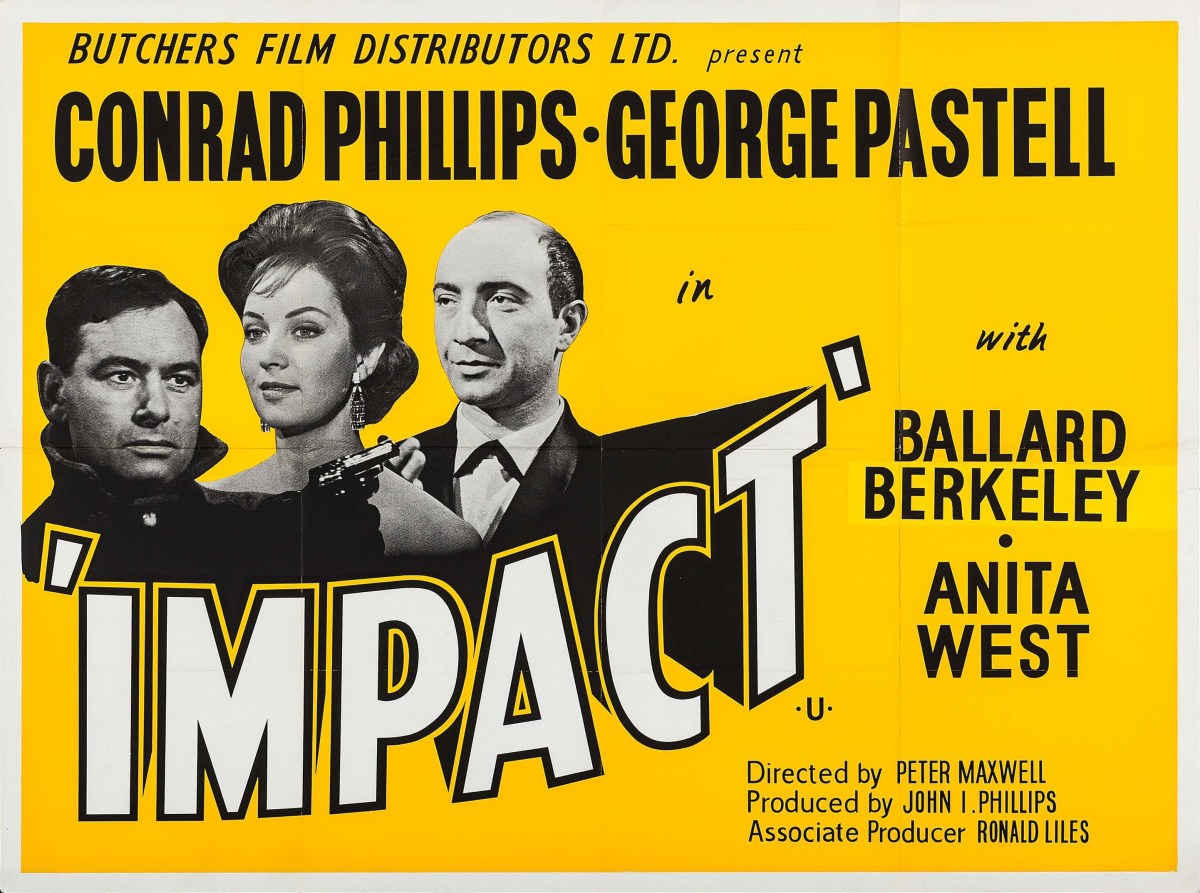
Impact (1963) ***

I enjoy a demanding supremely-acted fluently-directed movie with possibly a hint of Oscar reward as much as the next person. But last thing at night, I often prefer something that makes no demands at all except paying attention to a twisty narrative. And that’s where Talking Pictures TV comes in, with its string of low-budget crime pictures made by British indie outfit Renown.

The twist here is an unusual one. Gangster Mr Big, Sebastian “The Duke” Dukelow (George Pastell), alerted by girlfriend Melanie (Anita West), a cabaret singer in his nightclub, to the work of journalist Jack (Conrad Philips), determined to expose the crook, decides to put him out of the action. But not in the normal way of fitting him with a cement boot and dropping him in the Thames. Instead he frames him or a robbery and Jack ends up doing two years in jail, losing his job, but not girlfriend Diana (Linda Marlowe), in the process.
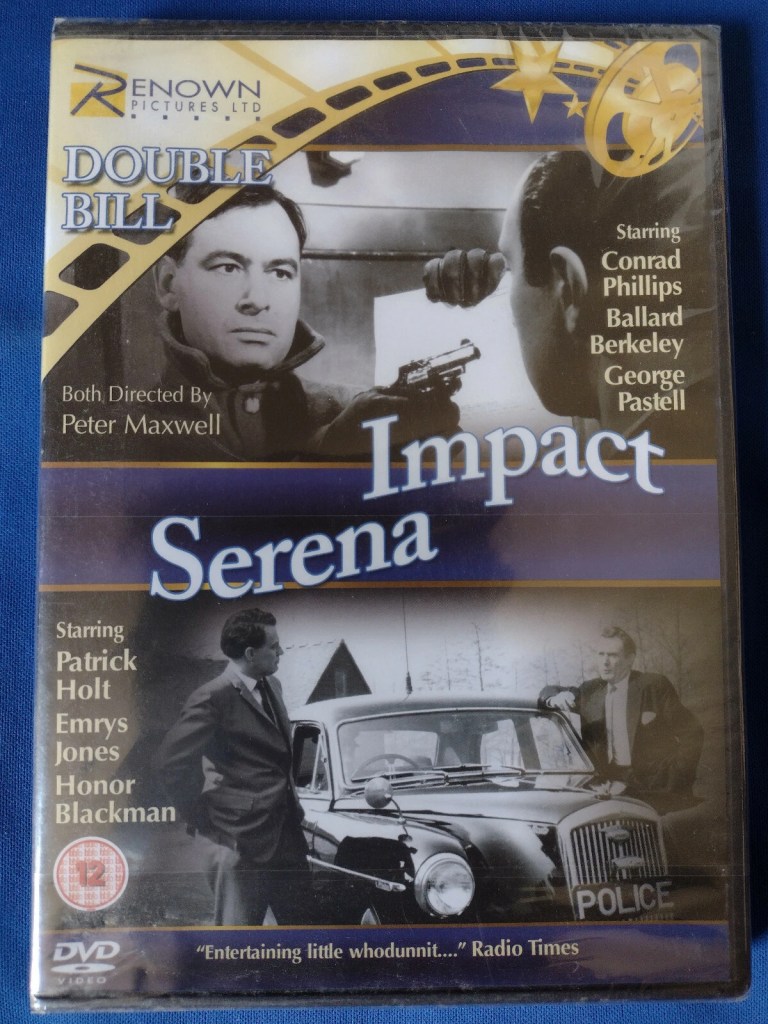
In prison he bonds with cellmate Charlie (John Rees), who holds a grievance against The Duke. When he hatches his own revenge plan, it appears Charlie is all in.

Or is he? Out of jail, Charlie has gone straight with a job in a refrigeration depot. Jack, meanwhile, has no job and festers away. Any chance Jack has of getting the best in a one-to-one confrontation with The Duke is knocked on the head when he realizes how closely guarded the crook is. So Jack makes do, in the meantime, with making The Duke jealous by dancing with Melanie.

And who’s side is Charlie on? Charlie approaches The Duke with a deal. In return for some cash, he will reveal Jack’s revenge plan.

So now the twist is in. Jack is lured by Charlie into the refrigeration plant where The Duke proceeds to lock him inside one of the units where he will conveniently freeze to death.

But will he? Not when Charlie, secretly pressing an array of control buttons, sets him free and they turn the tables on The Duke, sticking him inside the freezing compartments until he signs a confession releasing Jack of any involvement in the robbery. Meanwhile, as it happens, Jack and Charlie find a way to stitch up The Duke and his gang, ensuring they will be arrested for diamond smuggling, a crime of which they are entirely innocent.

Pretty much all narrative, but with well-drawn characters. You wouldn’t expect a well-heeled highly moral reporter like Jack, even if wrongfully convicted, to turn to crime himself. Nor, now unemployable, to make a living by placing stories sympathetic to The Duke in the newspapers.

And The Duke proves exceptionally savvy. To muddy the waters, he donates £1,000 to cover Jack’s legal fees and has all manner of highly sophisticated surveillance and protection devices to keep tabs on his empire.

The women, too, are well drawn. Melanie constantly pokes fun at her scary lover, and is not above making him jealous by coming close to smooching with Jack. And Hilda (Jean Trend), the editor’s ineffectual secretary, working her romantic way through the ranks of the reporters, knows that her legs ensure she will never be out of work. On the other hand Diana has relatively little to do dramatically.

Conrad Phillips (The Switch, 1963) and George Pastell (The Long Duel, 1967) enjoy an interesting duel. Anita West (Shadow of Treason, 1964) steals the acting honors ahead of Linda Marlow (The Big Zapper, 1973).

Directed by Peter Maxwell (Serena, 1962) from a screenplay concocted by himself and the star.

An easy late-night watch.
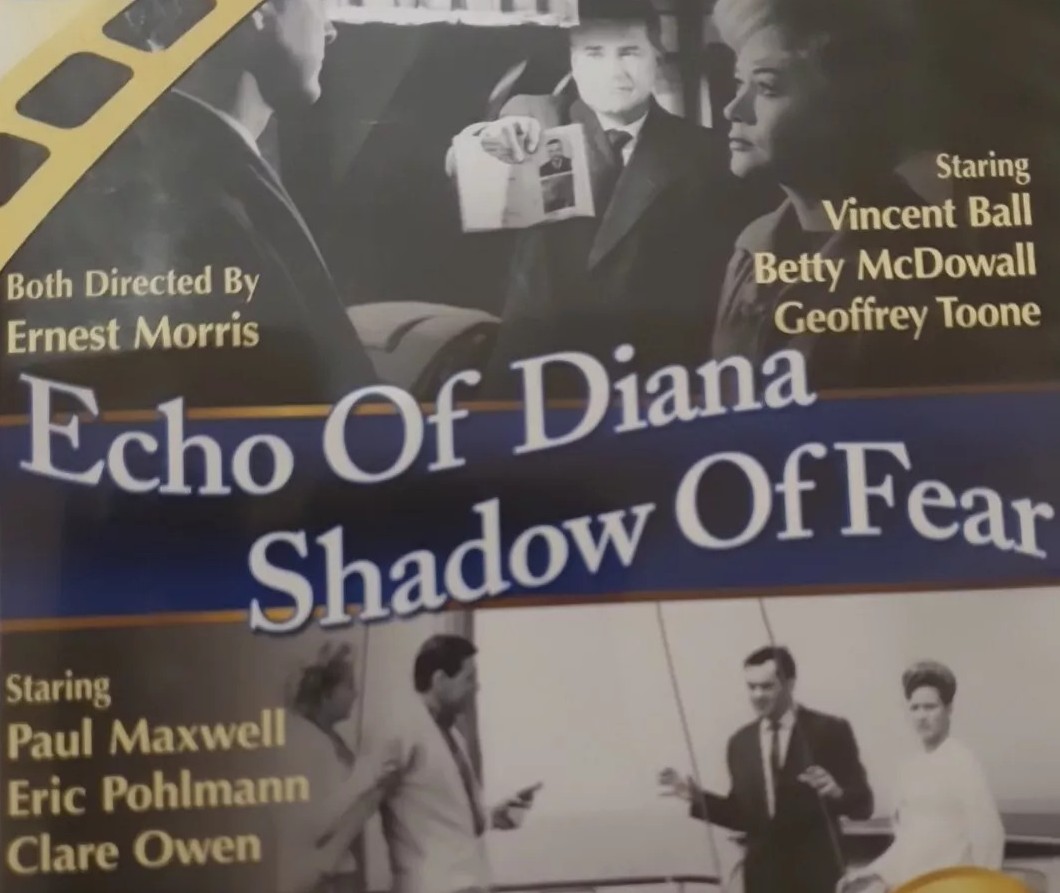
Shadow of Fear (1963) **

The Eady system at its worst. I’ve been singing the praises of quite a few of these British crime B-movies, made to take advantage of the Eady Levy cashback system and a Governmental dictat that cinemas had to show a certain proportion of British-made features. Generally, they were intended to fill the supporting feature slot, providing cinemas with a double feature. In the course of writing this Blog, I’ve uncovered a few minor gems, brisk, well-directed thrillers, good acting not necessarily essential.

The best this has to show for it is the ruthlessness of British spy chiefs in using an innocent couple as bait for foreign spies. Otherwise, beyond the initial twist, it’s too desultory for words, with too much time – even in a 60-minute feature – spent on too little.

American oilman Bill Martin (Paul Maxwell), flying back to London from Baghdad, agrees to carry a coded message for Jack Carter (Antony Wager), a casual British acquaintance. On landing at Heathrow Bill discovers Jack has been murdered. He’s accosted by a couple of cops, taken to a seedy hotel to wait for a fellow called Oliver, accepting all this oddness because he assumes he’s delivering a message for British Intelligence. After handing over the message he makes the mistake of telling Oliver that not only did he read the message, although failing to decode its content, but, having a photographic memory, had committed it to his brain.

Cue imprisonment. He escapes only because someone attempts to kill him and in turning the tide finds a way out. He flees to girlfriend Barbara (Clare Owen) and she whizzes him in a nifty sports car to her Uncle John (Colin Tapley) who knows somebody who knows somebody and it soon emerges that the fellow called Oliver was actually a fellow called Sharp (John Arnatt), a spy of unknown affiliation.

Assuming the bad guys would still want to eliminate our hero, the real Oliver (Reginald Marsh) reckons this is too good an opportunity to miss – the end justifying the means and all that rather than the more traditional British notion of fair play – and gets Bill and Barbara to agree to act as bait to trap the spies.

This doesn’t go as neatly as the good guys might expect and the baddies make further attempts on the couple’s lives and finally manage to kidnap them and take them out to sea with the intention of dropping them overboard. Luckily, the Brits are able to call in the Coastguard – armed for the occasion – to intercept and it all ends happily.

There’s not enough of anything to keep this moving – scarcely a red herring – and there’s about a dozen characters who flit in and out, various thugs, a top thug called Warner (Alan Tilvern), a femme fatale Ruth (Anita West) who is given no chance to exert her femme fatale wiles, and sundry MI5 and FBI characters and various others along the way. From the amount of time spent focusing on the belly dancer (Mia Karam) in the Baghdad hotel, you might have expected that she would have a role to play because she had more screen time than Ruth.

Nobody went on to greater things. Canadian Paul Maxwell (Man in the Middle / The Winston Affair, 1964) specialized in playing Americans in British films and television, even had a running part in soap opera Coronation Street and if you look closely you’ll see him pop up in A Bridge Too Far (1977).

Director Ernest Morris (Echo of Diana, 1963) can’t do much with the script by Ronald Liles (Night of the Big Heat, 1967) and Jim O’Connolly (Smokescreen, 1964) based on a tale by T.F. Fetherby.

Dull whichever way you cut it.

Shadow of Treason (1963) **

Tracking down forgotten B-pictures it’s easy to convince yourself you’re going to uncover an under-rated gem. Sadly, despite mixing film noir with espionage and a treasure hunt, this fails dismally at getting over the line.

And that’s a shame because the credits roll over a background of long shadows, recalling instantly to mind not a film noir trope but the later famed poster of The Wild Bunch (1969). And there’s an excellent repetitive theme by Martin Slavin (Sherlock Holmes and the Deadly Necklace (1962), an interesting striptease involving a bear, and a superb chase sequence where the pursuer is in a wheelchair. Otherwise, it’s got such a convoluted storyline you wished someone could get on top of it sooner rather than dragging the audience from Trieste to Dubrovnik to Somaliland.

Femme fatale No 1 Anita West literally in a hole with John Bentley.

In his final movie British star John Bentley, who brought to life both Paul Temple and The Toff, plays Steve, a drifter of unspecified means, who saves cabaret singer/stripper Tina (Anita West) from  assassination. Hired by her as bodyguard/detective, he learns her father was a German spy who has left her a list of names and a map to hidden treasure and strangely enough she has been receiving regular anonymous donations of cash. It soon becomes obvious to Steve that blackmail is the source of this unexpected bounty. And that he is caught in the middle. Some people want to pay him off, others to kill him off.

It doesn’t help that he is seduced by both Tina and Nadia (Faten Hamamah), daughter of Litov (Vladimir Leib), one of those being blackmailed but now confined to a wheelchair.

Along with Mario (Ferdy Mayne) and Michel (John Gabriel) they are all soon convinced that the solution to all their problems will be joining Steve on a trip to Somaliland to find the hidden treasure, cash the father was reportedly carrying to pay his team of spies.

Femme fatale No 2 Faten Hammamah looking disgruntled. You could say the same about Bentley.

Usually, with any kind of picture involving hunting for treasure, the audience is invited to be baffled by various clues, but here none are offered and the audience simply remains baffled. Once in Africa, of course, the action hots up, courtesy of stock footage of stampeding elephants and a variety of dangerous animals and by the double-crossing that appears essential to such schemes. Eventually, they end up in a cave, where the only bit of treasure detecting actually takes place. Assume more double cross and you’re just about there.

Director George P. Breaksaton (The White Huntress, 1954) must take full responsibility for this mess since he was also the writer and producer. Apart from the various sequences previously mentioned, he has little idea of narrative drive or even narrative. None of the characters connect with each other and certainly not with the audience.

John Bentley does his best but that’s mostly down to frowning and grunting and trying to get a share of everyone’s spoils. He’s intended as some kind of James Bond lounge lizard given the movie begins simply because he follows an attractive woman in a nightclub. But he really has very thin material to work with. Neither of the femme fatales, Anita West (Shadow of Fear,1963) and Egyptian star Faten Hamamah, has enough in the smouldering department and if they did weren’t inclined to waste it on the likes of Steve.

Hardly a fitting end to Bentley’s career. More of a curiosity than an entertaining watch.

Discover WordPress

A daily selection of the best content published on WordPress, collected for you by humans who love to read.

The Atavist Magazine

by Brian Hannan

WordPress.com News

The latest news on WordPress.com and the WordPress community.