After The Hunt (2025) *

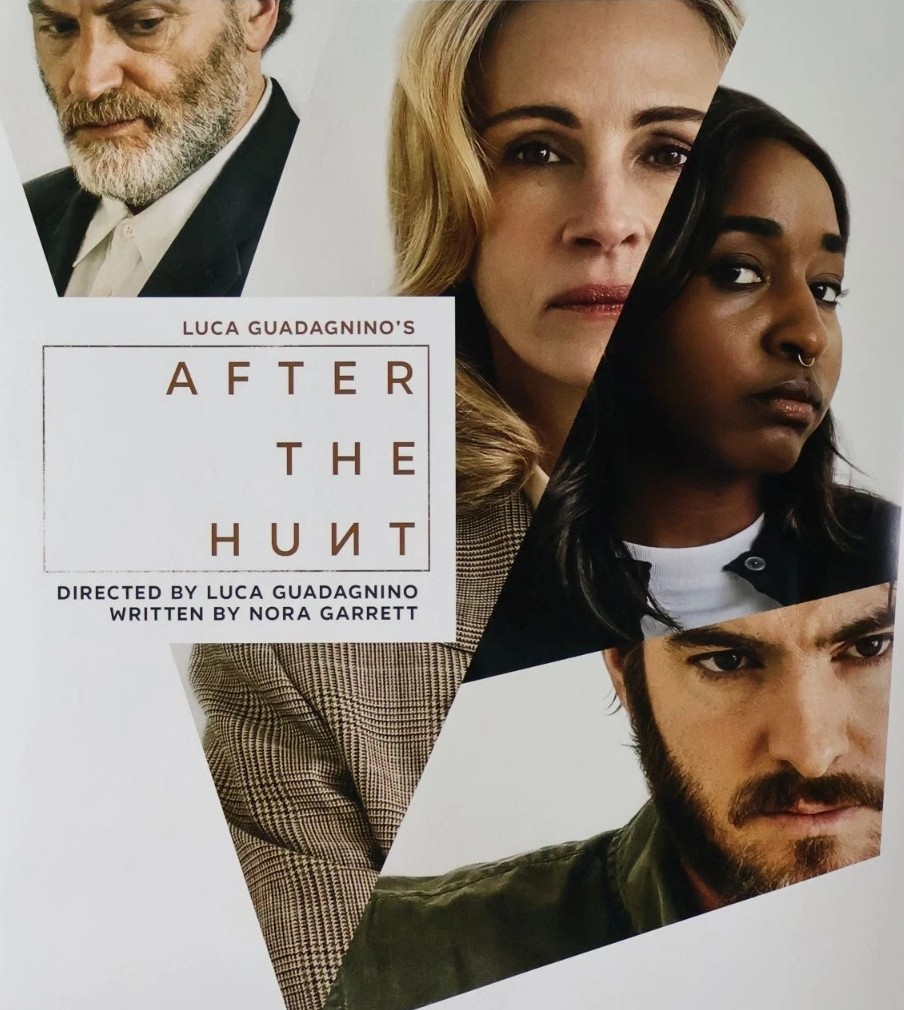
Don’t you hate it when directors want to have their cake and eat it? Effectively, this is a fairly humdrum MeToo thriller but looks like it’s written by a dozen op-ed columnists taking aim at half a dozen targets, populated by little more than cliche characters, wrapped up in a fog of pretension, and spectacularly sabotaged by a deus ex machina ending that no amount of Oscar-baiting can salvage.

Large gobbets of narrative are missed out, theoretically so we make up our minds about the characters but in reality because the director can’t make up his mind where he wants to go. When the director can’t make up his mind how to frame a scene he resorts to showing us hands.
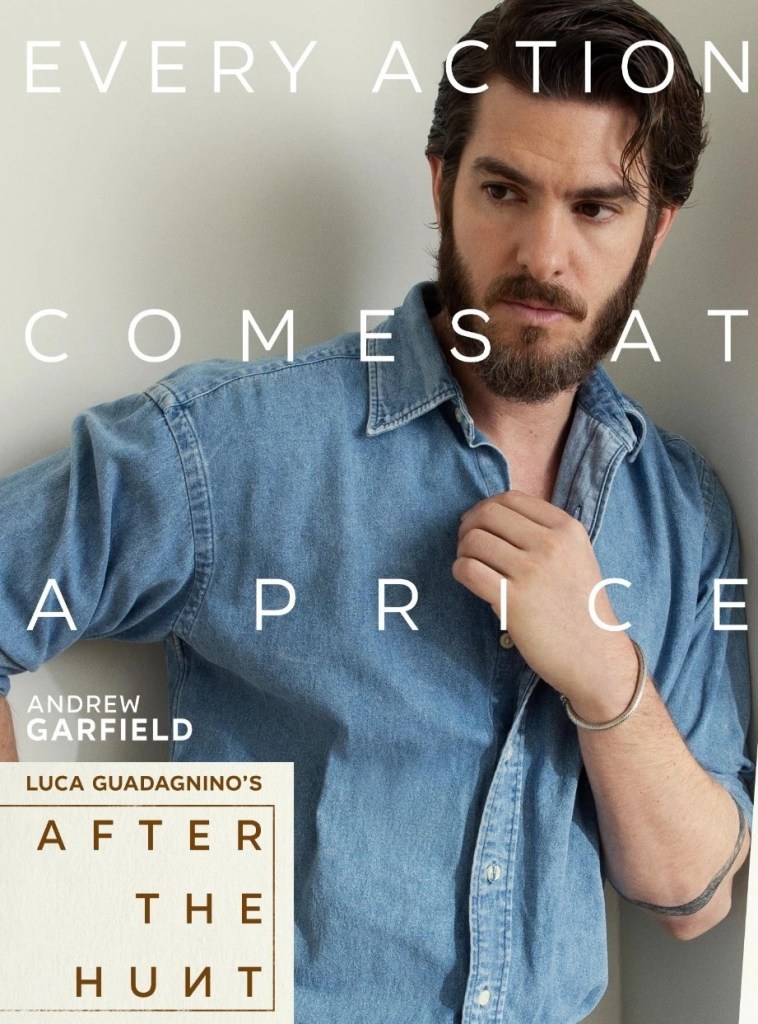
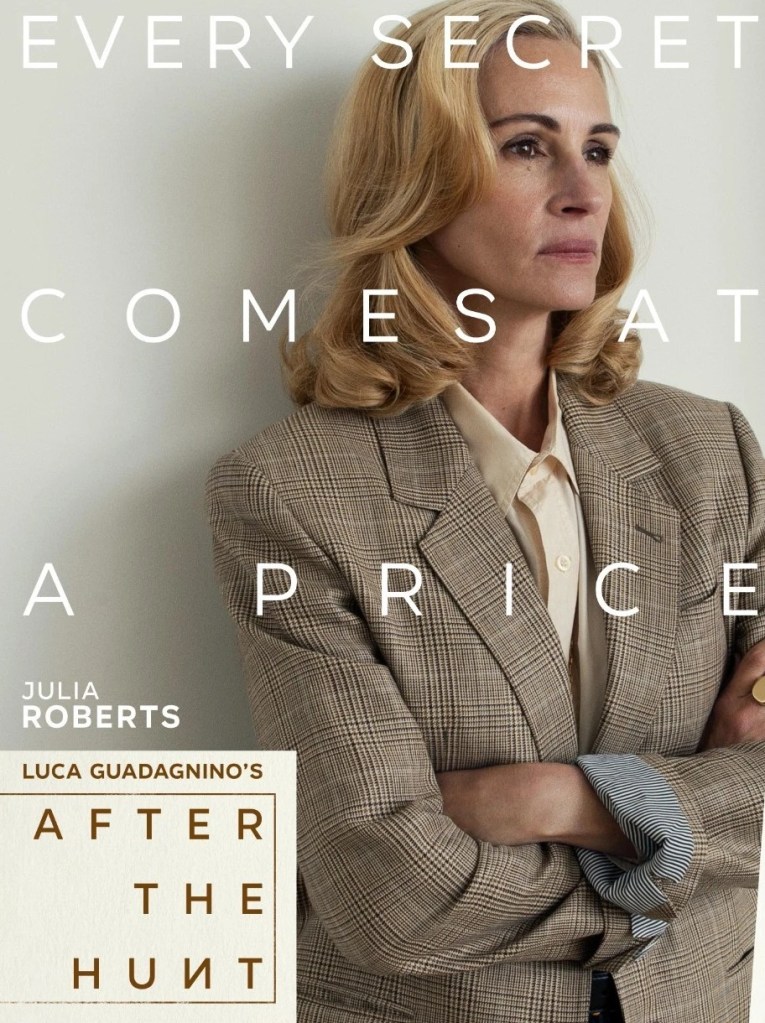
So here’s the myriad scenarios at play. Married alpha female Alma (Julia Roberts), pushing 60, a philosophy professor, adored by her students, with whom she flirts at will, is battling a pushing-40s singleton rival Hank (Andrew Garfield), adored by his students, with whom he flirts at will, for a coveted tenure at Yale. Quite why Alma, at her age, hasn’t achieved tenure before is never explained. To help heat things up, Hank has the hots for the older woman.

Wealthy gay student Maggie (Ayo Edebiri) claims Hank raped her and he’s fired. Pressure is brought to bear on Alma to back Maggie. But there’s a twist. Or theoretically, there’s a twist. Hank is about to expose Maggie as a plagiarist so she’d use any excuse to get rid of him. Theoretically. And this is one of the many ways in which the picture ties itself up in knots because Maggie doesn’t know about Hank’s suspicions.

Maggie also knows Alma’s big secret because hunting in a toilet cabinet for toilet roll she finds taped to the underside of a shelf an envelope containing stuff that might (it later transpires)  allow Maggie to happily set Hank up on the assumption Alma would take her side.
This he said/she said plays out to a mess of philosophy. The screenplay takes potshots at each generation in turn, the older one represented by Alma, the next one represented by Hank and the entitled younger contemporary one represented by Maggie who take up vicious arms against anyone who oppose their limited point-of-view, i.e. the cancel culture generation.

But there’s something wrong with Alma. She takes a couple of pills first thing in the morning and is prone to collapsing in pain. But being the philosophic sort, she’s a stoic and doesn’t tell faithful husband Frederik (Michael Stulbarg) and is popping other pills at other times. But she’s committed the grievous sin of not fully endorsing Maggie and the pupil has stirred up her friends to arms.

Given Alma’s been caught stealing a prescription and is hauled before the departmental authorities, it seems she’s for the high jump. But, lo, suddenly she’s handed a miraculous get-out-of-jail-free guard. Surrounded by baying students, she collapses. Naturally, this being the social media generation, this encounter is filmed. Turns out Alma has perforated ulcers. And the outcome is that the students end their opposition to her (in case, presumably, they are blamed for causing said collapse), and the department decides that stealing prescriptions can be swept under the carpet, so she gains tenure, Hank is cast out into the wilderness and Maggie transforms herself into a MeToo poster girl for Yale.

But that’s not even the barmiest part. Alma’s big secret is that, as an underage teenager, she was seduced by an older man. She only exposed him when he dropped her for another woman and he  committed suicide. Despite common sense telling her that she was not to blame, she persists in wallowing in guilt, viewing the man who abused her as the victim of her wiles. Which just goes to show you can study Kierkagaard and philosophers till the cows come home but if it suits a barmy director’s narrative purpose you will end up being presented as dumb as all get-out.

So this all plays out against a backdrop of philosophical gibberish and Frederik’s jealousy of the attention lavished, by males and females alike, on his charismatic wife.

When a marketing team goes down the Oscar-bait route – see Dwayne Johnson and The Smashing Machine – and claims stunning acting is the reason for seeing a movie devoid of the  more essential audience engagement you know you’re in for a rough ride.

Sure, both Julia Roberts (Ticket to Paradise, 2022) and Andrew Garfield (We Live in Time, 2024) have dumped their usual cuteness but it’s not enough to save the picture. Ayo Edebiri (Omni Loop, 2024) is left with no choice but to over-act. Directed by Luca Guadagnini (Challengers, 2024), written by Nora Garrett in her debut.

I saw four movies in two days and in all honesty Gabby’s Dollhouse best fulfilled audience expectation.

This is not just a complete dud but way past its meager theatrical run is going to annoy the hell out of everyone as marketeers and critics try to position Roberts as an Oscar contender.

The worst kind of lazy filmmaking.

We Live in Time (2024) ****

Approached this with some trepidation as I’m not a huge fan of either star and since, frankly, I was only there because I go to the pictures every Monday and this was all that was on. In fact, I adored the acting. An intelligent adult movie to sit nicely alongside this year’s Conclave, Juror #2 and It Ends with Us without the artsy-fartsy frills that have put me off so many similar. Kept me absorbed even as I noted in passing the several flaws that should have brought me up short. And you should know it’s narrative as mosaic, not an admittedly complicated one, but a series of vignettes over a few timeframes  and backstory chucked in at various points.

But there’s no grandstanding, no auteur forcing an annoying style down your throat, no desperately cute scenes, and none of that will-they-won’t-they that’s virtually impossible to achieve these days outside of Anyone But You (2023). The main characters are ordinary people, stranded loveless in their mid-30s, driven chef Almut (Florence Pugh) out of choice, Tobias (Andrew Garfield) dumped by a more ambitious wife and now living out of cardboard boxes with his widowed father.

There’s major illness brewing but it doesn’t go down the sickly route, nor, despite the couple agreeing to make the most of life, is it a whirl of bucket list activities. In fact, the main source of friction is that that she ignores family duties in favor of entering an upmarket Strictly Come Cooking competition.

But, as I said, the pleasures are all in the acting. The twists are in the dialog. She doesn’t respond to his sudden declaration of love, as she would, gushing like billy-o, in any other picture. He doesn’t have a marriage proposal off pat but has to refer to notes. He’s pretty damn staid, she’s, as you’d expect in an imaginative chef, more free-wheeling. And I did learn the correct three-bowl method to crack eggs, the rest of the cookery malarkey thankfully not entering the angst-ridden territory of The Bear or The Boiling Point or the she-made-it cock-strutting of so many movies about a woman battling her way to the top.

There are a heck of a number of grace notes of infinite shades. Tobias is absolutely delighted, not resentful, that his father (Douglas Hodge) cuts his hair. An asleep cancer patient has her wig adjusted by a nurse to cover her bald patch. A woman giving Tobias the thumbs-up signs constantly through a job interview is never seen again – wife/lover perhaps? A guy at a dinner party looks sour but we never learn why. Almut keeps from Tobias and everyone else that she was a world-class amateur ice skater in her earlier life, giving it up when her father died, unable to continue in the absence of his presence. We could almost have dispensed with how Tobias won Almut back after initial rejection because we know he must have done somehow otherwise we wouldn’t be where we are in the story.

The very ordinariness grounds this. The couple eat Jaffa Cakes in the bath – from a giant-sized packet – and miniature chocolate bars from one of those selections you used to just get at Xmas. And then compare what they selected – he goes for Twix, she Bounty.

Some bits don’t work so well. The meet-cute has been robbed of originality by Australian television comedy Colin from Accounts. I’m not sure if we were meant to laugh at the birth scene. But the sequence you saw in the trailer when Tobias whacks two parked cars in order to get out of a tight parking spot actually has deeper meaning. Tobias, remember, is the kind of guy who takes notes, who examines himself in front of a mirror not out of vanity but to make sure there’s nothing wrong with his attire, a guy, in other words, roughly in command of his emotions, and this is one of the few scenes where that characteristic slips.

Nor are we in for a wheen of sibling rivalry or parental displeasure, so it’s not tumbled-full of repressed anger, but there’s still time for snippets of Tobias standing like an idiot in a roomful of her more excitable friends at a party, something holding him back from even trying to join in.

There was a great ending that was ignored: Almut waving in the distance to husband-and-daughter. The ending chosen luckily worked as well, proving that Tobias, in his lifelong note-taking fashion was a good learner, and was determined to fulfil a promise.

This could have fallen down on some narrative choices, the illness trope or the cooking, but generally these are incorporated into the story in a character-led way. But mostly it works because it is not highwire sturm und drang nor a will-they-won’t-they approach, and especially because their bucket list appears to extend only so far as a trip to a carnival ride. Everyone holds back. No over-playing at all.

I had recently praised Nicholas Hoult in Juror #2 for using his eyes rather than his entire face to express his feeling and Andrew Garfield (Spiderman to you)  here works along the same lines. Florence Pugh (Oppenheimer, 2023) is every bit as good, a quiet inner grit, forthright when required without biting your head off. Douglas Hodge (Joker, 2019) and Adam Jones (Wicked, 2024) have nice turns.

I have to confess I wasn’t too keen on director John Crowley’s previous outings – Brooklyn (2015) and The Goldfinch (2019) – but here he has the sense to stand back and let the actors act. Written by Nick Payne (The Last Letter From Your Lover, 2021).

Worth a punt. A good piece of counter-programming.

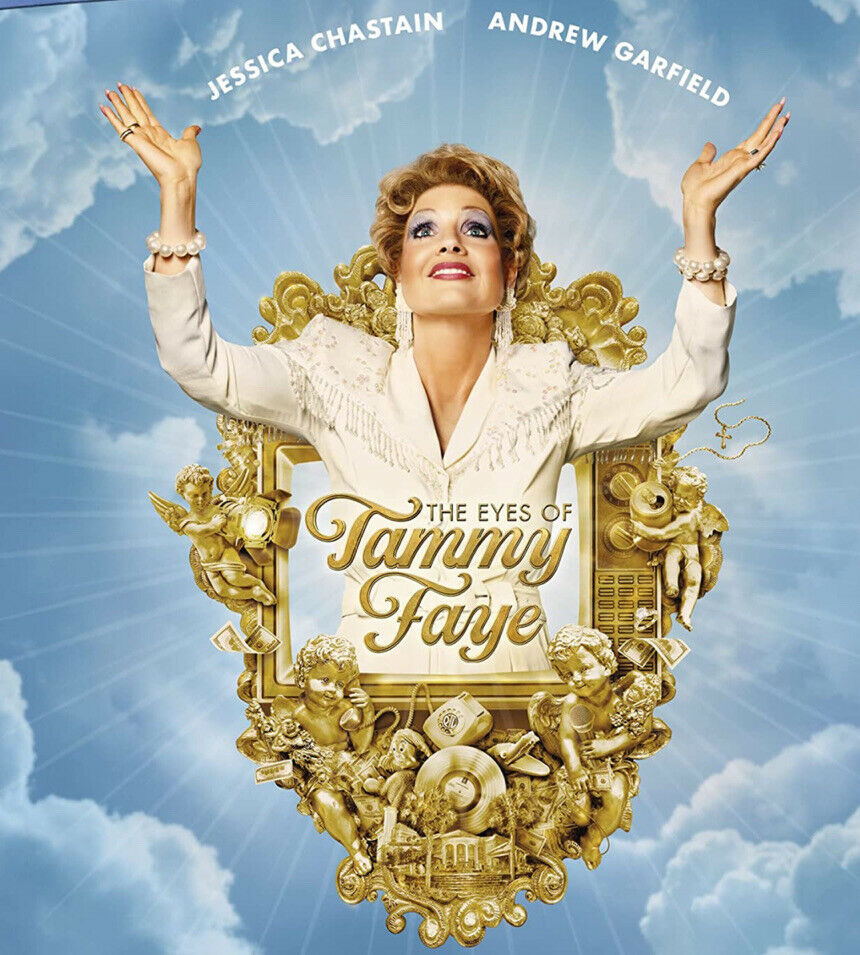
The Eyes of Tammy Faye (2022) **** – Seen at the Cinema

It’s rare to see an actor’s screen persona complete disappear when playing a role but that’s what Jessica Chastain achieves in this potentially Oscar-winning performance as the wife of television evangelist fraudster Jim Bakker (Andrew Garfield). Responsible much of the time for holding Bakker together when he was falling apart, backing diversity at a time when it was anathema to any organised religion, although a fool for love and with an appetite for self-deception that would have floored a rhinoceros.

A fascinating docu-drama into how an opportunistic couple became the fatted calves their religion deplored. The movie doesn’t delve too deeply into the fund-raising activities of the couple any more than The Two Popes spent time wondering who funded the Vatican. Instead, it’s a character-driven study. There’s no doubt Bakker and Faye delivered on the motivational front to their legions (20 million subscribers at their peak), preaching about God’s love rather his downside of Hell and damnation. The fact that Faye got to sing and become an adored television personality was the least of it.

In keeping with a lot of modern biopics, it races through the years, new characters introduced with screen titles as we move from the trudge of freelance missionaries to low-grade television performers until, at Faye’s instigation, they set up their own television station. However big the bucks that roll in, it’s never enough, Bakker constantly in hock and coming up with more grandiose schemes to bankroll his grandiose schemes. It’s hard to say how much they actually achieved, since the film skips over this until Bakker is brought up on major fraud charges. 

Instead what we have is a four-ring circus, Faye happily getting richer but missing out on the expected sex life that goes with it, excoriated for nearly having an affair, Bakker playing fast and loose with male and female but his transgressions not coming to light until much later, rival preaching kingpin Jerry Falwell (Vincent D’Onofrio) stitching them up when they fall, and Faye’s tight-permed thin-lipped mother Rachel (Cherry Jones) herself a “fallen woman.”

Although falling into the “Stand By Your Man” cateogory, Faye’s continued effervescence in the face of mounting scandal is astonishing, lack of fear of male hierarchy (calling Falwell by his Christian name instead of his title, going against inbred conservative politics) and her genuine desire to help those eviscerated by the world, namely AIDS victims, would have set her up almost for saintood had the pillar on which she depended not been made entirely of salt.

The movie is a fascinating insight into how slick evangelism parts people from their bucks, almost a masterclass in maximizing frailty and playing the victim – more money rolls in when they confess infidelity and weakness than when playing superheroic good guys.  Forget the hypocrisy with which it paints the television evangelist and the viewers (i.e. suckers) keeping the enterprise afloat, the Catholic church made a mint from its parishioners, anybody who sought comfort in religion had something wrong with them as was pointed out to Clint Eastwood in Million Dollar Baby.  

As I knew nothing about any of the background and was only vaguely familiar with the real-life characters, I thought it was superb, but mostly through the acting. I have rarely seen an actor play vulnerability so well without an eye to self-pity. It’s ironic of course that Faye is so in favour of love when she is denied it first by her mother and then by her husband. Only an adoring wife would fail to see the weasely character she married.

Chastain transitions from giggly teenager, too enraptured by passion, to the self-possessed puppet-master and from thence to the all-engulfing stardom to which they have opposite responses, he overwhelmed by being found out, she believing every word he says and living the dream as if she was the original Kardashian. Garfield channels inner entitlement, entirely convincing as the ultimate salesman with the ultimate item to sell to a more than willing set of loyal customers, happy to sacrifice his wife’s shame at the altar of mammon while hiding his own indiscretions. But he’s also the preacher as businessman, learning from his predecessors, planning to out-do his rivals, praying that he can keep the devil at bay.

And that’s not forgetting an excellent turn by Cherry Jones as the repressed mother who would have been disowned by her own church except they had no one else to play the piano, fearful but never tearful, her only criminal act holding on to a cherished fur coat that should have been surrendered to the law. Vincent D’Onofrio relishes playing the sanctimonious thug, wooed by politicians, kowtowed-to by preacher underlings, with a whole pile of machinations up his sleeve.

Chastain’s performance belongs to those larger-than-life real-life characters imbued by Julia Roberts (Erin Brockovich, 2000) and Jennifer Lawrence  (Joy, 2015) who turned their fragility on its head and fully deserves her Oscar nomination. A fascinating film with terrific performances, and enjoyable with it.

Discover WordPress

A daily selection of the best content published on WordPress, collected for you by humans who love to read.

The Atavist Magazine

by Brian Hannan

WordPress.com News

The latest news on WordPress.com and the WordPress community.