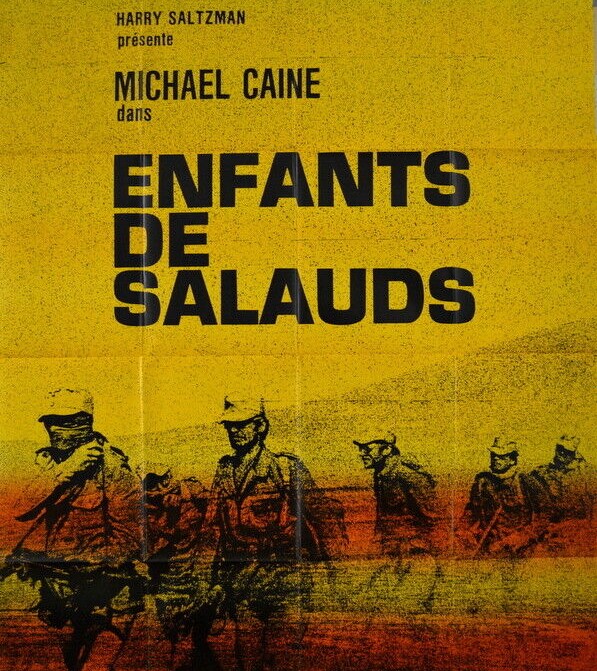
El Condor (1970) ****

Highly under-rated western, directed with some style by a Britisher, bolsters Jim Brown’s marquee credentials and twists and turns every inch of the way. The basic story couldn’t be more cliché: outlaw Luke (Jim Brown), after escaping from a chain-gang, hooks up with gunslinger Jaroo (Lee Van Clef) and his gang of Apaches to steal the gold bullion hidden inside a Mexican fortress.

It just doesn’t work out that way. Any time a cliché rears its ugly head, director John Guillermin (The Blue Max, 1966) treats it as narrative obstacle and finds a neat way round it. Luke’s attitude doesn’t help either. Looking at a woman the wrong way, not showing Apaches sufficient respect, failing to rein in his larcenous partner, all lead to trouble. But at the right time and the right place, the pair show – almost show off – their respective skills, permitting escape when necessary and finding a way into the citadel.
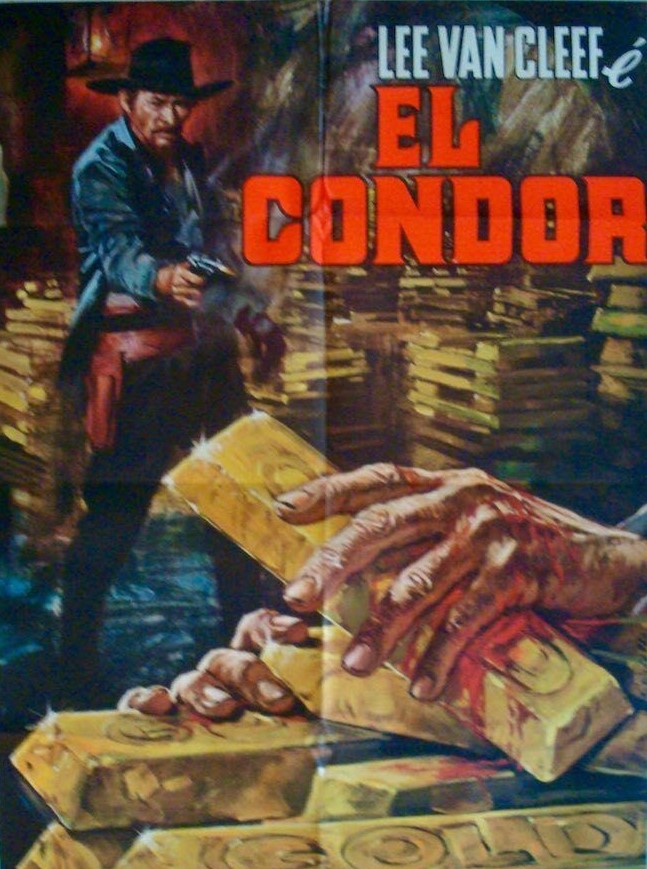
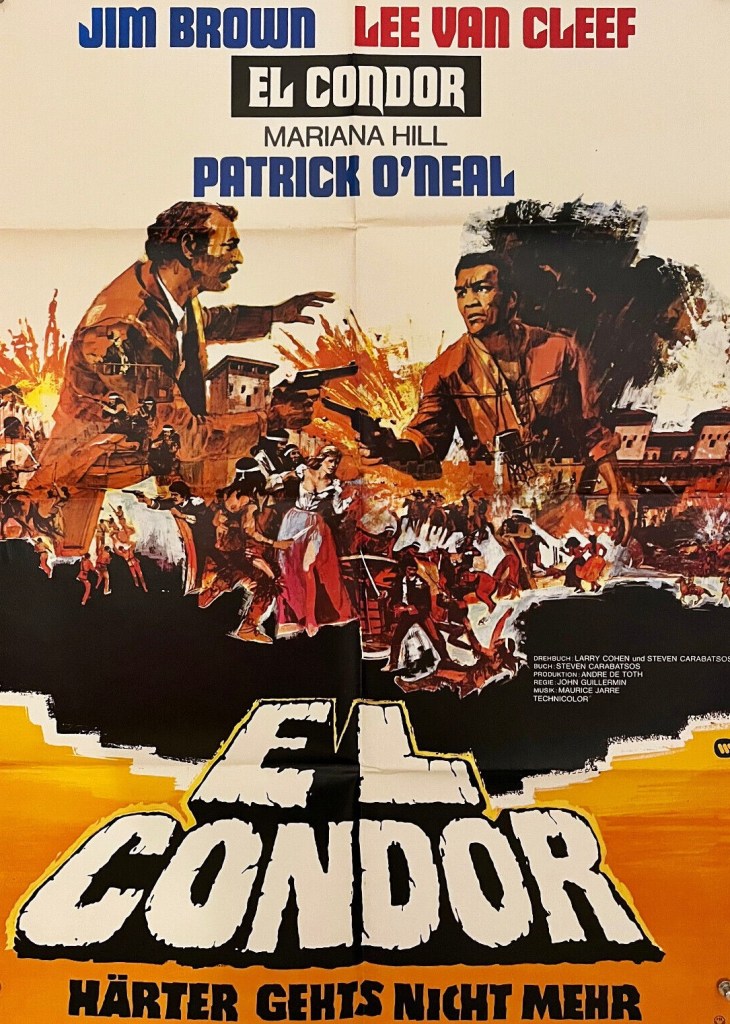
Lee Van Cleef takes top billing in the Italian poster which adopts a more thematic approach than the normal action-oriented marketing.

Did I mention there was a bullfight with fort commander Chavez (Patrick O’Neal), wielding a saber, dancing around the animal on horseback, or that at one point Luke becomes the bull substitute. Or that, in the picture’s most notorious scene, shades of Raquel Welch taking an impromptu shower in 100 Rifles (1969), the invaders are helped by Chavez’s disgruntled mistress Claudine (Marianna Hill) distracting the defending soldiers by disrobing.

And, though minus such distractions, this is probably where the white walkers in Game of Thrones learned to scale a mighty wall. Even so, it’d be a pretty big ask to infiltrate a fortress almost medieval in its construct with an outer and an inner wall, so Luke evens the odds by subjecting the inmates to involuntary thirst, having destroyed their water tower and poisoned all nearby wells.

Given the heist involves gold, it’s no surprise that the weaselly Jaroo is overcome by greed, taking any opportunity to help himself to more than his fair share, encouraged of course by the even wilier Chavez who has the measure of the potential thief. Luke might have been cautioned about entering into a partnership with such a character after witnessing a couple of Jaroo’s schemes backfire. In one of them, in just about the cleverest and most audacious cut you will ever see, we go from Jaroo in a store stuffing illicit goods under his coat to the pair emerging tarred and feathered from a pond.
And this ain’t The Dirty Dozen, nobody appears to understand a command structure, or even stick to orders, Apache chief Santana (Iron Eyes Cody), left to his own devices, liable to attack a wagon train despite that giving due warning of their presence in the vicinity. But then Luke doesn’t show due respect either, resulting in the pair being staked to the ground in the boiling sun, and finding it impossible to dislodge an Apache clinging to his back.

As you might expect, it’s a bloody affair, but without dwelling on gore, none of the visceral exploding body parts of The Wild Bunch (1969). And there is a surprisingly touching moment when, shades of Charles Bronson in The Magnificent Seven (1960), the hard-nosed Jaroo bonds with a young boy on the grounds that they are both illegitimate and parts with one of his two precious gold nuggets to give the child a start in life.

Harsh reality intrudes. Unspoken racism on the part of Chavez sets him against Luke. And that women are prizes of war provides an uneasy undercurrent. Claudine is Chavez’s lover because he offers safe haven, a security not afforded other Mexican woman, forcibly parted from husbands to provide soldiers with sexual playthings.

Jim Brown (100 Rifles) and Lee Van Cleef (The Good, the Bad and the Ugly, 1967) are an inspired teaming, both playing against type, incurring more laughs than you might expect, and less inclined to play their previous stock characters, the former just a tough guy, the latter a ruthless professional. Patrick O’Neal (Stiletto, 1969) is a formidable opponent, perfectly capable of outwitting the more easily-duped Jaroo.

Despite, perhaps unfairly being remembered more for her nudity than her acting, Marianna Hill (Medium Cool, 1969) exhibits vulnerability as well as a tough core. Iron Eyes Cody (Nevada Smith, 1966) has a very refreshing take on an Apache war chief.  And you might spot British starlet Imogen Hassall (The Long Duel, 1967) and veteran Elisha Cook Jr (Welcome to Hard Times, 1967).

But this movie really belongs to director John Guillermin who takes a fairly routine western and turns it on its head, extracting reversals at every opportunity, and clearly delighting in the several twists in the tail. Larry Cohen (Daddy’s Gone A-Hunting, 1969) and in his movie debut Steven Carabatsos (The Revengers, 1972) wrote the screenplay and the presence in the producer’s chair of Andre de Toth (Play Dirty, 1968) might account for some of the movie’s subversiveness.

There’s a historical footnote to El Condor. In a revision of the certificates issued by the censor, the British Broad of Film Classification in 1970 introduced the “AA” certificate, permitting people aged over 14 to view material that would previously have been restricted to the X-certificate. Admission to that category was raised to 18. So for a whole generation of teenage boys, hormones going wild, the first glimpse they had of a naked woman was in El Condor. (In the US it was an “R”.)

Not only well worth seeing but free to view on YouTube.

And when that source dries up you can find it on the Warner Archive.

https://amzn.to/46FBZn8

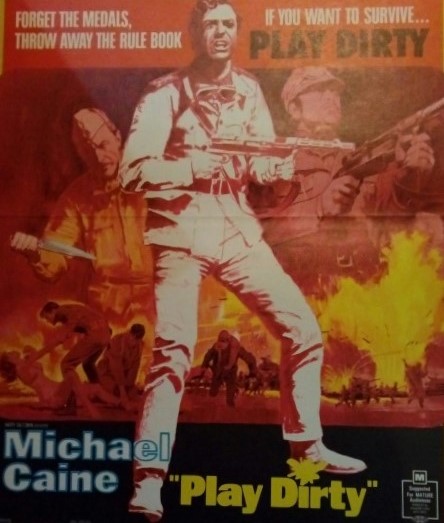
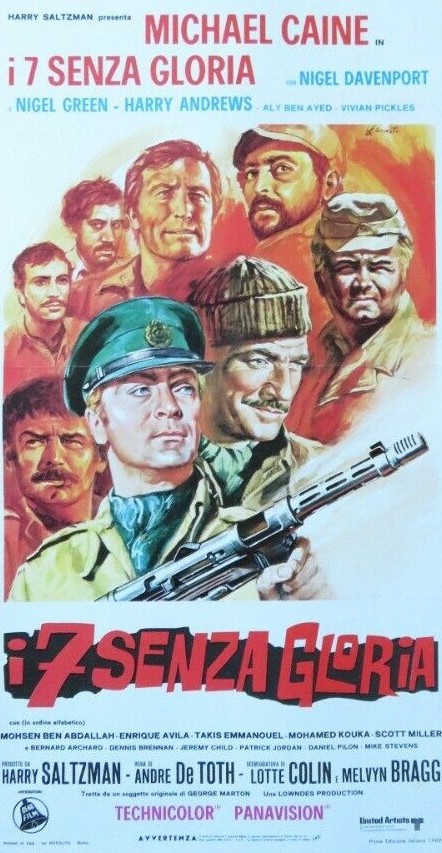
Behind the Scenes – “Play Dirty” (1969)

Hungarian Andre de Toth’s somewhat cavalier career had become ultra-cavalier during the 1960s. Best known for westerns such as Ramrod (1947) with Joel McCrea, Springfield Rifle (1952) starring Gary Cooper and The Indian Fighter (1955) headlined by Kirk Douglas plus House of Wax (1953), he was not, you might have imagined, riding high in the critical stakes. Hollywood considered him a journeyman. Esteemed French magazine Cahiers du Cinema, which had championed Hitchcock in the face of mainstream indifference, believed otherwise and interviewed him for a 1967 issue.

He might have been the name of everyone’s lips for more hard-won commercial reasons had attempts in the late 1950s come to fruition of filming the Ian Fleming portfolio beginning with Dr No. Instead, he was deemed a spent force and during the ensuing decade limited to only four films:  Man on a String (1960) and the Italian-funded Morgan The Pirate (1960), The Mongols (1961) and Gold for the Caesars (1963).

The Fleming enterprise had put him into the orbit of Harry Saltzman which led to a producing gig on Billion Dollar Brain (1966). Saltzman was also involved in The Deadly Patrol – the basis of Play Dirty – with French director Rene Clement (Rider on the Rain, 1970). According to de Toth, Saltzman wanted to elevate himself in movie circles. He “looked down on the Bond pictures” and wanted to make more serious movies.

And the pair clashed on style. “Genteel Rene wanted to make ‘a poetry of war.’ Harry wanted blazing guns and roaring tanks.” Saltzman feared Clement’s version  “was going to be some kind of art movie.”

Play Dirty was originally set to be shot in Israel – even though insurance was impossible – as a favor to Arthur Krim, head honcho at United Artists which was providing the finance. In the end filming was switched to Spain, even though neither Saltzman nor Clement was familiar with the terrain of Almeria, and the reality fell far short of the Lawrence of Arabia landscape both envisaged.

De Toth, by now part of the Saltzman entourage, was again assigned production duties with a new script to be written by de Toth, John McGrath (Billion Dollar Brain) and Melvyn Bragg (Isadora, 1968) as long as the credits made room for Lotte Colin, Saltzman’s mother-in-law. Shuttling pages to Saltzman, de Toth had little conviction the revised screenplay was being passed on to the Frenchman.

Michael Caine, already contractually committed, was keen to make a movie “good, bad or indifferent” with Clement. Richard Harris, on a salary of £150,000, pulled out of the role of Capt Leach after script rewrites eliminated four of his major scenes. “I wasn’t going to play second fiddle to Caine,” raged Harris. (Nigel Davenport, originally in a supporting role, was upgraded to take his place). Caine didn’t like the script. But it was either go ahead or Saltzman lose out on all the money already spent. Sets were built with still no guarantee from Clement that he would actually turn up.  

The inducement of receiving the final chunk of his salary, payable on completion of the picture, did the trick. At first Clement appeared fully committed, altering the script, and “observant and meticulous about details.” But soon mere tinkering escalated into demanding to “revamp the set, find new locations maybe in North Africa; in short, shoot another film.” When de Toth turned up on set, Clement vanished. Then the director went sick but refused to admit a doctor to his hotel room. A three-day enforced hiatus ended after De Toth was subjected to a barrage of abuse down the telephone by Saltzman and then instructed to get on the set and start shooting.

“It was a strange way to get the directorial assignment,” noted de Toth. “I would have been a hypocrite to deny I wasn’t happy. I had wanted to do a story like Play Dirty since I had wallowed in the blood of futility in Poland.” But that combat experience came in handy. “I had learned in Poland how to crawl under barbed wire with fishhooks dangling on it and if you were caught and the tin cans rattled you had no chance to start your last prayer.” De Toth’s acquaintance with the realities of war inform the film. Location manager Andrew Birkin, brother of actress Jane Birkin, described de Toth as “more of a sergeant-major and he made the picture that way which was probably the right way to do it.”

“Michael Caine was probably more disappointed than I and I understood him and his resentment of the film. He felt uncomfortable, insecure, in the film without Clement, which made his portrayal in Play Dirty so remarkable, considered by many one of his very best…My respect for his professionalism grew as we drilled.”

Unexpectedly in the desert, rain came to the aid of the already hard-pressed production. The downpour turned the sand into a flower garden. Shooting was postponed for two weeks allowing the cast and crew to bond and iron out the script.

Since the beginning of the decade Almeria, decidedly smaller than it usually appeared, was a an in-demand location, favored by King of Kings (1961), El Cid (1962), Lawrence of Arabia (1962), Cleopatra (1963) and, following the success of A Fistful of Dollars (1964) hugely popular for westerns. The local authorities had regulations in place regarding usage, limiting employing of the sand dunes made famous by Lawrence of Arabia. “You got them for two weeks because another picture was coming in.” Even so, competing movies often got in each other’s way.

Michael Caine recalled  that one scene requiring German tanks to advance over the desert sands were “confronted round one of the dunes by a horde of American Indians in full battle cry in pursuit of a nineteenth-century stagecoach” for the western Shalako (1968). The noise of the tanks made the horses rear up, throwing off their riders, and the war picture production was delayed while all evidence of the western, including, of course, mounds of horseshit, were cleared away.

Caine remembered the experience more for the opportunity to meet Brigitte Bardot, the female lead on Shalako. One afternoon his peace was disturbed by the arrival of Bardot who uttered the immortal words, “I have been looking for you everywhere.” Caine leapt to his feet, knocking over a table of drinks.” Caine’s assumption that the French sex goddess had her eyes on him was wide of the mark. Instead, it was Bardot’s assistant, Gloria who was keen to make Caine’s acquaintance, the actor falling far short of Bardot’s taste in men, extremely young and very dark.

Despite disgruntlement about not working with Clement and over the picture in general, there was a happy ending for Caine. For his 35th birthday present, Saltzman presented him with an envlope containing his contract torn up into small pieces.” From being beholden to Saltzman, albeit his salary on a seven-year contract signed in 1965 was incrementally increased on an annual basis – the fee for The Ipcress File was just £6,000), Caine was now a free man.

Lotte Colin hated the end result and tried convincing Saltzman to shelve it – unlikely given the millions involved and the commitment to a distributor and not least because Caine’s name attached guaranteed audience interest . But she did succeed in removing elements of the Michel Legrand score. And she did replace de Toth on the screenplay credits.

Play Dirty disappointed at the U.S, box office bringing in a miserly $650,000 in rentals (the amount returned to studios once cinemas have taken their cut of the gorss). It did better overseas with $2 million in rentals. but since it cost $3 million it incurred a loss.

“Play Dirty” managed to offset some of its losses by being a regular on the reissue scene – though it would probably have been hired for a fixed fee rather than a percentage. It later showed up as the support to “Beach of the War Gods” (1973).

This proved to be de Toth’s last directorial assignment. But it might not have been. The bosses of new production shingle National General were ardent pacifists and wooed de Toth. Offered the choice of producing or directing western El Condor (1970) he chose the latter.

Nowadays de Toth is best described as a director’s director, an “unsung hero,” by the likes of Martin Scorsese who confesses to being “fascinated” by the “underlying anger and determination” that often makes the director’s movies “very disturbing.” 

“Take Play Dirty for instance,” he observes. “The characters have no redeeming social value; they don’t think, they just act. They have a job to do and they’re going to do it. The nihilism, the pragmatism – it’s at least unsettling. Disguise becomes a way to survive that brings doom at the end.”

SOURCES: Andre de Toth, Fragments: Portraits from the Inside (Faber and Faber, 1996) p390-391, 399, 416,433-447; Michael Caine, What’s It All About? (Century, 1992) p247, 256; Michael Caine, From Elephant to Hollywood, The Autobiography ( Hodder and Stoughton, 2010) p142-144; Robert Sellers, When Harry Met Cubby, The Story of the James Bond Producers (The History Press, 2019) p182-184; De Toth on de Toth (Faber and Faber, 1997) p151, 158; “United Artists Corporation and Subsidiaries, Motion Picture Negative Costs for Pictures Released in the Year Ended January 3, 1970” (University of Wisconsin).  

Play Dirty (1969) ***

Heroism is a handicap in this grimly realistic, brutally cynical, ode to the futility of war. David Lean would have struggled to turn this stone-ridden desert into anything as romantic as his Lawrence of Arabia (1962) though he might have recognized the self-serving glory-hunting superior officers.

There’s a murkiness at the outset that is never quite clarified. You could easily assume that the long-range bunch of saboteurs led by Captain Leach (Nigel Davenport), with the peculiar habit of losing new officers, was involved in something more nefarious rather than doing its utmost to disrupt Rommel’s supply lines in North Africa during World War Two.

Brigadier Blore (Harry Andrews) appoints raw officer Captain Douglas (Michael Caine) to take charge of the next mission – a 400-mile trek to blow up a fuel dump.  Col Masters (Nigel Green), in overall charge of the commandos, bribes Leach to ensure Douglas comes back alive. Blore is using this small unit as a decoy before deploying a bigger outfit to complete the mission with the singular aim of snaffling the glory for himself.

Leach proves insolently disobedient, forcing Douglas at one point to draw his weapon on his crew. But when it comes down to a question of heroism vs survival, Leach takes control at knifepoint, preventing Douglas going to the aid of the larger outfit when ambushed by Germans.

It’s mostly a long trek, somewhat bogged down by mechanics of desert travel. You’ll be familiar with the process of rescuing jeeps buried in sand dunes and of personnel sheltering from sandstorms, so nothing much original there. What is innovative is the terrain. Stones aren’t conveniently grouped together, edges softened by time, as on a beach. They’re jagged- edged and less than a foot or so apart so as to more easily shred tires. So there’s a fair bit of waiting while tires are replaced.

Some decent tension is achieved through sequences dealing with mines – threat removed in different fashion from Tobruk (1967) or, for that matter, The English Patient (1996) – and in crawling under barbed wire.  But that’s undercut by the sheer brutality of the supposed British heroes slaughtering an Arab encampment and viewing a captured German nurse as an opportunity for rape.  

A couple of twists towards the end raise the excitement levels but it’s less an action picture than a study of the ordinary soldier at war. Captain Douglas, the only character worth rooting for, soon loses audience sympathy by foolish action and behavior as criminal as his charges.

A few inconsistencies detract. For a start, there’s no particular reason to assign Douglas to this patrol. Primarily a backroom boy, he’s put in charge because he was previously an oil executive. But it hardly takes specialist knowledge to lob bags of explosives at oil drums. And the ending seems particularly dumb. I can’t believe Douglas and especially the canny Leach, both dressed in German uniforms, would consider walking towards the arriving British forces waving a white flag rather than stripping off their uniforms and shouting in English to make themselves known to the trigger-happy British soldiers.

And a good chunk of tension is excised by the bribery. Why not leave the audience thinking that at any moment the bloody-minded Leach would dispatch an interfering officer rather than offering him a huge bounty (£75,000 at today’s prices) to prevent it?

It suffers from the same affliction as The Victors (1964) in that it sets out to make a point and sacrifices story and character to do so. That individuals will be pawns in pursuit of the greater good or glory is scarcely a novel notion.

Having said that, I thought Michael Caine (Gambit, 1966) was excellent in transitioning from law-abiding officer to someone happier to skirt any code of conduct. There’s no cheery Cockney here, more the kind of ruthlessness that would emerge more fully grown in Get Carter (1971). Nigel Davenport (Life at the Top, 1965) adds to his portfolio of sneaky, untrustworthy characters.  Equally, Harry Andrews (The Charge of the Light Brigade, 1968) has been here before, the kind of upper-class leader who behaves like a chess grandmaster.

In his first picture in half-a-decade Andre de Toth (The Mongols, 1961) produces a better result than you might expect from the material – screenplay courtesy of Melvyn Bragg (Isadora, 1968) and in her only known work Lotte Colin, mother-in-law of producer Harry Saltzman – and creates some exceptionally tense scenes and the occasional stunning image.

Anti-war campaigners line up here.

Discover WordPress

A daily selection of the best content published on WordPress, collected for you by humans who love to read.

The Atavist Magazine

by Brian Hannan

WordPress.com News

The latest news on WordPress.com and the WordPress community.