You wonder how much the unexpected success of this French gangster picture encouraged Paramount to invest in The Godfather (1972). The studio had gone down the Mafia route with The Brotherhood (1968) but to a significantly muted response. But where that film was heavy on family and drama, Borsalino went wild with charismatic performances and, as important, machine-gun-driven violence. And you couldn’t ignore the success the previous year of the French The Sicilian Clan (1969).
While Borsalino doesn’t go into the weighty issues and family sensibility that elevated The Godfather in the eyes of critics, its starting point owed more to Butch Cassidy and the Sundance Kid (1969) with two likeable hoods, even, initially at least, sparring over the same girl. The family element here concentrates on fraternity, brothers in crime, rather than the father-son dynamic that drove The Godfather. And it’s just so much goddam fun.
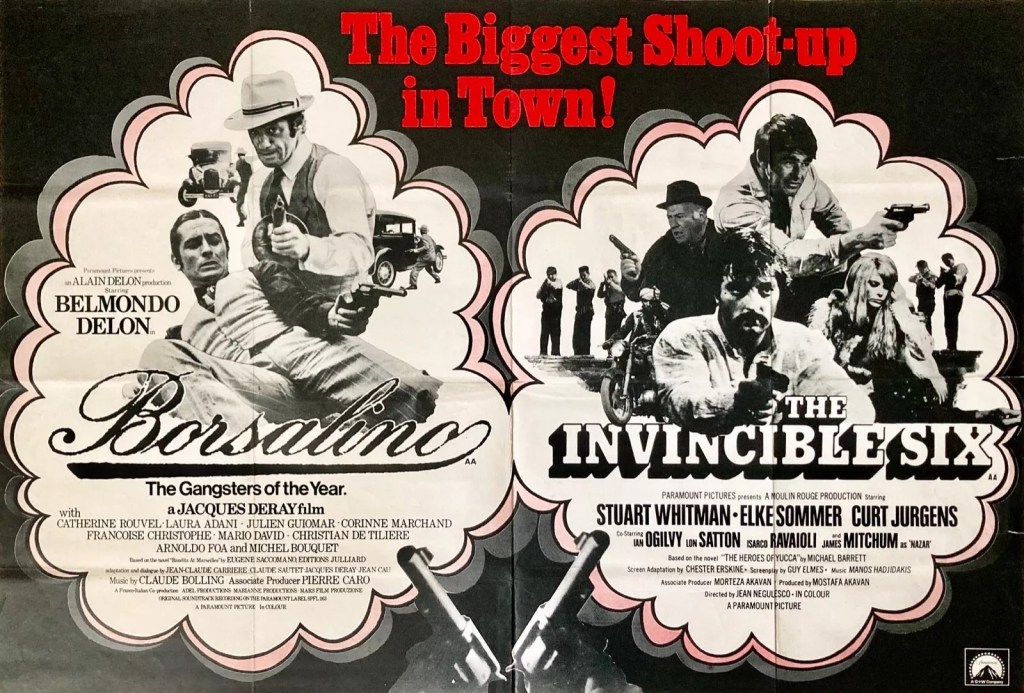
Francois (Jean-Paul Belmondo) and Roch (Alain Delon) are petty crooks in Marseilles in the early 1930s working their way up to the top, initially just with scams like presenting a longshoreman who can’t speak a word of German as a German regional boxing champion, hijacking the favorite in a horse race, setting up a slot-machine business, disrupting the city’s fish market, until graduating to more serious crime and challenging Marello (Arnoldo Foa) and Poli (Andre Bollet), kingpins of the area’s organized crime. They set fire to an abattoir, establish their own fiefdoms, running legitimate businesses like casinos. But the higher they climb the closer they come to a devastating irony which cannot be ignored. Once they’ve eliminated everyone else, their only competition is with each other, and both realize that, inevitably, one will begin to want to become the undisputed top gangster.
Roch is the more thoughtful of the pair, the one looking ahead, sensing opportunity, the strategist, Francois more likely to indulge his playboy instincts, but both enjoy the high life, mixing with celebrities, politicians and archbishops. There’s plenty collateral damage. Try to steal a bigwig’s girlfriend away and you are virtually condemning her to death.
Unexpectedly, for the genre, it’s huge fun, in part helped along by the genial earworm of a score by Claude Bolling, as evocative of the period as Scott Joplin’s rags were to The Sting (1973). We don’t have to suffer any sanctimonious prig on the sidelines offering commentary or the gangsters making out that they’re better than they are because they don’t indulge in certain types of crime. But the biggest contributory factor is the teaming of Alain Delon (Once a Thief, 1965) and Jean-Paul Belmondo (Is Paris Burning?, 1966), the two biggest French male stars of the decade, the former enjoying substantially more success overseas than the latter.
Remember that Robert Redford was a not star when he made Butch Cassidy and the Sundance Kid so the pairing of two huge marquee names was not a regular feature anywhere in the world. It was Alain Delon, in his capacity as producer, who snared his rival, ceding top billing to achieve it.
This was the second of nine movies that Delon made with director Jacques Deray and could not have been more different from their previous outing La Piscine/The Swimming Pool (1969), a claustrophobic psychological thriller. Deray had history with Belmondo, too, Crime on a Summer Morning (1965). The characters were a great fit for their screen personas. And the photography, with some sepia tint, is distinctive.
Written by Jean-Claude Carriere (Viva Maria!, 1965), Claude Sautet (Nelly and Monsieur Arnaud, 1995), Jean Cau (Jeff, 1969) and the director, based on the book Bandits a Marseille by Eugene Saccomano.
Buddy movie breakout. Highly enjoyable.
 The Magnificent 60s