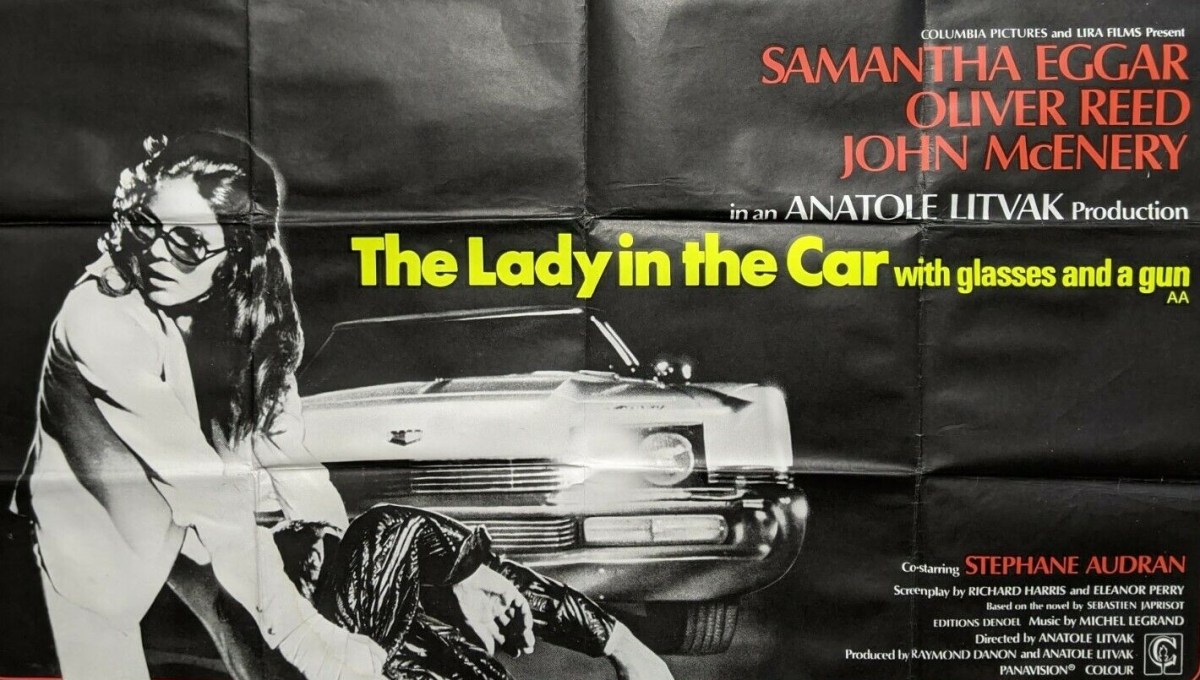
Samantha Eggar (The Collector, 1965) in her first top-billed role and an adapatation of a novel by French cult item Sebastian Japrisot (Adieu L’Ami/Farewell Friend, 1968). You couldn’t get a better mix.
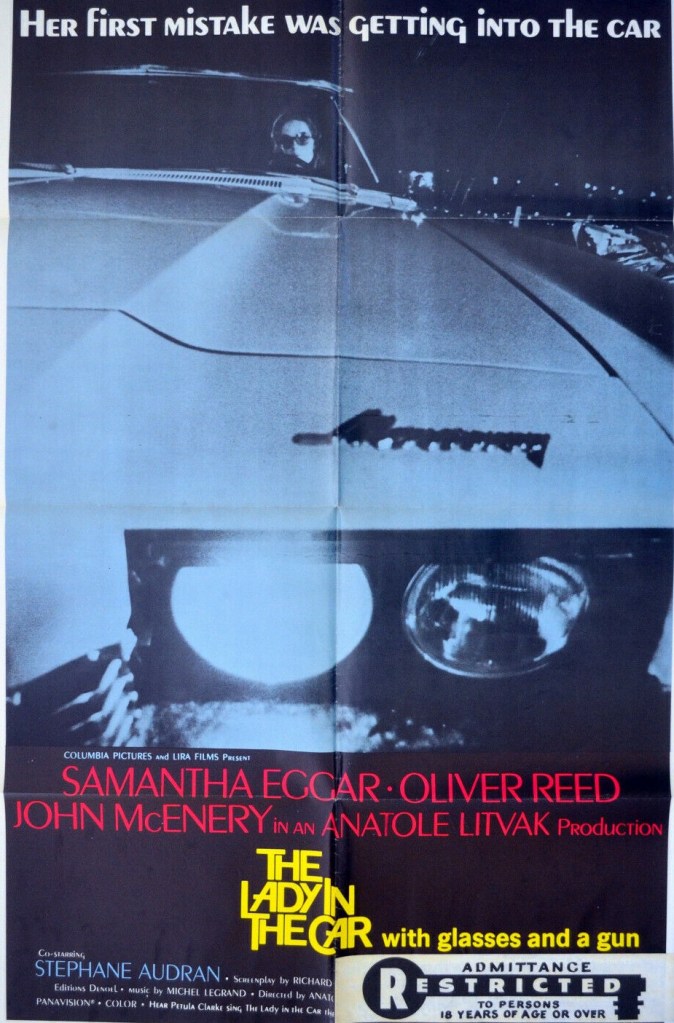
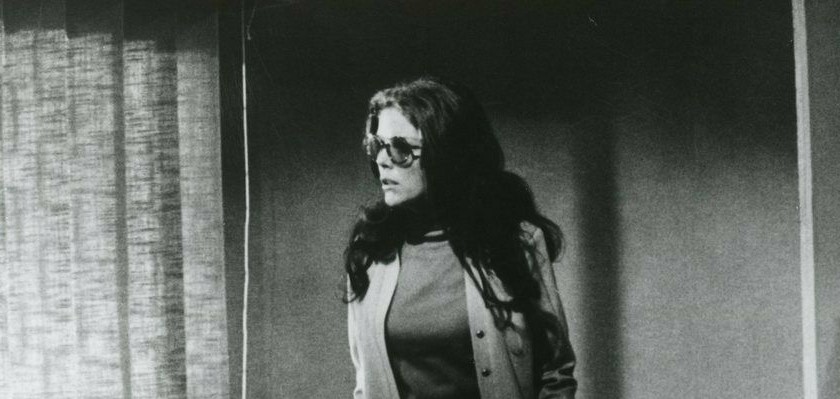
Fashion photographer Danielle (Samantha Eggar) sets off on road trip from Paris to the south of France only to discover everywhere she goes a doppelganger has been there first. She’s on edge anyway because she’s “borrowed” the car of employer Michael (Oliver Reed) and once police start recognizing her she gets jumpier still. The discovery of a body in the boot and the titular gun (a Winchester rifle) don’t help her frame of mind. But instead of reporting the corpse to the police – she’s a car thief after all – she tries to work it out herself. Amnesia maybe, madness because she keeps having flashes of memory – a spooky surgical procedure – or something worse?
She’s got a battered hand she doesn’t know how. Michael’s wife Anita (Stephane Audran) says she’s not seen Danielle in a month though she is convinced she stayed with the couple the previous night. A drifter Philippe (John McEnery) starts helping her out. Eventually she ends up in Marseilles none the wiser.
It’s a tricksy film and like Mirage (1965), recently reviewed, being limited to her point of view means the audience can only work out everything from her perspective. The string of clues sometimes lead back to the original mystery, other times appear to provide a possible solution. The explanation comes in something of a rush at the end.
Despite being the first top-billed role for Samantha Eggar (Walk Don’t Run. 1966), she would not scale that particular credit mountain again until The Demonoid (1981) but she is good in the role of a mixed-up woman struggling with identity. But since it’s based on a novel by Sebastian Japrisot (The Sleeping Car Murder, 1965) there’s a sneaky feeling a French actress might have been a better fit. Oliver Reed (Women in Love, 1969) is not quite what he seems, a difficult part sometimes to pull off, but he succeeds admirably.
Stephane Audran (Les Biches, 1969), jealous of Danielle, a friend whom she views as a rival for her husband’s affections, has the most intense part, using Danielle as an unwitting cover for betraying Michael. John McEnery (Romeo and Juliet, 1968) could almost be a London spiv, blonde hair, impecunious, clearly using women wherever he goes. Watch out for French stalwarts Marcel Bozzuffi (The French Connection, 1971) and Bernard Fresson (The French Connection II, 1975).
There’s certainly a film noir groove to the whole piece, the innocent caught up in a shifting world, and that’s hardly surprising since director Anatole Litvak began his career with dark pictures like Sorry, Wrong Number (1948) while previous effort Night of the Generals (1967) also involved murder. Litvak and Japrisot collaborated on the screenplay.
I expected a project laced with more atmosphere and a host of original characters. In truth, this is less atmospheric than the other two Japrisot adapatations , the interplay between the characters not so tightly woven, nor the climax so well-spun but it was enjoyable enough.
There was a remake in 2025 starring Freya Mayor (The Emperor of Paris, 2018).
Something of a feminist icon with middle-aged single woman choosing her lovers. I should warn you that there’s a May-December trope, which was very common at this period, as older female stars, engaging on romance with younger males, catch up with the unchallenged notion that any ageing male star should be accorded a younger female partner regardless of the age difference.
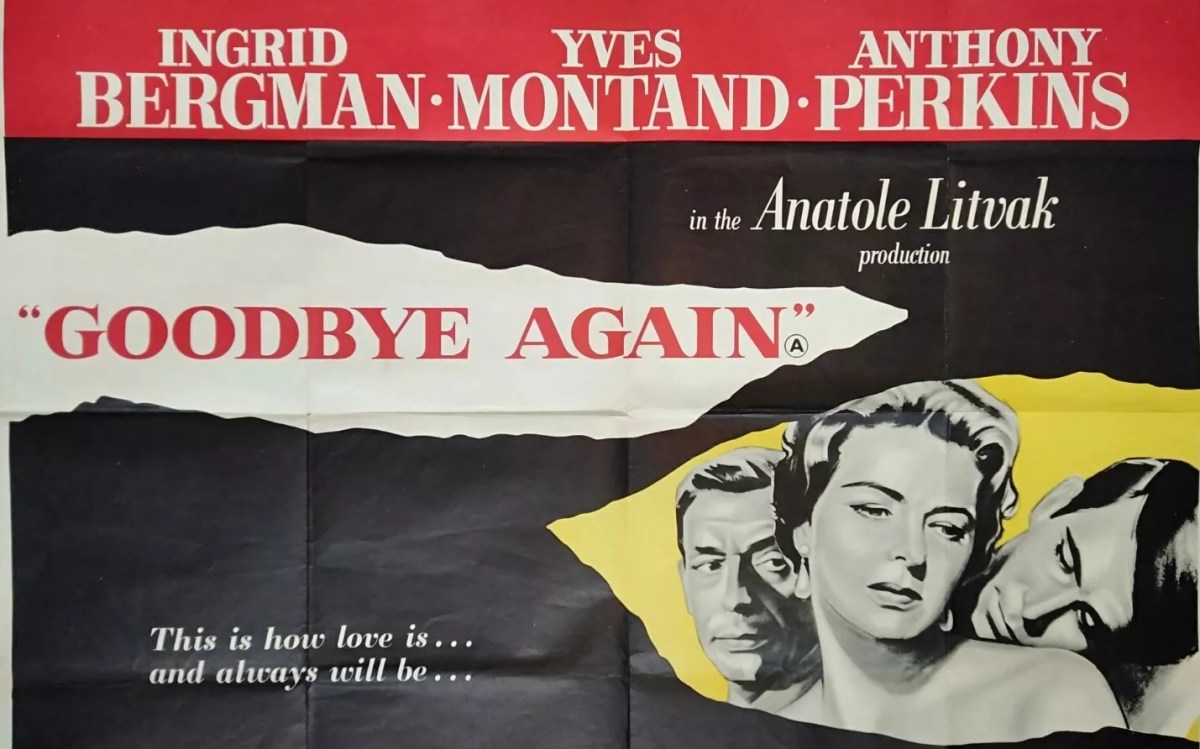
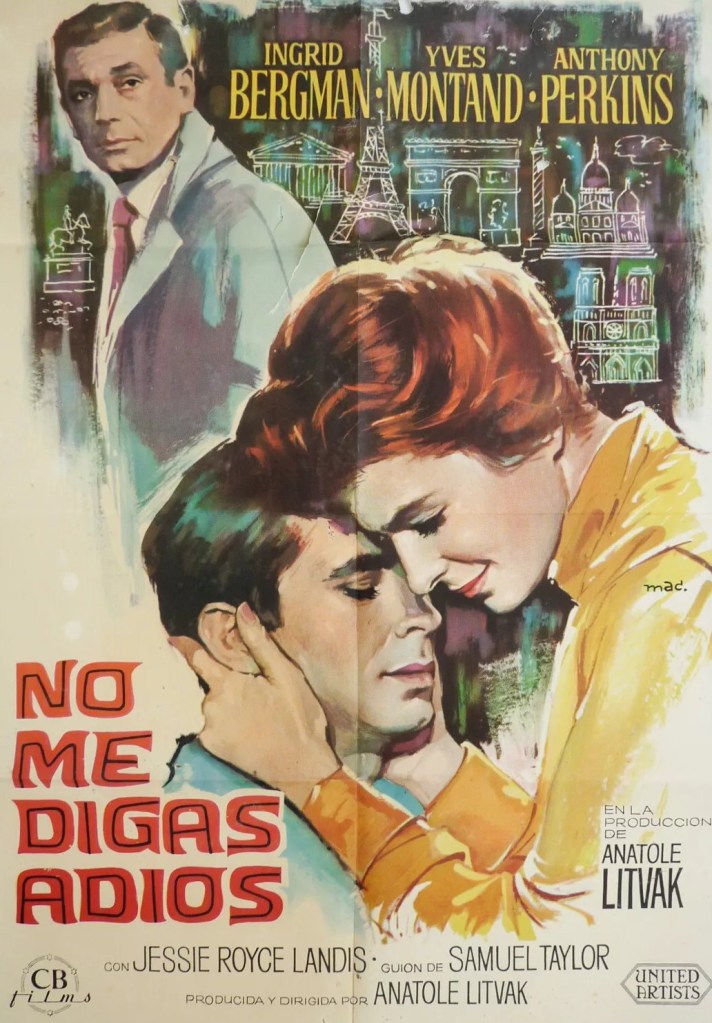
Paula (Ingrid Bergman), a lady of independent means, is tiring of philandering lover Roger (Yves Montand). After five years, he still can’t keep his hands off any young girl – known as “Maisies” – who come within reach. Paula is pursued by a younger man Philip (Anthony Perkins) and eventually succumbs to his ardent wooing. They differ on whether their relationship has much of a future, she the more pragmatic of the two, as, I would guess, are the audience.
While he’s refreshing and energetic, the spoiled rich boy exhibits childish tendencies. There’s a clash between the independent woman and the older macho misogynist male who expects his lover to be at his beck and call, even when his disappearances are the result of assignations with other lovers.
A middle-aged woman was as much on the hook to an unfaithful lover as a married woman. While she doesn’t want to be married, she wants to enjoy the same sense of trust that marriage might bring. However, she’s not destroyed, as a married woman of the period might have been, by her partner’s infidelity. And precisely because they are not bound by legal obligation, she is perfectly within her rights to choose another lover.
Still, there is an intense melancholy that she cannot make Roger settle down with just the one woman – her – and that if their affair is to continue it must be on his unacceptable terms. Yet she is terrified of being alone and except for the appearance of Philip and her independence there is the sense that she might subdue tragic instinct and settle for the crumbs from Roger’s table.
Glorified soap opera, no doubt, but it survives on the playing of Ingrid Bergman (The Visit, 1964) who shares with Deborah Kerr the ability to show conflict and sadness in her eyes. She brings so much depth to her character you are apt to forget you are watching a soap opera. That she remains attracted to Roger beyond the realms of logic compounds her tragedy.
Anthony Perkins (Pretty Poison, 1968) is very charming, ridding himself in the main of the jumpiness that appeared to fit his screen persona. While Perkins and Bergman make an unlikely screen couple, they are a believable one.
Yves Montand (Let’s Make Love, 1961) doesn’t have to drift much outside his screen persona of male fantasy figure, the one who has all the dames at his feet.
This is one of those very well-made Hollywood movies, full of gloss, trimmed with an edginess that soon takes center stage. Made in the 1940s it would be a classic weepie. The ending will take you by surprise.
Directed by Oscar-nominated Anatole Litvak (The Night of the Generals, 1967) in determined old-fashioned style from a screenplay by Samuel A. Taylor (Topaz, 1969) based on the Francoise Sagan bestseller.
Impressive vastly underrated whodunit that breaks all the rules. Take the length for a start – just stopping short of two-and-a-half hours. The investigation covers multiple time periods – 1942, 1944 and 1965. The killer outwits the detective. Most important of all, the murder is clearly a MacGuffin to examine politics among the German officer class.
A Polish woman who turns out to be a German agent is viciously stabbed to death in Warsaw in 1942 during a period of staunch resistance by the inhabitants. General Tanz (Peter O’Toole), sent in to quell a potential uprising, is one of three generals on the suspect list compiled by Major Grau (Omar Sharif), the others being the alcoholic General Khalenberge (Donald Pleasance) and the philandering General von Seidlitz-Gabler (Charles Gray).
But Grau is no ordinary detective or, put another way, this not an ordinary investigation.
Grau lacks any of the powers we associate with an investigator. Yes, we expect obstruction, perhaps collusion, as the murderer tries to avoid detection. But Grau might well have been a sergeant for the disdainful treatment and lack of cooperation he receives. And there’s a fair chance he’s going to be shot at as he prowls the streets, and resistance fighters in tenement exchange fire with the invaders. None of the generals can account for their whereabouts on the night in question.
While Tanz is benign to children, ordering a hungry bunch fed from his own supplies, he is ruthless with adults, willing to employ flamethrowers (Phase Two of his plan) to drive snipers out of buildings and if that fails move onto Phase Three which simply uses tanks to obliterate everything. Like some knight of old, Tanz stands upright in his jeep directing operations in full view of the enemy, almost taunting them to kill him.
The most powerful image in the film – the one used in the posters – has Tanz standing (on the right of the screen) upright in his jeep with the world on fire behind him. What’s edited out of the poster is that Grau occupies the left side of the screen, standing like a servant awaiting his master’s orders.
That Grau makes no progress at all is down to the power of his superiors. Since he commits the cardinal sin of getting in the way, he is just shuttled out of Warsaw, promoted to Colonel and given other duties in Paris. So the scene shifts to the Parisian capital in 1944 after D-Day. The same three generals are on duty in the French capital, not supervising, as you might expect, the defence of the city against the encroaching Allies, but planning an attempt on the Fuhrer’s life (Operation Valkyrie). This time it’s Tanz, returning from the Russian front where his regiment has been decimated, who is shuttled to one side, ordered to take two days leave so he doesn’t get in the way of the saboteurs.
At this point, the movie boldly switches perspective, in part to encompass the assassination subplot, in part to focus more closely on Army politics, in part to follow Tanz, not just an alcoholic but a poster boy for OCD, as he tries to enjoy some downtime. He is accompanied on his tourist trip through the city and jaunts to visit museums by his chauffer/butler Corporal Hartmann (Tom Courtenay) whose other duties include spying on the general on behalf of the plotters. Grau, meanwhile, recruits French Inspector Morand (Phillippe Noiret) to assist in his investigation, which is otherwise being obstructed on all sides.
I won’t reveal the shocking ending which shows just how clever the murderer is because that’s not actually the ending and the story shifts to 1965 when the generals have been rehabilitated after the war, the case still open because a third woman has been killed in the same fashion.
I may have seen this back in the day and certainly remember it vaguely from a pan-and-scan version edited for television, but I had generally avoided it because of the poor reviews. I wonder how many critics just found it in poor taste, to be spending big Hollywood bucks on a story that treated German generals as pretty well ordinary human beings, the war itself so much in the background you would think it non-existent. Plenty critics sniped at the performance of the principles, perhaps because Peter O’Toole (Becket, 1964) and Omar Sharif (Genghis Khan, 1965) played so much against type. The image I mentioned of O’Toole with the world ablaze is an ironic one, not charged with the glory of David Lean’s vision of the actor in Lawrence of Arabia (1962). Similarly, not once does director Anatole Litvak (Five Miles to Midnight, 1962) rely on Omar Sharif’s soulful brown eyes the way Lean did in Doctor Zhivago (1965), in fact there is no such shot here at all. Sharif looks weary and jaded, kept going in the face of obstruction by his own convictions about justice. O’Toole is so wound up he likes like he’s about to explode and at times certainly teeters off-balance.
Critics seemed so intent on dishing out barbs that they missed two excellent performances, Sharif , in particular, unable to call on his romantic side, delivering very fine work. Donald Pleasance (Soldier Blue, 1970), devoid of his usual physical tics, is also memorable. And there is so much to enjoy from the direction. Litvak, in particular, makes superb use of the tracking shot. Often a scene begins with a close-up, tracks back to reveals others, allows them to deliver their lines, then tracks back into the original character, usually the one with most to lose at this moment. He allows time to develop the other characters. Without ever appearing drunk in the way of Tanz, Khalenberg is always pouring or drinking a shot of alcohol. Seidlitz-Graber is inhibited by family politics as his wife (Coral Browne) attempts to ease their daughter Ulrike (Joanna Pettet) into high society.
I must also mention the brilliant score and the pithy lines that shoot out from cynical mouths. “Making up one’s mind is one thing,” observes Seidlitz-Graber acidly, “speaking it is another.” On hearing of the assassination plot, Grau points out, “when things were going well, the generals enjoyed the war as much as Hitler.” Music came courtesy of Maurice Jarre (Doctor Zhivago) and the screenplay was a joint effort between Joseph Kessel (Army of Shadows, 1969) and Paul Dehn (The Spy Who Came in from the Cold, 1965) who hacked away at the H.H. Kirst novel, retaining only the opening.
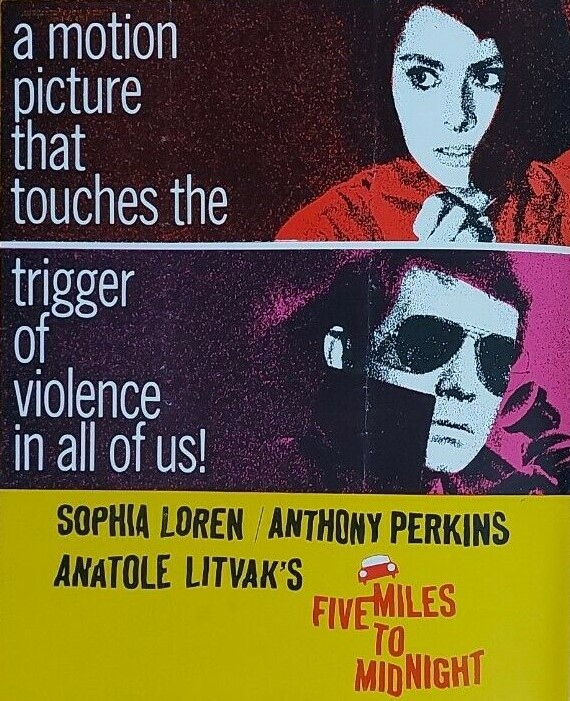
Superb performance by Sophia Loren (Arabesque, 1966) lifts taut Parisian-set thriller into outstanding class. Forced, of narrative necessity, to keep a lid on her emotions, Loren’s eyes betray her feelings. Director Anatole Litvak’s (Lady in the Car with Glasses and a Gun, 1970) camera is relentless, trapping her with almost claustrophobic compulsion, allowing little release, preventing her escaping the eye of truth.
Husband Robert (Anthony Perkins) and wife Lisa (Sophia Loren) embark on major insurance fraud. He’s the instigator, she reluctantly goes along with the plan as she imagines that, with their unlikely marriage already teetering, it will buy her freedom. Robert, sole survivor of a plane crash, rather than announcing he is alive, uses his death to scam the insurance company out of $120,000 (equivalent to $1.2 million today).
Given he is deceased, she has to carry out the formalities of making the claim, dealing with the various authorities, including police and the American consulate. Meanwhile, hiding out, every knock on the door or ring of the telephone creates panic. At various points Robert has to hide in every room in the apartment – remembering to remove any sign of his existence – and on the stairwell and when that proves too dangerous on the roof.
Little things that could give him away. The extra plate or glass could trigger suspicion from the cleaner. Lisa, a non-smoker, has to purchase cigarettes for Robert, the remains of an ashtray a possible reveal. She returns to work much faster than you would expect of a grieving widow.
She attracts an initially unwelcome suitor, David (Gig Young), a doctor, a friend of a friend. Workmates turn up at inopportune moments. A boy in an apartment opposite spots the recluse, at one point, shining a mirror into Robert’s eyes, dazzling him as he hides, precariously, on the roof. A cat, too, threatens to reveal the voluntarily imprisoned man.
You might wonder how why she married the financially dissolute Robert in the first place, more baby than man, a “charming octopus” whose needs would strangle the life out of a wife. He was her meal ticket from post-war Naples. She was so desperate to escape poverty that she would, as Robert acidly (and truthfully) puts it, that she would have gone off with any fellow with “a couple of bucks in his pocket.”
In Britain it was released on the lower part of a double bill to “Taras Bulba.”
He suspects she has a lover. And from random clues in the apartment, David also suspects she has a lover. But mostly it’s nail-biting waiting. And when her nerves are so shredded she is inclined to confess all to the police, and be rid of her husband, she realises she would be jailed as his accomplice. And though going along with the notion that the money will buy both their (separate) freedom, the devious Robert has no intention of letting her go, intending to blackmail her into remaining with him.
As the stakes rise we enter a frankly magnificent endgame, with one twist after another, Lisa barely coherent from overwhelming pressure even as freedom beckons.
It’s splendidly done, chock full of surprises, from the opening credits to the last intense close-up of Lisa. The credit sequence, a long tracking shot following a pair of legs from a bus to a nigh club, jaunty jazz in the background, Lisa exuberantly dancing the Twist, ends in an explosive slap. Where are obstructive insurance agents, the kind that automatically challenge every claim, hoping to whittle down the amount, when you need them? This one couldn’t be more helpful, even easing the path, when she had counted on the opposite in order to scupper the outrageous plan, to getting a death certificate out of the American consulate. It turns out you can easily dupe the police by simply denying that a coat found near the location of the crash does not belong to Robert.
The focus is kept almost evenly on the culprits. Awful husband that he is, Robert’s little-boy-lost persona still extracts audience sympathy – she is a deceiver after all, conning him into marriage, lover on the side – especially as you know that, even though this never occurs to Lisa, that capturing Robert will result in her imprisonment. But Robert already lives on the emotional edge and there’s one terrifying scene where he is clearly tempted to throw the small boy off the roof.
Even when Lisa believes she has found sanctuary in David, his suspicions threaten that. I won’t spoil the endgame for you because it is exceptional, very well worked in terms of action and emotion.
This didn’t get much attention when it appeared despite Loren’s stunning performance, perhaps because insurance fraud suggests little of the inherent tension of a heist. Anthony Perkins, desperately trying to avoid the typecasting triggered by Psycho (1960), successfully develops a more attractive screen persona that would climax in Pretty Poison (1968). Given the set-up, you imagine that the eternally charming Gig Young (They Shoot Horses, Don’t They, 1969) will turn out to be an undercover insurance agent. Even when that is obviously not the case, he is too inquisitive for Lisa’s good.
In contrast to the claustrophobic tension, the movie plays out against the backdrop of fun-filled parties, dancing, nightclubs, cocktails, the high life.
At this point Anatole Litvak was rarely mentioned in dispatches, critics considering his best films (The Snake Pit, 1948, for example) way behind him and that he was more likely to helm lumbering well-meaning vehicles like The Journey (1959). But, opening credits and a couple of scenes making using of perilous shadow apart, he is primarily an actor’s director. And when he gives a star of the skill of Sophia Loren such leeway, the script not permitting her self-justification, he is truly rewarded.
Superb performance by Sophia Loren (Arabesque, 1966) lifts taut Parisian-set thriller into outstanding class. Forced, of narrative necessity, to keep a lid on her emotions, Loren’s eyes betray her feelings. Director Anatole Litvak’s (Lady in the Car with Glasses and a Gun, 1970) camera is relentless, trapping her with almost claustrophobic compulsion, allowing little release, preventing her escaping the eye of truth.
Husband Robert (Anthony Perkins) and wife Lisa (Sophia Loren) embark on major insurance fraud. He’s the instigator, she reluctantly goes along with the plan as she imagines that, with their unlikely marriage already teetering, it will buy her freedom. Robert, sole survivor of a plane crash, rather than announcing he is alive, uses his death to scam the insurance company out of $120,000 (equivalent to $1.2 million today).
Given he is deceased, she has to carry out the formalities of making the claim, dealing with the various authorities, including police and the American consulate. Meanwhile, hiding out, every knock on the door or ring of the telephone creates panic. At various points Robert has to hide in every room in the apartment – remembering to remove any sign of his existence – and on the stairwell and when that proves too dangerous on the roof.
Little things that could give him away. The extra plate or glass could trigger suspicion from the cleaner. Lisa, a non-smoker, has to purchase cigarettes for Robert, the remains of an ashtray a possible reveal. She returns to work much faster than you would expect of a grieving widow.
She attracts an initially unwelcome suitor, David (Gig Young), a doctor, a friend of a friend. Workmates turn up at inopportune moments. A boy in an apartment opposite spots the recluse, at one point, shining a mirror into Robert’s eyes, dazzling him as he hides, precariously, on the roof. A cat, too, threatens to reveal the voluntarily imprisoned man.
You might wonder how why she married the financially dissolute Robert in the first place, more baby than man, a “charming octopus” whose needs would strangle the life out of a wife. He was her meal ticket from post-war Naples. She was so desperate to escape poverty that she would, as Robert acidly (and truthfully) puts it, that she would have gone off with any fellow with “a couple of bucks in his pocket.”
He suspects she has a lover. And from random clues in the apartment, David also suspects she has a lover. But mostly it’s nail-biting waiting. And when her nerves are so shredded she is inclined to confess all to the police, and be rid of her husband, she realises she would be jailed as his accomplice. And though going along with the notion that the money will buy both their (separate) freedom, the devious Robert has no intention of letting her go, intending to blackmail her into remaining with him.
As the stakes rise we enter a frankly magnificent endgame, with one twist after another, Lisa barely coherent from overwhelming pressure even as freedom beckons.
It’s splendidly done, chock full of surprises, from the opening credits to the last intense close-up of Lisa. The credit sequence, a long tracking shot following a pair of legs from a bus to a nigh club, jaunty jazz in the background, Lisa exuberantly dancing the Twist, ends in an explosive slap. Where are obstructive insurance agents, the kind that automatically challenge every claim, hoping to whittle down the amount, when you need them? This one couldn’t be more helpful, even easing the path, when she had counted on the opposite in order to scupper the outrageous plan, to getting a death certificate out of the American consulate. It turns out you can easily dupe the police by simply denying that a coat found near the location of the crash does not belong to Robert.
The focus is kept almost evenly on the culprits. Awful husband that he is, Robert’s little-boy-lost persona still extracts audience sympathy – she is a deceiver after all, conning him into marriage, lover on the side – especially as you know that, even though this never occurs to Lisa, that capturing Robert will result in her imprisonment. But Robert already lives on the emotional edge and there’s one terrifying scene where he is clearly tempted to throw the small boy off the roof.
Even when Lisa believes she has found sanctuary in David, his suspicions threaten that. I won’t spoil the endgame for you because it is exceptional, very well worked in terms of action and emotion.
This didn’t get much attention when it appeared despite Loren’s stunning performance, perhaps because insurance fraud suggests little of the inherent tension of a heist. Anthony Perkins, desperately trying to avoid the typecasting triggered by Psycho (1960), successfully develops a more attractive screen persona that would climax in Pretty Poison (1968). Given the set-up, you imagine that the eternally charming Gig Young (They Shoot Horses, Don’t They, 1969) will turn out to be an undercover insurance agent. Even when that is obviously not the case, he is too inquisitive for Lisa’s good.
In contrast to the claustrophobic tension, the movie plays out against the backdrop of fun-filled parties, dancing, nightclubs, cocktails, the high life.
At this point Anatole Litvak was rarely mentioned in dispatches, critics considering his best films (The Snake Pit, 1948, for example) way behind him and that he was more likely to helm lumbering well-meaning vehicles like The Journey (1959). But, opening credits and a couple of scenes making using of perilous shadow apart, he is primarily an actor’s director. And when he gives a star of the skill of Sophia Loren such leeway, the script not permitting her self-justification, he is truly rewarded.
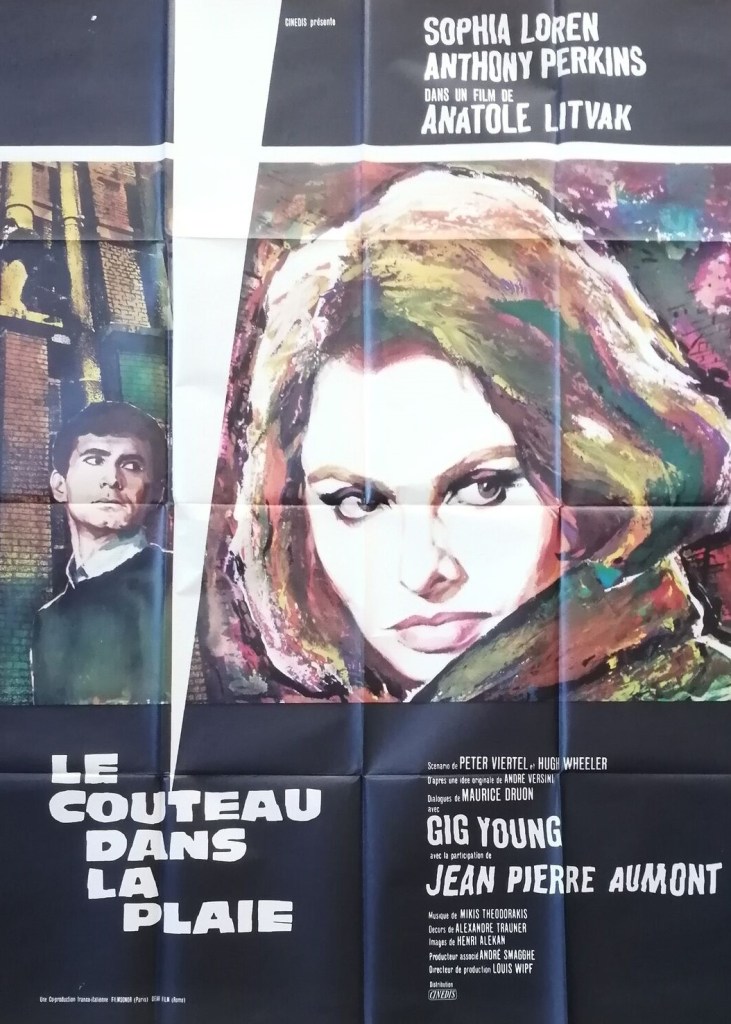
The screenplay, for once not drawn an another source like a novel or Broadway play, is an original drawn out of the combined minds of Peter Viertel (The Old Man and the Sea, 1958), Hugh Wheeler (Kaleidoscope, 1967) and Andre Versini (Mission to Venice, 1964).
Loren is the true star. In a peach of a performance, her eyes constantly reveal inner turmoil.



 The Magnificent 60s