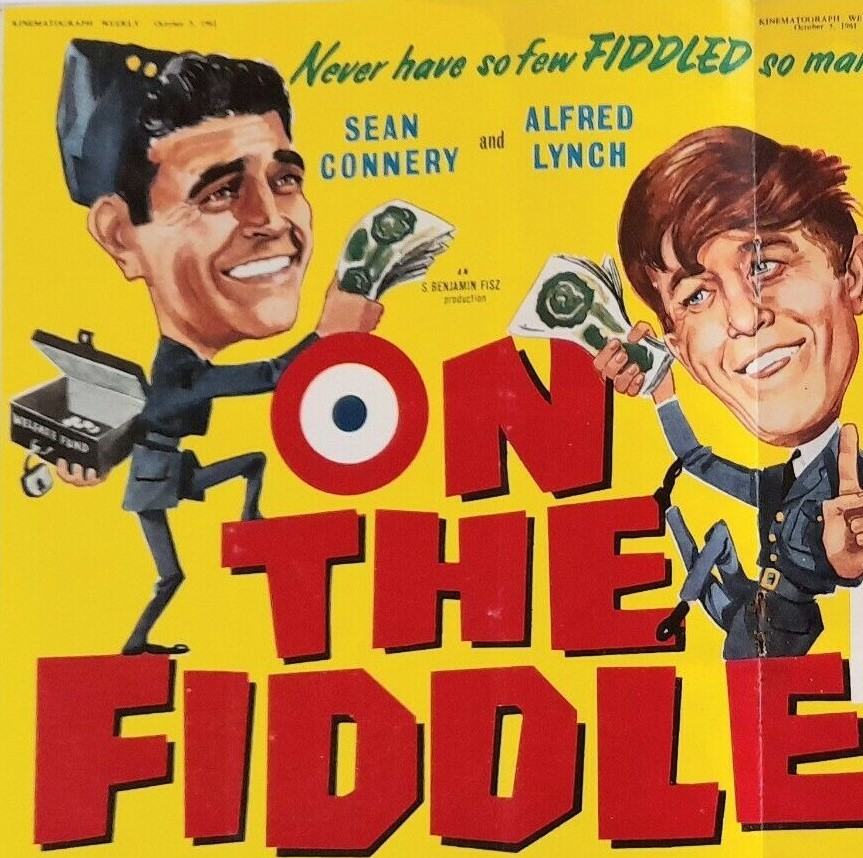
On the Fiddle / Operation Snafu (1961) ***

Unassuming but undeniably charming British World War Two comedy denied U.S. release until four years later when a savvy distributor jumped on the James Bond bandwagon. Primarily of interest these days for the opportunity to see a pre-Bond Sean Connery (Dr No, 1962) in action its merit chiefly lies in ploughing the same furrow, though with a great deal less pomposity and self-consciousness, as the later The Americanization of Emily (1964), of the coward backing into heroism.

Horace Pope (Alfred Lynch) is a scam merchant who only dodges prison by enlisting. Assigned to the RAF he teams up with Pedlar Pascoe (Sean Connery) and they embark on a series of schemes designed to keep them as far away from the front line as possible. It’s hardly an equal partnership, Pope dreams up the fiddles while Pascoe just falls in with them. It’s not dumb and dumber but a collaboration that goes no further back in the annals of movies than brain and brawn.
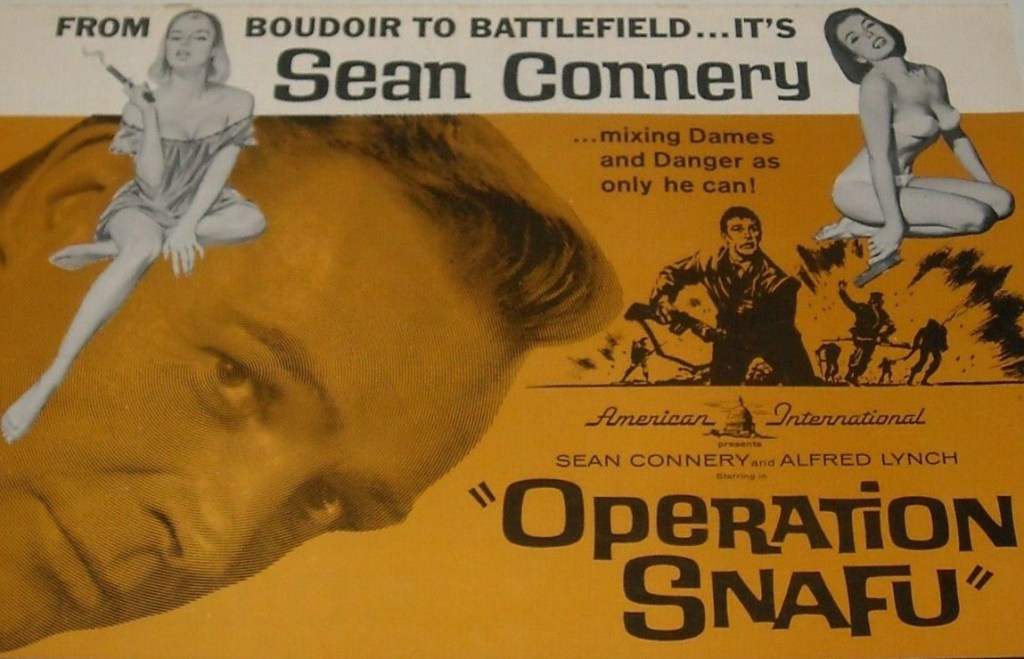
Needless to say, the movie lacks the the damsels in bikinis which were a prerequisite of the Bond pictures. Sean Connery takes top billing Stateside where he was originally behind Lynch.

It’s certainly a cynical number, reflecting the boredom experienced by many of the Armed Forces backroom staff, the administrators whose inefficiency turns them into easy dupes, and the determination of soldiers to take advantage of every opportunity to bend the rules. It takes the unusual position of presenting the ordinary soldier as smart and every officer as a numbskull, an approach that would only have been possible 15 years after the war ended and in marked contrast to the determined heroism of other British war films – such intrepid stiff-upper-lip behavior a hallmark of the British version of the genre.

First stop is to run an operation issuing leave passes – for a price – and the sheer effrontery exhibited by Pope is a joy to behold. Next up is selling stolen meat on the black market.

While Pedlar is the wide-eyed camp follower, and more likely to forever sit on the sidelines, cheerful but shy, and only a few pratfalls away from being a bumbling idiot, they do make a good team. Being sent to France is more of a heaven-sent opportunity to increase their bankrolls than a hazardous wartime mission as Pope sells rations to the French. Eventually, of course, their various scams are rumbled and they are forced into battle.

The only thing better than one pre-Bond Connery picture is two.

The movie switches a bit more deftly into serious mode than the aforementioned The Americanization of Emily mostly because these are actual soldiers trained to be soldiers rather than an officer who landed a cushy number and whose main effort is to avoid combat. War is presented as horrific rather than comedy and it must have been the same experience for an ordinary soldier at the time, after months of inactivity suddenly thrust into the cauldron.

The picture moves at a brisk pace and is continually amusing if not particularly laugh-out-loud. You’ve probably seen most of the set-ups before but they are reinvented with an appealing freshness and briskness  As a bonus there’s reams of British character actors and comedians – plus token American Alan King (who would appear in Connery starrer The Anderson Tapes, 1971) – along the way. The term “snafu” in case you’re interested, has a similar meaning to the “fubar” of Saving Private Ryan (1998).

Alfred Lynch (The Hill, 1965) doesn’t milk the Cockney patter overmuch and he’s got a greater international screen appeal than the likes of the more English Sid James (Carry On films) or Norman Wisdom. Think a shiftier Sgt Bilko, if the Phil Silvers creation could be any more untrustworthy.

Connery’s performance is well worth a watch as a prelude to what was to come once his roles were tailor-made. He is an effortless scene-stealer, gifted in expressing emotion through his eyes, and although verbally Lynch dominates it’s difficult to take your eyes off Connery.

The roll-call of character actors includes Cecil Parker (A Study in Terror, 1965), Stanley Holloway (My Fair Lady, 1964), John Le Mesurier (The Moon-Spinners, 1964), Graham Stark (The Wrong Box, 1966) and Victor Maddern (The Lost Continent, 1968).

Cyril Frankel (The Trygon Factor, 1966) comfortably cobbles this together from a screenplay by Harold Buchman (The Lawyer, 1970, and who had ironically enough penned the picture Snafu in 1945) based on the novel Stop at a Winner by R.F. Delderfield.

When the box office supremacy of the Bond pictures was underscored by the reissue of the Dr No/From Russia with Love double bill in 1965, distributors, as had been their wont, racked the vaults for anything featuring Connery that could be re-sold to a willing public.    

While there is a readily available DVD, this turns up on a regular basis, in Britain at least, on television.
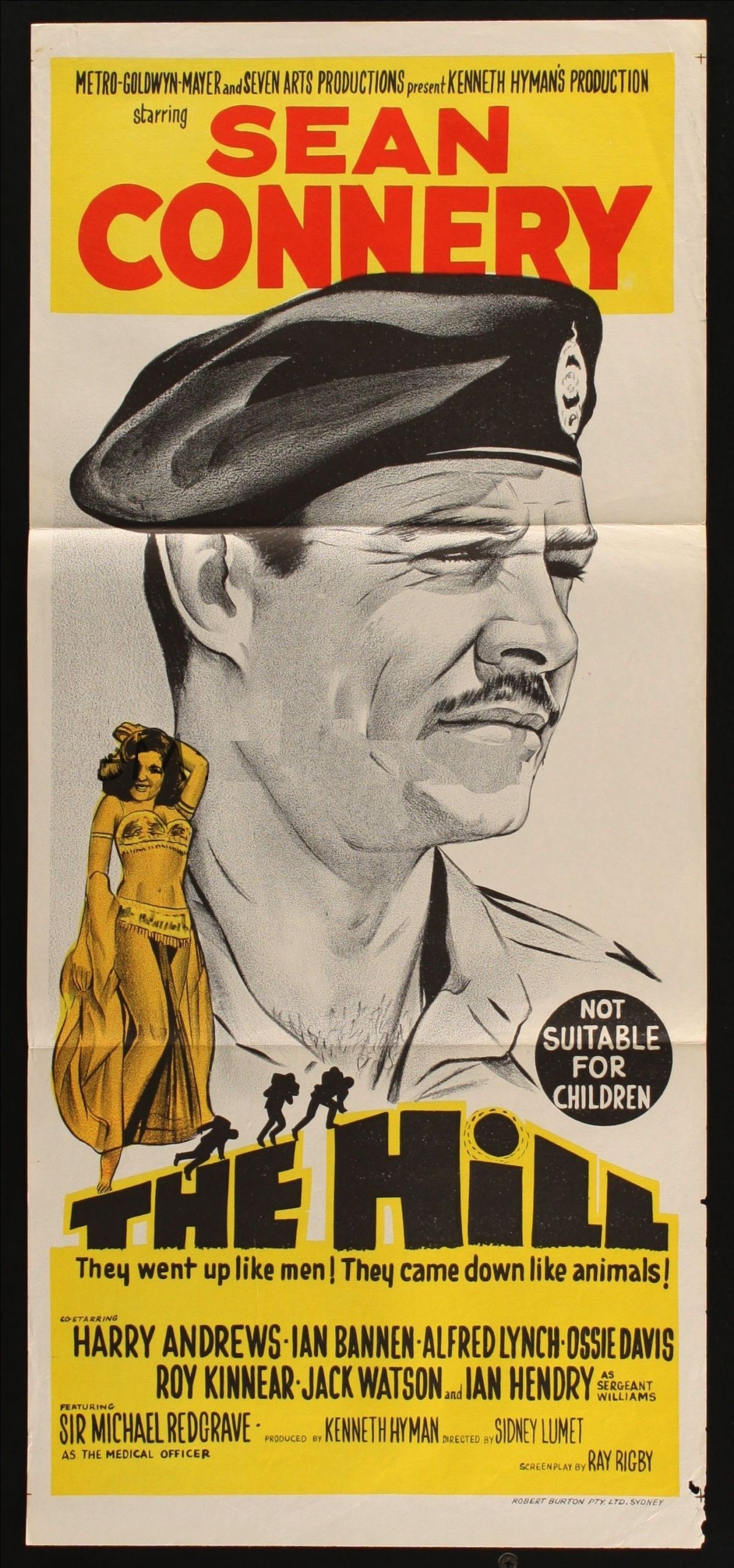
The Hill (1965) ****

Set in a British Army prison camp in North Africa during World War Two ruled by sadistic Sergeant Wilson (Harry Andrews) who believes himself above the regulations he forces others to follow, The Hill is a parable about the hypocrisy of totalitarian rule. And much of what is shown would be offensive to modern sensibilities. Although the commandant (Norman Bird) and medical officer (Michael Redgrave) are his superior officers, Wilson runs the unit by force of personality. He believes his ruthless treatment of the prisoners turns them into proper soldiers. Into his fiefdom come five new prisoners including coward Joe Roberts (Sean Connery), spiv Monty Bartlett (Roy Kinnear), African American Jacko King (Ossie Davis), another Scot Jock McGrath (Jack Watson) and weakest link George Stevens (Alfred Lynch).

Most films about prisons emphasize imprisonment, most scenes taking place in cells or other places of confinement. Sidney Lumet (The Pawnbroker, 1964) directs this film as though it is a paeon to freedom with incredible shots of the vista within which the men are contained. He uses some of the most bravura camerawork you will ever see outside of David Lean. The film opens with a two-minute crane shot credit sequence that begins with a prisoner collapsing on the titular hill and pulls back to reveal the entire encampment and follows with a one-minute reverse tracking shot of Andrews striding through his domain. And while the camera controls what we see, our ears are constantly assailed by the constant drumbeat of other marching prisoners.  

Climbing the hill in full pack would break any man and those who collapse are roused by pails of water. The first to crack is Stevens who is constantly tormented by homophobic jibes. Continuous racist abuse is heaped on Jacko King until driven to the point of madness he begins to behave like a gorilla which frightens the life out of his superiors. Obeying orders, says Joe Roberts, is “like a dog picking up a bone.”  RSM Wilson is out of control, the commandant spending his nights with a prostitute, the medical officer clearly sent here as punishment for some previous misdemeanor. Of the senior staff only Harris (Ian Bannen) comes away with any dignity, constantly trying to thwart the worst bullying.

When Stevens dies suddenly, the film changes tack and becomes a battle for survival among those who could be blamed for causing his death and those who dare to point the finger.  Wilson has no problem stitching up his colleagues and blackmailing the medical officer while Roberts is beaten up for his effrontery in standing up to authority. But the astonishing presence and self-confidence and, it has to be said, courage of Wilson lords it over everyone, and there is an extraordinary scene where he forces the entire battalion of prisoners to back down when they are on the brink of open rebellion.

Connery as Roberts is superb in what is his first dramatic role in a bread-and-butter dramatic production rather than the glossier Marnie (1964) and Woman of Straw (1964) and while he has his moment of defiance he gives enough glimpses of vulnerability and fear to ensure we do not mistake him for his alter ego James Bond. Ian Bannen delivers a touching assured performance far removed from the nasty sarcastic personalities he portrayed in his other desert pictures, Station Six Sahara (1963) and the Flight of the Phoenix (1965).  Ossie Davies, as defiant as Connery, is brilliant as the man who works out a way to beat the enemy by confusing them; the scene in the commandant’s office where he treats the officer as his inferior is a tour de force.   

Although the Army is meant to run according to established regulation, where obedience to a superior is paramount, it is equally apparent that it can also become a jungle if those who are the fittest assume control. Sgt Wilson demands unquestioned discipline even as he is breaking all the rules in the book. But he retains his authority not just by bullying, but by intelligence, exploiting weakness, coolness under pressure and by welcoming confrontation, his personality as dangerous as any serial killer.   

Discover WordPress

A daily selection of the best content published on WordPress, collected for you by humans who love to read.

The Atavist Magazine

by Brian Hannan

WordPress.com News

The latest news on WordPress.com and the WordPress community.