A Cold Wind in August (1961) ***

Touching low-budget B-movie shot in black-and-white of a young man receiving his sexual education from an older woman. Motherless Vito (Scott Maxwell), the son of an apartment block super, is seduced by the older Iris (Lola Albright), three-time divorcee, looking for a son to mother. 

This is not the transactional sex of The Graduate, and seduction is too strong a description for the yearning Iris whose advances are sensual and romantic, stroking Vito’s head, trapping his hand with her foot, and there is nothing clandestine about their affair either, no false names on a hotel register. They dally in the park, eat hotdogs, and he buys her flowers. 
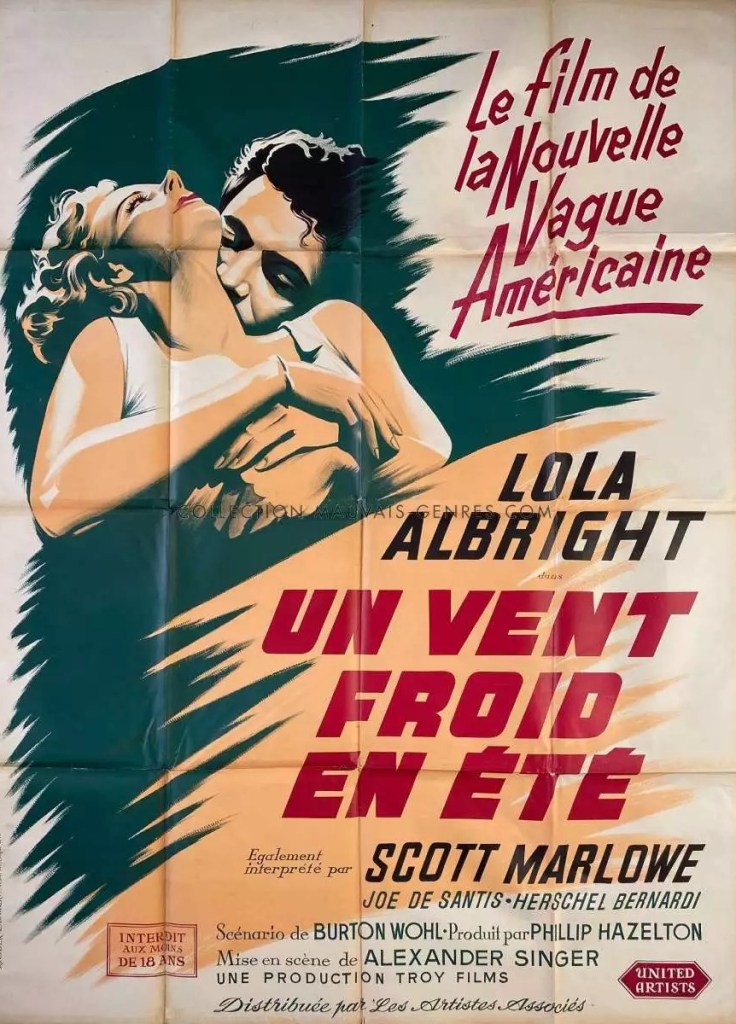
But as he experiences love for the first time, he also experiences more difficult emotions like jealousy and finds it difficult not just to cope with what seems like another man in her life, the wholesaler Juley (Herschel Bernardi), but the fact that she treats him with such contempt. Spoiler alert – well, not really, because you know from the off this is not going to turn out well – the affair ends when he discovers she is a stripper. And while she is left bereft, he now appears more attractive to girls his own age.

In contrast to the powerful emotions stoked up when the pair are together, director Alexander Singer (Psyche ‘59) fills us in on the rest of Vito’s humdrum life, working for his father during the school holidays, goofing off with his pals, and generally failing to make headway with girls his own age.  But Iris’s life is not humdrum. Although she has a rule not to work in her own area, she breaks that to accommodate her estranged husband, whom she seems to tolerate, while at the same time drinking herself into oblivion to avoid any moves from Juley. Nor is she ashamed of her profession. It is an act, a job like any other, and provides her with a nice apartment.

Small wonder she treats men with contempt. Perhaps what she falls in love with is untainted innocence. In some senses she is adrift, at other times in full command. And her love for Vito is convincing.

It is full of incidentals. He gulps down ice-cream, she teaches him to drink one sip at a time, without being patronizing the father (Joe De Santis) tries to educate him to honor his inner feelings.

Lola Albright (Peter Gunn television series) carries off a difficult role very well indeed. Without laughs to help him out as it did Dustin Hoffman in The Graduate, Scott Maxwell is believable both as the youth growing into adulthood and the youth wanting to remain a youth with no adult responsibilities. The low-key performance of Joe De Santis is worth a mention.

While the picture no doubt attracted attention for the risqué material, which would have certainly given the Production Code pause for thoughts, it provided a more rounded picture than was normal at the time of a woman working in the sex industry, even if only in the stripping department. Iris did not fall into any of the cliches. She is presented as a woman first and foremost rather than a stripper.   

Alexander Singer sticks to the knitting and doesn’t come unstuck. John Hayes (Shell Shock, 1964) wrote the screenplay based on the Burton Wohl bestseller.

Unusual variation on the theme.

Psyche 59 (1964) ****

This is a low-budget gem, an exploration of the psychological consequences of grooming. You can probably guess from the outset where it is headed but simmering tension has rarely been handled so stylistically.

With the exception of Patricia Neal, an unexpected Best Actress Oscar-winner for her previous film Hud (1963), there were no stars in the cast. Curd Jurgens was only beginning to play characters for whom a German accent was not essential, Samantha Eggar one movie shy of her breakout picture The Collector (1965), Ian Bannen, essentially a character actor, building on his success in Station Six Sahara (1963).

Blinded after an unexplained psychological trauma, Allison (Patricia Neal) welcomes back, over the objections of husband Eric (Curd Jurgens), her much younger sister Robin (Samantha Eggar) to the family home. Family friend Paul (Ian Bannen) cares (possibly overmuch) for Allison while hankering after Robin. The screenplay by veteran Julian Zimet (Saigon, 1947, with Alan Ladd) is taut as a drum, every line a threat, suppressed emotion or piece of exposition that could bring the whole house of cards tumbling down.

The blindness is exceptionally well handled, Allison’s need for physical contact with her husband sensual in its expression. Though she can a ride a horse, her vulnerability is implicit; as she is led across a beach you wonder what would happen were she to be abandoned. What she cannot see becomes central to the movie. That Robin – vivacious but damaged – clearly has some hold over Eric is demonstrated in a tete-a-tete between them but as tensions mount such scenes cannot be kept secret. When Eric grabs Robin’s hair and she retaliates by jabbing him with scissors, neither party emits a sound, leaving Allison oblivious to it all.

Robin takes delight in exposing what has lain on the surface for too long. When Paul begins to fall for Robin, the younger woman astutely remarks to her sister: “Am I taking him away from you?”  Allison, however, is self-aware, convinced she could see if she wanted to, if she was prepared to lift the psychological barrier that keeps the past safely hidden. “I’m afraid to see,” says Allison, “there’s something I’m scared to look at.”

Given the period when it was made there was a lot that could not said – or shown – and even so the film was censored prior to release, but it is the direction by Alexander Singer (A Cold Wind in August, 1961) that lifts the picture up. An acolyte of Stanley Kubrick, the movie teems with imagination, close-ups and extreme close-ups are balanced by long two-shots, a conversation in a car between Eric and Paul mostly direct to camera a prime example.

Emotion is captured at every turn and Singer avoids the cardinal sin of treating Allison like an invalid or focusing on her reaction to what she cannot possibly see, her eyes hidden behind dark glasses for much of the time. Levity is provided by Mrs Crawford (Beatrix Lehmann), Eric’s sci-fi-reading horoscope-obsessed mother and by a couple of excitable children.

The grooming is in the past but the after-effects are very real. In a film like this it is tempting to consider that certain attitudes are dated, but it is clear from this film that nothing has changed, that men believe they can take what they want regardless of the impact on their victims.

Discover WordPress

A daily selection of the best content published on WordPress, collected for you by humans who love to read.

The Atavist Magazine

by Brian Hannan

WordPress.com News

The latest news on WordPress.com and the WordPress community.