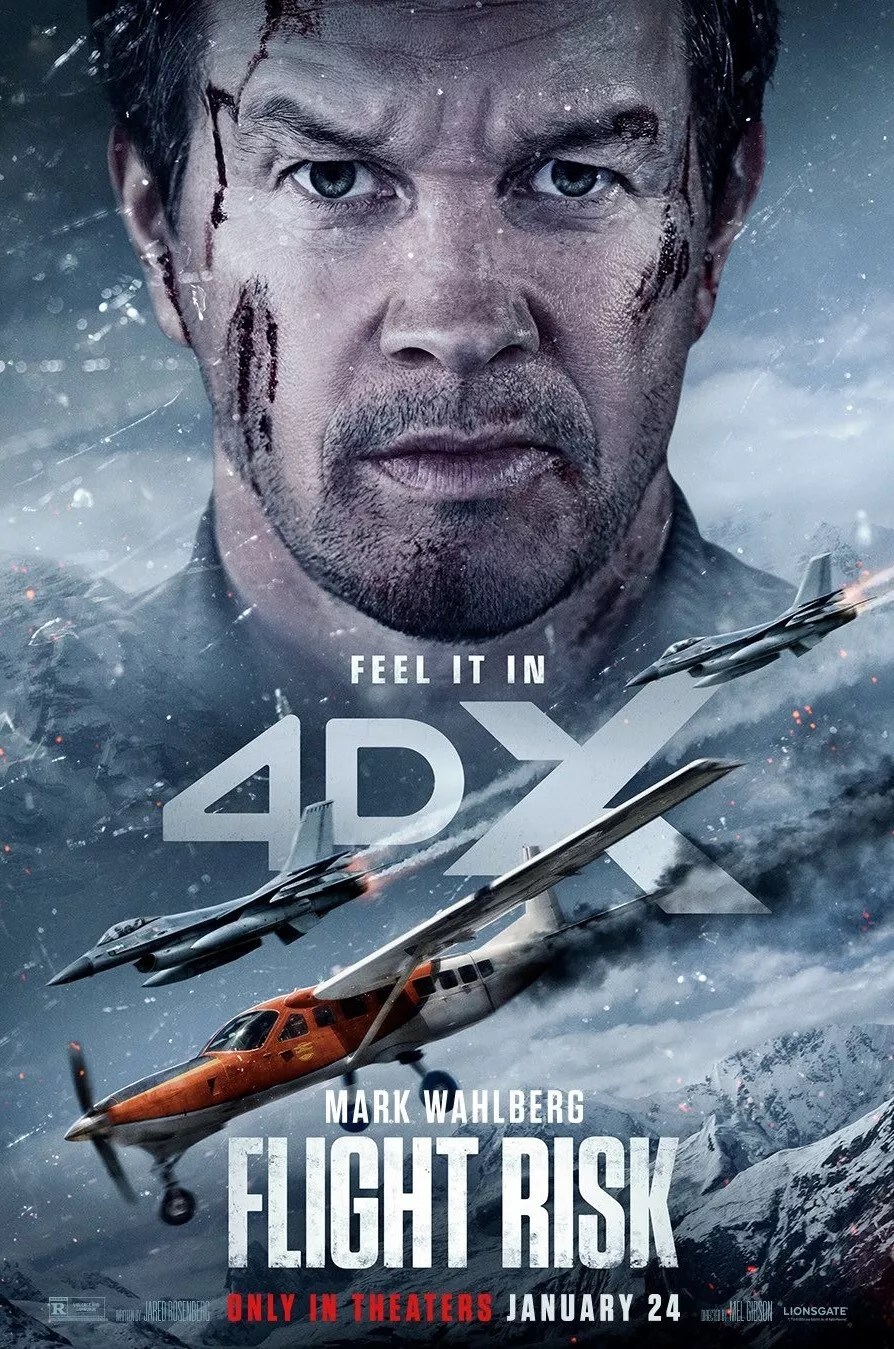
Flight Risk (2025) ** – Seen at the Cinema

At best, nifty piece of counter-programing, short on running time compared to the ballast-heavy bum-numbing three hours-plus of The Brutalist. At worst – where do we start? Maybe with the bald wig where you can see the join. Just part of the bombastic over-the-top zoppazaloola performance by Mark Wahlberg, deciding not to entertain a smidgeon of finesse or subtlety, not even of the John Malkovich (In the Line of Fire, 1993, Con Air, 1997) vintage, in his portrayal of a sadistic bisexual rapist murderer with a propensity for chopping off fingers and indulging in other anatomical atrocities.

The aim was, I guess, Narrow Margin on a Plane, though the confines of a cabin in a tiny plane leave little room for maneuver. And blow me down if the whole damn thing wasn’t shot over Alaska as the movie portends, but in Nevada, although I guess to the uninitiated one snow-capped peak looks very much like another. And blow me down number too, just when the tension (what tension?) should be ratcheting up to eleven, if we don’t take time out from chaining up the bad guy to allow our other more civilized bad guy to go all sentimental on us and want to do something good.
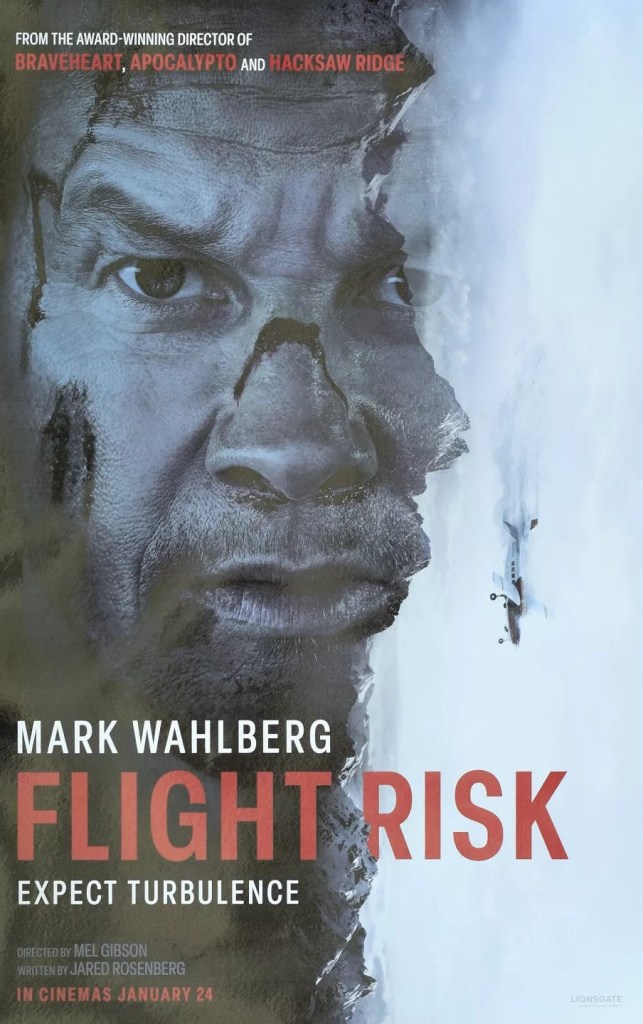
And that’s before we delve deep into a dumb back story about our cop being responsible for burning a prisoner to death after she went against all the rules of the profession and allow said female prisoner to take a shower, shackled to the bath to permit privacy, not expecting someone to lob a Molotov Cocktail into the bathroom. Your heart bleeds.

So, U.S. Marshal Madolyn (Michelle Dockery) in sore need of redemption after the prisoner-burning episode is escorting Winston (Topher Grace) from his hidey-hole near the Arctic Circle so he can appear as a witness in a Mafia trial, him being the mobsters’ accountant. Daryl (Mark Wahlberg) is their cocky pilot. Winston’s main job is to add laffs, by being just the kind of weak-minded entitled chap who took the easy route to riches rather than go to college and get a proper job. Madolyn has got other things on her mind beyond redemption and not liking the look of the cocky pilot.

She has sniffed out corruption in the department which might go as high as very high indeed, with a guy on the Mafia payroll, whom Winston, once he gets into his stride as a reformed criminal, is going to give up. All this by dint of her remote detection.

Or she could just be distracted by the rom-com elements of the plot. Did I mention there was romance? Our Madolyn is way too smart to fall for a dumbass like Winston and ain’t going to let a cocky hardhead like Daryl engage her in banter. But she’s a sucker for a sweet-talking off-stage fella who’s going to instruct her how to fly the plane once she’s incapacitated Daryl. He’s full of great information which I’ll bear in mind next time I’m on a plane coming in to land that’s run out of fuel. Guess what, it’s easier to land a plane if it’s run out of fuel. Phew, that’s a relief.

I’m generally all-in when it comes to hard-edged crime pictures with less-than-stellar casts as long as the action keeps coming and the plot makes some sense. This feels like they put out an all points bulletin for any idiotic plot handle they could find and when that didn’t work thought  the casting would save them. Let’s get one of those top-class English lasses from Downton Abbey and put her through the mill and let’s get a fairly stellar action star and let him go off-piste.

In fairness, Michelle Dockery, who had already mined a tough streak in Godless (2017), isn’t bad, discarding all the girly girl prettiness in favour of no make-up no-nonsense toughness and twisting around seven ways to sundown to accommodate all the twists in the plot, even softening enough to indulge the romantic dreams of her off-stage lothario.

There’s maybe a chance this will turn into so-bad-it’s-good gold and if so it will be down to a demented performance by Mark Wahlberg (Father Stu, 2022), one of the few top stars, either by desire or financial necessity, to take risks with his screen persona. The problem is that his part is really a glorified cameo, the picture not so much revolving around his horrid horror-porn imagination, as the redemption-cum-rom-com focus of Michelle Dockery, the latest in a series of eye-gouging unlikely action heroines.

Directed by double Oscar-winning Mel Gibson (Hacksaw Ridge, 2016), no slouch himself, as an actor, in putting in a demented performance. Directed, without, I guess, the slightest notion of irony. Script by Jared Rosenberg in his screen debut.

But as I said, beats The Brutalist hands-down when it comes to lean running time (just 87 minutes).
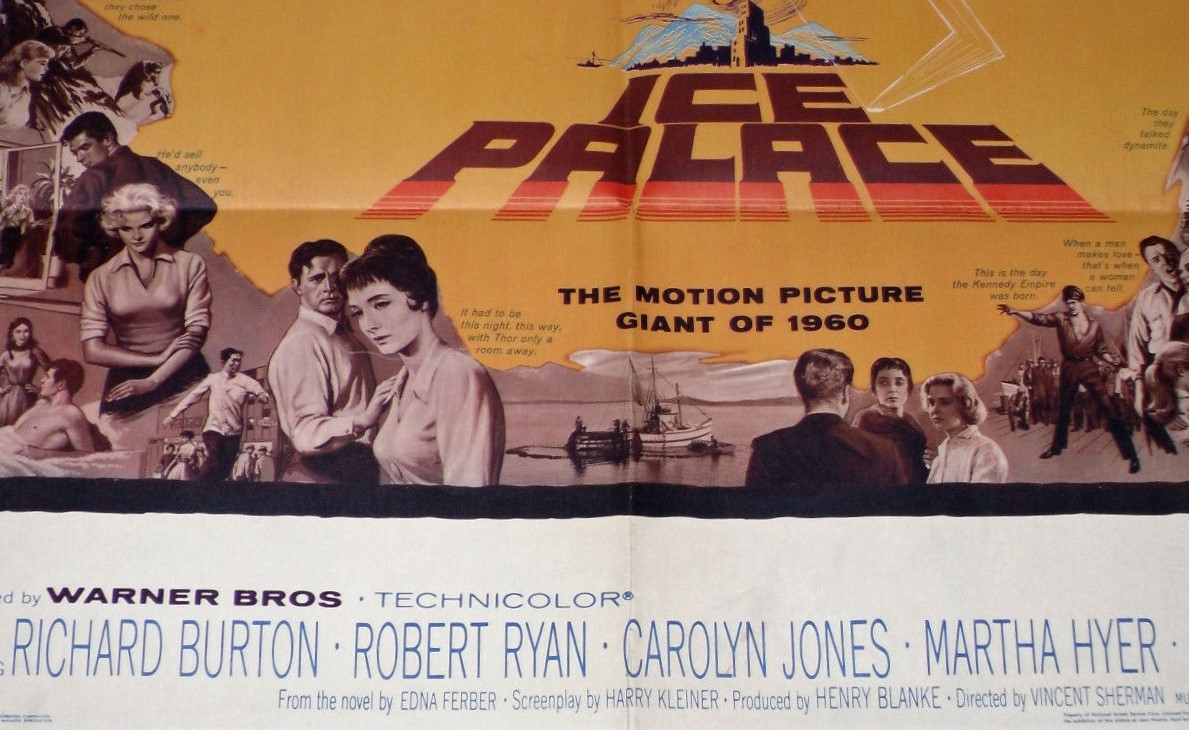
Ice Palace (1960) ***

Adaptations of sprawling novels require a firm hand at screenplay stage. Exodus (1960), for example, excised the first couple of hundred pages depicting the first two millennia  relating the history of the Jews in the Leon Uris bestseller. Hawaii (1966) sliced the James Michener epic in two, the sequel The Hawaiians (1970) taking up the slack. Otherwise, like here, you end up with a multi-generational sprawl.  

The producers clearly felt that the endzone – two grandfathers warring over a grand-daughter that was also  somehow a metaphor for the battle for Alaskan statehood – was too good to miss. Except author Edna Ferber (Giant, 1956) had already dealt with that problem, in her book beginning at the end, where feminist icon Christine Storm is given a voice and the story unfolds in flashback. Instead, it’s Christine who has to wait ages to make an appearance and scarcely in the manner outlined by the novelist.

Initially, ex-World War One soldier Zeb (Richard Burton) and Alaskan fisherman Thor (Robert Ryan) become friends after the latter saves the former from drowning, Zeb having lost his job in a cannery for fancying boss’s daughter Dorothy (Martha Hyer). The pair then decide to go into business together, Thor catching the salmon, Zeb canning them. But illicit love tears the incipient partnership apart, Thor’s fiancée Bridie (Carolyn Jones) falling for Zeb.

Finding banks are against funding a nobody, Zeb hits the mother lode in capitalizing his business by marrying the wealthy Dorothy, while a distraught Thor hits the snowy wastes and returns with an Eskimo son. Bridie hangs around long enough to sew the seeds of suspicion and take a hand in bringing up the baby, though holding back on the marriage that might seal the deal.

So then we are quickly onto the second generation. Thor’s son Einer (Barry Kelley) and Zeb’s daughter Grace (Shirley Knight) elope to the snowy wastes where, guess what, she gets pregnant, but, guess what, he is killed by a bear and she dies giving birth to Christine (Diane McBain).

So that takes us to the final act, Dorothy now also conveniently dead, grandfathers sharing custody, and the metaphor for the birth of Alaska in full swing. Zeb, now  a greying ruthless industrialist who finds it easier to feed his multiple canneries by catching fish in traps as they exit the Alaskan rivers, opposes statehood, fearing legislation will curb his entrepreneurial tendencies and that, more to the point, he will be hardest hit by the taxation required to fund the government apparatus. Thor, meanwhile, has turned greying politician, fighting Zeb every inch of the way, Christine now mere collateral damage.

An Australian daybill hence the date “1961” rather than “1960”
the date it appeared in the U.S.

It’s certainly a full-throated melodrama, and might have worked better if it had skipped a generation and got to the warring grandparents sooner, or worked the love triangle up to a higher pitch, but that might have felt like the bloodbath required to kill off Dorothy, Einer and Grace would have looked even more calculated. And it could have done with more actual high drama, fishermen battling mighty waves on the high seas, for example, as in The Perfect Storm (2000), and to be honest watching caught salmon shooting along cannery travelators is no substitute.

The other problem is that neither Richard Burton (Becket, 1964) nor Robert Ryan (The Wild Bunch, 1969) has settled into their screen persona. In the former’s case it’s the voice. Except in fleeting instances, we are deprived of his whisky-sodden sonorous tones. In the latter it’s the stillness, all the work done with the eyes or a grimace instead of an overworked marionette, body jumping, arms pumping. In both cases, and with the entire cast for that matter, there’s over-reliance on flashing eyes, a mainstay of overwrought melodrama.

If you’re searching out subtlety you’d have to watch the women, the look on Dorothy’s face on first meeting Bridie and recognizing a rival, the various expressions on Bridie’s face – for virtually the whole picture – as she observes the unobtainable Zeb grow even more distant, and Grace as she realizes she is being duped into a marriage of political convenience. And with so much story to pack in, the best scene in the picture just whizzes by, when, in the absence of the town doctor, Bridie is called upon to be  midwife to Zeb’s child, knowing that it should, if only she had the courage at the time, be hers.

The Alaskan statehood element was, I imagine, lost on non-American audiences, the statehood metaphor probably lost on everyone except discerning critics, and as far as I can work out from the box office nobody anywhere gave two hoots for the picture. Bear in mind Richard Burton was far from a major star, having burned his boats after star-making roles in The Robe (1953) and Alexander the Great (1956) failed to provide the necessary glue to bind actor and moviegoer.  In fact, Burton was so little in demand he was scarcely making a movie a year – and only The Robe entered positively in the box office balance sheet – until Cleopatra (1963) revived his career.

So with a cut-price Burton and an over-extended Robert Ryan there’s little the women can do to rescue the picture, though Carolyn Jones (How the West Was Won, 1962), Martha Hyer (The Sons of Katie Elder, 1965), the debuting Diane McBain (Claudelle Inglish, 1961) and Shirley Knight (The Group, 1966) put in more heartfelt performances.

Vincent Sherman (A Fever in the Blood, 1961) directed from a screenplay by Harry Kleiner (Bullitt, 1968). One look at the gem George Stevens created from Giant and all you can see here is missed opportunity.

Discover WordPress

A daily selection of the best content published on WordPress, collected for you by humans who love to read.

The Atavist Magazine

by Brian Hannan

WordPress.com News

The latest news on WordPress.com and the WordPress community.