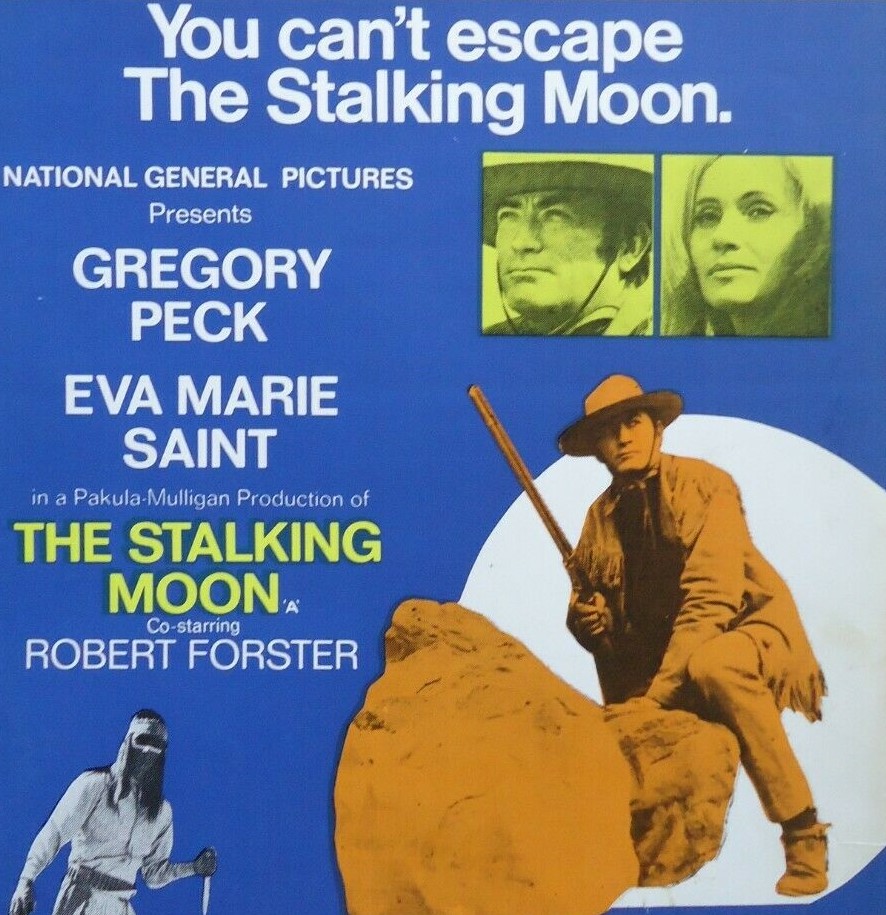
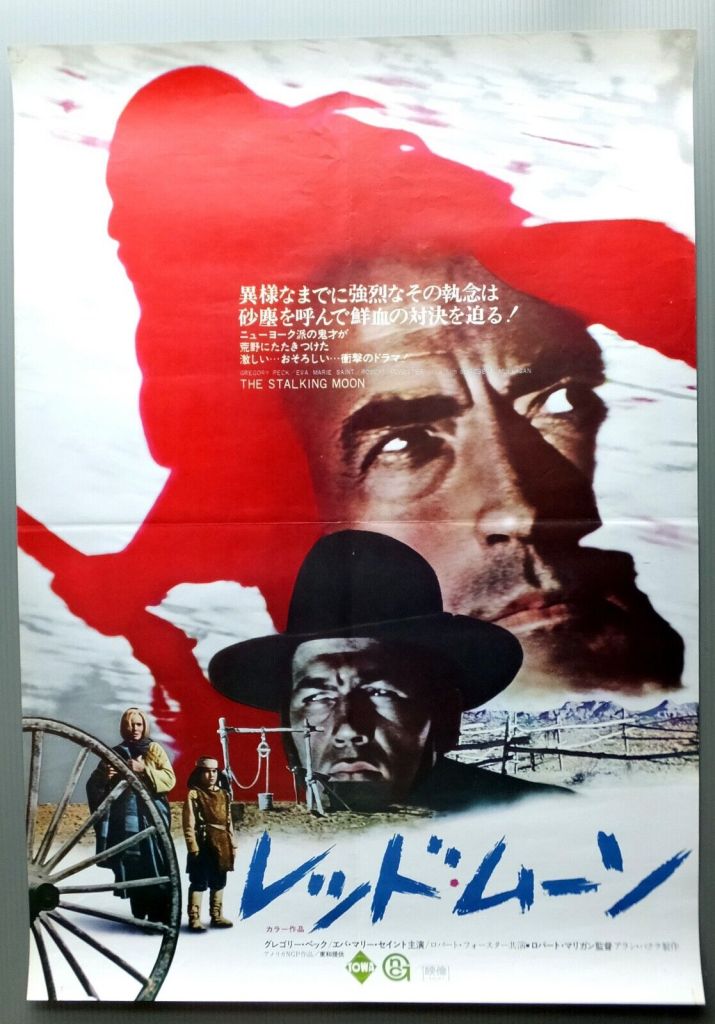
The Stalking Moon (1969) ****

About-to-retire Indian scout Sam Varner (Gregory Peck) helps the U.S. Cavalry round up Indians to take to reservations. One of these is American Sarah Carver (Eva Marie Saint) who, with her Apache son, is attempting to escape her vengeful Apache husband Salvaje (Nathaniel Narcisco). Varner agrees to take her to the nearest stage coach post, and then to a train depot, and, finally, to his ranch in New Mexico where they enjoy a period of security. But wherever she goes, death follows, culminating in a shootout in the hills around his ranch.

But the treatment by director Robert Mulligan (Up the Down Staircase, 1967) is far more complicated, often asking questions that cannot be answered, and placing the principals in situations that cannot be easily resolved. Sarah Carver has not gone running in order to find a man to save her; she does not think she can be saved and accepts the inevitable. She feels guilty for “lacking the courage to die,” of accepting Salvaje as her husband instead of dying along with the rest of her family when attacked a decade before by Indians.
She is weak in other ways, hiding the identity of her husband from the Army and everyone else in case she is abandoned. She shows no great bond with her son, who, several times, attempts to escape.

Sam Varner is very much an ordinary guy, just wanting to quit the Army and work his ranch. He is not the traditional extrovert western hero, nor the man who reluctantly takes up arms.  He has no wish to get involved with Carver and each time he does agree to help it is with a time-limited condition attached and these scenes lack any sense of meet-cuteness, no romantic interplay hastening him to a decision, little expectation that either party is angling to fall in love.

It is practicality rather than intimacy that makes them share a blanket during a dust storm and he asks her to come to his ranch because he will get on with the work quicker if he has someone to cook. In fact, his honesty prevents that: he confronts her over the fact that she “put us out here knowing all the time that he’d come after us” and making her face the corpses of men who died because she hid the truth. He is honest with his emotions and he is determined (“I got a place to go and I’m going”). But he bears none of the normal western hero’s traits, neither a hard drinker, loner, or gunman. He is not gauche like James Stewart or malevolent like Clint Eastwood. 

Even more unusual is the treatment of Salvaje. Despite the savagery of his actions, there is within him a sense of honor. He only chases his wife because she has stolen his son; there could be no greater affront to his dignity. The story is told from the point of view of the pursued i.e. Sarah Carver. But, by turning that perspective on its head, The Stalking Moon more easily fits into the category of revenge western, characteristically a picture concerning chase and pursuit by someone who has been wronged.
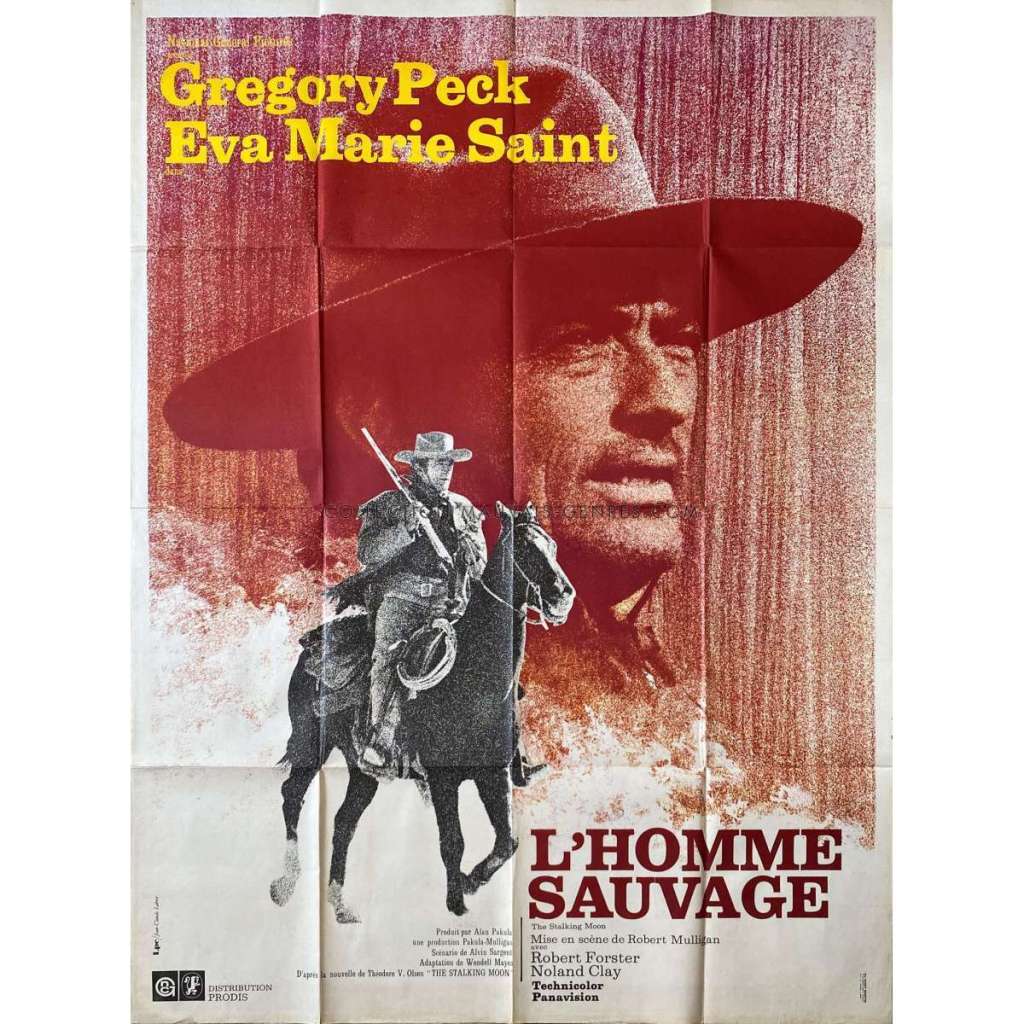
The director takes a bold step in the presentation of Salvaje. He is not seen at all in the first hour, then in just a few glimpses of a shape, his face only revealed at the climax. He is a ghost and a killing machine combined. Like a latter-day “Terminator,” he cannot be stopped, so skilful he evades capture, and relentless.

It is also, unusually for a western, a thriller. The tension mounts from the discovery, at the 10-minute mark, of Salvaje’s first three victims, all fully-armed soldiers, and the news, one minute later, that he single-handedly killed four troopers previously. At Hennessy, a staging post, when Varner and Carver go out into a dust-storm to search for her son who has run away, they return to find all dead. Everyone they left behind at Silverton, a train depot, is also killed.

Initially, Carver appears impatient, not willing to wait five days for an Army escort, but once she reveals who the boy’s father is, the reason becomes clear, and her desire for speedier transition creates more tension. Even in New Mexico, the death toll mounts, once Salvaje arrives. Now the trap closes in on them. Even the ranch house cannot prevent Salvaje from sneaking in and kidnapping his wife, leaving her for dead outside.

When Varner and a fellow scout, the half-breed Nick Tana (Robert Forster), attempt to turn the tables on Salvaje and track him down, it ends in Tana’s death. Although most of the tension comes from the will- he-won’t-he dynamic, there are number of Hitchcockian touches such as offscreen sound cues triggering alarm in characters. In two instances, a door provides shock.

Far from providing the expected relief, the ranch house merely provides a claustrophobic setting for the characters. Varner is trapped with an inarticulate pair. Instead of arrival at the ranch house precipitating emotional response and romantic interlude, as would be par for the course for other westerns, Varner finds himself stuck with a woman who refuses to talk and a boy who does not understand a word he says. The seven-minute scene where he sits down to eat and then has to virtually command mother and son to join him and encourage them to talk even if it is just to say “pass the peas” is one of the most awkward ever filmed. 

The movie is so darned awkward that you never laugh even at the few moments of comedy, the complicated issuing of train tickets, Varner keeping up a one-sided conversation at the table, Nick’s attempts to teach the boy poker. Relationships are more likely to remain in limbo than move on to any romantic or sentimental plane.

The film has a tight structure, the first 40-odd minutes setting up the story and tracing Varner and Sarah’s journey to the ranch house, the next 20 minutes at the ranch alternating between comfort and discomfort as emotional release battles with restraint, the final 40 minutes the physical battle between the mostly unseen enemy and the farm occupants. 

Stylistically, it is exceptional. The first section is all open vistas, characters minute figures on vast landscapes, the middle section suggests harmony with nature, and the final battle alternating between being the hunter and the hunted. When we first see Varner he is picked out along the edges of the screen as he leaps up or down or across rocky hillsides. That he appears and disappears at will could almost be the motif for the film.

Virtually everyone is in long shot or medium shot for the first half. Varner appears on the periphery of the screen and the action. He enters scenes where something important is being discussed, such as Sarah’s pleading to be allowed to leave the Army camp quickly. Most directors present Gregory Peck with aura intact, keeping him motionless on the screen to maintain his authority, but here he is always on the move, walking across open ground or confined spaces or darting across hillsides or through bushes, dashing on foot down slopes or racing on horseback.

Although the script – by Alvin Sargent (Gambit, 1966) and Wendell Mayes (Von Ryan’s Express, 1965) based on the T.V. Olson (Soldier Blue, 1970) novel –  was viewed in many quarters as being underwritten, in particular Sarah’s role, and that there were too many silences for comfort, in the view of many  that is the strength of the picture. There is none of the easy dialogue, crackling lines, coarse confrontation, sentiment or raw emotion of other westerns.

The movie hardly even skirts a cliché. This is in a class of its own in terms of the distance characters maintain between each other. Varner has very little to say, Sarah’s guilt restricts her vocabulary. In one regard the thriller element gets in the way of a study of two remote characters.

If I have any reservations about The Stalking Moon it is that is neither enough of a thriller nor enough of a character study. George Stevens might have sought emotional resolution and producer Alan J. Pakula, who later went on to direct Klute (1971) and The Parallax View (1974), might have proved more adept at marrying the thriller elements to personal anguish. Although The Stalking Moon may not have entered the pantheon of the greatest westerns, it is a very noble effort indeed, its slow pace and lack of dialogue providing it with a very modern appeal.

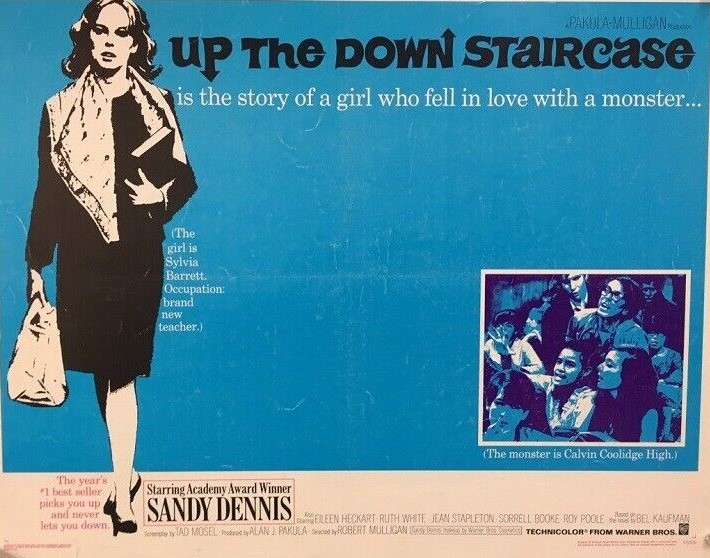
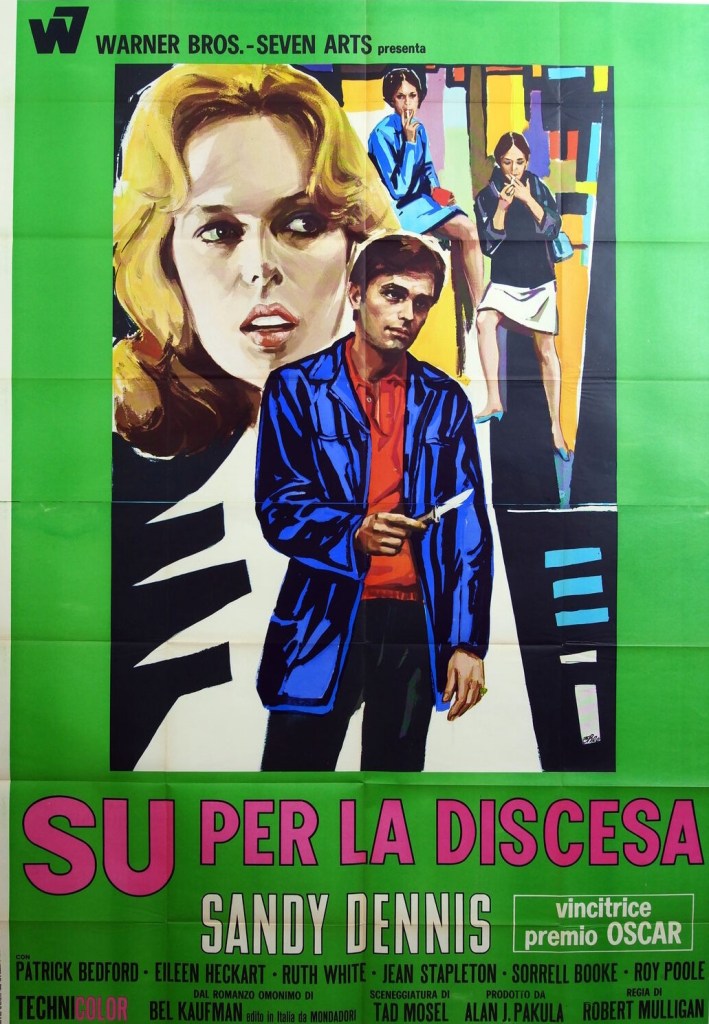
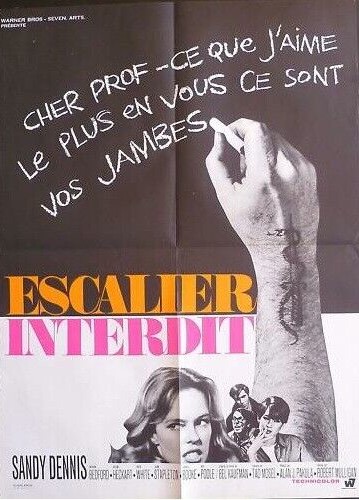
Up the Down Staircase (1966) ****

Impressive impressionistic tale of naïve young teacher and her travails in a rough inner city New York high school, a world away from the preppie hi-jinks of The Group the previous year and a good bit more realistic and less sentimental than To Sir, With Love the same year. If you thought teachers had a tough time these days, it was no better half a century ago.

We get no insight into the home life of idealistic singleton Sylvia (Sandy Dennis) beyond that once a week she gets a phone call from her annoying mother. Outside the school, she is warned to walk slowly in order to show she is not frightened to walk down these mean streets.

The school appears chaotic, hordes of almost-adult kids rampaging along corridors, hellbent on causing anarchy. And it takes some objective observation to realize that the endless rules,  sometimes delivered by intercom and very often improvised on the spot, imposed by the tough headmaster McHabe (Roy Poole) have created a semblance of order.

But if the kids are led astray by inherent attitude, the adults are undone by bureaucracy and petty infighting. A list of rules on the wall forbids the school nurse from actually treating any patients. There’s a marvellous librarian whose reaction to an attempted suicide is to demand the return of an overdue book. Teachers squabble about who has precedence to use a particular drawer. Budding novelist and lothario Barrington (Patrick Bedford) spends his mornings in a local café, an adoring secretary covering for his absence.  

The end-zone in all movies about schools (excepting If…a couple of years later) focuses on a struggling teacher who doubts her abilities but finds worth in her calling. Although that cliché pops up towards the end, mostly it’s an examination of the terrible home lives, seen in snippets, of the pupils and their parents, possibly who had the same experience, of viewing schools as obstacles to life and nothing more than the existing hierarchy’s way of keeping them in their place, education peeceived as akin to a police force exacting penalty.

With her fragile beauty, posh voice, and ideas of converting teenagers to the joys of Chaucer, Dickens and myriad poets, you would expect Sylvia to be gobbled up by the system. And at times, her quivering lip goes into overdrive, but that masks an inner determination not to fall for any sob stories – no matter that the audience will lap them up – and to extricate herself from dangerous situations with the macho Joe (Jeff Howard) who is convinced she won’t hand in him for carrying a switchblade and that she must be in love with him.

Pupils fall into three categories: those who fall in love with their teachers, those who want to kill them and those who are dying of boredom, living day-to-day in catatonic indifference.

Sylvia’s understated refusal to be intimidated carries the day and, while she encourages, realizes that she can’t resolve the endemic social issues – children battered at home or who have to work at night or who are brought up by a series of neighbors – by inflating a pupil’s mark just to help out. There’s none of the grandstanding of Dead Poets Society (1989) or Mr Holland’s Opus (1995) either, no individual or group who, in dramatic fashion, demonstrates allegiance, sides with the teacher or proves a test case for the teacher’s brilliance.

If Sylvia makes any impact, it’s shown in a small way by awkward pupil Alice (Ellen O’Mara) who believes all literature is about love and is humiliated by Barrington. Sylvia hasn’t the personality to collect a coterie of adoring pupils as in Dead Poet’s Society, nor like Robin Williams there have the confidence to chuck away set texts and do it his own way. But it would be a close run thing as to who would be the better teacher. Williams should win by a neck given his exuberance, but Sylvia, the mouse, is actually the better teacher.

It’s pretty bold of director Robert Mulligan (Inside Daisy Clover, 1965) to actually force the audience to watch Sylvia dissect the opening paragraphs of A Tale of Two Cities in order not just to prove what an insightful teacher she is but to demonstrate her command of her once-rowdy class. The show of hands of pupils desperate to ask questions is testimony to her quiet methods.

Superb performance from Sandy Dennis (The Fox, 1969), showy one from Patrick Bedford, touching one from Ellen O’Mara and with Jeff Howard attempting to channel his inner James Dean, but, for the last three, unusually in a film stuffed with newcomers, their roles did nothing for their careers. You might spot Bud Cort (Harold and Maude, 1971),  Eileen Heckart   (No Way To Treat a Lady, 1968), and Jean Stapleton (Emmy award winner for All in the Family, 1971-1979) but mostly it’s cameos in an ensemble picture.

Expertly mounted by Robert Mulligan with a screenplay by Tad Mosel (Dear Heart, 1964) from the Bel Kaufman runaway bestseller.

As much as it has you rooting for the little guy, it doesn’t gloss over the calamities schools are left to deal with.

The Parallax View (1974) ****

The shocking ending ensures the need to re-evaluate everything you have seen. The middle film in Alan J. Pakula’s paranoia trilogy – after Klute (1971) with All the President’s Men (1976) to come – is a dark (in more ways than one) reflection in essence on the John F. Kennedy assassination. The superbly stylish, on occasion over-stylised, cinematography carries an undercurrent of fear.  

Ambitious reporter Joe (Warren Beatty) investigates the notion that too many witnesses, including ex-girlfriend Lee (Paula Prentiss), to a senatorial assassination have been dying. Joe’s boss Bill (Hume Cronyn), while turning up acceptable reasons for each death, reluctantly backs him. Other witnesses such as Tucker (William Daniels) have run for cover. But, as Joe soon discovers, nobody can hide forever.  

Joe’s initial foray leads him to a small-time small-town Sheriff Wicker (Kelly Thorsden) with an unexpectedly large bank balance and murderous intent. Finding a link to a mysterious company the Parallax Corporation, Joe takes a written psychometric test to become a potential recruit for a company that is seeking, apparently, to find the hidden talents of under-achievers. After preventing one attempt on the life of another senator (Charles Carroll), Joe realises Parallax will stop at nothing.

Effectively, it’s a straightforward private eye number, Joe moving from character to character, building up a case. But the way Pakula frames the film, peppered with unusual scenes, turns it into an exercise in tension. One of Joe’s contacts works in a lab that is trying to train chimpanzees to play video ping-pong. Another scene takes place, disconcertedly, on a miniature train. At times we can hear every word delivered, even with the camera far away from the speakers, other times we hear nothing. Ominous music appears sparingly. Every step Joe takes in solving the mystery pushes him further into a corporate heart of darkness.

Beatty in the bar he’s about to wreck after ordering a drink of milk.

Joe believes Parallax are recruiting assassins but in point of fact their aim is considerably more devious. And here I don’t see how I can avoid a SPOILER ALERT. Parallax already have their assassins on board. What they are looking for are dupes, a patsy to take the blame once the killing has been done.

So when you look back from the ending what you find is that the cocky reporter is in fact exactly the kind of under-achiever the Parallax web attracts. There’s no proof of Joe’s editorial pedigree. Bill can point to any number of stories where Joe got hold of the wrong end of the stick. And the audience can see for themselves that he’s not exactly a super-brain. Sure, he can easily, with the help of a psychiatrist, pass the psychometric test, but how is he going to fare when he is linked up to some kind of machine that measures his response to visual imagery?

And you have to wonder what kind of idiot gets on a plane he suspects has a bomb on board  instead of staying off the aircraft and making a phone call. Or how he managed, after surviving an explosion at sea, to swim several miles to shore and land on a beach without drawing attention to himself so that he can masquerade as a dead man.

There’s also a curious section where Joe triggers a fist fight that ends in a John Ford-style saloon-wrecking. After killing the suspicious sheriff and hijacking his car, Joe then, in true French Connection style, sparks a car chase, managing to evade his pursuers by (natch) jumping onto the back of a passing truck.

But for all these flaws, there is something hypnotic about the picture. A camera that moves with snail-like precision from extreme long shot to medium shot or close-up, a reining in of flamboyance in favor of discipline, and shadow given its biggest outing since the film noir golden era. Pakula was trying to make an obvious point about the shady authorities that exercise behind-the-scenes power. The government is either powerless or complicit, various hearings into assassinations discovering zilch. Paranoia is no less prevalent now, of course, but what makes the biggest impact is journalistic entitlement, the reporter who can change things because he is willing to go down those dark streets like an avenging angel, not realizing he is always going to one step behind.

Warren Beatty (Kaleidoscope, 1966) has lost all the acting tics, the mumbling and stuttering he used to inflict on a weaker director, and instead delivers a great performance. Which is just as well because it’s a one-man show. Paula Prentiss (Man’s Favorite Sport, 1964) barely appears before she’s bumped off. William Daniels (Two for the Road, 1967) eschews his normal harassed husband for a well-judged turn.     

David Giler (Aliens, 1986) and Lorenzo Semple Jr. (Three Days of the Condor, 1975) fashioned the screenplay form the novel by Loren Singer. Also worth a mention is the eerie score by Michael Small (Klute, 1971) who for a time was the go-to composer for paranoia pictures.

Discover WordPress

A daily selection of the best content published on WordPress, collected for you by humans who love to read.

The Atavist Magazine

by Brian Hannan

WordPress.com News

The latest news on WordPress.com and the WordPress community.