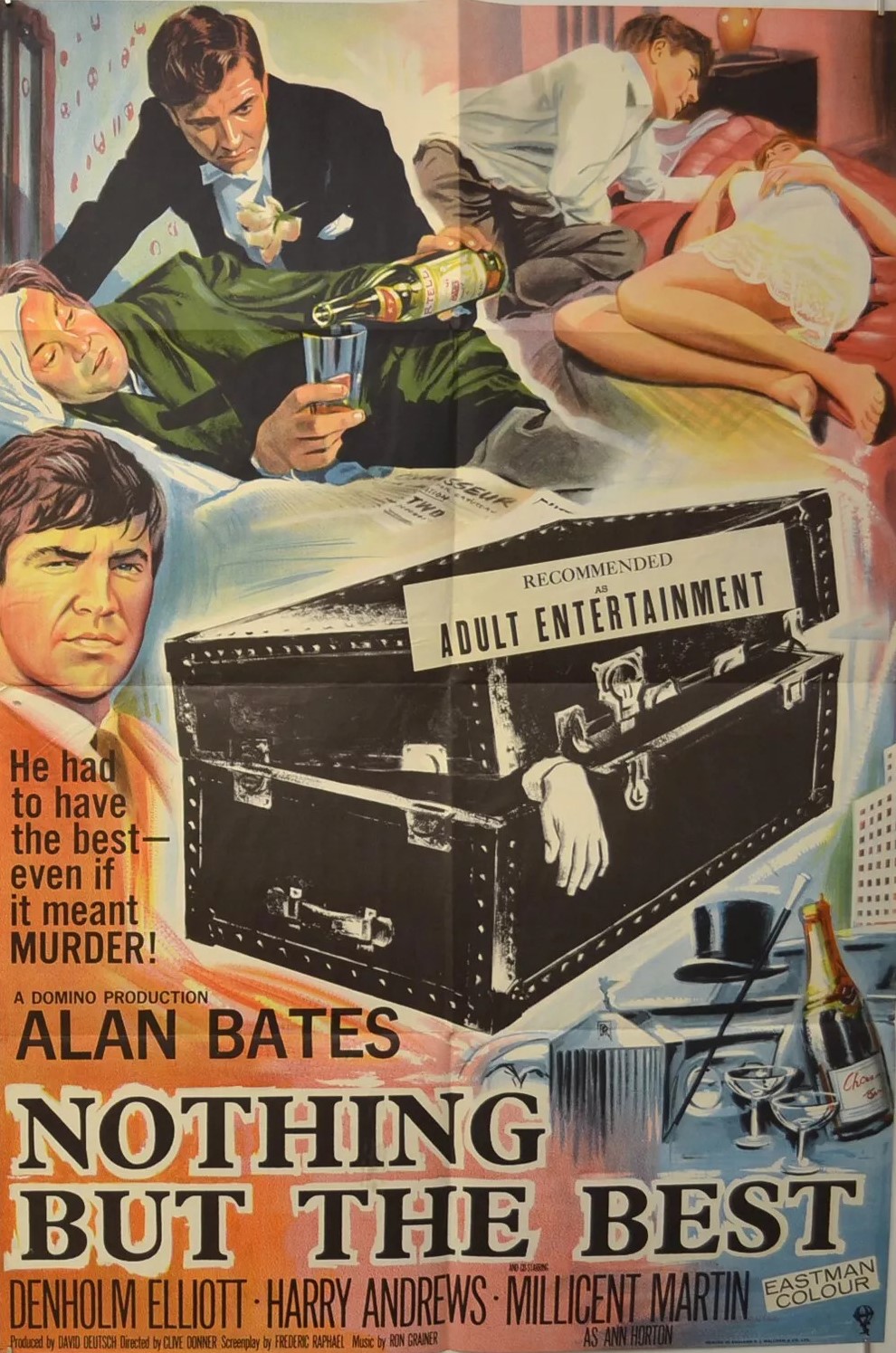
Nothing but the Best (1964) ***

Hardly surprising Denholm Elliott comes a cropper in this delicious British upper class black comedy – he steals the show from denoted star Alan Bates. Had he kept going any longer you would hardly have noticed Bates even featured, such was the clever impact of Elliott’s insiduous playing.

The toff version of Room at the Top (1958) meets Alfie (1966) as “ambitious young yob” Jimmy Brewster (Alan Bates) manipulates his way to the top. Too many people not coming up to scratch for his upwardly mobile purposes are cast aside – or strangled. Arrogance and bluff are the key to getting ahead in the upper-class world towards which he pivots. Doing absolutely nothing at all also works wonders in high society as does dismissing one’s hugely expensive education.
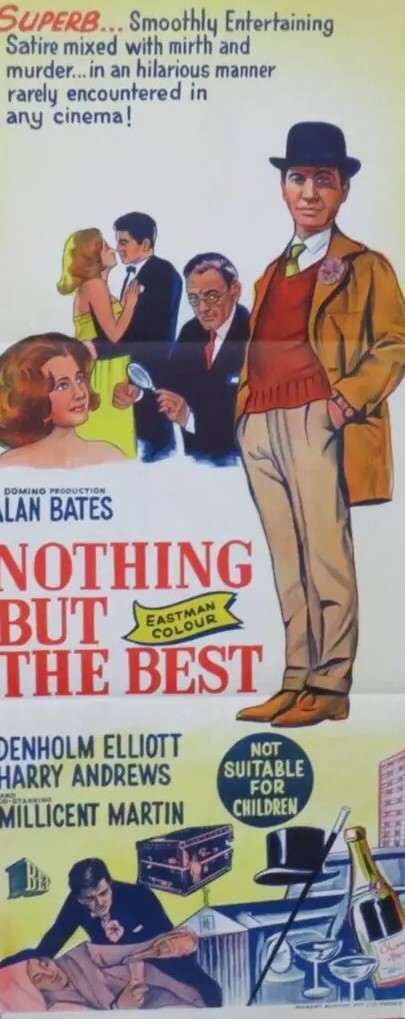
Jimmy is initially helped on his way, given an insider’s guide, by dissolute layabout toff Charles (Denholm Elliott) with a marked predilection for forgery, and other minor criminal schemes, but whose chief skill appears to be sponging off everyone else. Jimmy is a lowly executive in an upmarket estate agent, fighting for promotion against people with silver spoons rattling around every part of their anatomy and who have the genuine class their business appears to call for.

Every now and then the satire still contains contemporary bite, the difference between universities still relevant, as is that most people are not swayed by actual knowledge but by the fact that you can toss out the names of various academics. But, mostly, it’s bluff that opens the doors. Jimmy misses an appointment with an important banker, a dereliction that should have scuppered his chances of negotiating a better deal for his client. But, in fact, the banker takes this as Jimmy having gone elsewhere and immediately offers a better deal.

When confronted by a colleague for ignoring another appointment, Jimmy merely vaguely waffles on about being detained by “Sir Charles,” true identity left shrouded in mystery, contentious colleague silenced by either not being on speaking terms with the person mentioned or unwilling to admit his ignorance.

Having seduced every secretary within reach – none of whom meet his lofty standards – Jimmy manages to wangle his way into catching the eye of wealthy boss Horton (Harry Andrews) and his attractive daughter Ann (Millicent Martin), whom he marries.

While this would have been sharp as a tack in satirical terms back in the day, most of that weaponry is now out-dated. Suffers because none of the upper-class characters show any sense whatsoever – they can’t all be duffers and most seem to have tumbled out of central casting’s idea of an upper class twit. Charles is the exception, but even he is something of an innocent, not quite aware of what ruthlessness he has unwittingly set afire.

The lower classes aren’t much better. Secretaries and switchboard girls fall at Jimmy’s feet, handsome beggar that he is, though his landlady Mrs March (Pauline Delaney) appears to have his measure and is not above indulging in hypocrisy.

The voice-over works to the detriment of the picture. Because that device is doing so much of the heavy lifting, filling in the audience on Jimmy’s true feelings, the actor doesn’t have to do much acting and we’re presented with a kind of wooden figure who hides behind a mask. Of course since he’s masking his feelings, you might be inclined to give Alan Bates the benefit of the doubt.

And it would work very well if there wasn’t Denholm Elliott giving a master class in duplicity. He exhibits genuine charm.

I’m guessing that the voice-over was already there in Frederic Raphael’s script and not added to compensate for Alan Bates’s one-note performance. So if it was, that certainly presented a problem for the actor since most of what made his character interesting was at one remove, not presented in dialog or confrontation as would be the norm.

Alfie solved the problem by breaking the fourth wall – all the rage these days – and having the character directly address the audience, which allowed Michael Caine to present his own case.

So, if Alan Bates felt limited in what he could show on screen, he certainly does a good job of maintaining the façade. But Denholm Elliott (Station Six Sahara, 1963) steals the show. Harry Andrews (The Charge of the Light Brigade, 1968) is permitted no nuance to his normal bluff persona, singer Millicent Martin (Alfie, 1966) sparkles, and a bunch of British character actors including James Villiers (Some Girls Do, 1969) and Nigel Stock (The Lost Continent, 1968) put in an appearance.

Directed with some glee by Clive Donner (Alfred the Great, 1969) from a script by Frederic Raphael (Darling, 1965) adapted from a short story by Stanley Ellin (House of Cards, 1968).

Not as coruscating now as originally intended.

The Running Man (1963) ****

Twisty Carol Reed thriller pivoting on emotional entanglement that keeps you guessing right up to the end. In revenge for losing his business after an insurance company failed to cough up for his crashed plane, entrepreneur Rex (Laurence Harvey) fakes his own death and flees to Malaga in Spain.

But when girlfriend Stella (Lee Remick) joins him she discovers he has assumed the identity of an Australian millionaire whose passport he has purloined and completed the transformation by changing his black hair to blond. Rex has a mind to repeat the experiment by killing off himself (under the new identity) and claiming the insurance. Stella, complicit in the original scam, not only balks at this idea but finds disconcerting his change of personality and clear attraction to the opposite sex.

Tensions mount when mild-mannered insurance investigator Stephen (Alan Bates) appears on the scene. Anyone watching the film now has to accept that in the days before social media every face was not instantly tracked and accept that Stephen is unaware of what Rex looks like.

The couple cannot run because they are awaiting a bank draft. Stephen immediately sets the tone for suspicion when he pronounces that their vehicle  “looks like a getaway car.”  Forced to follow “The Godfather” dictum of keeping your enemies closer, the pair befriend Stephen  with the intention of finding out what he knows and what are his intentions. Rex and Stella  have to pretend they have only just met, separate bedrooms et al, leaving the door open for Stephen to gently woo Stella, an action endorsed by Harvey. They are caught out in small lies. Rex’s Australian accent falters. Stephen keeps on making notations in a notebook. Rex  foils his pursuer’s attempts to photograph him.

The ensuing game of cat-and-mouse is complicated by Stephen’s romantic inclinations towards Stella. Is this as genuine as it appears? Or is he trying to get her on her own to admit complicity? Both Rex and Stella are, effectively, forced to adopt the new identities they have forged to dupe Stephen, with unforeseen results. There are red herrings aplenty, a race along mountainous roads, and some marvelous twists as the couple find the tale they have woven is turning too tight for comfort until murder appears the only solution.  

As with his international breakthrough The Third Man (1949), Carol Reed grounds the whole Hitchcockian enterprise in local culture – this being unspoiled Malaga prior to the tourist deluge – Spanish churches, a wedding, fiesta, the running of the bulls, with an occasional ironic twist – “gypsy” musicians watching ballroom dancing on television. Reed resists taking the material down a darker route – Hitchcock would undoubtedly have twisted the scenario in another direction until Stella came under threat from Rex – but instead allows it to play out as a menage a trois underwritten by menace.

The acting is sublime. Laurence Harvey (A Dandy in Aspic, 1968) wallows in his part, Remick (Days of Wine and Roses, 1962) quietly anxious scarcely coming to belief that she had played a part in the original crime, Alan Bates (The Fixer, 1969), his deceptively pleasant inquisitive demeanor the ideal foil to Harvey. Unusually, they all undergo change, Harvey uncovers a more ruthless side to his character, Remick responds to the gentler nature of Bates, while Bates shrugs off his schoolmasterly aspects to become an attractive companion.

A couple of footnotes – special mention to Maurice Binder for the opening credits and this was the final score of British composer William Alwyn (The Fallen Idol, 1948). John Mortimer (Bunny Lake Is Missing, 1965) wrote the screenplay based on the Shelley Smith novel.

Full throttle film noir.

https://amzn.to/45ZFynU

The Fixer (1968) ***

Stunning opening section thrown away by shifting tone and despite excellent performances by the Oscar-nominated Alan Bates and Dirk Bogarde drifts into Kafkaesque virtue-signalling.

But let’s get the title out of the way first. I had assumed a “fixer” was a manipulator, an underworld type of character who could, for a price or future favor, sort out problems or find someone a job or act as an intermediary between politicians or businessmen. Not so. Yakov (Alan Bates) is nothing more than a handyman, who can fix broken windows or railings and turn his hand to anything such as wall-papering or basic accountancy.

In the credit sequence he demonstrates his skills by fashioning with wood, a couple of screws and some steel, a razor, with which to remove the hair and beard that would identify him as a Hassidic Jew. He is, as soon becomes apparent, afflicted by dogs. As he departs his remote cottage in a cart, a vicious dog so disturbs his horse that it bolts, resulting in the loss of a wheel. He continues his travels on horseback, arriving in a small town in time to witness a parade and Cossacks rampaging through the streets.

As it’s set in Czarist Russia, his journey is accompanied by melancholy violin with, for some reason, a disturbing undercurrent of military drum. As the credits end, we cut to the Russian flag and a marching band. He hides in terror as the horsemen drag people along by the ear, slash with sabers, hang others. It’s a pogrom, the type of attack commonly experienced by Jews living in ghettoes.

Up to now, it’s just outstanding. Then it tips into the picaresque. Yakov helps an old drunk Lebedev (Hugh Griffiths) who’s fallen down in the snow in the street. As reward he is offered work wall-papering a room. He has a prick of conscience when he realises that Lebedev is an anti-Semite. Lebedev’s daughter Zinaida (Elizabeth Hartman) seduces him. But, on spotting some blood on a cloth, he refuses to go through with the act.

Luckily, my reading of crime novelist Faye Kellerman has alerted me to the fact that it is an act of faith for Jews not to make love when a woman is menstruating. Luckly, Zinaida isn’t so up on her Bible (Leiticus 15: 19-23 in case you were interested) that she catches on to this revealing fact, for, as has been pointed out earlier, minus the distinctive curl, Yakov doesn’t have the physical characteristics associated in those times with a Jew. In fact, you would say Lebedev would more easily pass for one.

Anyway, Lebedev gives him another job, of counting the loads leaving his brickworks because he suspects he is being swindled. But the foreman, who has been rumbled, and suspects Yakov of being a Jew, calls in the Secret Police, it being a crime for Jews to leave the ghetto.

Now we tip into Kafka. The initial charge against Yakov is that he harbored another Jew during Passover. But then things spiral out of control. He is accused of passing himself off as a Gentile (non-jew), attempted rape of Zinaida and then of ritual murder, killing a small child.

Investigating magistrate Bibikov (Dirk Bogarde) is sympathetic and manages to avoid the rape charge much to the fury of prosecutor Grubeshov (Ian Holm) but once the other charges mount, he is nailed, everyone determined to prove an innocent man guilty.

This is based on a true case and clearly was a case of persecution and Yakov’s transition from worker happy to hide his ethnicity to gain work to a man who rediscovers his religion is a piece of great acting from Alan Bates. But the points are hammered home endlessly and where director John Frankenheimer (The Train, 1964) so deftly dispensed with dialogue in the superb opening sequence, now he more than makes up for it with leaden speeches, and a film that would worked better for being considerably shorter.

It feels like Hollywood is hard at work. After some moments of mild happiness Yakov’s cinematic chore is to invoke sympathy for an entire nation rather than taking on the Holocaust directly. Dalton Trumbo’s (Lonely Are the Brave, 1962) screenplay is filled with brooding lines. But providing Yakov with an interior monologue when he dithers over having sex doesn’t work at all, certainly not next to the more effective use of that technique in John and Mary (1969).

At the outset, Frankenheimer treats violence with discretion. We don’t see the dog being impaled on a saber, just its corpse thrown at Yakov. We witness a rope being wound round a man’s neck, as innocent of any crime as Yakov, but not the actual hanging. So what begins as highly-nuanced turned into a battering ram of a picture and characters forced into lines like “the law will protect you unless you are guilty” and “I am man who although not much is still more than nothing.”

Alan Bates (The Running Man, 1963) certainly deserves his Oscar nomination and Dirk Bogarde (Modesty Blaise, 1966) might feel aggrieved he missed out on a Supporting Actor nomination. But too many of the rest of the cast over-act. It’s an all-star cast only if you’re British. But check it out if you’re a fan of Hugh Griffith (The Counterfeit Traitor, 1962), Elizabeth Hartman (The Group, 1966),  David Warner (Perfect Friday, 1970), Ian Holm (in his sophomore movie outing), Carol White (Daddy’s Gone A-Hunting, 1969) and Georgia Brown (Lock Up Your Daughters!, 1969).

Frankenheimer at his best when he lets the action play without the overload and there’s one almost Biblical scene, lit only by candlelight, that demonstrates his cinematic virtuosity. But  otherwise it’s drowned in the verbal rather than the visual. Trumbo based his screenplay on the Pulitzer Prize winner and bestseller by Bernard Malamud.

Some effective moments, but too long drawn-out to make the impact expected.

The Running Man (1963) ****

Twisty Carol Reed thriller pivoting on emotional entanglement that keeps you guessing right up to the end. In revenge for losing his business after an insurance company failed to cough up for his crashed plane, entrepreneur Laurence Harvey (Butterfield 8, 1960) fakes his own death and flees to Malaga in Spain.

But when girlfriend Lee Remick (Days of Wine and Roses, 1962) joins him she finds he has assumed the identity of an Australian millionaire whose passport he has purloined and completed the transformation by changing his black hair to blond. Harvey has a mind to repeat the experiment by killing off himself (under the new identity) and claiming the insurance. Remick, complicit in the original scam, not only balks at this idea but finds disconcerting his change of personality and clear attraction to the opposite sex.

Tensions mount when mild-mannered insurance investigator Alan Bates (A Kind of Loving, 1962) appears on the scene. Anyone watching the film now has to accept that in the days before social media every face was not instantly tracked and accept that Bates is unaware of what Harvey looks like.

The couple cannot run because they are awaiting a bank draft. Bates immediately sets the tone for suspicion when he pronounces that their vehicle  “looks like a getaway car.”  Forced to follow “The Godfather” dictum of keeping your enemies closer, the pair befriend Bates with the intention of finding out what he knows and what are his intentions. Harvey and Remick have to pretend they have only just met, and have separate bedrooms, leaving the door open for Bates to gently woo Remick, an action endorsed by Harvey. They are caught out in small lies. Harvey’s Australian accent falters. Bates keeps on making notations in a notebook. Harvey foils Bates’ attempts to photograph him.

The ensuing game of cat-and-mouse is complicated by Bates pursuit of Remick. Is this as genuine as it appears? Or is he trying to get her on her own to admit complicity? Both Harvey and Remick are, effectively, forced to adopt the new identities they have forged to dupe Bates with unforeseen results. There are red herrings aplenty, a race along mountainous roads, and some marvelous twists as the couple find the tale they have woven is turning too tight for comfort until murder appears the only solution.  

As with his international breakthrough The Third Man (1949), Reed grounds the whole Hitchcockian enterprise in local culture – this being unspoiled Malaga prior to the tourist deluge – Spanish churches, a wedding, a fiesta, the running of the bulls, with an occasional ironic twist – “gypsy” musicians watching ballroom dancing on television. Reed resists taking the material down a darker route –  Hitchcock would undoubtedly have twisted the scenario in another direction until Remick came under threat from Harvey – but instead allows it to play out as a menage-a-trois underwritten by menace.

The acting is sublime. Harvey wallows in his part, Remick quietly anxious scarcely coming to believe that she had played a part in the original crime, Bates with a pleasant inquisitive demeanor the ideal foil to Harvey. Unusually, they all undergo change, Harvey uncovers a more ruthless side to his character, Remick responds to the gentler nature of Bates, while Bates shrugs off his schoolmasterly aspects to become an attractive companion. It all leads towards a thrilling conclusion.

A couple of footnotes – special mention to Maurice Binder for the opening credits and this was the final score of British composer William Alwyn (The Fallen Idol, 1948).

Many of the films from the 1960s are to be found free of charge on TCM and Sony Movies and the British Talking Pictures as well as mainstream television channels. But if this film is not available through these routes, then here is the link to the DVD and/or streaming service.

Discover WordPress

A daily selection of the best content published on WordPress, collected for you by humans who love to read.

The Atavist Magazine

by Brian Hannan

WordPress.com News

The latest news on WordPress.com and the WordPress community.