Wait Until Dark (1967) ****

You wouldn’t have figured Audrey Hepburn – she of the model looks (Breakfast at Tiffany’s, 1961)  and upmarket twang and belonging to the highest echelons of the movie business – for a Scream Queen. But there were precedents – Doris Day had at times been screaming fit to burst in Midnight Lace (1960) and Lee Remick, though not in either’s marquee league, had been terrified to bits in Experiment in Terror / The Grip of Fear (1962). By this point in pictures, the screen was awash with Scream Queens, courtesy of lower-budgeted efforts from Hammer, AIP and Amicus, so asking a top star to exercise her lungs in similar fashion might have been career suicide.

As it was, which would have come as a surprise to her legion of fans, this turned out to be pretty much the star’s swansong. She wouldn’t make another movie in nearly a decade and only another three after that. But here she certainly hits a dramatic peak.

The story’s a bit muddled and initially requires unraveling. Drug mule Lisa (Samantha Jones) passes a doll packed with heroin to fellow passenger Sam (Efrem Zimbalist Jr.) on a plane. She had been planning to steal the dope and set up on her own with Mike (Richard Crenna) and former cop Carlino (Jack Weston). There’s a bit missing from the tale but you have to assume that somehow Lisa got talking to Sam and he gave her his address and that she has turned up at his apartment looking for the doll, which wasn’t there.

Mike and Carlino turn up and have no luck searching the apartment. They don’t look hard enough because if they’d looked in the closet they’d have found the corpse of Lisa, killed by her employer Roat (Alan Arkin) who arrives to confront the pair and then hire them to help him find the heroin and dispose of the body.

So with all that out of the way we come to the meat of the story. And it follows the same premise as Man in the Dark / Blind Corner (1964) –  though, luckily, so few people saw that it wouldn’t be at the forefront of the audience mind at the time – of not so much a blind person being terrorized in their home but being largely played for a fool. The audience knows more than the blind person does and much of the story is not their vulnerability but just how long it will take for them to twig what’s going on.
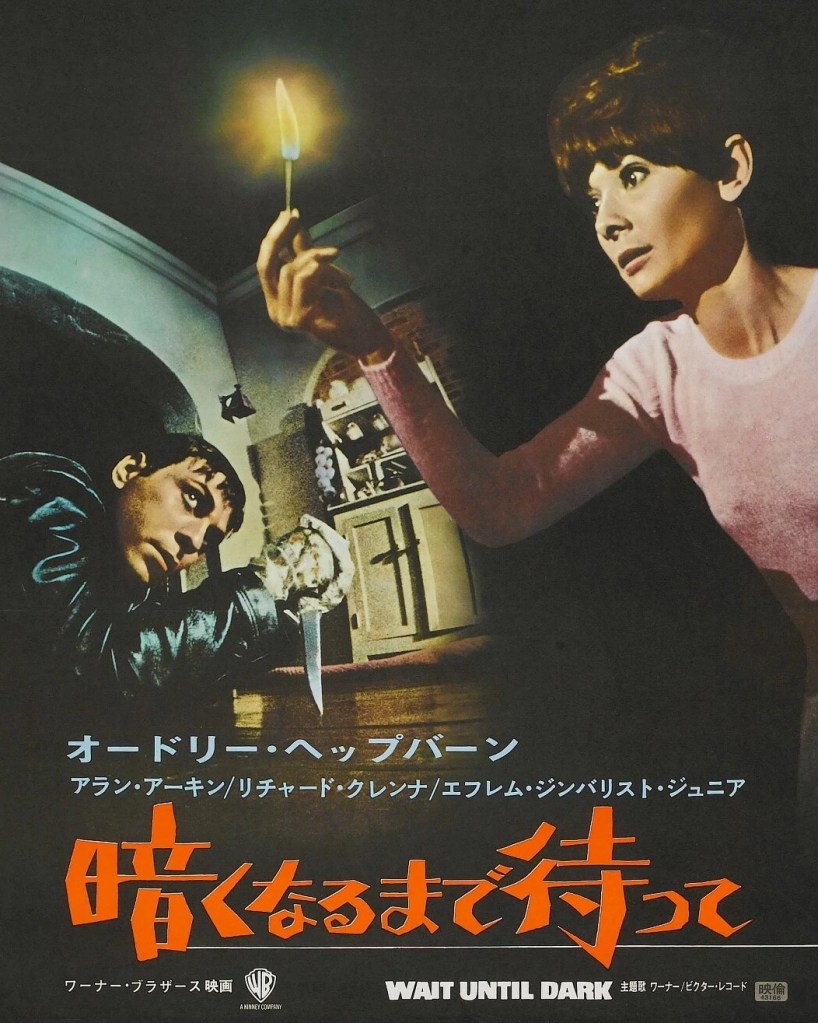
In the case of Susy (Audrey Hepburn), as with the composer in Man in the Dark, her ears are her radar. She is on the alert after hearing the same pair of squeaky shoes on different people and wondering why people are opening and closing her blinds so often. Mike and Carlino masquerade as good guys, cops investigating the murder of Lisa for which her husband Sam is a suspect. She helps them tear apart the apartment looking for the doll.

She trusts Mike implicitly, less so Carlino, and when she starts to put two and two together she has an ally, teenager Gloria (Julie Herrod) who lives upstairs – they communicate like jailbirds by banging on the pipes. Although her eyes are denied sight, they still express her emotions – trust, relief, gratitude, fear.

But there’s not just one game of cat-and-mouse. There’s three. You know damn well that Mike and Carlino plan to squeeze Roat out of the equation just as you know damn well that he is planning to play them for patsies, apt to take revenge when double-crossed.   

Gradually, her suspicions ramp up. She’s pretty smart working out the various clues. And then we hit two dramatic peaks. Firstly, when she discovers Mike is a bad guy. Secondly, when Roat kills Mike and turns on her, splashing petrol about the place, exploiting her terror of fire. She’s still got a couple of moves to turn the tables, at least temporarily but when absolute darkness does descend – she’s smashed all the lights out – and theoretically they are both in the same boat, and advantage her because of her keener hearing, it doesn’t quite work out the way she’s expected because he knows how to exploit sound.

I won’t tell you where the doll is hidden because that’s a very clever twist in itself, but apart from the few plotholes at the outset (how did Lisa manage to break into Susy’s apartment for a start and leave no trace, for example) once the narrative takes hold it exerts a very strong bite.

Audrey Hepburn is on top form. Alan Arkin (The Russians Are Coming, The Russians Are Coming, 1966) and Jack Weston (Mirage, 1965) are a bit too obvious for me, but the smoother Richard Crenna (Marooned, 1969) is excellent.

Directed with both an eye to character and tension by Terence Young (Dr No, 1962) and adapted by Robert and Jane-Howard Carrington (Kaleidoscope, 1966) from the Broadway play by Frederick Knott (Dial M for Murder, 1954).

Top notch.

Behind the Scenes: Thumbs Up or Thumbs Down, United Artists 1966 – Part One

Most observers don’t have a clue why some films are made in preference to others, or even of which movies have sat in turnaround hell for years. When I was researching my book The Making of The Magnificent Seven I came across some priceless material that gave some clues regarding the process. An “Inter-Office Memorandum” dated February 3, 1966, provided an insight into how independent producers Mirisch, then allied to studio United Artists, set about giving the thumbs up or thumbs down.

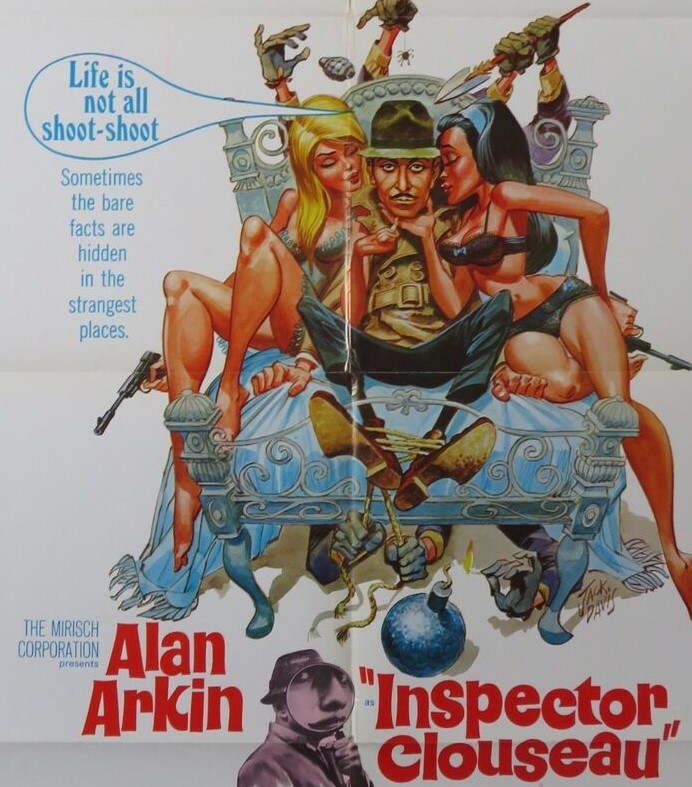
The memo referred to a meeting held at the Beverley Hills Hotel on January 29-30, 1966, attended by the three Mirisch Brothers – Harold, Marvin and the recently-deceased Walter – as well as UA head honcho Arthur Krim, Herb Jaffe and David Picker. On the agenda: Inspector Clouseau, Sherlock Holmes, The Mutiny of Madame Yes, The Egyptologists, Garden of Cucumbers, Wind on Fire, High Citadel, Saddle and Ride, The Narrow Sea, The Great Japanese Train Robbery, Lydia, In the Heat of the Night, The Cruel Eagle, How To Succeed in Business, and Death, Where Is Thy Sting-a-Ling.

Separately, the group examined commitments to various talents including John Sturges, Norman Jewison, Bryan Forbes and Billy Wilder.

Top of the agenda was Inspector Clouseau, a sequel to the successful Pink Panther series, from which Peter Sellers had withdrawn. The budget was set at $3 million including $466,000 for director and star. Alan Arkin was not yet a lock, UA reserving its opinion on Arkin’s marquee’s credentials until it saw how The Russians Are Coming, The Russians Are Coming (1966), in which he was the star, performed at the box office. Should it bomb, second choice was Zero Mostel. Jonathan Winters, viewed as a “questionable choice,” was also in the running. Clive Donner was the preferred director. If he passed, next up was Guy Hamilton. (In the end both rejected the offer and it was released in 1968 with Bud Yorkin at the helm.)

Two projects on the table were mooted as vehicles for Steve McQueen. The first, Wind of Fire, was intended as “immediately following Sturges’ racing picture.”(This was Day of the Champion but a legal battle with MGM would derail this and McQueen was five years away from releasing Le Mans). Wind of Fire, to be directed by Norman Jewison, suffered from an incomplete script which restricted discussion. John Wayne had shown an interest but UA “was not really interested in Wayne,” possibly as a result of the fall-out from The Alamo (1960). The second McQueen project was the thriller Lydia based on the book by E.V Cunningham (the pseudonym of Howard Fast of Spartacus fame). Here, the script was complete and in the actor’s hands. Doris Day had been touted for female lead but Mirisch had nixed her involvement. When dealing with any major star, greenlighting a picture depended on schedules not clashing. (In the end neither project saw the light of day.)

Mirisch was also juggling two properties to star Dick Van Dyke.  The Great Japanese Train Robbery was due to commence filming in June 1966, although that meant cooperation from Columbia and Disney who had first call at that point on the actor; Disney had excused him, Columbia had not. Virna Lisi, the intended female lead, was dunped for demanding too much money, $300,000 her current asking price. In her place were suggested Claudine Auger, Catherine Deneuve, Stefania Sandrelli or Luciana Paluzzi. Although the budget was approved at around £3.3 million, the movie never went ahead.

Garden of Cucumbers with Van Dyke, though minus a female lead, was already scheduled to start shooting in August-September 1966. Proposed director, in order of preference, was Norman Jewison, Arthur Hiller or Elliott Silverstein. This project did make it over the line though the title, changed to Fitzwilly, was helmed by Delbert Mann and co-starred Barbara Feldon in her biggest role to date.

A budget of $1.89 million had been set for High Citadel, based on the Desmond Bagley thriller. UA was locked into a pay-or-play deal, which meant star James Garner would receive his salary whether or not the picture was made. However, there was a get-out clause. The studio could use Garner for another picture as long as it slotted into the same timeframe. The other options were Saddle and Ride and The Narrow Sea. Of these Mirisch preferred the former, UA the latter. But there was a directorial issue with The Narrow Sea. Mirisch had a moral commitment though not a legal contract with producer Robert Relyea to make this his directorial debut and UA didn’t want him. (In the event neither film was made.)

There were budget issues on How To Succeed in Business. UA had given the go-ahead on the basis that it would cost no more than $3.25 million but the budget had since soared by over half a million. To meet the May 1 start date, the budget had to be trimmed back to the original amout. (This was presumably done, since the movie appeared the following year). In the Heat of the Night was in the early stages of development, the production company still to see the Stirling Silliphant script, but at this stage no objections were raised. Fred Zinnemann was being considered as the director of The Cruel Eagle by Frederick E. Smith, author of 633 Squadron. (It was never greenlit).

Making movies in Britain – in order to take advantage of the tax advantages of the Eady Plan – was central to the Mirisch strategy. While Inspector Clouseau, Death, Where Is Thy Sting-a-Ling,  and The Mutiny of Madame Yes– budgets totalling around the $10 million mark – were already committed to the Eady Scheme, Mirisch was also seeking backing to set up a low-budget unit in Britain to maximize the government’s largesse. Budgets per picture would be limited to $1 million or less. In the memo they were described as “disciplined” or “service” pictures to be “produced in color.” In essence that meant basic programmers that could be sold to drive-ins and cinemas with a high movie turnover, on a rental basis if they topped the bill, for a flat fee if they were supports. This would have the added benefit, for those houses whose customers demanded a double bill, of being able to offer a program where all the revenue would end up in the Mirisch pocket.

Discover WordPress

A daily selection of the best content published on WordPress, collected for you by humans who love to read.

The Atavist Magazine

by Brian Hannan

WordPress.com News

The latest news on WordPress.com and the WordPress community.