The Mephisto Waltz (1971) ****

Jacqueline Bisset’s good looks often got in the way of her acting. Or, more correctly, in the way of producer perception about what she could do.  Too often she was the female lead that simply hung on the arm of the male lead. But, here, to my surprise, she is not only the narrative fulcrum, but steals the show from Alan Alda, mostly remembered these days for TV’s M*A*S*H (1972-1983) but at the start of the 1970s being heralded in Hollywood as the next big thing and top-billed.  

Alda’s character here is little more than his screen persona in embryo – glib, wise-cracking, cocky. In an earlier Hollywood he would have been the smooth-talking gangster beefing up B-pictures.
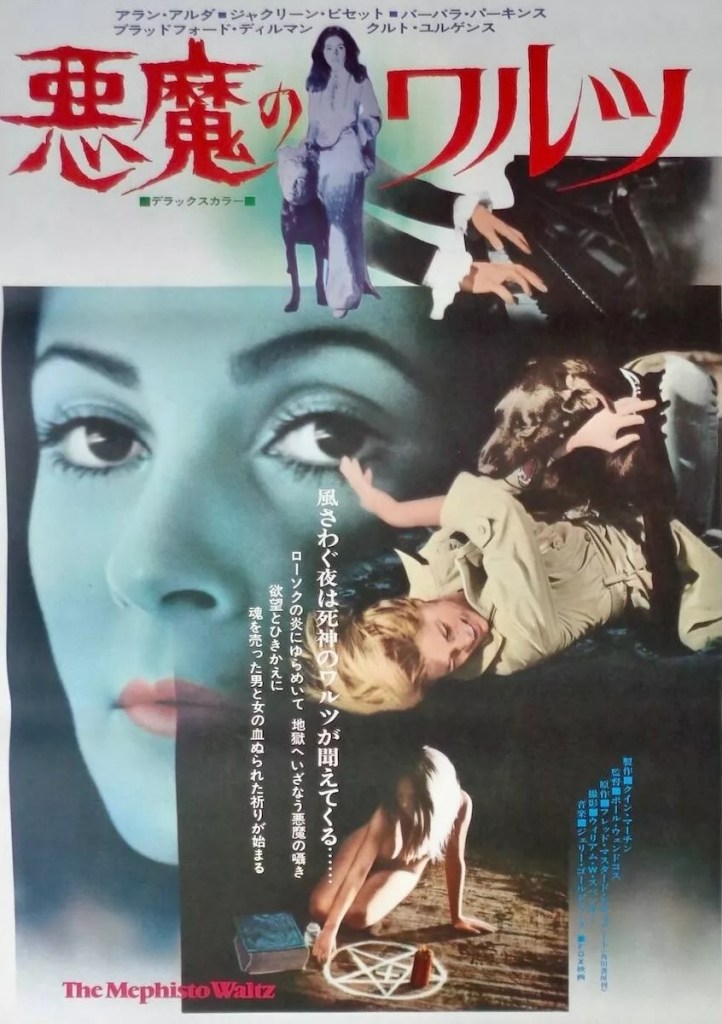
Appearing between the demonic high-spots of Rosemary’s Baby (1968) and The Omen (1976), director Paul Wendkos (Cannon for Cordoba, 1970) escapes his journeyman roots to suffuse the picture with nightmarish scenes, and clever use of the fish-eye lens, treating Satanism with the most subtle of brushes, restricted to a mark daubed in a forehead and a pentagram on the floor but minus any chorus of witches or warning from priests or sundry other holy persons.

Myles (Alan Alda), piano prodigy who never made the cut, now a journalist, is encouraged by interviewee, concert pianist Duncan Ely (Curt Jurgens), to take it up again. Under the older man’s tutelage, he thrives, promising career beckons, plus an entrée into quite a heady world of parties, sex and wealth. Wife Paula (Jacqueline Bisset) is more sceptical especially once Duncan and his buddies start buying up everything in sight in her new antiques emporium. She’s especially perturbed to see Duncan sharing an intimate kiss with his married daughter Roxanne (Barbara Parkins) never mind wondering whether her husband is going to fall prey to the daughter’s seductive technique.

Just what’s going on is never entirely obvious, making the audience work rather than bombarding them with shock scenes. I’m not sure what you’d call it in demonic terms, some kind of transference, body and soul. Once Duncan dies, Myles’s life is transformed, not just thanks to an extremely generous bequest in the old man’s will, but a dramatic increase in his piano-playing prowess, plus, almost as a bonus, the increased attentions of Roxanne.
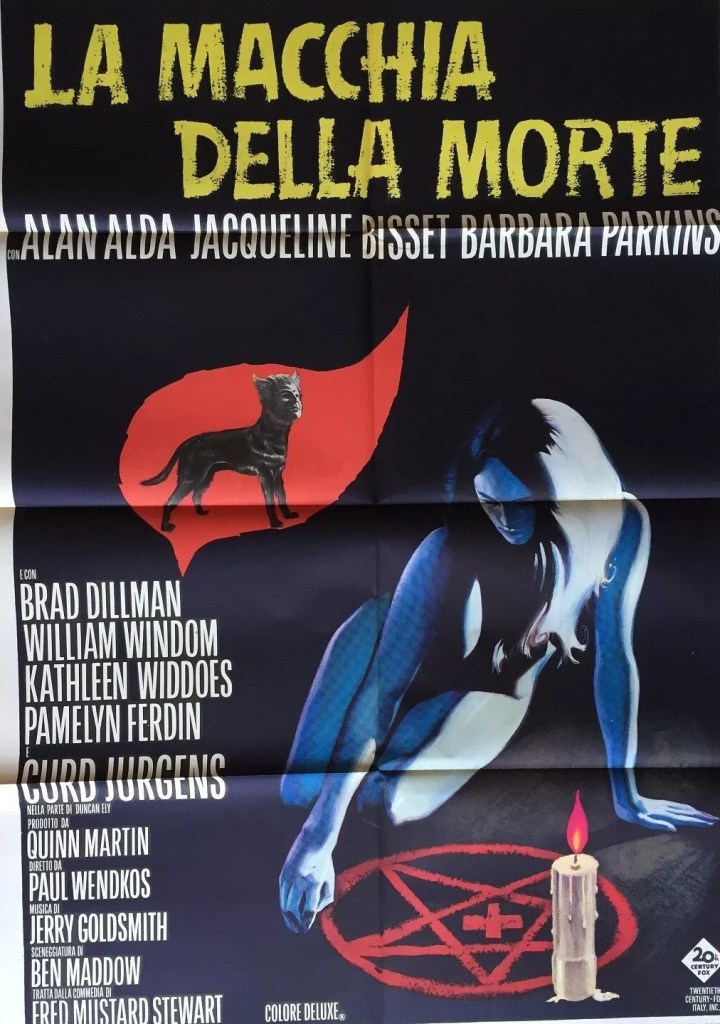
True scares are limited, mostly a huge drooling black mastiff who may or may not be a killer, and so the tale remains more subtle and eventually boils down to whether Paula will follow her husband on his satanic journey or lose him to the wiles of Roxanne and, perhaps more importantly, never enjoy him as the personality he once was.

We all know that, where money and career is concerned, Myles has a cynical bone in his body and has already demonstrated a capacity for the finer things in life, whether they be animate or inanimate. So his character carries little dramatic tension. And so Paula carries the dramatic burden and she bears that, too, with surprising subtlety.

There’s almost a reverse Gaslight vibe to the whole exercise, Paula convincing herself that she must take this step into what would otherwise be considered madness. It’s worth noting that nobody’s pushing her. She makes the decision herself, although takes you a while (that subtlety again) before you cotton on to consequence. And while we’re on the subject of subtlety, full marks to Wendkos for treating two scenes in particular of Bisset nudity with commendable restraint.  

Quite where Satan’s apparent mission to bring classical music to the masses fits into his plans for global domination is never made clear, leanings of such an esoteric nature rarely a prerequisite of the evil mastermind.

Still, a much classier feast than I was expecting, Bisset (The Sweet Ride, 1968) the standout. Her performance served to give Hollywood notice of a classier star than merely the barely seen girlfriend of Steve McQueen in Bullitt (1968). From here on in she would catch the eye of a better grade of director, including Francois Truffaut in Day for Night (1974) though it can be arguedthat it was her looks that sent her into the stratosphere after the wet t-shirt modelling in The Deep (1977).

Alda, meanwhile, jumped straight into M*A*S*H and didn’t resurface as a creditable movie marquee name until California Suite (1978) and The Seduction of Joe Tynan (1979).  Curt Jurgens (Psyche ’59) as ever is good value, Barbara Parkins (Puppet on a Chain, 1970) his rather slinky associate and Bradford Dillman (The Bridge at Remagen, 1969) also pops up.

Wendkos in top gear. Screenplay by Ben Maddow (The Way West, 1967) from the Fred Mustard Stewart bestseller. Excellent Jerry Goldsmith score.

Well worth a look.

The Extraordinary Seaman (1969) **

It wouldn’t be the first time that a director, disgruntled by his fee or some snit with the producer, was wrong in his summation. But John Frankenheimer’s pronouncement that it was “an absolute disaster from beginning to end” is only slightly off the mark. It only really comes apart mid-section when you discover what makes the British Lt. Commander Finchhaven (David Niven) anything out of the ordinary.

Up till then it resembles a decent enough riff on The African Queen (1951), the bearded Finchhaven perennially drunk though not wild-eyed and disorderly like Humphrey Bogart, and take your pick from Lt Krim (Alan Alda) or Jennifer (Faye Dunaway) as the character trying to keep him on the straight and narrow. Instead of being sharp-tongued, Jennifer is a sharp-shooter.

And if anyone’s in the habit of communing with God, it appears to be the British captain. And it’s a bit more upscale, Finchhaven in charge of a ship – the oddly named HMS Curmudgeon, which should give you a hint all is not fine and dandy –  rather than a small steamboat.

But he’s stranded on a Philippine island towards the end of World War Two when rescued by four U.S. Marines who themselves have been uncommonly detached from their vessel during a lifeboat exercise in the fog.

But there is more than enough talent assembled to keep any seagoing yarn shipshape. You wouldn’t discount an immediate return to form, despite flopping with The Fixer (1969), by director John Frankenheimer, a huge name after The Manchurian Candidate (1962), Seven Days in May (1964) and Grand Prix (1966) though you might have worried a tad since comedy did not appear to be his forte.

David Niven, whose war movie credentials were still held in high regard after The Guns of Navarone (1961), had resurrected a fading career with unexpected hits The Impossible Years (1968) and Prudence and the Pill (1968) while Faye Dunaway was riding extremely high in Hollywood following the double whammy of Bonnie and Clyde (19670 and The Thomas Crown Affair (1968) and a pre-Mash Alan Alda was a rising star.  

Cut off from contact with either British or American forces, and unaware of Hiroshima turning the tide in the Far East, Finchaven and Co (Krim has three buddies) set off in pursuit of the enemy. If anybody is the odd one out at this point in proceedings, you would put your money on Krim who is liable to fall overboard with every turn of the wheel.

But before they get anywhere near the kind of action that typified The African Queen or the later The Sea Wolves (1980 – also starring Niven), there’s the big reveal. Krim is puzzled that the captain never seems to eat and continues to drink constantly despite no sign of any obvious supplies, doesn;t require sleep or to launder his uniform. Krim would never get his detective’s badge, his suspicions are only really raised when he discovers an old photograph of the captain, dated 1914, and when Finchhaven’s empty whisky bottle miraculously refills.

Finchhaven is a ghost. Yep. Have you ever? Nope. The dumbest notion ever to set sail or be funded by a major studio. His back story is worth the price of admission alone if you have your heart set on the so-bad-it’s-good fraternity. He died, wait for it, at the start of World War One, when he fell overboard drunk on this very ship and is condemned, so it would appear, to a hellish life of captaining the ship.

Well, after that, you just couldn’t care less.

You might have already begun to get itchy feet by the constant barrage of newsreel or stock footage interjections, presumably offered as social and/or comic commentary, or perhaps to augment the length which stands at a very neat 80 minutes, somewhat short of the standard feature. Or the fact that after demonstrating her shooting skills, Dunaway gets nothing more to do.

On the plus side, which is still stretching it a bit, David Niven makes a believable ghost, not existing in an imaginary world of his own making, behaving in every way as a normal ship’s master. And Alan Alda gives glimpses of his somewhat unique screen persona. This might have worked on paper – the source is a novel by Phillip Rock – but Frankenheimer makes a pig’s ear of translating it to the screen.

I’m still toying with giving this a one-star review.

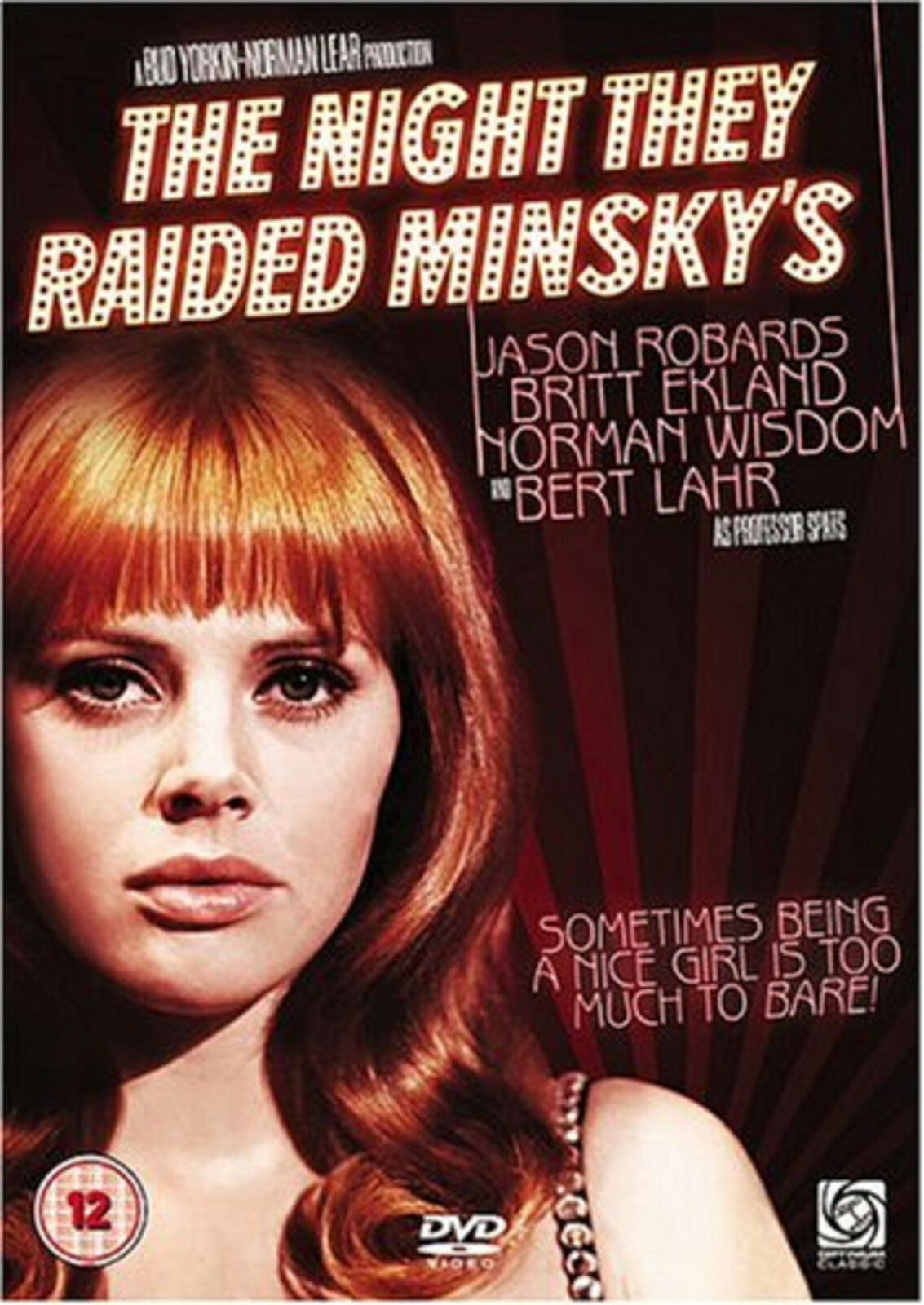
Behind the Scenes: “The Night They Raided Minsky’s” (1968)

Why films are flops is sometimes more interesting than why they become hits. That’s assuming no one’s memory plays them tricks. Originally, according to Tony Curtis, he was going to produce The Night They Raided Minsky’s and at that point it was more focused on the strippers working there. “Each stripper thought she was going to end up being a star like Gypsy Rose Lee” he wrote in his autobiography. However, in the star’s memory this film was going to be made after the completion of You Can’t Win ‘Em All (1970) and Suppose They Gave a War and Nobody Came (1970) when he was a dead duck Hollywood-wise – he did not appear in another picture until Lepke in 1975. The fact that The Night They Raided Minsky’s was made in 1968, two years before You Can’t Win ‘Em All, appears to have escaped his attention or that of the book’s editors and publishers and, strangely enough, also of Michael Munn whose later biography of the actor Nobody’s Perfect equally oddly attributed his involvement in Minsky’s to after You Can’t Win ‘Em All.

Director William Friedkin has a better recollection, but, also strangely enough, nothing like as detailed as that for the film that made his name The French Connection (1971). He had met Bud Yorkin at a private screening at the house of producer David L. Wolper (The Devil’s Brigade, 1968). Yorkin and partner Norman Lear had a two-picture deal at United Artists. (In his autobiography Friedkin called United Artists “newly-formed” which was a hell of a miscalculation since that studio had been on the go since 1919 and even the modernized UA had come into being in 1951 – he was probably referring to the takeover of the studio in 1967 by Transamerica). Even though at that point Friedkin’s only picture had been the Sonny and Cher flop Good Times (1967) he was offered $100,000 to direct on the grounds that he could “bring something original and contemporary to an older subject.” He was honest enough to admit the fee probably swayed him since he found the script “thin, superficial, not funny.”

Friedkin makes no mention of Tony Curtis potentially being involved on the production side. The first actor to be approached, Curtis agreed to do the film if the script was rewritten. According to Friedkin, Curtis was “at the peak of his popularity.”  That was wishful thinking. According to Variety, Curtis was one of the least successful stars in the business, his last four pictures averaging a lamentable $1.77 million in U.S. rentals. Curtis did not like the rewrite. He complained that between the two drafts, his role had “shriveled” and quit the production “due to differences in the concept of the male star role.” Or it could have been that he dropped out in favor of The Boston Strangler (1968).  

For a while it seemed his departure might benefit the planned production. Two rising Broadway stars – Alan Alda and Joel Grey – showed interest. Alda was in The Apple Tree directed by wunderkind Mike Nichols and Grey was attracting fabulous notices for his performance in the stage version of Cabaret. “It was a real coup to land those guys,” purred Friedkin. But it was a coup too soon – they could not get out of their stage contracts. “Unbelievably,” commented producer Norman Lear, whose job presumably it was to read the fine print, “nobody read the fine print.”

All roads then led to Jason Robards (“my first choice anyway” according to Lear) third-billed in Yorkin and Lear’s Divorce American Style (1967). Although Norman Wisdom had primarily a British moviegoing following, he had just finished a run in the Broadway comedy Walking Happy, so he was not entirely unknown. Bert Lahr fell ill a third of the way through production and died within a week so the pivotal role he was to play, “as a kind of tour guide to burlesque…left a hole in the film’s emotional center.” To try and minimize his loss, the producers “included every frame of Lahr including test footage.”

Worse, according to the director, Robards and female lead Britt Ekland proved a mismatch and had “no chemistry as lovers.” Danny Daniels took over the staging of the burlesque routines and Friedkin came close to being fired.

At least Friedkin was honest about the film’s failings. The biggest problem, he admitted, “was my own ineptitude…I was in over my head….Each time I set up a shot or talked to an actor about a scene I was filled with uncertainty….much as I’d like to absolve myself of blame for the film, I see my handiwork all over it, especially in the documentary approach to many of the scenes.” He didn’t help matters by almost sabotaging the release when he told a late-night talk show host that the picture was “terrible” and advised viewers not to “bother to see it.”

But for all Friedkin’s later downplaying of the picture, at the time he was giving it big licks, anticipating some kind of artistic breakthrough in part through innovative use of the hand-held camera. He aimed to achieve a “Brechtian flavor of casual seediness.” It was the biggest production ever filmed in New York with a budget in the $3 million-$4 million region. Friedkin had rejected the New York streets available on Hollywood studio lots in favor of the real thing. The producers found a block on the Lower East Side scheduled for demolition that fitted exactly the art director’s exterior design and successfully campaigned Mayor Lindsay to postpone demolition until shooting was completed. Friedkin confidently boasted to Variety that the Lower East Side so closely resembled what it was like half a century before that “all you have to do is rip out the parking meters and conceal the air conditioning” and line the streets with vintage cars.  

Cameraman Andrew Laszlo had developed a special camera that permitted much steadier handheld photography than before which would facilitate “Friedkin’s improvisational directorial style.”  Friedkin called it “the most expensive movie ever made with a hand-held camera.”

The picture finished shooting at the end of 1967 but that it did not appear in theaters until the tail end of the following year indicated the problems facing the producers. You might think Xmas an odd time to launch a movie about what was effectively a tawdry subject no matter how affectionately filmed. In a bid to shine a light on the more successful aspects of burlesque, United Artists publicists gave a major push to Dexter Maitland, a 40-year veteran of the business who had a small part in the picture.

SOURCES: Tony Curtis with Peter Golenbock, American Prince: My Autobiography (Virgin Books – paperback, 2009) p279 ; Michael Munn, Tony Curtis, Nobody’s Perfect (JR Books, 2011) p214; William Friedkin, The Friedkin Connection, A Memoir (Harper Perennial, 2014) p115-120; Lee Beaupre, “Rising Skepticism on Stars,” Variety, May 15, 1968, p1; “Tony Curtis, Britt Ekland To Co-Star in Minsky’s,” Box Office, June 26, 1967, p12; “A Minsky Burlecue Theme Needs N.Y.,” Variety, August 2, 1967, 18; “Tony Curtis Withdraws from Minsky’s Pic,” Box Office, August 7, 1967, pW-2; “Wreckers Refrain,” Variety, September 27, 1967, p28; Lee Beaupre, “Costliest Ever on Hand Held Camera; UA’s Calculated Risks As To Minsky’s,” Variety, December 6, 1967, 3; “Norman Lear Digs ABC,” Variety, December 4, 1968, p22); “Dexter Maitland Is Alive and Real,” Variety, December 11, 1968, 4.

William Friedkin’s autobiography pictured below is immensely informative of the director’s somewhat controversial career.

Discover WordPress

A daily selection of the best content published on WordPress, collected for you by humans who love to read.

The Atavist Magazine

by Brian Hannan

WordPress.com News

The latest news on WordPress.com and the WordPress community.