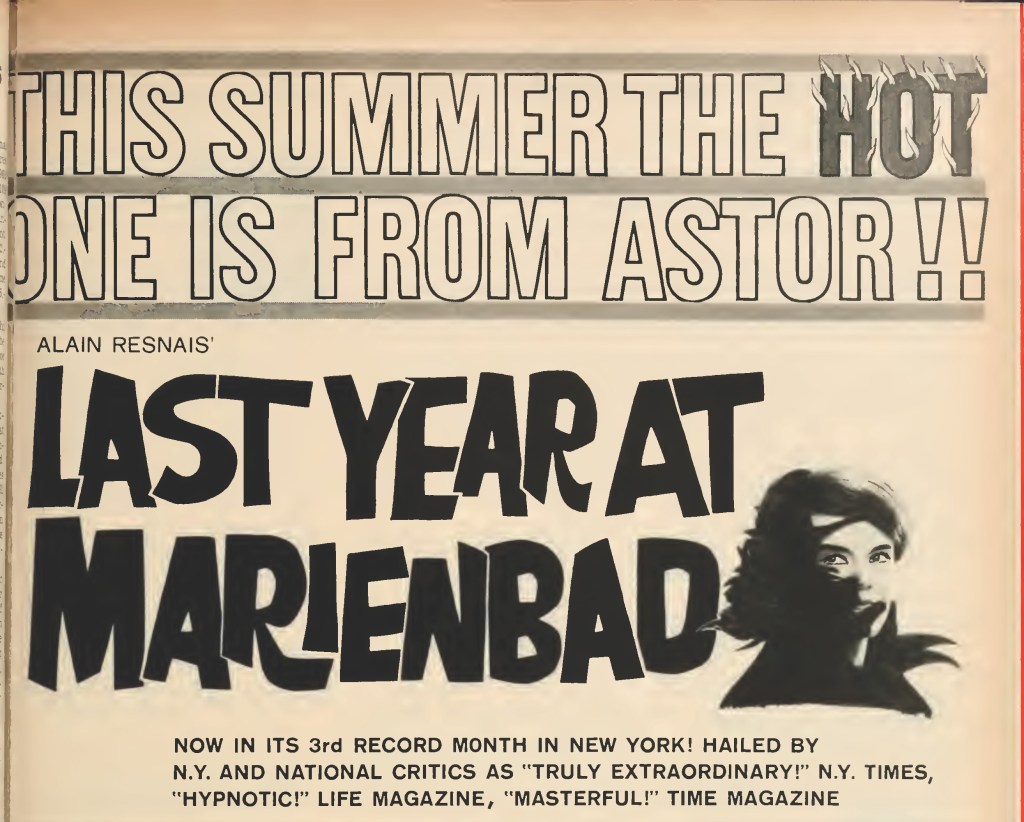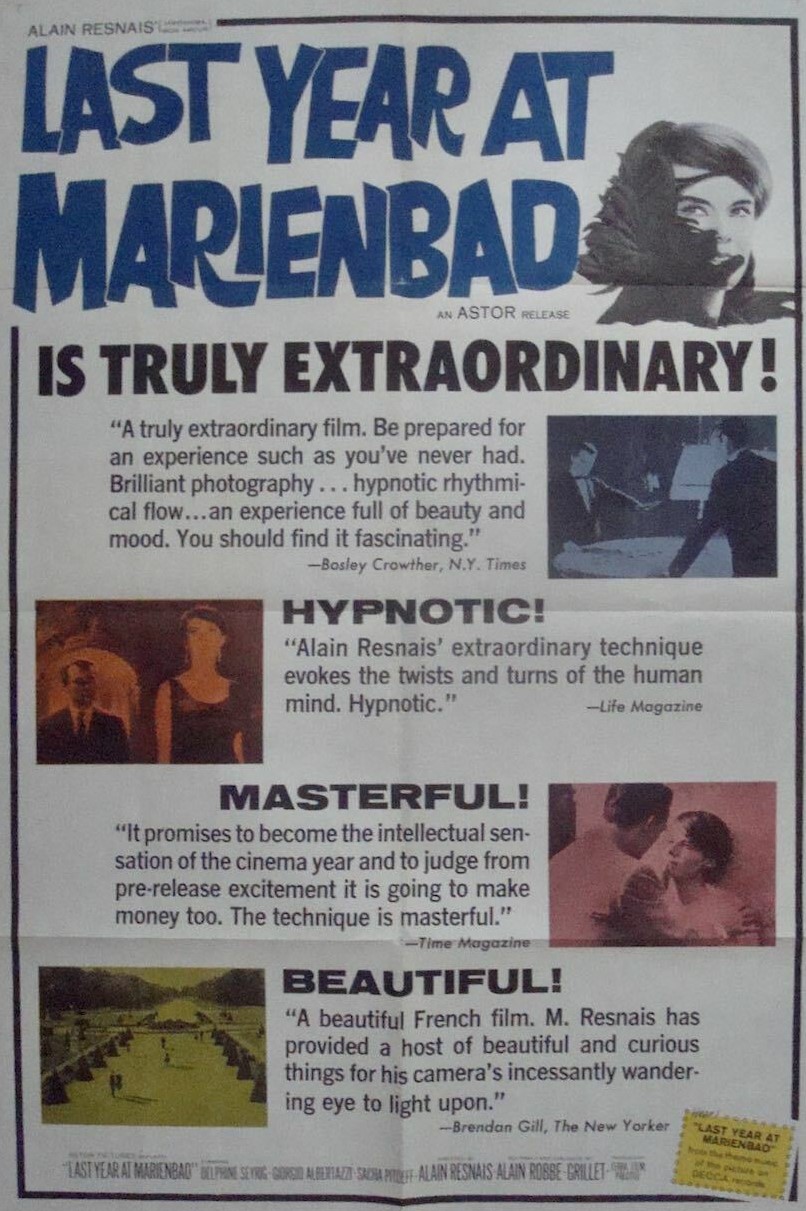
Behind the Scenes: “Last Year in Marienbad” (1961)

The late British Queen Elizabeth II put it succinctly, “Recollections may vary.” Or as director Alain Resnais, in reference to his masterpiece Last Year in Marienbad, explained, “It is quite possible that all the characters are speaking the truth…what is presented as the present or the past is simply a reality that exists while the character is speaking.”

However, Resnais was keen to dismiss other theories. “As far as I am concerned Marienbad contains no symbols or allegories.” He suggested that anyone looking for such meanings “will arrive at a correct interpretation 60% or 80% of the time but your interpretations will never hold good for the film as a whole.” Nonetheless, even Resnais was susceptible to such possibilities, for example, there is a Breton legend of Death coming to fetch his victim but allowing him a year’s respite.   
It was unusual for a director to admit he has no clue what his film was actually about. Resnais confesses that “the game (Nim) is the only point about which I am unable to tell you anything…Robbe-Grillet (the screenwriter) invented a variation without knowing it (the game) existed. My personal impression is that Albertazzi (the would-be lover) loses it consciously and deliberately.”

Offering an alternative view to the film’s meaning, Resnais added, “The whole thing is possibly a part of the woman’s stream of consciousness, as, on the point of deciding what to do, she recalls all the various factors in a few seconds.”

The last pages of the script had barely been written before shooting began. And while that was scarcely unusual, nor for pages to be rewritten during filming, what was singular in this approach was that when the editing could offer dozens of ways of putting it back together, “we always fell back on our original ideas.”

“We wanted the film to work quite differently from a conventional entertainment: by a sort of contemplation, of meditation, a series of advances and retreats from the subject. We wanted to feel ourselves in the presence of a sculpture which one studies first from one angle, then from another, from near or farther away.”

In one sense the movie, as Resnais accepted, can be seen as the man playing the role of a psychiatrist forcing his patient to accept events she has deliberately suppressed. Resnais also introduced other psychoanalytic themes: “the ostentatiously large rooms indicating a tendency to narcissism.”
Resnais added, “It is also attractive to conceive of her (Delphine Seyrig) as an invalid. First of all, the hotel has a special air. And I have always been intrigued by (potential husband) Sacha Pitoeff’s words to the woman as she lies on the bed, ‘You must rest, remember that is why we came here.’ Perhaps the hotel is really a clinic.”

Resnais’s directorial method included making sketches to elucidate his thoughts. “It helps in my relationships with the actors and the cameramen. They save the actor from getting panicky eight or ten days before the shoot. If he has read the shooting script and has a clear idea of it and then while shooting I place him in a position or composition which hasn’t been foreseen he is apt to worry.

“And as I like everyone to be relaxed as possible on the set, I prefer arguments to be over before shooting. I’m all in favor of rehearsing the entire film before shooting begins.

“For Marienbad we drew up a complete chronology on squared paper. And before beginning any scene with the actors, we said, ‘in the editing this scene follows such and such a scene, but in actual chronology it follows another scene which will appear later in the film.’ I frequently recorded a fragment of the preceding scene so as to work from the continuity rather than from the cue.”

He hesitated to adapt his ideas to suit the cinematographer. “I would be reluctant to transform a setting, even in small details, to suit the camera. It is up to the camera to present the décor in the right way, it’s not for the setting to conform to the camera. The same holds good for the actor. I have an immense respect for an actor’s work. (But) how rarely we alter the shooting to suit an actor’s feelings, whereas we are constantly changing it on account of the weather.”

SOURCE: Alain Resnais, “Trying To Understand My Own Film,” Films and Filming, February 1962. P9-10, 41; translated from Cahiers du Cinema by Raymond Durgnat.
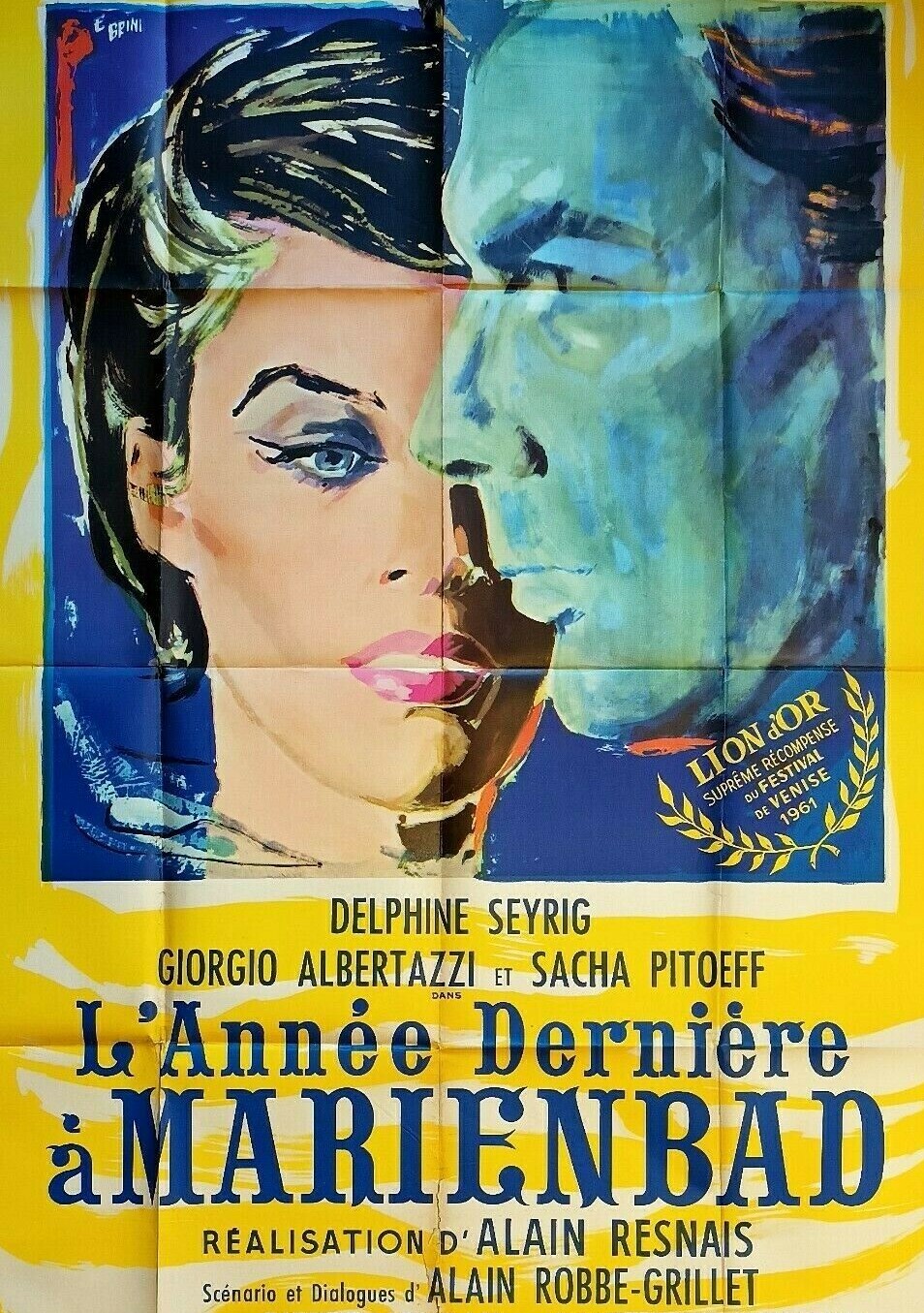
Last Year in Marienbad / L’Annee Derniere a Marienbad (1961) *****

Six decades later this miraculously emerges as a compendium of contemporary themes. Starting off with “my truth,” and segueing through unreliable narrator, false memory, parallel universe, stream of consciousness, dream vs. reality, repetitive voice-over, and still the most tantalising – or infuriating – movie ever made. A cinematic jigsaw with every piece of the puzzle highly stylized.

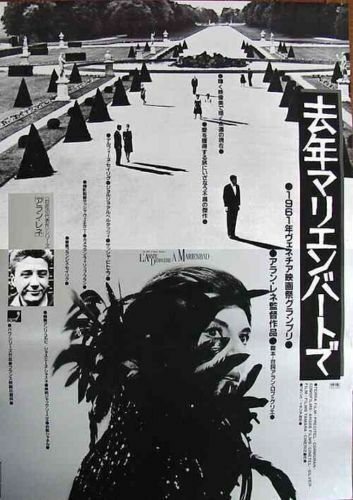
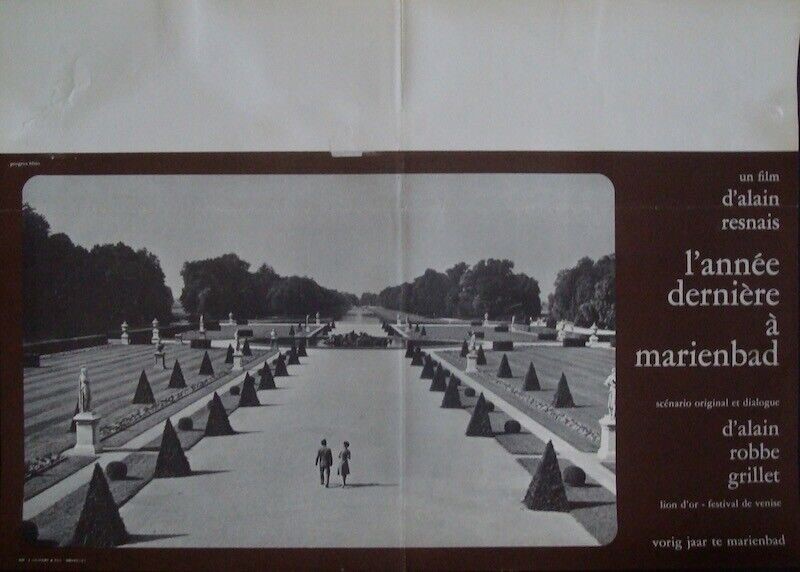
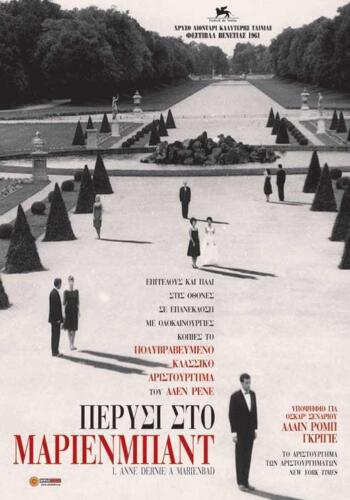
People have shadows but not the trees, the interpretation of a statue is disputed, characters in backgrounds are as frozen as mannequins, there’s a game you cannot win, no one has a name, and every now and then a row of men as if choreographed by Busby Berkeley wivel in turn and shoot at targets. Set in a huge baroque chateau with fabulous meticulous grounds, this fantasy building proves the ideal locale for an endless discussion of reality. And whatever happened last year in Marienbad could have occurred instead  in a number of other locations.

The trees have no shadows. These days CGI would rid trees of shadows but in those days it was the other way round and the shadows of the characters
were painted on the ground.

Two men, a prospective lover (Giorgio Abertazzi) and potentially a husband (Sacha Pitoeff), buzz around a woman (Delphine Seyrig). The would-be lover conjures up a tremendous amount of detail about when he met the woman, only for her to deny all knowledge of the incident, to the extent of failing to recall the reason they are meeting again, one year on. According to him, she had refused to enter into an affair the previous year but vowed to consider his ardent proclamations of love a year later. He has come to claim his reward.

That plot, slim as it is, is all you’re going to get. The movie goes all around the houses trying to establish not only was such an agreement actually struck but also whether she has ever met him at all and where exactly this supposed event might have taken place.

And were it not for the hypnotic tone, the mastery of camerawork, the cleverness of the situation, and the long tracking shots – for me an enormous plus – you might have given up the moment the man repeats, with mild differences, sentences he has already uttered. It’s the equivalent of the crime novel’s closed room mystery, except there is no solution.

So you either dismiss it as a typical French New Wave farrago, fall out with your friends over its meaning, or just sit back and enjoy it, as I did.

For a start, it’s one of the best films ever made in black-and-white, the contrast between the two so striking, the white glowing, the black occasionally ethereal, the lack of dialog almost insisting this is in reality a silent film. There are all sorts of pieces of experimental cinema, flash cuts in conflict with the languorous stately progress of the tracking camera, the aforementioned shadows and mannequins, greater emphasis given to the ceilings and corridors than to the people.

Time and place are distorted, different versions of events presented, the initial story given substance by the husband attempting to put the lover in his place by continuously beating him at an obscure game of cards (the Japanese Nim). And much to my astonishment, just as I was well settled in to letting the director take me where he wanted and expecting no conclusion, there is a climax of sorts that may point the audience in the direction of the correct reality.

By that point, did we even care, the whole essence of the movie being the inability to detect truth, the slipperiness of meaning, the elusiveness of intent and the certainty that what was clear one year is not the next. Cinema is built on conflict, and the most obvious one is difference of opinion. What one person regards as fact, the other dismisses as supposition. This could have been played out in dialog, endless discussion about meaning and veracity, we see it all the time in crime pictures and romance, what exists in one mind not having the same resonance in another, but instead we are treated to one long glorious cinematic essay.  

Director Alain Resnais had already set cinema alight with Hiroshima Mon Amour (1959) and there can have been few artists who hit the arthouse ground running in such style. That the script had been written by eternal bad-boy and future director Alain Robbe-Grillet (Trans-Europ Express, 1966) ensured that it was always going to be controversial. Unusually, Resnais, apparently, stuck very close to the script, so in that sense it was a collaboration rather than the usual loose interpretation of a screenplay.

The stars all took different subsequent routes. Delphine Seyrig, in her debut, would go on to become an arthouse darling in Accident (1966), Francois Truffaut’s Stolen Kisses (1968) and Jacques Demy’s La Peau Deuce/Donkey Skin (1970). Italian Giorgio Albertazzi did not become an arthouse darling, more likely to turn up in bit parts in a historical drama like Caroline Cherie (1968) or in a supporting role in giallo Five Women for the Killer (1974). You might remember Sacha Pitoeff from The Golden Claws of the Cat Girl (1968) and he, too, headed down the support/bit part route.

You might end up resistant to what you see, but everyone with an interest in cinema should see Last Year at Marienbad at least once.

Discover WordPress

A daily selection of the best content published on WordPress, collected for you by humans who love to read.

The Atavist Magazine

by Brian Hannan

WordPress.com News

The latest news on WordPress.com and the WordPress community.