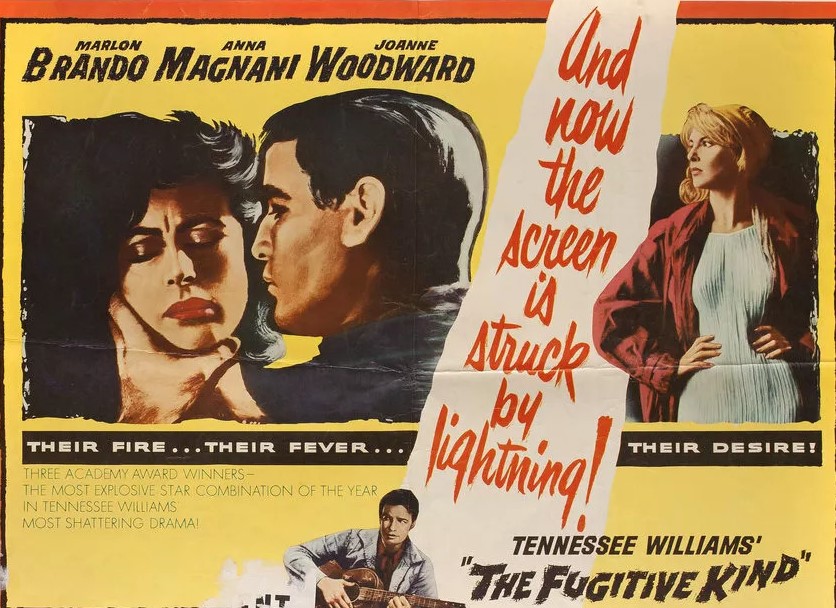
The Fugitive Kind (1960) ***

Audiences were promised sparks that never appeared. Marlon Brando (The Chase, 1960) remained electric but his charismatic screen presence wasn’t matched by miscast co-stars Anna Magnani (The Secret of Santa Vittoria, 1969) and Joanne Woodward (Paris Blues, 1961).  That was three Oscars right there. Throw in a Pulitzer Prize for playwright Tennessee Williams and the project should have been home and dry.

Instead, it struggles to get going as the screenplay flounders under a flotilla of old maids, alcoholics, drug fiends, racists and deadbeats while the central conceit of a May-December romance fails to catch fire. That last element is something of a contemporary trope, and one that even now is exceptionally hard to pull off and it was no easier back in the day.

Itinerant guitarist and sometime criminal Valentine (Marlon Brando), desperate to go straight, ends up in a small Mississippi town when his car breaks down on a stormy night and he finds shelter in the home of Vee Talbot (Maureeen Stapleton), wife of the sheriff. Given his good looks, it’s likely that Valentine would be viewed as a catch, but in this small town he appears to have stumbled upon a nest of sexually frustrated and/or voracious women, way too many dependent on the kindness of a stranger.

First to throw her hat, and virtually everything else, into the ring is the young vivacious unfettered alcoholic Carol (Joanne Woodward), outcast of a wealthy family, barred from shops and bars alike for her uninhibited behavior. But Valentine’s seen too much of her kind. Next up is middle-aged dry goods shop owner Lady Torrance (Anna Magnani) who gives him a job as a counter hand. Bitter and frustrated, she has to run after morphine-addicted husband Jabe (Victor Jory). Vee hovers around trying to pick up the pieces.
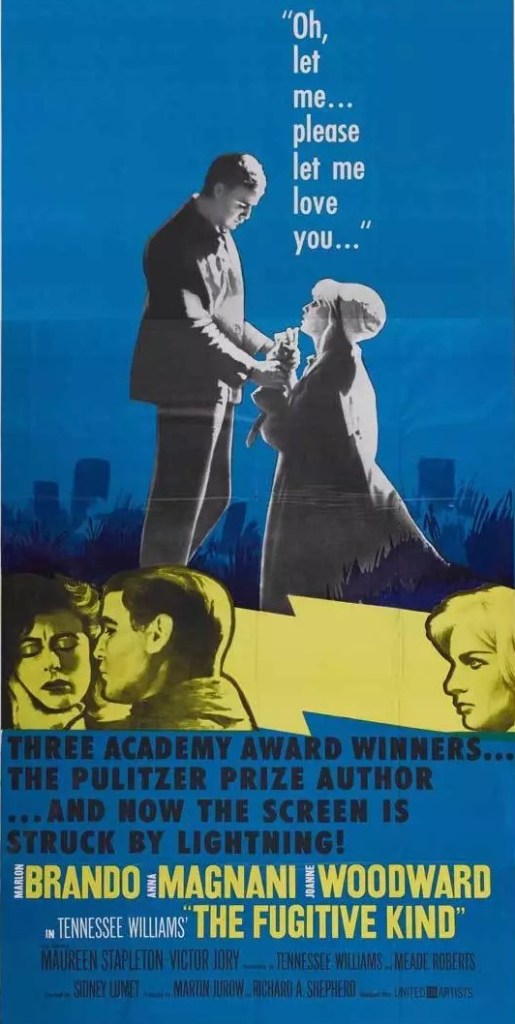
Small town, jealousy rife, word bound to get back to duped husbands, tragedy the outcome. By this point the Deep South on screen was pretty much played out as are the various basket cases who inhabit it and there’s not much fresh ground to be ploughed here. Valentine is called upon to do “double duty” as employee and lover, and finally responds to her sense of desperation.

He can’t quite cut his ties to the illicit, stealing from the cash register to fund a gambling stake, and when caught is subtly blackmailed.

The backstory mostly concerns Lady. Her father’s wine plantation was destroyed by vigilantes in revenge for him selling liquor to African Americans. She wants to establish her independence by setting up a confectionary stall. Turns out of course it’s her husband that led the vigilantes. Valentine totes around a guitar that he never plays, as if it’s a reminder of a previous life. He’s running away from a past in New Orleans without any idea of the future to which he aspires. He doesn’t know what he wants but won’t make a move in case it’s the wrong one. He may desire  a mother more than a lover.

It’s all set for a violent melodramatic ending, though the climax doesn’t ring true. Mostly, it’s about loneliness, both within and outside marriage. Relationships fester rather than last. The males are brutal or impotent.

While Joanne Woodward is determinedly over-the-top with her good-time-bad-girl routine, way out of control, and using over-acting as a crutch, Brando’s performance is more subtle and Magnani’s heart-wrenching.

But it just doesn’t add up. There’s too much emphasis on seedy background and forced drama. Williams has an alternative of the Raymond Chandler edict of when in doubt have a man come through a door with a gun; with him it’s unwanted pregnancy.

Director Sidney Lumet (The Appointment, 1969), who would later be more sure-footed, seems unsure here, the faux noir adding little, and inclined to indulge over-acting from the bulk of the supporting cast. Meade Roberts (Danger Route, 1967) adapted the Williams’ play.

An excellent Brando can make up for the rest.
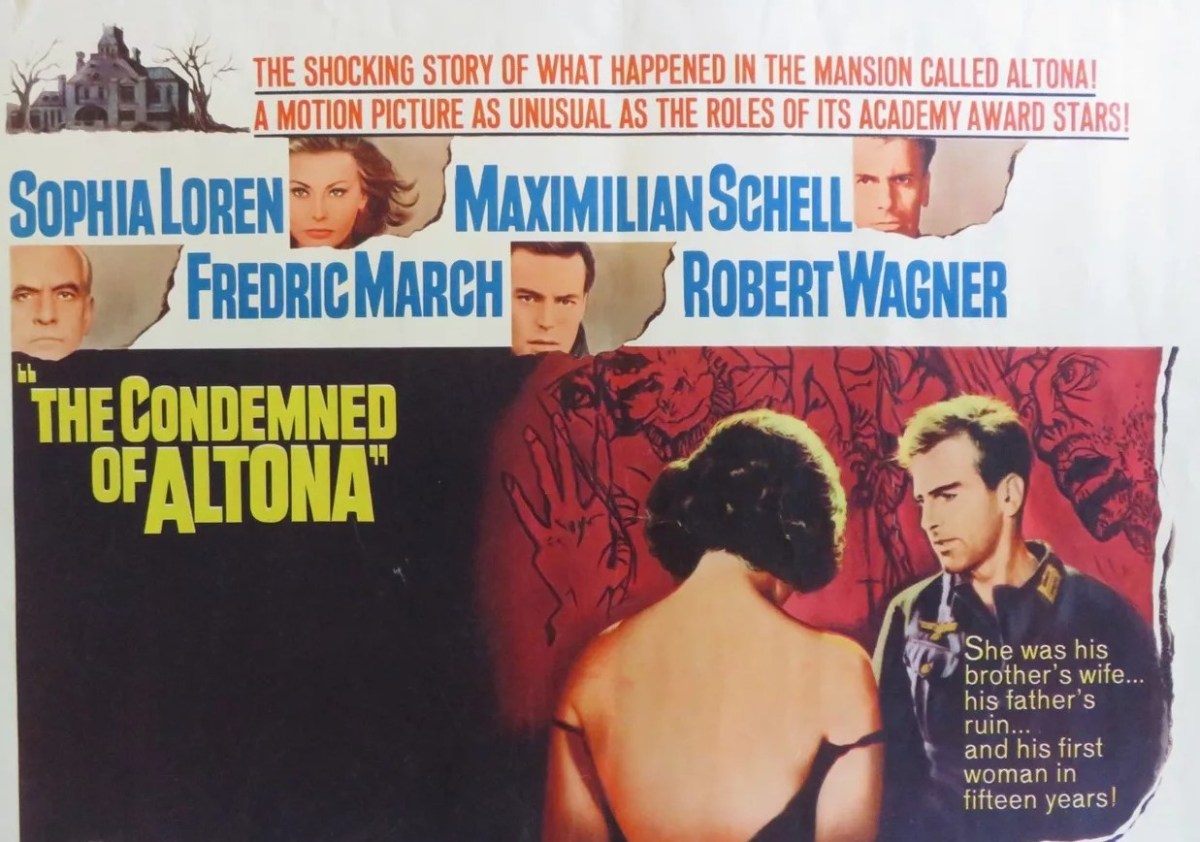
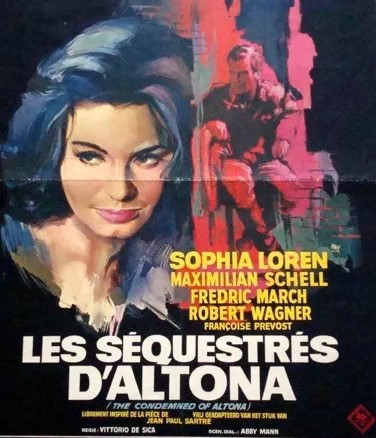
The Condemned of Altona (1962) ****

Shades of last year’s Oscar-winning Zone of Interest but with more guilt, some characters dodging it, others driven mad by remembrance of what they did or didn’t do during the Holocaust of World War Two. But mostly, an object lesson in how to expland a play (written by French philosopher Jean-Paul Sartre). Despite top class performances from Sophia Loren (Arabesque, 1966), Maximilian Schell (Counterpoint, 1967), Fredric March (Seven Days in May, 1964) and even, astonishingly, from Robert Wagner (Banning, 1967) it’s director Vitttorio De Sica (A Place for Lovers, 1968), with stunning images and clever camerawork, who steals the show.

You won’t forget in a hurry the outstretched hand of a prisoner in a blizzard condemned to die, nor the skeletal jaw seen through an x-ray machine. The backward crab crawl will remind you of a later movie. De Sica moves the camera every whichway. Aerial and overhead shots are mixed in with the camera swivelling from character to character or suddenly pulling back from a scene and then suddenly he stops you his restraint. But that doesn’t prevent him getting to the heart of the narrative matter and adding in some frisson of accuser attracted to accused.  

Set at the end of the 1950s, we begin on a Succession note, but without the contemporary angst and back-stapping. German shipping entrepreneur Albrecht (Fredrich March), a war profiteer turned post-war profiteer having taken advantage of demand in the Germany industrial boom, and now with only months to live, wants to pass on his business to son Werner (Robert Wagner). But Werner shies away, disgusted by his father’s unspoken collaboration with the Nazis during the war, ignoring the argument that the businessman was simply dealing with whatever party was in power. And this would be the narrative, father explaining actions, hoping for expiation, planning for the business to pass down the family line rather than be sold off.

Except that Werner’s left-winger actress wife Johanna (Sophia Loren) discovers there is another contender, the supposedly dead older son Franz (Maximilian Schell) who, instead of being sentenced to death for war crimes and fleeing to Argentina, where he purportedly died, as was the story given out, is actually hiding in the family mansion. He’s pretty much been driven mad, the walls of his substantial hidey-hole daubed with disconcerting images. Windows blocked-up and no knowledge of the outside, wearing his Nazi uniform he envisages a Germany languishing in decay, poverty and hunger. He lives on champagne, oysters and chocolate (so not quite the tough prison regime), and, as discreetly portrayed as was possible at the time, has an incestuous relationship with doting sister Leni (Francoise Prevost), the only human being with whom he is in contact. The inmate, knocking back handfuls of Benzedrine, occupies his time by recording messages to be delivered, he hopes, to Germans many centuries ahead.

Johanna wonders how this mentally-ill man came to be obsessed with guilt and we discover that when he was growing up his father rented out spare land around the mansion to the Nazis for a concentration camp where 30,000 people died. But Franz hid a Jew in the house, was reported to the S.S. by his father, and witnessed the man’s execution, then was punished by being forced to join the Army where he was known as a torturer. Finally, he emerges from isolation and sees a different Germany and confronts his father in a shock ending.

Both Loren and Schell had just won Oscars, for Two Women (1960) – incidentally directed by De Sica – and Judgement at Nuremberg (1961), respectively, so their confrontation, where his initial male dominance (the poster image reflects this scene) settles into a more equal power dynamic. Frederic March is good as the father convinced he has done no wrong and I had to check that this was the same Robert Wagner who had often been indifferent in pictures. De Sica draws great performances from all and layers the whole movie in a doom-laden atmosphere. Written by Abby Mann (Judgement at Nuremberg) and Cesare Zavattini (Woman Times Seven, 1967)

Remains surprisingly potent.

Discover WordPress

A daily selection of the best content published on WordPress, collected for you by humans who love to read.

The Atavist Magazine

by Brian Hannan

WordPress.com News

The latest news on WordPress.com and the WordPress community.