Television hadn’t produced the goods in terms of furnishing Hollywood with an abundance of new talent. We were still only talking about Steve McQueen (Bullitt, 1968) and James Garner (Buddwing/Mister Buddwing, 1966) in the 1960s as having made a successful transition from small-screen to big-screen stardom with occasional brief flurries from the likes of Clint Walker (The Dirty Dozen, 1967). Though Hollywood kept trying – Universal had tossed thirty-two of its contracted players into Airport (1970) in the hope one would catch audience attention.
But it turned out Hollywood had been looking in the wrong direction. Expecting to unearth actors who could carry dramas or thrillers or westerns, Hollywood had, in general, not considered comedy as a source of new talent. Dick Van Dyke (Chitty, Chitty, Bang, Bang, 1968) was considered an anomaly because he could morph into a song-and-dance man and his comedy was based on the physical.
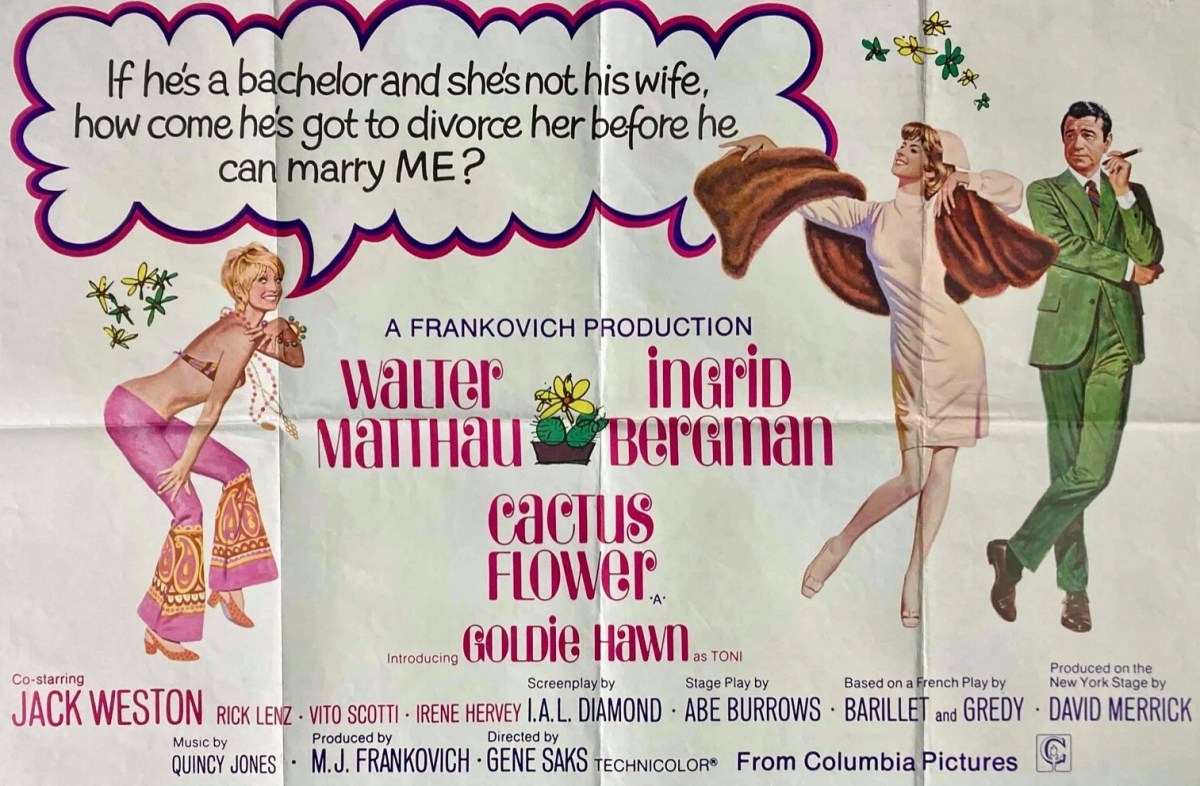
So the industry was astonished when Goldie Hawn emerged from what was essentially a comedy skit show, The Rowan and Martin Laugh-In, to become a genuine screen box office comedienne and over the next decades there would be an excellent harvest from television comedy including Robin Williams, Chevy Chase and a whole troupe of others.
But it’s a shame that Goldie Hawn got all the glory – she won an Oscar – because this was the picture that established Walter Matthau as a genuine star as opposed to part of a double act with Jack Lemmon (The Fortune Cookie, 1966, and The Odd Couple, 1968). John Wayne once made the point that most acting is actually reacting to what someone else has said and in that regard there’s a masterclass from Ingrid Bergman (The Visit, 1964), playing determinedly against type.
Deceit drives the narrative. Just like Dean Martin in Airport (1970), upscale dentist Dr Julian Winston (Walter Matthau) has cottoned onto the fact that he can keep marital interest from mistress Toni (Goldie Hawn) at bay by the fact that he’s married. Except he isn’t and has to rustle up a fake wife to keep Toni on the hook. So he turns to spinster nurse Stephanie (Ingrid Bergman), a Swede cut from the repressed Bergmanesque cloth rather than the free loving spirit of popular (male) imagination, who has been carrying a torch for him for years, so, despite the notion that it’s not real, she goes full-tilt-boogie into the pretense. She’s even got a couple of nephews in tow who can masquerade, unknowingly, as Winston’s own kids.
Meanwhile, Winston rethinks his position, realizes he doesn’t want to lose Toni and reckons the only way he can get himself out of the sticky situation of his own creation is to pretend that his imaginary wife is also having an affair, so he has to set Stephanie up on dates with some of his customers so Toni can get a peek at them.
Assuming from its stage origins – France before being adapted for Broadway – this had more farce in the original production, that aspect has been trimmed back to concentrate on the various degrees of deceit. Instead of trying to force laffs from opening and closing doors and men being caught with their trousers down, this follows the simpler plotline of maintaining the deceits while inserting a potential twist when Toni develops an interest in her neighbor, author Igor (Rick Lenz).
The three principals are excellent, all bringing something fresh to the table, Walter Matthau as a lothario rather than a crafty conniver a distinct change of pace, Goldie Hawn a refreshing new face who was soon able to carry pictures on her own, and, especially, to my mind Ingrid Bergman. She has two absolutely marvelous reactions to information received – in the first her elbow literally falls from a table, in the second she is overwhelmed at the thought of receiving a gift, and she has the best scene of all, cutting loose on the dance floor.
As you might expect, the romantic entanglements are resolved.
Director Gene Saks (A Thousand Clowns, 1965) sticks to the knitting, extracting weighted performances from the cast without resorting to insipid extras. I.A.L. Diamond (The Fortune Cookie) adapted the Broadway play by Abe Burrows (Can-Can, 1960) who in turn had borrowed the French play by Pierre Barillet and Jean-Pierre Gredy.
Most 1960s comedies have lost their verve but this still plays exquisitely.
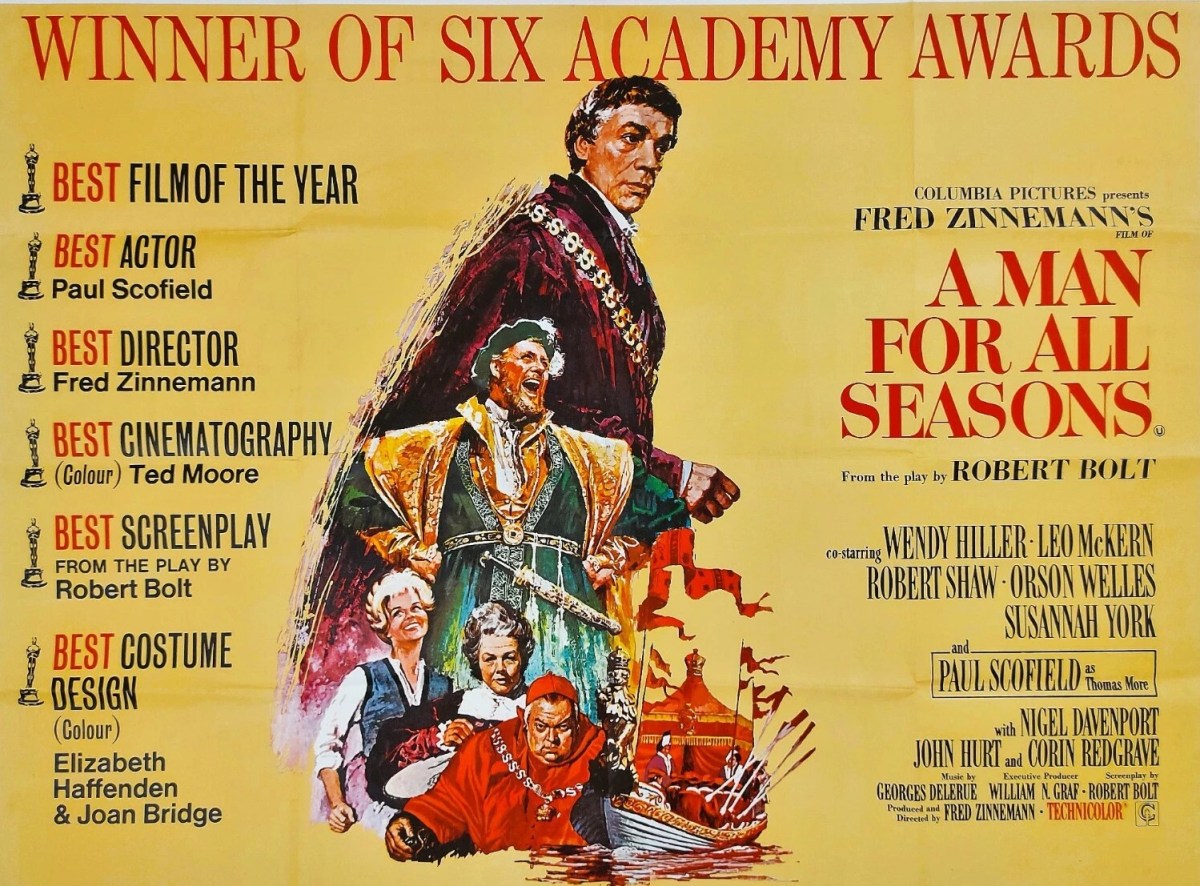
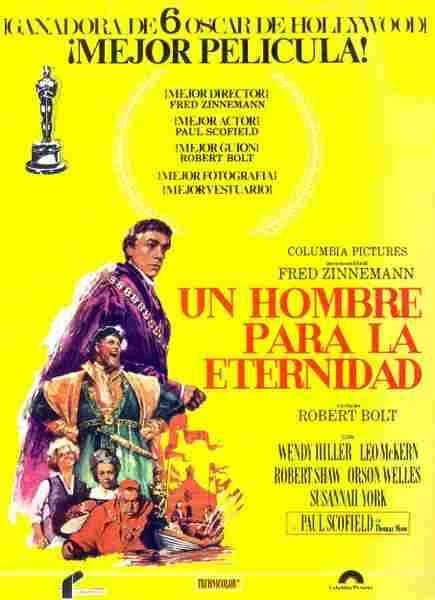
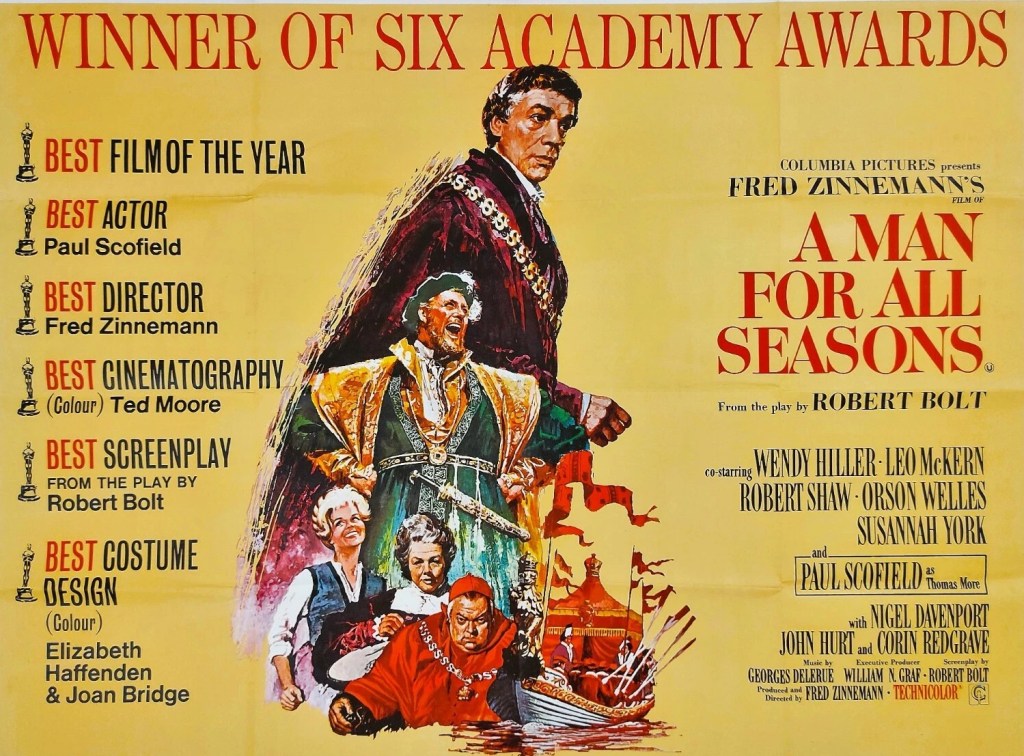
Columbia offset the gamble of turning an award-winning play with a stage star with no movie marquee luster, a co-star who had just about the same pulling power for audiences, and a host of actors nobody had ever heard of by cutting the budget to the bone – the $ 2million spent would barely be enough for a mid-level Hollywood production – even though director Fred Zinnemann belonged in the upper reaches of the Oscar hierarchy with one win and six nominations to his name.
You could even argue that the best-known person in the cast was female lead Susannah York (Sands of the Kalahari, 1965, The 7th Dawn, 1964) or the legendary Orson Welles or even screenwriter Robert Bolt, acclaimed for his work on Lawrence of Arabia (1962) and Doctor Zhivago (1965).
Movie audiences of the period would be hard put to even recognize male lead Paul Scofield, in only his second major screen role after The Train (1964), while Robert Shaw had little more popularity unless you were familiar with From Russia with Love (1963) in which he played a bad guy and Battle of the Bulge (1965). There was a fair chance that Scofield could hit the mark among the upscale stage audiences in London and New York, where he had won a Tony. The play, by Robert Bolt, had proved substantially more popular in terms of length of run and critical esteem in New York than London.
But Zinnemann hadn’t made a picture in six years, not since The Sundowners (1960), having become embroiled in two projects The Day Custer Died (never made) and Hawaii (made but without him) without anything to show for it.
This was a virtue-signaling picture long before the term became over-used. England’s Lord Chancellor Sir Thomas More (Paul Scofield) makes a principled stand against King Henry VIII (Robert Shaw). From today’s perspective, the principled stand is more complex. The idea that the ruler of a country would have to bend the knee to the leader of a religion would not sit well today. You might be unlikely to blame Henry VIII for wanting to break the rules, given he was in dire need of a male heir that his current wife could not supply, especially as without said heir the country would most likely fall into civil war.
You could make a case for Henry VIII being the heroic one, standing up to the Pope, who, for political reasons, as much as anything else, refused to annul the king’s existing marriage. When the Pope didn’t see it the king’s way, Henry VIII decided the only alternative was to break away from the Catholic Church and set himself up as the secular head of the church in England.
And although Thomas More has a fair following today for his philosophy – he wrote Utopia – Robert Bolt was guilty of leaving out aspects of his character which were more unsavory. He was a prime mover in the persecution of Protestants, condemned as “heretics,” but that’s been excised from the story told here in order to present Thomas More as a man of conscience.
Apart from the verbal duel between More and Henry VIII, there’s a rich backdrop of political machination bringing in such names as Thomas Cromwell (Leo McKern) – of Wolf Hall fame – Cardinal Wolsey (Orson Welles), the Duke of Norfolk (Nigel Davenport), William Roper (Corin Redgrave) and Richard Rich (John Hurt). There’s corruption, bribery and betrayal and at times it appears that More is the only one to place any significance on the law.
But More’s no innocent, he’s well used to playing the political game and arguing his case. He only becomes undone by his stand against a king who will brook no opposition.
Paul Scofield has a fine time of it with a well-developed character, gently spoken, appealing to sense and sensibility, and generally well loved by the populace. Although in retrospect I think other Oscar nominees Richard Burton for Who’s Afraid of Virginia Woolf and Michael Caine for Alfie might have been more deserving of the Oscar gong.
Robert Shaw makes a fine opponent, tempering the monarch’s known bluster with a sense of humor. While Paul Scofield tended to steer clear of Hollywood except for films like Scorpio (1973), Robert Shaw went immediately into the male lead in Custer of the West (1967) and eventually became a genuine draw.
The uncredited Vanessa Redgrave (Blow-Up, 1966) was otherwise the star-picker’s pick. Future years would invest greater luster in the supporting cast. John Hurt (Sinful Davey, 1969) the first to be given a tilt at marquee splendor. Leo McKern (Assignment K, 1968) achieved small-screen deification through Rumpole of the Bailey (TV series, 1978-1992). Colin Blakely (The Vengeance of She, 1968) played Dr Watson in Billy Wilder’s The Private Life of Sherlock Holmes (1970).
Robert Bolt deserved his Oscar for the considerable work he put in to converting his stage version for the screen. The staging looks quite stagey to me, but Zinnemann did an excellent job of adding the necessary richness and ensuring the tale was rounded-out.
Not sure I’d place it in the Top Fifty Best-Ever British Films, but it’s still enjoyable even though you might take issue with the issues presented.
Tennessee Williams wrote better parts for women than he did for men. You can start with Vivien Leigh, Oscar-winner for A Streetcar Named Desire (1951) – Marlon Brando only nominated – and Anna Magnani Oscar-winner for The Rose Tattoo (1955) with Maria Pavan nominated and star Burt Lancaster left out of gong consideration. Carroll Baker and Mildred Dunnock were nominated for Baby Doll (1956) with star Karl Malden ignored. Paul Newman did receive an Oscar nomination for Cat on a Hot Tin Roof (1958) as did Elizabeth Taylor.
Montgomery Clift was frozen out of Oscar consideration for Suddenly, Last Summer (1959) while both Elizabeth Taylor and Katharine Hepburn scored nominations. Marlon Brando received no Oscar recognition for The Fugitive Kind (1960). Ditto Laurence Harvey for Summer and Smoke (1961) though Geraldine Page and Una Merkel received nominations. Lotte Lenya was recognised with a nomination for The Roman Spring of Mrs Stone (1961).
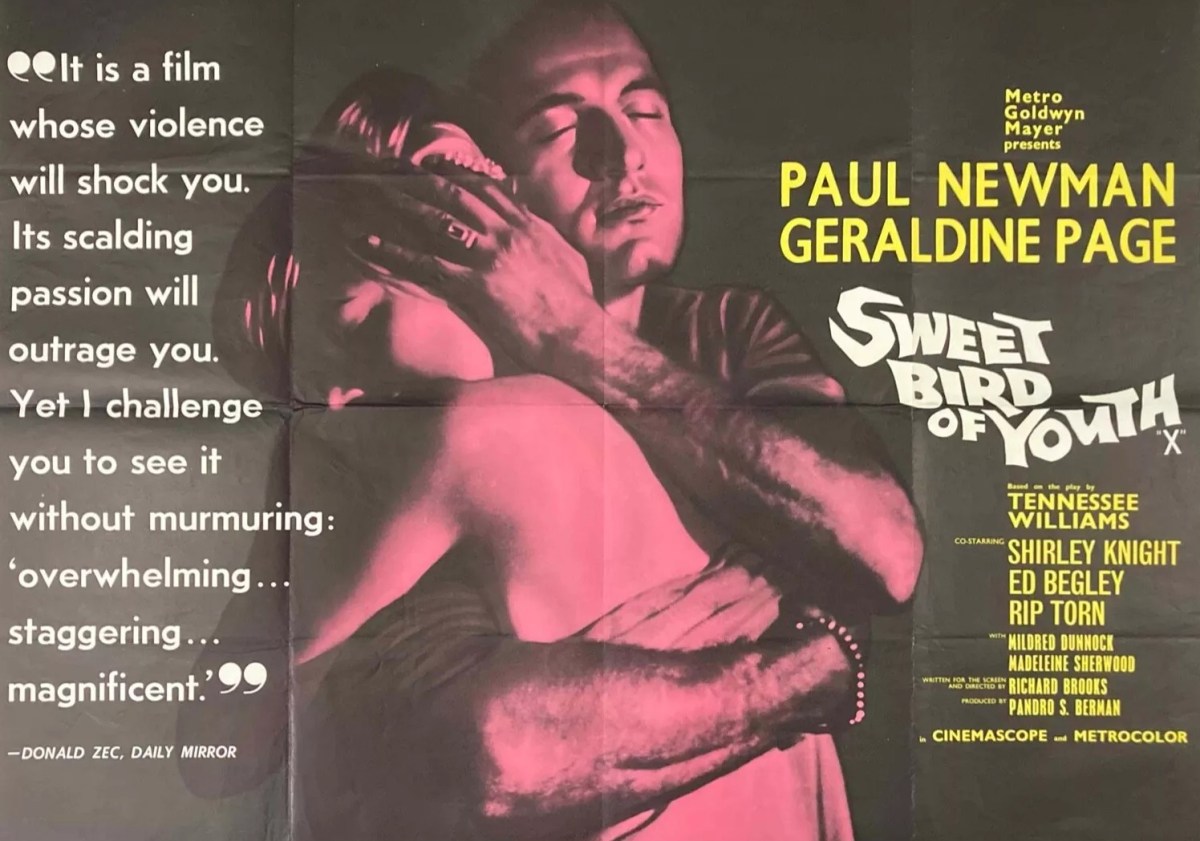
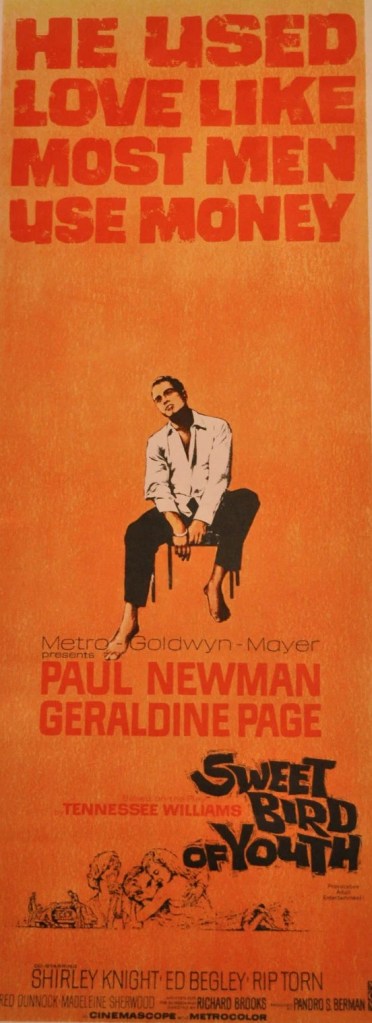
So the omens were not particularly good for Paul Newman when he repeated the role he had essayed on Broadway of Chance Wayne in Sweet Bird of Youth. In the stage version, while he received respectable notices, it was Geraldine Page who picked up the glory, winning the New York Drama Critics Award and nominated for a Tony.
So it was going to be a long shot that Newman could outshine her in the film version, even though he received considerably more screen time – Page and Shirley Knight were nominated, Newman was not.
The flaws in the tale are more obvious in the screen version. On stage, sheer force of personality can win over an audience, on screen that’s more difficult. And in truth Chance was another of Williams’ male losers. The main difference between Williams’ male and female characters is that not only are the women more reflective and aware of their shortcomings while the men simply bulldoze ahead but they are more able to express their feelings without dialog.
Chance is a failed actor turned gigolo taking advantage of alcoholic over-the-hill movie actress Alexandra Del Lago (Geraldine Page), running away from what she believes will be her final and calamitous movie, who half the time doesn’t know where she is or who he is. Chance has dreams of using her to hustle his way into the movie business, blackmailing Del Lago over her drugs abuse to front a new picture, and begins knocking on doors, but long-distance, since he’s returned to his home town in the hope of winning back his childhood sweetheart Heavenly Finley (Shirley Knight), planning to set her up as a movie star.
Expectations that there might be a welcome for a young man made good are dashed when everybody continues to treat him as the waitperson he once was or wants to run him out of town. To protect his daughter from such an unworthy suitor, the town’s most prominent citizen and political heavyweight Tom Finley (Ed Begley) had previously managed to pay Chance to leave town. His son Tom Jr (Rip Torn) shares his father’s aspirations.
Despite the odds Chance determines to woo Heavenly but his Hollywood dream is scuppered when Del Lago realizes that her last picture looks like becoming an unexpected success and she can once again write her own ticket rather than rely on a con man like Chance.
It doesn’t end well though, for reasons best known to him, writer-director Richard Brooks tacked on a happy ending – the play had an unhappy ending – that doesn’t ring true.
There’s nothing wrong with Paul Newman’s acting even if it didn’t attract the attention of the Oscar voters, but there’s not enough meat on the character. On the other hand, Geraldine Page and Shirley Knight (The Group, 1966) in part excel because their characters are better written. Rip Torn (Beach Red, 1967) develops his screen menace. Ed Begley’s (Warning Shot, 1966) over-the-top performance snagged him an Oscar.
The story’s just too thin and the hard edges of the play have been trimmed back so it was less appealing to an audience.
Lacks the usual Tennessee Williams bite but the female performances are well worth a watch.
I’m doing a Behind the Scenes article tomorrow so look out for that.
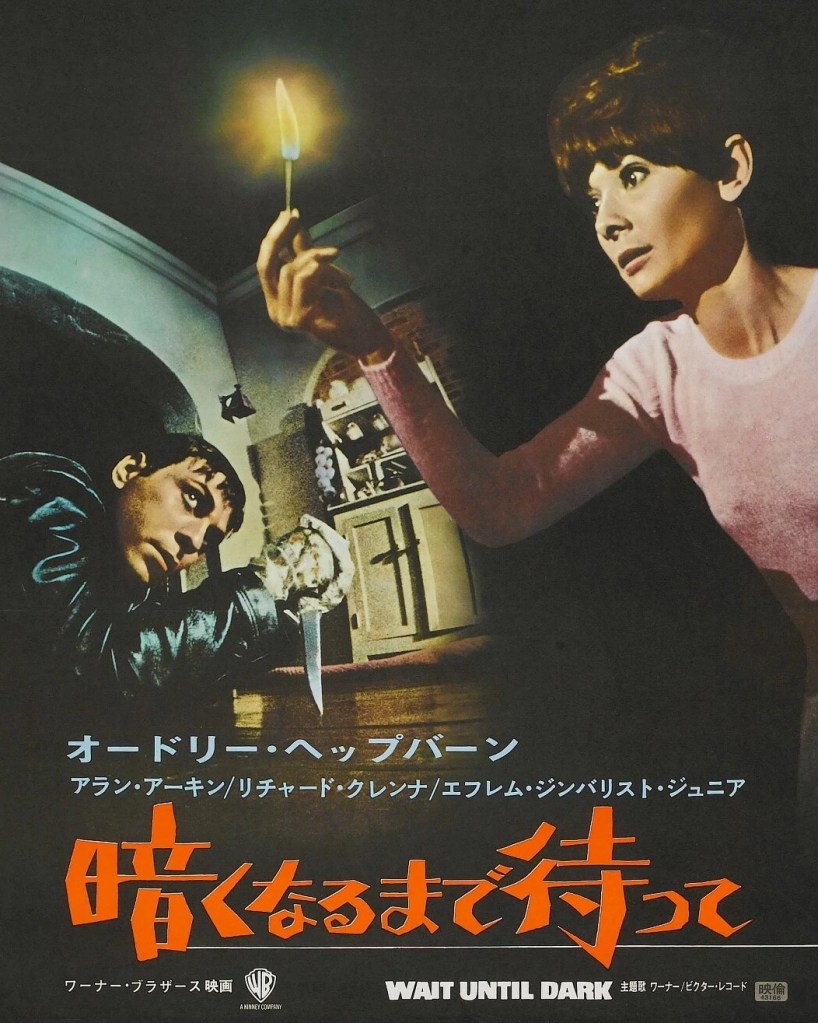
You wouldn’t have figured Audrey Hepburn – she of the model looks (Breakfast at Tiffany’s, 1961) and upmarket twang and belonging to the highest echelons of the movie business – for a Scream Queen. But there were precedents – Doris Day had at times been screaming fit to burst in Midnight Lace (1960) and Lee Remick, though not in either’s marquee league, had been terrified to bits in Experiment in Terror / The Grip of Fear (1962). By this point in pictures, the screen was awash with Scream Queens, courtesy of lower-budgeted efforts from Hammer, AIP and Amicus, so asking a top star to exercise her lungs in similar fashion might have been career suicide.
As it was, which would have come as a surprise to her legion of fans, this turned out to be pretty much the star’s swansong. She wouldn’t make another movie in nearly a decade and only another three after that. But here she certainly hits a dramatic peak.
The story’s a bit muddled and initially requires unraveling. Drug mule Lisa (Samantha Jones) passes a doll packed with heroin to fellow passenger Sam (Efrem Zimbalist Jr.) on a plane. She had been planning to steal the dope and set up on her own with Mike (Richard Crenna) and former cop Carlino (Jack Weston). There’s a bit missing from the tale but you have to assume that somehow Lisa got talking to Sam and he gave her his address and that she has turned up at his apartment looking for the doll, which wasn’t there.
Mike and Carlino turn up and have no luck searching the apartment. They don’t look hard enough because if they’d looked in the closet they’d have found the corpse of Lisa, killed by her employer Roat (Alan Arkin) who arrives to confront the pair and then hire them to help him find the heroin and dispose of the body.
So with all that out of the way we come to the meat of the story. And it follows the same premise as Man in the Dark / Blind Corner (1964) – though, luckily, so few people saw that it wouldn’t be at the forefront of the audience mind at the time – of not so much a blind person being terrorized in their home but being largely played for a fool. The audience knows more than the blind person does and much of the story is not their vulnerability but just how long it will take for them to twig what’s going on.
In the case of Susy (Audrey Hepburn), as with the composer in Man in the Dark, her ears are her radar. She is on the alert after hearing the same pair of squeaky shoes on different people and wondering why people are opening and closing her blinds so often. Mike and Carlino masquerade as good guys, cops investigating the murder of Lisa for which her husband Sam is a suspect. She helps them tear apart the apartment looking for the doll.
She trusts Mike implicitly, less so Carlino, and when she starts to put two and two together she has an ally, teenager Gloria (Julie Herrod) who lives upstairs – they communicate like jailbirds by banging on the pipes. Although her eyes are denied sight, they still express her emotions – trust, relief, gratitude, fear.
But there’s not just one game of cat-and-mouse. There’s three. You know damn well that Mike and Carlino plan to squeeze Roat out of the equation just as you know damn well that he is planning to play them for patsies, apt to take revenge when double-crossed.
Gradually, her suspicions ramp up. She’s pretty smart working out the various clues. And then we hit two dramatic peaks. Firstly, when she discovers Mike is a bad guy. Secondly, when Roat kills Mike and turns on her, splashing petrol about the place, exploiting her terror of fire. She’s still got a couple of moves to turn the tables, at least temporarily but when absolute darkness does descend – she’s smashed all the lights out – and theoretically they are both in the same boat, and advantage her because of her keener hearing, it doesn’t quite work out the way she’s expected because he knows how to exploit sound.
I won’t tell you where the doll is hidden because that’s a very clever twist in itself, but apart from the few plotholes at the outset (how did Lisa manage to break into Susy’s apartment for a start and leave no trace, for example) once the narrative takes hold it exerts a very strong bite.
Audrey Hepburn is on top form. Alan Arkin (The Russians Are Coming, The Russians Are Coming, 1966) and Jack Weston (Mirage, 1965) are a bit too obvious for me, but the smoother Richard Crenna (Marooned, 1969) is excellent.
Directed with both an eye to character and tension by Terence Young (Dr No, 1962) and adapted by Robert and Jane-Howard Carrington (Kaleidoscope, 1966) from the Broadway play by Frederick Knott (Dial M for Murder, 1954).
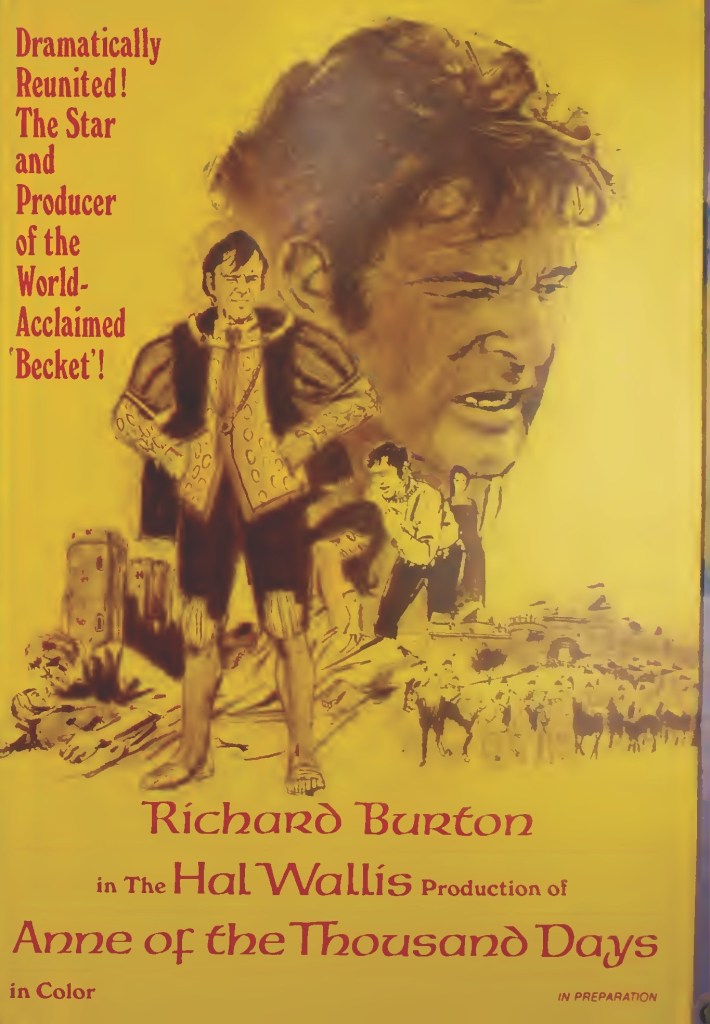
You can keep your Succession dramas with families squabbling over a mere business empire. And even the more woke Snow White (2025) doesn’t remotely tackle the realities of marriage in medieval times when the role of a woman, in an era when more children died in childbirth or soon after than actually survived, was to produce an heir. And not just random in gender. But male.
So, on the one hand, you can sympathize with the dilemma of English King Henry VIII whose Spanish wife Katherine, while eminently fertile – several babies died in childbirth – had managed only one male offspring, who died shortly after birth, and one female, Mary. All the queen had given him, rails Henry (Richard Burton), are “dead sons.” So with the future of one of the biggest kingdoms in the world at stake, Henry isn’t keen to leave it in the hands of a woman. Even if he can arrange a suitable marriage, it would inevitably mean letting the kingdom fall into the hands of someone he doesn’t trust.
But in the twisted world of inheritance, here’s the rub. Henry shouldn’t be king. His elder brother Arthur should have, except he died before he could succeed to the throne. And Katherine, married to Arthur, should have been Queen. But Spain at that point was as powerful, if not more so, than England, so Henry decided to marry his sister-in-law, on the basis that the marriage was never consummated, and the Pope, the authority in such matters, gave the go-ahead, glossing over the technicality of what was considered in those days incest.
So, Henry comes up with a cunning plan. He will go trophy-hunting and marry a younger wife. This isn’t just because he’s fallen in love with Anne Boleyn (Genevieve Bujold). He doesn’t have to marry her to have sex with her. He’s already having sex with her mother (Valerie Gearon) with the tacit approval of her father (Michael Hordern) who receives benefits in kind.
To add complication, Anne is promised in marriage already, and deeply in love. Siring a bastard son would inevitably cause an inheritance battle. So legitimizing the relationship seems the only way forward. This time the Pope isn’t keen, mostly because the Spanish have invaded the Vatican and if he wants to survive he can hardly annoy his captors.
But when the Pope refuses, Henry takes the nuclear option, and splits from the Catholic Church, not just taking advantage of the old church vs state argument, but also made aware by Thomas Cromwell of the sudden increase in wealth acquiring the items of the Catholic Church would bring.
Sorry to bore you with a history lesson but this intriguing backdrop – as well as the dazzling performances – is what twists this away from lush costume confection into riveting drama. This was the peak of a trend in historical movies that shifted the emphasis from heroic action to the down’n’dirty. Camelot (1967) to some extent had begun the trend but only dealt with infidelity and was given something of a free pass because it focused on the iconic Knights of the Round Table and a legendary love affair. The Lion in Winter (1968) primarily concentrated on inheritance.
Depending where your sympathies lay this was either corruption writ large or a battle to free the ordinary man from the yoke of religion.
Primarily, it works because it revolves around the human drive, the king refusing to bow the knee to anyone, Anne Boleyn seduced not just by gifts but by this older man who is much more virile and passionate than her younger somewhat effete fiancé (and who couldn’t be dazzled by a man risking his kingdom for her love?) – and the courtiers looking after number one, always seeking a way of winning the king’s favor, and as importantly, not losing it, for that could lead to banishment or execution.
No one dares stand in Henry’s way – except Sir Thomas More (William Squire) and here he’s merely a small subplot (not center stage as in A Man for All Seasons, 1966) – not even the religious hierarchy, especially Cardinal Wolseley (Anthony Quayle), head of the Catholic Church in England, who keeps a mistress.
The tragedy is that the cunning plan unravels. While Anne is fertile enough, she gives birth to a girl, Elizabeth (the later Virgin Queen). Convinced she’s not going to present him with the male heir he so desperately desires, he hatches a conspiracy that sees her executed for adultery and treachery, leaving him free to marry again and continue his mad obsession.
So we’ve got all the back-biting and bitching we expect from court, plus regal revelry, costumes, castles, and in the middle of it all a driven king and a feisty woman, not by any means a pushover, and not either going unwillingly into his bed. This would be a match made in heaven except that’s probably the last place, the way things stand, the king would be welcome. He’s very aware of excommunication and it shows the power of the Catholic Church that its teachings are so embedded in his brain that he fears that consequence.
This is rich in performance – Richard Burton (The Spy Who Came in from the Cold, 1965), Canadian Genevieve Bujold (The Thief of Paris, 1967) and Anthony Quayle (East of Sudan, 1964) were Oscar-nominated. The only significant figure in the production not to receive one of the movie’s ten nominations – including for Best Picture – was director Charles Jarrott who pulled the whole thing together. Maybe it was thought he was rusty, not having helmed a picture since Time to Remember seven years previously.
The acting is particularly well-judged by the two principals, Burton could easily have lurched into cliché, and Bujold into passivity. Others worth noting are Irene Papas (The Guns of Navarone, 1961), Michael Hordern (Khartoum, 1966), Valerie Gearon (Invasion, 1966) and Peter Jeffrey (The Fixer, 1968).
Based on the play by Maxwell Anderson (The Bad Seed, 1963), screenwriters John Hale in his movie debut and Bridget Boland (Gaslight, 1940) manage to balance what could be dry subject matter with fragility and tragedy.
There couldn’t be a better demonstration of women used as pawns and collateral damage in male power struggles.
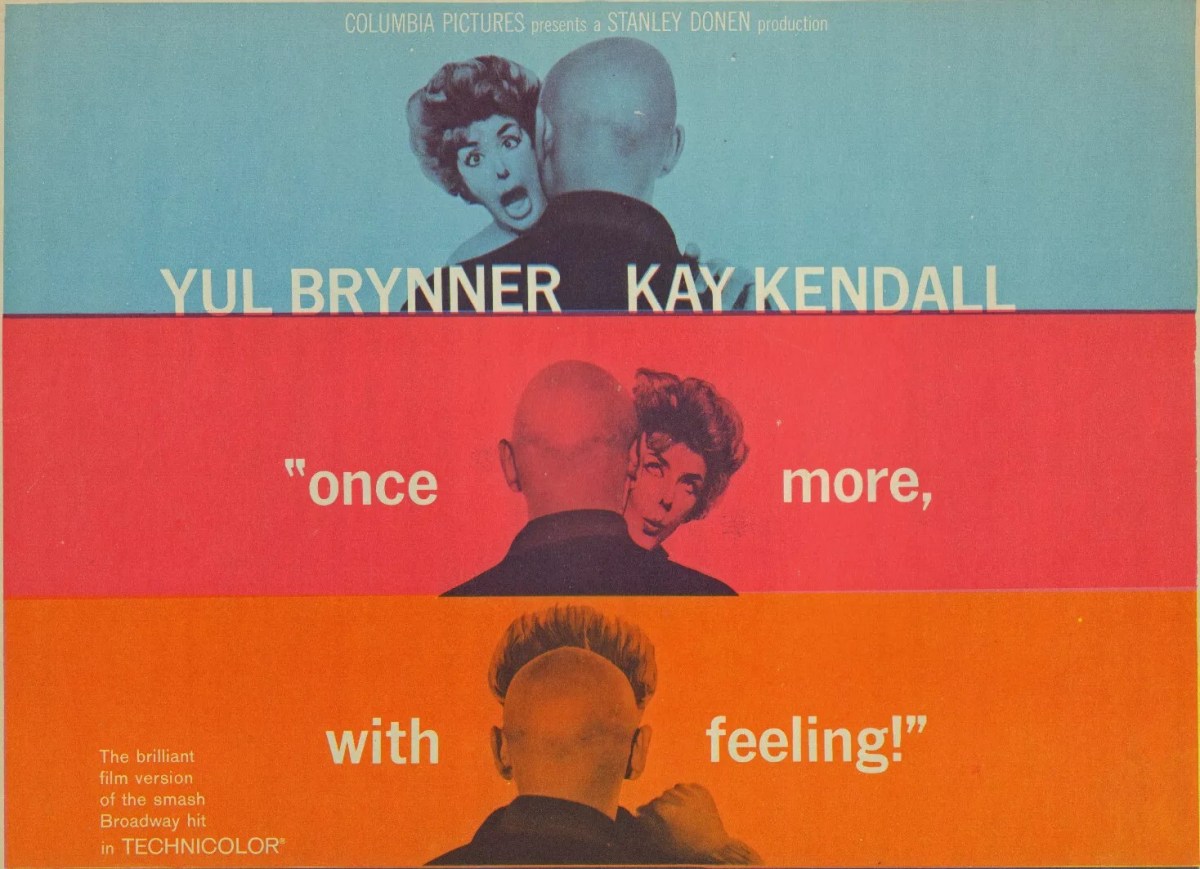
At the very least I had thought, given the involvement of classy director Stanley Donen (Charade, 1963) that this might go down as a glorious failure rather than just a straightforward glossy dud thanks to the woeful miscasting of Yul Brynner (The Double Man, 1967) and a bizarre plot. Am sure it must have appeared a welcome change of pace from a string of heavyweight dramas for the actor.
Adapted from the Broadway success by playwright Harry Kurnitz (Goodbye Charlie, 1964) this never escapes its stage origins, too many dramatic entrances, faked dramatic faintings, unwelcome guests ushered out. That would all have been manageable had Yul Brynner shown the slightest instinct for comedy. Bluster doesn’t compensate. Playing a tyrannical orchestra conductor would hardly take any acting for a performer who radiated intensity.
Victor Fabian (Yul Brynner), as egomaniacal and temperamental as you’d expect from a top conductor, is caught in flagrante by harpist wife Dolly (Kay Kendall) with young musician Angela (Shirley Anne Field). After she storms out, he loses his mojo. Worse, his orchestra loses its most efficient fundraiser, since Dolly is the one who keeps donors sweet.
Dolly has wasted no time acquiring a new admirer, esteemed physicist Richard (Geoffrey Toone), and wants a divorce in order to marry him. But wait, there’s a catch. Not the obvious one that Victor turns over a new leaf and determines to win her back, abandoning arrogance in favor of humble ardent wooing.
No, she can’t leave him because, wait for it, they never married. Well that’s not so jaw-dropping as the consequence. He insists that she can’t get a divorce unless she marries him and during an agreed short period together presumably that will give him time to flex his romantic muscles and win her back.
I can only assume that in the sophisitcated circles in which they run, the idea that they have been living in sin might cause her considerable embarrassment. But I’m perplexed at the notion, even for the less permissive times, that this would provoke sufficient scandal – more scandal than getting divorced in the first place? Or that they would expect nobody to notice the sudden marriage and wonder how they have managed to so openly live together? This seems nothing more than a jumbled-up head-over-heels barmy plot strand.
Anyway, she agrees, and he does his best to win her back even to the extent of playing a piece of music, beloved of a sponsor, that he detests.
The plot belongs to the golden age of the screwball comedy but the picture doesn’t play it that way. There’s more to being frenetic in pursuit of laffs than just being frenetic and this never takes off.
While Brynner is strictly one-note and never manages to bring a suggestion of genuine romance into the proceedings, the director is equally at a loss to inject any oomph or style and it looks as if he’s done little more than film a stage show with all its cinematic limitations.
Kay Kendall (Les Girls, 1957) in her final role – she died of leukemia – is equally constricted by a character who huffs and flounces and never embraces the comedy side of screwball.
This was the first of two straight comedies pairing Donen and Brynner and I’m dreading its successor Surprise Package (1960). Kurnitz adapted his own play which had been a decent success on Broadway, so the movie failure can’t all be blamed on him.
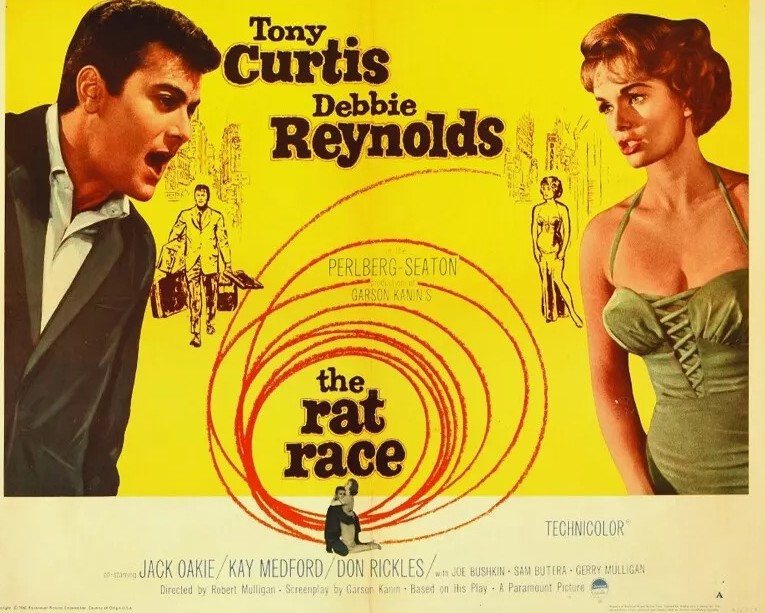
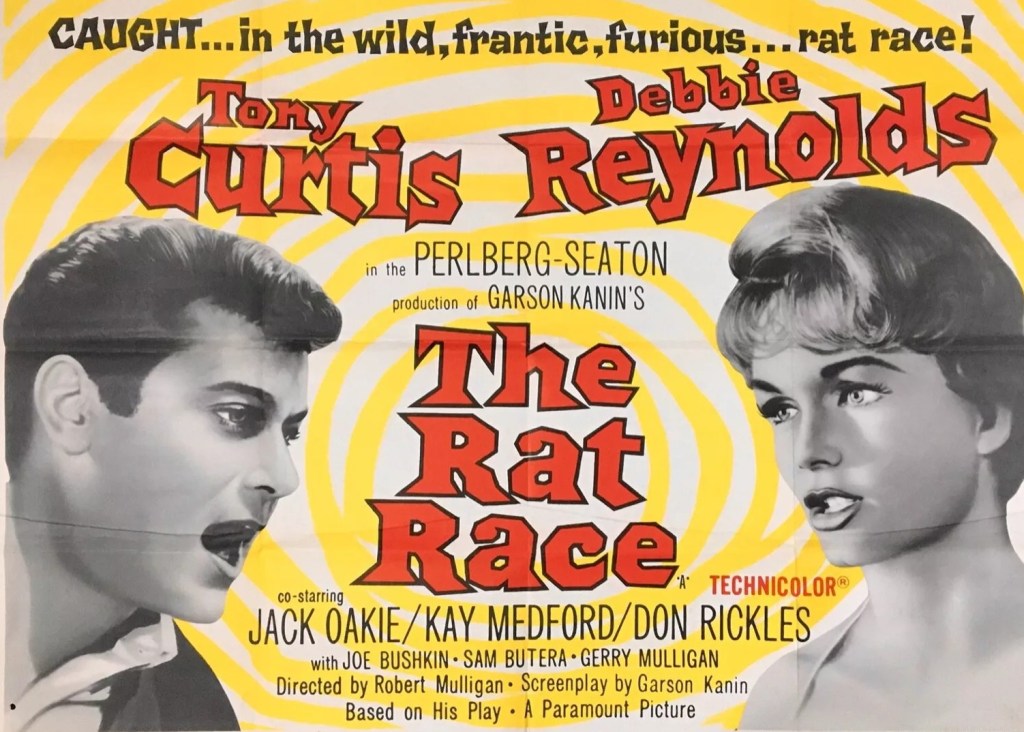
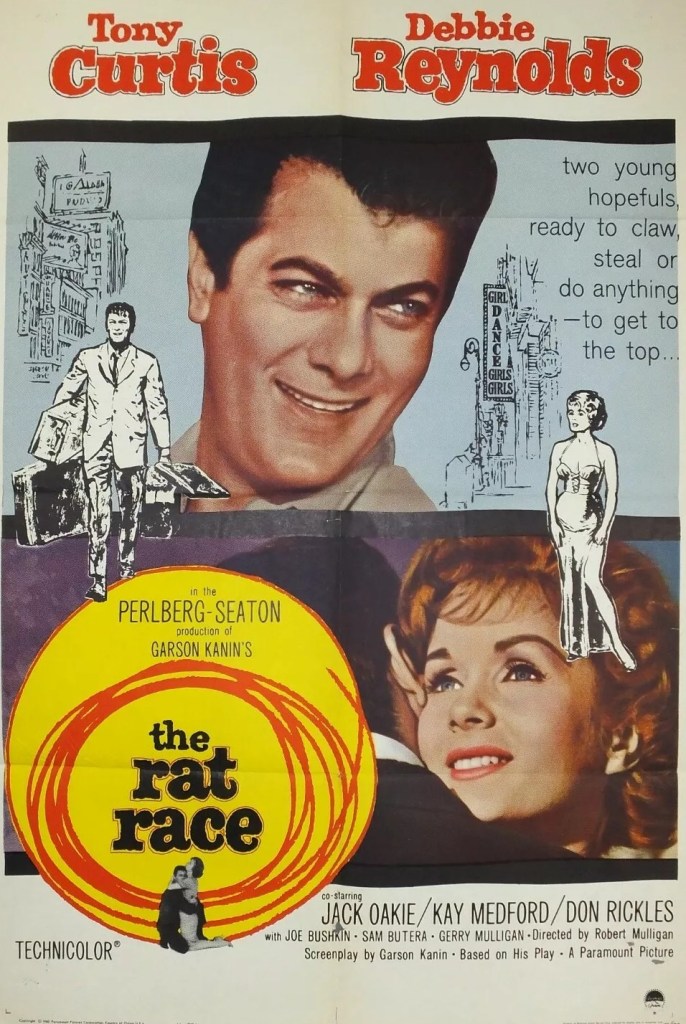
Surprisingly hard-edged tale with Debbie Reynolds giving the performance of her career and with a steely contemporary relevance. Snookers the audience into thinking it’s a standard romance, mismatched characters thrown together by circumstance, various rows and incidents to keep them apart before the expected happy ending. If screenwriter Garson Kanin had held his nerve, there wouldn’t be the get-out of a happy ending. As it is though, a formidable drama that doesn’t pull its punches.
From the title I expected a movie set in the world of big business, but instead we’re looking down on the lowest tiers of the entertainment business and, effectively, it’s a piece about the price paid for dreams. There are laffs, some good one-liners, but even these have a sourness to them.
Pete (Tony Curtis) leaves Milwaukee for New York seeking fame and fortune as a saxophonist, not realizing he’s more likely to join the thousands of out-of-work musicians already resident, dreams dashed but determined to avoid the ignominy of going home with their tails between their legs, not just to face the mundane life that awaits but seared through with the guilt of failure. Through circumstance he ends up sharing an apartment with model-cum-dancer Peggy (Debbie Reynolds), who’s already given up on her dream once, but couldn’t stand more than a few minutes of the home she’d clearly been desperate to leave.
Peggy is clean out of modelling assignments and hasn’t made it to Broadway, either, not even to a chorus line. Instead, she earns not much of a living as a taxi dancer, more innocent than it would be now in the era of the lap-dancer but still seedy enough with roving male hands. She’s paid to dance with complete strangers, the kind of deadbeats unlikely to ever get on the dance floor with a beautiful woman in the normal course of events.
She’s about to lose her phone, but not above leading on the creepy repairman (Norman Fell) to believe he’s onto a promise should he give her a break. Only pride prevents her solving her financial problems – as well as not making her rent she owes cash to her sleazebag boss Nellie (Don Rickles) – by going down the sex worker route.
Pete thinks he’s got the smarts but in fact he’s afflicted with dumbness and gets ripped off for a mink coat made of cat fur and then loses a complete set of brand-new musical instruments to another scam. When he’s thrown the lifeline of a gig on a cruise ship, Peggy stumps up to buy him a new sax and the requisite tux. She’s paying for this with a promise to Nellie to enter the prostitution game, not quite spelled out as that but as close to the knuckle as you’re going to get in this era, the kind of soft-soap approach that worked for Butterfield 8 (1960).
When Peggy fails to deliver, Nellie humiliates her in the worst possible way. Beginning with her jewellery he strips her down to undergarments to show how much he owns her and just how good he is at playing hardball. It’s a gut-clenching scene. Sure, you know there’s not going to be any nudity, not in this period before the Production Code got flattened, but even so, it works extraordinarily well, especially as clearly Peggy doesn’t know just how far he will go and that he might not, in his quiet fury, be above turning her out into his club starkers.
Meanwhile, to ensure we get to the ending that audiences expected, Pete, on board the ship, has been ignoring any other romantic opportunities, and sending her a heartfelt letter a day, which she appears determined to ignore, knowing that the “rat race” isn’t the kind of world that accommodates long-term romance.
Suffice to say, when Pete manages to bail her out, that changes her mind, though the genuine Peggy would still have balked, knowing that, with their levels of talent, they were only going to become more wasted by lack of fulfilment.
So, yeah, happy ending, but you feel that’s been grafted on to allow audiences to take the rest of the tougher storyline. The MeToo campaign has exposed the pitfalls of the entertainment business, so what happens to Peggy wouldn’t come as a surprise to a contemporary audience.
By this point Debbie Reynolds (Goodbye Charlie, 1964) wasn’t known for drama, more for a spunky or sparky screen persona in a series of lightweight comedies or romances, this showed Hollywood what it was missing. Tony Curtis (Goodbye Charlie) had proven he could do comedy or drama and here he mostly plays it straight.
Director Robert Mulligan (The Stalking Moon, 1968) is probably responsible for maintaining the harder edge. This was originally a Broadway number, so I doubt if the sharpness would have worked so well in that medium. Garson Kanin (Where It’s At, 1969) and an uncredited John Michael Hayes (Nevada Smith, 1966) knocked out the screenplay based on the former’s play.
Producer Harold Mirisch purchased the rights to the 1960 Broadway hit play by Lilliam Hellman as a way of hooking William Wyler. He had originally signed up the director in the mid-1950s when his Paramount contract came to an end. This was before the Mirisch Brothers was an independent production entity and later responsible for films like The Apartment (1960), The Magnificent Seven (1960), West Side Story (1961) and The Great Escape (1963). At that point Mirisch worked for Allied, the upmarket offshoot of B-picture outfit Monogram. Allied backed Wyler’s Oscar-nominated western Friendly Persuasion (1956).
In 1960 Wyler was the most celebrated Hollywood director of the era, not just with three Oscars and ten nominations, but riding as high as anyone ever had after the monumental critical and commercial success of Ben-Hur (1959). He had his pick of the projects and had shown “great eagerness” to do Toys in the Attic. He was friends with the playwright Lillian Hellman and had filmed These Three (1936) from her stage play The Children’s Hour and The Little Foxes (1941) from her original screenplay.
But Wyler decided instead to opt for a remake of The Children’s Hour (1961), assuming that changes in public perceptions would permit him to bring to the fore the lesbian elements kept hidden in his previous adaptation, but, critically, it was a Mirisch production.
In his absence, the Mirisch Bros decided to stick with Toys in the Attic, possibly to bolster their attempt to be seen as a purveyor of serious pictures and hence a contender for Oscars, which would solidify their reputation, as would soon be the case. After consultations with distribution and funding partner, United Artists, “it was decided that…since we had considerable investment in (Toys in the Attic)… we should try and put together a film,” explained Walter Mirisch.
Next in line for directorial consideration was Richard Brooks who had acquired a reputation for adapting literary properties after The Brothers Karamazov (1958), Cat on a Hot Tin Roof (1958) and Elmer Gantry (1960). Initially, Brooks “had been so insistent and enthusiastic” about becoming involved. However, he, too, rejected the opportunity. He, too, after Oscar and commercial success, was riding high. “It was not because he did not wish to work with the Mirisches because he would be delighted to make a picture for them…but he felt it would be wrong for his career to do a film so similar in mood and background as the one he was working on, Sweet Bird of Youth (1962).”
In fact, it was probably more to do with his financial demands. He wanted $400,000 a picture, which was extremely high at the time, plus “a drawing account of $2,000 a week” (i.e. payment in advance of an actual production). While Cat on a Hot Tin Roof and Elmer Gantry had been box office hits, they were nothing like Ben-Hur. And Brooks already had other pictures in mind. He had purchased a book called Goodbye My Son – never filmed – and was already revving up for Lord Jim (1965) funded by Columbia.
Walter Mirisch eventually settled on television director George Roy Hill (Thoroughly Modern Millie, 1967). This would have been his debut except preparations for the movie dragged on and in between Hill helmed Period of Adjustment (1962), an adaptation of another play, this time by Tennessee Williams. He would later direct Hawaii (1966) for Mirisch.
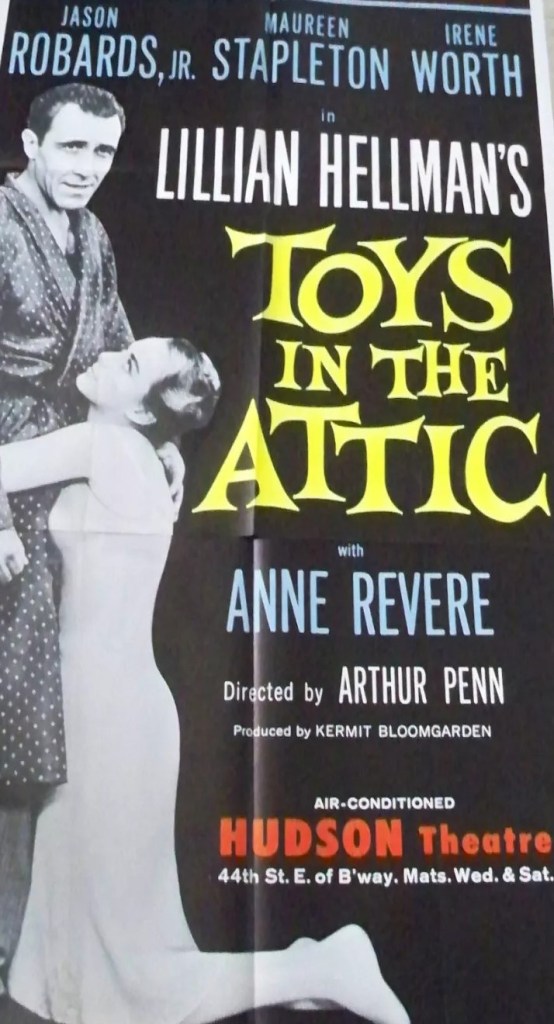
The play had been a significant hit, running for just over a year on Broadway at the Hudson Theater, and making $129,000 profit on a $125,000 investment, though it incurred a loss of $48,000 on a subsequent tour. Hellman did pretty well out of it too. She received ten per cent of the gross and twenty per cent of the profit – a total of around $36,000 – exceptionally good going for a playwright, especially when other monies would be forthcoming from movie rights and foreign and amateur runs. Director Arthur Penn’s share of gross and profit came to over $10,000 in addition to a $5,000 fee.
Turning a play or musical into a movie came with one inbuilt problem. It was inevitably subject to delay. No movie could go into production until the play had exhausted its theatrical (as in stage-play) possibilities. In this case, that meant 58 weeks in the original run and then another 20 weeks once it hit the road. Any contract with a significant movie player would have to include the possibility that in the meantime star or director would have lined up other projects while awaiting the green light on this one, and that in itself could cause further hold-ups.
Hill was in greater demand than Mirisch anticipated, juggling four separate projects – Period of Adjustment, The Rise and Fall of the Third Reich for MGM (never made), and the $2.5 million A Bullet for Charlemagne starring Sidney Poitier (not made) as well as Toys in the Attic.
Jason Robards, star of the play, was the obvious contender for the movie role. But he lacked box office cachet, so he was bypassed in favor of Dean Martin, “an attractive motion-picture figure.” However, in the time it took the movie version of the play to reach the public, Robards was potentially a screen star. He had bought himself out his stage contract after 37 weeks – paying $3,950 for the privilege – having been offered second billing on By Love Possessed (1961) opposite Lana Turner, and in Twentieth Century Fox’s ambitious mounting of Tender Is the Night (1962) opposite Jennifer Jones. While Robards would never become as big a star as Dean Martin, he was the superior actor, later adding two Oscars and one nomination to his name.
In addition to being much better known to cinema audiences than Robards, “we felt he (Martin) would bring humor to it” – Martin having originally made a splash as part of the Martin-Lewis comedy team of the 1950s – “as well as an audience that might expand the normal constituency of that type of film.” Trade magazine Box Office agreed with the decision, viewing Martin as a “good choice for the haunted show-off.”
The play’s other stars – Oscar nominee (and later winner) Maureen Stapleton (The Fugitive Kind, 1960) – and Irene Worth (Seven Seas to Calais, 1962) – were ignored in favor of Geraldine Page, who incidentally scored an Oscar nomination in Summer and Smoke, and Wendy Hiller (Sons and Lovers, 1960), who already had an Oscar. Shooting began on September 16, 1962. Hill tried to “inject more suspense, more action, more melodrama into the movie version,” without cheapening the material. He was convinced the hiring of Martin was inspired, and would prove a personal turning point, as he gives “the best dramatic job of his career.”
Titles didn’t matter so much on Broadway, plays sold on the name of the writer or the star. Mirisch feared Toys in the Attic would either mean nothing to a general audience ignorant of the picture’s origins or be considered so obscure as to serve to confuse them. So, they planned to rename it Fever Street or “some sensational substitute.” Hill was furious, pointing out the “violence of his feelings” to this title. He complained that “others will assume that it is an exploitation title…a cheap gimmick to get people into the theater (cinema) … automatically puts the picture in a low budget quickie picture category that might be appropriate for 42nd St all-night houses or a second feature at Loews 86 St.”
Hill felt changing the title would demonstrate that Mirisch was “ashamed to have bought the play Toys in the Attic, have no faith in the picture, are resorting to panic tactics to get some money out.” And that Fever Street would have the opposite effect, and “keep people away in droves.” His impassioned plea worked, and the original title remained.
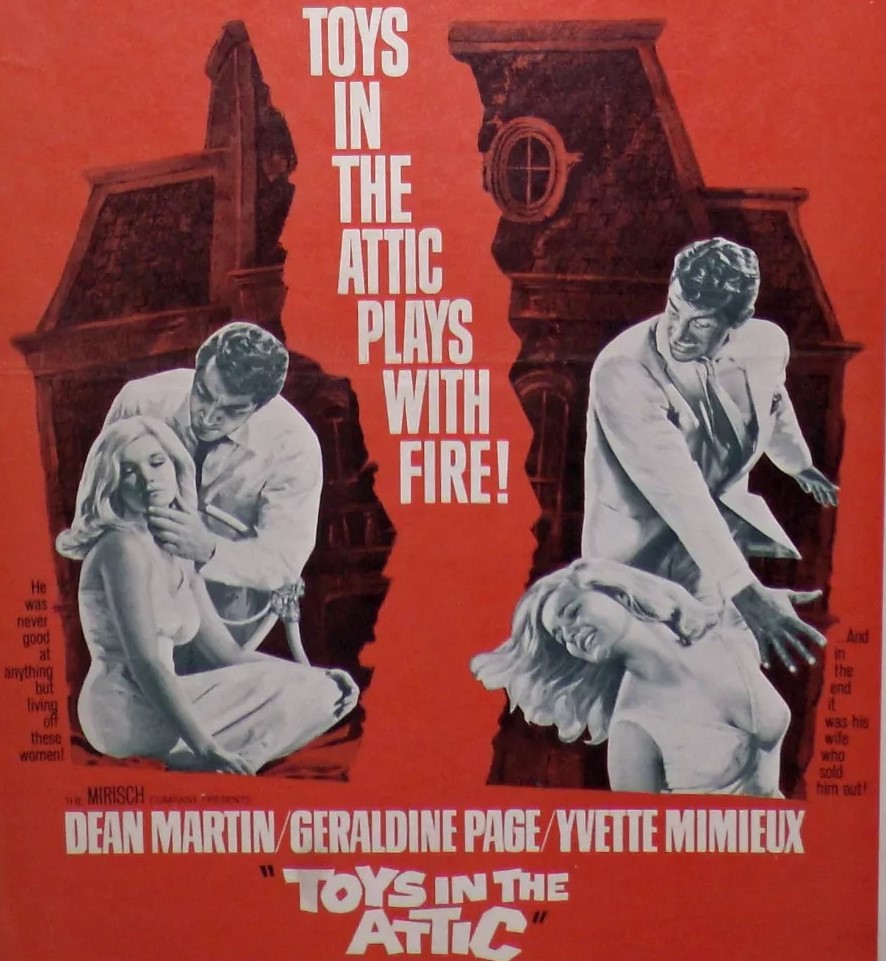
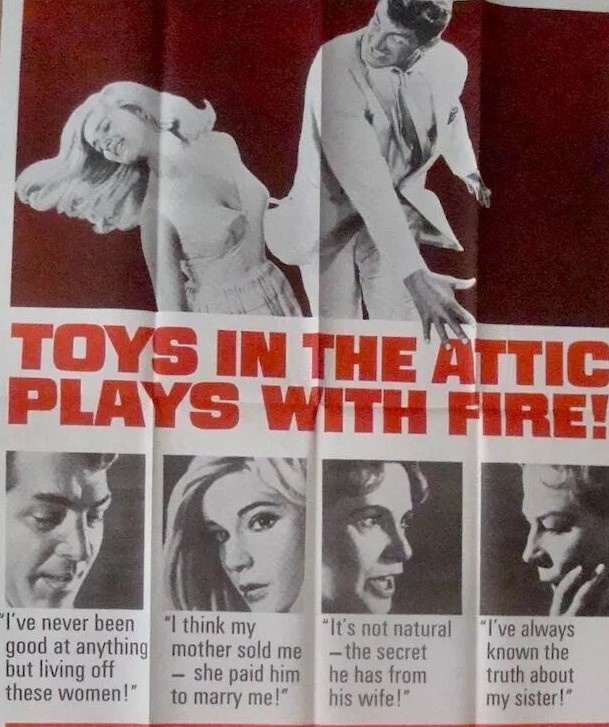
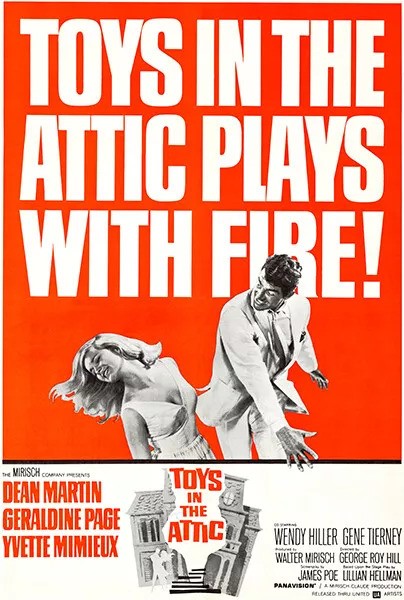
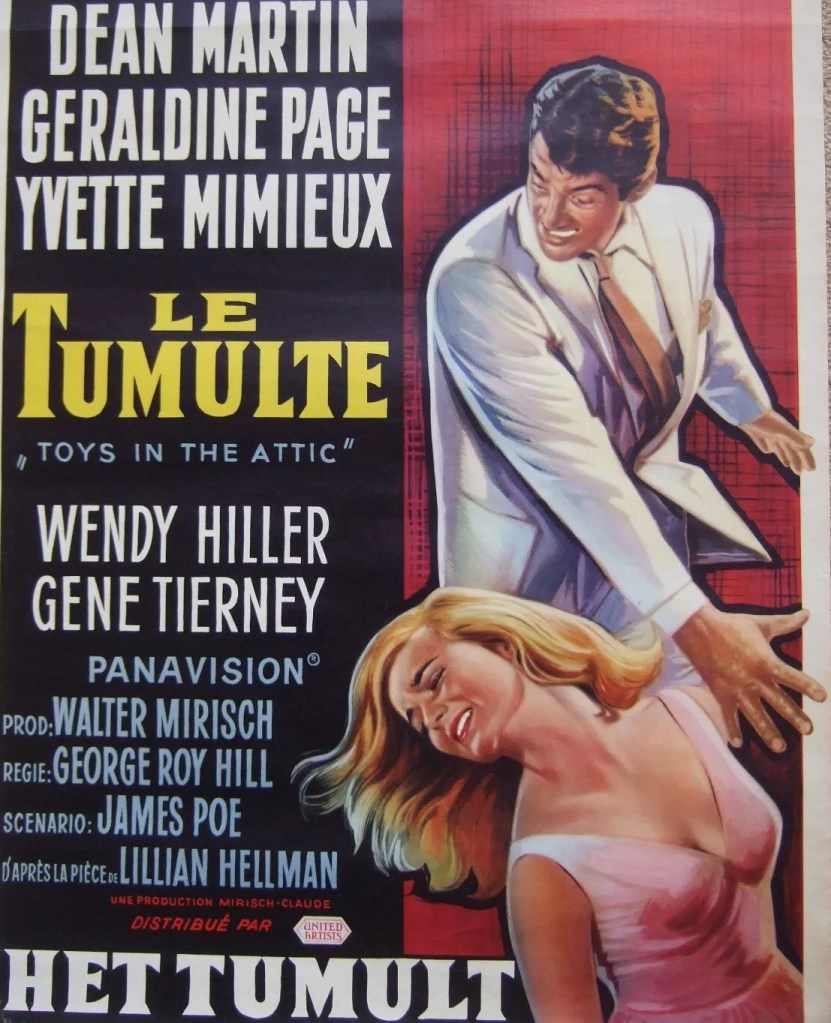
While backing down on the title, Mirisch veered towards the exploitative in the main poster which showed Dean Martin slugging Yvette Mimieux.
However, United Artists remained in two minds about the release policy. Despite the prestige of being chosen for the San Sebastian Festival, United Artists opted to open it in New York as part of a “showcase” run. That was a relativelynew distribution notion, a version of regional wide release. It would eventually be refined to allow several weeks in prestigious first run venues first, but inclusion in this release pattern meant first run was simultaneous with an opening in – in this case – another 20 New York neighbourhood cinemas. Had UA had more faith in the project, it might have benefitted from an opening just in first run. The $55,000 first week from two first run houses on Broadway was judged a “wow” result by Variety. First run in other major cities suggested a prestige title – “very stout” $15,000 in Boston, a “sock” $14,000 in Washington D.C., “neat” $14,000 in Buffalo, while it was “bright” in Kansas City ($8,000), Los Angeles ($10,000) and Chicago ($18,000).
Hill’s concerns about United Artists’ ability to sell the picture were mirrored in the result. “It did not turn out well,” concluded Walter Mirich, “It’s a grim story. It was not well reviewed and was not financially successful.” Part of the reason for its failure, he argued, was that it “probably appeared at the end of a cycle” of American Broadway adaptations of heavy Tennessee Williams dramas.
While the movie came in $70,000 below the $2.1 million budget, the savings were put down to the fact that it was filmed in black-and-white rather than color, as had been originally envisioned. The box office followed a common, but disturbing, trajectory, a big hit in the big cities, mostly ignored elsewhere. But it was not as bad as all that. Mirisch tallied the domestic box office as $1.7 million with another $900,000 from the overseas box office. By its estimation, once marketing costs were considered, it was facing a loss of $183,000. But that was before television revenue entered the equation and that should have at the very least, made up the difference. There were various pickings later on, too, picked up by CPI under the “Best of Broadway” label in 1981.
SOURCES: Walter Mirisch, I Thought we Were Making Movies, Not History (University of Wisconsin press, 2008) p157-159. Leon Goldberg, “Office Rushgram: Final Cost on Toys in the Attic, May 13, 1964, United Artists Files, Wisconsin Center for Film and Theater Research; “Mirisch Pictures Box Office Figures,” UA Files; Letter,” George Roy Hill to Walter Mirisch, March 15, 1963, UA Files; “Lillian Hellman Could Mop Up if Toys Clicks,” Variety, February 4, 1960, p103; “Toys Exit,” Variety, January 18, 1961, p72; “George Roy Hill To Direct Toys for Mirisch Co,” Box Office, January 22, 1962, pE8; “Hollywood Report,” Box Office, February 22, 1962, p16; “George Roy Hill Announces First Film on UA Deal,” Box Office, March 19, 1962, p16; “Bloomgarden Had Varied Fortune,” Variety, August 29, 1962, p49; “Toys in Attic Chosen for San Sebastian Festival,” Box Office, June 10, 1963, pE8; “Premiere Showcase,” Variety, July 31, 1963, p22. Box office figures from Variety issues dated August 7, August 14, August 21, September 4, September 11 and October 23.
Dean Martin is at his best when he’s not playing the character you expect. Coming over as big and brash came to define his screen persona, and that just wasn’t, unless a comedy job where he was being set up to be taken down a peg or two, as interesting as his quieter, slow-burn performances in Rough Night in Jericho (1967) or Five Card Stud (1967). To some extent Geraldine Page was known for over-the-top performances, generally quivering on the edge of some emotional disaster. Even in Dear Heart (1964), which I adored, despite her lively exterior, that was her character.
So you match that pair with relatively raw director George Roy Hill (Butch Cassidy and the Sundance Kid, 1969) and you can see the problems he has reining them in, especially as the movie is based on a topline Broadway drama written by the highly-venerated Lillian Hellman (The Chase, 1966). Screenwriter James Poe (Riot, 1969) accommodates some scenes outside the smothering atmosphere of the home of sisters Carrie (Geraldine Page) and Anna (Wendy Hiller).
Given it’s set in sweaty muggy New Orleans, the shadow of Tennessee Williams hangs heavily over the picture, though the Deep South twangs are not fully in evidence. Throw in that their brother Julian (Dean Martin) has brought home a child bride Lily (Yvette Mimieux), suspicious not just of her newfound environment but of her possibly already-straying husband, plus that he returns a wealthy man, when normally his entrepreneurship has usually dealt a losing hand, and you have the making of a rather predictable tale of home truths, overheated emotions and a hint of incestuous longing.
This is the kind of tale, reverberating with unhappiness and frustration, that requires an unlikely trigger to get going. It’s not as dumb as the murderer in the recently-reviewed “five-star” so-bad-it’s-good Doctors Wives (1971) who funds an escape from police custody by blackmailing his wife’s extensive band of lovers and getting a colleague to momentarily pretend to take on his identity.
This time it’s an overheard phone call and the conniving Carrie who suggests to the new bride that Julian has taken up with old lover Charlotte (Nan Martin), the source of his newfound wealth by helping him buy up cheaply land that her husband Cyrus (Larry Gates) needs for his business. This not only puts the marriage in danger but, when Cyrus realizes he has been duped by his wife, Julian’s life is threatened.
This is one of those films where the plot threatens to run away with the story which is essentially that the two sisters have come to expect that their wastrel brother is dependent on them and cannot accept it when he is not. Whereas dealing with a depressed loser maintains the family status quo, coming to terms with a winner takes some doing and jeopardizes existing relationships.
The sisters are equally jealous of each other, so there’s constant niggling. Escape is in the offing for too many of the characters. Julian, from his down-at-heel existence, the sisters from their poverty, Charlotte from her clearly over-dominant husband and Lily from what seems like an ill-chosen husband. That, in several instances, escape pivots on revenge makes the situation sweeter.
The sisters have the best scenes, but that’s a limitation. While audiences watching a stage play might remain in rapt awe at actresses dealing with their frustrations, within the confines of a movie, it weighs the picture down, two old maids quarrelling is hardly a concept that would have movie fans signing up.
Stage plays often suffered from translation to screen, if the characters were not sufficiently louder than life. It’s significant that none of the works of Arthur Miller, not even his masterpiece Death of a Salesman, managed this. Tennessee Williams was more successful because of leading characters with explosive temperaments. The Glass Menagerie (1950), A Streetcar Named Desire (1951), The Rose Tattoo (1955), Cat on a Hot Tin Roof (1958) and Suddenly, Last Summer (1959) were showered with Oscar wins and nominations and generally hit the box office mother lode.
Lillian Hellman was largely in the Arthur Miller category when translating her stage plays to the screen. While The Dark Angel (1935) and These Three (1936) had enjoyed some success, The Children’s Hour (1961) had stumbled at the box office.
Fans of Dean Martin didn’t enjoy him going all hi-hat and in truth he comes up short compared to Wendy Hiller (Sons and Lovers, 1960) and Geraldine Page, both nominated for Golden Globes. Yvette Mimieux (Diamond Head, 1962) continues to show promise and Gene Tierney (The Pleasure Seekers, 1964) puts in an appearance.
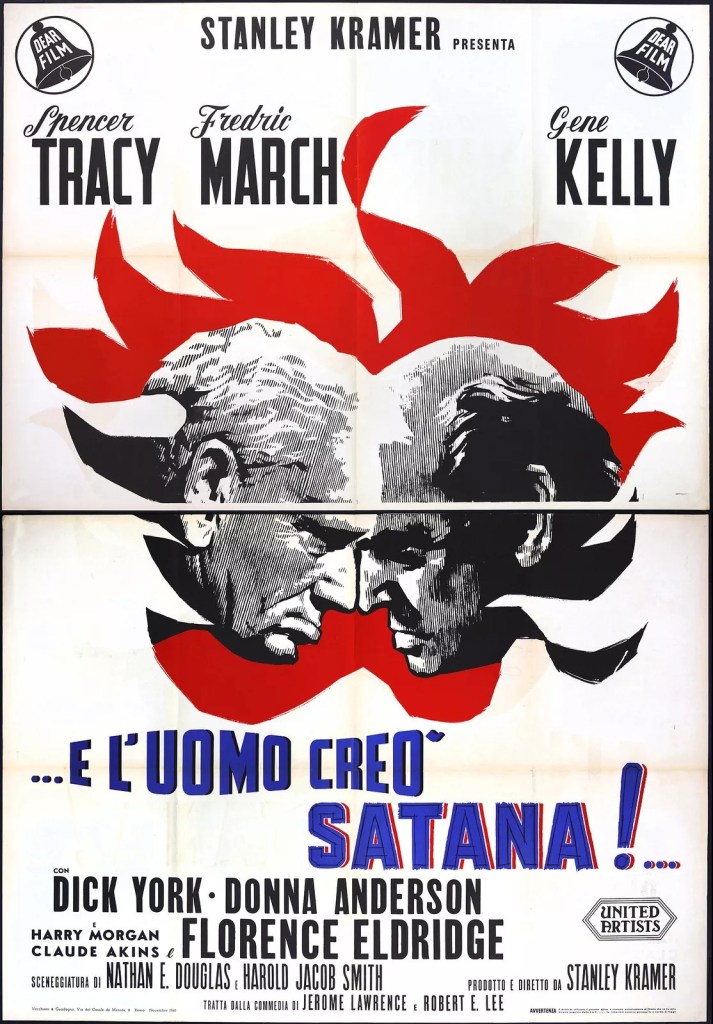
As timely as ever with America seemingly always on the brink of dictating what freedoms people can enjoy. At the time the target was the oppression engndered by McCarthysim, rather than the more basic tale of whether State law could forbid its citizens to talk about evolution. It was set almost a century ago, based on a real-life case, and even now fundamentalists reject Darwin’s theories. Setting aside the context, the principle contested is still the same – not just free speech but the right to be different. You could even argue that scientists and fundamentalists are all agreed these days, that out of nothing came the universe, whether created by a Deity or someone operating a contraption called the Big Bang.
Setting aside the various arguments for and against Darwin’s theory, what we have, nonetheless, is an acting highpoint, a fabulous courtroom battle, of the kind adored by audiences, full of objections sustained, attorneys being warned by the judge, inadmissible evidence, smart remarks and witty rejoinders. This all takes place in a sweltering courtroom, temperature so high that the judge agrees to depart from court procedure and permit the verbal duellists to shed their jackets.
Given further depth because the antagonists, Henry Drummond (Spencer Tracy) and Matthew Harrison Brady (Fredric March), were once the best of pals, political allies, on the same side in the latter’s failed bid for the Presidency, and willing to accept the other’s personal foibles. Probably the first legal drama to accept that outside the courtroom the participants could be friends.
Luckily, most of it isn’t long speeches, but sharp comebacks, plus the detours, twists and turns that come about from concentrating more on the court than on any surrounding action, though there is forbidden romance, pastor’s daughter Rachel (Donna Anderson) defying her father over her love for the accused, schoolteacher Bertram (Dick York) whose teaching is in conflict with the Bible.
The most outraged denizens of the town get into a right tizzy, marches, religious songs, protest, but that’s leavened by commercial interests, a bank manager worrying that the town being ridiculed by those cleverer folks back east will harm his business, hoteliers, sideshow operators licking their lips at the financial bounty of reporters and gawkers descending on the town.
This is as you’d like to see Spencer Tracy, not the silent judge of Judgement at Nuremberg (1961), personality reined in by the weight of his decisions and the need to do right by those accused of even the most heinous of crimes, but the exuberant character, confident, up for battle, able to fend off any criticism and come back to any witticism at his expense with stinging repartee.
Fredric March, too, has a ball with a loudmouth character, convinced of his infallibility (except of course in terms of the Presidential Race), apt to stuff his face at dinner, but still with an intellectual thrust capable of parrying anything Tracy can throw at him. Tucked somewhere in between is weaselly reporter E.K. Hornbeck (Gene Kelly) whose newspaper has hired Drummond to defend Bertram in the hope of filling the front pages for days with the Trial of the Century (taking the prize from Leopold and Loeb the year before – both cases in real-life handled by Clarence Darrow).
Harry Morgan (The Flim-Flam Man/One Born Every Minute, 1967) plays the snipppy judge trying to maintain order while Claude Akins (Claudelle Inglish, 1961) the hellfire preacher. With so many interesting characters on parade, there’s never a dull moment, especially with each actor trying to wring every ounce of drama and/or pathos from their part.
Director Stanley Kramer (Judgment at Nuremberg) looks as if early on he made up his mind to give the actors their sway. There’s no reining in, even in the early scenes, with the populace up in arms and carrying very professionally-made signs and banners (no handwritten scrawls here, no sirree). And once Tracy and March hit their stride, it’s all an audience can do to sit back and admire. Sentiments expressed will still strike a chord, but, mostly it’s a testament to two great actors at the top of their game.
If you only remember March from the likes of The Condemned of Altona (1962) or Seven Days in May (1964) you should know he was a huge marquee attaction in his day, double Oscar-winner (and three nominations besides), as at home in swashbucklers like The Buccaneer (1938) as drama and comedies, leading man who could more than hold his own against top female stars – Greta Garbo (Anna Karenina, 1935), Katharine Hepburn (Mary of Scotland, 1936), Merle Oberon (Dark Angel, 1935) and Janet Gaynor (A Star Is Born, 1937).
Written by Nedrick Young (The Train, 1964) and Harold Jacob Smith (The McMasters, 1970) from the play by Jerome Lawrence and Robert E. Lee.









 The Magnificent 60s