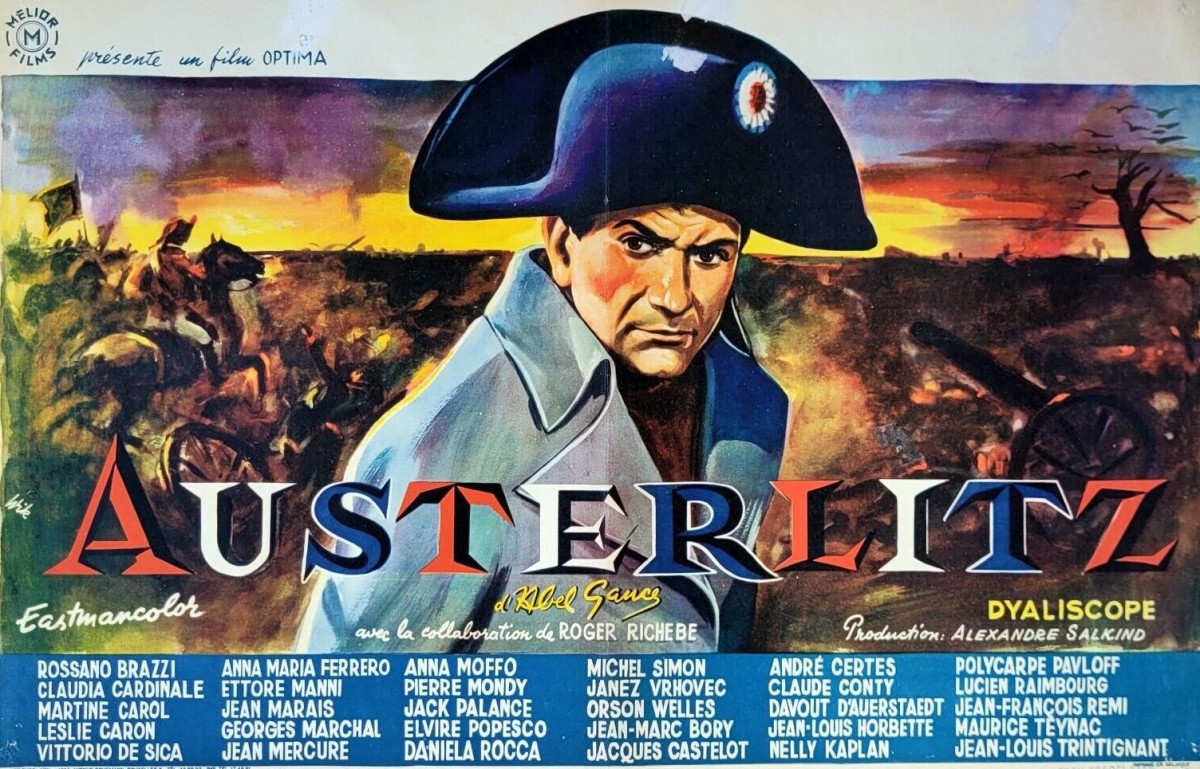
If I’d seen this first, I might well have resisted the publicity tsunami that welcomed in 1981 the restoration reissue of Abel Gance’s silent epic Napoleon (1927). It’s the equivalent of John Ford following up The Searchers (1956) with something as clunky as Cannon for Cordoba (1970).
Oddly enough, the first few minutes are outstanding in telegraphing the French leader’s myriad insecurities. He forces a flunkey not only to break in his stiff new shoes – for fear the master of all he surveys be seen limping along – but also his new hat and then cheats when he undergoes the self-imposed ritual of being measured, pushing up on his toes to elevate his height by two inches from its genuine five foot two inches.
After that splurge of exquisite exposition, it goes not so much downhill as up and down ever narrative pathway possible. No wonder Ridley Scott felt that encompassing this particular life required at least four hours (the length of the planned streaming version) and that Steven Spielberg aims to devote seven hours to the subject when he revisits Stanley Kubrick’s script for HBO.
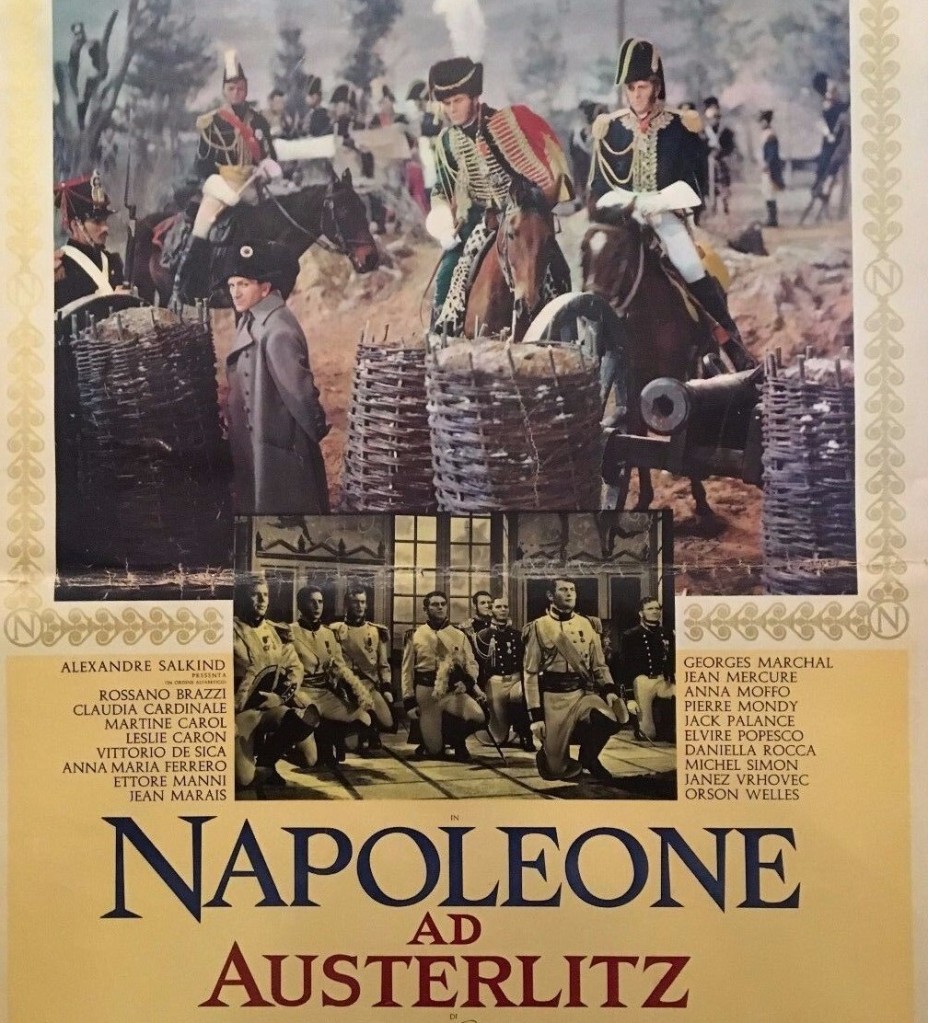
Mercifully, this part of the Napoleon legend is truncated to just three years, from the Treaty of Amiens in 1802, which purportedly brought peace to Europe, to the Battle of Austerlitz in 1805 when the French commander-in-chief demonstrated his military genius and shredded his opponents. But that battle is an almighty time coming.
In between, we have to put up with endless balls and endless characters shuttling through doors, although following the protocol of the time at least we have a clue who they are since they are announced by another flunkey in advance of their appearance. You would need Google open to check out who exactly they all are and what part they play.
Roughly, the story goes: Napoleon (Pierre Mondy) is attempting to achieve the “unification of Europe” (as would occur by more peaceful means over a century and a half later). The rest of Europe, naturally, isn’t in agreement so when foreign countries are not despatching assassins or reneging on treaties they’re lining up armies against him. Things are just as tough domestically. Even though, by overwhelming public vote, he has been named Consul for Life, he hankers after reviving the old title of Emperor, despite the last owner having his head chopped off.
Plus, there are problems on the romantic front, wife Josephine (Martine Carole) has taken a lover and is jealous of the imminent arrival of his former Italian lover. All in all, it’s a pretty busy affair with countless sub plots, including an attempt to dupe the English into thinking he plans to invade their country via Ireland, and American inventor Robert Fulton (Orson Welles) trying to sell him on the notion of an ironclad steamship and submarine. Even when he gets to war, it’s nothing but chatter and subterfuge, various underlings almost rebelling at his, according to them, lack of military skill and troops disobeying orders.
The battle also lacks that essential ingredient, of the audience being told exactly what’s going on and understanding just how clever a maneuver might be, and although there are thundering horses aplenty it comes nowhere near the scale and grandeur he achieved with Napoleon, nor, it has to be said, the later Waterloo (1970), except for the horses and men disappearing under the frozen lake.
It was the fate of Abel Gance to be ruthless edited, his monster Napoleon chopped by two-thirds for original U.S. release, this one losing one-third of its running time, though I suspect what was cut out was no great loss, assuming it was just more rigmarole and costume drama set around his court, although it might have helped in working out what part his sister Pauline (Claudia Cardinale) and Mlle de Vaudey (Leslie Caron) play in the proceedings. Though we could have done with less of the Austrian General Weirother (Jack Palance with an execrable accent). Pauline has the best line in the whole endeavour, refusing to sit on a couch because its color clashes with her outfit.
Nestling among the all-star cast you’ll find – or not, depending on which version you view – names like Vittorio De Sica (The Shoes of the Fisherman, 1968), Rossano Brazzi (The Battle of the Villa Fiorita, 1965) and Jean-Louis Trintignant (Les Biches, 1968).
Nobody does much to earn their crust and Pierre Mondy (The Night of the Generals, 1967) just looks irritated beyond belief that he got mixed up in this.
Far from director Abel Gance’s finest moment. Little more than an elongated information dump.
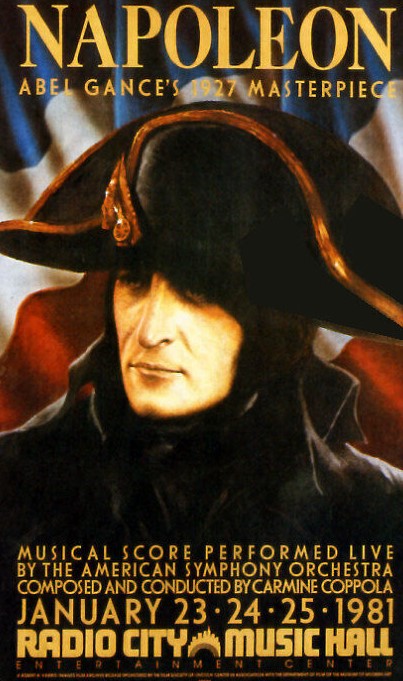
If you ever wondered what kicked off the fad for having live orchestras playing at screenings of older films, you might be even more surprised to discover that Napoleon (1927) was the cause. And, for that matter, created the “event” movie, another contemporary buzzword that appears to indicate a limited-time-only showing. Abel Gance’s picture also set up another template, one that every director and critic ascribed to in their thousands, the restoration. For, in one fell swoop, the revival of this picture in 1981 after over half a century of neglect, turned restoration into an event, worthy of acres of newspaper articles, hi-hat premieres, and subsequent profitable release in both the theatrical and ancillary pipeline.
Equally, as luck would have it, Abel Gance’s Napoleon (1927), truly was an event, a silent epic, the last section projected across three screens (the famed triptych, precursor of Cinerama and 70mm), road-shown with a full orchestra and ticket prices as high as $20. It became the “must-see” cultural happening of the year. American journalists gave director Francis Coppola virtually all the credit and he was certainly due everything that went with the bold showmanship and the financial risk, underwritten by his Zoetrope company, of launching the film in America’s largest cinema, the Radio City Music Hall in New York, with a complete score (incorporating classical music) by his father Carmine and the aforementioned full orchestra.
But in fact, the actual restoration had been carried out in Britain by silent film expert Kevin Brownlow – author of The Parade’s Gone By and director of It Happened Here (1965), the documentary Abel Gance, The Charm of Dynamite (1969) and Winstanley (1976) – who had compiled his version from eleven different sources including the Cinematheque in Paris, an MGM print and a seventeen-reel version from a private collector.
Thanks to Brownlow, Napoleon became “The Greatest Reissue Story Ever Told.”
Why? Because it was the result of obsession and passion, emotions every artist shares with every cinephile. Brownlow first came across Napoleon as a fifteen-year-old, and although he only glimpsed a few fragments, it was enough to trigger a quest that was to last nearly thirty years. Ironically, it was thanks to a quirky French invention that Brownlow encountered the Gance masterpiece. Where other countries adapted the 8mm format for showing abridged features at home, the French projected these films on a 9.5mm gauge.
After being gifted such a projector for his eleventh birthday, Brownlow started hunting down and purchasing silent films. In 1954, at the age of fifteen, disappointed by Jean Epstein’s Lion des Mongols (1924) he asked for a replacement and was offered two reels of a movie of which he had never heard – Napoleon vu par Abel Gance. It proved a revelation. He was “converted as surely as Paul on the road to Damascus.” He found exhilarating the “rapid cutting and swirling camera movement…and the magic of the visuals were exceptional.” From scouring junk shops and advertising in magazines, he assembled other reels and began showing a 90-minute version to family, friends and other film lovers. Even when the British National Film Archive turned down the opportunity to view the picture Brownlow, undeterred, wrote to Gance and, by happy coincidence in 1955, was invited to meet the director at the British Film Institute.
The accepted version of the Gance story was that Napoleon was a neglected masterpiece, but that was not strictly true. If the parade had passed him by, it was not for want of trying. Napoleon was revived (although primarily in France) as Napoleon Bonaparte in 1935 and in 1953-1955 on the back of his original technological innovations and other films about the French Emperor. In directing the silent picture, Gance had anticipated the arrival of sound and made his actors speak actual dialogue which later facilitated dubbing. The 1935 sound reissue (140 minutes including new footage), partly piggybacked on a new film about Napoleon written by Mussolini.
The next revival owed everything to recognition of his part in creating the first wide screen. Another French inventor Henri Chretien, inspired by Gance’s triptych, had invented what Twentieth Century Fox marketed as CinemaScope. While delighting in Chretien’s process, French journalists recognized Gance’s contribution. In 1953, when Twentieth Century Fox toured Cinemascope throughout Europe one port of call was the Venice Film Festival where the organizers “planned to surprise those who think widescreen is a new thing” by showing Napoleon on the CinemaScope screen.
Gance timed public demonstrations of his process (called Polyvision) to coincide with the launch of The Robe. The arrival of Cinerama also sent journalists delving into the past. However, Gance’s film had to wait until 1955 for another commercial outing, when it rode in on the heels of Sacha Guitry’s phenomenally successful Napoleon (the most expensive French film ever made and a box office smash) and enjoyed a two-year run at the Studio 28 arthouse in Montmartre aided by the releases of Desiree (1954) starring Marlon Brando and King Vidor’s War and Peace (1956). Independent distributor Tomas J. Brand acquired the U.S. rights in 1954, hoping to interest Cinerama in showing the movie as a “spectacle.” Gance toured his process, renamed Magirama, through France in 1956 but his comeback venture Austerlitz (1960) with an all-star cast of Orson Welles, Claudia Cardinale, Maurice Chevalier, Leslie Caron and Vittorio de Sica flopped in the U.S.
And there, pretty much, the matter lay, the parade now racing past Gance, until 1969 when, separately, Brownlow, using the facilities of the British Film Institute, began work on restoring the silent picture, while French film director Claude Lelouch (A Man and a Woman), who owned a cinema devoted to classics, purchased the rights and with funding from the French government released in 1971 (the 150th anniversary of Napoleon’s death) the 235-minute sound version Bonaparteand the Revolution, with some new scenes shot by Gance, who had reworked other scenes and added a color preface. Outside of France, it was destined for the rarified atmosphere of the film festival circuit, turning up in Rotterdam in 1972, Boulogne in 1972, the University of California in 1973, Paris again in 1973, not reaching New York till 1976.
Brownlow was aghast at this version, which had, in effect, been butchered by its maker, but after running out of money to complete his version turned in 1975 to the British National Film Archive which made a master print. The U.S. rights were purchased by Image Film Archive in 1975, which, with the New York Museum of Modern Art, purchased the rights to the MGM negative which contained several sections never seen before and working with Brownlow produced the five-and-a-half hour silent shown at the Telluride Film Festival in late summer 1979 in the presence of the director on a giant exterior screen erected by mountaineers for a screening beginning at nine o’clock at night. This edition, with music by Carl Davis, was the highlight of the London Film Festival in November 1980.
Interesting though all this was to the film buff, it was not going to make headlines across America. That was where Coppola’s marketing genius came in. He saw the necessity of creating an event that would match Gance’s ambitious scope and in one fell swoop remove restoration from the discreet chambers of museums and arthouses and push it out in the full public spotlight. For commercial reasons, Image Film Archive trimmed an hour, achieved by projecting the film at a faster speed and, at Brownlow’s suggestion, cutting scenes from the Toulon battle and a subplot concerning the secret passion of an innkeeper’s daughter for Napoleon.
Hiring Radio City Music Hall was an act of unsurpassed faith. The premiere on January 23, 1981, and two other performances cost $150,000, break-even set at ten thousand admissions (at $10-$15 a ticket) and the days when the Music Hall commonly did that were long gone. Bookings were sluggish until an article in the New York Times stimulated interest.
Napoleon at the Radio City Music Hall counted as three days that shook the reissue world. A gross of $297,000 spurred further showings. Image Film archive envisaged a 70mm version to avoid the necessity of projecting across three screens. If New York was a marketing coup, it was just the start. Coppola and Image Film Archive conceived an even bolder strategy. The movie would embark on an old-fashioned roadshow, harking back to the days of Griffith’s Birth of a Nation, when print and orchestra traveled from city to city. The touring schedule took in Columbus, Chicago and Los Angeles (in time for Bastille Day). Tickets would cost $10-$20. The 3,890-seat Chicago theater racked up $195,000 for the first four performances, $199,000 for the second four and $173,000 for the third. The 2,750-seat Midland in Kansas City pulled in $150,000, in New Orleans at the 2,800-seat Saenger Performing Arts Center it was $232,000, in Syracuse $93,000 at the Area Landmark.
By July the gross from just forty-five performances was over $2.5 million and for cinemas that could not afford the expense of a live orchestra the score was married to the print. Two more weekends at the Radio City Music Hall in October added $834,000. By year end that had more than doubled, an unbelievable sum for a silent movie revival. The way the film was presented was seen as the reissue catalyst to fight the twin onslaught of video cassettes and cable, since it could not be mounted anywhere but a cinema.
In a move that would have far-reaching implications for the reissue business, Universal’s new classics division was emboldened to buy the worldwide rights from Image. “This will be the kind of event that will be the mainstay for exhibitors over the next five to ten years as we come to grips with home entertainment,” prophesied Ben Commack Jr., the unit’s boss. “If all we get are film buffs, we’ve failed,” he added, “There’s no reason why this film can’t be accessible to mainstream audiences.” A second release wave in 1982-1983, minus the orchestra, targeted smaller first run emporiums in eleven key cities, following a more traditional roadshow pattern of two performances a day and three on Saturdays, an intermission and sales of posters and records in the lobby.
The 70mm six-track stereo version, utilizing the Carmine Coppola score, was tested at the 915-seat Cinerama Dome ($7.50) in Los Angeles. Brochures were distributed to high schools, colleges, hospitals, corporations and museums. The concept almost fell at the first hurdle, first week only $18,400. The second week rose by $100, and fell, but not by much, over the next three weeks. When a final week was announced, takings soared to $19,900. Universal need not have worried. Seattle opened “big” on two small theaters, Philadelphia figures were excellent, Pittsburgh was “wow,” San Francisco “dandy,” Denver “impressive” and Cleveland took in a “sensational” $40,000 opener. Returning to New York, it scored $9,000 at the 549-seat Sutton (at $5 a ticket) arthouse. Although the French premiere of the revival had taken place in Le Havre in 1982, the film did not open commercially until July 1983. Running at five-and-a-quarter hours and with top tickets priced at $20, the three shows at the 3,700-seat Palais de Congress saw twelve thousand admissions.
All in all Napoleon was a triumph, grossing $7.5 million worldwide, certainly the most unexpected reissue of all time, and one that changed attitudes to revivals for the next three decades.
SOURCES: Brian Hannan, Coming Back to a Theater Near You, A History of Hollywood Reissues, 1914-2014 (McFarland, 2016) p275-279; Kevin Brownlow, Napoleon, Abel Gance’s Classic Film, (London: Jonathan Cape, 1983); “Il Duce’s World Try on Napoleon Pic,” Variety, April 3, 1935, 19; “20th Fox Adaptation of Chretien System Stirs Paris Interest in 3D,” Variety, August 19, 1953, 13; “27 Pix from 16 Lands Incl Russia in Venice Festival Race This Week,” Variety, August 19, 1953, 3; “More 3D Systems Flooding Paris,” Variety, September 2, 1953, 10; “The New Always Has a Past,” Variety, November 3, 1954, 20; “Gance Preps Polyvision Prod. like Cinerama,” Variety, August 17, 1955, 14; “Gance Takes His Screen Process on Road Tour,” Variety, November 21, 1956, 14; “Abel Gance, at Age 90, Hit of Telluride; Napoleon on 3 Screens Runs Till 3am,” Variety, September 12, 1979, 28; “Gance’s Napoleon to be Shown at Nuart,” October 23, 1979, 17; “Zoetrope Mulls Symphonic Music for Gance’s Napoleon at Radio City,” Variety, March 19, 1980, 6; “British Slighted on Napoleon,” Variety, November 4, 1980, 1; “1926 Napoleon to Play Music Hall,” Variety, November 5, 1980, 1; Vincent Canby, “Gance’s Silent Napoleon is Reconstituted,” New York Times, January 24, 1981; “1927 Napoleon Makes Strong Showing,” Variety, January 27, 1981, 3; “Napoleon Sellout Prompts Added Screenings,” Variety, January 28, 1981, 2; “Picture Grosses,” Variety, 1981 – Chicago (April 29), Kansas City (May 27); “Napoleon Wow B.O. with 232G, 4 Shows; Syracuse is also Happy,” Variety, July 8, 1981, 5; “Napoleon Grosses $2.6-Mil to Date,” Variety, July 21, 1981, 4; Kevin Brownlow, “Napoleon a Triumph,” New York Times, October 11, 1981; “U’s new deal for Napoleon,” Variety, December 4, 1981, 2; “Big Rental Films of 1981,” Variety, January 13, 1982, 42; “Napoleon Retakes Paris,” Variety, July 27, 1983, 7.
Purportedly, Frenchman Abel Gance got the idea for his film while walking down Broadway in New York in 1921. At that point he envisaged what we would these days term a “Napoleon Universe,” a series of six interlinked films (although early U.S. reports promised eight films) tracking the Emperor from his student days to exile in St Helena. Gance was a successful director, from La Droit a la Vie in 1917 to J’Accuse two years later each successive film had out-grossed the last. His La Roue / The Wheel (1923) was so lauded that French critics put it on a par with the later Citizen Kane.
He conceived each film to run about 5,500 feet for domestic release with a reduced version for the United States market. Unfortunately – or fortunately, depending – he could not contain his ambition. The film, eventually restricted to just the early part of Napoleon’s career, took two years to make, beginning in 1925. But his innovations included dolly shots, handheld camera, overhead camera, footage shot from the back of a horse, tracking, rapid editing and split screen. It’s worth remembering just why cameras were so static during that period – moving them was extremely laborious and time-consuming, which meant it cost too much money to do. And when it did move, the unsteady camera attracted too much attention. Gance wanted movement to be discreet, not just for its own sake.
He also invented an extremely wide-angle lens and then the camera employed for the triptych. Anticipating the arrival of sound, and although they could not be heard, he made his actors speak dialog, which facilitated later dubbing. And if that wasn’t enough, he conducted tests in 3D – used in the battle scenes it was discarded for distracting the eye. Rock salt substituted for hail and filming proved so dangerous there were 220 insurance claims.
Gance took another swipe at the legend in 1960 with an all-star cast but no better results at the box office.
It cost $500,000 – equivalent to $8.7 million today – a hefty sum for those days but nothing compared to MGM’s Ben-Hur which cost eight times as much. However, Gance had anticipated box office returns of $4.4 million. As well as his technical skills, Gance was a whiz at salesmanship and eventually secured the bulk of his funding from Russian entrepreneur Vladimir Wengeroff who had previously invested in German films. Wengeroff had earmarked Gance as a potential director for a projected movie version of War and Peace.
But with little finance from the major French studios, Gance retained control. Initially, he promised the first part would be completed by the end of 1924 with the rest two years later. In the end, part one was as far as he got. Initially, he planned to use four actors to play the Emperor at different stages of his life. Oddly perhaps from the modern perspective, he placed more emphasis on physical resemblance to Napoleon than acting ability and screen-tested over a dozen actors. In fact, the actor who won the part of the adult Napoleon was a “rank outsider,” considered too old and too fat. When tested Albert Dieudonne “looked rather like an old woman.” But when Gance’s original choice rejected the role, he returned to Dieudonne who had transformed himself into a slimmer person after undertaking an extreme diet.
The first of the innovative multi-screen images – nine in total – occurs early in the picture, in the snowball fight. Later, as many as 16 images would be superimposed. All this was achieved through technical drudgery, repeating shots endlessly until they fitted into a pattern, and Gance likened the effect to listening to an orchestra, not necessarily taking in each instrument but enjoying the accumulated effect. The snowballs were actually made from cotton wool so didn’t fly far. To achieve authenticity, the sequence took place in winter, parents outraged that their children in the conditions risked flu or bronchitis.
The chase scene filmed in Corsica employed camera cars, with other shots from cameras placed in pits, while extreme long shots over the hills and the use of wide angle lens enhanced the experience. But there were three cameras on the one car, one facing back, one sideways and another fixed to the running board. He also filmed from the back of a horse devising his own means of working the camera.
Ambition cost money. And soon the movie was in financial trouble, filming put on hold while the director sought new backers. Eventually, funding came from a new source. Despite its name, the Societe Generale du Films, originally set up to develop film itself, was actually owned by a Russian. The SGF funding came with a proviso – that if necessary it was entitled to edit the film to bring it down to the contractual length.
Gance’s boldest innovation was without doubt the triptych (more easily explained as film projected on three screens simultaneously in the manner, a quarter of a century later, of Cinerama). “I felt in certain scenes I lacked space,” he said, “That the picture was too small for me. Even a big picture was too small…I had the idea of stretching the screen. I didn’t know how. I vaguely thought if I put one camera on the right, one in front and one on the left I would have an enormous panorama.” To achieve this effect – his name is on the patent – he intended to mount three cameras on top of each other, in a pyramid linked by a motor.
There was no time to test the new equipment, manufactured by Debrie. It was completed just in time for the filming of the battle scene on 11 August 1926. When shooting ended in October 26 (though editing and post-production would continue into the following year), the producers had cause for celebration, the signing of a distribution deal with MGM, which promoted it in Variety as a “celebrated world epic.”
The version that premiered in Paris ran for 210 minutes although the following month the trade press were treated to a longer version. But it proved a flop. Even in France where audiences had been reared on the myth of Napoleon, and revered him, it was too long. Though MGM purchased it for American consumption, and some critics enthused (Variety deemed it an “extremely impressive job”) they cut it down (Variety was in agreement – noting “it would have to be sliced” while conceding “no picture producer can picture Napoleon in 70 minutes”) and it was given a very restricted number of showings. It was expected to attract most attention from the “sure-seaters” (i.e. arthouses).
Response was poor. Although shown in New York, it didn’t warrant information on the box office, suggesting it had been such a disappointment the figures were not revealed. At the 600-seat Arcadia in Philadelphia box office was “very bad.” However, returns at the 3,200-seat Loews in Montreal the returns were “above average.” That could possibly explained by Canadian affinity with France except that in Toronto the 2,300-seat Loews “took one in the jaw” at the box office. In Baltimore audiences “let it alone.” In Havana, exhibitors complained of Napoleon overload, this being the third film on the subject in as many months.
Although most U.S. exhibitors contended that interest from “the horde” in Napoleon was extremely limited that didn’t stop studios from churning out rivals. Films that may have got in its way included Frank Lloyd’s The Eagle of the Sea (1926), Napoleon (1927) with Lionel Atwill, Glorious Betsy (1928) with Dolores Costello, the German Queen Louise and Napoleon (1928) and Napoleon’s Barber (1928), one of the first talkie shorts.
In Britain, while critics doubted the effect of the triple screen, it was shown to “great success” at the Tivoli in London’s West End. But the promised general release failed to materialize.
The cost of creating “a new alphabet for the cinema” proved excessive. That the film sank into the vaults, quickly forgotten, ensured that when critics came to assess foreign silent pictures inevitably they alighted instead on Battleship Potemkin (1925) and Metropolis (1927). To all intents and purposes, Abel Gance’s Napoleon was gone – but it turned out not to be quite so forgotten and its resurrection ushered in a new experience in cinema-going.
SOURCES: Kevin Brownlow, Napoleon, Abel Gance’s Classic Film (Threefold Music, 2009); “French Napoleon,” Billboard, March 21, 1925, p85; Review, Variety, April 27, 1927, p20; Advertisement, Variety, October 26, 1927, p14; “Napoleon,” Kinematograph Weekly, December 15, 1927, p59; “Napoleon,” Variety, March 7, 1928, p50; Review, Kinematograph Weekly, July 5, 1928, p41; “Scenes From,” Kinematograph Weekly, July 26, 1928, p4; “Theatre Atmosphere,” Kinematograph Weekly, August 2, 1928, p50; “Too Many Napoleons,” Variety, October 24, 1928, p2; “Picture Grosses,” Variety, November 14, 1928, p9; “Picture Grosses,” Variety, December 5, 1928, p10; “Picture Grosses,” Variety, January 9, 1929, p7; “The Empire 13,” Kinematograph Weekly, January 17, 1929, p34; “Advertising Cost Biz for Stanleys,” Variety, February 6, 1929, p9.
Behind the Scenes: Napoleon (1927)
Purportedly, Frenchman Abel Gance got the idea for his film while walking down Broadway in New York in 1921. At that point he envisaged what we would these days term a “Napoleon Universe,” a series of six interlinked films (although early U.S. reports promised eight films) tracking the Emperor from his student days to exile in St Helena. Gance was a successful director, from La Droit a la Vie in 1917 to J’Accuse two years later each successive film had out-grossed the last. His La Roue / The Wheel (1923) was so lauded that French critics put it on a par with the later Citizen Kane.
He conceived each film to run about 5,500 feet for domestic release with a reduced version for the United States market. Unfortunately – or fortunately, depending – he could not contain his ambition. The film, eventually restricted to just the early part of Napoleon’s career, took two years to make, beginning in 1925. But his innovations included dolly shots, handheld camera, overhead camera, footage shot from the back of a horse, tracking, rapid editing and split screen. It’s worth remembering just why cameras were so static during that period – moving them was extremely laborious and time-consuming, which meant it cost too much money to do. And when it did move, the unsteady camera attracted too much attention. Gance wanted movement to be discreet, not just for its own sake.
He also invented an extremely wide-angle lens and then the camera employed for the triptych. Anticipating the arrival of sound, and although they could not be heard, he made his actors speak dialog, which facilitated later dubbing. And if that wasn’t enough, he conducted tests in 3D – used in the battle scenes it was discarded for distracting the eye. Rock salt substituted for hail and filming proved so dangerous there were 220 insurance claims.
It cost $500,000 – equivalent to $8.7 million today – a hefty sum for those days but nothing compared to MGM’s Ben-Hur which cost eight times as much. However, Gance had anticipated box office returns of $4.4 million. As well as his technical skills, Gance was a whiz at salesmanship and eventually secured the bulk of his funding from Russian entrepreneur Vladimir Wengeroff who had previously invested in German films. Wengeroff had earmarked Gance as a potential director for a projected movie version of War and Peace.
But with little finance from the major French studios, Gance retained control. Initially, he promised the first part would be completed by the end of 1924 with the rest two years later. In the end, part one was as far as he got. Initially, he planned to use four actors to play the Emperor at different stages of his life. Oddly perhaps from the modern perspective, he placed more emphasis on physical resemblance to Napoleon than acting ability and screen-tested over a dozen actors. In fact, the actor who won the part of the adult Napoleon was a “rank outsider,” considered too old and too fat. When tested Albert Dieudonne “looked rather like an old woman.” But when Gance’s original choice rejected the role, he returned to Dieudonne who had transformed himself into a slimmer person after undertaking an extreme diet.
The first of the innovative multi-screen images – nine in total – occurs early in the picture, in the snowball fight. Later, as many as 16 images would be superimposed. All this was achieved through technical drudgery, repeating shots endlessly until they fitted into a pattern, and Gance likened the effect to listening to an orchestra, not necessarily taking in each instrument but enjoying the accumulated effect. The snowballs were actually made from cotton wool so didn’t fly far. To achieve authenticity, the sequence took place in winter, parents outraged that their children in the conditions risked flu or bronchitis.
The chase scene filmed in Corsica employed camera cars, with other shots from cameras placed in pits, while extreme long shots over the hills and the use of wide angle lens enhanced the experience. But there were three cameras on the one car, one facing back, one sideways and another fixed to the running board. He also filmed from the back of a horse devising his own means of working the camera.
Ambition cost money. And soon the movie was in financial trouble, filming put on hold while the director sought new backers. Eventually, funding came from a new source. Despite its name, the Societe Generale du Films, originally set up to develop film itself, was actually owned by a Russian. The SGF funding came with a proviso – that if necessary it was entitled to edit the film to bring it down to the contractual length.
Gance’s boldest innovation was without doubt the triptych (more easily explained as film projected on three screens simultaneously in the manner, a quarter of a century later, of Cinerama). “I felt in certain scenes I lacked space,” he said, “That the picture was too small for me. Even a big picture was too small…I had the idea of stretching the screen. I didn’t know how. I vaguely thought if I put one camera on the right, one in front and one on the left I would have an enormous panorama.” To achieve this effect – his name is on the patent – he intended to mount three cameras on top of each other, in a pyramid linked by a motor.
There was no time to test the new equipment, manufactured by Debrie. It was completed just in time for the filming of the battle scene on 11 August 1926. When shooting ended in October 26 (though editing and post-production would continue into the following year), the producers had cause for celebration, the signing of a distribution deal with MGM, which promoted it in Variety as a “celebrated world epic.”
The version that premiered in Paris ran for 210 minutes although the following month the trade press were treated to a longer version. But it proved a flop. Even in France where audiences had been reared on the myth of Napoleon, and revered him, it was too long. Though MGM purchased it for American consumption, and some critics enthused (Variety deemed it an “extremely impressive job”) they cut it down (Variety was in agreement – noting “it would have to be sliced” while conceding “no picture producer can picture Napoleon in 70 minutes”) and it was given a very restricted number of showings. It was expected to attract most attention from the “sure-seaters” (i.e. arthouses).
Response was poor. Although shown in New York, it didn’t warrant information on the box office, suggesting it had been such a disappointment the figures were not revealed. At the 600-seat Arcadia in Philadelphia box office was “very bad.” However, returns at the 3,200-seat Loews in Montreal the returns were “above average.” That could possibly explained by Canadian affinity with France except that in Toronto the 2,300-seat Loews “took one in the jaw” at the box office. In Baltimore audiences “let it alone.” In Havana, exhibitors complained of Napoleon overload, this being the third film on the subject in as many months.
Although most U.S. exhibitors contended that interest from “the horde” in Napoleon was extremely limited that didn’t stop studios from churning out rivals. Films that may have got in its way included Frank Lloyd’s The Eagle of the Sea (1926), Napoleon (1927) with Lionel Atwill, Glorious Betsy (1928) with Dolores Costello, the German Queen Louise and Napoleon (1928) and Napoleon’s Barber (1928), one of the first talkie shorts.
In Britain, while critics doubted the effect of the triple screen, it was shown to “great success” at the Tivoli in London’s West End. But the promised general release failed to materialize.
The cost of creating “a new alphabet for the cinema” proved excessive. That the film sank into the vaults, quickly forgotten, ensured that when critics came to assess foreign silent pictures inevitably they alighted instead on Battleship Potemkin (1925) and Metropolis (1927). To all intents and purposes, Abel Gance’s Napoleon was gone – but it turned out not to be quite so forgotten and its resurrection ushered in a new experience in cinema-going.
SOURCES: Kevin Brownlow, Napoleon, Abel Gance’s Classic Film (Threefold Music, 2009); “French Napoleon,” Billboard, March 21, 1925, p85; Review, Variety, April 27, 1927, p20; Advertisement, Variety, October 26, 1927, p14; “Napoleon,” Kinematograph Weekly, December 15, 1927, p59; “Napoleon,” Variety, March 7, 1928, p50; Review, Kinematograph Weekly, July 5, 1928, p41; “Scenes From,” Kinematograph Weekly, July 26, 1928, p4; “Theatre Atmosphere,” Kinematograph Weekly, August 2, 1928, p50; “Too Many Napoleons,” Variety, October 24, 1928, p2; “Picture Grosses,” Variety, November 14, 1928, p9; “Picture Grosses,” Variety, December 5, 1928, p10; “Picture Grosses,” Variety, January 9, 1929, p7; “The Empire 13,” Kinematograph Weekly, January 17, 1929, p34; “Advertising Cost Biz for Stanleys,” Variety, February 6, 1929, p9.
Behind the Scenes: Napoleon (1927)
Purportedly, Frenchman Abel Gance got the idea for his film while walking down Broadway in New York in 1921. At that point he envisaged what we would these days term a “Napoleon Universe,” a series of six interlinked films (although early U.S. reports promised eight films) tracking the Emperor from his student days to exile in St Helena. Gance was a successful director, from La Droit a la Vie in 1917 to J’Accuse two years later each successive film had out-grossed the last. His La Roue / The Wheel (1923) was so lauded that French critics put it on a par with the later Citizen Kane.
He conceived each film to run about 5,500 feet for domestic release with a reduced version for the United States market. Unfortunately – or fortunately, depending – he could not contain his ambition. The film, eventually restricted to just the early part of Napoleon’s career, took two years to make, beginning in 1925. But his innovations included dolly shots, handheld camera, overhead camera, footage shot from the back of a horse, tracking, rapid editing and split screen. It’s worth remembering just why cameras were so static during that period – moving them was extremely laborious and time-consuming, which meant it cost too much money to do. And when it did move, the unsteady camera attracted too much attention. Gance wanted movement to be discreet, not just for its own sake.
He also invented an extremely wide-angle lens and then the camera employed for the triptych. Anticipating the arrival of sound, and although they could not be heard, he made his actors speak dialog, which facilitated later dubbing. And if that wasn’t enough, he conducted tests in 3D – used in the battle scenes it was discarded for distracting the eye. Rock salt substituted for hail and filming proved so dangerous there were 220 insurance claims.
It cost $500,000 – equivalent to $8.7 million today – a hefty sum for those days but nothing compared to MGM’s Ben-Hur which cost eight times as much. However, Gance had anticipated box office returns of $4.4 million. As well as his technical skills, Gance was a whiz at salesmanship and eventually secured the bulk of his funding from Russian entrepreneur Vladimir Wengeroff who had previously invested in German films. Wengeroff had earmarked Gance as a potential director for a projected movie version of War and Peace.
But with little finance from the major French studios, Gance retained control. Initially, he promised the first part would be completed by the end of 1924 with the rest two years later. In the end, part one was as far as he got. Initially, he planned to use four actors to play the Emperor at different stages of his life. Oddly perhaps from the modern perspective, he placed more emphasis on physical resemblance to Napoleon than acting ability and screen-tested over a dozen actors. In fact, the actor who won the part of the adult Napoleon was a “rank outsider,” considered too old and too fat. When tested Albert Dieudonne “looked rather like an old woman.” But when Gance’s original choice rejected the role, he returned to Dieudonne who had transformed himself into a slimmer person after undertaking an extreme diet.
The first of the innovative multi-screen images – nine in total – occurs early in the picture, in the snowball fight. Later, as many as 16 images would be superimposed. All this was achieved through technical drudgery, repeating shots endlessly until they fitted into a pattern, and Gance likened the effect to listening to an orchestra, not necessarily taking in each instrument but enjoying the accumulated effect. The snowballs were actually made from cotton wool so didn’t fly far. To achieve authenticity, the sequence took place in winter, parents outraged that their children in the conditions risked flu or bronchitis.
The chase scene filmed in Corsica employed camera cars, with other shots from cameras placed in pits, while extreme long shots over the hills and the use of wide angle lens enhanced the experience. But there were three cameras on the one car, one facing back, one sideways and another fixed to the running board. He also filmed from the back of a horse devising his own means of working the camera.
Ambition cost money. And soon the movie was in financial trouble, filming put on hold while the director sought new backers. Eventually, funding came from a new source. Despite its name, the Societe Generale du Films, originally set up to develop film itself, was actually owned by a Russian. The SGF funding came with a proviso – that if necessary it was entitled to edit the film to bring it down to the contractual length.
Gance’s boldest innovation was without doubt the triptych (more easily explained as film projected on three screens simultaneously in the manner, a quarter of a century later, of Cinerama). “I felt in certain scenes I lacked space,” he said, “That the picture was too small for me. Even a big picture was too small…I had the idea of stretching the screen. I didn’t know how. I vaguely thought if I put one camera on the right, one in front and one on the left I would have an enormous panorama.” To achieve this effect – his name is on the patent – he intended to mount three cameras on top of each other, in a pyramid linked by a motor.
There was no time to test the new equipment, manufactured by Debrie. It was completed just in time for the filming of the battle scene on 11 August 1926. When shooting ended in October 26 (though editing and post-production would continue into the following year), the producers had cause for celebration, the signing of a distribution deal with MGM, which promoted it in Variety as a “celebrated world epic.”
The version that premiered in Paris ran for 210 minutes although the following month the trade press were treated to a longer version. But it proved a flop. Even in France where audiences had been reared on the myth of Napoleon, and revered him, it was too long. Though MGM purchased it for American consumption, and some critics enthused (Variety deemed it an “extremely impressive job”) they cut it down (Variety was in agreement – noting “it would have to be sliced” while conceding “no picture producer can picture Napoleon in 70 minutes”) and it was given a very restricted number of showings. It was expected to attract most attention from the “sure-seaters” (i.e. arthouses).
Response was poor. Although shown in New York, it didn’t warrant information on the box office, suggesting it had been such a disappointment the figures were not revealed. At the 600-seat Arcadia in Philadelphia box office was “very bad.” However, returns at the 3,200-seat Loews in Montreal the returns were “above average.” That could possibly explained by Canadian affinity with France except that in Toronto the 2,300-seat Loews “took one in the jaw” at the box office. In Baltimore audiences “let it alone.” In Havana, exhibitors complained of Napoleon overload, this being the third film on the subject in as many months.
Although most U.S. exhibitors contended that interest from “the horde” in Napoleon was extremely limited that didn’t stop studios from churning out rivals. Films that may have got in its way included Frank Lloyd’s The Eagle of the Sea (1926), Napoleon (1927) with Lionel Atwill, Glorious Betsy (1928) with Dolores Costello, the German Queen Louise and Napoleon (1928) and Napoleon’s Barber (1928), one of the first talkie shorts.
In Britain, while critics doubted the effect of the triple screen, it was shown to “great success” at the Tivoli in London’s West End. But the promised general release failed to materialize.
The cost of creating “a new alphabet for the cinema” proved excessive. That the film sank into the vaults, quickly forgotten, ensured that when critics came to assess foreign silent pictures inevitably they alighted instead on Battleship Potemkin (1925) and Metropolis (1927). To all intents and purposes, Abel Gance’s Napoleon was gone – but it turned out not to be quite so forgotten and its resurrection ushered in a new experience in cinema-going.
SOURCES: Kevin Brownlow, Napoleon, Abel Gance’s Classic Film (Threefold Music, 2009); “French Napoleon,” Billboard, March 21, 1925, p85; Review, Variety, April 27, 1927, p20; Advertisement, Variety, October 26, 1927, p14; “Napoleon,” Kinematograph Weekly, December 15, 1927, p59; “Napoleon,” Variety, March 7, 1928, p50; Review, Kinematograph Weekly, July 5, 1928, p41; “Scenes From,” Kinematograph Weekly, July 26, 1928, p4; “Theatre Atmosphere,” Kinematograph Weekly, August 2, 1928, p50; “Too Many Napoleons,” Variety, October 24, 1928, p2; “Picture Grosses,” Variety, November 14, 1928, p9; “Picture Grosses,” Variety, December 5, 1928, p10; “Picture Grosses,” Variety, January 9, 1929, p7; “The Empire 13,” Kinematograph Weekly, January 17, 1929, p34; “Advertising Cost Biz for Stanleys,” Variety, February 6, 1929, p9.
That Fritz Lang’s Metropolis (1927) dominated the foreign film scene in the silent era was only because Abel Gance’s majestic Napoleon the same year was butchered on release and rarely seen outside its native France. Audiences who might fancy waiting for streaming to view Ridley Scott’s new epic on the grander four-hour scale might prefer to test their stamina against this early masterpiece that broke incredible new cinematic ground.
You could easily get the impression from the vast amount of innovation on display here that one man – and a Frenchman at that – had single-handedly decided to revolutionize the entire medium. Of course, France had been instrumental in the birth of cinema. Alice Guy was key to the development of narrative cinema although the world being male-dominated that singular achievement was erroneously handed over to George Melies.
Here’s the list of Abel Gance’s innovations: split screen (in fact, triple images), underwater shots, tinting, fast cutting, hand-held shots, extensive close-ups, point-of-view shots, superimposition, use of multiple cameras, mosaic shots and multiple exposure. Perhaps even more astonishing was that at the time the bulk of movie cameras were static. Even if the result had been, dramatically speaking, as dull as ditch water, it would have been of historical cinematic importance, possibly on a par with This Is Cinerama (1952) or House of Wax (1953), the first 3D.
And it if had been as visually striking and cinematically interesting as The Robe (1953), Twentieth Century Fox’s first demonstration of Cinemascope, it would have more than passed muster as a cinematic footnote.
Instead, it is just stunning. You couldn’t ask for a bolder storyline, the biopic of one of the most fascinating characters who ever lived, Napoleon Bonaparte, who resurrected France after the Revolution of 1789, conquered most of Europe, and rose from defeat and captivity to rally his troops for one final battle at Waterloo in 1815. Wisely, Abel Gance doesn’t attempt to cover all that territory, only going as far as the invasion of Italy, which marked the Little General’s rise as a battle master.
Unlike other directors such as Orson Welles who scarcely made another movie after one of his first efforts was butchered on release, Gance kept plugging away despite the debacle of Napoleon. “Venus of Paris” was shown in 1941.
Which version you see – the most common one comes in at around the four-hour mark but if you have the stamina there’s enough in the longer version to keep you engrossed for another couple of hours – will inform your assessment of the authenticity of the narrative and attest to the compelling nature of the tale.
Beginning with a young Napoleon revealing his military skills just to engage in a snowball fight, it moves with narrative focus and cinematic flair through his difficult time at school to the invasion of Italy. Some of the imagery is haunting, a freed pet eagle returning out of choice to his side, the French flag used as a sail, lightning illuminates hand-to-hand combat (that battle taking place in the kind of driving rain Kurosawa would employ in Seven Samurai, 1954), scenes change color, and the final unfurling of the triptych (three connected screens a la Cinerama) is one of the most visual climaxes in cinema.
But even the shortest version contains the bulk of the innovation, perhaps proving that dialog was the most redundant of all the cinematic developments. The trailer, which you can catch on YouTube (see link below), is almost jukebox cinema, a compilation of many of the greatest scenes. Unless you are familiar with silent cinema style, you might recoil at some of the acting, but, once you get into the swing of it, that seems to jar less.
Much as I am a huge fan of Ridley Scott (the extended version of Kingdom of Heaven, 2005, a long-time fave), I doubt if his version (even the longer one promised for the Netflix screening) will come anywhere close to the almost cinematic perfection of Abel Gance.
Don’t take Stanley Kubrick and martin Scorsese’s word for it, this is a must watch.




 The Magnificent 60s