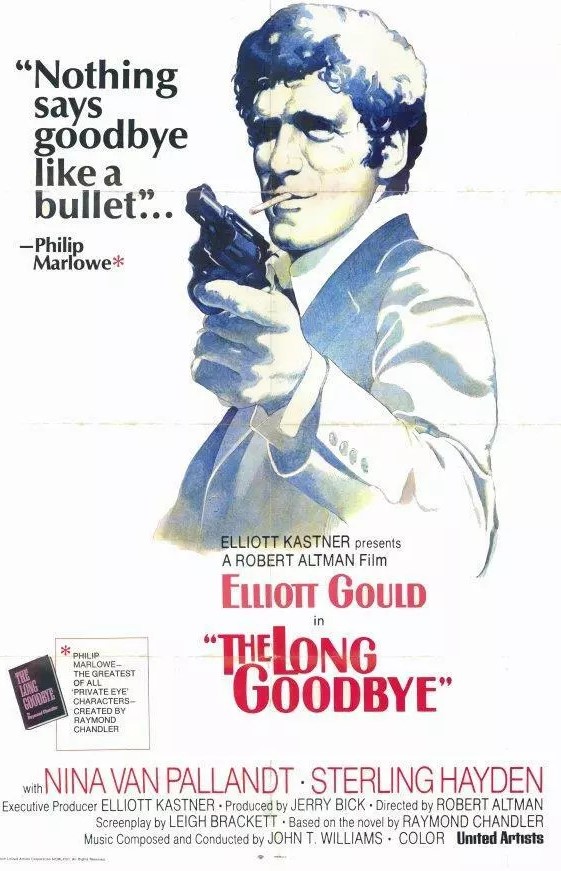
Indulge me. Perhaps the quirkiness that runs through The Long Goodbye is infectious. Here’s my question: can you buy matches loose in America? Do they sell them in bags and not boxes? If boxes, I’m assuming there’s no striking surface on one side of the box. Because here’s the niggling thought that was running through my mind all during the picture. I imagined the pockets of private eye Philip Marlowe (Elliott Gould) bulging with loose matches. Because if they were in a carton, like the cigarettes he appears to chain-smoke, wouldn’t he have to take them out of the box and empty them into his pockets or take them out one at a time from the box but not use the striking edge because, apparently, it’s just a lot easier to strike the match off any solid surface that’s handy – walls, tables, floors. Just asking.
I’m also asking; is he a lush? Or is the celebrated chasing after cat food opening just an attempt to find something as quirky as the credit sequence in Harper (1966) where a hungover Paul Newman re-uses his coffee grounds. Because Marlowe wakes up at half past three in the morning fully dressed and I’m guessing that’s not because he fell asleep reading a book.

It’s rammed full of “characters,” Dr Verringer (Henry Gibson) has a very curious running gait, there’s a gateman who can’t let a car pass without lapsing into an impression of a movie star and for neighbors Marlowe has the “Goodbye Girls” – as they’d be marketed in a Bond or spy film – a bevy of stoned topless yoga-loving females whose friendly overtures Marlowe has clearly resisted, providing him with some kind of moral rectitude.
Of course, this isn’t noir and you could argue this updated version doesn’t come close to the character author Raymond Chandler envisioned. There’s no mean streets here, not unless they’ve been tucked away somewhere between the very sunny side of Los Angeles and the upscale Malibu beach houses.
What is it is – is original. Set aside Marlowe’s mumbling and the menagerie of animals assembled, not just the cat but a fierce guard dog that scares Marlowe to death and mutts trained, presumably, to walk into the middle of a highway and ignore the honking horns, or to shag each other as if auditioning for porn.
Once the movie gets going, Marlowe is a proper detective in an immoral world where corruption doesn’t even have the decency to slink under the surface and self-indulgence is all. He’s got a case to crack – initially tracing missing Hemingwayesque alcoholic writer Roger Wade (Sterling Hayden) – but he’s not on the clock when he decides to investigate the supposed suicide of old buddy Terry Lennox (Joe Boulton) accused of the murder of his wife.

He’s a pretty clever snoop, finding ways into places he’s barred from entering, following suspicious people he’s not being paid to follow and, in the end, delivering his own kind of justice. There’s betrayal a-plenty, misbehaving wives and husbands, cops inventing their own rules. But mostly he’s a good guy adrift in a different wealthy immoral world. And there’s more humor than you’d expect. Some pretty good lines and sight gags. The hood who’s meant to be keeping his eyes on Marlowe fetching the binoculars so he can spy on the topless girls, a gangster whose preferred mode of apology is to strip stark naked.
And there’s a restless camera. It can’t stop moving, prowling around the characters who are mostly static, as if everyone has something to hide And just when you think, missing man found, this is all too aimless for words, there’s an exceptionally sharp crack of violence as gangster Marty (Mark Rydell) smashes a bottle across the face of his girlfriend (Jo Ann Brody) in the hunt for his missing loot. Contrapuntal is the suicide of Roger Wade, sucked into the surf, wife (Nina van Pallandt) and Marlowe not just helpless, but in trying to save him, in danger of drowning themselves.
If it wasn’t for people roughing him up, cops and gangsters alike, Marlowe might well have spent his time hunting for cat food. As it is, his antenna are up, he’s sniffing around, and pretty capable, as a solid private dick should be, of putting two and three together and working out what the hell has been going on. There’s a noir twist. Usually it’s the dame pulling a fast one on the hero, he’s it’s an old buddy.
There’s enough quirkiness to get you hooked and keep you thinking you’re watching an offbeat detective story, when, really, the quirkiness is some kind of stylistic MacGuffin to lure you into a more straightforward and very satisfying sleuth picture. You could be fooled into thinking director Robert Altman (M*A*S*H, 1970) had tossed away the detective story rule book, but he’s not, he’s just reframing the character for a different era.
There was a trend for movie directors to act – John Huston (The Cardinal, 1963) a repeat offender, Roman Polanski going in for a bit of nose-slitting in the same year’s equally stylistic Chinatown, and here we have Mark Rydell (The Reivers, 1969) who had been an actor in the 1950s.
But he doesn’t build his character from the inside as neatly as Sterling Hayden (The Godfather, 1972), adrift on a sea of booze, and one-time folk singer Nina van Pallandt who keeps her femme fatale credentials close to her chest. Admittedly, Elliott Gould (Bob & Carol & Ted & Alice, 1969) can sometimes be an acquired taste, but here he fits the groove perfectly. Don’t let the exterior, the mumbling, the self-absorption, fool you, this is the classic detective re-born.
Leigh Brackett (Hatari!, 1962), who had a hand in the original The Big Sleep (1946), wrote the script with an occasional improv. But this is very much a director’s picture.
These days, this would be called a re-boot, and it set a standard for the re-boot that’s never been matched, taking a much-loved screen character and refashioning him in a way that not only works but makes you think Humphrey Bogart could have done a better job.
A flop at the time – a paltry $1 million in rentals at the U.S. box office, less (barely $800,0000) abroad with the $1.5 million from television not enough to keep the red ink at bay – this has now, rightly, has come into its own as a majestic directorial triumph. Some credit due , too, to producer Elliott Kastner who made Harper and backed Altman’s singularly alternative vision.
I saw this at the cinema not for some kind of anni reissue (it’s year late for that) but just because reviving old pictures is what arthouses do.
Terrific.









 The Magnificent 60s