Central to this under-rated tale of psychopathy and racism is one extraordinary scene, possibly the most exceptional bar-room sequence ever filmed. In the annals of imaginative repulsion, it ranks alongside the rape committed by Alex and his “droogs” in Stanley Kubrick’s A Clockwork Orange (1971). It begins with mere intimidation as an unnamed young man (Bobby Darin) begins to etch into a bar-counter the lines and symbols of Tic-Tac-Toe (aka Knots & Crosses or Noughts and Crosses). Discovering tins of paint, the man and his gang proceed to cover the entire bar – floor, walls, ceiling, even tables – with the same symbols.
The humiliation is ratcheted up a notch when, after forcing the tavern owner (Howard Caine) to lie on the floor behind the counter, the bar hostess (Mary Munday), rigid with fear, is tormented. Using lipstick rifled from her handbag, the young man decorates her face in the same fashion before pulling down the back of her dress and doing the same there. Fortunately, the scene – although unlikely the reality – ends at this point.
Other potent scenes show how the man arrived at his crazed state, smothered with affection by a weak mother (Anne Barton) who has taken to bed by choice in order to escape his drunken, raucous father (James Anderson) who taunts his ineffective wife by flaunting to her face his casual pick-ups and making love to them in the same room. Indicative of the lonely child’s disturbed personality is that when he invents an imaginary playmate, it is to have someone to subjugate, making his fictional friend lick his boots.
Imprisoned during the Second World War for sedition, the man, suffering from blackouts and nightmares – in which he imagines himself clinging to the edge of a giant plughole before being swept away by a torrent of water from the taps – becomes a patient of a young, also unnamed, doctor (Sidney Poitier) whom he subjects to racial abuse. The doctor, physically bigger and more imposing than the patient, would like to simply give him a good thumping, but his profession necessitates that he treats this objectionable person as just another patient. And eventually they come to enough of a concord that the patient accepts treatment although the doctor suspects that his core personality has not changed.
The movie is layered with themes other than psychopathy and psychiatry. While the racist element is to the fore, including the doctor’s need to prove himself in a white man’s world, director Hubert Cornfield also explores the growth of right-wing extremism among the disaffected who see no contradiction in still espousing traditional American values, for example giving the Nazi salute while singing in all sincerity the national anthem. The African American doctor has to come to terms with lack of objectiveness when dealing with such an abhorrent person.
The movie flits between scenes between the two protagonists staged in a stagey manner and expressionistic almost dreamlike sequences representing the patient’s upbringing such as being menaced by his butcher father among the swinging carcasses of the store. The patient flashbacks are shown without dialog, explanation given in voice-over – far more potent use of this device than in Nothing but the Best (1964) – by either the patient or the doctor.
Reliance on visual dexterity, however, detracts from the tension and director Hubert Cornfield (The 3rd Voice, 1960) is also hampered by an unnecessary framing device which results in the story being told in flashback – and a conflation of flashbacks: of Poitier’s problems as a young doctor dealing with a difficult patent and the patient’s own life story. So the pressure indicated by the title is often undercut and does not build as much as you might expect. Critical reaction in those days pivoted on the racism elements, but a contemporary audience is almost certainly going to be more influenced by sequences involving the patient, so the picture automatically becomes more involved and Cornfield’s visual mastery more appreciated.
You can detect the influence of producer Stanley Kramer. In his capacity as director he had explored psychiatric therapy and antisemitism in Home of the Brave (1949) and racism in The Defiant Ones (1958) also with Poitier. As producer he was responsible not only for selection of the original material, based on a short story The Fifty-Minute Hour by Robert M. Lindner, but also imposing the present-day framing device, which Kramer wrote, on the picture. Those scenes relate to another psychiatrist (Peter Falk) coming to a much older and experienced Poitier for advice after hitting a brick wall with a similarly repugnant patient, Poitier telling the story of his treatment of the Bobby Darin patient as a way of showing that even the worst patients are treatable.
This is quite a different Sidney Poitier than you might be used to. Wearing suit and tie, and spectacles, this is a more restrained, measured performance. Poitier’s taboo-busting Oscar nomination for The Defiant Ones had not progressed his career that much, still restricted to starring roles in low-budget pictures. But Kramer broke another taboo in Poitier’s favor with this one, casting him a role not initially written as an African American.
Bobby Darin (Come September, 1961) had parlayed his status as hit recording artist into a burgeoning movie career but does not quite display the menace necessary for a fully-fledged psycho. Peter Falk (Machine Gun McCain, 1969) has a small one-tone role. The jazz-nuanced music by Ernest Gold (Exodus, 1961) is worth a listen. And if someone can tell me who designed the striking credit sequence, I would be very pleased.
Incidentally, the title of Lindner’s short story is ironic. Patients pay for one hour of a psychiatrist’s time but in reality only receive 50 minutes in order for the professional to achieve a swift turnaround and keep his/her appointment timetable scheduled to the hour.
Tic-Tac-Toe, in case you are unfamiliar with this two-person childhood game, consists of drawing lines to create nine squares and filling those with either a zero or a cross. The object of the exercise is to create a complete line of either symbols.
Charlton Heston started the 1960s if not as the biggest star in the world then at least the star of the biggest film in the world, Ben-Hur, released in the last month of the previous year, and ushering in the roadshow era. One of eleven Oscar winners for the picture, Heston’s career was at all-time high. While he wouldn’t ever enter the Steve McQueen/Robert Redford universe of being offered every conceivable script, he was still a huge marquee draw. And it’s interesting to see not so much just what he chose but what he rejected and why.
Often an automatic choice for epics in the vein of El Cid (1961), 55 Days at Peking (1963), The Agony and the Ecstasy (1965) and Khartoum (1966), he was versatile enough to play in westerns like Major Dundee (1965) and Will Penny (1967), ground-breaking sci fi Planet of the Apes (1968), war Counterpoint (1967), drama Number One (1969) and even leave room for some comedy The Pigeon That Took Rome (1962). When you were as big as Heston, you had choice and could vary your projects.
In 1960 while dithering over a poor screenplay for El Cid, Heston turned down By Love Possessed (1961) made by John Sturges, and From the Terrace (1960) which Mark Robson filmed with Paul Newman. Heston’s judgement was that both scripts were inferior to even what was currently being put before him for El Cid. While the Sturges flopped, the Robson did well.
The next year Samuel Bronston, producer of El Cid – and later 55 Days at Peking – attempted to tie Heston down to a picture about William the Conqueror and The Fall of the Roman Empire (1964). Nicholas Ray, who would direct Heston in 55 Days at Peking, wanted him for a picture about the Children’s Crusade. Twentieth Century Fox offered him a three-picture deal, beginning with western The Comancheros (1961). Heston “was leery” and rejected the project – and the overall deal – when the directors Fox initially suggested were too “routine” for Heston’s taste. Presumably, neither was legendary Warner director Michael Curtiz who made the picture with John Wayne.
Heston felt “a slight pang of guilt” turning down the opportunity to work with Laurence Olivier on an adaptation of Graham Greene’s The Power and the Glory because while it would receive cinematic distribution abroad it would be shown on television in the U.S. That went ahead with Olivier and Frank Conroy in the Heston role but with very limited overseas distribution.
He was very keen on Otto Preminger’s Advise and Consent (1962). It appealed “without reading the script.” However, he was offered the part of Brig Anderson, which he disliked. “I’m not put off by the homosexual angle,” he confided to his Journal, “but the part isn’t very interesting.” He pushed for Senator Cooley but Preminger was already chasing Spencer Tracy for that role and, when he passed, happy with second choice Charles Laughton.
Heston dithered over Easter Dinner because he didn’t want to work in Rome. Director Melville Shavelson suggested filming in Paris with Charles Boyer or Maurice Chevalier as co-stars. An alternative title was Americans Go Home. It became The Pigeon That Took Rome (1962) but a chunk was filmed on the Paramount lot.
Perhaps the most interesting prospect was a remake of Beau Geste (1939) with Dean Martin and Tony Curtis. Also on the table was The View from the Fortieth Floor from the bestseller by Theodore H. White.
In 1962 he became enamoured of a project he had previously rejected. The Lovers by Leslie Stevens (who would later create The Outer Limits television series) was a Broadway play starring Joanne Woodward in 1956. Heston now envisaged it as an ideal movie vehicle. He would spend the next few years trying to put it together; it became The War Lord (1965). He turned down a Renaissance film from Arthur Penn (The Chase, 1966), The Royal Hunt of the Sun (1970) and a similar Orson Welles project on Cortez (never made).
In 1963 he received three scripts in one day. A pair were presented as a two-picture deal from Twentieth Century Fox. While Heston was keen on The Agony and the Ecstasy (1965) he was less impressed by Fate Is the Hunter (1964). The other script, from the Mirisch Bros, was The Satan Bug (1965) from the Alistair MacLean thriller, which went ahead with name director John Sturges but no-name star George Maharis. He rejected Lady L (1965) opposite Sophia Loren and Morituri (1965), wryly commenting that Brando “should have passed too.” He was very tempted by a “very funny” script for The Great Race (1965) but “taking it would mean pushing back War Lord again.” Tony Curtis stepped in.
Twentieth Century Fox was pushing in 1964 for him to become involved in a film about General Custer. He declined. “It doesn’t seem like a good idea to me.” He also turned down Hawaii (1966) “with a few regrets, it has too much plot and not enough people.”
In 1965, another Alistair MacLean project came his way with Ice Station Zebra (1968). “Good script but I don’t like the part.” He was also offered a “curious comedy” Twinkle, Twinkle, Killer Kane by unknown William Peter Blatty, later author of The Exorcist (1973). This was filmed as The Ninth Configuration (1990), directed by the author. He mulled over Sam Peckinpah script Hilo (never made), an unnamed Mirisch western, The Quiller Memorandum (1966) – “modern story and a simple part” – and The Way West (1967). A second effort was made to enrol him for the Beau Geste (1966) remake with him playing the sadistic sergeant.
Vittorio De Sica came calling in 1966 for a film with Shirley MacLaine Woman Times Seven (1967). He was “flattered to be asked” to star in Heaven’s My Destination to be directed by Garson Kanin based on the bestseller by Thornton Wilder. There was short-lived attempt in 1968 to mount Eagle at Escambray to be directed by Sandy Mackendrick. He turned down Elia Kazan’s The Arrangement (1969) – “don’t care for it…loser for a protagonist” – Colossus: The Forbin Project (1970), a science fiction picture about a giant computer, and a western by Elliott Silverstein (Cat Ballou, 1965) called The Marauders.
Beyond The Great Race and perhaps Hawaii, unlike some stars – come in Steve McQueen and Robert Redford – he doesn’t appear to have turned down anything that subsequently became a major commercial or critical hit.
SOURCE: Charlton Heston, The Actor’s Life, Journals 1956-1976 (Penguin, 1979).
You can decamp to Europe all you like and even make a flashy bow in a hit French picture but that still won’t stop Hollywood hauling you back and treating you like a contract player. Thus it was with Jean Seberg. The toast of France and of arthouses worldwide for Breathless (1960) but relegated to ingenue here.
In truth, this had all the makings of an edgy drama given it was littered with alcoholics and drug addicts and pimps and heroin dealers. Set in the roughest part of Chicago, the shining light was Nick (James Darren), piano prodigy, weighted down not just by his surroundings but by memory of his murderer father who died in the elecric chair.
Single mom Nellie (Shelley Winters), not decent barmaid material because she refuses to allow customers to grope her, nonetheless ends up working as a B-girl and part-time sex worker to support Nick and pay for his ambition.
The motley gang promising to keep Nick out of harm’s way include alcoholic Judge Sullivan (Burl Ives), drug addict chanteuse Flora (Ella Fitzgerald), reduced to singing in deadbeat bars, ex-con George (Bernie Hamilton) and goodtime aloholic Fran (Jeanne Cooper). Unfortunately, Nick can’t keep himself out of harm’s way, responding too readily with his fists – not apparently noticing how risky that might be for his future – to the barbs and slurs meted out.
Nellie thinks she’s turned a corner when she hooks up with Louis (Ricardo Montalban). In her neck of the woods everyone’s shady so if he’s involved in the numbers or some other racket, she’s not that perturbed. But he’s spotted the stash in her bankbook, set aside to pay for her son’s tuition when he gets into music school, and gets her hooked on drugs to separate her from her dough.
Nick just thinks her erratic behavior is the kind of drunkenness he encounters every day. An old buddy of his father, Grant (Philip Ober), a lawyer, deciding to make restitution for not getting his father off the murder charge, eases the way into Nick getting an audition for music school. And this is where Jean Seberg comes in, as Grant’s daughter, whose only role is to believe in Nick. So much for swanky Paris!
Naturally, everything comes unstuck. Protecting Nick, George ends up on a charge, not saved by the judge riding to his alcoholic rescue, summoning up his previous oratorical skills to plead the case but only for so long as it takes for him to tumble to the ground in a drunken haze. When Nick discovers that Louis has got his mum hooked, he tackles the thug only to come out the worse, and end up hogtied in a garret. It’s up to the big man, i.e. the judge, to come to the rescue again. He’s the kind of man mountain that you can plug with several bullets and still he comes after you with his lethal hands to strangle the life out of you.
Made a decade later, this would have been much grittier, with tougher-minded directors happy to grind the audience in the residue filth and would probably have dumped some of the faithful retainers who come across like a Hollywood picture from the 1940s, the kind of save-the-day angels who always lingered on the edges of villainy ready to poke their heads above the parapets of degradation in the hope of snatching a glimpse of redemption.
It might have helped if singer James Darren (The Guns of Navarone, 1961) looked as if he could actually play the piano. A bit too cute in places and concentrating more on the only non-addict means too much bypassing of the generational consequences of addiction.
Oscar-winner Burl Ives (The Brass Bottle,1964) is the standout but that’s not saying much in a picture where the other actors pretty much stand by their existing screen personas. Shelley Winters (The Scalphunters, 1968) sways between tough and whiny, Ricardo Montalban (Sweet Charity, 1969) disappears behind his tough guy demeanor. You wouldn’t notice Jean Seberg.
Directed by Philip Leacock (Tamahine, 1963) from a script by Robert Presnell Jr (The Third Day, 1963) from the bestseller by Willard Motley.
Tom Gries was a jobbing television director who had written a script he wouldn’t sell except with the proviso that he also direct. Sylvester Stallone with Rocky (1976) and Matt Damon and Ben Affleck with Good Will Hunting (1997) used the same ploy to ensure they were given the starring roles. In August 1966, the script reached Charlton Heston. “I read the first forty pages of a damn good western,” he noted in his diary, “if the rest is up to the beginning it could really be something.”
He had envisioned a director of the caliber of John Huston or William Wyler coming on board until his longtime producer Walter Selzer pointed out “the catch”. Gries was attached. Heston was on the point of declining but swiftly changed his mind. “The script’s so good, there’s really nothing else to do but give him a go at it.” The script became Will Penny, although Heston’s first reaction to the title was “that won’t do.”
This wasn’t Tom Gries’ movie debut though it was certainly a step up from the quartet of B-pictures he had directed in the previous decade – Serpent Island (1954) with Sonny Tufts, Hell’s Horizon (1955) starring John Ireland, The Girl in the Woods (1958) headlined by Forrest Tucker and Mustang! (1959) featuring Jack Buetel. But television was his beat, he’d even won an Emmy in 1964 for an episode of East Side/West Side with George C. Scott as a social worker.
Will Penny was based on his script for a 1960 episode of The Westerner called Line Camp. In preparing to write the movie, Gries spent two years researching “language, customs, fighting techniques and other aspects of the period” to provide the movie with an authentic feel. When it came to direction, he ensured the cowboys used antique weaponry rather than stock rifles and guns.
First call for funding was United Artists. The board turned it down “three to two.” Heston was “shocked” that the studio didn’t “recognize the value of this.” At that point, Heston was also putting together what became Counterpoint (1967), was in initial talks for Planet of the Apes (1968) and was also trying to get Pro/Number One (1969) off the ground.
Twentieth Century Fox was next to give Will Penny the thumbs-down. It was the same story all round Hollywood until Lew Wasserman of Universal showed an interest. But then rejected it. Finally, Selzer made a deal with Paramount, his first movie there since The Pigeon That Took Rome (1962).
Finding an actress willing to play the lead proved troublesome. Top of the agenda was Lee Remick (The Hallelujah Trail, 1965). Heston had two reservations. He considered her “too contemporary” and didn’t think “she’d be much help at the box office.” (She hadn’t had a hit since Days of Wine and Roses in 1962). She was the studio’s choice and although Heston’s contract allowed him to veto her casting, he couldn’t bring himself to do it. In the end, he didn’t have to take any action at all. After “all the fuss,” Lee Remick turned the part down. (Following The Hallelujah Trail she didn’t work again for three years.)
Next choice was Jean Simmons (Rough Night at Jericho, 1967), not as plain as the woman called for in the script, but a “helluva good actress.” Paramount chief Robert Evans was less keen. In the event Simmons was unavailable, so they turned to Eva Marie Saint (Grand Prix, 1966), “closer physically to our frontier woman.” But she rejected the script, too. They settled in the end on the less experienced Joan Hackett (The Group, 1966).
Meanwhile, Heston was trying to get into character, beginning with his clothing. “The look is the beginning, then you dig for the center.”
Filming started on February 8, 1967, on location in Bishop, California, shooting for around a month in the high altitudes. Heston was accommodated in a “not-quite-large-enough apartment.” It was slow going, Gries quite a one for the close-up especially in the action sequences. Some shots such as Heston milking a cow were edited from the final version. When the snow melted, bare patches of land were covered with detergent foam, “satisfactory enough in close angles, but we can’t cover enough for a long shot (and)…too slippery to work in for fight scenes.” A further fall of snow arrived five days later, the location covered in six inches of snow, ensuring that the previous week’s work required reshooting. But the “lovely snow” melting away every day created a deadline, calling for careful selection of which scenes to shoot on location and which to leave for the studio, consequently managing to finish location work only marginally over schedule.
To get the reaction he required from Heston and Lee Majors to drinking rotgut whisky, Gries plied them with straight gin. “If Wyler (famous for many takes) had been shooting it, we’d have been unconscious by the time he got a print,” noted Heston. This was an example of Gries’ inexperience. A good drunk scene was better played sober.
After two decades in the business, Heston had a technique that worked. “Since what you’re aiming for in a performance is the illusion of the first time, I like to start on takes as early as possible. I don’t forget lines, so I can nail down the necessary physical matches, then try to reach some truth in playing the scene.”
He was enough of an old hand, too, to ascertain when a scene wouldn’t work. “The scene (when the Quints captured the pair in the cabin) with Joan wasn’t really valid as written,” he pointed out. “To talk intimately within earshot of the Quints was unreal. We finally arrived at a concept of the scene where the Quints allow her to talk to Will so they can overhear and bait them.”
Sometimes, though, with an inexperienced director it was only failure that convinced. For the scene where Will pours sulfur down the chimney (to smoke the Quints out of the cabin), “I told Tom (Gries) we should begin with the acting scene and do the pickup shots with the sulfur later on, but he wouldn’t listen. I was right.” However, he conceded, “I saw Tom’s point. He wanted to shoot in sequence.”
On viewing the initial cut, Heston confided to his diary, “We may have something very worthwhile on our hands.”
Heston complained that Paramount, favoring movies instigated by the new management, “more or less buried the film.” But that wasn’t true. In the first place, this was made under the aegis of the new production team headed by Robert Evans. More importantly, Paramount made a determined effort to sell it as a serious picture, initial ads promoting positive critical response, leading with the Los Angeles Herald-Examiner claim that it was “quite possibly a classic.” However, its release was flawed. It was launched in Britain first, pitched out, again despite excellent reviews (“Gries…deserves an Oscar” proclaimed the London Evening News), in general release in January 1968 after a short run the West End. It may have suffered from the choice of premiere venue. Except for this one year, the Cambridge in cambridge Circus had operated as a venue for stage shows. It had been co-opted into becoming a cinema because so many other cinemas were tied up showing roadshows.
In the US, it was sent out in “selected engagements” in March 1968 but without hitting the box office target so that by the time it reached New York Paramount had ditched the “artiest campaign of the year” and reverted to more action-oriented marketing, dispensing with a Broadway first run in favour of a showcase (wide release) outing which generated an “okay” $189,000 from 31 theaters in its first week and $144,000 from 28 in its second.
Overall tally came to $1.8 million in rentals, placing it 44th in the annual chart, far below the sixth place and $15 million in rentals accrued by Planet of the Apes (1968) which didn’t appear till later in the year. Had release dates been swapped, and Will Penny sold off the back of the success of the sci-fi epic, it might have done better. In general, it was hampered by the downbeat ending and the overacting of the villains. Although initially touted for Oscar glory, all the movie won was the annual Wrangler Award, for best western of the year handed out by the National Cowboy Hall of Fame.
Despite not making quite the anticipated impact, nonetheless it set Gries up as a movie director. His next project, for Columbia, Fugitive Pigeon, based on a Donald Westlake novel, didn’t reach the screen.
Despite tabbing Gries “gifted, mercurial, oddly unpredictable and somewhat childlike”, Heston lined him up to direct Number One/Pro (1969) and The Hawaiians (1970). In fairness, Heston conceded that “given the right material, Gries was excellent.” Gries directed two more westerns, 100 Rifles (1969) and Breakheart Pass (1975).
SOURCES: Charlton Heston, The Actor’s Life, Journals 1956-1976 (Penguin, 1980); “Heston To Star,” Box Office, October 17, 1966, pW1; Advert, Kine Weekly, January 6, 1968, p2; Advert, Variety, March 6, 1968, p20; Advert, Box Office, March 18, 1968, p8; “Big Rental Films of 1968,” Variety, January 8, 1969, p15; “Rex Reed Case Histories,” Variety, February 19, 1969, p22; “Will Penny Winner of Wrangler Award,” Box Office, April 21, 1969, pSW2.
Screenwriter Alec Coppel, responsible for Alfred Hitchcock’s Vertigo (1958) – until recently considered the best film ever made, supplanting Citizen Kane in the Sight & Sound poll – follows pretty much the same structural idea as in the James Stewart-Kim Novak thriller. The second half here is in many respects a repeat of the first, with a man trying to recapture previous experience in a bid to reawaken memory.
But in this case the man is French police inspector DeFargo (Gregoire Aslan) trying to trap glamorous Kay Stanton (Jean Seberg) suspected of killing young sailor and architect-wannabe Mark (Sean Garrison) with whom she has engaged in a brief affair. DeFargo is cunning in the extreme, almost stalking Stanton, turning up unexpectedly, employing all sorts of ruses, including recruiting Stanton’s unsuspecting husband Neil (Arthur Hill), an internationally renowned psychiatrist.
The picture is set on the French Riviera so it’s the height of fashion. Kay wears a series of stunning top-of-the-range clothes (designed in fact by Yves St Laurent), as does high-living neighbor and suspected accomplice Daphne (Honor Blackman). She drives a red sports car and frequents swanky restaurants and chic bars.
A number of cleverly-wrought images in the first half – white doves that turn golden at sunset, dancing to a tune called “Moment to Moment,” the wind causing shutters to bang, a statue in a village square, some sketches, the clacking together of the hard balls used to play the French traditional games of boules, a boardgame called “Blockhead” – prove pivotal in the second half. They form clues from which the inspector has to determine meaning.
But if ever there was a film of two halves, this is it, and they are not a great fit. The first section involves Kay, lonely due to her husband’s continual absence, embarking on an affair. That she initially resists, in order to prove she is at heart really a good woman, gets in the way of the picture, since that makes the romance more drawn-out than necessary and leaves the viewer wishing the director would get a move on. Even though the time is spent in planting all the clues necessary for the second half to work, had Kay been more keen on a piece of action, driven for example (as is the case) by her husband staying away far longer than promised, it would have speeded things up to get to the more interesting part of the story.
Part of the problem is that the affair is totally unconvincing. Mark the character is handsome enough and dashing in the way most sailors are in uniform with an artistic streak, first viewed making sketches, but actor Sean Garrison is so wooden the romance never sparks. That leaves Seberg to do the heavy lifting and, in fairness, once she is targeted by the wily inspector she comes up to the mark.
I’m not the first to think, after watching this picture, what would Hitchcock have done? That was exactly the same conclusion reached by the New York Times critic on original release. For this picture has a great deal going for it, but not a sufficient quota of suspense, and, as I mentioned, takes too long to get to the core of the story.
Seberg’s career up to now had been somewhat disjointed, a sense of unfulfilled potential. An Otto Preminger protégé via Saint Joan (1957) and Bonjour Tristesse (1958), she was widely believed, despite the artistic coup of Jean-Luc Godard’s Breathless (1960), to have thrown her career away by decamping to France where she made no further films of particular note. Her previous Hollywood film Lilith (1964) had not commercially delivered. So this high-budget Universal number was considered something of a comeback. But the perfectly-coiffed fashion-model look seems a poor imitation of Grace Kelly (To Catch a Thief, 1955) and Tippi Hedren (The Birds, 1963). At the times, with the romance scarcely touching the lower rungs of passion, the movie falls back on haute couture.
However, the second half works exceptionally well, as Seberg is put under pressure by the wily inspector and her husband unexpectedly enters the equation. An abundance of twists culminate with a number in the final few minutes that serve to confound audience expectation.
Second half Seberg is better than the first as she is given far more material to work with and a decent opponent in Gregoire Aslan. Honor Blackman, as a flirtatious divorcee, reinvents her screen persona, far removed from her memorable incarnations as Catherine Gale in British television series The Avengers (1962-1964) and Pussy Galore in Goldfinger (1964). Sean Harrison made only one more movie, and his career mainly consisted of television. Arthur Hill (Harper, 1966) is excellent as the over-enthusiastic husband, unwittingly hammering nails in his wife’s coffin and Gregoire Aslan (Lost Command, 1966) almost steals the show as Seberg’s accomplished adversary.
Veteran Mervyn LeRoy (The Devil at 4 O’Clock (1964) had a distinguished and versatile career including an Oscar nomination for Random Harvest (1942) and recipient of an Oscar in the form of the Irving G. Thalberg Award for lifetime contribution to the business. But this isn’t quite up to the mark of innovative gangster picture Little Caesar (1931), drama Little Women (1949), Biblical epic Quo Vadis (1951) or cultish The Bad Seed (1958).
“Showmanship” isn’t a word likely to crop up in critical appraisals of David Lean’s magnificent Russian romance. Few people in any audience would have an idea of its meaning. But when you see Doctor Zhivago given the full roadshow treatment with overture and entr’acte and in a theater where curtains come into play and a good chunk of the audience comprises industry professionals – projectionists, exhibitors and the like – it takes on a certain significance.
Generally speaking, “showmanship” related to the efforts of the exhibitor to sell a picture to a local audience in an enterprising manner. It’s not about posters or adverts. It’s about, in this instance, tying up a fashion show with a department store or having a sleigh sitting outside the cinema on opening night or running a competition where the prize is Russian fur.
But there was another element to showmanship and that was what was under consideration for the 70mm screening at the Bradford Widescreen Festival. You’re probably unaware that studios were incredibly dictatorial when it came to the presentation aspects of roadshows. Not only were musical cues expected to be rigidly adhered to, but projectionists were supposed to open the curtains at a specific point and progressively dim the lights at other pre-set moments.
The opening of the second half of this picture was considered a highlight – if not the highlight of all roadshows – of the movie. For when the movie recommences, we are in a tunnel and stay there until the train emerges at the other side. If such a thing exists it’s a roadshow coup de theatre, a director who’s not just taken immense pains over the most infinite of details but worked out to the last second where the first half of the movie should end and, more importantly here, how the second half should begin.
So the couple of hundred in the audience were watching to see if the projectionist would cock it up. Luckily, he didn’t. I was expecting the audience to burst into applause, but they didn’t do that either.
I hadn’t seen this picture in well over a quarter of century, once the director’s reputation, outside of Lawrence of Arabia (1962), had declined in the face of a critical onslaught that declared him the wrong kind of auteur, the one who wastes his power on frivolities. As far as the auteur theory went, it wasn’t a good idea for a director to drift outside set lines.
And this was one who’d moved from movies featuring a flawed hero struck down by circumstance as with Bridge on the River Kwai (1957) and Lawrence of Arabia, to one who’s major flaw was falling in love. What’s more, in Doctor Zhivago and its critically reviled successor Ryan’s Daughter (1970) he was focusing far more on women than ever before.
Lean was the type of director who visually went all-in. You want jungle, you’ll get masses of it in Bridge on the River Kwai, acres of sand dunes in Lawrence of Arabia, ice-covered panorama in Doctor Zhivago and the pounding Atlantic Ocean in Ryan’s Daughter.
And, boy, especially in 70mm, does it work here. The whiteness of the land is as implacable as the situation our hero finds himself in.
I was surprised how cleverly constructed the film was in terms of the romance. Zhivago (Omar Sharif) and Lara (Julie Christie) are kept apart for substantial periods of screen time. Even when they do fall in love, working side by side in medical tents during the First World War, you don’t see it, or at least not that moment so beloved of the romanticists.
In fact, it would have been better if he had disdained her, given she was the mistress of loathsome businessman Komarovsky (Rod Steiger) and attempted murderess and wife of vicious Bolshevik leader Pasha (Tom Courtenay) to boot. In any case, he’s in love with Tonya (Geraldine Chaplin).
That Zhivago is tossed here and there by the consequences of the Russian Revolution serves the movie’s purpose of keeping him even further apart from Lara. For good measure, his half-brother, the secret policeman Yevgraf (Alec Guiness) turns up from time to time to keep the narrative on track.
Zhivago moves from rich society to a somewhat rebellious proletariat and finally settles down as a poet in an icebound wilderness. But, except for a couple of sequences, David Lean avoids the sweeping action of Lawrence of Arabia, and in fact the most notable scene, the charge of the horsemen down the streets of Moscow, is dealt with discreetly, its impact most viewed through the eyes of the watching Zhivago.
Lean took an enormous risk in imposing two virtual unknowns on MGM for the leads. Theoretically, Sharif was a star but had done nothing to bolster his marquee credentials following Lawrence of Arabia, ending up in a series of duds that did not envisage him as the Egyptian equivalent of the Latin lover. It took Lean to see the power in those brown eyes. And to put his faith in Julie Christie, who had even less in her locker (she made Darling, 1965, after this).
There is very dependable work all round, Rod Steiger (The Pawnbroker, 1964) overplaying, Alec Guinness (Lawrence of Arabia) underplaying, Tom Courtenay (A Dandy in Aspic, 1968) doing both.
But the movie belongs to the principals and to Lean and on seeing again after all these years and with the benefit of 70mm, it now sits very close to the peak of the director’s achievements. Screenplay by Robert Bolt (Lawrence of Arabia) and memorable score from Maurice Jarre (Lawrence of Arabia).
Not just sumptuous, but tough, hard-edged, and doesn’t let the audience a moment to breath.
These days fact-based magazine articles commonly spark movies – The Fast and the Furious (2001) inspired by a piece in Vibe, A Beautiful Day in the Neighborhood (2019) started life in Esquire – but it was rare in the 1960s (see Note below).
However, a series of seven lengthy historical articles in the multi-million-selling Life magazine in 1959 about the Wild West, extensively illustrated with material from the time, captured the attention of the nation. Bing Crosby acquired the rights, not as a potential movie, but for a double album recorded in July 1959 on a new label Project Records set up specifically for the purpose – two months after the series ended – and a proposed television special.
When the latter proved too expensive, the rights were sold to MGM which then linked up in a four-film pact with Cinerama to create the first dramatic picture in that format, the three-screen concept that had taken the public by storm in 1952 with This Is Cinerama. Since then, Cinerama had focused exclusively on travelogs and coined $115 million in grosses from just 47 theaters, including $9 million in seven years at the Hollywood theater in Los Angeles. Eight years in its sole London location had yielded $9.4 million gross from a quartet of pictures, Cinerama Holiday (1955) leading the way with (including reissue) a 120-week run, followed by 101 weeks of Seven Wonders of the World (1956), 86 for This Is Cinerama and 80 weeks for South Seas Adventure (1958).
Box office was supplemented with rentals of the projection equipment. But the novelty had worn off, lack of product denting consumer and industry interest, many of the theaters set up for the project returning the equipment, so that by the time of this venture there were only 15 U.S. theaters still showing Cinerama. The company went from surviving primarily on equipment royalties to becoming a producer-distributor-exhibitor. Ambitiously, the company believed it could generate $5,000 a week profit for each theater, and, assuming growth to 60 houses, could bring in $15 million a year.
Crosby initially remained involvement – crooning songs to connect various episodes – but that idea was soon abandoned. Director Henry Hathaway (North to Alaska, 1960), claimed he came up with the movie’s structure. “The original concept was mine,” he said, “The first step in the winning of the West was the opening of the canal, then came the covered wagon, next the Civil War which opened up Missouri and the mid-West then the railroads, and finally the West was won when the Law conquered it instead of the gangs; which was the theme I worked out for the picture.
“So I conceived the whole idea and then got writers to work on the five episodes. Each episode was about a song originally. Then I travelled all over the country to find locations.”
For once this was a genuine all-star cast headed up by actors with more than a passing acquaintance with the western: John Wayne (The Man Who Shot Liberty Valance, 1962), Oscar-winner Gregory Peck (The Big Country), James Stewart (Winchester ’73, 1950), Richard Widmark (The Alamo, 1960) and Henry Fonda (Fort Apache, 1948) with Spencer Tracy (Broken Lance, 1954) as narrator plus George Peppard (Breakfast at Tiffany’s, 1961) in his first western.
The two strongest female roles were given to actresses playing against type, Carroll Baker (Baby Doll, 1956), who normally essayed sexpots, as a homely pioneer and Debbie Reynolds (The Tender Trap, 1955), more at home in musicals and comedies, as her tough sister. The impressive supporting cast included Lee J. Cobb, Eli Wallach, Walter Brennan, Robert Preston, Carolyn Jones and Karl Malden.
Glenn Ford and Burt Lancaster were unavailable. Frank Sinatra entered initial negotiations but ultimately turned it down. Gary Cooper, also initially considered, died before the film got underway.
Initially under the title of The Winning of the West screenwriter James R. Webb (The Big Country, 1958) was entrusted with knocking the unwieldy non-fiction story into a coherent fictional narrative. In effect, it was an original screenplay at a time when Hollywood was turning its back on bestsellers, “the pre-sold theory less compelling.” His first draft accommodated various montages covering the journey from the Pilgrim Fathers to the building of the Erie Canal and the Civil War and it was only in subsequent drafts that the tale of Linus Rawlings (James Stewart) emerged with surprising focus on female pioneers.
Webb’s initial ending had involved a father-son conflict, presumably a fall-out between the Rawlings played by James Stewart and George Peppard, but that was abandoned in order not to finish on a “note of bitterness” not in keeping with spirit of the movie. Although he did not win a credit, John Gay (The Happy Thieves, 1961) also contributed to the screenplay.
Given the film’s episodic structure it is amazing how well the various sequences fit together and a narrative thrust is maintained. The story covers a 50-year stretch beginning in 1839 with the river sequence bringing together James Stewart and Carroll Baker. After Stewart is bushwhacked by river pirates, he marries Baker and they set up a homestead. The next section pairs singer Debbie Reynolds with gambler Gregory Peck whose wagon train is attacked by Indians on the way to San Francisco. Later, Stewart and son George Peppard enlist in the Civil War (featuring John Wayne as an unkempt General Sherman).
Stewart dies at the Battle of Shiloh. Peppard joins the cavalry and later as a marshal in Arizona meets Reynolds and prevents a robbery that results in a spectacular train wreck. It took a superb piece of screenwriting to pull the elements together, ensure the characters had just cause to meet and to create solid pace with a high drama and action quotient.
The undertaking was too much for one director. Initially, it was expected five would be required but this was truncated to three – John Ford (The Searchers, 1956), Henry Hathaway and George Marshall (The Sheepman, 1958) although Hathaway carried the biggest share of the burden and Richard Thorpe (Ivanhoe, 1952) handled some transitional historical sequences.
The directors broke new ground, technically. The Cinerama camera was actually three cameras in one, each set at a 48 degree to the next and when projected provided a 146-degree angle view. Each panel had its own vanishing point so the camera could, uniquely, see down both sides of a building.
But there were drawbacks. The cumbersome cameras required peculiar skills to achieve common shots. Directors lay on top of the camera to judge what a close-up looked like. Sets were built to take account of the way dimensions appeared through the lens, camera remaining static to prevent distortion. When projected, the picture was twice the size of 65mm and before the invention of the single-camera lens led to vertical lines running down the screen. Trees were built into compositions to hide these lines.
“You couldn’t move the camera much,” recalled Hathaway, “or the picture would distort. You have to shove everything right up to the camera. Actors worked two- and three-feet away from the camera. The opening dolly down the street to the wharf was the first time it had ever been done.”
Despite a lengthy pre-production of over a year, and an eight-month schedule due to start on May 28, 1961, and a completion date of Xmas 1961, MGM anticipated a 1962 launch, Independence Day pencilled in for the world premiere. The original $7 million budget mushroomed to $12 million and then to £14.4 million, $1 million of that ascribed to adverse weather conditions, hardly surprising given the extent of the location work. A total of $2.2 million went on the 10 stars and 13 co-stars, virtually talent on the cheap given the salaries many could command, transport cost $1 million and there was another million in props including an 1940 vintage Erie canal boat.
Rain and overcast skies added $145,000 to the cost of shooting the rapids sequence in Oregon and another $218,000 was required when early snowfall scuppered one location and required traveling 1,000 miles distant. Nearly 13,000 extras were involved as well as 875 horses, 1,200 buffalo, 50 oxen and 160 mules. Thousands of period props were dispersed among the 77 sets. Over 2,000 pairs of period shoes and 1500 pairs of moccasins were fashioned as well as 107 wagons, many designed to break on cue.
Virtually 90 per cent of the picture was shot on location to satisfy Cinerama customers accustomed to seeing new vistas and to bring alive the illustrations from the original Life magazine articles. Backdrops included Ohio River Valley, Monument Valley, Cave-in-Rock State Park, Colorado Rockies, Black Hills of Dakota, Custer State Park and Mackenzie River in Oregon.
The picture, including narration, took over a year. Cinerama sensation was achieved by shooting the rapids, runaway locomotive, buffalo stampede, Indian attack, Civil War battle and cattle drive. Motion was central to Cinerama so journeys were undertaken by raft, wagon, pony express, railroad and boat, anything that could get up a head of steam.
Initially, too, the production team had been adamant – “rigid plans for running time will be met” – that the movie would clock in at 150-155 minutes and there was some doubt, at least initially, on the value of going down the roadshow route in the United States. Roadshow was definitely set for Europe, a 15-minute intermission being included in those prints, a continent where both roadshow and westerns were more popular than in the States.
Big screen westerns in particular in Europe had not been affected by the advent of the small-screen variety. Some films received substantial boosts abroadd. “The Magnificent Seven and Cimarron (both 1960) took giants steps forward once they made the transatlantic crossing.” British distributors also reported “striking” success with The Last Sunset (1961) and One-Eyed Jacks (1962) which had toiled to make a similar impression in the U.S.
In the end the decision was made to hold back the release in the U.S. in favor of The Wonderful World of the Brothers Grimm, which had begun shooting later and ultimately cost $6 million, double its original budget. Rather than bunch up the release of both pictures together, MGM opted to kick off its Cinerama U.S. launch with Grimm in 1962 and shifted How the West Was Won to the following year. MGM adopted the anticipation approach, holding the world premiere in London on November 1 1962 and releasing the picture in roadshow in Europe.
A record advance of $500,000 was banked for the London showing at the 1,155-seat Casino Cinerama (prices $1.20-$2.15) on roadshow separate performance release. Before the advertising campaign even began in October, a full month prior to the world premiere, over 62,000 reservations had been made via group bookings. Critics were enamored and audiences riveted. The cinema made “unusually large profits” and after two years had grossed $2.25 million from 1722 showings.
Dmitri Tiomkin (The Alamo, 1960) was hired to compose the music, but an eye condition prevented his participation though he later sued for $2.63 million after claiming he was fired before the assignment began. Alfred Newman (Nevada Smith, 1966) wrote the thundering score but uniquely for the time MGM shared the publishing rights with Bing Crosby.
In the U.S. Bantam printed half a million copies of a paperback tie-in, sales of the soundtrack were huge and there was a massive rush to become involved by retailers and museums with educational establishments an easy target.
Audience response was overwhelming, a million customers in the first month, two million by the first 10 weeks at just 36 houses, some of which had only been showing it for half that time. But it failed to hit ambitious targets – predictions that it would regularly run for three years in some situations “based on the star roster and the fact the pic offers more natural U.S. vistas than anything yet done on the screen” proving wildly over-optimistic. Still, it had enjoyed 80 roadshow engagement including eight months at the Cinerama in New York and grossed $2.3 million in 92 weeks in L.A, $1.14 million after 88 weeks in Minneapolis and $1.5 million after one week fewer in Denver.
By 1965, as it began a general release roll-out with 3,000 bookings already taken, it had already passed the $9 million mark in rentals including a limited number of showcase breaks the previous year.
Nominated for a Best Picture Oscar, it won for screenplay, sound and editing. The movie became MGM’s biggest hit after Gone with the Wind and Ben-Hur. In my recent book The Magnificent ‘60s, The 100 Most Popular Films of a Revolutionary Decade I placed it twelfth on the chart of the decade’s top box office films.
It provided a popularity fillip for most of the big stars involved, none more so than James Stewart who, prior to shooting, had been on the verge of retirement. Box office appeal diminishing, work on his next picture Take Her, She’sMine postponed by the Actor’s Strike, after the death of his father he had “quietly begun to make plans to get out of his Fox contract, retire, and move his family out of Beverly Hills.” He had spent $500,000 on a 1,100-acre ranch and was already well set for leaving the movies behind having accumulated a large real estate portfolio in addition to oil well investments.
SOURCES: Brian Hannan, The Magnificent ‘60s, The 100 Most Popular Films of a Revolutionary Decade (McFarland, 2022) p168-170; Marc Eliot, James Stewart A Biography (Aurum Press, paperback, 2007) p350-351; Sir Christopher Frayling, How the West Was Won, Cinema Retro, Vol 8, Issue 22, p25-29; Greg Kimble, “How the West Was Won – in Cinerama,” in70mm.com, October 1983; “Reisini Envisions Cinerama Leaving Travelog for Fiction Pix,” Variety, December 14, 1960, p17; “Metro in 4-Film Deal with Cinerama,” Variety, March 1, 1961, p22; “Cinerama Action Awaits Plot Tales,” Variety, March 8. 1961, p10; “Fat Bankroll for How West Was Won,” Variety, May 24, 1961, p3; “Return to Original Scripts,” Variety, June 28, 1961, p5;“MGM-Cinerama Set 3-Hour Limit For West Was Won,” Variety, August 23, 1961, p7; “Hoss Operas in O’Seas Gallop,” Variety, August 23, 1961, p7; “Coin Potential As To Cinerama,” Variety, September 20, 1961, p15; “Changing Economics on Cinerama,” Variety, October 11, 1961, p13; “Bantam’s 22 Paperback Tie-Ups in Hollywood,” Variety, October 25, 1961, p22; “How West Was Won for July 4 Premiere,” Box Office, December 11, 1961, p14; “Crosby Enterprises Holds West Cinerama Songs,” Variety, January 24, 1962, p1; “Grimm First in U.S. for Cinerama but Abroad West Gets Priority,” Variety, April 4, 1962, p13; “Cinerama Fiscalities,” Variety, April 11, 1962, p3; “Cinerama Story Pair Burst Budgets,” Variety, May 16, 1962, p3; “Tiomkin’s $2,630,000 Suit Vs MGM et al,” Variety, June 27, 1962, p39; “Hathaway a Pioneer,” Variety, July 25, 1962, p12; “Bernard Smith Clarifies Fiscal Facts,” Variety, August 8, 1962, p3; Review, Variety, November 7, 1962, p6; “London Critics Rave Over West,” Variety, November 7, 1962, p19; “Brilliant World Premiere in London for West,” Box Office, November 12, 1962, p12; “West in Cinerama the Big Ace,” Variety, November 14, 1962, p16; Feature Reviews, Box Office, November 26, 1962; Bosley Crowther, “Western Cliches; How West Was Won Opens in New York,” New York Times, March 28, 1963; “Big Book Aid for West,” Box Office, April 1, 1963, pA3; “West Was Won Seen By 2,000,000 in 10 Weeks,” Box Office, June 3, 1963, p15; “How West Was Won for 19 Showcase Theaters,” Box Office, June 15, 1964, pE1; “West End,” Variety, November 11, 1964, p27; “How West Was Won Ends Roadshowing,” December 9, 1964, p16; “3,000 Bookings Expected for How the West Was Won,” Box Office, May 3, 1965;
NOTE: Robert J. Landry (“Magazines a Prime Screen Source,” Variety, May 30, 1962, 11) pointed to Cosmopolitan as the original publication vehicle for To Catch a Thief (1955) by David Dodge in 1951 and Fannie Hurst’s Back Street (1932), serialized over six months from September 1930. Frank Rooney’s The Cyclist’s Raid – later filmed as The Wild One (1953) – first appeared in Harpers magazine. Movies as varied as Edna Ferber’s Ice Palace (1960) and The Executioners by John D. MacDonald, later filmed as Cape Fear (1962) were initially published in Ladies Home Journal. The Saturday EveningPost published Alan Le May’s The Avenging Texan, renamed The Searchers (1956), and Donald Hamilton’s Ambush at Blanco Canyon, renamed The Big Country (1958) as well as Christopher Landon’s Escape in the Desert which was picturized under the more imaginative Ice Cold in Alex (1958).
I’ve got Alfred Newman’s toe-tapping theme music in my head. In fact, every time I think of this music I get an earworm full of it. Not that I’m complaining. The score – almost a greatest hits of spiritual and traditional songs – is one of the best things about it. But then you’re struggling to find anything that isn’t good about it. For some reason, this western never seems to be given its due among the very best westerns.
Not only is it a rip-roaring picture feature the all-star cast to end all-star casts it’s a very satisfying drama to boot and it follows an arc that goes from enterprise to consequence, pretty much the definition of all exploration.
Given it covers virtually a half-century – 1839-1889 – and could easily have been a sprawling mess dotted by cameos, it is an astonishingly clever in knowing when to drop characters and when to take them up again, and there’s very little of the maudlin. For every pioneer there’s a predator or hustler whether river pirates, gamblers or outlaws and even a country as big as the United States can’t get any peace with itself, the Civil War coming plumb in the middle of the narrative.
Some enterprising character has built the Erie Canal, making it much easier for families to head west by river. Mountain man fur trader Linus Rawlings (James Stewart) on meeting prospective pioneers the Prescotts has a hankering after the young Eve (Carroll Baker) but as self-confessed sinner and valuing his freedom has no intention of settling down. But he is bushwhacked by river pirates headed by Jeb Hawkins (Walter Brennan) and left for dead, but after saving the Prescotts from the gang changes his mind about settling down and they set up a homesteading.
We have already been introduced to Eve’s sister Lilith (Debbie Reynolds) who has attracted the attention of huckster Cleve Van Valen (Gregory Peck) and they meet again in St Louis where she is a music hall turn and widow. Her physical attraction pales in comparison with the fact she has inherited a gold mine. He follows her in a wagon train which survives attack by Cheyenne, but still she resists him, not falling for him until a third meeting on a riverboat.
Zeb Rawlings (George Peppard) wants to follow his father to fight in the Civil War. Linus dies there, but there’s no great drama about it, he’s just another casualty, and the death is in the passing. In probably the only section that feels squeezed in, after the Battle of Shiloh a disillusioned Zeb saves General Sherman (John Wayne) and Ulysses S. Grant (Harry Morgan) from an assassin.
The space at the top of this ad was for cinemas to stick in their own name.
Returning home to find Eve dead, Zeb hands over his share of the farm to his brother and heads west to join the U.S. Cavalry at a time when the Army is required to keep the peace with Native Americans enraged by railroad expansion. Zeb links up with buffalo hunter Jethro Stuart (Henry Fonda), who appeared at the beginning as a friend of his father.
Eve, a widow again, meets up in Arizona with family man and lawman Zeb who uncovers a plot by outlaw Charlie Gant (Eli Wallach) to hijack a train. Zeb turns rancher once again, looking after her farm.
But the drama is peppered throughout by the kind of vivid action required of the Cinerama format, all such sections filmed from the audience point-of-view. So the Prescotts are caught in thundering rapids, there’s a wagon train attack and buffalo stampede, and a speeding train heading to spectacular wreck. There’s plenty other conflict and not so many winsome moments.
Interestingly, in the first half it’s the women who drive the narrative, Eve taming Linus, Lilith constantly fending off Cleve. And there’s no shortage of exposing the weaknesses and greed of the explorers, the railroad barons and buffalo hunters and outlaws, and few of the characters are aloof from some version of that greed, whether it be to own land or a gold mine or even in an incipient version of the rampaging buffalo hunters to pick off enough to make a healthy living.
And here’s the kicker. Virtually the entire all-star cast play against type. John Wayne (Circus World, 1964) reveals tremendous insecurity, Gregory Peck (Mirage, 1965) is an unscrupulous though charming renegade, the otherwise sassy Debbie Reynolds (My Six Loves, 1963) is as dumb as they come to fall for him, and for all the glimpses of the aw-shucks persona James Stewart (Shenandoah, 1965) plays a much meaner hard-drinking hard-whoring version of his mean cowboy. Carroll Baker (Station Six Sahara, 1963) is an innocent not her usual temptress while George Peppard (The Blue Max, 1966) who usually depends on charm gets no opportunity to use it. .
Also worth mentioning: Henry Fonda (Madigan, 1968), Lee J. Cobb (Coogan’s Bluff, 1968), Carolyn Jones (Morticia in The Addams Family, 1964-1966), Eli Wallach (The Moon-Spinners, 1964), Richard Widmark (Madigan), Karl Malden (Nevada Smith, 1966) and Robert Preston (The Music Man, 1962).
Though John Ford (The Man Who Shot Liberty Valance, 1962) had a hand (the short Civil War episode) in directing the picture, it was a small part, and virtually all the credit belongs to Henry Hathaway (Circus World) who helmed three of the five sections with George Marshall (The Sheepman, 1958) taking up the slack for the railroad section.
And though you might balk at the idea of trying to cover such a lengthy period, there’s no doubting the skill of screenwriter James R. Webb (Alfred the Great, 1969) to mesh together so many strands, bring so many characters alive and write such good dialog.
I’m still tapping my toe as I write this and I was tapping my toe big-style to be able to see this courtesy of the Bradford Widescreen Weekend on the giant Cinerama screen with an old print where the vertical lines occasionally showed up.
Astor had yanked La Dolce Vita from the Henry Miller Theatre in December 1961 perhaps a bit prematurely but, unless willing to wait until spring when another arthouse became free, it had nowhere else to put Les Liaisons Dangereuses, which had performed extremely well in its native France with 639,000 admissions.
Anxious to get this latest hit, the Henry Miller Theatre had offered a fat guarantee. Although only 1¾ hours long, compared to the three-hour La Dolce Vita, it was launched as a roadshow, with three performances a day, at 2.30pm, 7.00pm and 9.30pm. This was an equally controversial film; it only managed 10 days play in February in New Jersey before being closed down by the authorities, although by then it had been seen by 7,500 customers.
Believing there was a lot more juice left in the Fellini film, Astor acquired all the worldwide rights, including all existing contracts with current distributors, for $1.35m. The film had not yet been released in Latin America, which was expected to provide strong box office. This proved correct; for example, it grossed $100,000 in Chile. Despite not being entered in the foreign film category of the Oscars, La Dolce Vita managed nominations for best director, best screenplay, best art direction and best costume design, for which it won. Nino Rota’s music was nominated for a Grammy.
In the summer, Astor continued to expand, acquiring the Pathe American distribution company, a deal which included 18 unreleased films such as Bryan Forbes debut feature Whistle Down the Wind. The purchase was part of a broader strategy to give Astor a deeper penetration of the market, guaranteeing them better playoffs for their own films. Even so, questions were beginning to be asked of the company’s financial situation. President George Foley complained: ‘People seem to have the knife in us.’ He explained that, in the wake of the company’s explosive growth from a turnover of $500,000 to $4m it was guilty of over-ambition, and it was trading profitably.
But that was not correct and soon the company required a $1m loan. Negotiations dragged on and when they were concluded in August, the loan granted by the Inland Credit Co was only half that requested.
However, La Dolce Vita remained a cash cow. After completing a 34-week run at the Henry Miller Theatre in December, it transferred to two cinemas in New York, the Embassy and the Beekman, where, with lower admission prices, it took an astonishing $44,500 in its first week. Thereafter, it shifted to 15 neighborhood cinemas in New York. Its longevity was assisted by the shortage of mainstream product created by the major studios investing so much money in roadshows. That meant the big studios made fewer feature films, leaving exhibitors scrabbling to fill playdates. Some cinemas survived by extending the playing period of existing bookings, but for other cinemas, accustomed to a weekly change or lacking the audience-base to support films running for two or three weeks, this was impractical.
More and more local cinemas turned to foreign movies. Often these movies, sometimes helped along by lurid titles, received the saturation treatment previously given to horror or science-fiction films. La Dolce Vita was able to take advantage of these changes in exhibitor strategy. But where you might have expected a subtitled film to play at the bottom of a double bill (local theatres always showed two films), more often than not La Dolce Vita was by that time so well-known that it was advertised as the main feature.
By September it had clocked up 3,000 bookings, a record for a subtitled film, and expected at least another 2,000 before the well ran dry. It also started to be reissued, turning up in programmes with A Cold Wind In August and Two Women. At year’s end it was Joe Levine’s turn to crow. Two Women was the top foreign film of the year and with a gross of $6m took 30th position at the annual box office race.
By now Astor’s rapid expansion was taking its toll. Ironically, La Dolce Vita, the gamble that had succeeded beyond anyone’s dreams, had inspired too many other gambles that had failed. In the old days, the revenues generated by Anotnioni’s Rocco and His Brothers and Vadim’s Les Liaisons Dangereuses would have put them in the category of hits. While favoured by the critics, the Italian film did not fare well at the box office. The Vadim film, hampered by a Condemned rating from the Production Code and by mixed reviews, managed only 300 bookings and ended up costing Astor $500,000. Last Year at Marienbad had only managed a $350,000 gross.
Not only did none of the films replicate the success of La Dolce Vita, they did not justify the amounts Astor had paid for them. In January 1963 Inland Credit announced a public auction of Astor’s assets. This crisis was quickly resolved with a new loan repayment schedule. There were no irregularities involved, just an inexperienced company diving into the acquisition market with too much enthusiasm. Having quit its plush offices in Madison Ave and cut back on staff, Astor remained optimistic. The cash cow La Dolce Vita was not dead yet and in February was reissued again, this time in a double bill with British film Victim starring Dirk Bogarde, on the RKO circuit in New York.
There were high hopes for the adaptation of the Brendan Behan play The Quare Fellow and The Black Fox. Better, there was a new full-length Fellini on the horizon. Based on its first six weeks in Rome and Milan, where it notched up $320,000, the producers of 8½ were projecting an Italian gross of $3m. Astor had marked out June for its US premiere.
But Astor did not make it to June.
In March, Inland Credit called in its loan. Astor battled this in court, but the judgement went again them. The company which had single-handedly launched arthouse films into the mainstream was out of business. The rights to La Dolce Vita were acquired by Landau-Unger, who had made the American arthouse hit The Pawnbroker starring Rod Steiger. But their reissue of La Dolce Vita in 1965 was underwhelming and they sold on the rights to AIP, another company which saw marketing foreign films as the way to mainstream credibility. AIP was famous for horror and exploitation films and for turning out both on ludicrously short shooting schedules. It had ransacked almost the entire portfolio of Edgar Allan Poe for Fall of The House Of Usher, The Pit And The Pendulum, The Premature Burial and The Raven.
Fellini, of course, had an unassailable name at the arthouse box office. While 8½ attracted neither the critical kudos, although it did receive an Oscar nomination and took the BAFTA for best foreign film, nor the box office of its predecessor, it was still good for $3.6m gross. Counting the grosses of 8½, La Dolce Vita, La Strada and his share of Boccaccia 70, Fellini was, with De Sica, the top foreign filmmaker. De Sica added his box office clout to that of Loren in The Condemned of Altona and Marriage Italian Style, which won Loren another Oscar nomination, and in Yesterday, Today and Tomorrow, which was named Best Foreign Film in 1965 at the Oscars.
Like Astor, AIP was not a company that played by the rules. In 1966, it decided to reissue La Dolce Vita in a dubbed version. One of the main reasons for this was to achieve a sale to television, a medium still hostile to subtitled films.
The dubbed film went against Astor’s original agreement with the National Legion of Decency (now re-named the National Catholic Office of Motion Pictures), but by now there were more contentious films on the market. Who’s Afraid of Virginia Woolf had gone out with a ‘no under-18’ policy. And the Production Code’s A+IV classification (morally objectionable for adults but with reservations) had been slapped on Alfie, 8½, Tom Jones and The Servant. So AIP sidestepped a Legion condemnation by agreeing to a ‘recommended for adults’ advertising campaign and accepted the Code’s A+IV classification.
Quite why AIP chose two cinemas in Virginia and Oregon, respectively, to launch the new dubbed version is anybody’s guess. Perhaps it was inexperience, or a belief that the movie was played out in the bigger cities, or market hostility to a company best known for a different product. Or maybe this was simply a tactic to generate television interest, similar to the way some movies are released these days for a week in cinemas to fulfil a contract prior to DVD release. Eventually, however, La Dolce Vita found its way to its spiritual home, an arthouse in a big city and in its opening week at the 868-seater Four Star in Los Angeles in October it took a ‘socko’ $10,000. And like Astor before it, AIP found it had a bigger hit on its hands than it could imagine when the dubbed version took another $3m.
The tactic worked and next year La Dolce Vita was screened on television, with, once again, astonishing results.
In November, on the independent WOR-TV station, it swept aside in the ratings a Frank Sinatra special and I Spy. Unsurprisingly, the network served up the dubbed version. But there were a few eyebrows raised at the bowdlerisation. ‘Homosexual’ was changed to ‘depraved’ and ‘fascist’ to ‘scandal’. By then, the arthouse movie was rejuvenated by movies like Elvira Madigan, A Man and A Woman and Belle De Jour. But La Dolce Vita was the one that had opened to the door for arthouses movies into the mainstream and it was fitting that by the end of the decade it was declared the foreign film champ of all time with a gross that had risen to $15m.
In my exclusive chart of The 1960s Top 100 Movies according to US box office it was ranked 91st, above such films as To Kill A Mockingbird, Blow Up, Where Eagles Dare, Cool Hand Luke, The Thomas Crown Affair and The Pink Panther. Even to people who never visited an arthouse cinema, Fellini was a household name and the term La Dolce Vita passed into the general vocabulary.
SOURCES: Brian Hannan, La Dolce Vita and the American Box Office Bust-Out (Baroliant, 2018) ; “Brian Hannan Revisits La Dolce Vita,” Cinema Retro, No 33.
La Dolce Vita opened in New York and Boston the same day – April 19, 1961 – and smashed the first day record in both cinemas. And the weekly record. In truth, given the hype, and the increased ticket prices, that was no surprise. But whereas La Dolce Vita made $16,000 in its first week in New York and $35,000 in Boston, Mein Kampf made $87,000 in New York. In the 1960s, movies lasted in cinemas far longer than they do now. And that kind of longevity cannot be maintained by advertising alone. The two most powerful tools in giving a film ‘legs’ were word-of-mouth and the critics, who could make or break a movie in a way that is impossible these days.
Reviews were superlative. ‘Awesome but moral,’ commented the New York Times. ‘Brilliant’, ‘outstanding’, ‘a masterpiece’, seemed to be the consensus. Another powerful opinion-maker, in that it was her business to put her money where her mouth was, Helen Thompson, bought out 25 complete shows for her Play-of-the-Month club. There were sell-out performances in New York and Boston, but would the rest of the country fall in line?
In an attempt to create a bidding war, Astor screened the movie for 25 cinema owners from the big cities. The Todd Theatre in Chicago was chosen as the next venue, also as a roadshow, but that was for a limited period only and when it moved onto continuous performances (called ‘grind’), it set a new high for ticket prices – $2.50 compared to the previous record of $1.80. In Los Angeles, Herbert Rosenor, owner of two arthouses, guaranteed $75,000 and an eight-week minimum run.
Despite breaking so many rules in the launching of La Dolce Vita, there was one rule that remained sacrosanct.
In the 1960s, delay, which in turn created heightened anticipation, was a powerful marketing tool. It was used by the major studios to build demand for their roadshows. So it did no harm that the rest of America had to wait for La Dolce Vita.
It took three months for the film to reach Los Angeles. On arrival it shattered all records, taking in upwards of $30,000 between the two cinemas. And its first weeks elsewhere that July achieved similar results – $17,000 in Pittsburgh, $14,000 in Baltimore, $26,000 in Detroit. Astoundingly, it was keeping pace with the year’s biggest blockbuster The Guns of Navarone. In its 25th week at the Henry Miller Theatre, La Dolce Vita registered $25,000 while The Guns of Navarone in its 6th week at two cinemas took a combined $66,000. In the first week of both films in San Francisco, the war film made off with $32,000 at one 1,400-seater while the art film scrambled £28,000 at two 400-seat cinemas, and both had the same top price of $2.
In Baltimore, the second week of La Dolce Vita beat the second week of The Guns of Navarone. In the weekly national box office chart compiled by Variety, which covered the 24 US major cities, La Dolce Vita notched up fifth position. By August it was fourth and then third.
Ancillary marketing helped. RCA issued the soundtrack album, which included the sensuous theme as well as Rota’s adaptations in the movie of standards like “Yes, Sir, That’s My Baby” and “Jingle Bells.” While the album reached the lower echelons of the Top 50 album charts for several weeks, which, for an arthouse film would be considered an excellent result, it was overshadowed by its biggest competitor Never on Sunday, which spent over a year there, reaching the top five. Ballantine publishers brought out a paperback of the screenplay with 200 stills.
Controversy was milked when Atlanta threatened to boycott the movie and the Los Angeles Times censored an advert, blacking out most of a prostrate girl with her hands on her breasts. Clubs began springing up calling themselves La Dolce Vita. Archbishop William Scully launched a campaign to prevent its showing in Albany. ‘Pass this one up for the good of you soul,’ he intoned. Getting equal press attention was a review in The Presbyterian Life which called it ‘a highly moral movie.’ The media latched onto news reports that the tossing of coins into the Trevi Fountain in Rome had trebled.
To prove it was not a one-hit wonder, in July Astor launched its follow-up movie, another Italian film, Rocco and His Brothers, directed by Luchino Visconti. This had been a box office sensation in Italy, earning over $625,000 in its first year, and the rights had cost $325,000.
Astor had made three versions – subtitled and dubbed versions of the full 175-minute film and an edited 145-minute dubbed one. Now that Astor was a proven success, cinemas opened up to them and it was able, this time, to launch the Visconti film on two cinemas, the Beekman and the Pix. The film was launched on June and broke records at both cinemas, with $15,000 at the Beekman. Using a promotional technique borrowed from La Dolce Vita, to coincide with the launch the company released a single, “The Ballad Of Rocco”, even when there was no such song in the movie, following up with the original soundtrack, by Nino Rota, in August.
With other backers from Italy and France, it was financially involved in a planned remake of the Hedy Lamarr 1930s sensation Ecstasy and was in negotiation with the new pretenders to the Italian artistic throne, Michelangelo Antonioni and Luchino Visconti.
Astor purchased India by Robert Rossellini and, as if not wishing to lose trace its roots, The State Department Murders and were hoping to conclude a deal with Russell Hayden for three pictures. Having been pipped by Joe Levine to Boccaccia 70, a compendium of short films directed by Fellini, Visconti, De Sica and Mario Monicelli and starring Loren and Ekberg, Astor turned towards the French New Wave.
George Foley snapped up Roger Vadim’s Les Liaisons Dangereuses, so controversial no other distributor had gone near it since its launch in September 1959, Alain Resnais’ Last Year at Marienbad and the new film from Francois Truffaut, hot after Breathless and 400 Blows, Shoot the Pianist. The company moved into prestigious offices in Madison Avenue and recruited more staff including Douglas Netter who joined as international president from Samuel Goldwyn’s head office. Soon it would set up a literary department, its first purchase The Only Reason by Tereska Torres, which, since it was set in Paris, was being proposed as a future project for Vadim. Confidently mapping out the company’s direction, Foley said, ‘In coming years we foresee co-productions in every major picture-producing locale where satisfactory projects can be created.’
Gradually, Astor achieved its ambition of expanding La Dolce Vita beyond its core audience in the big cities. Mastroianni embarked on a 28-city promotional tour. On October, a double-page advert in Variety announced: ‘All over American cities and towns, theatres that have never played a subtitled picture before are doing terrific business with La Dolce Vita.’
The advert listed cinemas in previously unimaginable locations for an art film such as Little Rock and Hot Springs, Arkansas, Wilmington in Delaware, Macon in Georgia, and Dodge City in Kansas. In all, 162 cinemas had shown the film including nine roadshows, all still running, and nine modified roadshows. The top roadshow run was in New York (27 weeks). The roadshows totalled 121 weeks including stints in Chicago, Miami, Philadelphia, Milwaukee, Minnesota, Toronto (US grosses always include Canada), New Jersey and Vancouver. Astor had bookings for another 134 cinemas.
Towards the end of the year, it started moving into neighborhood theatres where, at lower prices (called ‘popscale’), it played extended runs. In London, after ending its run at the Curzon, La Dolce Vita transferred to the Berkeley where it ran for another 20 weeks, and then went on national release through the National Circuit cinema chain. Its 34th and final week, in December, at the Henry Miller Theatre generated $10,000. In Italy, it was bracketed with Ben Hur as the top film of the 1960-61 season, beating the Hollywood epic in several cities including Milan.
When all the US figures were in, La Dolce Vita proved the most successful gamble of the year, the three-hour arthouse epic turning into a massive mainstream hit well beyond even the most optimistic expectations of the ambitious Astor, taking in an astonishing $9m (gross not rental).
It ranked 12th on the 1961 box office chart, above other big-risk movies like One Eyed Jacks and Cimarron. It finished ahead of Paul Newman in The Hustler, Audrey Hepburn in Breakfast at Tiffany’s, John Wayne in North To Alaska, Elvis Presley in Blue Hawaii, Never On Sunday and Mein Kampf. In that nationwide list, The Guns of Navarone came top, with The Alamo 5th and The World of Suzie Wong 8th. But in the placings for Los Angeles, La Dolce Vita came 5th, beating all three. Of course, the cognoscenti claimed it was a fluke. But the simple riposte to that was that every hit film was a fluke, otherwise the supposedly wiser Hollywood heads who had committed millions in One Eyed Jacks and The Alamo would have been left celebrating, rather than ruing, their investment.
Come the year end, La Dolce Vita was on every critics top ten list, if not the film of the year. It was named best film by the National Board of Review and the New York Film Critics Circle. It should have been a shoo-in for the best foreign film Oscar. In fact, it was not put forward, as the nomination was done by the Italian government, which believed, bizarrely that La Dolce Vita had won too many awards, and it was someone else’s turn.
Everyone involved, however peripherally, in La Dolce Vita wanted to build on its success. Columbia, for example, released La Verite starring Brigitte Bardot in the same Columbia/Curzon duet in London but its first week had brought in only a combined $13,500. But Omat soon faded from the marketplace. Other majors like 20th Century Fox were inspired to invest in European films, most notably TheCondemned of Altona, starring Loren, and Luchino Visconti’s The Leopard starring Burt Lancaster.
Meanwhile, Embassy had not conceded defeat on the arthouse front. Joe Levine knew only too well, from his success with Hercules, how to parlay an investment in a foreign film into gold at the American box office. And it was clear to him that Astor had copied his marketing techniques to turn La Dolce Vita into an enormous success.
So he cast around for another foreign film. He found it in De Sica’s Two Women. This toplined Sophia Loren who had the added benefit of already being a marquee name in the US, having starred with top names like Alan Ladd in Boy on a Dolphin, Frank Sinatra in The Pride and The Passion, John Wayne in Legend of The Lost, William Holden in The Key, and more recently, Houseboat (which, incidentally, produced another hit single) with Cary Grant.
Noting the success of the English-language Never On Sunday, Embassy was canny enough to make a dubbed version of this film. Of course, for the sake of appearances, a subtitled version was also available, but, inevitably, the bulk of cinema owners, especially outside the big cities, opted for the dubbed version. When Sophia Loren was nominated for the Best Actress Oscar in spring 1962, Levine capitalised on the publicity. She was far from being the favorite. She was the unexpected victor and, naturally, her win boosted bookings and, by association, conferred on Levine the mainstream recognition he craved.
Boccaccio 70 produced another fierce bidding war, this time just between Astor and Embassy. Levine was determined not to lose another prized asset. Again, Levine broke the rules, and on the strength of the directors and stars, pre-sold the movie to distributors in various countries. By the time the film opened, he reckoned he would have already broken even, before he received his share of the profits.
His boldness reached new levels. The four directors in the film had each made a segment that last one hour. He toyed with the option of releasing the movie in two parts. In the end, he simply chopped out the least well-known director Mario Monicelli, leaving him with a three-hour movie. Not only did he intend to present Boccaccio 70 as a roadshow, but it would have two intermissions instead of one, so that each section would be seen afresh.
His new-look company also had two films by Swedish director Ingmar Bergman, who had just won the Best Foreign Film Oscar for Through the Glass Darkly, lined up for distribution and Il Bel Antonio starring Claudia Cardinale and Mastroianni. Already involved, with various partners, in the production of Italian movies, he now had American movies in development. In total, he had committed nearly $10m to Sodom and Gomorrah, Boccaccio 70, The Wonders of Aladdin and Boys Night Out, for which he was paying star Kim Novak $500,000. In addition, he was planning a big budget roadshow film about the San Francisco earthquake plus psychological thriller Whatever Happened to Baby Jane (he pulled out of this after a row with director Robert Aldrich) and The Carpetbaggers (made for Paramount).
Every bit as bullish as Astor, he announced, ‘I want theater owners all over the world to know this is the kind of schedule they can expect from me.’
Until now the director had been the prime tool for marketing arthouse films, but La Dolce Vita and Never On Sunday threw up, for the first time, actors, in the shape of Mastroianni and Melina Mercouri, as dependable marquee names. They became ‘bankable’ names for European producers looking for a guarantee of selling their films to an American audience. Mastroianni appeared in most of the films by the big Italian directors while Mercouri was absorbed into the mainstream in films like The Victors and Topkapi. Fellini, of course, now the biggest box office draw in foreign films, could more or less write his own ticket. He was in talks to make his first American movie, but not with Astor. Instead, he opened negotiations with the Mirisch Brothers, who were known for entering into deals that actors and directors found profitable.
Part Three tomorrow.
SOURCES: Brian Hannan, La Dolce Vita and the American Box Office Bust-Out (Baroliant, 2018) ; “Brian Hannan Revisits La Dolce Vita,” Cinema Retro, No 33.


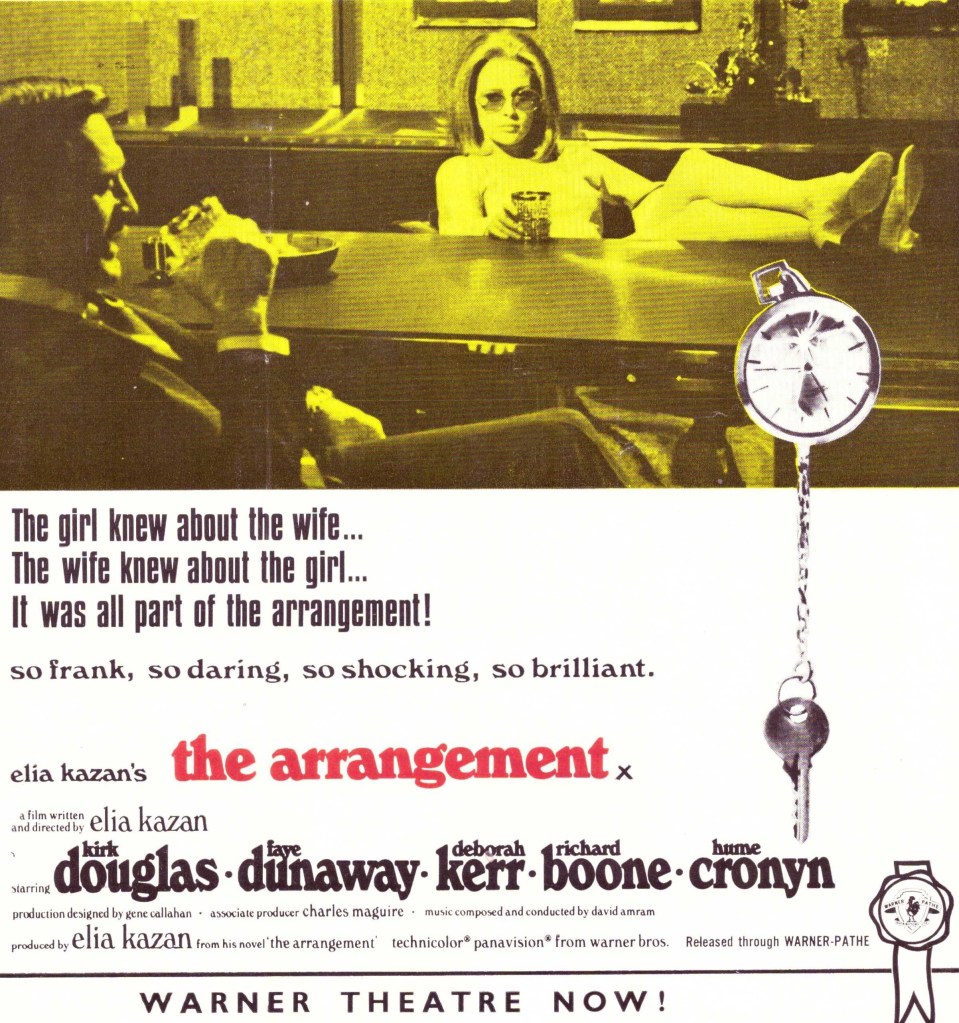
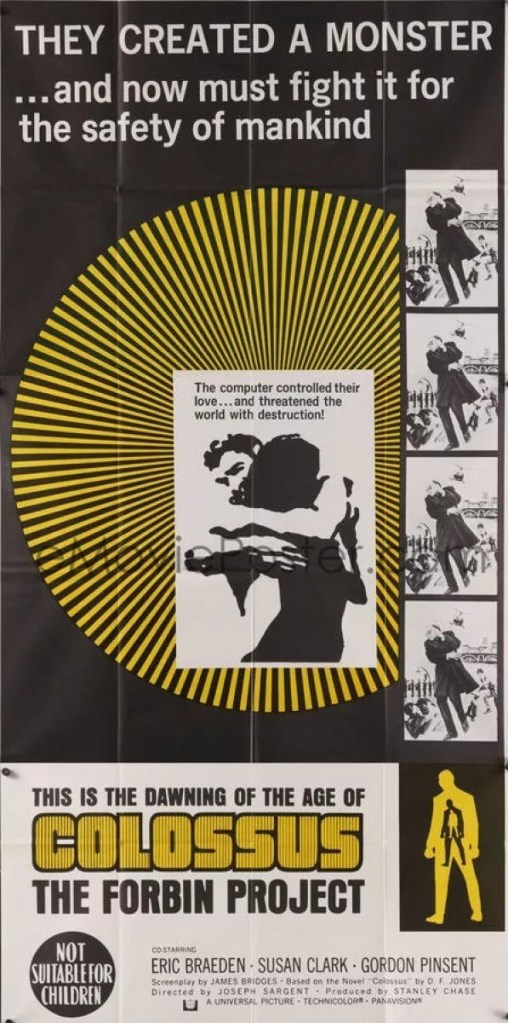
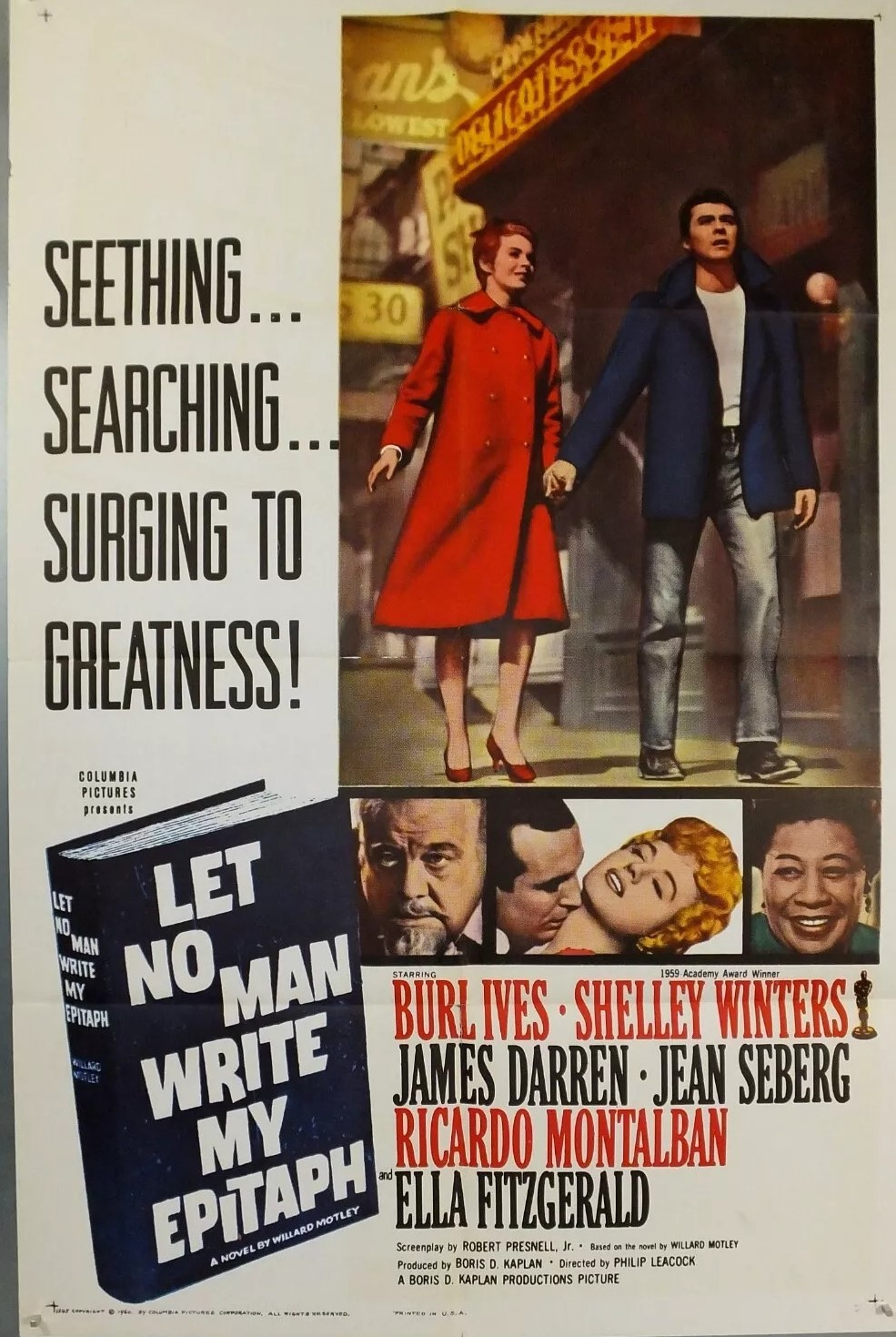
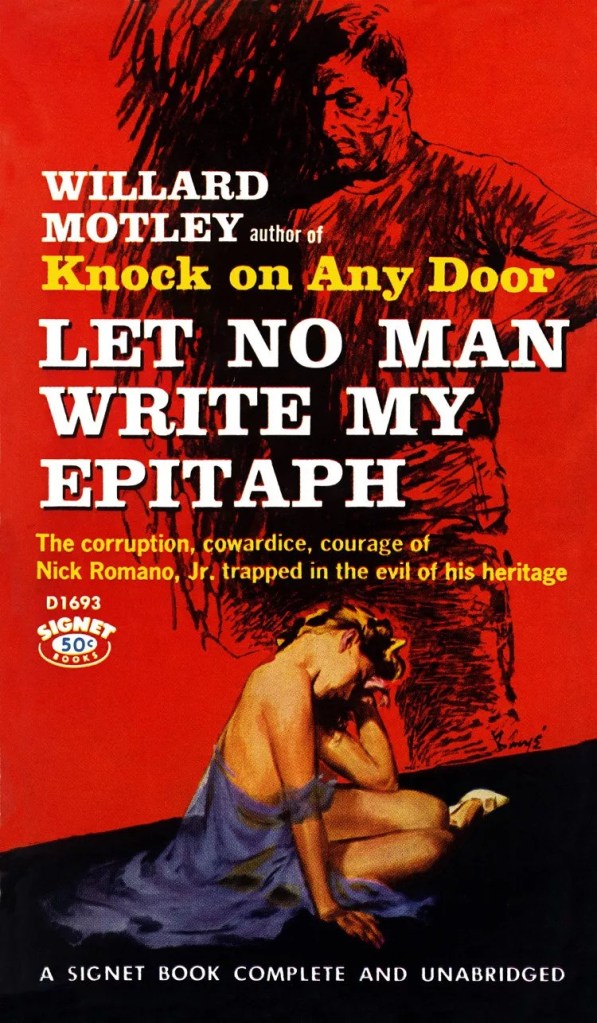
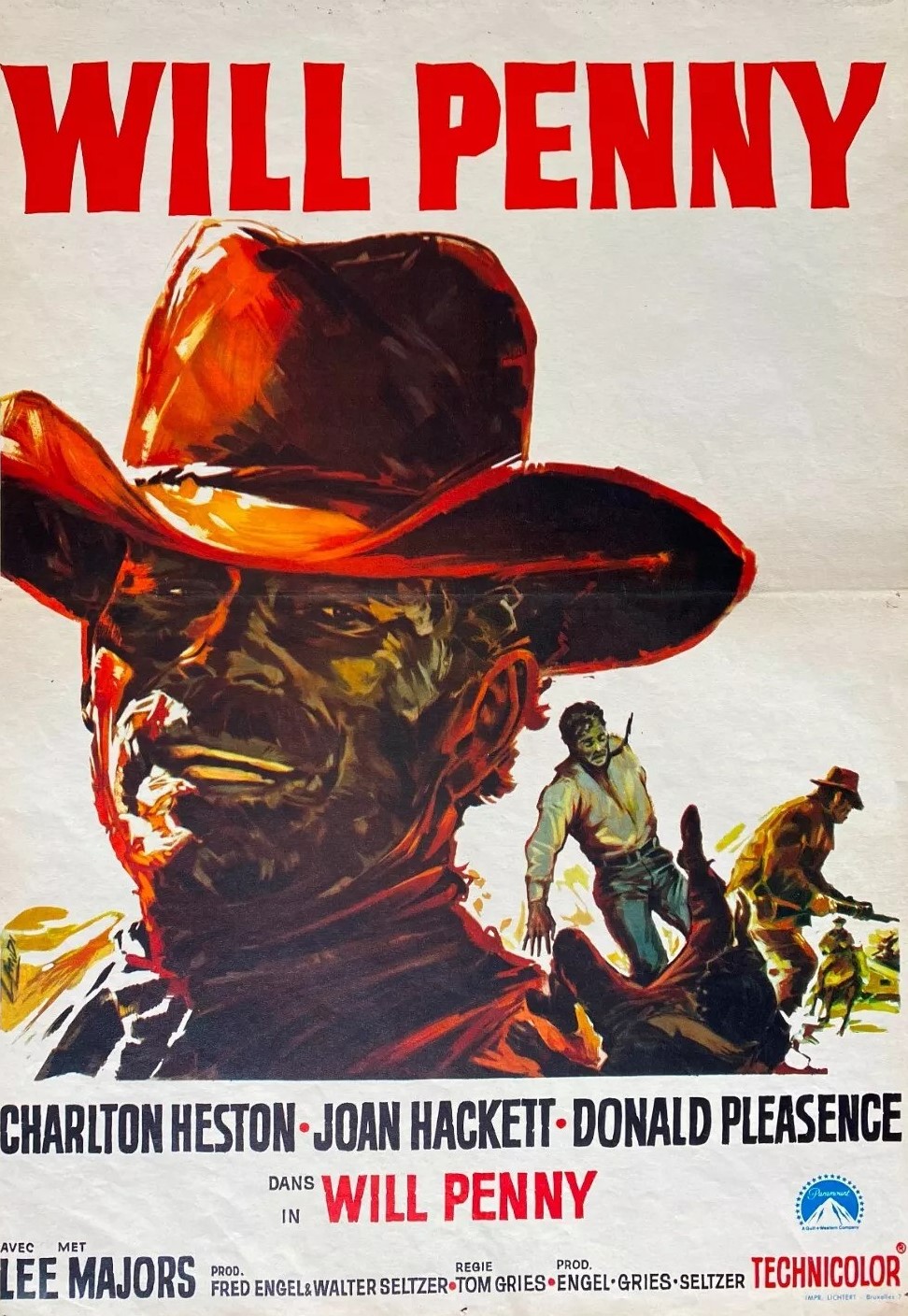
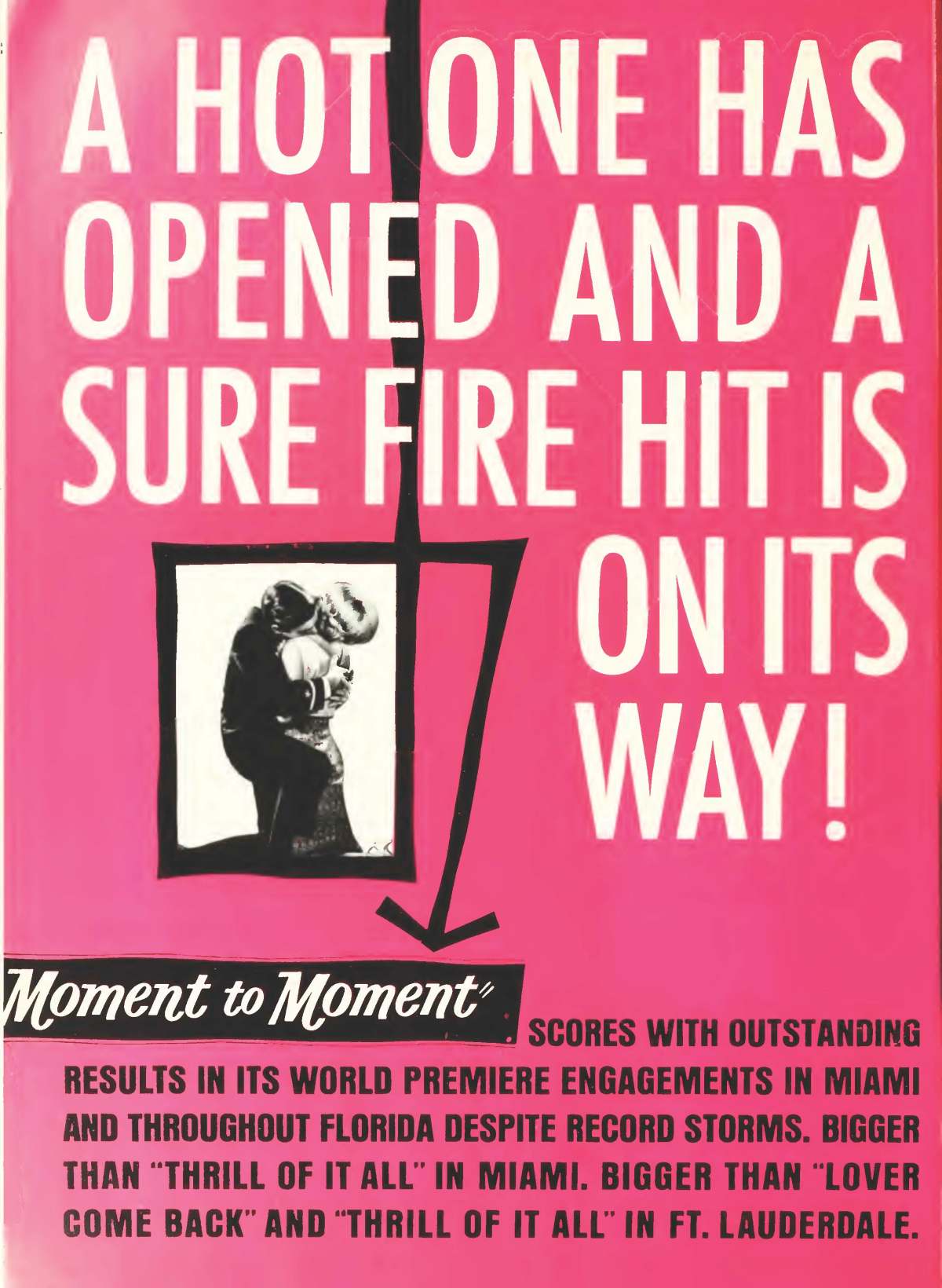
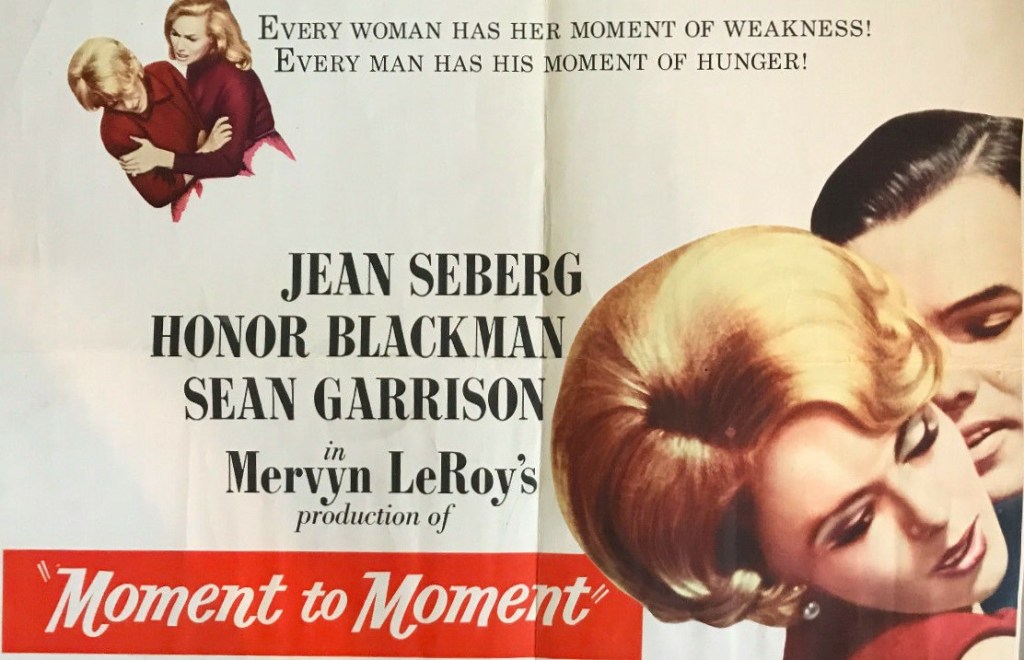
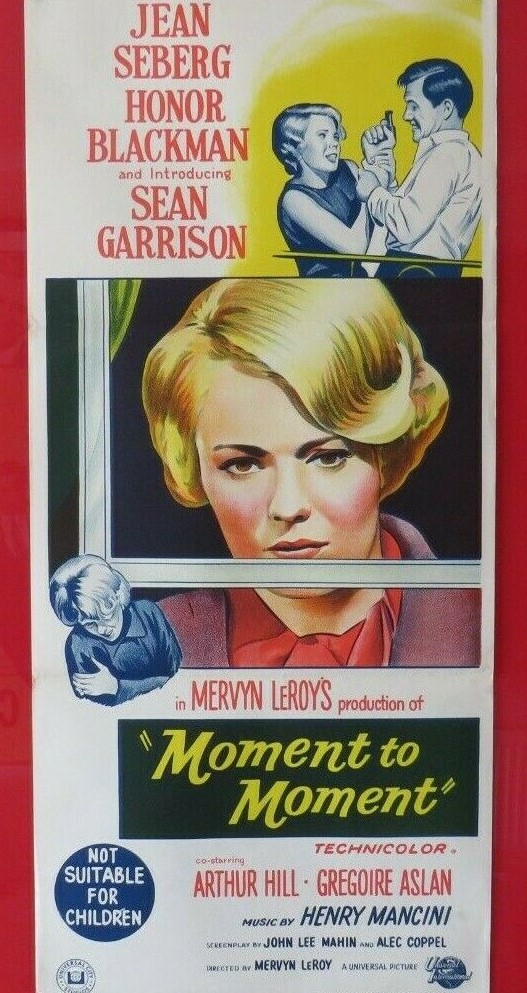

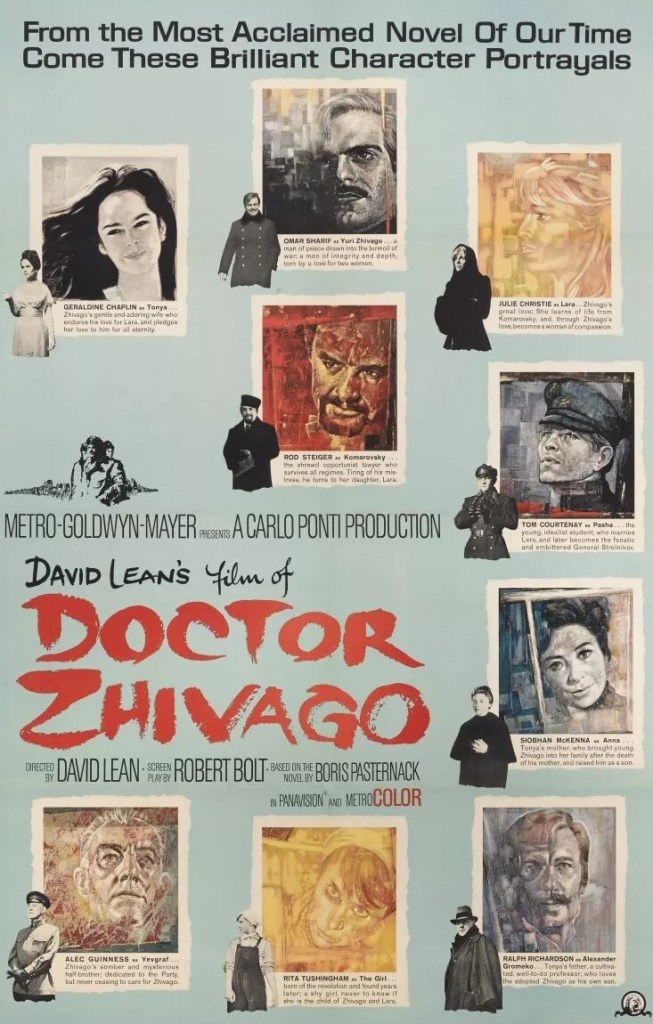


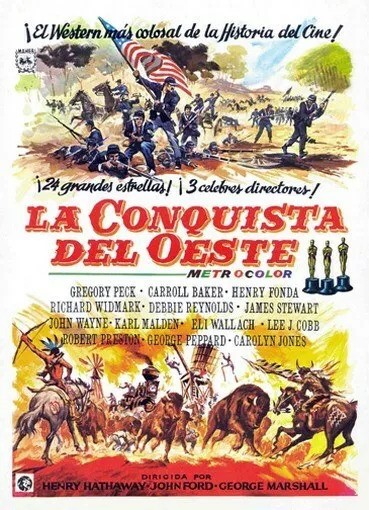

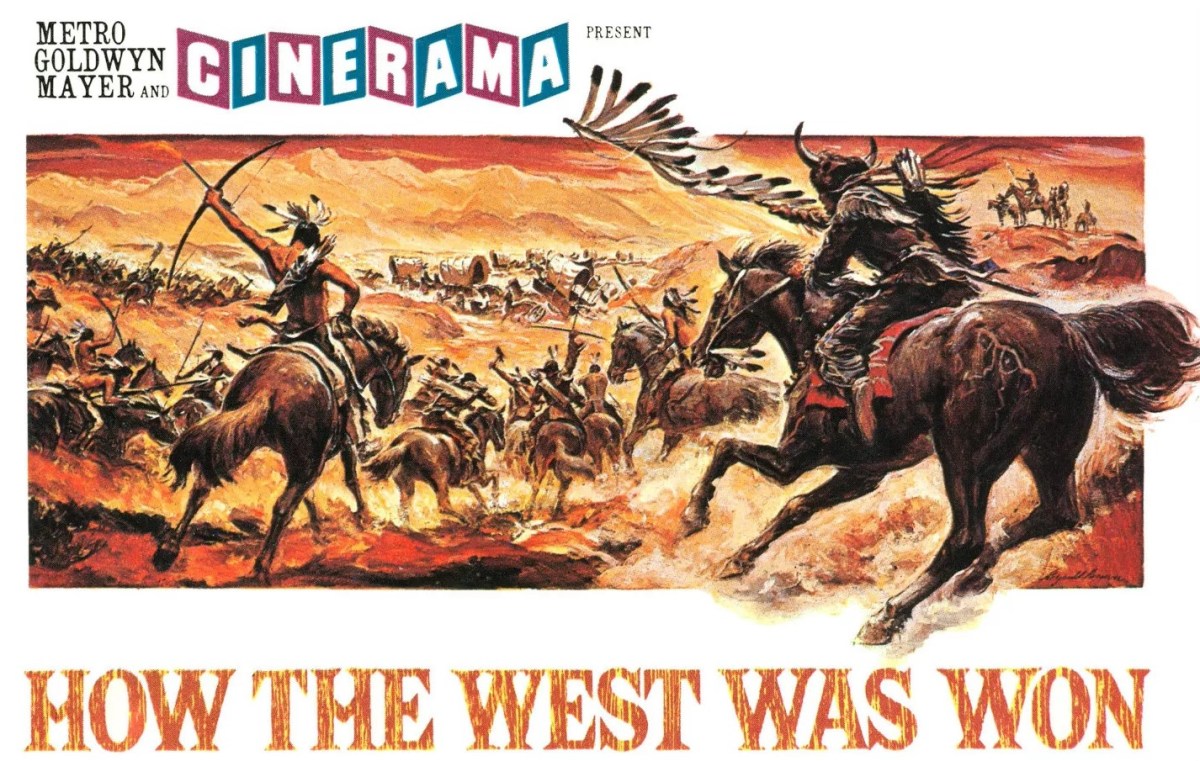


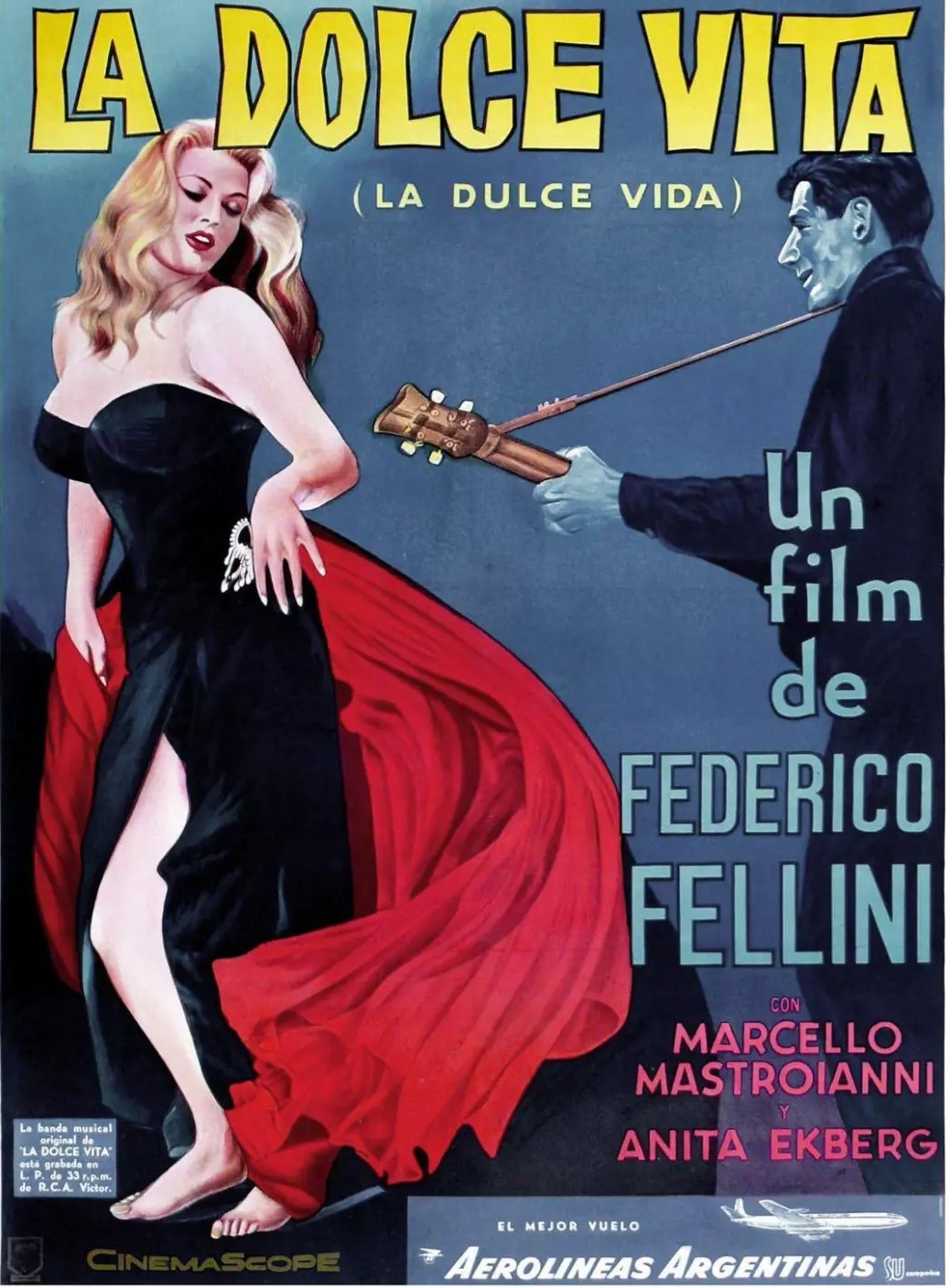
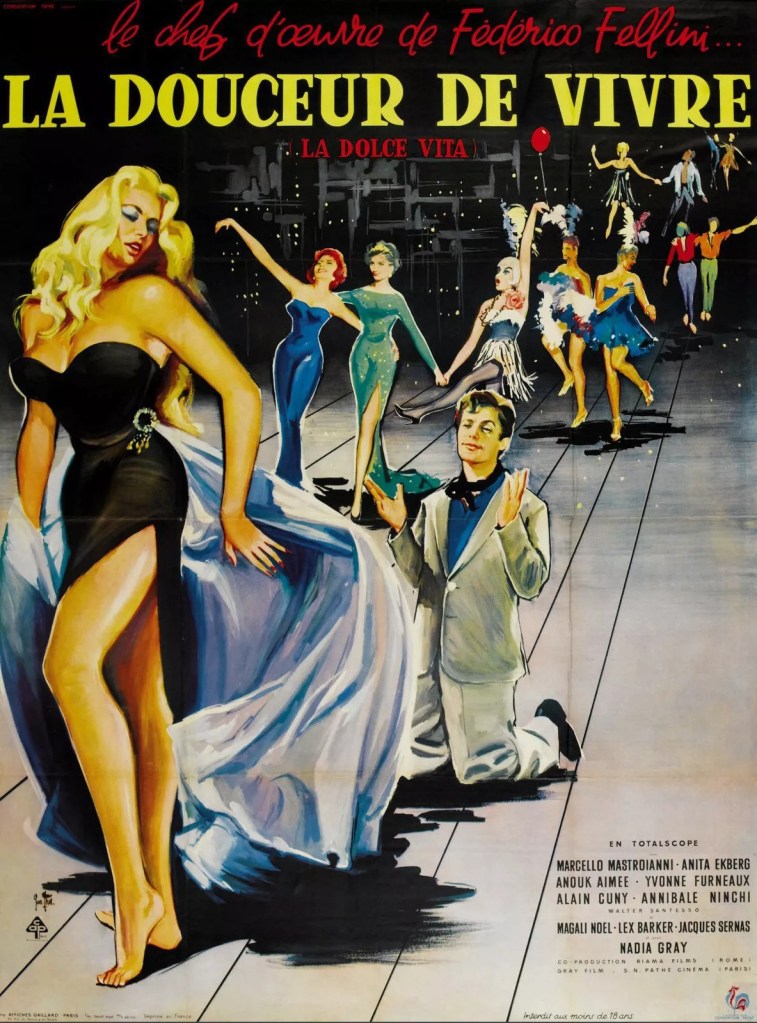
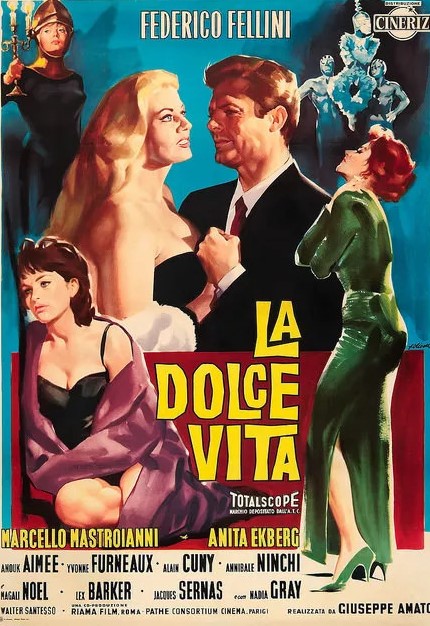
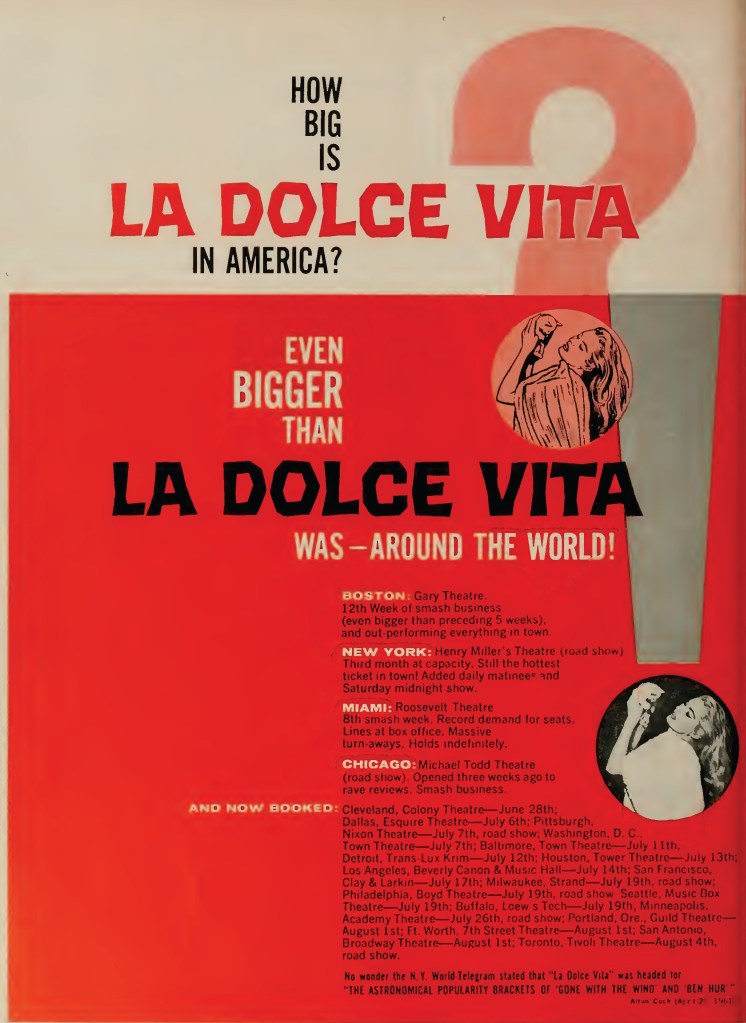
 The Magnificent 60s