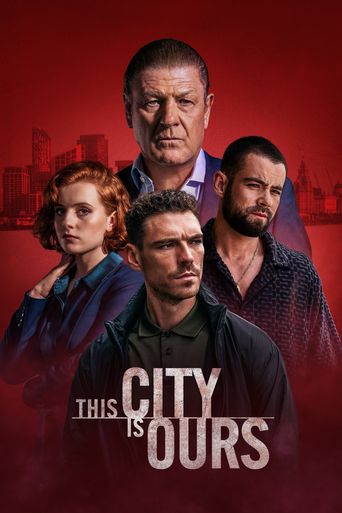
This City Is Ours (2025) *****

Knockout! Just stunning! I’m running out of superlatives for this one, the best crime series since The Wire (2002-2008). For sure, it takes a lead from The Godfather (1972) in that the core concerns family. But in a far more emotional manner than the Coppola epic where apart from a couple of scenes between Michael (Al Pacino) and his father (Marlon Brando) actual male expression of feelings is kept to an absolute minimum as though that might contaminate the pot.

Here, women, both in their relationships with husbands/fiancés, and their own naked ambition are very much to the fore. The new generation of males are vulnerable because of their desire for family, utterly exposed by love for babies and unborn babies, as opposed to old school boss Ronnie Phelan (Sean Bean) who spent little time with his son. And the fear of those on the fringes of being excluded from the “family” or those on the inside being cast out gives the narrative an iron soul.

The nail-biting climax is driven by three incidents involving the most vulnerable and therefore the most loved members of the clan. There’s betrayal, revenge and double-crossing but none of the infidelity or drug/alcohol abuse that was often a hallmark of the genre.

The tale pivots on three events. The first is of the brooding variety. Ronnie has allowed Michael Kavanagh (James Nelson-Joyce), almost an adopted son, to take the lead in crucial negotiations with Spanish drugs kingpin Ricardo (Daniel Cerqueira) much to the annoyance of his son Jamie (Jack McMullen). The second is that, in consequence, Jamie decides to hijack the next shipment. When Ronnie discovers his son is behind the plot, he decides not to follow up, and Michael realizes that blood is indeed thicker than water and that he will be squeezed out of his position in the organization. So he kills Ronnie and assumes command.

Except Jamie doesn’t take too kindly to this notion and, although generally not too bright and certainly way too impulsive for his own good (the Sonny, to keep The Godfather parallel going, of this particular gang), works out that only Michael had the motive to commit the murder which of course Michael strenuously denies. Both convince themselves the only way to take control is to rub the other out.

And then we’d be in standard gangster territory except for the other, emotionally-driven, plotlines. Jamie has a son he absolutely adores. Michael, with an unexpectedly low sperm count for a hardman, is hoping for an IVF baby with his girlfriend Hannah (Diana Onslow), a respectable businesswoman but hiding a very dark secret. Michael’s sidekick Banksy (Mike Noble) is grooming his son in the business. Ronnie’s wife Elaine (Julie Graham) treats Michael like a son and is inclined to take his side against Jamie. Rachel (Laura Aikman), wife of Jamie’s sidekick Bobby (Kevin Harvey), has ambitions way above her station of lowly book-keeper. She finds a way of finessing the fact that she physically controls the organization’s cash – and that it’s Ronnie’s wife whose name is on anything the gang owns – to exploit the divisions in the family as a means of of becoming the de facto “Godmother.”

Meanwhile, Ricardo, for good reason, distrusts Jamie and will only do deals with Michael, for whom he acts as mentor (so, if you like, Michael has two dads)  although Jamie plans to sidestep the Spanish connection and go elsewhere for drugs which would have the dual effect of leaving Michael isolated and, with Rachel controlling the purse strings, potentially millions of pounds in debt. And hovering in the wings is a crafty cop, causing problems in every sneaky way possible, and a liability Cheryl (Saoirse Monica-Jackson), stuck with keeping to the code of omerta even though she guesses Ronnie wiped out her husband.

So it’s a game of shifting loyalties, grasping after power, with uber gangsters laid emotionally low by commitments to babies and pregnant wives. There’s none of the posturing of The Godfather, no making excuses for career choice or murderous thugs who draw the line at dealing drugs or women purportedly unaware of what their husbands do for a living.

Directed with occasional elan and pace and a great nose for the cliffhanger. Terrific writing by Stephen Butchard (The Last Kingdom, 2015-2018), both in dialog and twists on character interaction, and with a marvellous sense of narrative. You never know which way it’s going to go.

But most of all bursting with outstanding talent. You won’t see a deader eye this side of Clint Eastwood than James Nelson-Joyce (A Thousand Blows, 2024-2025) in his first leading role, who’s as comfortable exploring his own emotions as planning destruction. Mother hen Julie Graham (Ridley, 2022-2024) could easily turn into Ma Barker. Hannah Onslow (Belgravia: The Next Chapter, 2024) is tormented by her secret. Laura Aikman (Archie, 2023) manipulates and schemes. Virtually the entire cast are seasoned television actors, yet they’ll never have been lucky enough to encounter such character depth before.

Get on to your local streamer/television station and harangue them to buy this from the BBC.

As I said I’ve run out of superlatives.

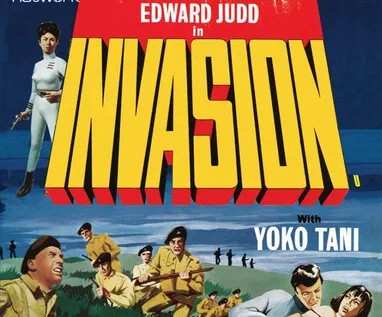
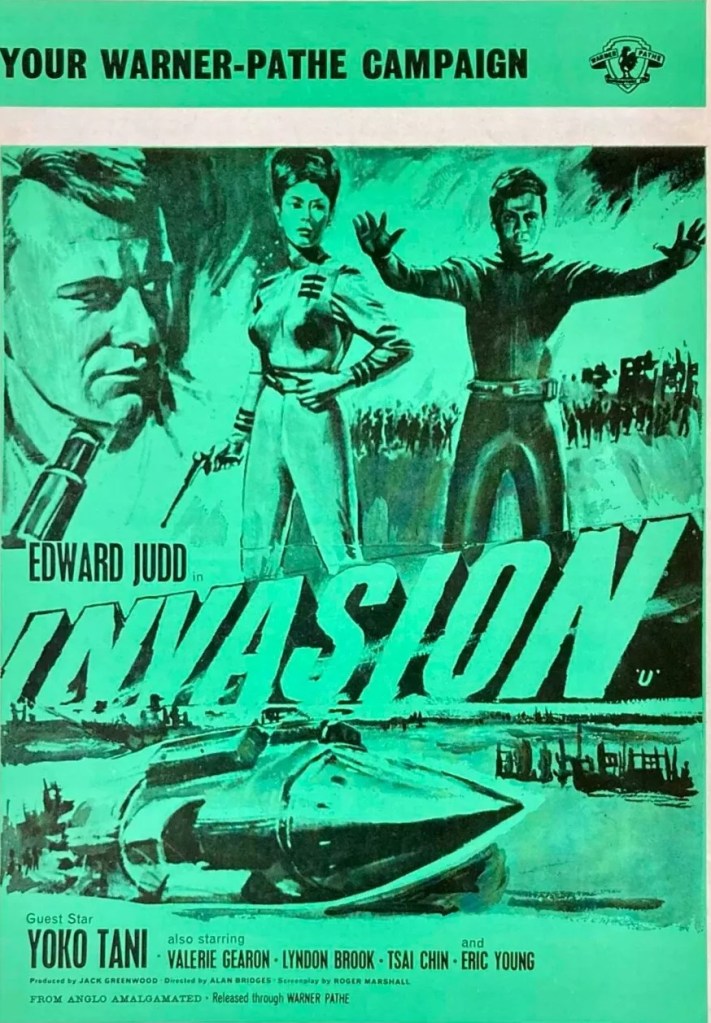
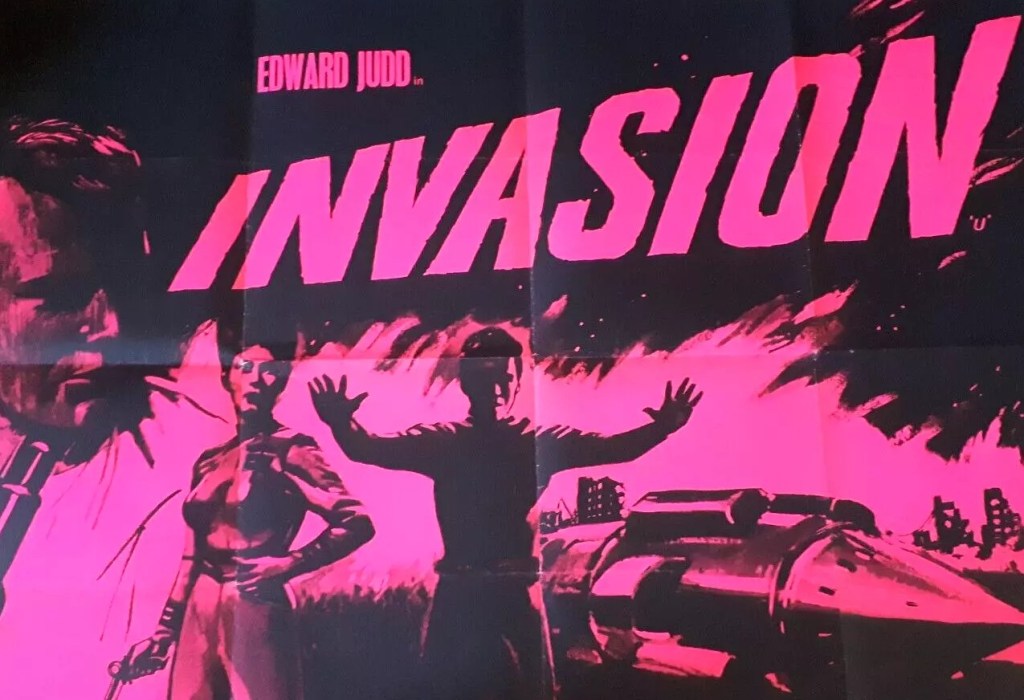
Invasion (1966) ****

Style is just about the only weapon in the directorial armory to mitigate against lack of budget. Or you can rely on a narrative twist. But in sci fi you’re inevitably going to come a cropper in this era and on a low budget when it comes to the special effects.

As director Alan Bridges would later prove in bigger budgeted efforts like The Hireling (1973) and Out of Season (1975) he was a genius at building atmosphere. Here, he also makes very effective use on the long shot. Not in the usual dramatic fashion of depicting a vista, but in building tension.

There’s a fabulous sequence which is superbly done given the budget. There’s a car crash. We see a window exploding. Next shot shows a man dead and bloodied sprawling over the hood. The car has crashed about a hundred yards away from a hospital where the main character Mike (Edward Judd) is standing outside. Instead of cutting to his face to register the shock, the camera stays where it is just to the side of the car so we can see the corpse and in the background watch Mike’s reaction. But he doesn’t race towards the camera. He moves in puzzled fashion, glancing around, even taking a step backward.

So where another director would in effect have speeded things up – crash, onlooker reaction – Bridges slows it all down. That’s the real purpose of the long shot. To waste vital seconds. To slow everything down.

There’s a reason why Mike is so slow on the uptake. Because there’s nothing for the car to crash into. There’s not a tree or a wall to get in the way of the moving car. This is the moment Mike works out there’s a force field surrounding the hospital, generated by the strange patient inside, who needs protection from his pursuers.

Sure Bridges uses long shot for budgetary reasons, to have all his characters in the same space without having to spend money on close-ups, but most of the time it’s for atmosphere and effect. There’s another great long shot of seated hospital patient Blackburn (Anthony Sharp) viewed from the other end of a long corridor. He’s in shock not just because he’s knocked down a pedestrian in unseasonal fog during the night but because he was with his mistress at the time and there is bound to be consequence.

And perhaps because his lover urged him not to stop, so that will change the dynamics of their relationship. And perhaps because the person he knocked done is so strange, walking around in some kind of plastic uniform in the middle of the road as if he didn’t know where he was going.

We’ve had decades now for movie makers to find ways of indicating the imminent arrival of aliens, and usually they’re able to call on bigger budgets and scenes of television reports to do so, witness Independence Day (1996) or Arrival (2106) and even have the luxury of delaying such action until they can introduce some of the characters.

Here, Bridges manages that in minimalist fashion. And without delay. Soldiers manning a radar station notice the radar misses a beat, on the road Blackburn’s vehicle inexplicably and momentarily stalls while in motion, in the hospital an iron lung inexplicably stops pumping oxygen into the inert patient for a moment. We don’t realize it until some time later but that’s the sign of arrival.

In the hospital the foreigner (Eric Young) is found to have a metal plate in his head. He appears surprised that women do as they’re told. The building begins to become unbearably hot. When the stranger awakens, we discover he is, in fact, an alien, from a distant planet, strayed from his course. He was escorting two female prisoners.

And sure enough every now and then we get a glimpse of the female pair outside in close-fitting uniforms. Phone lines are down. The rising heat threatens the chances of survival of the hospital’s 300 patients. Hospital chief Carter (Lyndon Brook), going for help, is the one who dies in the car crash.

Very snippy doctor Claire (Valerie Gearon), severe haircut indicating a no-nonsense personality, interrogates the alien and gets far more out of him than Mike or Carter. Meanwhile, Mike works out that the force field is less effective with water, so he escapes via the sewer, finds the alien’s power pack and returns so the alien can leave and find his spaceship, though by now they know he is an escaped convict not an officer of alien law.

And this is the kind of picture when a fellow undertaking superhuman activity, like crawling along a sewer and hauling himself out the other end, doesn’t do this in the blithe fashion of a hero. He is exhausted, staggering, completely wrung out.

Oddly enough, the special effects, given the budget, stand up. The alien takes off in his rocket but another alien craft shoots him down.

Despite the storyline with the feminist angle and the twist of alien being bad guy and not good guy, there’s not enough here sci fi-wise for it even to get an honorable mention in the list of great low-budget sci fi movies.

The fact that it deserves any mention at all – and it fully deserves one – is down to the direction. There’s a throbbing score by Bernard Ebbinghouse (Prudence and the Pill, 1968) that helps maintain tension. And the hospital staff, mostly called upon to sweat and be at the end of their tether, come over as very human, Edward Judd (First Men in the Moon, 1964) and Valerie Gearon (Nine Hours to Rama, 1963), especially. Roger Marshall (Theatre of Death, 1967) wrote the screenplay.

But Alan Bridges is the star.

Minor gem.

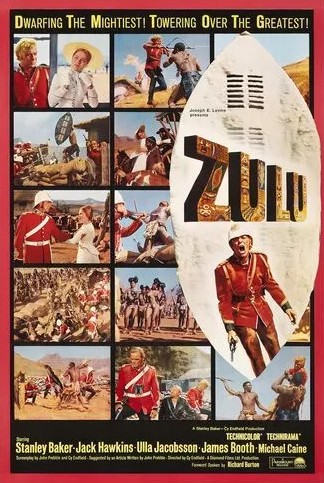
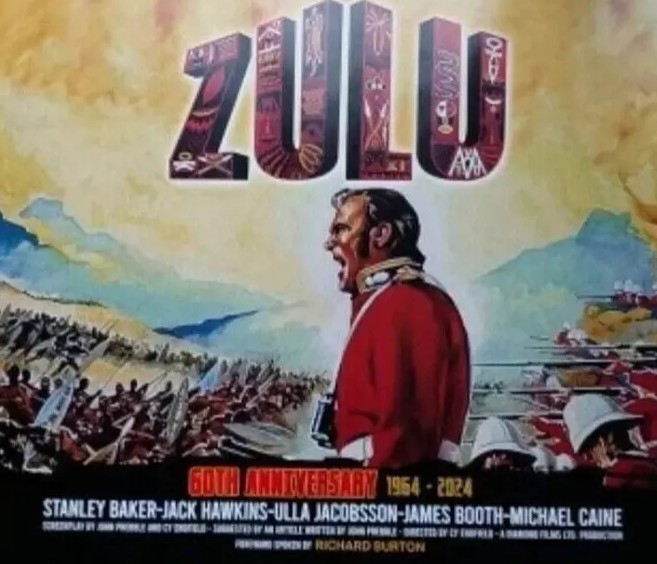
Behind the Scenes: How “Zulu” (1964) Flopped in the USA

With all the (deserved) appreciation of Zulu, it’s hard to imagine it was a massive flop in the United States. Independent producer Joe Levine planned a double whammy for summer 1964 – The Carpetbaggers, an adaptation of the sizzling Harold Robbins bestseller, and Zulu. He even arranged for Zulu to follow The Carpetbaggers into the prestigious Palace first run cinema in New York. Spending big, Levine whipped up a huge marketing campaign for Zulu, which had notched up record grosses in the UK. There was a double-page spread in Variety in January 6 and again in February 10. One million promotional badges were distributed. A featurette “Great Battles in Film” was sent to 100 television stations.

Levine had a great line for the media. “I haven’t had time to read the script but I liked the title.” Subsequently, he told reporters he had read the script on a Friday and bought it the following Monday.

It had opened at the end of January at the Plaza in London’s West End and reports of its record-breaking $26,000 opening were expected to generate high hopes among U.S. cinema owners. Like The Carpetbaggers, it was distributed by Paramount. By April it had earned a record $638,000 in London alone, including $155,000 in a nine-week run at the Plaza.

Levine had form in finding success from the most unlikely projects. He had launched the low-budget Italian-made Hercules (1958) on the American public. Audiences weren’t quite unsuspecting given the fortune he had spent on promotion. It was money well spent and quickly went into profit. So the prospect of selling a British film about a battle nobody had ever heard of and, except for Jack Hawkins in a supporting role, starring unfamiliar names, did not faze Levine.

But the two films could not have been further apart. Where The Carpetbaggers stormed to $862,000 from 25 theatres in the New York area, Zulu could only manage $190,000 from 30 in Los Angeles. Zulu scored well in first run in Detroit – an $18,000 opening at the 2996-seater Palms, a second week of $16,000 and running two more weeks. There was a “smash” $15,000 in the 606-seater Loop in Chicago first run for starters and another three weeks but then it was quickly consigned to drive-ins. It registered $16,000 at the 1909-seat Pilgrim in Boston, $10,000 in openers in Cincinnati, $6,000 in Portland and $7,500 in Buffalo. It held well in Providence at the 2200-seat Majestic, first week of $7,000, second week of $5,000.

But there was only $8,000 from nine houses in Denver and $80,000 from 13 in Kansas City. Failure to find a niche was not for want of trying. In successive weeks in Los Angeles, it was supported by Nicholas Ray epic 55 Days At Peking, comedy Ensign Pulver, and Viking adventure The Long Ships.

To salvage something, Levine send it out, within a couple of months of initial release, as the support film to Italian-made Yesterday, Today and Tomorrow starring Italian sexpot Sophia Loren, possibly one of the strangest movie programs of all time.

In the annual box office rankings, The Carpetbaggers placed second. To get into the Variety annual chart, you needed to make more than $1m in rentals (the amount the studio received after the cinema had taken its cut). Seventy-eight movies managed this. Zulu was not one of them. 

But even the poorest box-office performer has an afterlife. So in 1965 Zulu was pushed out again anywhere that would have it. That meant it supported some odd, not to say ugly, bedfellows – exploitationer Taboos of the World in Kansas City, The Three Stooges in The Outlaws Is Coming in Phoenix, B-western Stage To Thunder Rock in Long Beach, How to Stuff a Wild Bikini in Des Moines and Rhino in Abilene. They liked it in Long Beach where it supported both Circus World and That Man from Rio. It was the second feature to None but the Brave in Provo, Utah, and to two more successful Joe E. Levine movies, Yesterday, Today and Tomorrow in Ironwood, Michigan, and Marriage, Italian Style in Corpus Christi, Texas. Triple bills being a staple of drive-ins, it was seen with Viva Las Vegas and Beach Party in Tucson.   

But it was not just support meat. Almost a year after its release, it topped the bill in Helena, Montana, with Robert Mitchum in Man in the Middle as support. In Chester it was the main attraction with Homicidal in support. In Weimar, Texas, it was supported by Tarzan the Magnificent and in Bridgeport by First Men on the Moon. At the Cecil theater in Mason City, Iowa, it played on its own, as it did in Colorado Springs where it was advertised as “in the great tradition of Beau Geste” (supply your own exclamation marks.)

But it was not done yet. Exhibitors in San Mateo had a soft spot for Zulu in 1966. It played there seven times, as support to The Great Race, Marlon Brando western Appaloosa, Fantastic Voyage (in two theaters), What’s Up Tiger Lily?,  The Leather Boys and Lawrence of Arabia. Abilene brought it back twice, for a re-match with Rhino and then in a double bill with Kimberley Jim starring singer Jim Reeves when it was promoted as “a true story of the Zulu tribe.” Fremont cinemas also ran in twice – with Return of the Seven and Fantastic Voyage. In Troy and Bennington it rode shotgun with Elvis in Harum Scarum. In Charleston it supported Arabesque, in Winona The Second Best Secret Agent  and in Long Beach What Did You Do in the War, Daddy?

The highlight of 1967 had to be a double bill with The Daleks (Dr Who and the Daleks) in Delaware, or perhaps the teaming with Batman in Cumberland, Maryland, or El Cid in Ottawa. Zulu returned twice to Fremont to support Africa Addio and John Sturges’ Hour of the Gun. In Modesto it played with Where The Spies Are. In Long Beach it was put on at a pop concert where the headline act was Organized Confusion (anybody remember them?). These three years of repeated showings hardly counted as a proper reissue, but it did cast an interesting light on what may – or may not – have turned into something of a cult film. In Britain, where it was a smash hit, it was reissued on the ABC circuit in 1967 and 1972. While it was largely unwelcome in the U.S., worldwide was a different story, bringing in $9 million in grosses.

SOURCES: 1964:  Variety – U.S. box office figures: June 24, July 1, July 8, July 15, July 22, July 29, august 5, September 2, October 6. Information about other bookings comes from local newspapers.

Can Heironymus Merkin Ever Forget Mercy Humpe and Find True Happiness? (1969) **

I’ve been revisiting this oddity in the hope that maybe I was too quick to condemn what was, in some respects, one of the quirkiest pictures ever made. Alas, time has been no kinder.

One of the biggest-ever movie follies, an overblown vanity project with Fellini-esque overtones – written, directed, produced and starring British crooner Anthony Newley (Doctor Dolittle, 1967) – that turned into the first X-rated musical. Bob Fosse mined a similar, almost as seedy, sex-obsessed autobiographical vein in All That Jazz (1979) to critical acclaim whereas the Newley effort met critical coruscation.

Although primary known as a Broadway star (Stop the World, I Want to Get Off), he had a small but reasonable movie portfolio, star of The Small World of Sammy Lee (1963) and male lead to Sandy Dennis in Sweet November (1968), so in a sense he was ready for the leap into movie stardom, though perhaps not in such grandiose fashion. Had the movie shown the slightest touch of irony, that might have been its saving grace, but the main theme is that women queue up to bed a star who is fed up with bedding women yet appears to revel in his own moral decadence.

The story is so slim it defies belief or arrogance. Hieronymus Merkin (Newley) is preparing to make a film about his own life though he feels he has been controlled from the outset, his child view is that of a marionette with someone else pulling the strings. Once Goodtime Eddie Filth (Milton Berle) sets him on a stage career beauties flock to his side. Although married to Polly Poontang (Joan Collins) he longs to be reunited with earlier lover Mercy Humpe (Connie Kreski). Basically, he keeps asking the universal question besetting all men – if I can all the sex in the world, why am I not happy?

On the plus side it is certainly audacious, surreal, pretentious, unconventional and gives a good idea of what would happen if a director turned up on a beach in Malta with a cast of whoever happened to be available plus assorted nudes and rolled the camera to see what would happen and then argued with his crew or critics about what was taking place. One big minus is the songs. Newley was a talented lyricist (Goldfinger) and composer as well as performer. But the material here is poor and Newley, despite his Broadway experience, has no idea how to stage a musical.

Cameos abound. You can spot famed comedian George Jessel, singer Stubby Kaye, British entertainer Bruce Forsyth, Tom Stern (The Devil’s Brigade, 1968), and British character actors Patricia Hayes (The Terrornauts, 1967) , Victor Spinetti and Judy Cornwell. You may be surprised to learn that the script written in tandem with Herman Raucher (Sweet November, 1968) was named Best British Original Screenplay by the Writers Guild of Great Britain.

Theoretically, this is now regarded as a cult classic but I’ve yet to come across a review that treats it as anything other than a self-indulgent curiosity rather than a must-see.

Studio Universal was so embarrassed by the final outcome that it released it in the U.S. under its Regional Film unit “which handles product Universal doesn’t care to go out under its own banner.” The $1.25 million picture was not quite the box office disaster many anticipated. After poor runs in New York and Los Angeles and helped along by a 10-page spread in Playboy, it scored substantial business in cities as diverse as Detroit, Louisville and Minneapolis. In the US it grossed $1.3 million and coupled with overseas income went into profit.

Given Newley did not make another picture for six years, you might have imagined Hieronymos Merkin spelled the death-knell for his career. But that was not so. After the film opened, he signed a $1 million four-year deal at Caesar’s Palace in Las Vegas, was lining up a Broadway musical about Napoleon and Josephine with Barbra Streisand and was in talks to star in a movie adaptation of his hit musical The Roar of the Crowd.

SOURCES: “Newley Making Vegas Bow Aug 7 at Caesar’s Palace,” Variety, June 11, 1969, p76; “Newley-Streisand for B’way Tuner on Nappy-Josie,” Variety, July 2, 1969, p1; “Merkin Dates Overcome Jink,” Variety, July 9, 1969, p3; “Jack Haley Jr. Setup To Produce, Direct,” Variety, December 24, 1969, p6; “Variety B.O. Charts’ 1969 Results,” Variety, April 29, 1970, 26.   

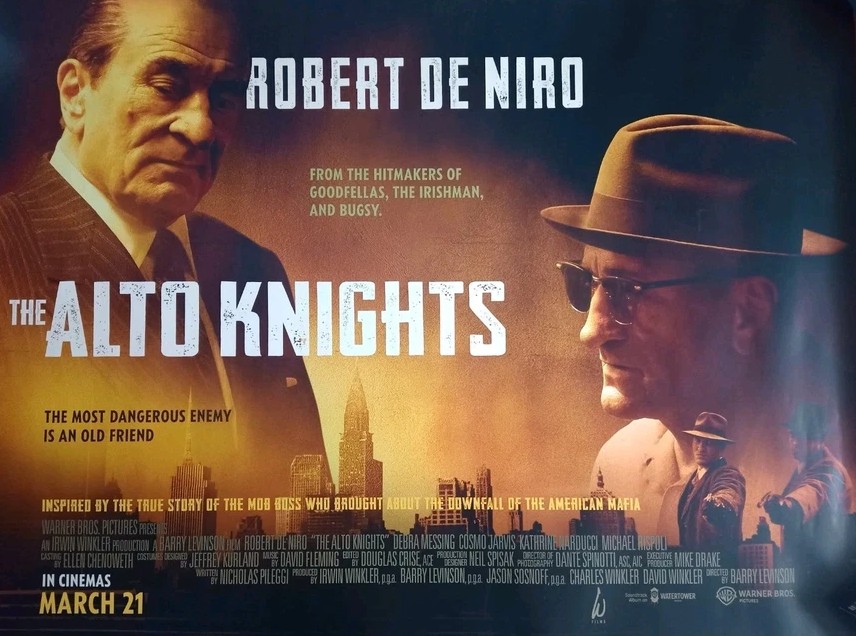
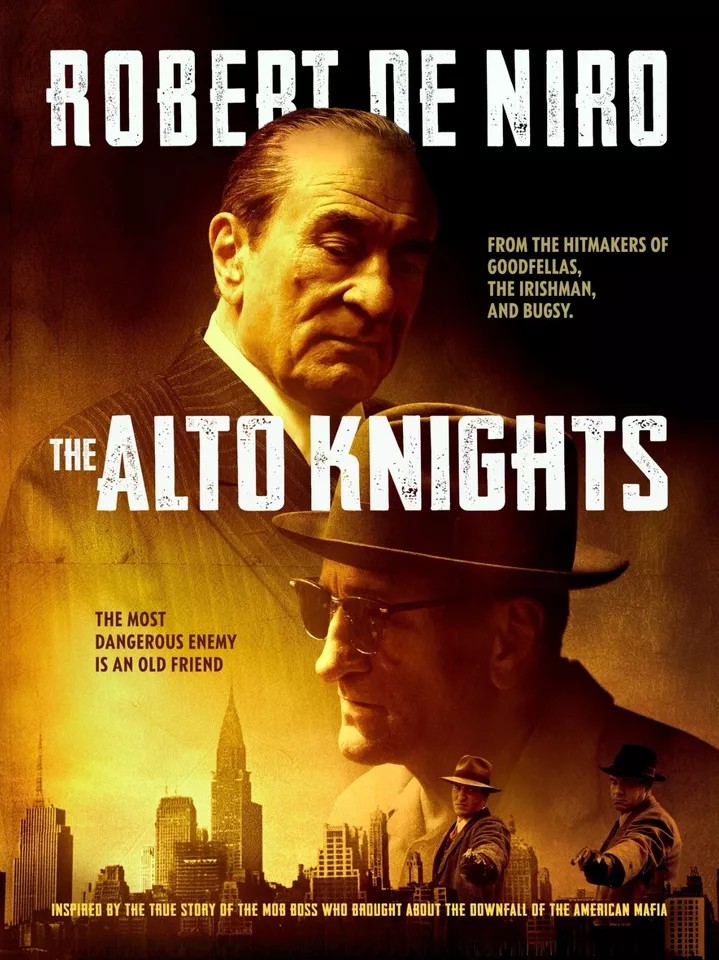
The Alto Knights (2025) *** – Seen at the Cinema

There’s a fabulous story buried inside this box office disaster. A Mafia boss rats out his colleagues so he can enjoy retirement. Instead of dwelling on this and the dramatic opportunities it opens up, instead we are given an info-dump. The betrayal meant that the United States woke up to the fact that the Mafia was a nationwide organization and not, as proposed by J Edgar Hoover, merely a localized east coast outfit.

I wasn’t particularly bothered by the gimmick – though it’s surely “enough already” for fly-by-night technical tricks – of Robert De Niro playing two gangster rivals, Frank Costello who runs the empire handed on a plate to him by Vito Genovese while the latter was in exile. Two simple pieces of prosthetics, false nose for Frank, false chin for Vito, plus the more rudimentary disguise of hat and spectacles for Vito makes this notion work without any need to call it into question. The fake chin stiffens the actor’s lips and once he dispenses with the arm-waving that is key to the De Niro screen persona, the characters are portrayed with measurable differences.

What needs called into question is the ramshackle construction. Voice-over for me is lazy. You can’t fit information into the story in dramatic fashion? Then too bad, drop it. You can’t just shoehorn it in and hope for the best. And all this shifting about with timelines, WTF? It’s crazy to try and condense a history of the Mafia up till the late 1950s when the movie would work much better dumping the historical malarkey and concentrating on the main story.

Vito returns to New York after a long absence and wants to reclaim his kingdom. Frank is naturally reluctant to give up an empire he has expanded and controlled for so long. Frank is more temperate, Vito distinctly temperamental. The fact they were boyhood buddies and made their bones together should have merited a single line of dialog rather than drawn-out montages and a bucket of voice-over.

Frank is happily married to Bobbie (Debra Messing) with no kids. Vito marries Anna (Kathrine Narducci) then bumps off his wife’s ex-husband for the kind of slight a paranoid is prone to. Majoring in violence, Vito rebuilds his empire and for the last piece of the jigsaw organizes a hit on Frank. The hitman misses. That should have cued all-out warfare. Instead, Frank tries to keep the peace. His solution when all else fails and planned retirement is jeopardized is to tip the nod to the New York cops that representatives of every nationwide family is going to assemble in a particular place all at the same time. Cue the cops solving Frank’s problem by imprisoning Vito and tons of his (relatively-speaking, of course) innocent compadres.

But instead of sticking to the bones of what’s an interesting (and ironic if irony is your thing) narrative – insane hunger for power and revenge –  the story bounces around like it’s been chucked inside a lottery drum only for bits and pieces of a longer and more complicated but less interesting story to fly out at different times.

The movie does make the point that without battalions of crooked cops and politicians on the take the Mafia would never have mushroomed. There are a couple of outstanding sequences, the cocky Frank volunteering to testify rather than, like all the other gangsters, taking the Fifth at a Senatorial Inquiry and a marvellous scene about the golden Bible of the Mormons that stands alongside the “You Talkin’ to Me?” and “You think I’m funny?” scenes from previous gangster classics.

De Niro gets one thing wrong in his impersonation of the gangsters. It’s virtually impossible for an 81-year-old actor to carry off the physicality of the 66-year-old Frank and the 60-year-old Vito. At least there’s no attempt to portray gangsters as mythical characters.

Not the swansong director Barry Levinson (Rain Man, 1988) was hoping for. Nicholas Pileggi (Goodfellas, 1990) wrote the script. 

Nobody’s going to bet $45 million on Robert De Niro again, no matter how many roles he plays.

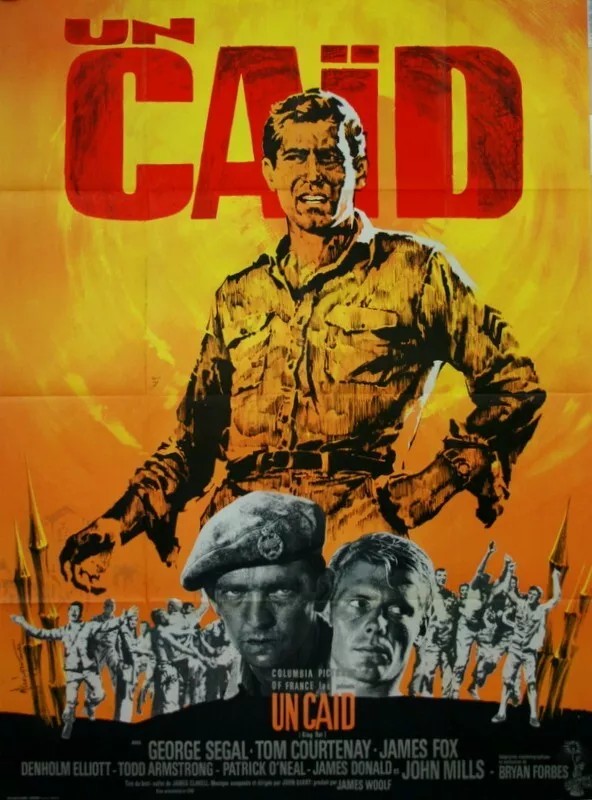
King Rat (1965) ****

Turns the POW sub-genre on its head. Nobody’s interested in escaping or, in the vein of Bridge on the River Kwai (1957), committing an audacious act of sabotage. It’s hard enough just surviving with any high-falautin’ notions of honor or courage getting in the way.

Imagine if the James Garner character in The Great Escape (1963) was wheeling-and-dealing to fill his own pockets or ease his confinement in the way of Morgan Freeman in The Shawshank Redemption (1994).

That’s what we’ve got here. American prisoner Corporal King (George Segal) hasn’t got the general good in mind. He’s only interested in number one. The British idea of “fair play” doesn’t register. But, of course, there being Brits involved, there’s the whole class thing. Officers are generally upper-class and speak with pronounced drawls and affect that this whole prisoner-of-war lark is merely tiresome. Throw into the equation as well as kind of Lord of the Flies scenario where ideas of civilization are rudely interrupted by desperate need to claw to the top.

Three narratives intertwine. King’s black market activities attract the ire of the British security chief Lt Grey (Tom Courtenay), who, despite his position is clearly working class. King befriends airman Lt Marlowe (James Fox) who, though occasionally sticking to some honor code, gradually drifts away from any notions of upright behavior into the seductive immorality implicit in dealings with the American. And while investigating the theft of rations, Grey comes up against the brick wall of camp commander Col Smedley-Taylor, who while distinctly upper-class, nonetheless is a realist and keeps the situation on an even keel.

In the background, of course, is deprivation. Men commit suicide if caught stealing – and in quite awful fashion, diving headfirst into the dung-hole and suffocating.

In due course, King, as the title of the picture suggests, hits upon the notion of breeding rats and selling the food to the other prisoners under the guise of calling it “mouse-deer,” a genuine species in the area.

Complicity in corruption lingers, Grey assuming that Smedley-Taylor is glossing over punishment for the thefts, while all the prisoners begin to view King in a better light once he becomes the source of much-needed nourishment.

Mostly, though it’s about the characters and therefore about the acting. Tom Courtenay (Otley, 1969) is the least interesting, we’ve seen this snarky grumpy screen persona too many times before. George Segal (The Quiller Memorandum, 1966) is the revelation. He’s so charming it’s sometimes difficult to realize that he’s the villain of the piece, the unscrupulous soldier taking advantage of circumstance. He might be like your local drug-dealer, the criminal aspect of his activity overlooked because people want so badly what’s he’s selling.

The impact of James Fox (Thoroughly Modern Millie, 1967) is largely down to the fact that he plays against officer type, that one of the supposed good guys goes along with King and junks his stiff-upper-lip when easier pickings are on offer. But John Mills (The Family Way, 1966) is the other standout, determined not to make waves that will only upset a delicate order. You’ll catch Patrick O’Neal (Stiletto, 1969) and Denholm Elliott (Maroc 7, 1967) in small parts and a whole host of British supporting actors.

Writer-director Bryan Forbes (Deadfall, 1968), adapting the James Clavell bestseller, keeps the package taut, allowing the actors to do their stuff.

Small Shameless Plug: Cinema Retro Special – Behind the Scenes of “The Magnificent Seven” (1960)

Yep, another plug. I’m honored to have been invited to adapt my book The Making of The Magnificent Seven (McFarland, 2015) for this magnificent full issue, packed full of illustrations, of the iconic Cinema Retro magazine.

Anthony Quinn was convinced it was his idea.  In 1956 watching a new 155-minute Japanese film about seven samurai, which had won the Silver Lion at the annual Venice Film Festival, second only in global prestige to Cannes, and was astonishingly action-packed for a movie playing an arthouse theatre, it occurred to him this would make a good western. It already had a great title – The Magnificent Seven(as Akira Kurosawa’s Seven Samurai was known in the US). Thinking it would be an ideal vehicle for them both, Quinn mentioned his samurai idea to Yul Brynner.

One of the fantastic images found by Cinema Retro for its Special Edition. The movie was a huge hit in Japan. If you’re not familiar with the magazine and love seeing posters and stills from old movies you’re in for a treat because these guys have access to an amazing treasure trove of memorabilia.

Brynner had been a star-in-waiting since appearing on stage in the Rodgers and Hammerstein musical The King and I in 1951. Born on July 11, 1920, in Vladivostok in the USSR, reaching the USA in 1941 via Paris, he starred in one of the first U.S. television shows Mr Jones and His Neighbors (1944) but also directed over 1,000 programs. He briefly decamped to Broadway for Lute Song (1946), leading man to star Mary Martin, but turned down the film version, making his movie in Port of New York (1947). “You’ll be seeing plenty of him after this film break,” prophesied Variety. But television presented better opportunity, future director Martin Ritt dabbed him “ a brilliant tv producer” and the BBC sent over a team to study his innovations.

When Rodgers and Hammerstein went looking for a strong male presence to compete with star Gertrude’s Lawrence’s stage charisma in The King and I, Mary Martin pushed for him. The musical turned Brynner into a star.

Paramount signed him up, along with Audrey Hepburn, for its new talent roster. The first project, A New Kind Of Love, to be directed by Billy Wilder, would pair him with Greta Garbo. Sam Spiegel wanted him for a biopic of Nijinsky. When Garbo proved, as you might expect, disinterested, Audrey Hepburn stepped in and when she dropped out was replaced by namesake Katharine Hepburn. When that project died, Paramount shifted Brynner to South Seas Story in 3D. But that didn’t work out either. He was up against Charlton Heston and Mel Ferrer for Columbia’s Miss Sadie Thompson starring Rita Hayworth. He was wooed by Dino De Laurentiis and Carlo Ponti for Lust for Life and then for Biblical drama Judith and Holofernes with Silvano Mangano.

At the interval of a performance of The King and I, Cecil B. DeMille went backstage. “In four years,” noted Brynner, “I have never had a visitor. There are only 7½ minutes between acts. By the time I had to go on stage again I had not only agreed to do The Ten Commandments with him but another picture following it.” Twentieth Century Fox ponied up $1m for movie rights to The King and I. Brynner pushed the studio to allow him to direct the musical.

Told you Cinema Retro had access to amazing images – this is the soundtrack.

Anthony Quinn was also hankering after going down the route of direction, or at least greater production control of his career. But while Brynner’s career was taking off, Quinn’s was at a standstill. Even winning the Best Supporting Actor Oscar for Viva Zapata (1952) had not done much for this career and in a bid to revitalize that he had gone to Italy in 1954, but Attila, Ulysses and Fellini’s La Strada did not bring him  stardom, second-billed in all three. When top billing finally did arrive in film noir The Long Wait (1954) it sank without trace

By contrast, Brynner made a pampered entrance to screen stardom, flown to Egypt at the end of October, 1955, for just two days shooting on The Ten Commandments (1956) for a scene involving Pharaoh heading his army of 10,000 men, then whisked back to the U.S. and not required for shooting until six months later. While assigned the male lead in Fox big-budget drama Anastasia (1956), directed by Anatole Litvak, as with The King and I (1956) he was not top-billed. That honour went to Ingrid Bergman, making her Hollywood comeback after her scandalous affair with Italian director Roberto Rossellini, while Deborah Kerr’s name came first for the musical. Whatever way you cut it, in his first three movies, Brynner was not considered the main attraction.

So his thoughts turned once again from acting to directing. “Acting was only supposed to be a temporary job,” he complained and he hustled Paramount to give him an actor-director deal. “Directing is my baby. It is for me more satisfying than acting – it’s like leading a symphony orchestra compared to playing a fiddle.” As to genre, “I have a yen to make westerns,” he said. “Westerns are the poetry of films.” he said. His badgering paid off. In 1956 Paramount announced it had signed him up as an actor-director in a purported million-dollar deal.

To take more control of his career, Quinn had shifted gear and established  Antone Productions. But none of the fist six projects announced – including an MGM-backed El Cid – made it over the line. By contrast after the triple success of The King and I,  The Ten Commandments, and Anastasia, Brynner could not be flying higher. He was inundated with offers.

But he envisaged himself as a mogul, setting up production outfit Alciona. And won a unheard-of $25m deal with United Artists for eleven movies.  This was unprecedented. Nobody in the annals of Hollywood had ever been given such largesse, never mind a man with no experience of the two skills – producing and directing – which he would have to master. On his slate, the idea to turn Seven Samurai into a western.

Unbeknownst to Brynner and Quinn, ex-newspaperman and Columbia Studios story editor Lou Morheim snapped up the remake rights for $2,500 from International Toho Inc. Despite previous cooperation Brynner and Quinn became rivals in bidding for the project.  Brynner won, contract signed in February 1958.

Brynner had decided the movie was the ideal vehicle for his directing debut. But he wouldn’t act. The Magnificent Six, to be shot in Europe, was announced as Alciona’s first film, being made for United Artists with Brynner directing.

Brynner offered Quinn $125,000 plus a profit share to star. Despite various delays, Brynner, still intent on directing, in January 1959 went to Spain to scout locations. But there were problems with Quinn. Brynner handed over the directorial reins to Anatole Litvak, while remaining on board as star, Glenn Ford

drafted in as co-star. But with the budget rocketing to $2.4m, UA pulled the plug on Alciona, reimbursing Brynner’s $112,000 investment, turning the project over to Mirisch.  Mirisch had the ideal director in mind, one who was equally proficient in the genre  – John Sturges.

Yep, sorry, this is just a taster. You can read the whole story (or a condensed version of it) in Cinema Retro – see link below – and if you want the whole shebang check out my book.

https://www.cinemaretro.com/index.php/archives/12925-UPDATE-ON-CINEMA-RETROS-THE-MAGNIFICENT-SEVEN-SPECIAL-EDITION-ISSUE!.html

Jessica (1962) ***

Roman Holiday (1953), Three Coins in a Fountain (1956) and Boy on a Dolphin (1956) had set a high bar for Hollywood romances set in Italy. Since Jean Negulesco had directed the last two, he was expected to sprinkle box office magic on this slight tale of young American midwife Jessica Brown Visconti (Angie Dickinson) adrift in a rustic village in Sicily.

She’s the kind of beauty who’s going to raise male temperatures except Jessica, having been widowed on her wedding day, is not romantically inclined. Unfortunately, that doesn’t stop the entire male population becoming so entranced that their wives become so enraged that led by Maria (Agnes Moorehead) they embark on a sex strike, assuming that without any pregnancies (contraception being frowned upon in a Catholic domain) to deal with Jessica will become redundant and go away. And that so annoys Jessica, who is doing a good job as a midwife, that she turns on the flirting to get back at her female tormentors. Luckily, there’s a reclusive landowner (Gabriele Ferzetti) who happens to be a widower, although romance takes a while to stir. There’s also a priest (Maurice Chevalier), in part acting as narrator, who turns to song every now and then.

So it’s a surprise that this unlikely concoction works at all. It’s charming in the obvious ways, the lush scenery, a traditional wedding, gentle comedy. But it’s a decade too late in taking an innocent view of sex. There’s no crudeness, of course; it doesn’t fall victim to the 1960s  need to sexualize in an obvious manner. And not every husband is continuously ogling Jessica so Nunzia (Sylva Koscina) and young bride Nicolina (Danielle De Metz) are in the awkward situation of potentially betraying the sisterhood.

But in resolving the central issue the story develops too many subplots and introduces too many characters, often leaving Jessica rather redundant in terms of the plot, with not much to do, especially when her prospective suitor is absent for a long period going fishing.

Angie Dickinson is delightful as the Vespa-riding innocent turned mischievous. However, in some way though this seemed a backward step for Dickinson, a rising star in the Lana Turner/Elizabeth Taylor mold after being John Wayne’s squeeze in Rio Bravo (1959) and Frank Sinatra’s estranged wife in Ocean’s Eleven (1960) and after a meaty supporting role in A Fever in the Blood (1961)  elevated to top billing in The Sins of Rachel Cade (1961). It seemed like Hollywood could not make up its mind whether it wanted her to be like Gidget or be given free rein to express her sexuality.

A charmer like Maurice Chevalier (A Breath of Scandal, 1960) was ideal for what was in effect a whimsical part. The singing probably met audience expectation. Perhaps like Sean Connery’s perennial Scottish accent, nobody ever asked Chevalier to drop his pronounced French accent even to play an Italian. But the picture is whimsical enough without him.

There’s a surprisingly strong supporting cast in four-time Oscar nominee Agnes Moorehead (Pollyanna, 1960), Gabriele Ferzetti (Once Upon a Time in the West, 1969) and French actor (and sometime writer-director) Noel-Noel. Yugoslavian Sylva Koscina (Deadlier Than the Male, 1967), Frenchwoman Kerima (Outcast of the Islands, 1951) and Danielle De Metz (The Scorpio Letters, 1967) all make a splash. Screenplay by Edith Sommer (This Property Is Condemned, 1966) from the bestseller by Flora Sandstrom.

Terrific turn from Angie Dickinson.

Shameless Double Plug: Go On, Pre-Order Now

As a result of writing this Blog, I’ve come to the attention of the venerated Los Angeles-based Vinegar Syndrome outfit, specialists in revamped special editions of longlost DVDs, mostly of the cult variety. So I was recently called upon to head into the recording studio and deliver an audio commentary on The Terrornauts (1967), an Amicus production that was funded, somewhat unusually, by Joseph E. Levine, producer of Zulu (1964) and about to become a gazillionaire with The Graduate (1967).

He had commissioned Amicus to bring him a sci-fi double bill, with They Came from Beyond Space (1967) intended as the main feature. This was the program that went out in the United States. But much of the reason for The Terrornauts’ entry into cult territory was that it went A.W.O.L elsewhere, the other picture in Britain going out as the support to a bigger Hollywood-style feature, and so The Terrornauts was effectively left on the shelf.

Where it would have remained except for one of those flukes of the business.

Following the lack of any sightings of The Terrornauts on British cinema screens, star Simon Oates’s career took a dive, and he ended up in a succession of guest appearances on television series.

But then, as luck would have it, one of the earliest television ecological thrillers Doomwatch (1972) put him back in the limelight and, cashing in on that success, The Terrornauts saw the light of day.   

Or so the story of revival miracle went.

In fact, I discovered this wasn’t the case at all. The Terrornauts had appeared on movie screens the previous year as support to Flight of the Doves (1971). But that was a flop and pretty much the movie disappeared. And as is the way with movies that vanish for no apparent reason, a groundswell grew.

The result of which is this splendid 4K offering, with yours truly as a bonus feature.

I plugged my forthcoming book King of the Action Thriller, Films from the Mind of Alistair MacLean, due to be published later this year by McFarland, a month or so back. At the time I said it was available for pre-order. Turns out it wasn’t at the time. But it is now.

So what are you waiting for?

My Blogs on Alistair MacLean have proved among the most popular I’ve ever done, so there’s clearly a demand for more. In fact, it was once again, thanks to the Blog, and someone else reading it, that I embarked on the book in the first place.

I’d be remiss in all the flurry of shameless plugs not to mention my audio commentary for Henry Hathaway’s Dean Martin-Robert Mitchum mystery western Five Card Stud (1968) also from Vinegar Syndrome.

See below for ordering links.

https://vinegarsyndrome.com/

The Rock (1996) *****

Amazingly, there was no 25th anniversary razzamatazz for this pulsating piledriver of an action movie, a stone cold classic. Instead of the standard breaking out of Alcatraz, a brilliant reversal sees a crack military team of U.S. Navy SEALS trying to break in to stop maniac martinet General Hummel (Ed Harris) devastating San Francisco with stolen missiles containing nerve gas. Notwithstanding his iconic turn as James Bond and Oscar acclaim for The Untouchables (1987), this is surely one of Sean Connery’s best, if not boldest, performance, the calm at the heart of the storm, exuding a riveting screen persona. No other star of his calibre would have allowed themselves to be seen at the start with such a lack of dignity, not just shackled but with dirty exceedingly long hair.

Not only is it a brilliant entrance but such is director Michael Bay’s mastery of his material that he makes audiences wait 25 minutes for it while he sets up the terror that awaits the city from a rain of terrifying gas, Hummel as a ruthless legendary officer with a point to prove and allows Nicolas Cage to break out of his initial geek. Backed by a classic battering ram of a score by Hans Zimmer and Nick Glennie-Smith and an outstanding battalion of supporting players, Bay never lets up the high-pitch tension, finding his stylistic way with slo-mo, helicopters swaying in the sky and brutal stand-offs.

Former British spy John Mason (Connery), the only man alive who has broken out of Alcatraz, is released from prison to lead the break-in, Hummel holding hostages as well as his weaponry. Never has a star done so much with so little, using a coin to discover his nemesis FBI director Womack (John Spencer) and with nothing more than a piece of string engineering his own escape from a San Francisco hotel that leads to a riveting car chase ending in wanton destruction and a touching scene reuniting Mason with a long-lost daughter (Clare Forlani). That such a cracking movie bothers with emotional hooks –  academic FBI chemical expert Stanley Goodspeed (Nicolas Cage) also has his girlfriend in harm’s way – shows the screenwriter’s skill in bringing greater character depth. Except for his daughter, Mason would have made another escape from Alcatraz at the first opportunity.

What appears a mission impossible becomes a mission impossible too far when Hummel’s men slaughter the military invasion leaving the unlikely duo of Mason and Goodspeed to save the city – and their own lives – when the equally ruthless rescue operation bosses determine it’s better to completely liquidate Alcatraz rather than risk the missiles being fired.

And without Cage as the mild-mannerd scientist stepping up to the action plate, this would be a different picture, over-dominated by Connery. Cage delivers a multi-layered performance, from the emphatic strum of a guitar string to his flickering fingers and the brilliant delivery of the humdrum line “in the name of Zeus’s butthole.” He shifts from fearful geek who has left his gun behind to determinedly hunting down Mason in a car chase and then finding a true action mojo on the rock.

Given this top-notch performance, it’s proof of Connery’s star power that he easily steals the picture. Suspicious, clever, ruthless, soft-hearted when it matters, he mentors Goodspeed, though not always gently, “losers always whine about their best, winners go home and f*** the prom queen.”

Odd as it might be to say about a Michael Bay picture, this is layered too. From the conflict between Mason and Womack, the nuanced performance by the essentially honorable Hummel, brilliant character development –  like Hilts in The Great Escape Mason the loner eventually persuaded to help the general cause –  the transition of Goodspeed from goofy oddball to savior, speedy edits, some cracking images, a script dipped in paranoia (references to Roswell, the Kennedy assassination, black ops and secret military slush funds)  and a stack of one-liners. All this delivered in passing as this high-speed train of an action blockbuster thunders along the line.

The whole enterprise is bolstered by a top-notch supporting cast led by the Mason-hating John Spencer (stepping up from a supporting role in L.A. Law, 1990-1996), David Morse (The Green Mile, 1999), eternal heavy William Forsythe (J. Edgar Hoover in The Man in the High Castle, 2018-2019) getting the chance to lighten his load, Michael Biehn (Aliens, 1986), John C. McGinley (Any Given Sunday, 1999) and Bokeem Woodbine (Queen and Slim, 2019). Two young actresses show tremendous promise – Clare Forlani capitalised on this break with Meet Joe Black (1998) but it proved less of a Hollywood calling card for Vanessa Marcil (Goodspeed’s fiancé), her best work coming in television (Las Vegas, 2003-2008).

It was also Michael Bay’s calling card to enter the high-octane world of big-budget blockbusters like Armageddon (1998). While his career had as many ups as downs, this is unquestionably his action masterpiece, a no-holds-barred non-stop adrenaline spike.

Discover WordPress

A daily selection of the best content published on WordPress, collected for you by humans who love to read.

The Atavist Magazine

by Brian Hannan

WordPress.com News

The latest news on WordPress.com and the WordPress community.