Normally around this time of year I’m – to use a Scottish expression – “bumming my load”, that is, boasting (there’s no other word for it if I’m being honest) about all the books I’ve written which IMHO you should be putting on your Xmas list.
But this time it’s different – because I’m “bumming your load.”
This time I’m celebrating your input into my humble Blog.
Last month I hit 50,000 views and this month I’ve already passed that figure.
So these kind of stats are phenomenal and though I contribute by doing the writing the bigger part in this is down to you, the reader, who has remained with me constantly and clearly informed others about the Blog.
When I first started the Blog I had no idea I’d still be writing it five years later. In the early days I was lucky if I could attract 200 views a month. Gradually, my figures crept up, but still nothing really to boast about. Every year I seemed to attract more views. By May this year I was at 10,000 views a month.
And then the Blog just exploded.
To go from 10,000 a month to 50,000 a month in just six months is beyond my comprehension. At this rate I’ll be easily surpassing half a million a year.
And this is all without the help of social media. I don’t post on Instagram, X or Facebook. I’m not on Rotten Tomatoes or any other critic-friendly or aggregate site.
The only place you can find my Blog is where you’re supposed to find it – on WordPress.
My Xmas has come early so many thanks to you all.
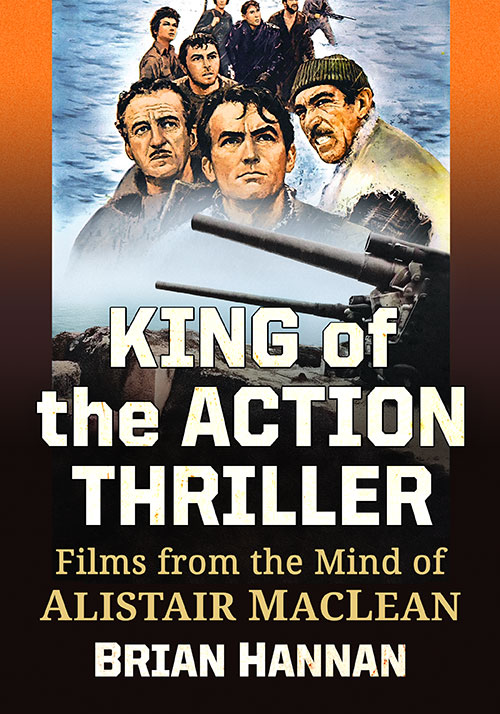
Now back to the shameless stuff. My latest book King of the Action Thriller – Films from the Mind of Alistair MacLean has been a long time coming but now it’s at the final stages of editing and is due out in February 2026. MacLean’s imagination, you might recall, was responsible for, among others, The Guns of Navarone, Where Eagles Dare, Breakheart Pass, Bear Island, Ice Station Zebra, Fear Is the Key and Puppet on a Chain.
I even found a long-lost screenplay he wrote that was never made. Eighteen of his books found their way onto the big and small screen.
You can order King of the Action Thriller it direct from the publisher McFarland or on Amazon and other sites and bookshops.
If you fancy going further into films of the 1960s I can recommend some other books to you. Admittedly, these are all books I’ve written but I did say this was a shameless plug.
Here are some of the titles:
The Making of The Magnificent Seven – Behind the Scenes of the Pivotal Western;
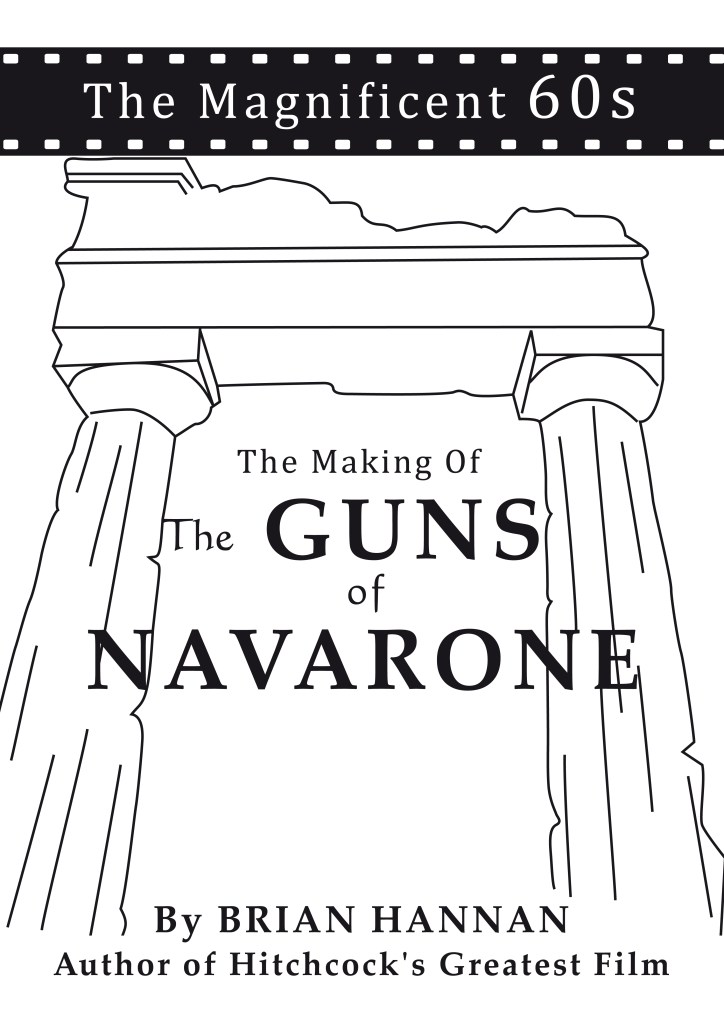
The Making of The Guns of Navarone;
The Making of Lawrence of Arabia;
The Gunslingers of ’69 – Western Movies’ Greatest Year;
and The Magnificent ‘60s – The 100 Most Popular Films of a Revolutionary Decade.
If you’re interested in more about the actual business of the movies you could dip into my books about reissues/re-releases and how Hollywood came to release new movies everywhere all at once. Check out my 250,000-word tome Coming Back to a Theater Near You, A History of Hollywood Reissue 1914-2014 and In Theaters Everywhere, A History of the Hollywood Wide Release 1913-2017.
I’m in the process of making available in printed form the reviews from the Blogs. I originally published these under the title 1960s Movies Redux but I’ve revamped these to now include illustrations and they’ll be available shortly in paperback and Kindle format under the title 1960s Movies Vol 1 (then Vol 2, Vol 3 etc).
I am indebted to one of my regular correspondents, who goes by the name of “Fenny100,” for the following “Behind the Scenes” report:
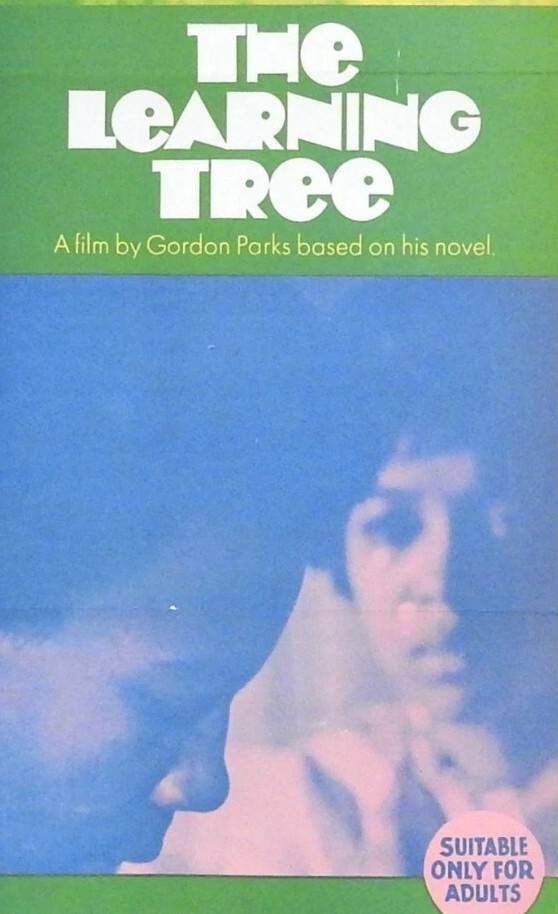
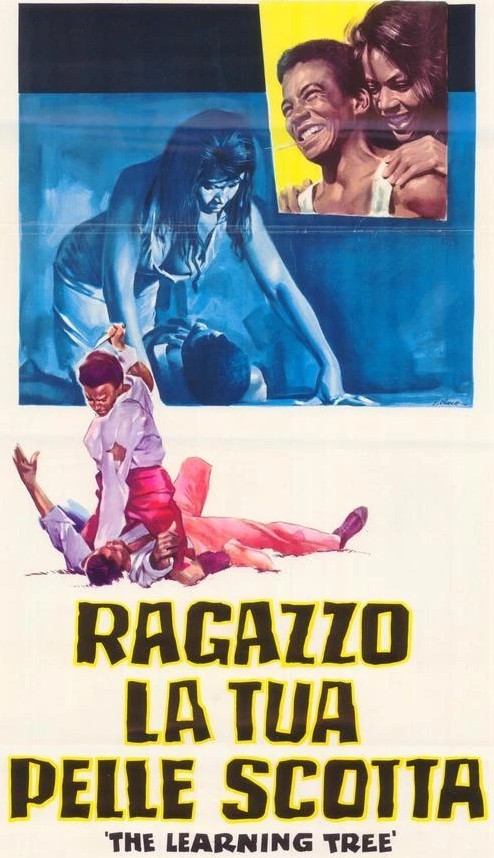
The working title of the picture was Learn, Baby, Learn. Based on his 1963 autobiographical novel, The Learning Tree, it marked the feature film debut of Gordon Parks, who was the first African American staff photographer for Life magazine. With the making of The Learning Tree, Parks became the first African American to direct a major theatrical motion picture. Parks had previously directed “several short film subjects and two one-hour features for National Education Television” (New York Times, 2 April 1968). The project was five years in the making (Variety, 17 April 1964), the writer-director in talks with producers interested in optioning his book. Two independent producers first acquired film rights (New York Times, 17 August 1969) but they were unable to raise the necessary funds. Another producer allegedly offered Parks $75,000 to adapt the script, with the stipulation that he must rewrite the black characters as white. Parks declined.
At some point, Bob Hope’s daughter, Linda Hope, was interested in producing the adaptation, (Variety, 7 November 1968). Parks’ friend, filmmaker John Cassavetes (Shadows, 1958), introduced his work to Kenneth Hyman, an executive at Warner Bros.—Seven Arts, Inc., which ultimately funded the production, although Cassavetes accidentally gave Hyman a copy of Parks’ 1966 memoir A Choice of Weapons rather than The Learning Tree. Hyman became enthusiastic about working with Parks and reportedly struck a four-picture deal with him within a fifteen-minute meeting. The Warner Bros.—Seven Arts deal (Variety, 1 April 1968) referred to Parks as “the first negro in film history to direct a major feature for a major film company.”
Also a well-respected musician, Parks was set to write the score, which (Variety, 12 July 1968) entailed a four-movement symphony. The production budget was set at slightly less than $2 million (Variety, 25 June 1969) and Parks was slated to receive twenty-five per cent of any profits (Los Angeles Times, 19 October 1969).
Principal photography was scheduled to begin on 30 September 1968 in Parks’ hometown of Fort Scott, Kansas, (“Production Chart,” Variety, 27 September 1968). Problems arose when the film crew, including six African Americans, began shooting in the town (Variety, 7 November 1968), a report which implied that the difficulties arose from racial tension. A later article (Variety, 25 June 1969) noted that there were twelve black crew members, not six, and blamed the tension between locals and filmmakers on the fact that Fort Scott residents wrongly assumed The Learning Tree was a “dirty film.” Parks said that shooting there eventually worked well, and that the local Elks Club admitted African Americans for the first time at a party thrown for the cast and crew. Parks was given a key to the city by local officials, and “Gordon Parks Day” was declared in early November 1968.
Following five-and-a-half weeks in Fort Scott, cast and crew moved to the Warner Bros.—Seven Arts studio lot in Burbank, California, where another two-and-a-half weeks of principal photography was scheduled, beginning in mid-November 1968. On 11 December 1968, Variety confirmed that filming had been completed.
Although William Conrad acted as executive producer throughout the shoot, his name was removed from the credits (Variety, 19 June 1969), though it was later explained that Conrad had agreed to help but wanted no credit, since The Learning Tree was “Gordon’s story.”
In discussing the small contingent of African Americans on his crew, Parks said (New York Times, 17 August 1969), “I hired 12 Negroes to work on the production. It was a fight, because the Hollywood unions are all white, but I got enormous cooperation from Warners.” The studio hired a black electrician, Gene Simpson, for the first time in its history (Los Angeles Sentinel, 13 March 1969), while publicist Vincent Tubbs – the only black union head as the president of the Hollywood Publicists Guild – worked on the film. Parks’ son, Gordon Parks, Jr., acted as still photographer. Seven African American craftsmen worked on the film (Box Office, 28 October 1968).
The Learning Tree was first screened on 18 Jun 1969 at a Warner Bros.—Seven Arts press junket held in Freeport, in the Bahamas (Variety, 18 June 1969). Following its debut there, Variety (25 June 1969) suggested that Parks’ “viewpoint on America and its racial problems” in the 1920s-set film might be negatively received by “black militants and other radical types.” Parks contended that black militants had been purposely planted in preview screenings, and although they had sometimes laughed at inappropriate times, they had generally congratulated him for his accomplishment. Parks stated, “But actually, I don’t care what they think. This is my story. I believe that in the black revolution there is a need for everyone.”
Despite the film’s perceived innocence, it received an M-rating (suggested for mature audiences) from the Motion Picture Association of America (Variety, 16 July 1969). It was due to have its world premiere on 6 Aug 1969 at the Trans-Lux East and West arthouses in New York City (Variety, 30 July 1969). Early reviews were mixed. Although the studio had initially planned a slow rollout of the film in arthouse theaters, its success at the more commercial Trans-Lux West – and relative failure at the Trans-Lux East – indicated the picture would play better at larger, inner-city theaters (Variety, 10 September 1969). A new “playoff pattern” was devised to take advantage of its box-office potential at theaters known for action films and other commercial fare.
Within seventeen weeks of release, cumulative box office gross topped $1.327 million from just 27 theaters (Variety, 5 November 1969).
At Los Angeles at Grauman’s Chinese Theatre, where The Learning Tree opened on 20 August 1969, a large fiberglass sycamore tree – which the studio planned to donate to the Crippled Children’s Society of Los Angeles County once the film’s run was complete – was built around the box office (Variety, 18 August 1969)
The Learning Tree was the U.S. entry at the Edinburgh Film Festival running 24 August – 7 September 1969. It won the Blue Ribbon Award from the National Screen Council in the U.S. for the month of September. The film went on to garner accolades including the National Association for the Advancement of Colored People (NAACP) Image Awards for Best Picture (in a tie with Joanna, 1968) Best Director, Best Actress in a Feature (Estelle Evans), and Most Promising Young Actor and Actress (Kyle Johnson and Alex Clarke).
Parks received an Annual Achievement Award from the Foundation for Research and Education in Sickle Cell Disease of New York City; an Achievement Award from the city of Cleveland, Ohio, presented by Cleveland Mayor Carl Stokes on the 24 September 1969 Cleveland premiere; and a Certificate of Merit from the Southern California Motion Picture Council, which also named the film a “Picture of Outstanding Merit.”
On the commercial front, the picture was a solid hit, raking in $1.5 million in rentals (what the studio earns after cinemas have taken their cut) in the annual box office chart (“Big Rental Films of ’69,” Variety, 7 January 1970).
Parks received honorary degrees from Boston University and Fairfield University in Connecticut. A week-long Gordon Parks Festival, also featuring Shaft (1971) and Shaft’s Big Score (1972), ran at Kansas State University in 1973.
Twenty years after its release, in 1989, it became one of the first twenty-five films selected for inclusion in the Library of Congress’ newly founded National Film Registry.
The big buzzword in movie marketing back in the day was “pre-sold.” The reason Hollywood pumped so much money into buying up the rights to bestsellers and Broadway hits was the notion that they came with a built-in audience, either of readers of theater-goers, and without any substantive proof made the connection that anyone who had read the book or seen the play or musical would be only too desperate to see what a movie maker made of the piece. In the 1960s, as I pointed out in a previous article, Hollywood had discovered the paperback tie-in, which marketing hacks perceived as free advertising, since those book covers would go on display in over a 100,000 book outlets across the country.
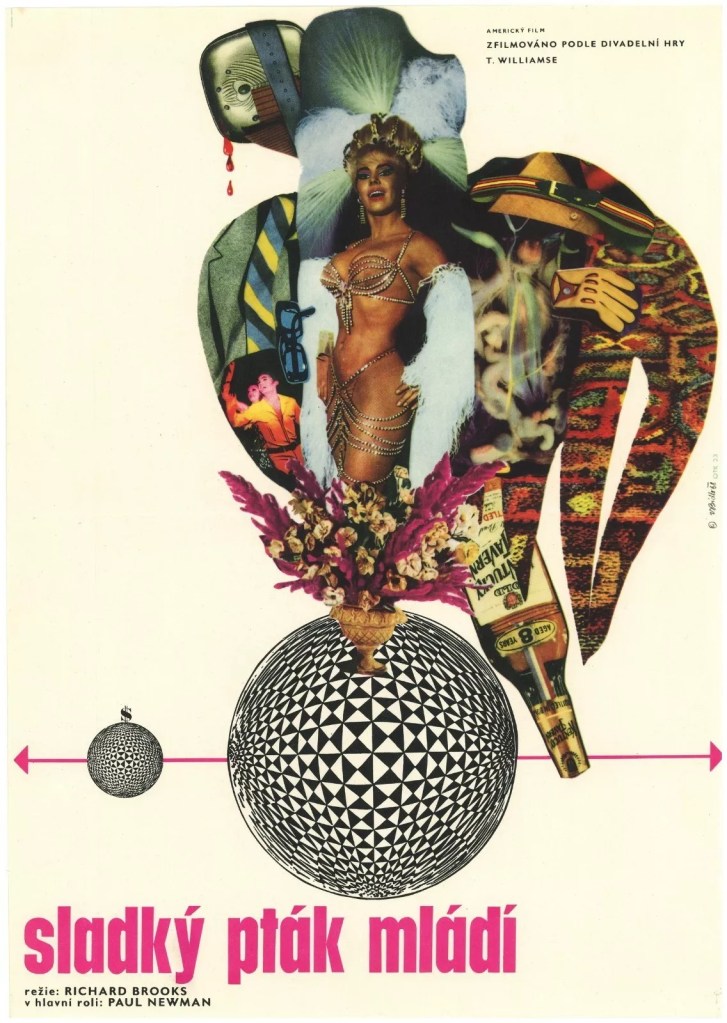
Even so, it comes as something of a surprise to see how dependent the marketeers writing the 16-page A3 Pressbook/Marketing Manual were on drawing cinema managers’ attention to the fact that Sweet Bird of Youth had originated on the stage. The three main articles in the Pressbook either went with “repeats role” or made mention in the headline of its origins. Admittedly, it had been a hit on Broadway, and with Paul Newman attached, ran for over a year – its poor performance on tour was naturally omitted. The opening article sensibly went to promoting Tennessee Williams. This was deemed “one of his greatest hits” and moviegoers would certainly be aware of his name thanks to Cat on a Hot Tin Roof (1958) and Suddenly, Last Summer (1959), both big hits.
However, given that Geraldine Page was the female lead and Oscar-nominated the previous year for Summer and Smoke, it seems odd that more column inches are devoted to third female lead Madeleine Sherwood with second female lead Shirley Knight overlooked except for a couple of postage-stamp-sized photos.
The “distinguished cast” notion was pushed much in the same way as trailers these days will promote anyone with the slightest brush with the Academy Awards.
“People have wondered why I had to work so hard to repeat a role I had done for more than a year in New York,” said Newman. “My only answer is that during the entire Broadway run of the play, Geraldine Page and I worked and rehearsed every day as if we were preparing for first night.” Despite his box office success he nurtured other ambitions. “ I want to be behind the camera. I’ve got my sights on directing. But I’ll start only when I think I know enough.”
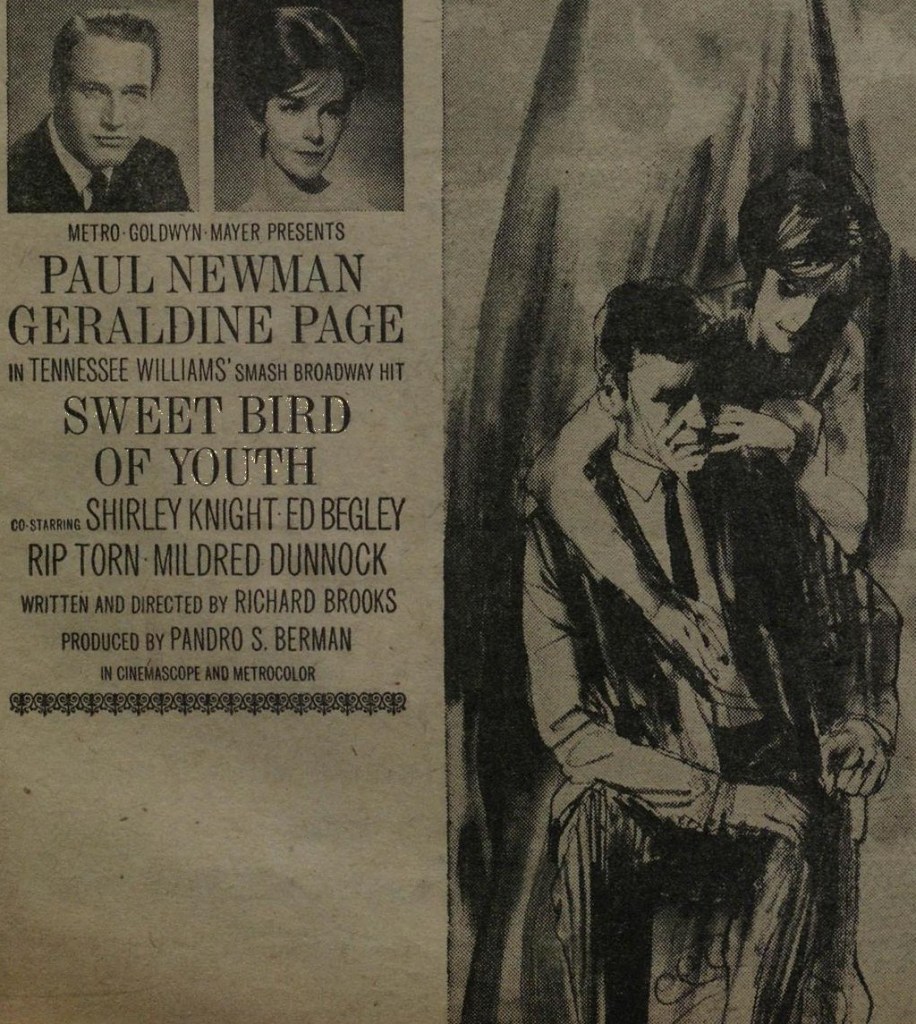
The first stab at artwork was less sensational than the final posters.
The marketeers fell in line with the notion now being touted in Hollywood that, despite leaving Geraldine Page out in the cold for seven years after she starred opposite John Wayne in Hondo (1954), was “a major talent to be reckoned with by fans and critics alike.”
Commented Page, “I played Sweet Bird and Summer and Smoke on stage for long so that I felt I knew the heroines Alexandra Del Lago (Sweet Bird of Youth) and Alma Winemuller (Summer and Smoke) as well as if they had been sisters of mine. This long-lived familiarity with a part might make some actresses feel cluttered but but it was a great comfort to me…You can work with them forever and never get bored…the longer you get to know them the more you become fascinated with them.”
And what was it, exactly, that was so fascinating about Madeleine Sherwood? It was the fact that she was a method actress, as though this was still big news after being known for over a decade. She explained that “emotional memory” as proposed by Lee Strasberg, method acting’s most famous proponent, was the key to her acting.
Pressbooks always tax the ingenuity of the marketeers who have to dream up snippets which might interest a local newspaper editor. Here we learn that virtually all the cast were blue-eyed, “associated with genius” according to the Pressbook team. For the scenes in which Newman drove a car – on a sound stage no less – he drove 600 miles without hitting a real road. We learned that Newman once wore a beard in a stage show in his early years and that Page once played an old crone also on stage. Also that Page was a dab hand a wearing a negligee, having spent time in her “lean years” working as a model in a negligee factory on Seventh Avenue.
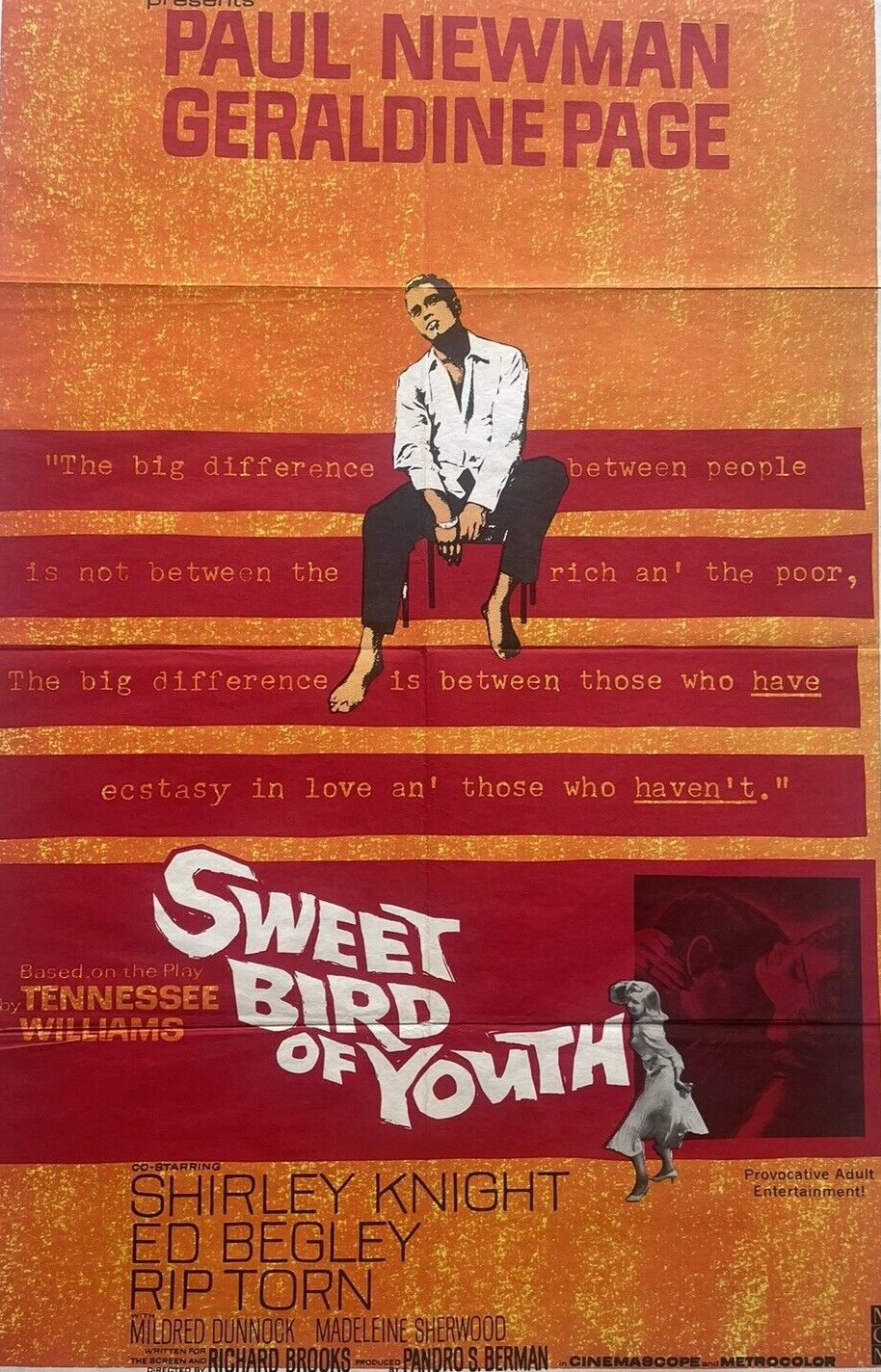
It would appear that there was a difference of opinion when it came right down to it about which advert – there were four to choose from – would lead the advertising pack. The Pressbook led with the tagline – “the big difference between people is not between the rich an’ the poor. The Big difference is between those who have ecstasy in love and those who haven’t.” Instead the team responsible for the posters went with the shorter, “He used love like most men use money.”
That tagline originated from a longer one, that more or less told the story of the movie. “Here he is right up on top of the gaudy world he swore he’d conquer. He’s got a movie contract in his pocket, a fish-tailed convertible in the hotel garage and a dame in his room payin’ for the drinks. He’s Chance Wayne who used love like most men use money!”
The speedboat that makes a brief appearance was central to the marketing campaign. Theater owners were urged to arrange tie-ins with local distributors of not just boats but boat engines. This was on the back of the Dumphy Boat Co of Oshkosh, Wisconsin, providing a $10,000 luxury speed boat for the shoot and because the Scott Racing Team supplied the $200,000 engine that powered it. Claims that the movie contained one of the greatest-ever telephone calls ever committed to celluloid provided the marketeers with an excuse to suggest a tie-in with a local telephone company.
Some ideas were more random. Because Newman wore a watch and Page a fur, tie-ins were suggested with those manufacturers. For no particular reason, except that she used them in her ordinary life, Shirley Knight was associated with cosmetics, perfumes and sportswear
A bit more imaginative was the idea of running a one-act play competition with a local dramatic group. A “Tennessee Williams Week” could be promoted through local libraries. A paperback version of the play had been published by the New American Library.
Actually, the biggest element of the Pressbook was the advertising. Twelve pages out of the sixteen were devoted to adverts in various shapes and sizes, that variety important because in those days cinema owners simply cut out the advert they required and passed it on to a newspaper to make up the advert to run there.
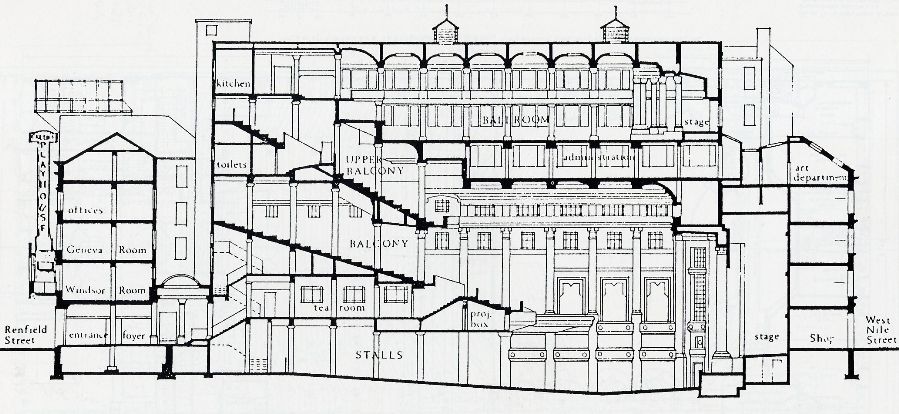
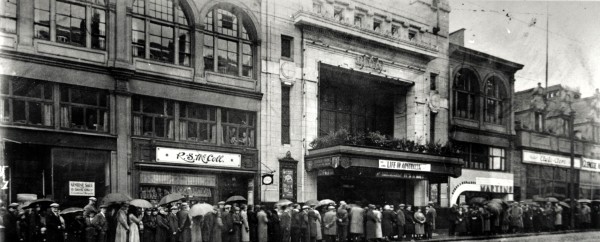
In theory by the time I discovered the cavernous Green’s Playhouse – the largest cinema in Europe with 4,368 seats and nearly double the size of any other picture house in the city – it should have been entering a cinematic twilight zone. Its glory days were long gone. Situated at the top of Renfield St, which itself sat at a 90-degree angle to Sauchiehall St (thus forming the L-Shape of the title), it had, on opening in 1927, been the epitome of luxury, built with remarkable foresight by the Green family, rather than one of the major chains, ushering in the era of the “super cinema” just in time to meet the demand for the Talkies.
Seats were color-coded according to price and there were “Golden Divans” in boxes for courting couples. It stood out at night through an electric-bulb vertical American-style sign. Business boomed until post-war the cinema began losing out to the major chains in the competition for the best films. By the time I made my first visit it was surviving on exploitation and horror. It was the shabbiest of giants, carpets torn, seats badly in need of reupholstering and a distinct lack of atmosphere.
The only time I ever witnessed anything approaching a full house was for a screening of a full-length showing of the European Cup Final of 1967 when Glasgow’s Celtic beat Inter Milan. But there was a light around the corner in the form of pop concerts and its size allowed it to take over from the Odeon as the venue of choice for touring bands. My best memories are not of seeing a great movie there but of watching a roster of the top bands, The Rolling Stones, The Who and Elton John. It’s the only city center venue which continued plying its trade as a movie merchant and eventually was turned into the Cineworld multiplex, the busiest cinema in Britain.
About 100 yards down Renfield St on the same side of the road was the 1314-seat Regent. Originally, in 1911 it was less than half that size, built for comfort over one storey with stadium seating. Remodelled in 1920 it gained an extra floor and partly by installing a balcony doubled the seating. It was very thrifty where the lobby was concerned. You were virtually at the ticket desk the minute you stepped through the frontage.
It was the only cinema I knew where the programme showed the times of the trailers and newsreels. Like the Playhouse its days of vying for top product with the Odeon, ABC Regal and La Scala were long gone. Now it was primarily a second-run establishment and virtually the minute a movie completed its allocated assignation at the Odeon it was shipped into the Regent. Once in a while, by local mandate, it showed a new film. As long as you were willing to wait a week or possibly two, you could see a top film for less money. It was very comfortable and well run.
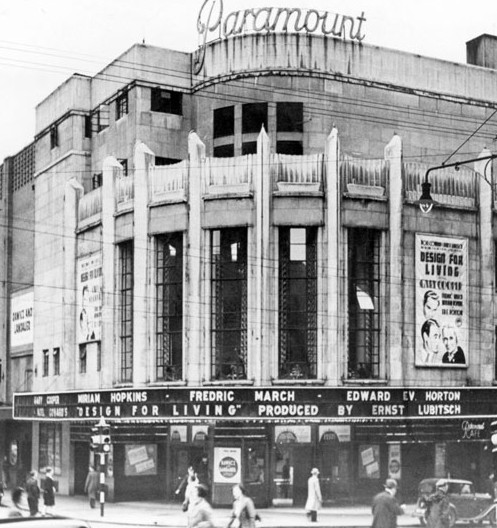
Less than 20 yards further down, on the same side of the road, was the majestic 2784-seat Odeon, certainly from the outside the most stylish of the city center houses thanks to its Art Deco design. Oddly enough, despite the Odeon chain’s association with Art Deco, it wasn’t built by Odeon. Instead it was commissioned by the American Paramount organization, at a time when studios also owned cinemas, opening on 31 December, 1934.
Green’s Playhouse
It was Glasgow’s first free-standing cinema built from scratch rather than being a conversion of an existing building. It was the size of a city block. As well as erecting the largest neon sign the city had ever seen atop the building, it also imported another American idea, a box office outside the cinema. At the outbreak of war Paramount sold the operation to Odeon and it became its Scottish flagship. This was the key first-run location for films by United Artists, Twentieth Century Fox, Disney and Columbia. Such was the demand for screenings that hardly any films during the 1960s – the Bonds a notable exception – were held over for a second week, in part because Rank had to feed movies into its suburban circuits.
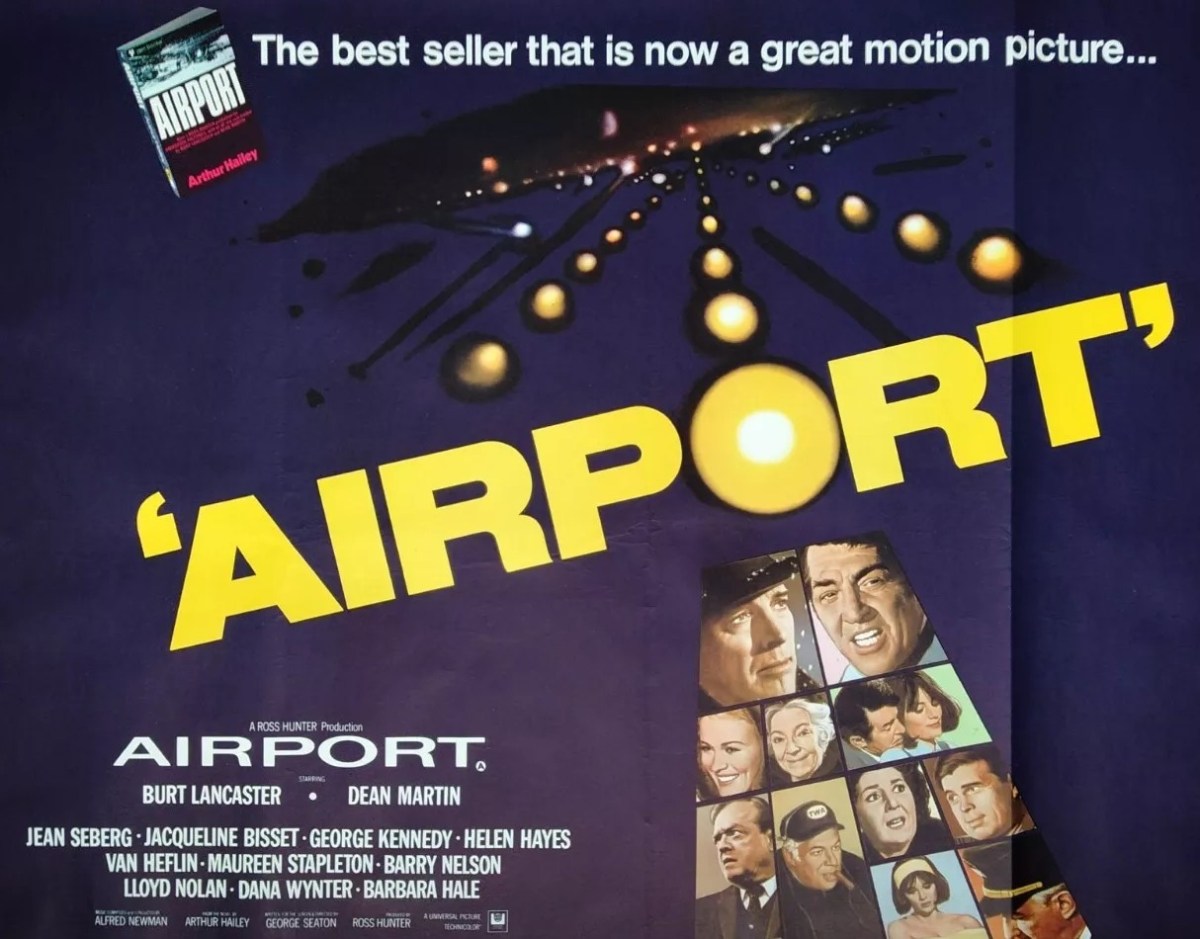
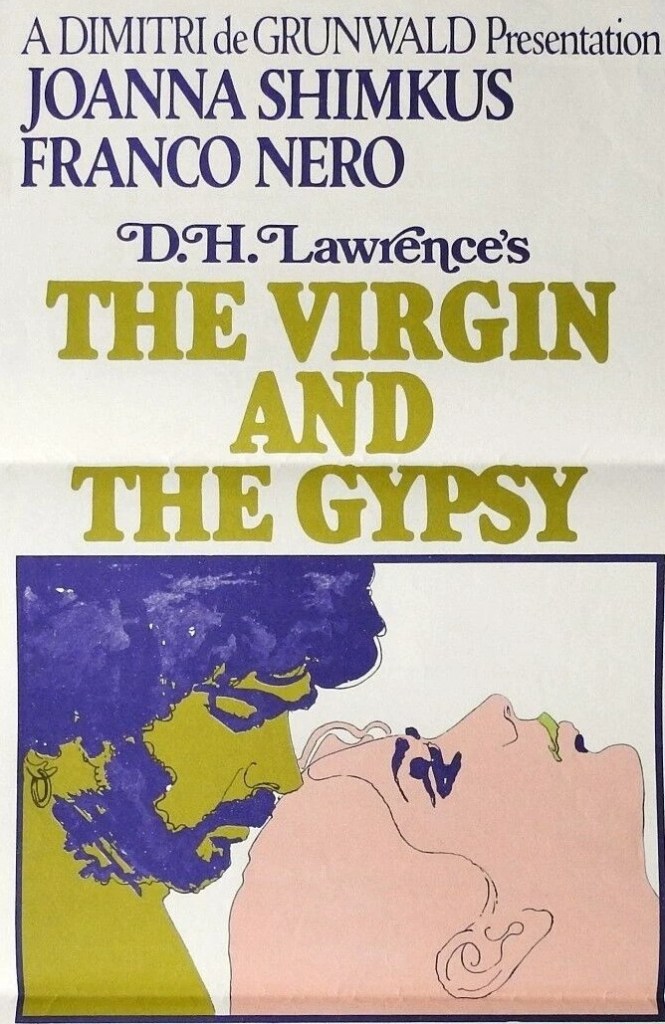
In 1970 the cinema was tripled, which allowed the cinema to double as a roadshow house, and operate more strategically, by switching movies from the bigger to the smaller cinemas to extend their city center runs. It opened with Cromwell in roadshow at Odeon 1, Airport at Odeon 2 and The Virgin and the Gypsy at Odeon 3. Theoretically this increased the flow of films through the Odeon operation, but in reality as often, when two or three long-runners came along at once, the system ground to a halt. I became very familiar with this operation when I had my first stint as a critic, reviewing films for the Glasgow University Guardian.
Another 50 yards down the street on the opposite side of the road was one of my favorite hangouts – the Classic – which, as the name suggests, specialized in reruns of old pictures. Much as I enjoyed spending time checking out the reissues, I would have loved to have been around for its initial iteration when it was known as Cranston’s De Luxe Cinema, an 850-seater opened in 1916 by the same Miss Cranston whose tearooms had been designed by renowned Scottish architect Charles Rennie Mackintosh.
It occupied the third floor of a stylish six-storey building and screened first-run movies in opulent fashion. When business declined after the Second World War it was sold twice, first to the Greens who added a newsreel cinema. Classic bought it over in 1960 and ran it as a repertory house, adding late night films. You felt like you were climbing to the stars, it was a long haul to enter but it was well upholstered inside and they ran a huge range of older films, often double bills and sometimes changing the programme midweek. It was far more useful in my movie education than the arthouse. In 1969 the venue added a smaller operation, the Tatler, showing sexier fare as a “members only” club. It only came into being because the Grand Central in Jamaica St had folded in 1966 (it reopened in 1973 giving Glasgow three soft porn emporiums).
That was the saddest decline tale of any of the Glasgow cinemas. Opened in 1915, the 750-seat Grand Central was an instant hit, classy enough to have an orchestra and technically the first city cinema to feature sound, which emanated from records playing simultaneously with the film. Even when it hit tougher times in the 1950s it attempted to go down the arthouse route but eventually succumbed to sexploitation
The connecting roads of Sauchiehall St and Renfield St should form the boundary for my L-Shaped Street of Dreams but if I had continued about a mile in a straight line from the end of Renfield St I would come to another palace of splendor, a roadshow kingdom, home to 70mm and Cinerama two-shows-a-day advance bookable productions which, like The Dirty Dozen (1967) and Where Eagles Dare (1968) enjoyed nine-month runs. The Coliseum opened in 1905 as a music hall seating 2893 over three levels. It became a cinema in 1925 and played host in 1929 to the first talkie The Jazz Singer which caused a sensation. In 1962, reducing eating capacity to 1300 after an expensive revamp, it reopened as the only cinema in Scotland showing Cinerama.
We all did it – or so I’m guessing. Head into our city center and take a long walk past all the big cinemas and stare at the posters and stills on display outside the cinema and peek inside to the far wall where was a smaller poster for what was coming next week. Of course, we could just have checked out the daily newspaper and spotted what each house was offering. But that wasn’t the same.
In Glasgow, Scotland, where I grew up, the main cinemas were conveniently situated along an L-Shaped drag of the city’s two chief shopping districts that ran for about a mile, abutted by the two main train stations, Charing Cross at one end, and the terminus of Central Station at the other. On Saturday afternoons I’d hop on a bus into town and take a stroll down my L-Shaped Street of Dreams.
Glasgow was a moviegoing mecca. It boasted the biggest cinema audiences in the whole of Britain on a per-head-of-population basis. Where Londoners might attend the cinema once every two months, Glaswegians turned up every two or three weeks. Green’s Playhouse was the biggest cinema in Britain and when the Odeon turned into a triple that was the busiest complex in Britain (a position that the Cineworld in Renfrew St held until its recent closure).
As far as this initial interest in moviegoing went, I’m talking the late 1960s/early 1970s, just at the start of multiplexing – the first of that breed appearing in 1967 and the second in 1970. And, unlike today, movies opened on a Monday for a six-day run with Sundays given over to a separate one-day double bill, usually of the exploitation/horror variety and generally an oldie. There were no split weeks in the city center movie houses. At the time of which I speak, the program changed every week. It was rare in the 1960s for a movie to be retained (held over) for a second week and even rarer for a third. Though that changed with the advent of the blockbuster in the 1970s when Love Story (1970), The Godfather (1972) and Jaws (1975) ran for months in one city center first run.
I always began my cinematic ramble in Sauchiehall St at the Charing Cross end which afforded me the opportunity, first of all, to peer into the relatively discreet windows of the Curzon Classic and take note of the risqué fare. This was by default an arthouse when the sexiest pictures available before the onset of more permissive movies all came from Europe. So, occasionally, you’d find it playing host to a genuine arty number that happened to contain whatever degree of nudity the British censor would permit. Eventually, it fessed up and became a members-only cinema where it could show whatever it wanted – though still within the strictures of the British Board of Film Censors, which meant no hard-core. Still, you were guaranteed that every movie shown was X-certificate.
The 450-seater Curzon Classic began life in 1912 as the Vitagraph before being renamed the Kings. In 1954, as the Newscine, it became the first cinema to specialize in newsreels. But that didn’t last long and, renamed Newcine, turned into a second-run house. The Classic chain, which ran a repertory outfit showing reissues, bought it in 1964. But this particular cinema strayed outside the normal Classic chain fare of older movies and tended to screen the kind of movies I mentioned.
A few hundred yards along and you came to the ABC Regal, one of the two biggest first run houses and local flagship of the ABC circuit. I learned much later on that the two most important British chains – the ABC and the Odeon – had separate exclusive deals with major Hollywood studios. So the ABC would only show pictures made by MGM, Paramount, Universal and Warner Bros while its rival ran pictures made by Twentieth Century Fox, Disney, Columbia and United Artists.
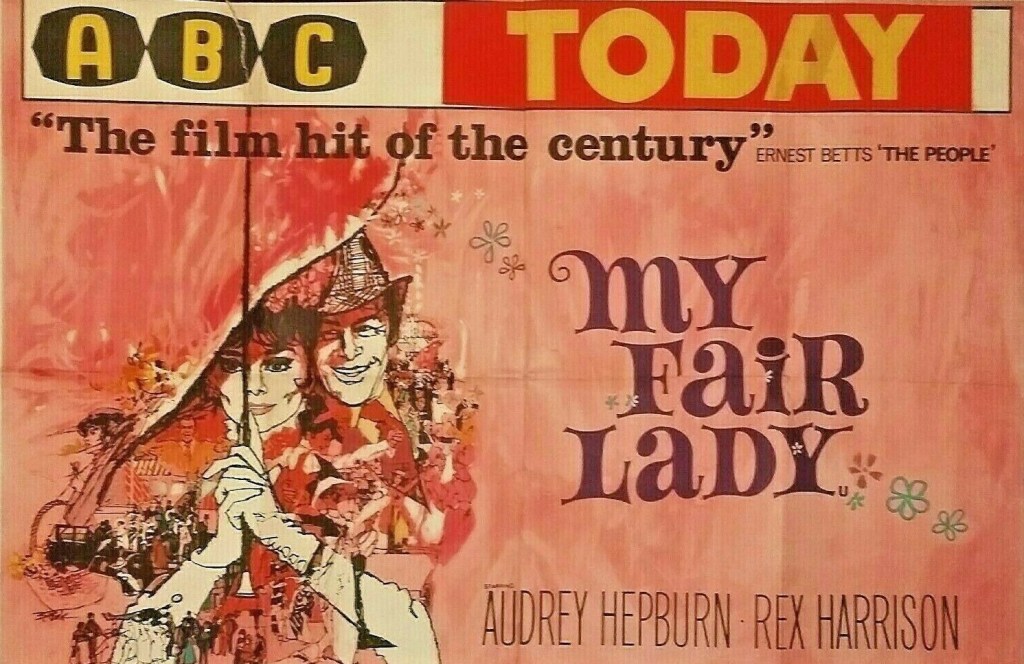
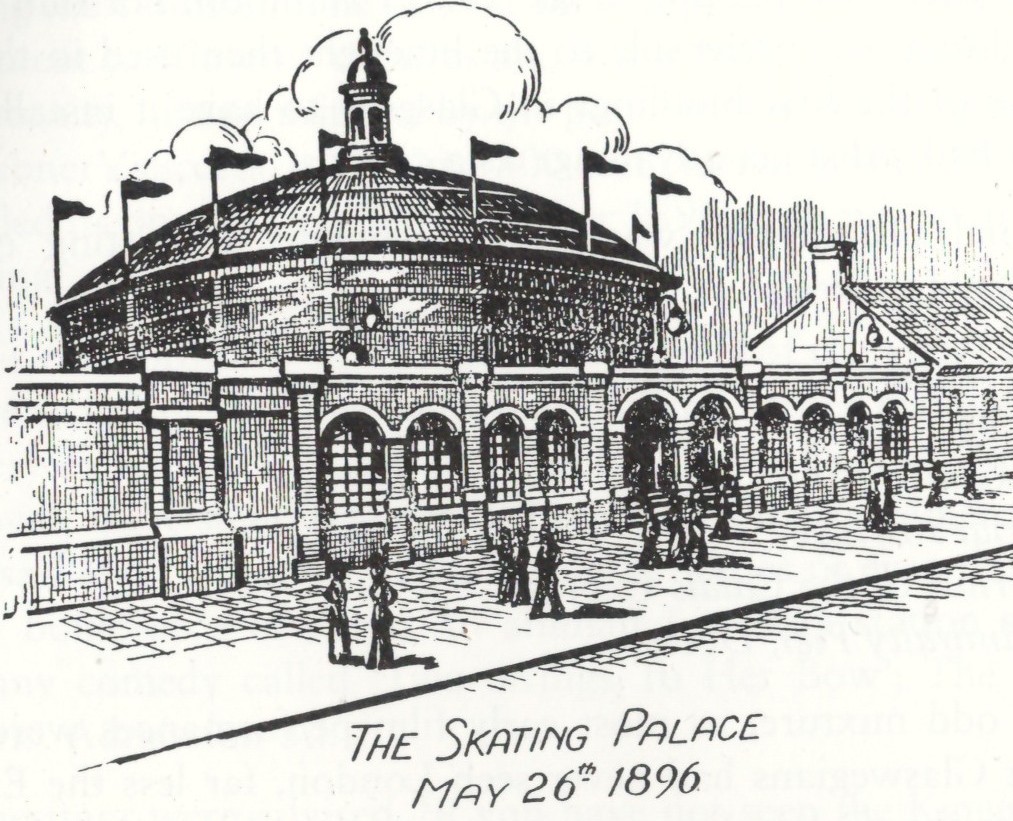
The Regal was one of the city’s first “super-cinemas,” opening on 13 November, 1929. The site had been entertainment-based since 1875 and successively had traded as the Diorama, The Panorama, the Ice Skating Palace (also showing movies from 1896) and The Hippodrome. For a quarter of a century from 1904 it hosted Hengler’s Circus and briefly was the Waldorf Palaise de Dance. The Regal had 2,359 seats. It changed its name to the ABC Regal in 1959. Occasionally, it doubled up as a roadshow house, My Fair Lady (1964) running there for several months.
Regal.
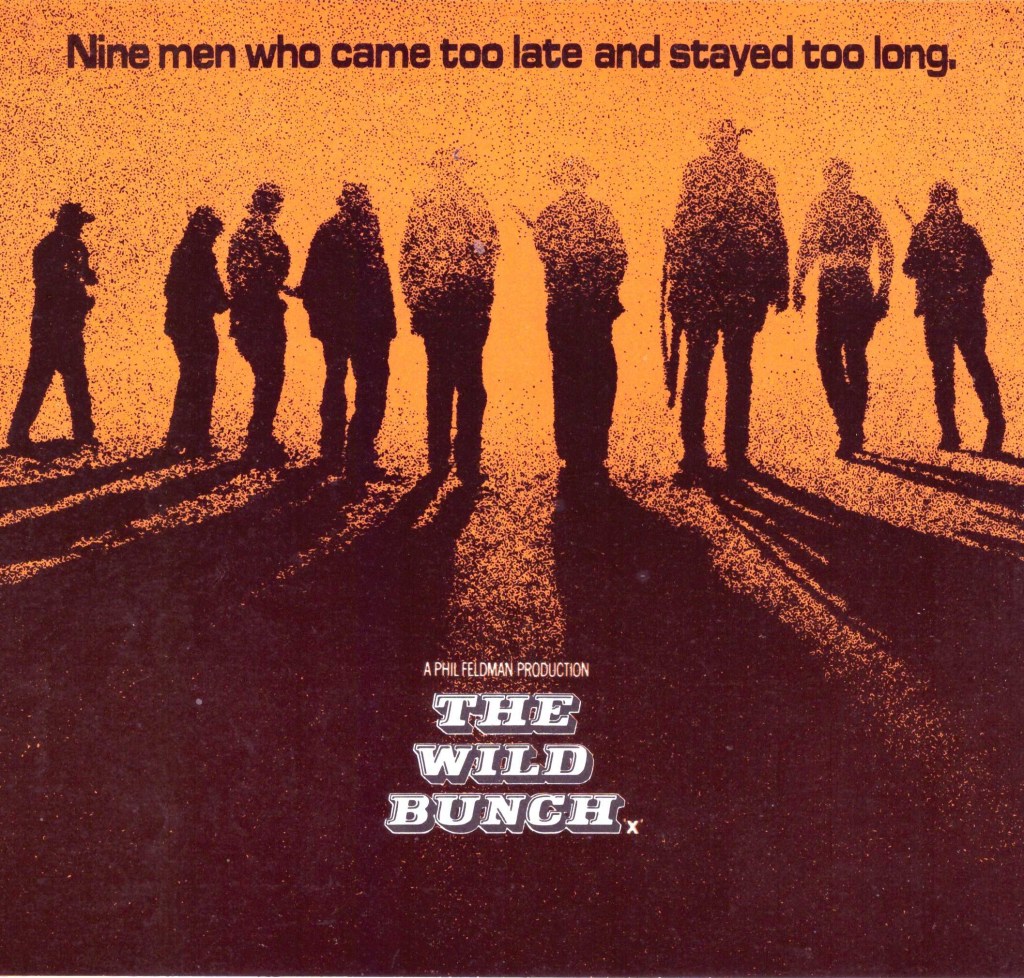
In 1967 it was split in two. The Regal was renamed the ABC 1 and its more luxurious partner, a 922-seater, the ABC 2. The former continued to change its program every week but the latter was a roadshow venue, so movies ran there at least for a month – Ryan’s Daughter (1970) held the record of lasting a full year. Some pictures which went out on general release and on a 35mm print in the USA were blown up to 70mm and road shown in Britain, and it was here and in that format I saw The Wild Bunch (1969).
When roadshow was in short supply or an earlier movie had not performed to expectations and its run was curtailed, the ABC 2 would put on reruns of previous roadshow successes – in 1968 The Great Race (1965), Battle of the Bulge (1965) and Becket (1964) all had one-week stints in continuous performance.
Having a reputation for the moviegoing habit did not ensure that films arrived any faster in Glasgow. All movies of any distinction had their first showings in Britain in London’s West End and rarely went north until both that run was complete and it had played the North London and South London circuits.
Just round the corner from the ABC, off Sauchiehall St, in Rose St, was the Cosmo (reborn as the Glasgow Film Theatre in 1974). Not only was Glasgow viewed as a vibrant city for Hollywood pictures, but it was also reckoned to be a prime target for alternative cinema. Built in 1939, the Cosmo was the first purpose-built arthouse outside of London. Owned by George Singleton the 850-seater arthouse had a quirky “Mr Cosmo” logo.
As well as a weekly change of program of largely foreign movies, the Cosmo also occasionally hosted roadshows. While not falling in with the standard 70mm format, the Cosmo maintained the separate performance element of the roadshow. In 1967 it premiered the Burton-Taylor Shakespeare extravaganza The Taming of the Shrew, which lasted 12 weeks, and the Oscar-winning A Man for All Seasons which held court for eight weeks.
Further along Sauchiehall St was the 1,000-seat La Scala, dating from 1936 and, famously, with a café on the ground floor. This was the flagship for Caledonian Associated Cinemas, a chain that had more cinemas throughout Scotland than either ABC or Odeon and therefore was in a strong position to negotiate for first-run product. First-run pictures often enjoyed a two-week engagement here. Generally, it alternated between first and second run, pictures receiving a repeat outing a week or so after finishing a run at the ABC or Odeon. Occasionally, it went roadshow, it was separate performances in 1968 for a four-week run of Doctor Zhivago after its initial roadshow outing in the city. In the early 1970s when ABC was in dispute with Paramount over its rental terms, the La Scala obtained the rights to Love Story (1970) and it ran at the cinema on continuous performance for 26 weeks.
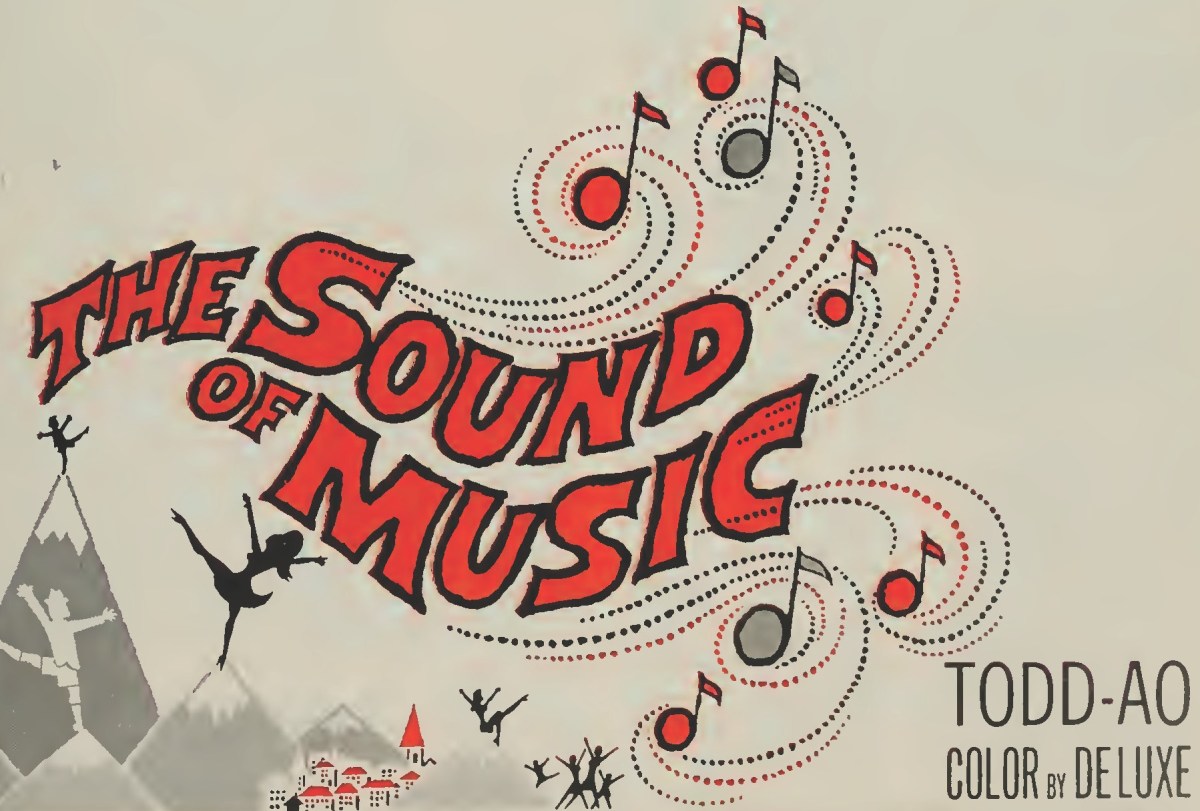
Opposite the La Scala was – until the ABC2 came along – Glasgow’s city center roadshow kingpin, the Gaumont, the Rank/Odeon chain’s roadshow flagship, which had played host to The Sound of Music for 134 weeks. Originally it was part of the Gaumont chain before being subsumed by Rank and merged with its existing Odeon circuit. It had opened in 1910 as The Picture House with a capacity of 1,084-seats and later expanded to accommodate 1,600 patrons. It was taken over by Gaumont in 1929 but the original name was retained until 1947. It became the city’s de facto venue for roadshows after being chosen to premiere Cecil B. DeMille’s The Ten Commandments (1956) in a run lasting four months and became internationally famous when South Pacific (1958) ran there for 18 months. Occasionally, it reverted to short runs in continuous performance such as, in 1968, Sgt Ryker with Lee Marvin.
This takes me to the halfway point of my stroll along my L-Shaped Street of Dreams. Next time I’ll be taking a turn both left and right from Sauchiehall St and going both up and down Renfield St.
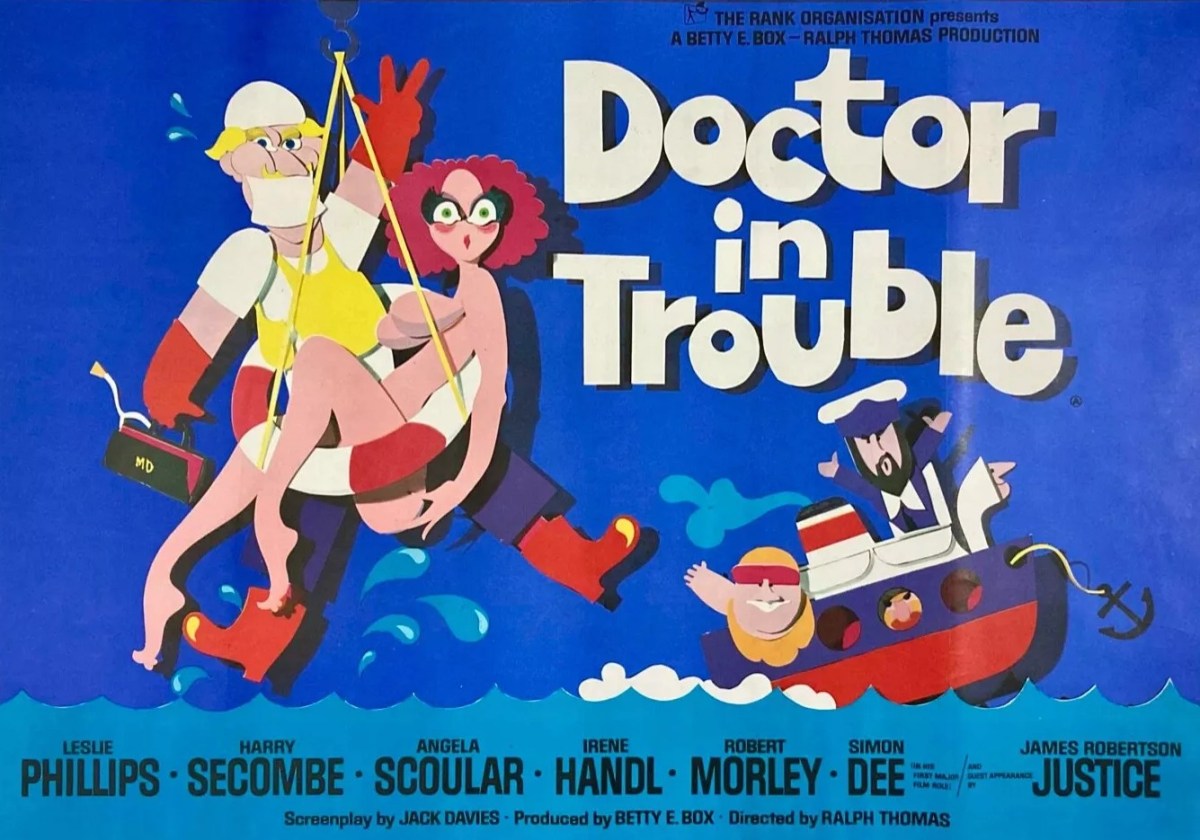
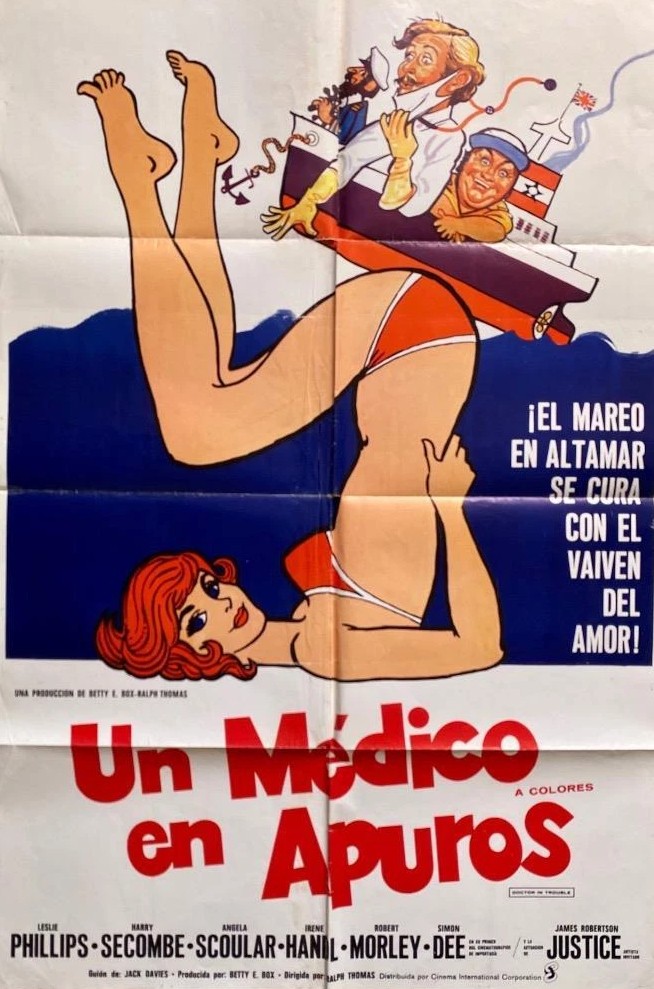
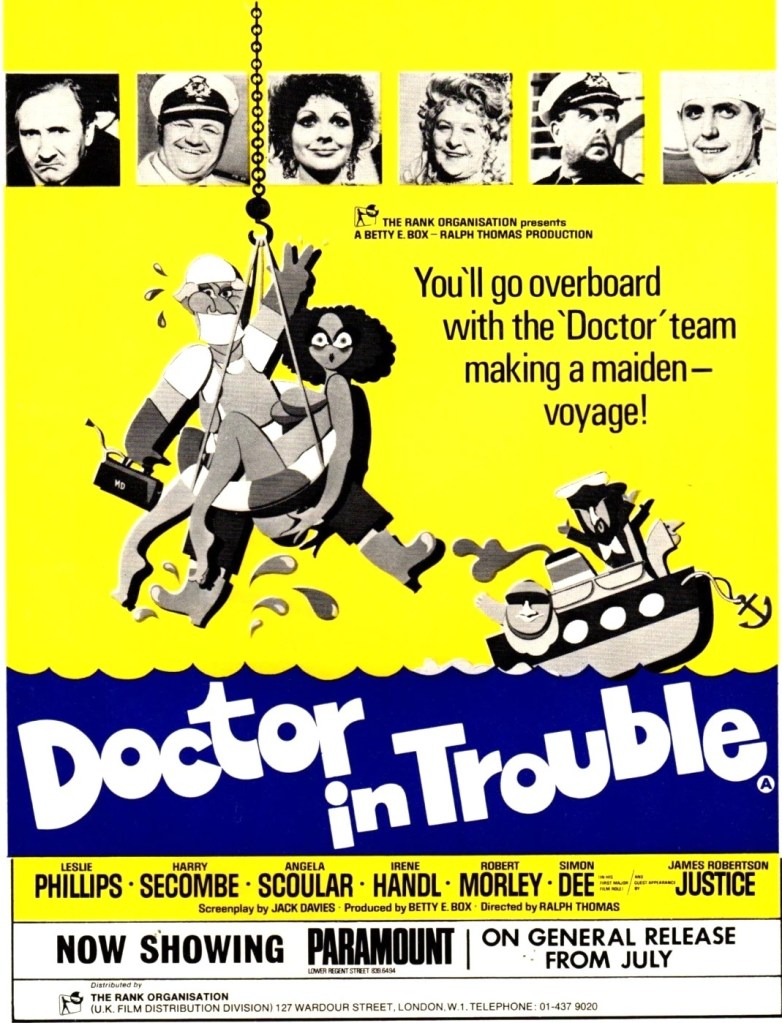
Limp ending to a fine series. Torpedoed by too many oddities. Leslie Philips returns in the top-billed role, but he’s not playing the suave Dr Gaston Grimsdyke of the previous iteration, but instead a more hapless version of Dr Paul Burke, the character he played a decade before in Doctor in Love (1960).
Confused? You will be. It’s clearly set up for James Robertson Justice to play two characters, a la Sinners (2025), his usual Sir Lancelot Spratt and his presumably identical brother, ship’s captain George Spratt. But Justice fell ill and the naval part was taken by Robert Morley, of similar bombastic ilk, but in diction more long-winded and fluffy and lacking the bite of the surgeon.
In the last two episodes I’d seen there had been an obnoxious salt-of-the-earth character who turned out to be surprisingly artistic. Here, we have to settle for the nouveau riche Pools-winner (a gambling game of the era) who is channeling his inner Sidney James, all leer and not much else. And if you want proof that it’s never a good idea to hire a television personality merely because he has a large following, look no further than Simon Dee.
Several notions will not endear themselves to the contemporary audience – the cross-dressing, the cliché gays, and the Englishman in brownface playing an Indian. That’s not to mention the pratfalls and endless falling into swimming pools.
There’s even less of a plot than in the last outing. Dr Burke (Leslie Philips) accidentally stows away on a cruise ship after pursuing model girlfriend Ophelia (Angela Scoular) who’s working there. He also comes up against actor Basil Beauchamp (Simon Dee), an old school bete noire, who plays a doctor in a television soap.
Dr Burke is hounded by the ship’s Master-at-Arms (Freddie Jones) so occasionally it lurches into farce. And there’s any number of sexy debutantes either desperate to climb into bed with the TV star or hook the gambler.
If it had settled on one tone – slapstick, sex comedy or farce – it might well have worked even in the face of the poor script. Cor blimey, there’s even some fleeting nudity from Ophelia and Leslie Philips and a striptease that’s way out of place for what was originally a much gentler comedy than the Carry Ons. In terms of style it’s all over the place and not a single member of the cast is appealing enough to rescue it.
Had Leslie Philips been in traditional “ding-dong” comfort zone it might have passed muster but here he’s just the butt of all the jokes without generating an ounce of sympathy. Robert Morley (Some Girls Do, 1969) isn’t a patch on James Robertson Justice. Angela Scoular (On Her Majesty’s Secret Service, 1969) seems off-key, Freddie Jones (Otley, 1969) as if he’s in a different picture while the constantly leering Harry Secombe (Oliver! 1968) belongs in a Carry On. Graham Stark (The Picasso Summer, 1969) is deplorable as the Indian waiter Satterjee.
The only person to rise above their station is Joan Sims (Doctor in Clover, 1966) who makes a cameo appearance as a Russian nurse. In bit parts you might spot Yutte Stensgaard (Zeta One, 1969) and Janet Mahoney in her debut.
Directed as usual by Ralph Thomas. Script by Jack Davies based on a Richard Gordon bestseller.
After this, the series was reimagined for television and returned to its gentle comedy roots.
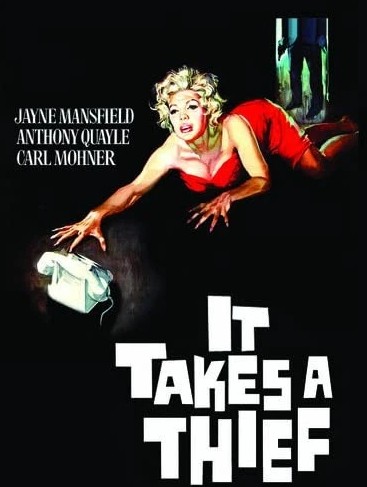
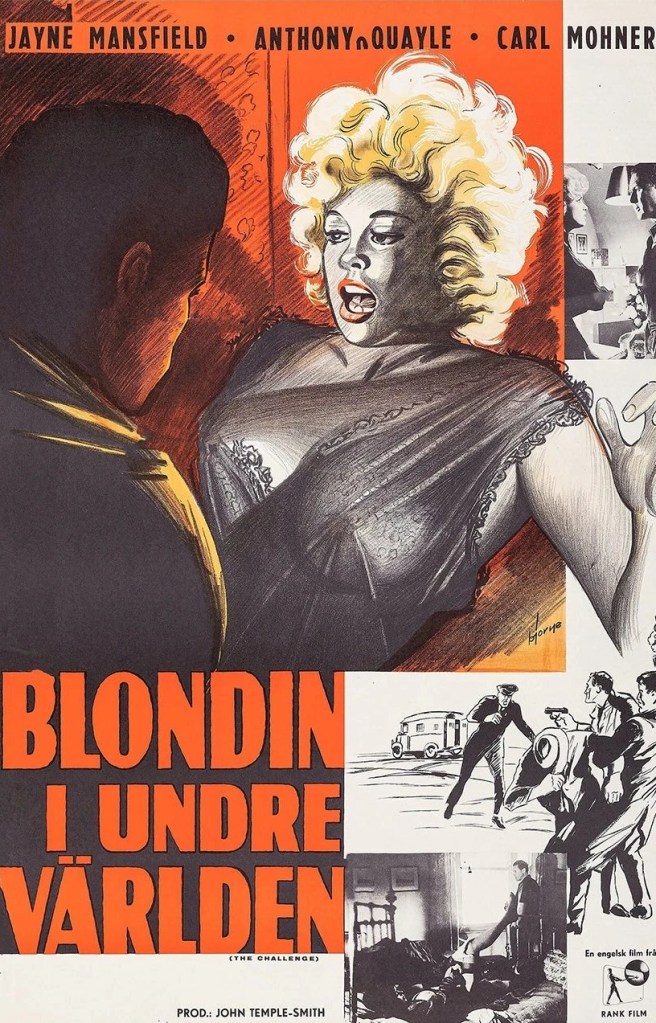
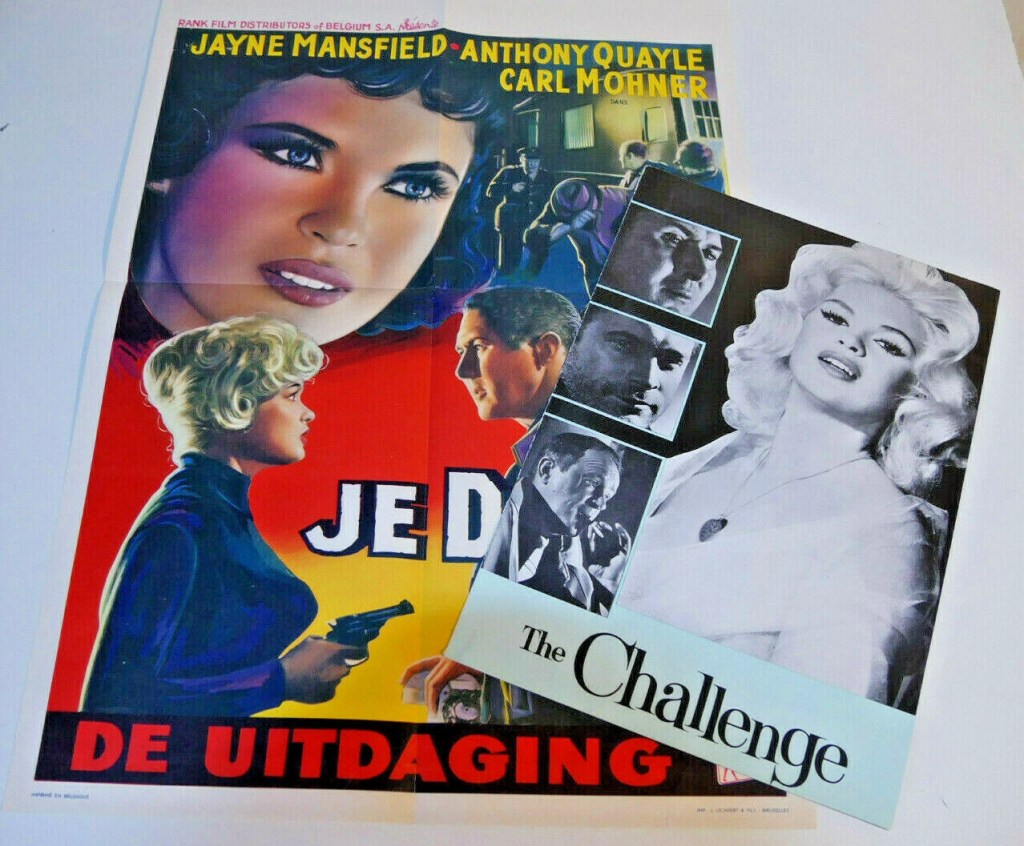
Extremely dark-edged thriller at least a decade ahead of its time. Absolute corker of a sting in the tail. Instead of being the gangster’s moll, Jayne Mansfield – following on from another British-made thriller Playgirl After Dark / Too Hot to Handle (1960) – turns the genre on its head by playing the smart leader of a gang of bank robbers constantly evading detection by the police. Anthony Quayle (East of Sudan, 1964) drops his good guy stiff upper lip screen persona in favor of a villain.
Most heist movies either fall into the category of mostly heist (Topkapi, 1964) and half-heist and half-aftermath. Here the heist is dealt with pretty quickly and then we’re into a complicated aftermath with double cross the order of the day. Even the supposed good guys – a cop and a union leader – have a distinctly mean streak. And on top of that we have a whole load of car chases. Just one would be unusual at the time for this budget category, but here we have three, complete with crashes and cars totaled off the road. And on top of that there’s an exceptionally creepy attempt at getting an inconvenient young child to commit suicide by playing chicken on a railway line.
Widowed lorry driver Jim (Anthony Quayle), who has dreams of owning a farm, is seduced into acting as the driver for the latest bank heist organized by Billy (Jayne Mansfield). While his van loaded with the loot tootles off unimpeded, she acts as bait in another car to snooker the cops into pursuing the rest of the gang. As proof of her love for him, she entrusts him with burying the loot in a place of his choosing.
He doesn’t get the chance to dig it up again because someone’s snitched on him, most likely Billy’s ex Kristy (Carl Mohner). And since he can’t snitch on the gang to save his own skin he ends up doing a five-year stretch. When he comes out, he finds the cops shadowing his every move, and Kristy taking his place in Billy’s bed. Det Sgt Gittens (Edward Judd) decides to play dirty by suggesting that Jim is intent on double-crossing her.
The gang, determined on recovering the loot as soon as possible, have their own arsenal of dirty tricks, beating up Jim’s mother and kidnapping his son. You’d think that with his mum black and blue and his son in the hands of the crooks that Jim would give up the loot. But, as I said, he’s not a good guy and is willing to risk all he supposedly holds dearly to get his hands on the dosh.
There’s a twist that Thunderbolt and Lightfoot (1974) later down the line exploit. Instead of someone building a school over the hiding place as with the Clint Eastwood picture, here it is hidden under dozens of barrels of high explosive encased in barbed wire. With the deadline approaching for killing his son, Jim attempts to enlist a bunch of local laborers only to be stopped in his tracks by the bureaucracy of a union shop steward.
Meanwhile, the couple, and despite all the motherliness of the childless wife (Barbara Mullen), forced to hide the child aren’t making the slightest attempt to help him escape. Instead, we watch with incredulity as one of the hoods, stumbling upon an easy way to get rid of a body, tempts the child into playing the aforementioned game of chicken.
Tension remains at a peak all the way through, in part because audiences are expecting Anthony Quayle to rouse himself from the depths of criminality and do the right thing, but mostly, in the template that Christopher Nolan would follow, three sets of narrative constantly come together.
There are two stings in the tail. Firstly, the burial site is obliterated when the barrels of high explosive shoot sky high. Secondly, with decided relish, Sgt Gittens informs Billy that the cops recovered the loot years before, so he’d risked mother and son for nothing. You can’t get blacker irony than that.
Jayne Mansfield was a much bigger attraction than Anthony Quayle and she puts in a superb performance as the mastermind and the practical woman, not willing to put career or love life on hold while Jim does his time. And while she’s slinky enough and occasionally brazen, she’s also decidedly human, but no more inclined than Jim to allow anybody to get in the way of the rewards of crime.
Like the crime pictures Britain showed a distinct aptitude for in the 1970s – Get Carter (1971), Villain (1971) and Sitting Target (1972) – this stays resolutely on the wrong side of the fence with not a single redeemable character.
Written and directed by John Gilling before he shifted into horror (The Reptile, 1966), this is a more than able piece, pulling no punches and resisting the temptation to sneak in any sentimentality.
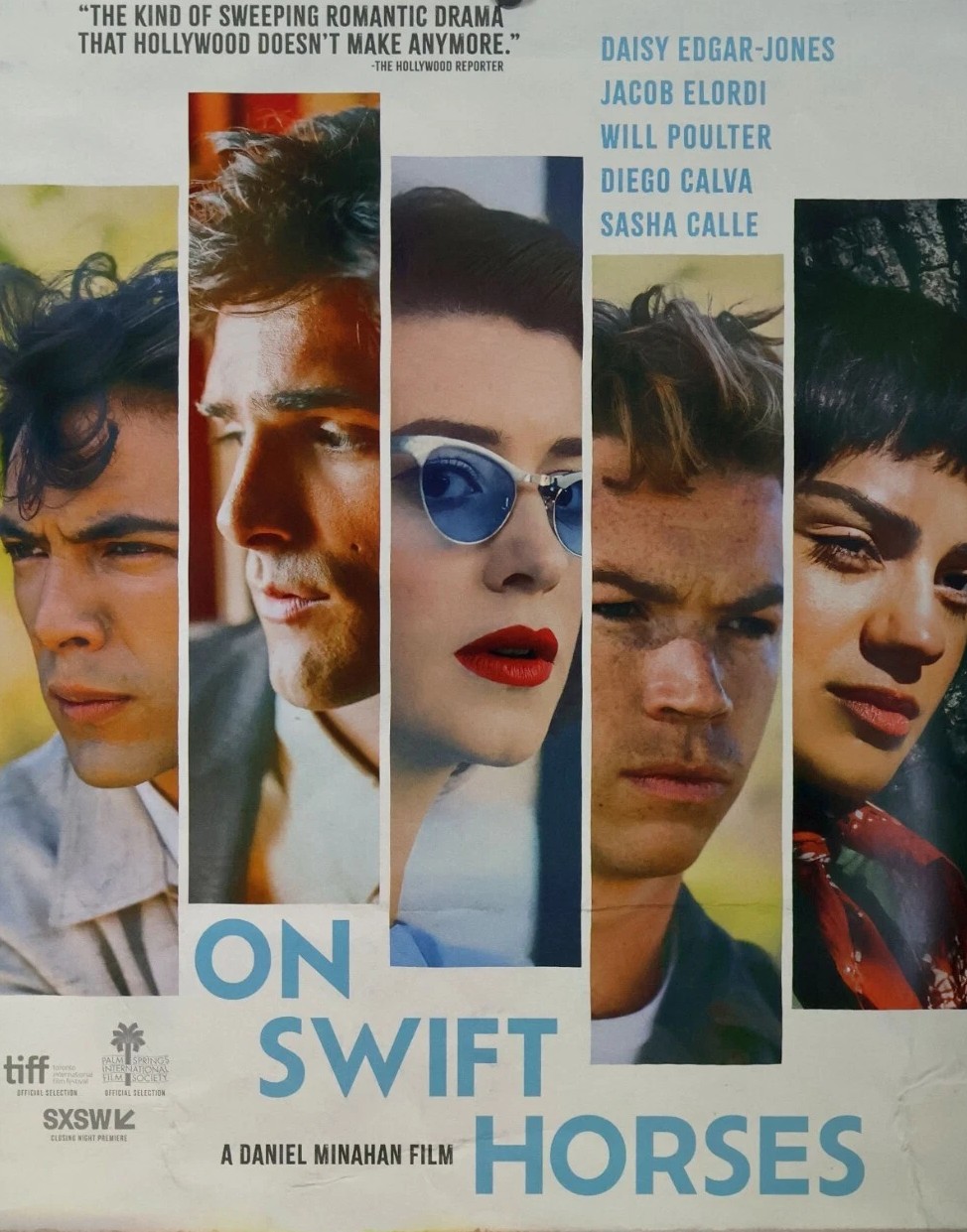
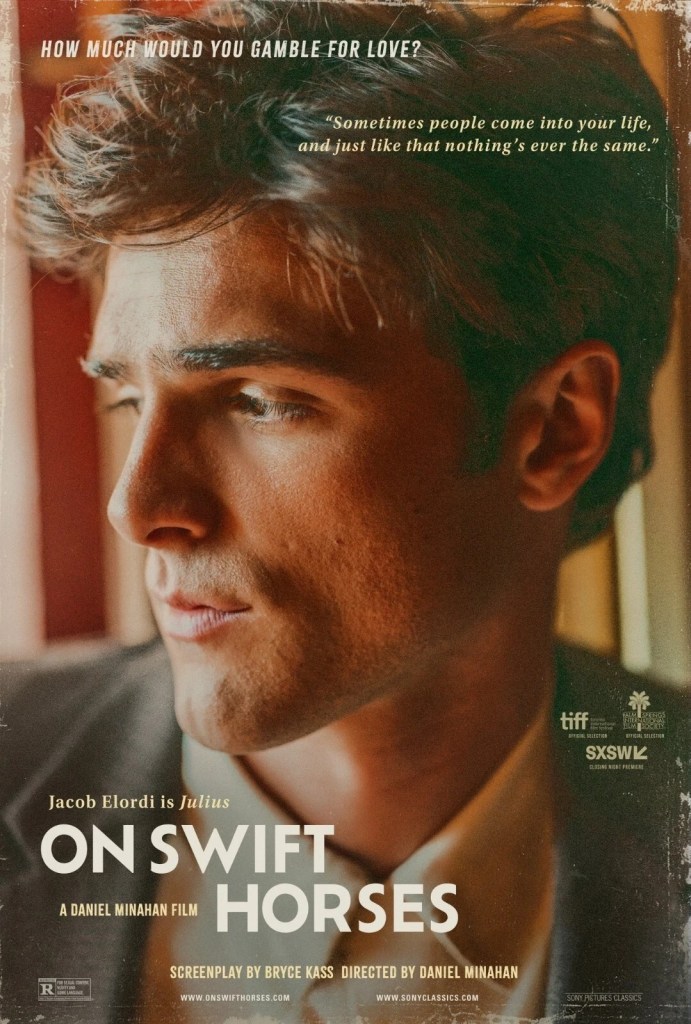
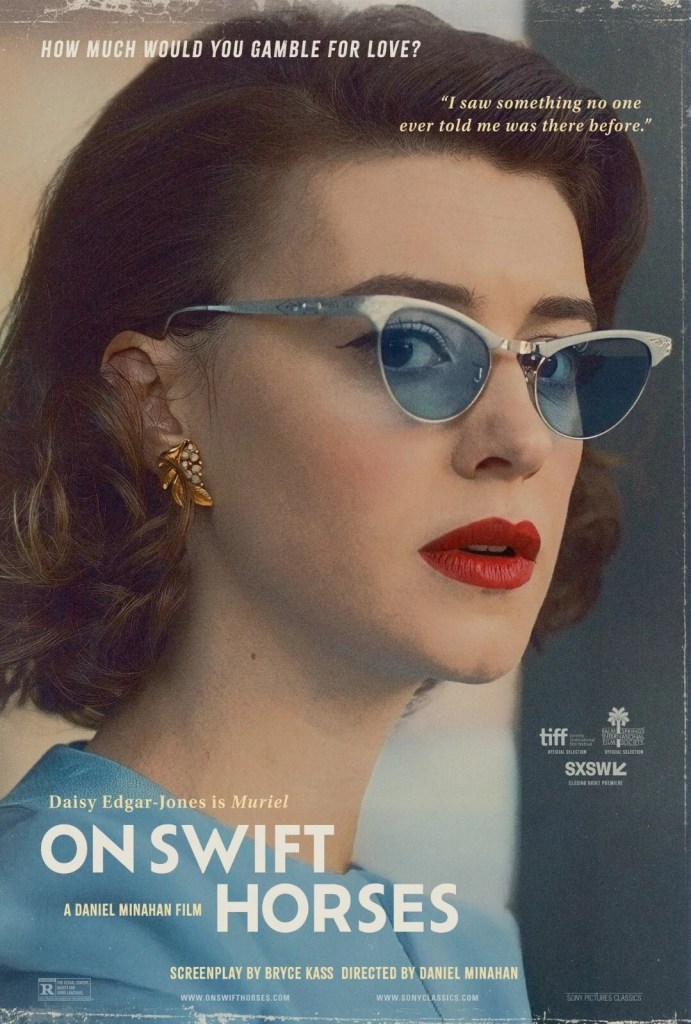
Authentic story stymied by unlikely plot. Set in a post-Korean War American when the United States is still a land of opportunity even for blue collar workers but sexuality and other forms of self-expression are stifled and the homosexual world is only accessible through secret codes. Married Muriel (Daisy Edgar-Jones) hankers after something of the wilder life apparently enjoyed by the brother Julius (Jacob Elordi) of her staid husband Lee (Will Poulter). Truth be told she hankers after an illicit relationship with Julius.
Muriel harbors two other secrets. Firstly, she wants to gamble, a notion that would never gain approval from her husband, who accounts for every penny in his bid to own his own home and thus move up in society. Secondly, she has lesbian tendencies and gradually, encouraged by the self-confidence generated through successful betting at the racetrack, she assumes a different persona, surprisingly capable of making the first move.
Lee is aware of his brother’s proclivities, though these, too, are measured in guarded tones. Julius lives “in another world”, not just the low-down hustling and gambling and earning a living as a gigolo and card cheat. His homosexuality is repressed but his barriers are broken down by Mexican hustler Henry (Diego Calva). But while Julius is willing to settle for a life of energetic sex with Henry, his lover has greater ambition and plans to move up in society via the scam route.
Muriel’s affection for Julius is not hampered by the fact that he constantly steals from her, pocketing the cash she sends him for a bus fare home, burglarizing their house while they sleep. And while she is happy to indulge in a casual affair with gay neighbor Sandra (Sasha Calle) she’s not whole-heartedly committed to that lifestyle. And it’s hard to see just how committed she is to Lee – the horde of cash she wins at the racecourse she keeps hidden from her husband even though it would miraculously ease their upwardly mobility.
While Muriel negotiates the hidden world with some care – gay people of both sexes meet at a certain hotel or come together under the guise of a book club – Julius is less wary and is beaten up and robbed a couple of times.
This isn’t quite the lush America of 1950s Hollywood with women bedecked in colorful dresses and enjoying cocktails, but there’s still satisfaction to be had in hauling yourself up and owning a tract of land and your own house. And it’s still down’n’dirty. Casinos spy on customers through two-mirror mirrors set in the ceiling and beat the life out of anyone caught cheating.
What wins your heart is the yearning. Muriel is caught in a half-world, even when she finds a willing lesbian partner she still aches for a heterosexual whirl with Julius. And Julius who believes he has found a safe sexual haven with Henry discovers that the latter’s naked ambition will destroy their tryst.
What doesn’t work are the fairy tale aspects. Julius isn’t a particularly good card cheat, a hidden ace or a partner at another table providing him with illicit advantage at the poker table. You’d expect he’d be rumbled quite easily. But the plot says no.
Similarly, Muriel enjoys an unbelievable good run on the horses, able to turn tips overheard from customers in the diner where she works into winning bets. Pretty quickly, and without a stumble, she has amassed a stash of $20,000. As if.
The ending doesn’t work either, Julius galloping on a horse (yep!) from San Diego to Las Vegas – a distance of some 350 miles (that’s some horse!) – after he realizes that, in fact, his heart belongs to Muriel, whose marriage has at last broken up, and she’s decided to follow her heart and become a gambler.
It leaves you wondering what kind of relationship they would have, a lavender marriage, where both are free to indulge in other aspects of their sexuality, no doubt living high on the hog from her racetrack winnings and his cheating at cards.
It looks to me like the director has bottled out of the third act, the one where supposedly they are the person of each other’s dreams and manage to make a life together as happy gamblers, until one or other decides that a person of their own sex is more fulfilling ultimately than a person of the opposite sex.
You didn’t need the barmy plot for this to work. And in fact it’s the barmy plot that gets in the way of it working. Both Julius and Muriel are entirely believable in looking for a love that dare not speak its name but can yet be easily located if you can follow the codes or if your gaydar is sufficiently developed.
Oddly enough, the most heart-breaking scene is the one before the barmy galloping. On the message board inside a gay meeting place are notes revealing the heartbreak caused not just by the dashing of love’s hopes but the destruction of marriages by men unable to conceal their secret desires.
The acting is uniformly good, though Jacob Elordi (Saltburn, 2023) thanks to his vulnerability, wins by a nose from Daisy Edgar-Jones (Twisters, 2024). But Will Poulter (Warfare, 2025) and Diego Calva (Babylon, 2022) also score points. Movie directing debut from Daniel Minahan from a script by Bryce Kass (Lizzie, 2018) based on the novel by Shannon Pufahl.
While you have to admire the actors for taking a gamble on this project – Elordi and Edgar-Jones are down as executive producers so they might also have taken pay cuts. But it has been an unmitigated financial bomb. Even the leanest movies these days appear to cost upwards of $10 million and this has barely touched the $1 million mark in global box offices. I attended the only daily screening at my local multiplex and there was only one other person in the audience. It probably deserves better and might have an afterlife on a streamer.
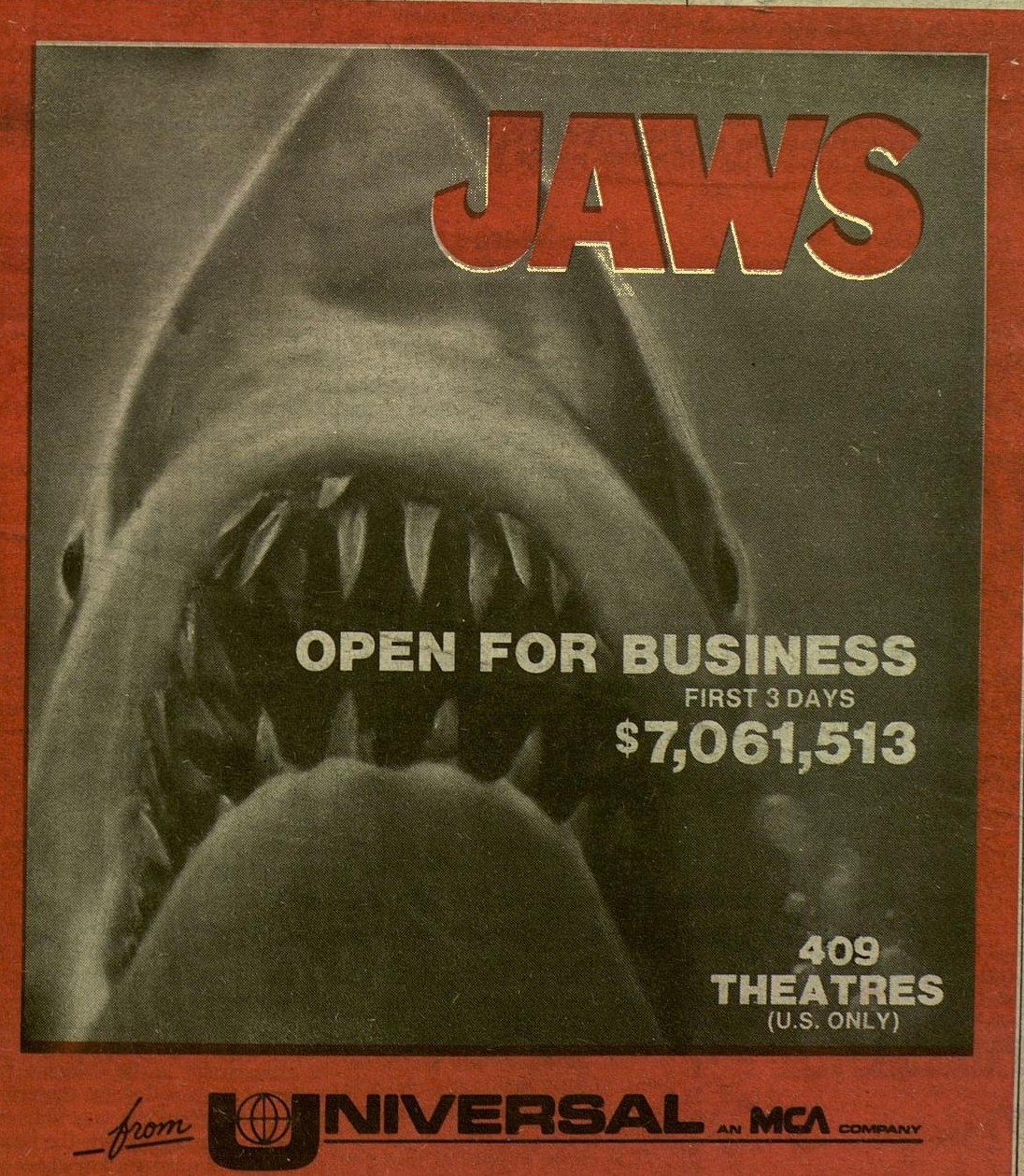
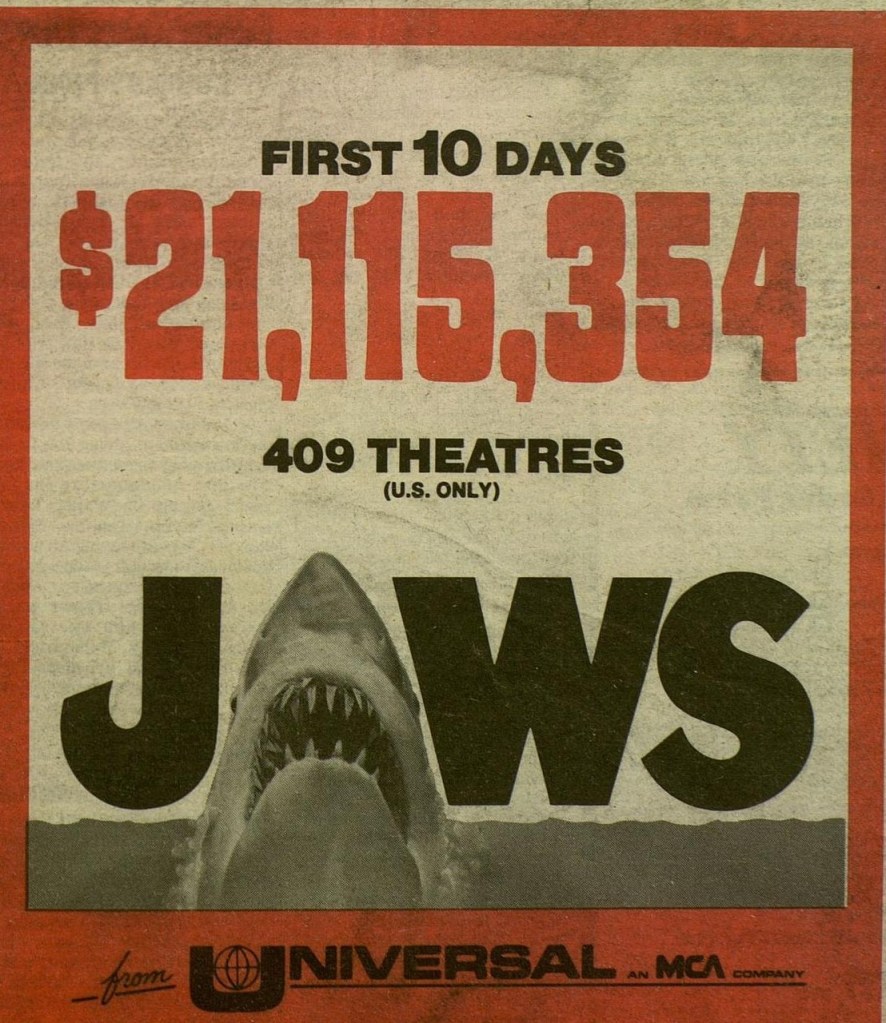
Given the surprising success of the reissue of Jaws this weekend – it came in second at the U.S. ticket wickets ahead of such new films as The Roses and Caught Stealing – I thought you might like a second look (or a first one) at exactly how Universal created box office history. And it was not the way you would expect. It did not follow the template set out by previous juggernauts.
Naturally, the hoopla surrounding the 50th anniversary of Jaws concentrates on the budget overruns, director Steven Spielberg’s problems and the mechanical shark, and no one gives a hoot about the most important aspect of the picture – the box office. Sure, it’s always mentioned in passing, because otherwise the movie would have had little impact on pop culture, the driving force of the water cooler effect when so many people see the same movie at the same time it drives word-of-mouth into the stellar regions.
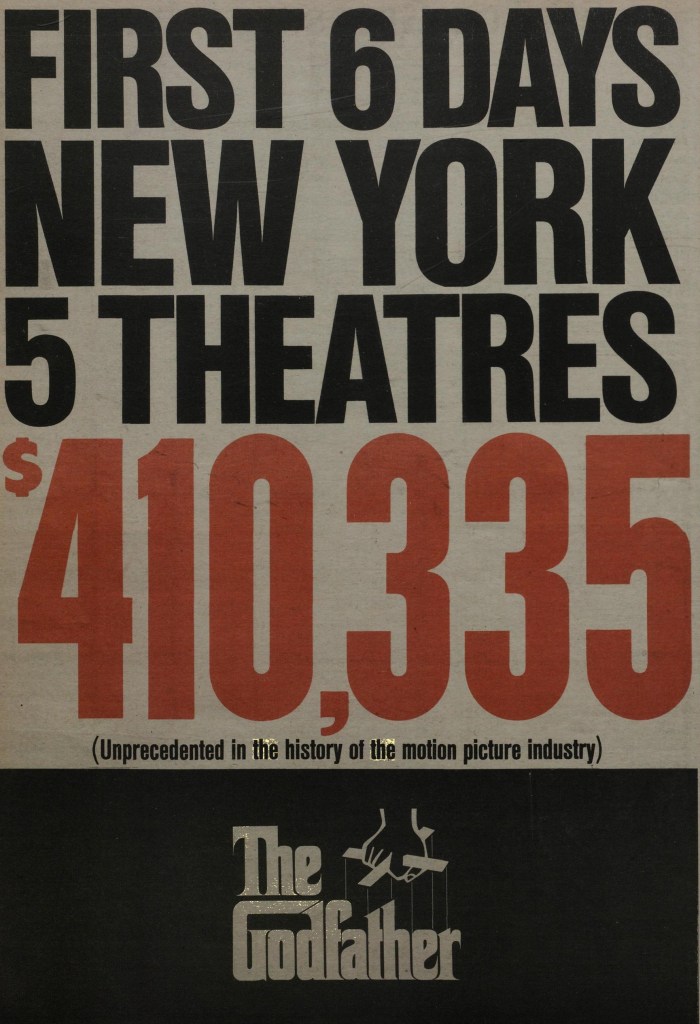
What is little known is how Jaws changed the release system forever. Even The Godfather (1972), its predecessor in topping the box office firmament, while spreading the goodies amongst nabes and the showcase houses did not ignore first run. In fact, for The Godfather Paramount used five New York first run houses – the 1025-seat Orpheum, 1175-seat State I, 1174-seat State II, 599-seat Cine and 588-seat Tower East – to create a pre-emptive strike. This quintet screened the movie exclusively for the first week, permitting the studio to trumpet the record-breaking results.
The other 350-odd cinemas had to wait a further week to get their hands on the gangster saga.
For Jaws, on the other hand, Universal completely froze out New York first run. Not a single first run house was given access to the picture on its initial release on this weekend 50 years ago.
Instead, in New York, Universal went down the showcase route and clocked up just over $1 million in the first three days at 46 cinemas. Prior to Jaws, the only pictures that would open first in showcase in New York and ignore that city’s vibrant first run were those that first run would most likely have declined to show.
With Jaws, across the country Universal was as ruthless in squeezing out first run if it could make a better deal in the nabes and drive-ins. So while Jaws set house records at all the first run houses that were deemed up to standard, it also creamed the nabes and drive ins. Significantly, not all the first run houses chosen would have been the first choice of most studios for a major picture. You wouldn’t have expected this behemoth to end up at the 925-seat Gopher in Minneapolis where it took in $47,000. Similarly, the 900-seat Charles in Boston ($55,000 take) would not have been your first choice (and it’s worth noting that it was only in this city that the movie did not top the week, beaten into second place by Woody Allen’s Love and Death at the 525-seat Cheri Three).
By and large, Universal picked off those first run cinemas that were so delighted to be asked they agreed to the tough terms – a 90/10 split in the studio’s favor and a 12-week run.
Other first run destinations included the 800-seat Cooper in Denver ($53,000 for openers), the 1670-seat Coliseum in San Francisco ($68,000), the 900-seat Southgate I and 550-seat Town Center II in Portland ($55,000 total), the 1836-seat Gateway in Pittsburgh ($70,000) and the 1287-seat Midland in Kansas City ($55,000). In these cities, the premiere outing was restricted to first run.
But while in Chicago the 1126-seat United Artists hauled in $116,000 in the opener, Universal played it canny by screening it simultaneously at four other nabes which brought in another $260,000. It was the same in Cleveland where the 455-seat Severance II was the only first run house among the five cinemas that hoovered up a total of $84,000. The first run 500-seat Goldman in Philadelphia was the only first run location among the total of 15 cinemas that knocked up $312,000.
Elsewhere, echoing the New York approach, first run cinemas were frozen out in Detroit, Buffalo and San Francisco. In Detroit seven nabes gobbled up $350,000, in Buffalo a deuce of nabes snatched $50,000, in San Francisco a trio set about $75,000.
We’ve all seen movies driven to opening weekend box office heights on the back of heavy advertising or hyperbole only to take a dive in the second week. And the fact that Universal was not making an “event” out of its movie by restricting it to first run meant that the sophomore weekend could easily have brought disaster.
Instead, receipts at virtually all the cinemas either beat the first week or fell only fractionally below. The opening weekend appeared to set the tone, every successive day better than the previous one.
Universal immediately set its sights on taking down The Godfather and began posting weekly advertisements in the trade papers hyping its performance at the box office. But in nudging first run out of the equation, it triggered the slow decline of first run houses.
Tomorrow, you can catch on my article that sunk many of the other myths surrounding Jaws, “Behind the Scenes: Exploding The Myth of Jaws.”
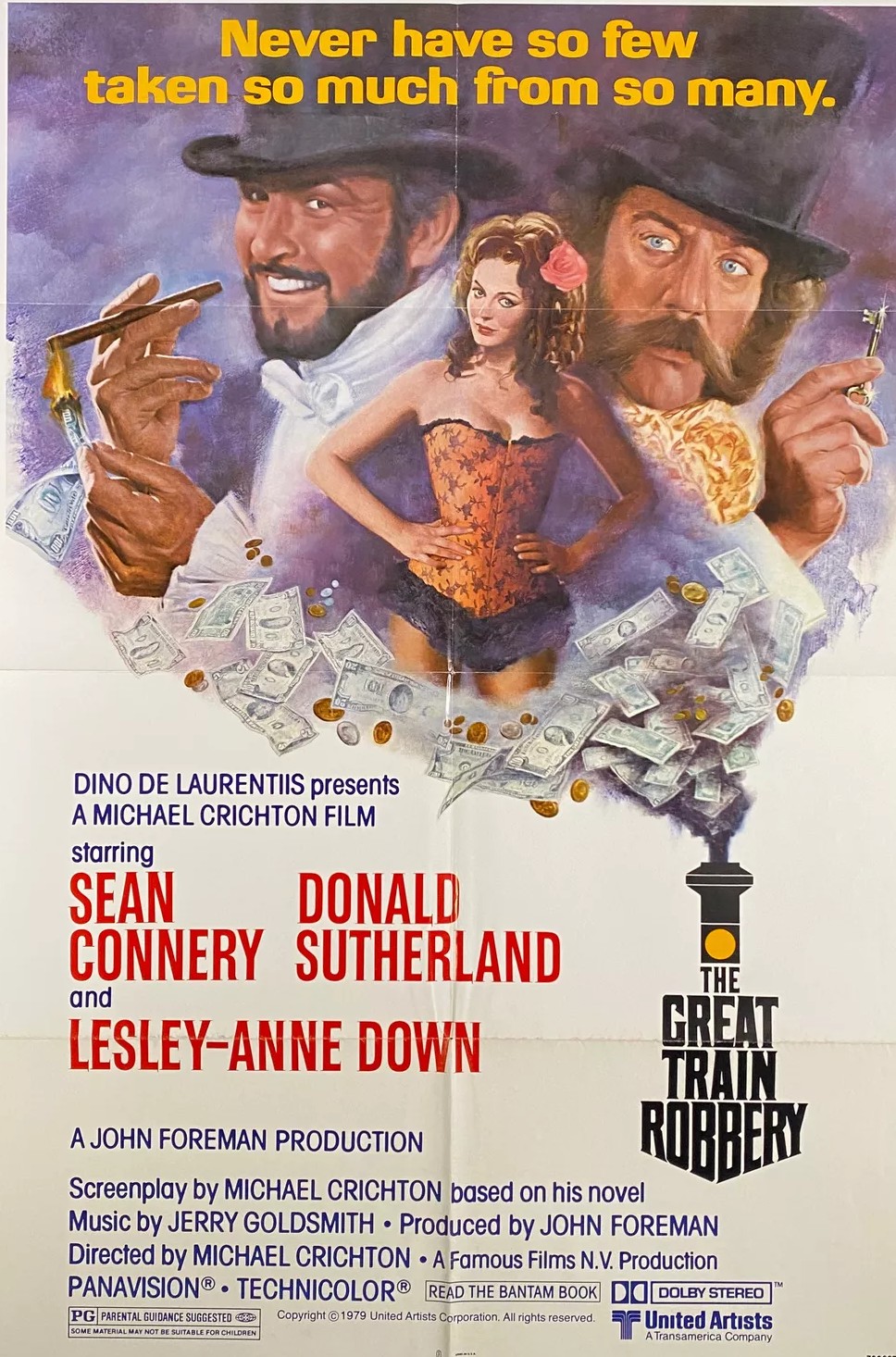
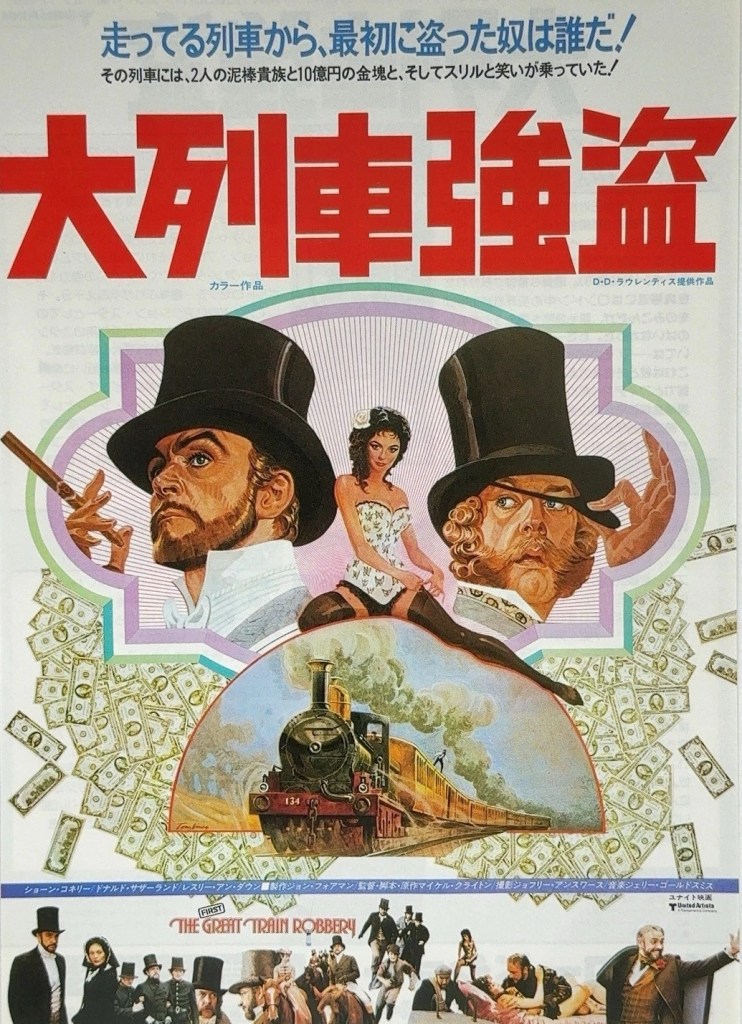
Back in the day your IP was the star. And here Sean Connery (The Hill, 1965) is the essence of that belief. The camera homes in on him. He steals every scene with an effortlessness that takes your breath away even as co-star Donald Sutherland (Don’t Look Now, 1973), complete with bizarre sideburns and winks to the audience, is huffing and puffing to compete.
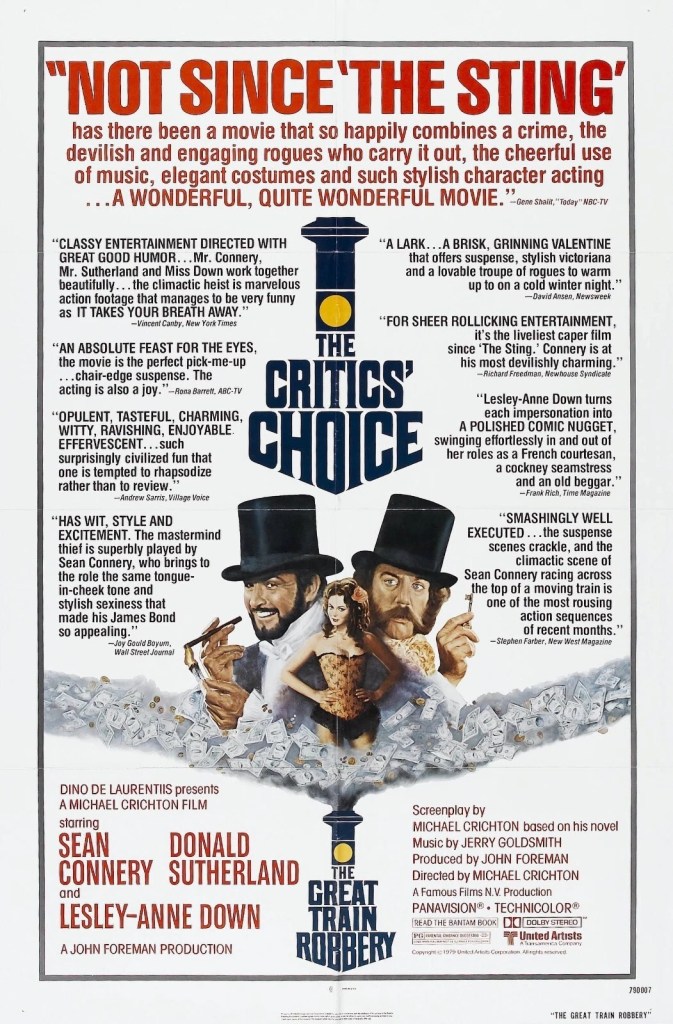
Come at it as the standard heist movie and you will struggle to enjoy it because it is made up of too many different components. But approach it from a different perspective, that of The Sting (1973) as one critic suggests, and it takes on a different complexion and the getting there becomes a whole lot of fun. The background, Victorian England of the 1850s, doesn’t help so much as the sets look like they’ve been plundered from Oliver! (1968) and dirtied up a bit.
It’s worth remembering that in an era when the Mission Impossible series has been constantly sold on Tom Cruise undertaking his own stunts that Sean Connery did something much more dangerous than anything attempted by Cruise which was to race along the top of a train travelling at 55 miles an hour.
And if you need some contemporary analogy, look no further than the rich get richer and mostly through plundering. The ending presents the notion of a Robin Hood outwitting the forces of law and order to the acclaim of the public. But that would be to overlook the fact that chief thief Pierce (Sean Connery) is already so wealthy from previous nefarious dealings that he hobnobs with the rich, so accepted in their world of male clubs and high society that, like a financial trader, he is able to pick their pockets of vital information.
Though it’s not quite that easy. The target is a trainload of gold bullion heading for the Crimean War. And the two safes containing the dosh require four keys, each under the control of a different high-up official, requiring several separate audacious thefts. This involves some play-acting from the principals, dressing up in the main from female accomplice Miriam (Lesley Anne Down), clever duping by Pierce and old-fashioned burglary from pickpocket Agar (Donald Sutherland) who waves his fingers around like a demented Fagin, and whose main job is make wax impressions of stolen keys.
So Pierce pretends to be the ardent wooer of the daughter of one of the key holders, and Miriam essays a prostitute to relieve a key holder of the precious possession he wears around his neck. But the other two keys require a more professional approach which involves first of all the springing from prison of cat burglar Clean Willy (Wayne Sleep) to break into the guarded railway premises in a time-dependent operation.
But the cops get wind of the plan and increase security on the train, including adding a new padlock to the outer door. “Find me a dead cat!”, while not quite in the league of “The name’s Bond, James Bond” might well count as one of the best lines ever uttered by Sean Connery.
Said deceased animal is brought in to supply the necessary stink for a corpse should the cops consider opening the casket containing Agar which is to travel on the train, providing the team with the necessary inside man. But Agar and Miriam as the weeping widow of the supposed dead man have very little to do compared to Pierce who has to climb on top of the train, racing along the speeding top, drop down the side in an improvised harness and pick the padlock, then do the whole thing in reverse.
I may be wrong, and I’m sure someone will correct me if I am, but if this wasn’t the first time running along the top of a moving train was employed in a movie it certainly set a new standard, especially in the willingness of the actor to carry out his own stunts.
Pretty much all that remains after that is the twists that see Pierce captured and then escape. You could pick a few holes in it if you wish. The fact that after Pierce swapping coats (the one that had lain beside a dead cat for hours and provided sufficient stink to convince the lawmen) with Agar, nobody noticed the smell seems unlikely. The same would apply to bank manager Fowler (Malcolm Terris) who fails to spot that the widow he shares a compartment with for the entire journey is the prostitute who duped him, though that prospect does increase the tension.
If you’re expecting a standard heist movie then this takes way too long to come to the boil, but if you go along with the conceit and enjoy the playing especially of Sean Connery and ignore the mugging of Donald Sutherland it is in the forefront of the best robbery pictures.
And it’s worth noting the little gems in Connery’s acting. There’s a scene where Lesley Anne Down is berating him for making her become a prostitute (implicit is her fear she might actually need to have sex with the client). He’s eating an orange. Ignoring her complaints as just part of the job, he offers her some of his fruit as if his main worry is being seen to be rude hogging the fruit to himself.
Connery proves exactly why you hire a star. He carries the picture. There’s a lightness to his overall performance, notwithstanding the few times he needs to take a tougher line, that makes the film a joy. Whereas Donald Sutherland is either too heavy-handed or overacting. This proved a breakthrough role for Lesley Anne Down (British television’s Upstairs, Downstairs, 1973-1975).
Director Michael Crichton (Westworld, 1973) cuts himself too much slack in the first half of the picture which could have been considerably tightened up but comes into his own with the tension and twists of the heist and he has the good sense to rely on Connery’s interpretation of Pierce. He also wrote the script based on his own novel, a fictionalization of the actual original robbery attempt.
There already had been an incredibly famous Great Train Robbery in Britain in 1963, hence the need to differentiate this from that by inserting the prefix “First” to the advertising in Britain.




 The Magnificent 60s