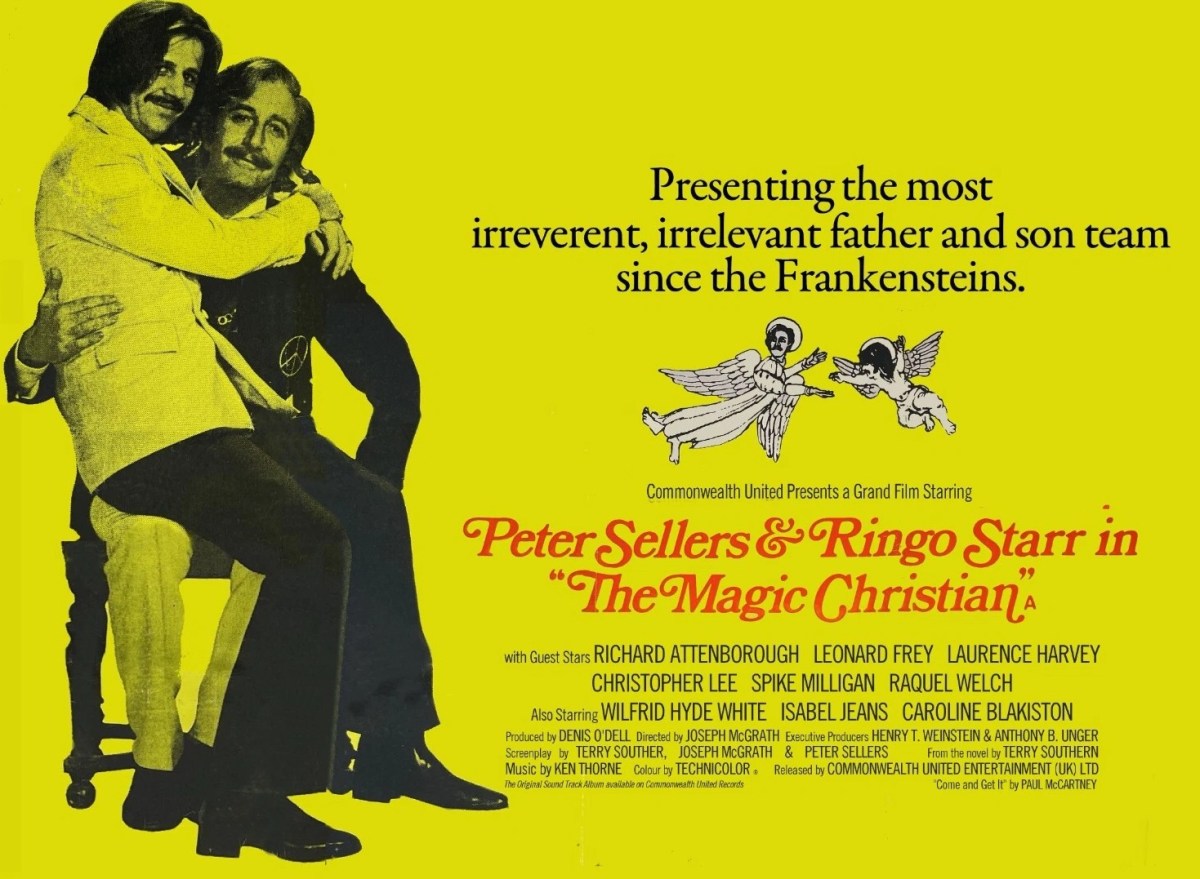
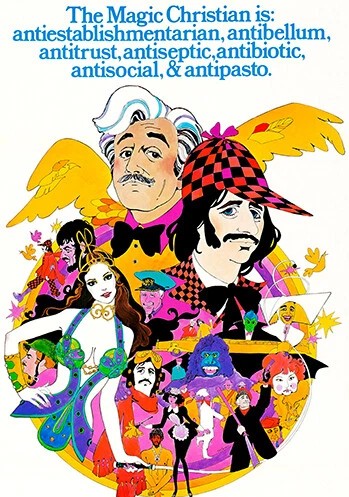
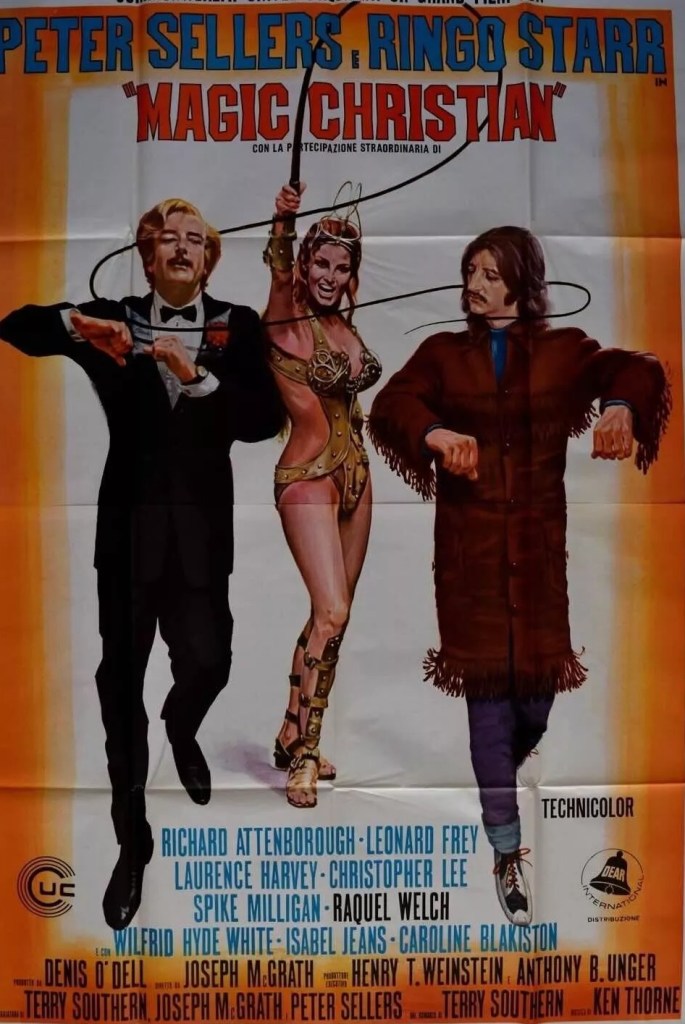
Substitute contemporary artwork/installation/performance art for practical joke and this will come up trumps. Taken in the artistic sense, where artists are pillorying society, there are gems – a stage Hamlet performing a striptease, feeding scraps of money to the ducks, ship passengers experiencing an apparent voyage when the vessel hasn’t left land, cutting up a famous work of art. Although I have to point out this will inevitably be remembered by some for a bikini-ed Raquel Welch cracking the whip over a galley of topless oarswomen.
Effectively a series of comedy skits loosely tied together under the theme of money, mostly in the form of bribery. Billionaire Sir Guy Grand (Peter Sellers) sets out to teach adopted son Youngman (Ringo Starr) just what money can buy. Could you pay one of the teams sufficient dough in the annual Boat Race for them to ram the other? Would a parking warden (Spike Milligan) eat the parking ticket he has just issued? In the spirit of fair play is it okay to down a pheasant with an anti-aircraft gun?
When the going slows down, surrealism enters the equation: ship’s captain kidnapped by a gorilla, vampire waitperson, black head on white body, urine-soaked banknotes given away to a crowd, the occasional nun or Nazi, newspapers where apologies are written in Polish.
Plot-wise, there’s not much to it and the satire is merely repetitive as Sir Guy embarks on educating Youngman on the perverse uses of money. It has the feeling not of following a storyline but of “what can we get up to next” and attempting to layer shock upon shock in the manner, it has to be said, of some contemporary directors.
But there’s neither sufficient bite to the satire nor punch to the shock so it remains an elaborate series of disconnected sequences. Luckily, nobody’s having to pretend to put in an acting shift which is just as well because Ringo Starr proves he can’t act.
And it’s not much helped by a host of cameos – Laurence Harvey (A Dandy in Aspic, 1968), Richard Attenborough (Guns at Batasi, 1964), Christopher Lee (Dracula, Prince of Darkness, 1965), Raquel Welch (Bandolero!, 1968), director Roman Polanski (Rosemary’s Baby, 1968), Wilfred Hyde-White (P.J. / New Face in Hell, 1967), comic Spike Milligan and various members of the future Monty Python team including John Cleese (A Fish Called Wanda, 1988) and Graham Chapman. Harvey and Welch make the biggest splash.
Excepting Dr Strangelove, Hollywood had failed to capture the essence of offbeat novelist Terry Southern (Candy, 1968) and despite input from Chapman, Cleese and Sellers, this never really gets off the ground.
Peter Sellers (The Pink Panther, 1963) was in something of a career rut where very little struck home at the box office and he would continue a dismal losing streak until resuscitating The Pink Panther franchise in 1975.
Director Joseph McGrath’s (The Bliss of Mrs Blossom, 1967) record was spotty. Best known for music videos for The Beatles, he was only well served when his cast was filled with strong actors.
No more than an occasionally humorous trifle with an equally occasional target hitting the bullseye.
I’m taking a day off. Someone else is doing the writing. Turns out I was sitting on a scoop, a major story of considerable interest. I was interviewed a week or so ago by the Daily Mail, Britain’s biggest daily newspaper with a massive online audience. The result made headlines in the paper as it was turned into a two-page feature and also went online. So I thought I’d share it with you.
Feel free to post this link elsewhere.
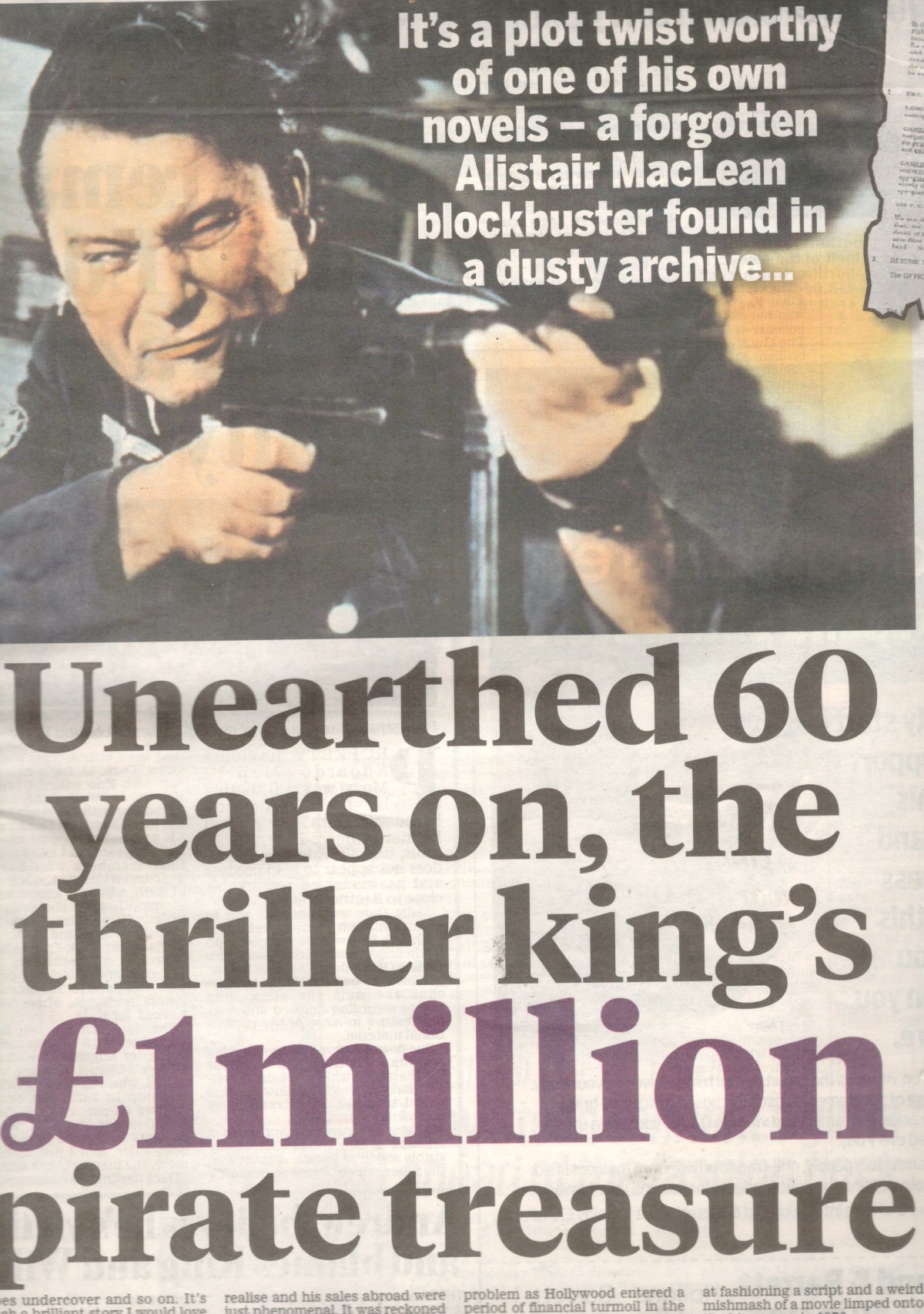
“Unearthed 60 Years On, Thriller King Alistair MacLean’s £1million Pirate Treasure,” By Gavin Madeley, Daily Mail, February 27, 2026
Staring at the words on his computer screen, Brian Hannan felt a heart-stopping jolt bring him up short.
It was like in the movies, when the hero realises they have stumbled across something big.
‘When I saw it, my eyes popped out of my head,’ he recalled. ‘I thought, “You’ve got to be kidding – how does this even exist? How does nobody know about it?” It’s a Fort Knox of gold, just sitting there waiting for somebody to make something of it.’
For months, the author and film historian had been trawling through an ocean of documents in search of priceless nuggets for his new book about Scots thriller writer Alistair MacLean’s extraordinary Hollywood career.
The vast archive he was mining had belonged to Elliot Kastner, the ebullient American producer who helped transform MacLean the bestselling novelist – of HMS Ulysses, Ice Station Zebra and The Guns of Navarone fame – into MacLean the brilliant screenwriter.
Such was the writer’s international appeal he earned the unprecedented accolade of seeing his name appear above the title of blockbusters such as Where Eagles Dare, When Eight Bells Toll, Breakheart Pass and Fear Is The Key.
For a period of time, it seemed everything he wrote flew straight off his typewriter and into movie theatres around the world.
A total of 14 movies and four films-for-television were made from his books and the MacLean brand was pure box office – except for the one time the magic formula failed.
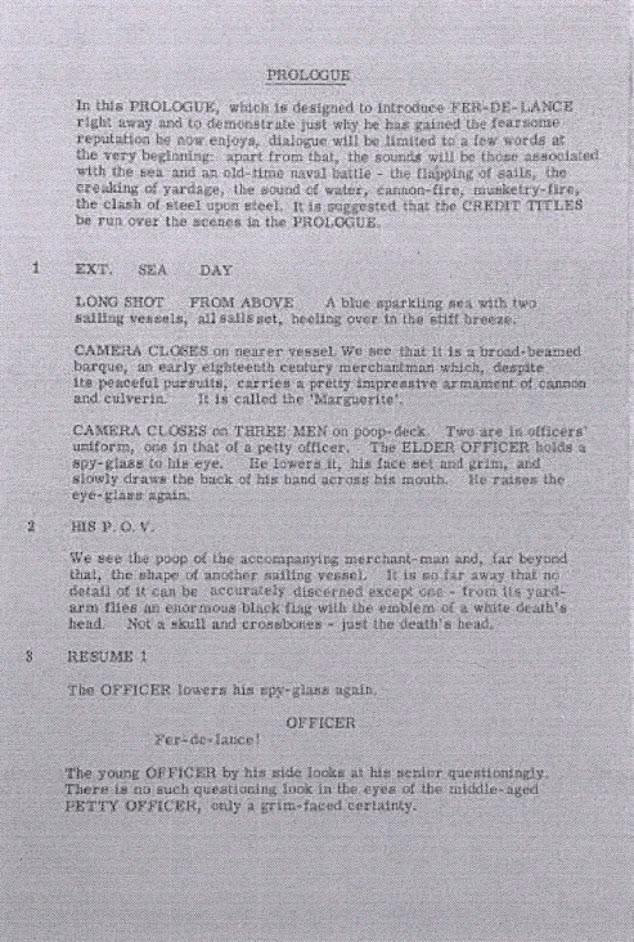
Opening scene of the lost screenplay, commissioned by Elliott Kastner, but never filmed.
Mr Hannan stumbled upon it by chance after Kastner’s son, Dillon, heard about his project and emailed over his father’s entire store of papers, in the hope it might offer up something new.
There, buried in an innocuous file marked ‘Pirates’ which Mr Hannan had ignored for weeks, he found treasure – a high seas adventure filled with swashbuckling heroes and buccaneering brigands written at the peak of his powers by the ‘king of the action thrillers’.
He said: ‘It is a genuine lost manuscript by Alistair MacLean and, as far as I’m aware, nobody else knows it exists, which means it could be extremely valuable.
‘MacLean died in 1987 so this could be his first work in at least 40 years.
‘Anyone familiar with MacLean’s work can see his hand. It’s just unbelievable to get your hands on raw material by someone of his stature which no-one has ever seen before.
‘But such is the continuing popularity of MacLean around the world, the script could easily be worth £1 million if it was novelised into a hardback book and another £1 million for the paperback.
‘It could make a beautiful film. You would have to add some proper sword fights but the story is great and it could make a commercially viable film.
‘It’s got a light tone and a lot of humour – like the Pirates of the Caribbean franchise and they are making another of those – so it’s not as if there isn’t an appetite for pirate movies. The female character is terrific, someone with smarts who can deal with the man on her own terms.
‘Sandra Bullock, in her younger days, or someone like Sydney Sweeney would be perfect for the role.’
Mr Hannan said it had become common for famous authors such as Wilbur Smith, Dick Francis and Lee Child to keep their names to the fore by having someone else write their books.
Last year, he wrote to Child asking if he would be interested in novelising the script. ‘He said it was fantastic but he was retired and that was that,’ he said.
‘I know James Paterson finished off a Michael Crichton novel so it has been done and if you put someone like that and MacLean together, it would be terrific.’
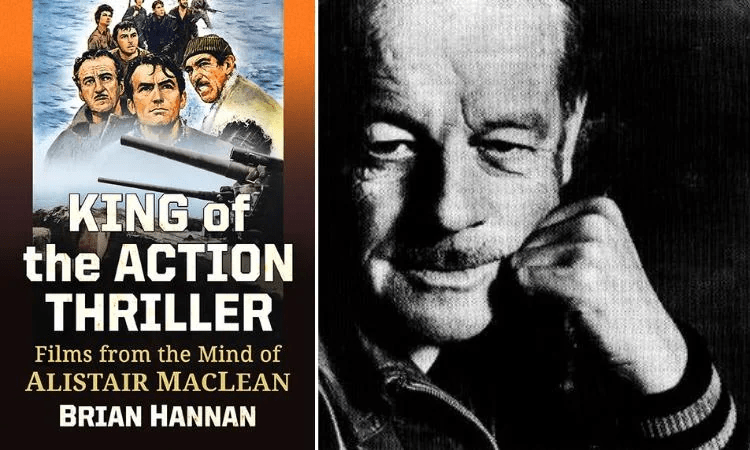
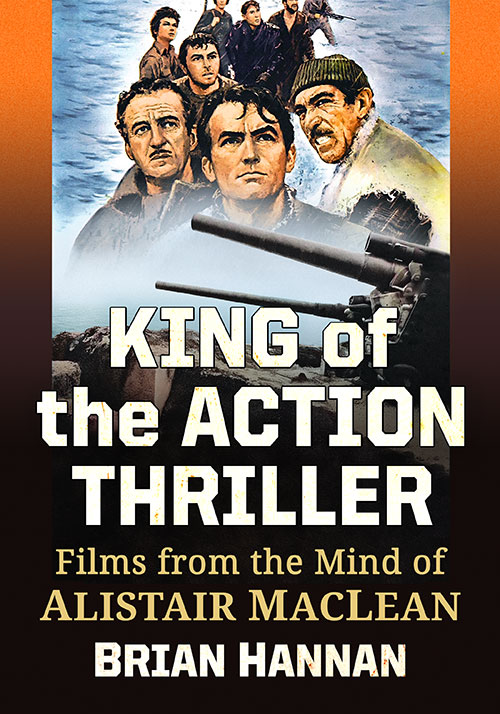
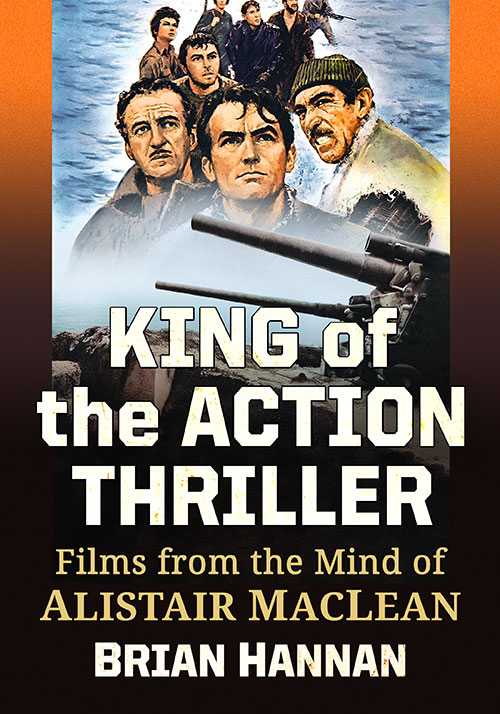
The unlikely story of how MacLean came to write about pirates is revealed in Mr Hannan’s new book – King of the Action Thriller: Films from the Mind of Alistair MacLean.
In it, he explains the key role played by Kastner, an American agent who moved to the UK with ambitions to be a leading movie producer.
Kastner was familiar with MacLean’s books and was desperate to make a movie with him. The only problem was that the film rights to every book he had written were already sold.
Born the third of four sons of a Church of Scotland minister on April 21, 1922, in Glasgow, MacLean grew up to be a literary sensation.
Raised in a manse at Daviot, near Inverness, he spoke only Gaelic until the age of six.
After studying English at Glasgow University, he initially worked as a teacher in Rutherglen but found his voice after winning a newspaper short story competition in March 1954. That led to Scottish publisher William Collins offering a £1,000 advance for his first novel.
MacLean duly obliged and battered out a book, drawing vividly on his wartime service in the Arctic Convoys. The book, HMS Ulysses, proved a word-of-mouth sensation, shifting 250,000 hardback copies in the UK alone and outselling Gone With The Wind by five to one. He was an instant hit.
His next book, The Guns of Navarone, was another bestseller and, at MacLean’s peak in the 1960s, one of his tales was snapped up every 18 seconds, every day of the year.
Below: An article that appeared in The Dubrovnik Times.
“Lost Alistair MacLean Screenplay Discovered — Thriller Legend Once Called Dubrovnik Home” by Mark Thomas, Dubrovnik Times, March 9, 2026
In time, he would outsell Ian Fleming and, for a season, even Agatha Christie. It wasn’t long before Hollywood came calling.
‘He wrote books very fast. The actual writing would take four or five weeks and all the books he wrote were sold to the movies as soon as he wrote them as they were cinematic and he told great stories,’ said Mr Hannan.
That might have put a dent in Kastner’s hopes of working with MacLean. Undaunted, he doorstepped MacLean in October 1965 and persuaded him to write him an original screenplay.
‘He said to MacLean, “I want a film like The Guns of Navarone, I want women in it, and I want action”,’ said Mr Hannan.
‘MacLean said, “I’ll write you a screenplay on one condition – you pay me for the screenplay and I keep the rights to novelise it afterwards”.’
Normally the producer would keep those rights, but wily MacLean changed the system, cutting out the publisher. Mr Kastner struck the deal, giving MacLean $200,000, a half-share of the profits and the book rights.
Within weeks, MacLean brought him a screenplay. It bore the rather insipid title of The Eagle’s Castle (soon changed to Where Eagles Dare), but the script packed a real punch.
‘Pretty much what he wrote appeared on screen with a few minor cuts,’ said Mr Hannan. ‘MacLean grasped the art of screenwriting very quickly.’
Kastner shrewdly bought up When Eight Bells Toll, which was his next book, pre- publication and commissioned two more screenplays.
One was ostensibly a Western, Breakheart Pass, and the other was a pirate-themed script, then known only as Caribbean. However, these slightly leftfield choices put him at odds with his publisher.
‘Because MacLean was known for writing a certain type of thriller, Collins weren’t keen on him writing Westerns or pirate films.’
For MacLean it was not so unusual, said Mr Hannan, as he liked to find inspiration in unusual settings. ‘He always wanted to try something new.
‘All his books are set in what in those days might be considered strange locales. Not like Graham Greene, who goes and finds a trouble zone, there’s no trouble zone in the Arctic unless MacLean creates one in Ice Station Zebra.
‘He tended to look for places which were different, where he could bring something new to the table – and I think that’s what he was doing with Breakheart Pass and Caribbean.’
Collins passed on Breakheart Pass, too, at least until Kastner put together the movie starring Charles Bronson more or less a decade later. The publisher then released a novelised version which became a huge bestseller.
But the same never happened for Caribbean, which MacLean twice refined, tightened and shortened.
Despite his endeavours, none of the studios bit and nor did Collins.
‘I’m sure at the time I would have had the same reaction as Collins, “You’ve got to be kidding”,’ said Mr Hannan.
‘But I knew Breakheart Pass had worked as a Western as I had seen it at the movies.
‘When I started reading this one, there was lots of clever stuff and it has all the hallmarks of a MacLean – there is always somebody who is being blackmailed, or someone who goes undercover and so on. It’s such a brilliant story I would love to see it as a book and a film.’
Caribbean follows the familiar MacLean template with the heroes battling huge odds, betrayals, breakneck plot twists and ending with a vast explosion, damnation for the baddies and sweet resolution for the good guys. To some extent the film world’s reluctance to touch Caribbean was a surprise, given the author’s global appeal.
‘MacLean had cracked something most people didn’t realise and his sales abroad were just phenomenal. It was reckoned if you had Alistair MacLean’s name on a film, people would come and see it regardless of who was in it or what genre it was,’ said Mr Hannan.
‘Film-makers started putting MacLean’s name above the title, and in huge letters, which was unheard of for a screenwriter to get that kind of billing. They used MacLean’s name to advertise his next film, using the tag, “From the mind of Alistair MacLean”.’
The project’s timing was also a problem as Hollywood entered a period of financial turmoil in the late-1960s. ‘They just couldn’t get the money. This was around 1969-70 and the movie industry was in incredible trouble, and nobody was really wanting to finance a big-budget pirate picture.
‘They hadn’t made any since the heyday of Burt Lancaster.’
When Kastner’s film rights lapsed, others tried their hand at churning out a swashbuckling feature. A succession of other screenwriters – including a young Robert Ludlum – tried their hand at fashioning a script and a weird mishmash of a movie limped onto the big screen in 1976.
Swashbuckler, starring Robert Shaw, was completely unrecognisable from the film envisaged by MacLean, whose name was, understandably, nowhere near it. It amounted to an act of movie-making piracy, said Mr Hannan. ‘It was garbage – done as a kind of spoof and it didn’t work at all. All MacLean’s clever stuff had gone.’
It was a rare blip in the MacLean conveyor belt of successes, although privately he was already suffering from the pressure of producing endless bestsellers.
It manifested itself in heavy drinking, which would eventually end his life.
Twice-divorced, he had reconciled with his first wife, Gisela, and was splitting his time between homes in Dubrovnik and Switzerland.
In 1985, health scares had prompted MacLean to give up drinking but, in January 1987, he relapsed and went on a bender with an Irish hotel porter which triggered several strokes.
He lapsed into a coma from which he never awoke.
‘He was an alcoholic,’ said Mr Hannan. ‘I think he started drinking heavily early in his career. It’s a very sore subject with his family.’
So much so, Mr Hannan has had little cooperation from them in his quest to promote MacLean’s lost manuscript. ‘It means nobody knows this script exists, apart from me and those I have chosen to tell. Maybe someday soon, someone will come knocking on my door and ask, “Can you show us what you’ve found?”
‘Well, what I found was a million-pound manuscript.
‘It’s like if somebody found a lost novel by Graham Greene, or Boris Pasternak. Similarly, this would rocket off the shelves without question.’
A lost MacLean manuscript may be a moneyspinner, but for whom? MacLean’s surviving relatives? Kastner’s family? MacLean’s publisher? Mr Hannan? Ultimately, this mystery thriller may well end in a courtroom drama, where intellectual property lawyers cross swords for a cut of the prize.
‘It’s not really clear who has ownership of the manuscript, but someone could be sitting on a multi-million-pound bounty,’ said Mr Hannan.
Perhaps one day, it will lead to a new film hitting our screens with Alistair MacLean’s name above the title? ‘Or my name,’ he laughs, ‘Brian Hannan’s version of Alistair MacLean’s Caribbean!’
■ King of the Action Thrillers: Films from the Mind of Alistair MacLean by Brian Hannan is out now, priced £28/$39.
SOURCES: Gavin Madeley, “Unearthed 60 years on, thriller king Alistair MacLean’s £1million pirate treasure,” Daily Mail, February 27, 2026; Brian Hannan, King of the Action Thriller (McFarland, 2026).
He was the world’s best-selling author. He was the highest-paid screenwriter in Hollywood. He didn’t learn to speak English until he was six.
“I’m a businessman, not a writer,” claimed the self-effacing Alistair MacLean. While his narrative skills acquired readers in the millions, his understanding of the publishing and entertainment business made him the most business-savvy author since Charles Dickens invented the cliffhanging chapter ending and the author tour. MacLean had an instinctive understanding of synergy.
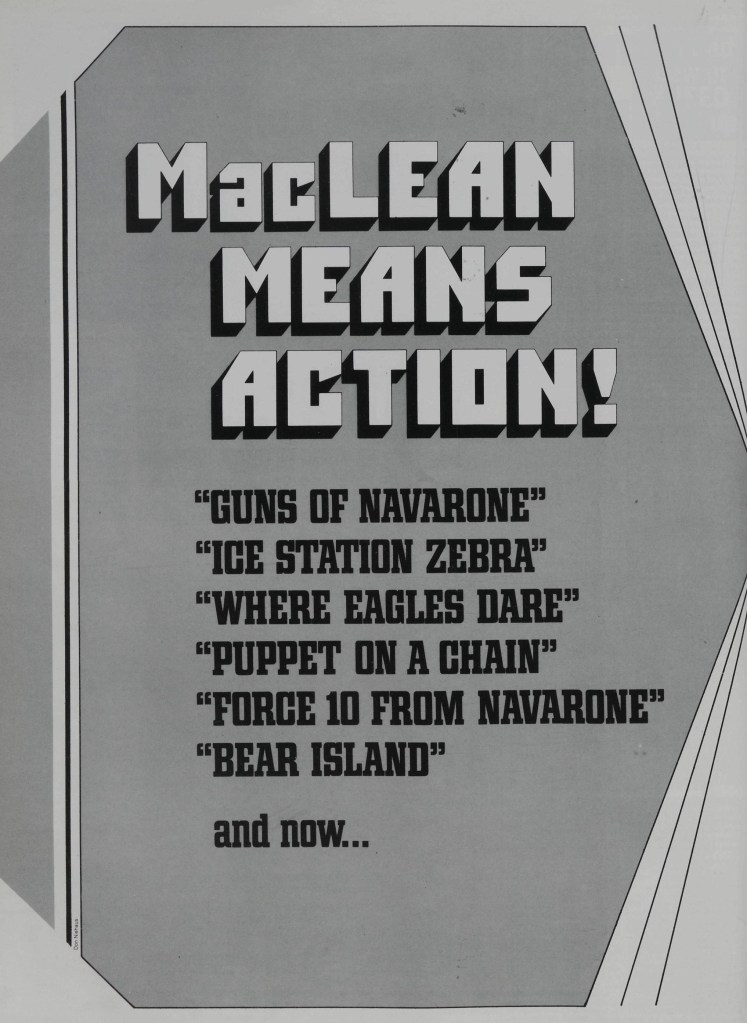
Standard style for trade ads. Unusually, movies made from Alistair MacLean books majored on the name of the author in the same way as they would for a box office star or director.
In Hollywood, “property” was king. This was real estate of a different commercial kind, an item on which many fates depended, and which could be used to raise the millions of dollars required to make a movie. And, virtually alone among authors of his generation, and certainly unique among screenwriters, his name acquired marquee status, carrying above-the-credit status, often billed above actors involved, ensuring that movies could be marketed as Alistair MacLean pictures, promising to deliver as certain an experience akin as those who embraced a Sherlock Holmes mystery.
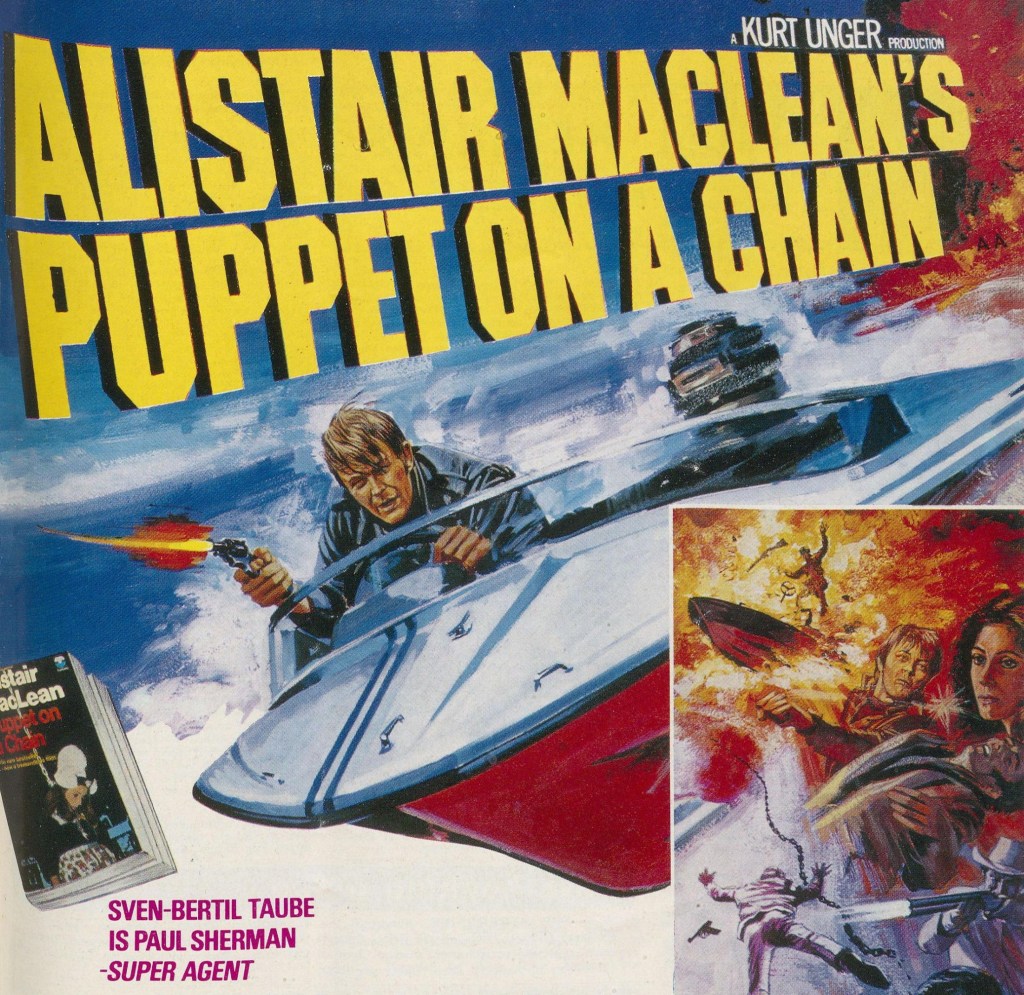
Alistair MacLean was unique among the authors who rose to bestselling prominence in the 1950s and 1960s and 1970s in that his books were translated onto the screen at a startling rate, eighteen in total making the transition. Many became the biggest blockbusters of the day – The Guns of Navarone (1961) and Where Eagles Dare (1968) for example – while others like Puppet on a Chain (1970) and Fear Is the Key (1972) not only attracted a cult following but reinvented the chase picture. His books spanned World War Two and the Cold War, espionage often a consideration, but his gift for authenticity ensured he was as at home in the Wild West or a race track.
A number of elements made him stand out from the other big-time bestsellers of the day. For a start, he didn’t rely like Harold Robbins (The Carpetbaggers) on sex, nor a retelling of history in the vein of James Michener (Hawaii), nor reliant in exploring institutions in the manner of Arthur Hailey (Hotel). He wasn’t interested in contemporary issues. He didn’t have a series character like James Bond, which allowed his thrillers to be cherry-picked by a far wider range of producers and Hollywood studios. Although his main characters were loners, often with a disfigurement or major flaw, they were sufficiently different to be interpreted by a very diverse number of actors.
You could argue that he re-purposed the thriller and invented the mission war novel. By the late 1950s the former was polarised between the critically-acclaimed novels of Graham Greene and Eric Ambler and the sexed-up pulp of Mickey Spillane. MacLean narratives were defined by serious purpose, dedicated professionals rather than amateurs stumbling onto a conspiracy. The aftermath of the Second World War saw the advent of many mission pictures, which, mostly based on real events, were documentary or gung-ho in style. The Guns of Navarone ushered in a new type of mission book/film, short on exposition and training and overloaded with tension.
Authors rarely become brand names. They may become bestsellers, well-known to readers and within the book trade, perhaps appreciated by critics, and yet their fame rarely extends beyond the publication arena. Dickensian, Chandleresque, Shakespearian, Tolkienesque, as well as being shorthand for describing a type of character or a fictional world are, in fact, the biggest accolade that can be bestowed upon an author, that their work has transcended the specific arena of publishing and entered the vocabulary. You can be a multi-million-selling author and still the impact of your work will be limited – nobody has created adjectives around the door-stopping sagas of Leon Uris and James Michener or the thrillers of Lee Child. The contemporary ancillary opportunities available to the likes of Stephen King and J.K. Rowling have ensured they have become brands, their names above the titles of movies made from their novels promising a certain kind of experience and, in broader terms, creating a marketing goldmine.
For over two decades Alistair MacLean was a brand name. The only author whose sales came close was Agatha Christie and yet her mysteries, stewing away in an impossibly English landscape, lacked the full international penetration of the harder-edged thrillers of MacLean. Her two most famous characters, Hercule Poirot and Miss Marple, barely made a dent in her lifetime on the big screen. But the pull of MacLean was such that his name was not just above the title of the movies but emblazoned across the posters, as if that was all the marquee an audience required.
As Elliott Kastner, producer of Where Eagles Dare, put it, “Alistair MacLean is the first bestselling author equally talented as novelist and screenwriter,” said producer Elliott Kastner, “This puts him astride the entertainment industry like a golden colossus.” Peter Snell, producer of Bear Island (1979), concurred, “He’s simply an author everyone knows. The films have a guaranteed audience and that’s hard to beat, knowing you have an audience before you begin.”
Bestsellers had underpinned Hollywood from the outset, studios believing they were a safer bet because resulting films were pre-sold. But as directors became more demanding, their name superseding that of the author of the source material, to the extent that audiences often believe a movie has emerged from the imagination of a director rather than originating elsewhere (Poor Things, 2023, a case in point). So it is Martin Ritt’s The Spy Who Came in from the Cold (1965) and Francis Ford’s Coppola’s The Godfather (1972).
But after the first few adaptations of MacLean thrillers, it was never Brian G. Hutton’s Where Eagles Dare or Geoffrey Reeves’s Puppet on a Chain or Don Sharp’s Bear Island. These movies were identified with their author. From the outset his films attracted variable budgets – very big for The Guns of Navarone, Where Eagles Dare and Ice Station Zebra (1968), the last two designated 70mm roadshows – but considerably smaller for The Secret Ways (1961) and The Satan Bug (1965).
In later films, it was apparent that the author’s name was as big a draw as any of the stars, and that you could make a film based on one of his books without going to the expense of recruiting a major marquee name – George Maharis, Sven Bertil-Taube, Anthony Hopkins and David Birney were virtual unknowns when cast, respectively, in the leading roles in The Satan Bug, Puppet on a Chain, When Eight Bells Toll and Caravan to Vaccares (1974).
Audiences knew what they were going to get and if a director added more exciting action sequences as with, for example, the speedboat chase through the canals of Amsterdam in Puppet on a Chain or car chase in Fear Is the Key, that was a bonus.
English was a foreign language for MacLean. Though born in Glasgow’s East End, in 1922, the son of a Church of Scotland minister, he was brought up in a small town in the Highlands of Scotland and spoke Gaelic until, aged five, he attended school. Drafted into the Royal Navy at 19 on what proved a five-year stint, seeing action in the North Sea, Atlantic, Mediterranean and Aegean Seas and the Far East, these experiences providing authentic material for several books.
Post-war, a schoolteacher in Glasgow, he tried his hand at short stories to generate extra income, and after winning a competition in a national newspaper was encourage to write H.M.S. Ulysses, the tale of a doomed wartime convoy. A massive bestseller shifting an unprecedented 250,000 copies in hardback, the film rights selling for £30,000, the combined income allowed him to become a full-time writer, his prospects cemented by the publication in 1957 of The Guns of Navarone, 450,000 copies sold in six months and film rights purchased by Carl Foreman who planned a multi-million-dollar star-laden picture for Columbia.
However, the first movie to roll off what would become the MacLean bandwagon was a lesser-known smaller-budgeted affair, The Secret Ways (1961). Thereafter, films based on his works appeared at regular intervals. For an author MacLean was unusually involved in the film-making process. Most writers, perhaps attracted by Hollywood mystique and the hefty sums paid out for film rights, generally entertain some interest, at least initially, in participating in the movie machine, but, equally usually, become quickly disaffected by the ruthlessness of a business where the screenwriter is on the lowest rung of the ladder.
William Goldman is usually held up as the best example of someone who straddled both fields with equal success, but of his original works only Butch Cassidy and the Sundance Kid (1969) was a big movie hit, and his fame largely rested on adaptations – Harper (1966), All the President’s Men (1975) and A Bridge Too Far (1977). You could as easily argue that he learned from MacLean to write books that were cinematic and enjoy the financial triple whammy of book sales, selling the film rights and writing the screenplay.
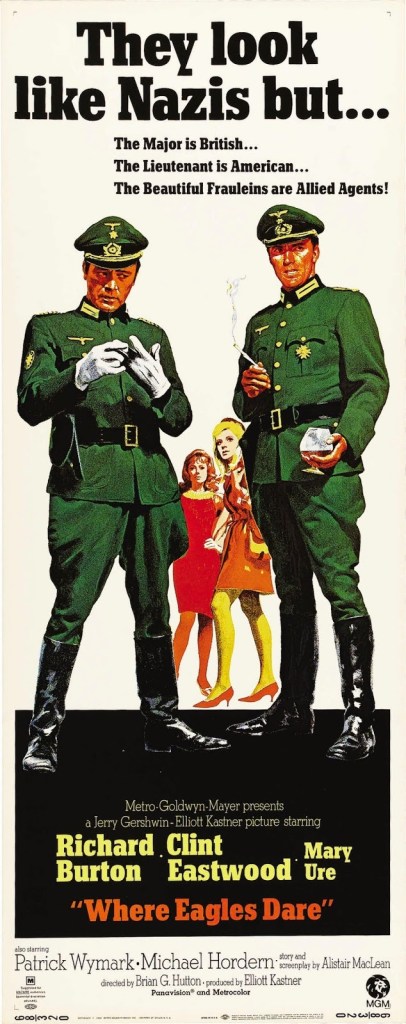
American agent-turned-producer Elliott Kastner (Harper, 1966), who had set up an office in London. Kastner invited the novelist to write an original screenplay. It’s fair to say that MacLean in creating Where Eagles Dare plundered his previous mission opus The Guns of Navarone, but jacked up the suspense and action. Kastner then signed up for another two original screenplays as well as novels.
While The Guns of Navarone set MacLean on his way as a hot Hollywood property, it was the experience of Where Eagles Dare that created the legend of an author whose commanded such a global following that audiences were guaranteed to turn up for movies based on his thrillers. Over the space of 18 years, from The Secret Ways in 1961 to Bear Island in 1979, a colossal 13 of his books were turned into movies, an extraordinary strike rate.
These 13 movies plus another five made for big- and small-screen are covered in this book. Each chapter focuses on one film, detailing its production, casting, and filming and then analysing both the film and the changes made to the book. The final chapter is a big surprise, which I won’t reveal here, and there’s a chapter devoted to what happened to the other books bought by studios or producers but never made – such as the involvement of Lord Puttnam in an aborted effort to make HMS Ulysses – and there’s a section on box office.
I’ll be speaking at various book festivals if you want to come along and meet me. The first of these is the Boswell Book Festival at Dumfries House in Scotland which runs May 8-10, 2026.
King of the Action Thriller, Films from the Mind of Alistair MacLean (McFarland Publishing) by Brian Hannan and, as ever, with copious and often rare illustrations, is available from all good bookshops and online via Amazon and other such traders as well as on Kindle.
For the first four decades of the Hollywood business, success in markets other than domestic was random. Many countries restricted the number of U.S. films that could be shown, others like Britain prevented American studios for a long time taking out of the country money earned at the box office. There was always the chance it could be less profitable if a dominant foreign cinema chain or distributor demanded a larger slice of the box office. In addition, some genres that worked in America stiffed abroad – musicals and comedies found it hard to translate.
Except in extremely sporadic fashion, foreign box office was not reported in the trade media until the 1990s. So there was no such thing as worldwide grosses available on any real scale. These days for many films overseas receipts bring in more than domestic – Zootropolis a current example with around 70 per cent of takings coming from abroad – but that was virtually never the case until the arrival of the James Bond pictures, which acquired a genuine global brand, in the 1960s.
However, the United Artists archives held by the University of Wisconsin provide some fascinating insights into the growing power of the foreign box office in the 1950s. Movies released into the foreign market would make a percentage of their domestic take. But that varied enormously. Even the star-studded Around the World in 80 Days (1956), the second-biggest blockbuster of the year Stateside, with a colossal $16 million in domestic rentals took in less than a quarter of that abroad, just $3.9 million.
For some films, the percentage was better. Controversial William Holden drama The Moon Is Blue (1953) notched up $1.3 million abroad compared to $3.5 million at home. War picture Beachhead (1954) starring Tony Curtis bundled up $1 million overseas as against $1.4 million in domestic. The Barefoot Contessa (1954), boasting Humphrey Bogart and Ava Gardner, added $2.2 million in foreign coin to its domestic tally of $3.25 million.
Richard Burton as Alexander the Great proved the breakthrough, domestic’s $2.5 million matched by the exact same amount abroad. Robert Mitchum in Foreign Intrigue (1956) went one further, reversing the usual situation, foreign of $1.14 million ahead of domestic’s $1 million.
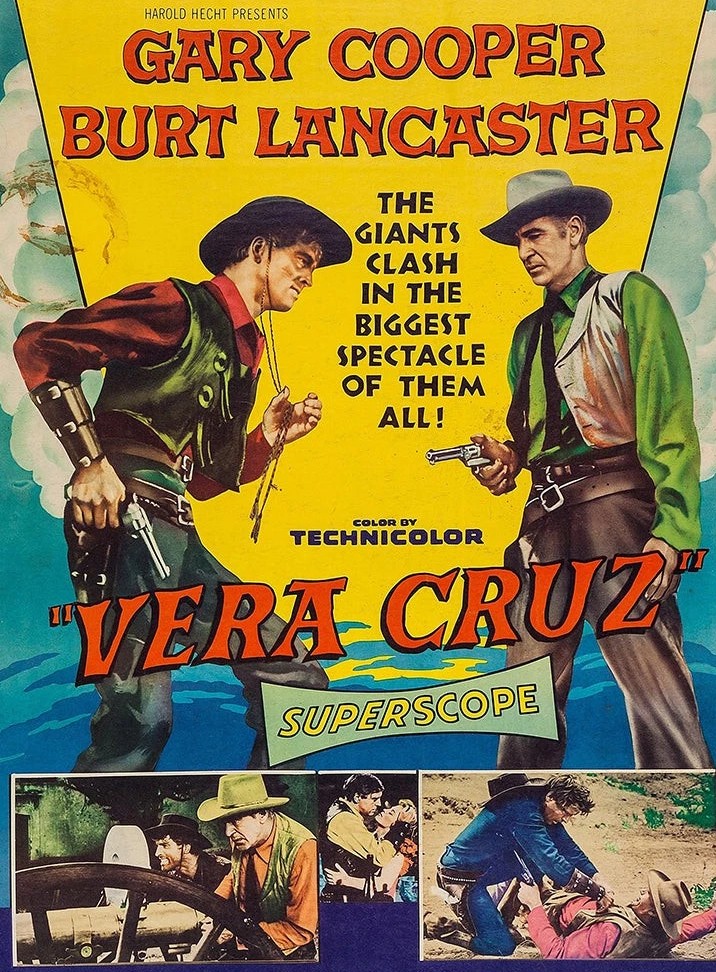
But the UA star with the biggest consistent pull overseas was Burt Lancaster. Robert Aldrich’s Apache (1954) knocked up $1.75 million abroad compared to $3.25 million at home. Vera Cruz, (1954) also directed by Aldrich and coupling Lancaster with Gary Cooper, hit a home run – the $3.94 million abroad being just short of the $4.5 million at home. The actor’s first venture into directing The Kentuckian (1955) kept up the pace with $1.97 million overseas versus $2.6 million at home.
While these were all action pictures, it was acrobatic drama Trapeze (1956), with Lancaster and Tony Curtis fighting over Italian sex symbol Gina Lollobrigida, that made Hollywood wake up. In the U.S, it came third on the annual box office charts with $7.5 million in rentals. If that took the industry by surprise that was nothing compared to foreign where the movie racked up $7.4 million.
Lancaster remained potent. Submarine war picture Run Silent, Run Deep (1958), co-starring Clark Gable, did virtually as well abroad as at home – $2.42 million overseas compared to $2.5 million at home.
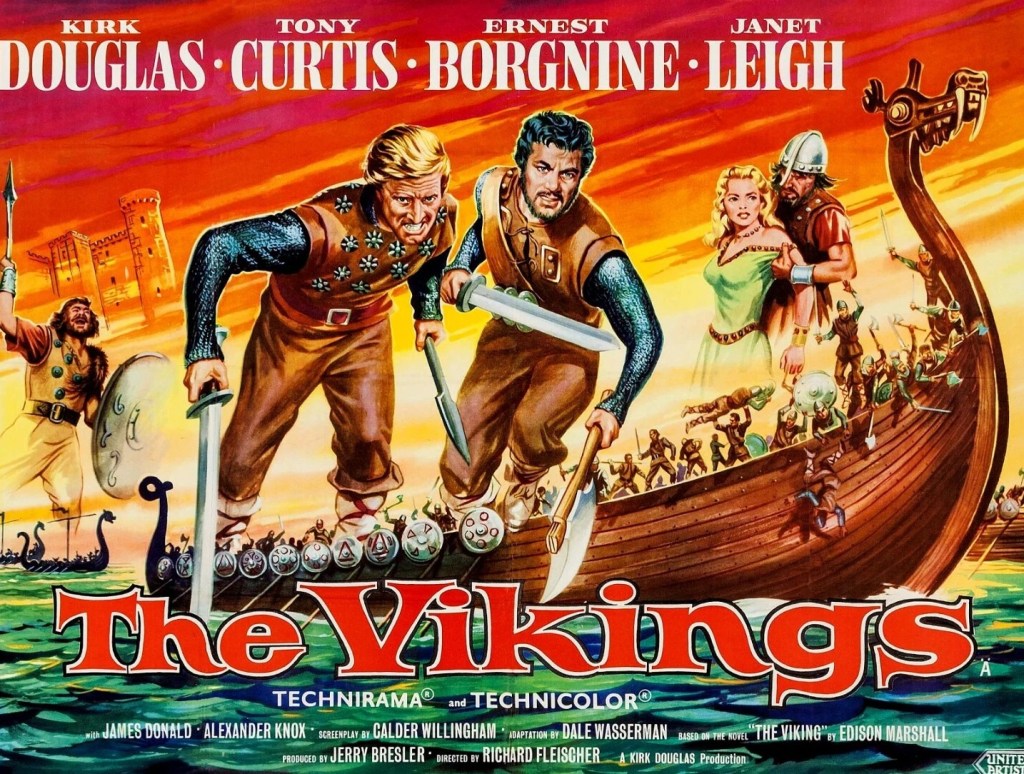
Perhaps learning from the experience of Trapeze, UA went for broke with historical actioner The Vikings (1958) starring Kirk Douglas and Tony Curtis. Domestic of $7 million, enough for fifth place in the annual box office league, was beaten by an overseas count of $7.34 million.
For the first time it appeared that Hollywood could count on overseas to swell the box office in sizeable fashion, thus allowing studios to invest more, especially in historical movies with an action angle, thus opening the door for the spate of 1960s roadshows. Such results also cemented star salaries. If a Burt Lancaster picture could make the same again abroad as at home that put him in a new category of dependable stars and allowed studios to gamble on increasing his salary.
That Charlie Chaplin proved a better draw overseas than in the U.S. was largely by default. The actor-producer-director had fallen foul of American politics with the result that his latest release Limelight (1952) flopped. Abroad it was a different story and Limelight hit a tremendous $5.1 million. With the U.S. reissue market also showing resistance to Chaplin oldies, it was left to overseas audiences to show what cinemas were missing as Modern Times (1936) racked up $2.1 million and The Gold Rush (1925) $1.25 million. For comparison the reissue of Red River (1948) pulled in just $19,000 overseas.
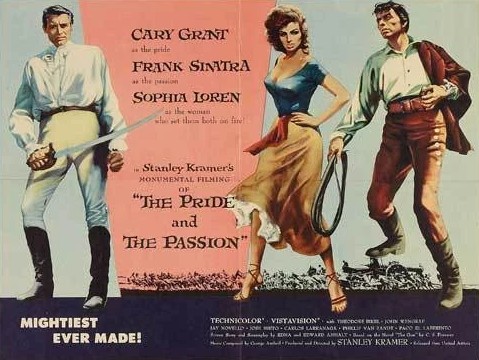
Other notable leaders in the overseas market included: Frank Sinatra, Cary Grant and Sophia Loren in The Pride and the Passion (1957) with $3.17 million ($5.9 million domestic); Billy Wilder’s Agatha Christie adaptation Witness for the Prosecution starring Tyrone Power and Marlene Dietrich on $2.81 million ($3.75 million domestic); and Love in the Afternoon (1957) with $2.7 million ($2 million domestic) starring Gary Cooper and Audrey Hepburn.
Also making a noise overseas were: Stanley Kramer medical drama Not As a Stranger (1955) toplining Olivia De Havilland, Frank Sinatra and Robert Mitchum on a $2 million haul ($7.1 million domestic): Sinatra again in Otto Preminger’s study of addiction The Man with the Golden Arm (1953) on $1.87 million ($4.35 million domestic); Sinatra in war picture Kings Go Forth (1958) on $1.83 million ($2.8 million domestic) and Kirk Douglas as The Indian Fighter (1955) with $1.84 million ($2.45 million domestic).
Bob Hope went against the grain when his overseas tally for Paris Holiday (1958) at $1.8 million bested the $1.5 million of domestic while John Wayne and Sophia Loren’s foreign engagements for Legend of the Lot (1957) counted as a disappointment with just $1.66 million compared to $2.2million domestic.
Low-budget Oscar-winner Marty (1955), produced by Burt Lancaster’s company, was as big a surprise abroad as at home, sprinting to $1.43 million ($2 million domestic). Others worth noting included: Bandido! starring Robert Mitchum on $1.42 million overseas ($1.65 million domestic); David Lean’s romantic drama Summertime (1955) with Katharine Hepburn on $1.3 million ($2 million domestic); Anthony Mann’s Korean War venture Men in War (1957) on $1.26 million ($1.5 million domestic); and Clark Gable in The King and Four Queens (1956) hauling in $1.24 million ($2.5 million domestic).
Olivia De Havilland as The Ambassador’s Daughter (1956) tabbed $1.1 million overseas ($1.5 million domestic) and Gary Cooper in Mark Robson’s Return to Paradise (1953) tallied $1.1 million ($1.8 million domestic). Slow burners numbered Dale Robertson in Sitting Bull (1954) with $1.1 million ($1.5 million domestic) and Stanley Kubrick’s anti-war picture Paths of Glory (1957) with Kirk Douglas shooting up $1 million ($1.2 million domestic).
SOURCE: “Foreign Distribution Gross Estimates,” United Artists Archives, Box 1, Folder 8, University of Wisconsin. Note that in this case “gross” means “gross rentals” not “box office gross.”
British outfit Talking Pictures has embarked on an educational program. Back in the day this would have been termed a “retrospective”, a coveted description indicating that a director or actor’s portfolio was worth reassessment. However, Talking Pictures has taken something of an outlier approach on this one. What it seems intent on educating us about is the U.S. “skinflick”.
You might not be aware of the difference between movies made in the U.S. and anywhere else that appealed to the lowest common denominator in the 1960s. Movies that featured nudist camps were generally acceptable to the British censor. And although major filmakers continually challenged the censor everywhere during the decade, that generally came under the auspices of artistic merit.
When permissiveness got the upper hand, the British seemed somewhat suspicious of abundant nudity and tended to overload it with comedy – Confessions of a Window Cleaner (1974) and Adventures of a Taxi Driver (1976) – and titles majoring on the double entendre like Keep It Up Downstairs (1976). There was a censor to keep everything in check.
In the U.S. it was different. You could avoid censorship simply by refusing to submit your film to the Production Code. And there were plenty cinemas only to0 keen to show the worst anyone could come up with in terms of sex and nudity.
The pair I’m reviewing here are not just the worst films I have ever seen but the worst films to be shown on a highly reputable channel, British outfit Talking Pictures TV. As you may be aware this channel has often been a first port of call in finding rare British pictures, often of the crime variety, especially the output from Renown. So pretty much I’m a sucker for anything they turn up dating from the 1960s even if it’s a new movie to me since I admit my knowledge of that era still has gaps. I’m the kind of sucker that never does any research on unknown titles, just trusts that TPTV is taking me down an interesting route
So if I’m unfamiliar with the picture, I generally give it the benefit of the doubt as I assume the people who run Talking Pictures will have done the hard yards. But now I’m not so sure.
Admittedly, there’s a fine line between cult and trash. A great deal of what passes for cult these days was dismissed as trash back in the day, so often it depends on your point of view. But it’s hard to make any justification for screening either of these movies.
At the time of their release neither would have been shown without extensive cuts in the UK and would have been shown in US cinemas minus a Production Code seal of approval.
Admittedly, too, I am making this damning judgement – deeming them worse than the awful Orgy for the Dead (1965) which was redeemed if only just by its campness – without having watched much of either picture. A 20-minute sample of each was as much as I could take.
It’s not just that they are devoid of any cinematic or even technical merit – there’s no dialog for a start, just a monotonous voice-over – but basically that they are an excuse for an endless parade of nudes. Skin flicks in the American vernacular, movies for the dirty raincoat brigade the British equivalent.
Take Me Naked purports to be the more artistic of the pair given it’s set in a derelict area of New York filled with alcoholics and bums. But really, it’s an excuse for a rancid low life to spy on a naked woman (Roberta Findlay) and imagine what’s he’s going to do to her. That’s pretty much it, apart from an unsavory violent aspect.
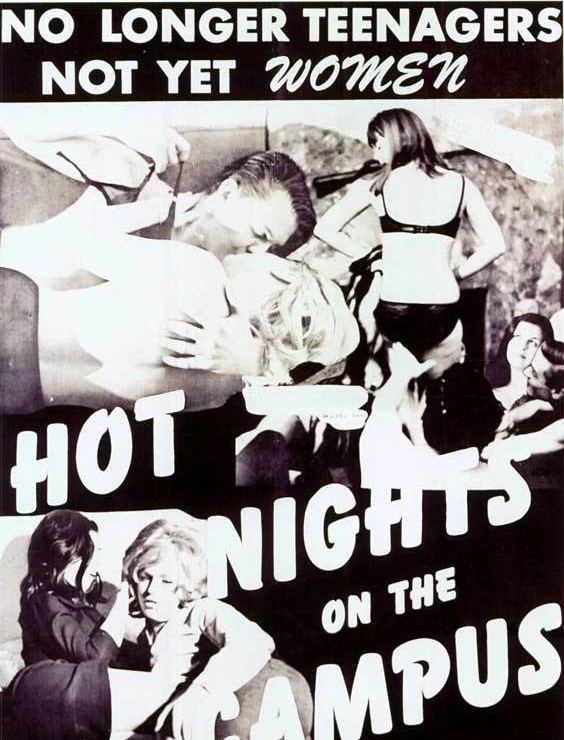
Hot Nights on the Campus has less nudity. But that’s it’s only saving grace. Again, there’s no dialog, just voice-over. Sally (Gigi Darlene) is a farm girl who is led astray at college and her education mostly comprises orgies, lesbianism and seduction. There’s at least an attempt at narrative since Sally’s adventures incur pregnancy and abortion, but like the rest of the picture their purpose is purely exploitational.
Take Me Naked was directed by Michael and Roberta Findlay, the latter making a name for herself helming exploitation, sexploitation and hardcore porn. Hot Nights on the Campus was written and directed by Tony Orlando who made three others in the same vein.
Shameless, I know. Egotistical? I plead guilty. But since there’s no financial reward in writing this Blog, I take pleasure in its increasing popularity. I started writing this Blog in 2020 and my first year’s figures amounted to a scant 1,648 views. Certainly nothing to write home about and definitely no inkling that I would hit a grand total of 565,000 views over the six years of the Blog’s existence. I would have been happy to settle for a regular 10,000-20,000 a year.
Luckily, readers had more faith than me and by my third year I was staring at an annual total of just short of 50,000. The following year I topped 75,000 and in 2024 it was a shade below 125,000.
Then came a bonanza. For the year 2025 I registered a phenomenal 301,000 views, more in that single year than cumulatively for the previous five years.
People often ask me why I latched on to the 1960s for the core of my reviews. It’s a question I often ask myself. Although the 1960s were my formative years, I didn’t spend much time at the cinema. I grew up in the new town of Cumbernauld in Scotland which didn’t have a cinema, even though the town planners must have been aware that Scotland had the highest cinema attendance per head of population in the whole of Europe. When I moved to Dumbarton, which had two cinemas, one burned down. Although I remember taking a detour on my journey home from school to stare at the stills on display outside the Rialto, incursions inside were rare. So maybe I’m just catching up on what I missed.
And although I’d written several books on films of the 1960s – one each about The Magnificent Seven (1960), The Guns of Navarone (1961) and Lawrence of Arabia (1962) and another devoted to the westerns of 1969, it wasn’t until I watched all the movies that comprised The Magnificent 60s: The 100 Most Popular Films of a Revolutionary Decade that my appetite was whetted for more.
I’ve got a huge DVD and VHS arsenal so that was a good place to start. I didn’t have any plan. I just watched what I fancied. Occasionally, I’d plunder TCM, Talking Pictures and other television channels and streamers. Since I still attend the cinema on a Monday, I add to the mix with reviews of contemporary films.
In this indiscriminate fashion, I’ve got to know a huge number of movies that I would probably never had an initial inclination to watch. Pictures such as Fraulein Doktor (1968) or A Dandy in Aspic (1968) or Invitation to a Gunfigfhter (1964) or Guns of Darkness (1962) or The Way West (1967), all underrated at the time – and since, which I am delighted to give a positive fillip. As such films turn up intermittently on streamers or television stations I find I am often the first port of call for people wanting a review of such pictures.
Because several of my books had been about the making of movies, I decided to sporadically investigate, on a smaller scale, how certain pictures were made and those “Behind the Scenes” articles have become a very popular element of the Blog.
Where do my fans come from? United States leads the way followed by China, then the United Kingdom, Thailand, Australia, Canada, India, Spain, Germany and Singapore. But I’ve got at least one reader in virtually every country in the world.
I’ve no idea how people find this Blog because I’m not on social media. The Blog isn’t represented on X or Facebook or Instagram so I can only assume it’s a version of word-of-mouth.
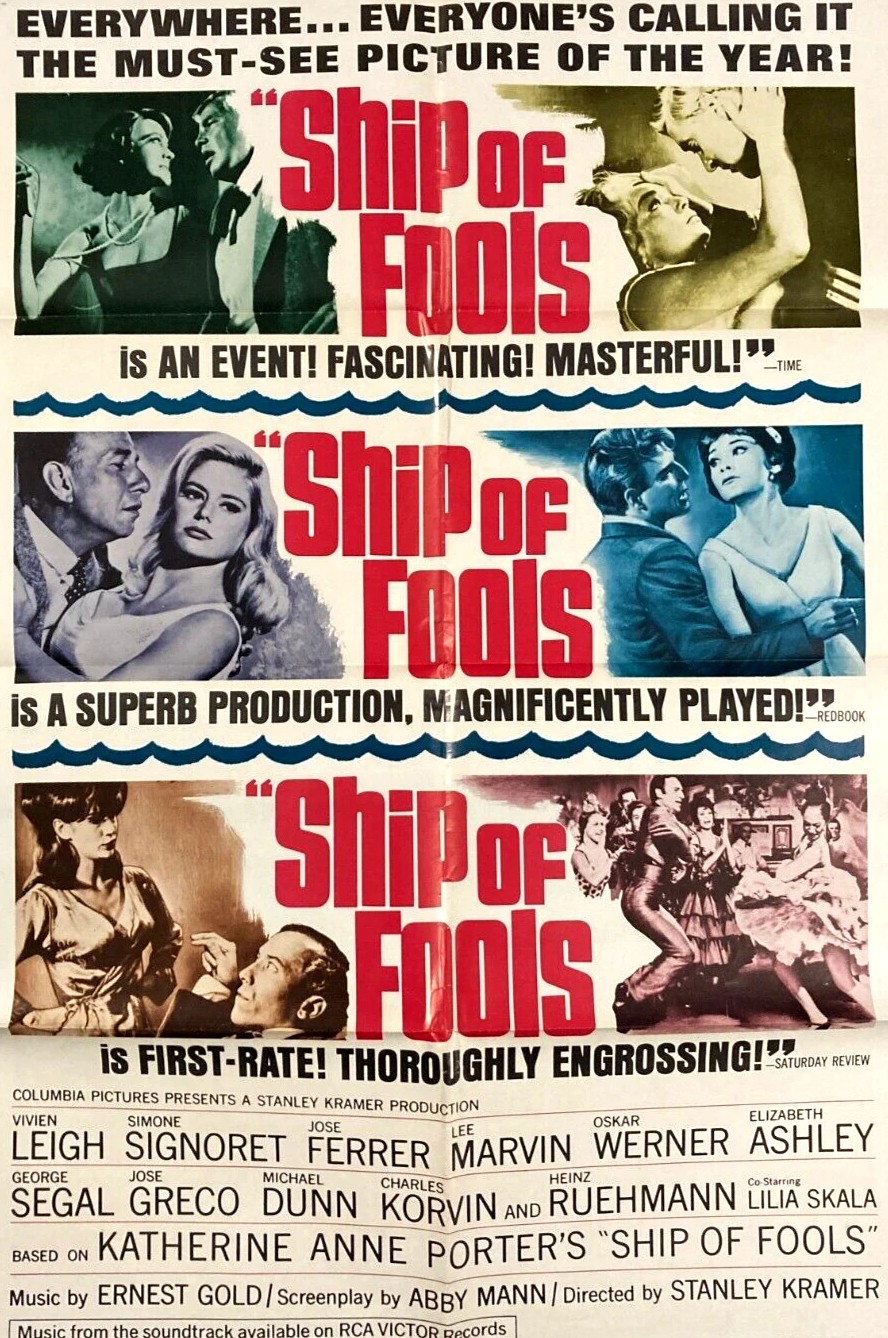
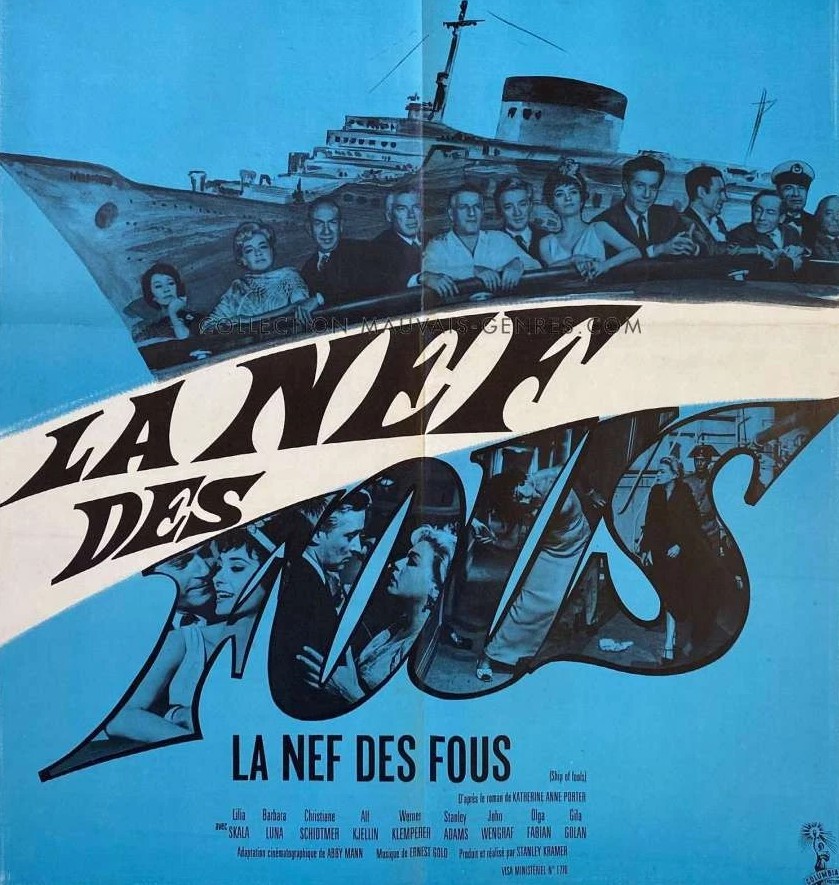
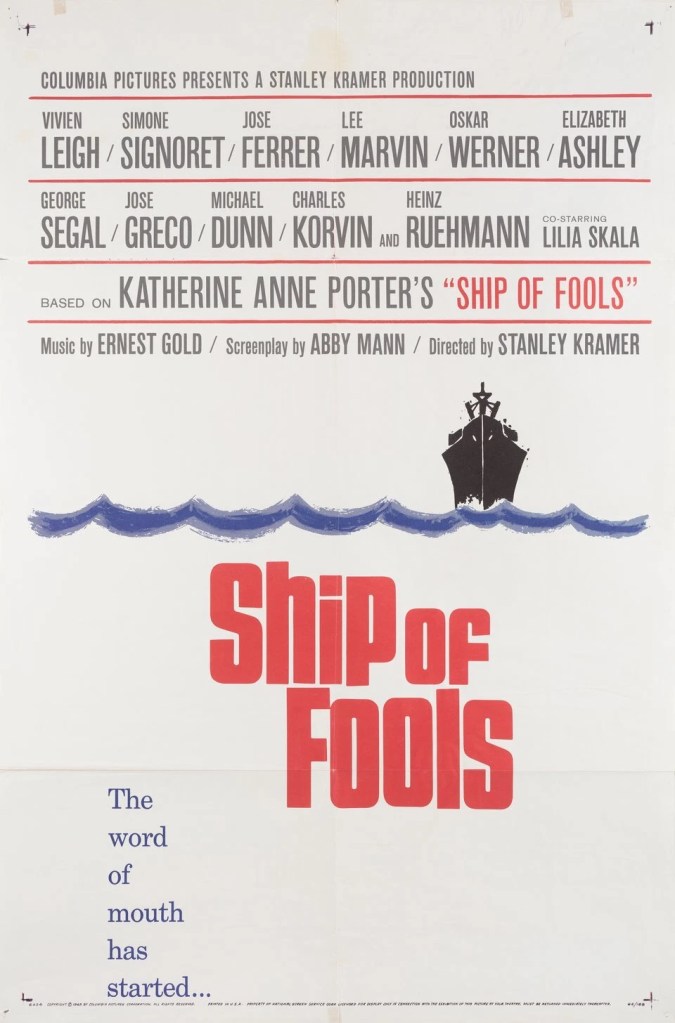
Stanley Kramer was on a roll, It’s A Mad, Mad, Mad, Mad World – an outlier in his portfolio of serious pictures – his biggest-ever hit. Although United Artists, where the director had made his last four pictures, was initially in the frame for Katharine Anne Porter’s 1962 best seller Ship of Fools, the project ended up at Columbia which Kramer had last partnered on The Caine Mutiny in 1951. While the asking price was $450,000 plus a percentage, Kramer secured the rights for $375,000 although he chipped in $25,000 towards the book’s advertising campaign.
Kramer envisioned a character-driven film that would make up for the lack of action. He shifted the timescale to 1933 from 1931 to bring greater overtones of the Hitler threat. “Although we never mention him in the picture,” said Kramer, “his ascendancy is an ever-present factor.” Since there were no seagoing liners available to take over, the movie was shot entirely on the soundstage. “We filmed a ship’s ocean voyage without a ship and without an ocean.” He ransacked old footage for establishing shots of the ship, usually seen in the distance. Decks, staterooms and dining areas were constructed in the studio.
The kind of muted color he would have preferred was not available and since “the theme was just too foreboding for full color” he decided to film in black and white. Shooting in black and white wasn’t yet redundant. Of 27 features going in front of the cameras in 1964, six (including The Disorderly Orderly and Hush, Hush, Sweet Charlotte) were made in monochrome – down from ten out of 24 the year before.
A thoughtful epic was always going to have trouble finding stars especially as current wisdom was that the industry only had at its disposal 22 genuine box office stars “thinly sprinkled” through the 43 pictures currently in production. While the movie’s marketeers boasted of an all-star cast, the reality was that while overall the actors had “combined heft” they were “minus any individual box office behemoth.”
Spencer Tracy, whom Kramer initially envisioned for the role of the ship’s doctor and who had starred in the director’s last three pictures, would have added definite marquee allure, but he was unavailable due to illness. Greer Garson and Jane Fonda also fell by the wayside.
And unusually, Kramer insisted that many of those actors were not American. Vivien Leigh was born in India, Simone Signoret – who had just quit Zorba the Greek (1964) – was German and Oskar Werner Austrian. Jose Ferrer (who had won the Oscar in Kramer’s production of Cyrano de Bergerac, 1950) hailed from Puerto Rico, Jose Greco from Italy, Charles Korvin from Hungary, Lila Skalia from Austria and Alf Kjellin from Sweden. Signoret and Skala had Jewish ancestry.
His biggest casting coup was luring double Oscar-winner Vivien Leigh (The Roman Spring of Mrs Stone, 1961) out of retirement. But that was a double-edged sword. In real-life she led a tortured existence. Her marriage to Laurence Olivier was over and she had only appeared in two films since A Streetcar Named Desire (1951). She suffered from mental illness and tuberculosis. “Happiness or even contentment” eluded her and in that respect she was ideal for the role. “I’m sure she realized that, in the picture, she was playing something like her own life yet she never, by word of gesture, betrayed any such recognition.” She was another gamble, the reason her dance card was so empty down to directors despairing of getting a performance out of her.
Kramer flew to Germany to persuade Oskar Werner to take on the role intended for Spencer Tracy. At the time Werner, while familiar to European audiences and the American arthouse set through Jules and Jim (1962),was a relative unknown and a casting gamble. On set he proved obstinate. For one scene where he was instructed to enter camera right he did the opposite. When the direction was repeated, he stood his ground, insisting he preferred that view of his face. Despite the cost of reversing the set-up Kramer was forced to concede. Despite these trials, Kramer got along with Werner better than the actors. “They just couldn’t stand him.” Notwithstanding such difficulties Kramer later signed him for another film, but the actor died before shooting began.
James MacArthur (The Truth about Spring, 1964) was mooted for a role as was Sabine Sun (The Sicilian Clan, 1969). The most unlikely prospect was German comedian Heinz Ruhmann who was cast as Lowenthal. The Screen Actors Guild complained when Kramer hired five Spaniards instead of Americans for bit parts paying union scale of $350 a week, but their complaints were ignored.
Kramer admitted the ingénue roles played by George Segal (The Bridge at Remagen, 1968) and Elizabeth Ashley (The Third Day, 1965) were too much of a cliché. “As in most pictures,” observed Kramer, “older actors not only had more stature but they were also better armed by the writers. There was no way Segal and Ashley could compete with Werner and Signoret.”
The film cost $3.9 million. Filming began on June 22, 1964. It was initially a long shot for roadshow release but since Columbia was already committed to the more expensive Lord Jim and there were already 15 others lined up from other studios, Columbia nixed the two-a-day release in favour of continuous program.
Boosted by book sales – it was the number one hardback bestseller of 1962 and had sold millions in paperback – the movie carved out a more commercial niche than had been anticipated. Positive reviews helped. It opened to a “mighty” $88,000 in New York breaking records at the 1,003-seat Victoria and the 561-seat Sutton arthouse.
There was a “socko” $25,000 in Chicago, “giant” $23,000 in Philadelphia, “sock” $14,000 in Baltimore, “strong” $13,000 in St Louis, “lively” $12,000 in Detroit, “stout” 12,000 in San Francisco, “sturdy” $11,000 in Pittsburgh, and “slick” $10,000 in Columbus, Ohio. The only first run location where it toiled was Denver where it merited a merely “okay” opening of $8,000.
There was a sense of Columbia letting it run as long as possible in first run in the hope of garnering Oscars to boost its subsequent runs. But the studio was the beneficiary three times over from the Oscars – with Cat Ballou, Ship of Fools and William Wyler’s The Collector in contention for various awards.
The studio had the clever idea of pairing Ship of Fools in reissue with Cat Ballou, for which Marvin had won the Oscar, and although not the star of Ship of Fools the teaming suggested it was a Marvin double bill. In Los Angeles the double bill hoisted $135,000 from 21 houses followed by $121,000 from 28. But in Cleveland Ship of Fools went out first with TheCollector and then Cat Ballou. A mix-and-match strategy also saw Ship of Fools double up with, variously, A Patch of Blue, Darling and The Pawnbroker.
The final tally was difficult to compute. In its 1965 end-of-year rankings Variety reckoned it had only pulled in $900,000 in rentals but it was good for $3.5 million in the longer term, a realistic target once you counted in the $1.3 million in rentals generated by the combination with Cat Ballou.
SOURCES: Stanley Kramer with Thomas F. Coffey, It’s A Mad, Mad, Mad, Mad World, A Life in Hollywood (Aurum Press, 1997) pp203-212; “New York Sound Track,” Variety, May 2, 1962, p4; “375G for Fools Novel,” Variety, May 2, 1962, p5; “Publisher’s Big Break,” Variety, May 23, 1962, p4; “Kramer to Produce Ship of Fools for Columbia,” Box Office, June 18, 1962, p9; “Abby Mann to Script Ship of Fools,” Box Office, November 1962, pSE4; “Top German Comic,” Variety, April 15, 1964, p23; “Simone Signoret Exits Zorba,” Variety, April 22, 1964, p11; “Control of Space,” Variety, May 6, 1964, p4; “Five Spaniards on Ship of Fools Irks SAG,” Variety, June 3, 1964, p5;“To Speed MacArthur for Ship of Fools,” Variety, June 10, 1964, p17; “27 Features Shoot in Color, Only Six in Monochrome,” Variety, August 5, 1964, p3; “Perennial Quiz,” Variety, September 2, 1964, p1; “15, Maybe 17, Pix for Roadshowing,” Variety, October 28, 1964, p22; “Too Many Roadshows,” Variety, August 2, 1965, p5. Box office figures, Variety September-November 1965, “Big Rental Pictures of 1965,” Variety, January5, 1966, p6.
Since I’ve expanded the All-Time Top Movies to 100 it seems only fair to enlarge the Behind the Scenes section. So this is now a Top 30. The rankings here relate to this time last year.
Includes three Alistair MacLean adaptations. John Wayne and Gregory Peck feature three times and Kirk douglas, Dean Martin, James Stewart, Steve McQueen and Omar sharif twice each. Andrew V. McLaglen leads the directorial charge with three mentions.
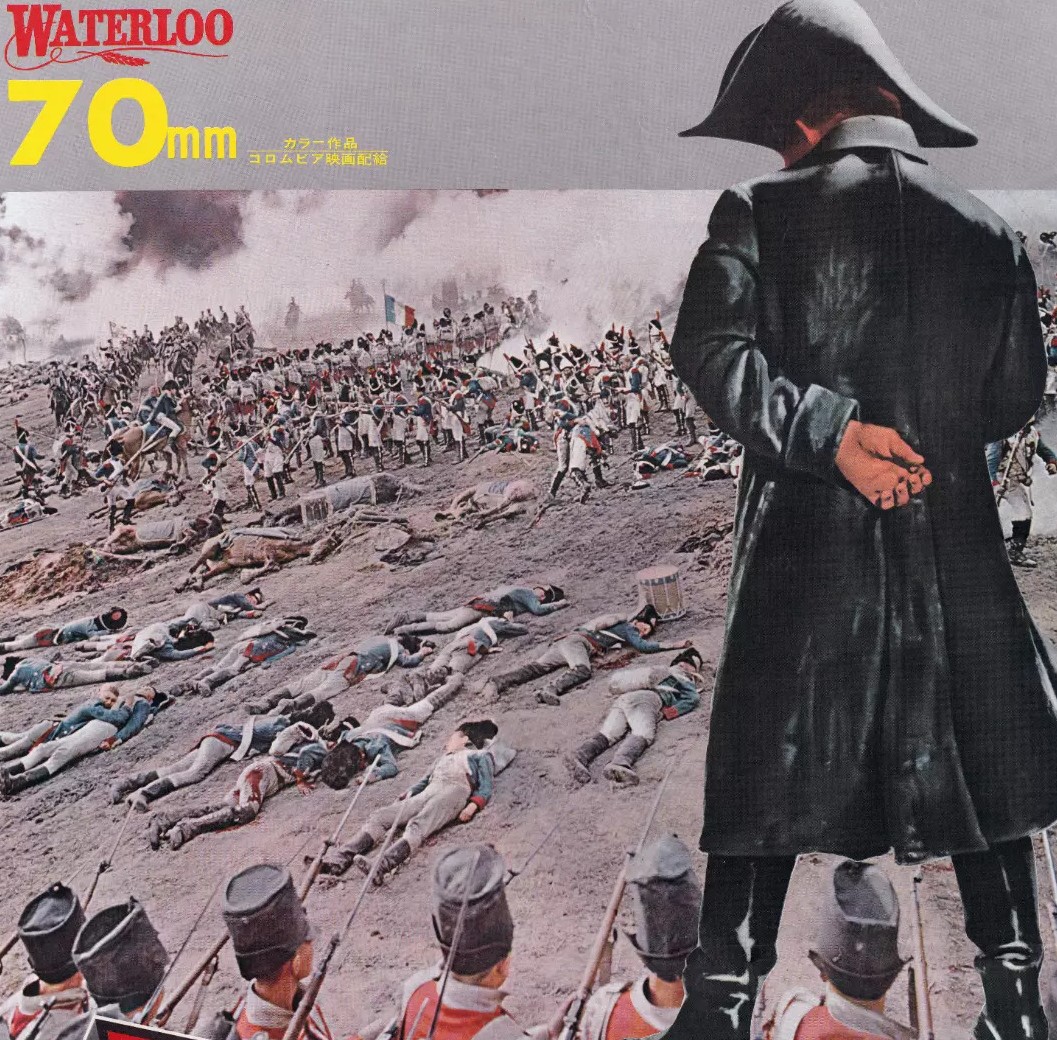
(1)Waterloo(1970). No doubting the effect of Ridley Scott’s Napoleon in increasing interest in this famous flop that had Rod Steiger’s French emperor squaring off against Christopher Plummer.
(3) In Harm’s Way(1965). Otto Preminger takes off the gloves to expose problems in the American military around Pearl Harbor. John Wayne and Kirk douglas head an all-star cat.
(2)Man’s Favorite Sport (1964). Howard Hawks back in the gender wars with Rock Hudson being taken down a peg by Paula Prentiss.
(4) The Guns of Navarone (1961). Alistair MacLean created the template for the men-on-a-mission war picture. Gregory Peck, David Niven and Anthony Quinn topline. Nominated for five Oscars including Best Picture, Best Director (J. Lee Thompson) and Screenplay (Carl Foreman) and enough jeopardy throughout the filming to qualify for a movie of its own.
(7) The Satan Bug(1965). The problems facing director John Sturges in adapting the Alistair MacLean pandemic classic for the big screen.
(6) Battle of the Bulge (1965). There were going to be two versions, so the race was on to get this one to the public first. A Cinerama number.
(5) Ice Station Zebra(1968). A complete cast overhaul and ground-breaking special effects are at the core of this filming of another Alistair MacLean tale. Second Alistair MacLean outing for John Sturges.
(New Entry) Barbarella (1968). Jane Fonda was fourth choice after Brigitte Bardot, Sophia Loren and Ira von Furstenberg. Should never have been directed by Roger Vadim who was out of favor with Paramount. One of the first movies to be given a global simultaneous release.
(8) Cast a Giant Shadow (1965). Producer Melville Shavelson wrote a book about his experiences and this and other material relating the arduous task of bringing the Kirk Douglas-starrer to the screen are told here.
(12) Mackenna’s Gold (1969). Tortuous route to the screen for Carl Foreman-produced roadshow western, filmed in 70mm Cinerama, with an all-star cast including Omar Sharif, Gregory Peck and Telly Savalas.
(9) The Girl on a Motorcycle / Naked under Leather (1968). Cult classic starring Marianne Faithful and Alain Delon had a rocky road to release, especially in the U.S. where the censor was not happy.
(12) The Sons of Katie Elder (1965). First envisioned nearly a decade before, Henry Hathaway western finally hit the screen with John Wayne and Dean Martin.
(11). Tora! Tora! Tora! (1970). Richard Fleischer dispenses with the all-star cast in favor of even-handed verisimilitude.
(15) The Trouble with Angels (1966). Less than angelic Hayley Mills sparring with convent boss Rosalind Russell. Directed by one-time star Ida Lupino.
(New Entry) The Misfits (1961). Robert Mitchum turned down the male lead. Clark Gable failed the medical, both Montgomery Clift and Marilyn Monroe had drug problems. It went 40 days over schedule and half a million over budget.
(14) The Bridge at Remagen (1969). British director John Guillerman hits trouble filming World War Two picture starring George Segal and Robert Vaughn.
(16) For a Few Dollars More (1965). Sergio Leone sequel to first spaghetti western brings in Lee van Cleef to pair with Clint Eastwood.
(20) The Collector (1963). William Wyler’s creepy adaptation of John Fowles’ creepy bestseller with Terence Stamp and Samatha Eggar.
(13) Sink the Bismarck! (1960). Documentary-style British World War Two classic with Kenneth More exhibiting the stiffest of stiff-upper-lips.
(18) Bandolero! (1968). Director Andrew V. McLaglen teams up with James Stewart, Dean Martin and Raquel Welch to fight Mexican bandits.
(19) The Train (1964). John Frankenheimer replaced Arthur Penn in the directorial chair to steer home unusual over-budget World War Two picture with Burt Lancaster trying to steal art treasures from under the nose of German Paul Schofield.
(17) How The West Was Won (1962). First non-travelog Cinerama picture, all-star cast and all-star team of directors tackling multi-generational western and all sorts of logistical problems.
(New entry) The Way West (1967). Burt Lancaster, James Stewart and Gary Cooper were the original cast. Charlton Heston turned it down. Robert Mitchum couldn’t make up his mind. Director Andrew V. McLaglen claimed it had been savaged by the studio.
(New Entry) The Wicker Man (1973) at the Box Office. A flop on initial release, U.S. release delayed, it took a long long time before the movie achieved both cult status and came out of the red.
(New Entry) The Stalking Moon (1968). Should never have been made, according to existing legislation, even with Gregory Peck’s participation long delayed in part due to original director George Stevens pulling out.
(New Entry) “Barbieheimer” Recalls the Old Double Bill. The perfect double bill aimed to attract different segments of the audience.
(New Entry) Judgement at Nuremberg (1961). Laurence Olivier was first choice to play the role taken by Burt Lancaster. United Artists was not at all keen on the proposition. Innovative use of the camera. Judy Garland and Montgomery Clift overcame personal problems while Marlene Dietrich was acquainted with one of men on trial.
(New Entry) The Thomas Crown Affair (1968). Sean Connery, Jack Lemmon and Brigitte Bardot turned it down. Director Norman Jewison thought Steve McQueen “completely wrong” for the part.
(New Entry) The Cincinnati Kid (1965). Sam Peckinpah was fired. Spencer Tracy quit. Sharon Tate declined.
(New Entry) The Appointment (1969). Booed at the Cannes Film Festival. Denied a release in the U.S., even with Omar Sharif as star and after being heavily edited by MGM. Only shown on American TV. The biggest financial flop of Sidney Lumet’s career.
Given that I’m now closing in on 2,000 reviews, it seems the correct time to expand the scope of the All-Time Views List. So instead of a Top 50, from now on it’s a Top 100. In case it’s not obvious I should point out that these are not necessarily my favourites, but yours, the movies most viewed since The Blog began five-and-a-half years ago. Since this little exercise is undertaken twice a year the rankings are compared to the previous standings in the all-time list from July this year.
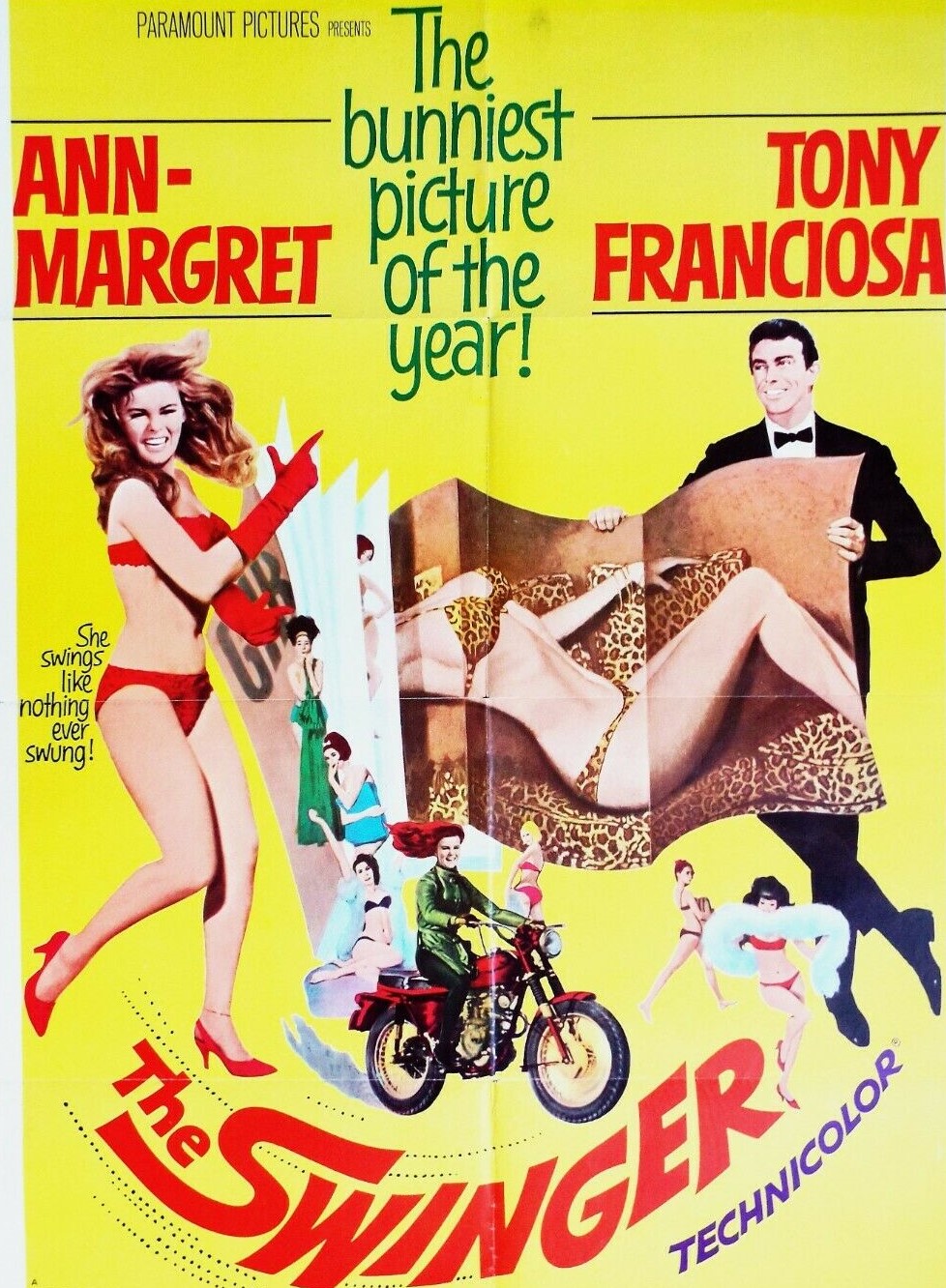
There’s still no shaking Ann-Margret, a brace of her movies – The Swinger (1966) and western remake Stagecoach (1966) – embedded in the top three. In terms of number of entries, Dean Martin is in pole position thanks to a quintet of westerns – Bandolero (1968), Rough Night in Jericho (1967), 4 for Texas (1963), Five Card Stud (1968) and The Sons of Katie Elder (1965).
On four apiece are Raquel Welch and George Peppard, the former in spy adventure Fathom (1967), western Bandolero (1968), crime drama Lady in Cement (1968) and One Million Years B.C. (1966), the latter in House of Cards (1968), Pendulum (1968), Operation Crossbow (1965) and Rough Night in Jericho.
Also making a fine showing are Hayley Mills, John Wayne, Charlton Heston, Senta Berger, Alain Delon and Omar Sharif with three entries each. Mills headlines The Family Way (1966), The Trouble with Angels (1966) and The Chalk Garden (1964). Wayne shows up for war picture In Harm’s Way (1965) and two westerns, The Sons of Katie Elder and Andrew V. McLaglen’s under-rated The Undefeated (1969). Heston shows his marquee power in Diamond Head (1962), The Hawaiians/ Master of the Islands (1970) and The War Lord (1965). Senta Berger is seen in Istanbul Express (19668), Our Man in Marrakesh (1966) and The Secret Ways (1961). Alain Delon tried to go straight in Once a Thief (1965), is intent on crime in Farewell Friend / Adieu L’Ami (1968) and is the lover in Girl on a Motorcycle.
Sharif stars in little-seen The Appointment (1969), Genghis Khan (1965) and J. Lee Thompson Cinerama western Mackenna’s Gold (1969). Ann-Margret also has three after you add Once a Thief (1965) to her list. On the directorial front, Robert Aldrich and Andrew V. McLaglen clock up three apiece, the former with Sodom and Gomorrah (1962), 4 for Texas (1963) and The Flight of the Phoenix (1965) and the latter with western trio The Way West (1967), Bandolero! (1968) and The Undefeated (1969).
Oscar-winner Anora (2024), Pamela Anderson as The Last Showgirl (2024) and French crime thriller Squad 36 / Bastion 36 (2025) head up the contemporary list, although only a handful of recent films have made their way into the Top 100.
If, like me, you’re interested in statistics, you might like to know the genre breakdown. Drama is top with 30 per cent of all the movies featured, crime comes next on 24 per cent, followed by westerns on 14 per cent then spy (11 per cent), war (nine per cent), sci fi/fantasy (five per cent), historical (four per cent), horror (two percent) and musical (one per cent).
The figures in brackets represent the positions in July 2025 and New Entry is self-explanatory. .
(1) The Swinger (1966). Despite shaking her booty as only she knows how, Ann-Margret brings a sprinkling of innocence to this sex comedy.
(2) Anora (2024). Mikey Madison’s sex worker woos a Russian in Oscar-winner.
(3) Stagecoach (1966). Under-rated remake of the John Ford western. But it’s Ann-Margret who steals the show ahead of Alex Cord in the role that brought John Wayne stardom.
(5) In Harm’s Way (1965). Under-rated John Wayne World War Two number. Co-starring Kirk Douglas, Patricia Neal, Tom Tryon and Paula Prentiss, director Otto Preminger surveys Pearl Harbor and after.
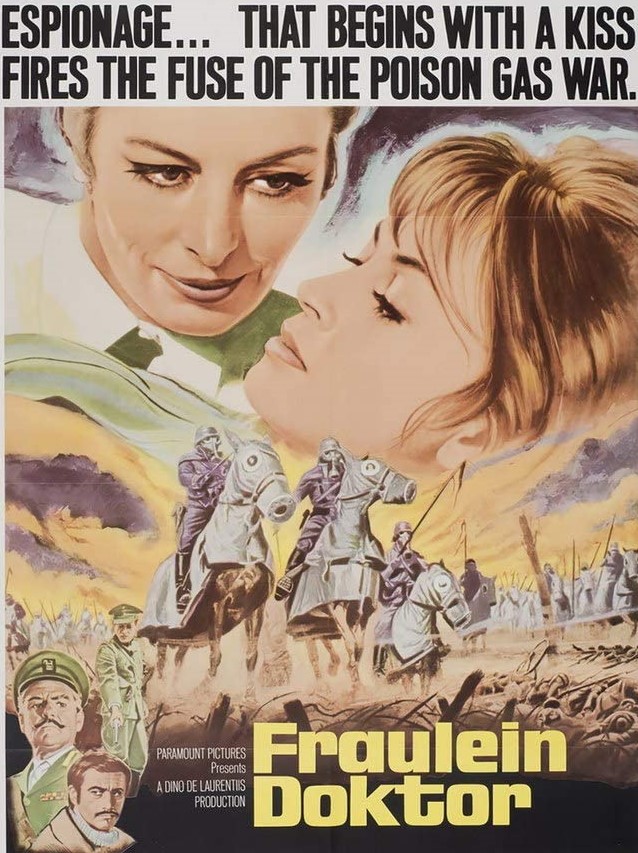
(6) Fraulein Doktor (1969). Grisly realistic battle scenes and a superb score from Ennio Morricone help this Suzy Kendall vehicle as a World War One German spy going head-to-head with Brit Kenneth More and taking time out for romantic dalliance with Capucine.
(4) The Last Showgirl (2024). Pamela Anderson proves she can act and how in this touching portrayal of a fading Las Vegas dancer.
(9) Squad 36 / Bastion 36 (2025). Corruption and interdepartmental rivalry fuel this French flic directed by Olivier Marchal.
(8)Once Upon a Time in the West (1969). Along with The Searchers (1956) now considered the most influential western of all time. Sergio Leone rounds up Claudia Cardinale, Henry Fonda and Charles Bronson and that fabulous Morricone score.
(32) Age of Consent (1969). Helen Mirren frolics nude in her debut as the freewheeling damsel drawn to disillusioned painter James Mason.
(16) A Dandy in Aspic (1968). Cold War thriller with Laurence Harvey as a double agent who wants out. Mia Farrow co-stars.
(New Entry) Our Man in Marrakesh / Bang! Bang! You’re Dead (1966). Humorous spy offering with Tony Randall and Senta Berger.
(7) Fireball XL5. The famous British television series (1962-1963) from Gerry and Sylvia Anderson, now colorized. “My heart will be a fireball…”
(14) Baby Love (1969). Controversy was the initial selling point but now it’s morphed into a morality tale as orphaned Linda Hayden tries to fit into an upper-class London household.
(New Entry) The Chapman Report (1962). Jane Fonda, Claire Bloom and Shelley Winters lead this investigation into contemporary sexual mores.
(18) The Family Way (1966). Hayley Mills comes of age in this very adult drama. Co-starring her father John Mills and Hywel Bennett.
(21) The Appointment (1969). Inhibited lawyer Omar Sharif discovers the secrets of wife Anouk Aimee in under-rated and little-seen Italian-set drama from Sidney Lumet.
(23) Pressure Point (1962). Nazi extremist Bobby Darin causes chaos for psychiatrist Sidney Poitier. Stunning dream sequences.
(11) Jessica(1962). Angie Dickinson doesn’t mean to cause trouble but as a young widow arriving in a small Italian town she causes friction, so much so the local wives for on a sex strike.
(16) Pharoah (1966). Polish epic set in Egypt sees the country’s ruler at odds with the religious hierarchy.
(12) Young Cassidy (1965). Julie Christie came out of this best, winning her role in Doctor Zhivago as a result. Rod Taylor as Irish playwright Sean O’Casey.
(30) TheSisters (1969). Incest rears its head as Nathalie Delon and Susan Strasberg ignore husbands and lovers in favor of each other.
(New Entry) Signpost to Murder (1964). Joanne Woodward trapped in a millhouse with escaped lunatic Stuart Whitman in twisty thriller.
(23) Istanbul Express (1968). Gene Barry plays a weird numbers game in spy thriller that sets him up against Senta Berger.
(13) Thank You Very Much/ A Touch of Love (1969). Sandy Dennis dazzles as an academic single mother in London impregnated by Ian McKellen.
(New Entry) Five Card Stud (1968). Gambler Dean Marin faces off against preacher Robert Mitchum and a serial killer in Henry Hathaway western also featuring Inger Stevens.
(20) Go Naked in the World (1961). Gina Lollobrigida finds that love for a wealthy playboy clashes with her profession (the oldest). Look out for highly emotional turn from the usually taciturn Ernest Borgnine.
(37) The Demon / Il Demonio (1963). Extraordinary performance by Daliah Lavi in Italian drama as she produces the performance of her career.
(17) Claudelle Inglish (1961). Diane McBain seeks revenge for being stood up at the altar in the Deep South.
(27) Fathom (1967). When not dodging the villains in an entertaining thriller, Raquel Welch models a string of bikinis as a skydiver caught up in spy malarkey.
(24) Pendulum (1968). Fast-rising cop George Peppard accused of murdering unfaithful wife Jean Seberg
(New Entry) They Came to Rob Las Vegas (1968). Gary Lockwood and Elke Sommer head up a heist thriller.
(19) Vendetta for the Saint (1969). Prior to James Bond, Roger Moor was better known as television’s The Saint. Two television episodes combined sees our hero tackle the Mafia.
(39) Operation Crossbow (1965). George Peppard is the man with the mission in Occupied France during World War Two. Co-stars Sophia Loren.
(25) The Sins of Rachel Cade (1961) Angie Dickinson (again) as African missionary falling foul of the natives and Commissioner Peter Finch. Roger Moore (again) in an early role.
(15) The Girl on a Motorcycle / Naked under Leather (1968). How much you saw of star Marianne Faithfull depended on where you saw it. The U.S. censor came down heavily on the titular fantasizing heroine, the British censor more liberal. Alain Delon co-stars.
(New Entry) The Battle of the Villa Florita (1965). Maureen O’Hara runs off to Italy to join lover Rossano Brazzi. When her kids follow, trouble ensues,
(New Entry) Assignment K (1967). Stephen Boyd in spy caper tangles romantically with Camilla Sparv and is on the receiving end of some tough thugs.
(New entry) Sands of the Kalahari (1965). Stanley Baker, Stuart Whitman and Susannah York are stranded in the desert. Instead of working together, it’s every person for themselves.
(New Entry) The Double Man (1967). Yul Brynner is the target for a kidnapping plot in complex spy thriller co-starring Britt Ekland.
(42) The Chalk Garden (1964). Wild child Hayley Mills, trying to break out of her Disney straitjacket, duels with governess Deborah Kerr.
(26) Diamond Head (1962). Over-ambitious hypocritical landowner Charlton Heston comes unstuck in love, politics and business in Hawaii. George Chakiris, Yvette Mimieux and France Nuyen turn up the heat.
(New entry) Gunn (1967). Blake Edwards turns hit television series into a movie with star Craig Stevens.
(45) A Fine Pair (1968). Rock Hudson and Claudia Cardinale join forces for a heist picture.
(New Entry) 4 for Texas (1963). Only Frank Sinatra and Dean Martin survive from the Rat Pack, but Ursula Andress and Anita Ekberg more than compensate in Robert Aldrich fun western.
(32) Farewell, Friend / Adieu L’Ami (1968). A star is born – at least in France, the States was a good few years behind in recognizing the marquee attractions of Charles Bronson. Alain Delon co-stars in twisty French heist thriller featuring Olga Georges-Picot and Brigitte Fossey.
(35) Once a Thief (1965). Ann-Margret again, in a less sexy incarnation, as a working mother whose ex-jailbird thief Alain Delon takes a detour back into crime.
(36) Woman of Straw (1964). More Hitchockian goings-on as Sean Connery tries to frame Gina Lollobrigida in a dubious scheme.
(New Entry) Jason and the Argonauts (1963). Ray Harryhausen steals the show in cracking fantasy.
(29) The Golden Claws of the Cat Girl (1968). Cults don’t come any sexier than Daniele Gaubert as a French cat burglar.
(New Entry) TheFlight of the Phoenix (1965). When James Stewart, Richard Attenborough, Peter Finch and Hardy Kruger crash in the desert they come up with an ingenious plan to escape. Robert Aldrich directs.
(51) Prehistoric Women / Slave Girls (1967). Martine Beswick attempts to steal the Raquel Welch crown as Hammer tries to repeat the success of One Million Years B.C.
(43) Dark of the Sun / The Mercenaries (1968). Rod Taylor’s guns-for-hire break out the action in war-torn Africa. Jim Brown and Yvette Mimieux co-star.
(31) Moment to Moment (1966). Hitchcockian thriller set in Hitchcock country – the South of France – as unfaithful Jean Seberg is on the hook for the murder of her lover. Also featuring Honor Blackman.
(New Entry) The Red Tent (1969). Sean Connery adds his weight to a rescue mission for an airship crashed in the Arctic. Based on a true story. Claudia Cardinale and Peter Finch co-star.
(New Entry) The Best House in London (1969). David Hemmings heads up a moralistic tale of rescuing sex workers in Victorian London.
(New Entry) The Sons of Katie Elder (1965). John Wayne and Dean Martin join forces to find out what happened to their mother in top-notch Henry Hathaway western.
(New Entry) Anatomy of a Fall (2024). Critically-acclaimed artie thriller starring Oscar-nominated Sandra Huller. The screenplay took the Oscar as well.
(New Entry) Invitation to a Gunfighter (1964). Yul Brynner cleans up the town in under-rated western. Janice Rule adds interest.
(34) Genghis Khan (1965). Omar Sharif as the titular warrior up against Stephen Boyd. Co-starring James Masion and Francoise Dorleac. Robert Morley is hilariously miscast as the Chinese Emperor.
(33) Horizon: An American Saga – Chapter 1 (2024). Kevin Costner’s majestic western that became one of the biggest flops of the year was underrated in my opinion.
(New Entry) Mickey One (1965). Cult Arthur Penn thriller with Warren Beatty as comedian on the run.
(New Entry) House of Cards (1968). Ex-boxer George Peppard gets tangled up in an international fascist conspiracy and with Ingrid Stevens. Orson Welles has a cameo.
(41)Can Heironymus Merkin Ever Forget Mercy Humpe and Find True Happiness? Fellini would turn in his grave at the self-indulgence of singer Anthony Newley who manages to lament that women falling at his feet cause him so much strife. Joan Collins co-stars.
(New entry) Rough Night in Jericho (1967). Corrupt lawman Dean Martin tangles with George Peppard in under-rated western Jean Simmons is the woman who comes between them.
(New Entry) Deadlier than the Male (1967). Richard Johnson as Bulldog Drummond in the clutches of femme fatales of Elke Sommer and Sylva Koscina.
(New entry) The Undefeated (1969). John Wayne and Rock Hudson duke it out in superb Civil War western directed by Andrew V. McLaglen.
(New Entry) Ten Little Indians (1965). Agatha Christie whodunnit. Hugh O’Brian and Shirley Eaton are among the suspects.
(New Entry) The Trouble with Angels (1966). Hayley Mills has the nuns on the run as she causes chaos at a convent school run by Rosalind Russell.
(New Entry) 633 Squadron (1964). You remember the soaring score more than the performances of Cliff Robertson and George Chakiris in World War Two aerial mission.
(New Entry) Black Butterflies (2022). Twisty French mini-series majoring on sex and murder in enjoyable film noir throwback.
(New Entry) The Shoes of the Fisherman (1968). Anthony Quinn is the unlikely candidate for the Papacy in Vatican drama co-starring Laurence Olivier, Oskar Werner and David Janssen.
(44) La Belle Noiseuse (1991). Emmanuelle Beart is the mostly naked model taking painter Michel Piccoli to his artistic limits.
(48) The Venetian Affair (1966). Robert Vaughn investigates spate of suicide bombs. Elke Sommer provides the glamor.
(New Entry) Bandolero! (1968). James Stewart and brother Dean Martin team up with Raquel Welch to evade George Kennedy’s posse in another Andrew V. McLaglen under-rated western.
(46) Lady in Cement (1969). Raquel Welch models more bikinis as the gangster’s moll taken on as a client by private eye Frank Sinatra in his second outing as Tony Rome.
(49) The Secret Ways (1961). The first of the Alistair MacLean adaptations to hit the big screen features Richard Widmark trapped in Hungary during the Cold War. Senta Berger in an early role.
(New Entry) Lost Command (1966). Algerian War picture sets Anthony Quinn and Alain Delon against George Segal.
(38) Guns of Darkness (1962). David Niven and Leslie Caron on the run from South American revolutionaries.
(New Entry) The Adventurers (1970). Adaptation of a Harold Robbins bestseller so it’s sex and violence and more sex as playboy Bekim Fehmiu turns revolutionary. Co-stars Charles Aznavour, Candice Bergen and Leigh Taylor-Young.
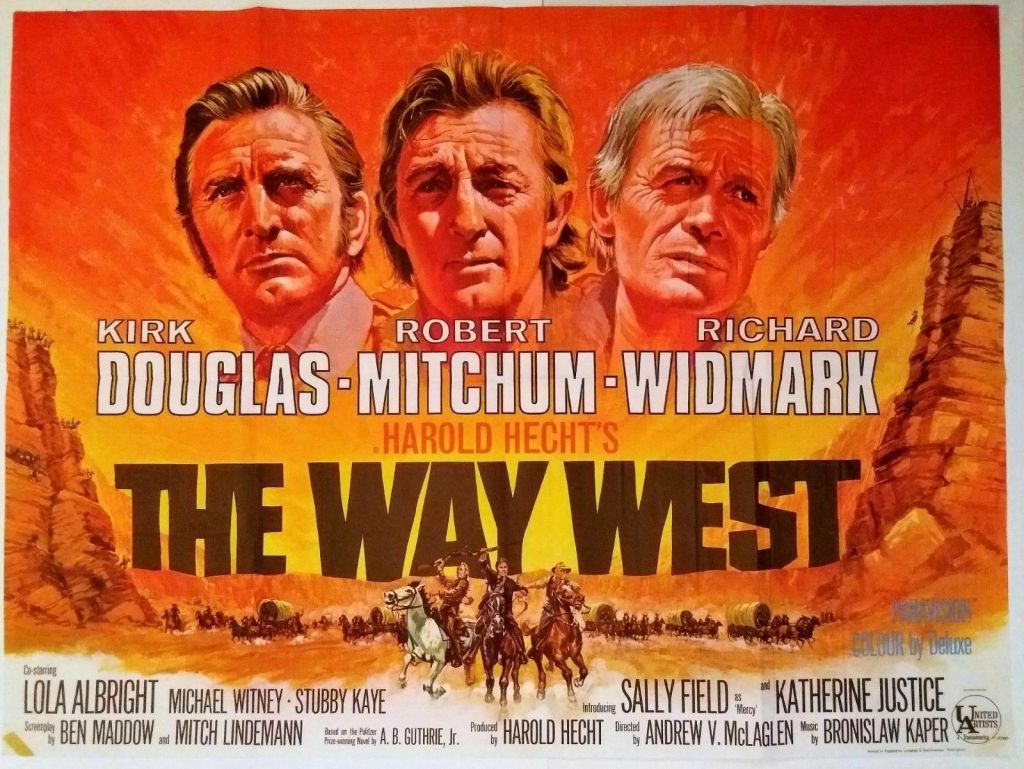
(New Entry) The Way West (1967). Andrew V. McLaglen again with an under-rated western again starring Kirk Douglas, Robert Mitchum, Richard Widmark on the long trail. .
(New Entry) One Million Years B.C. (1966). Ray Harryhausen’s models cede center stage to Raquel Welch in a fur bikini in the picture that launched her career..
(40) She Died with Her Boots On / Whirlpool (1969). More sleaze than cult. Spanish director Jose Ramon Larraz’s thriller sees kinky photographer Karl Lanchbury targeting real-life MTA Vivien Neves.
(New Entry) The Hawaiians / Master of the Islands (1962). Charlton Heston picks up where Hawaii (1966) left off and it’s chock full of corruption, racism and misogyny.
(New Entry) Subterfuge (1968). CIA agent Gene Barry hunts a mole in British MI5. Joan Collins lends a hand.
(47) Carry On Up the Khyber (1968). The most successful of the Carry On satires poking fun at the British in India.
(New Entry) Mirage (1965). Compelling thriller with Gregory Peck convinced he’s suffering from amnesia.
(New Entry) The War Lord (1965). Very realistic historical drama directed by Franklin Schaffner with Charlton Heston defending his land from invaders.
(New Entry) Petla (2020), Cracking Polish thriller as a cop loses his way in a world of sex, bribery and corruption.
(New Entry) Two for the Road (1967). Audrey Hepburn and Albert Finney try to get their marriage off the rocks by retracing their romantic steps when younger.
(New Entry) Battle of the Bulge (1965). World War Two epic filmed in Cinerama with a topline cast including Henry Fonda, Robert Shaw, Charles Bronson and Telly Savalas.
(New Entry) Sodom and Gomorrah (1962). Robert Aldrich biblical epic sees Stewart Granger facing off against treachery. Co-stars Pier Angeli, Rossana Podesta and Stanley Baker.
(New Entry) Joy in the Morning (1965). Touching romance starring Richard Chamberlain and Yvette Mimieux.
(New Entry) The Appaloosa / Southwest to Sonora (1966). Striking performance from Marlon Brando trying to recover a horse stolen by Mexican bandit John Saxon. Interesting western from Sidney J Furie.
(New Entry) The Titanic (1997). I saw this on reissue in 3D and was knocked out all over again.
(New Entry) Lonely Are the Brave (1962). Prison escape picture featuring cowboy Kirk Douglas who can’t cope with the modern world. Walter Matthau co-stars.
(New Entry) The Woman Who Wouldn’t Die / Catacombs (1965). Cult director Gordon Hessler at his best with husband Gary Merrill finding out trying to kill wife Georgina Cookson isn’t as easy as he expected.
(New Entry) The Lost World (1960). Arthur Conan Doyle fantasy features dinosaurs plus Michael Rennie and Jill St John.
(New Entry) Mackenna’s Gold (1969). J. Lee Thompson big-budget western treasure hunt starring Gregory Peck, Omar Sharif, Telly Savalas, Camilla Sparv, Eli Wallach, lee J Cobb, Edward G Robinson, Julie Newmar and Eli Wallach.
(New Entry) Beat Girl / Wild for Kicks (1960). Teenager Gillian Hills prefers becoming a striptease artist rather than hanging out with her pals in Soho milk bars. Cult with a capital C.
(New Entry) Some Girls Do (1969). Sequel to Deadlier than the Male and Richard Johnson has no easier time of it with Daliah Lavi and Beba Loncar preferring murder to seduction.





 The Magnificent 60s