Rage (1966) ***

You can count on Glenn Ford to bring his A-game to a B-picture. While never reaching the top tier of stardom he had been a box office stalwart in the 1950s until gradually losing his marquee touch in the early 1960s.

This is an odd one, with some nods at Wages of Fear (1953) and any picture that involved a trek or featured a hooker with a heart of gold. The story was certainly unusual – rabies. And the idea of a resulting pandemic will resonate more now than it did then. But it takes quite a long time for the key storyline to emerge, which is just as well because it allows Glenn Ford (Experiment in Terror, 1962) time to turn in one of his best characterisations.

Generally, Ford was Mr Dependable, very capable of holding his own and meting out punishment to anyone who crossed the line. So, this is as far from typecasting as you can get.

Dr Reuben (Glenn Ford) is a washed-up alcoholic working in a flyblown mining pitstop in Mexico, riddled with guilt at the death of wife and child. So when a posse of prostitutes turns up, he’s last in the queue, possibly his disinterest the attraction for Perla (Stella Stevens). By the time he realises he’s contracted rabies, he’s up against the clock, 48 hours to reach a town with an antidote, but still a baby to deliver, a jeep that has to cross a rickety bridge and then runs out of gas, so that, once linked up again with Perla and helped by Pancho, he has to cross mountain and desert to reach safety.

Logic isn’t in much evidence here. Despite knowing he has contracted the disease, he still delivers a baby and then spends most of the final 36 hours in the company of Perla and Pancho (David Reynoso), not to mention that the Mexican has abandoned his wife, who has just given birth in a shack, in order to accompany the doctor, or that the doc finds his way onto a bus loaded up with kids (presumably they are immune).

Not to mention that with a jeep running out of gas surely the last thing you’d want is to weight it down with passengers. And with a budget that’s not going to cater for a proper runaway bus that sequence falls back on the old speeded-up film.  And if you’re going down the line of a rickety bridge, do it once, don’t repeat it.

But then you wouldn’t have anyone on hand to deliver philosophic lines, or to start to fall in love (wih Perla, you understand, not Pancho).

Take away the illogicality and there is still quite enough that works. The driver of the hooker truck unceremoniously jacks up his load to dump them in the town. A woman is tied to a table in preparation for giving birth. A suspected rabies victim is dragged through the streets by rope. The hunt for gas leads them to drain oil lamps. There’s a very self-aware Perla, more than enough common sense for both of them. She knows exactly what she has become and that’s something for which there ain’t no cure. But there are a couple of beautifully-wrought scenes that would allow Reuben and Perla to express their true feelings if either was capable of letting go, and you won’t see more expressive fingers.

They struggled to sell this one. The old “woman scorned” line is out of place as is a town eaten up with rage and Glenn Ford does little pistol-packing. But Stella Stevens does look pretty in pink.

And the clock running down also means that the symptoms are building up. Reuben’s senses are heightened. Light is too bright, sounds deafening, and if the doctor is already too ill he won’t be able to drink from a waterfall.

Every now and then director Gilberto Gazcon – who hadn’t made a picture in four years since La Risa de la Ciudad (1962) and wouldn’t make another for three years – chucks in a cinematic morsel, the camera whizzing around or racing back, to show Reuben’s state of mind. But, honestly, he needn’t have bothered.

You hire Glenn Ford and you get everything through his eyes, maybe a sly tensing of his features or a gesture from time to time, but this is one actor – mostly under-rated – who is just rock solid when it comes to displaying character. So when he’s not trying to save himself, dashing from one scheme to the next, he’s flat out trying to stop himself going mad, and only pausing for a bit of reflection as Perla tries to inject some meaning into his life.

Stella Stevens (Sol Madrid, 1968) ain’t that gold-hearted she’s going to let men treat her like dirt, she hands out a couple of good thumpings, but in her world you’re not going to come across any men who aren’t pure predatory, and it’s a shock for her to meet someone who thinks a woman can’t be bought. This is a rounded character – tough but vulnerable, and surprisingly tender should the opportunity arise.

Definitely a mixed-bag and a bit more work on the screenplay would not have gone amiss but top-drawer performance from Glenn Ford.
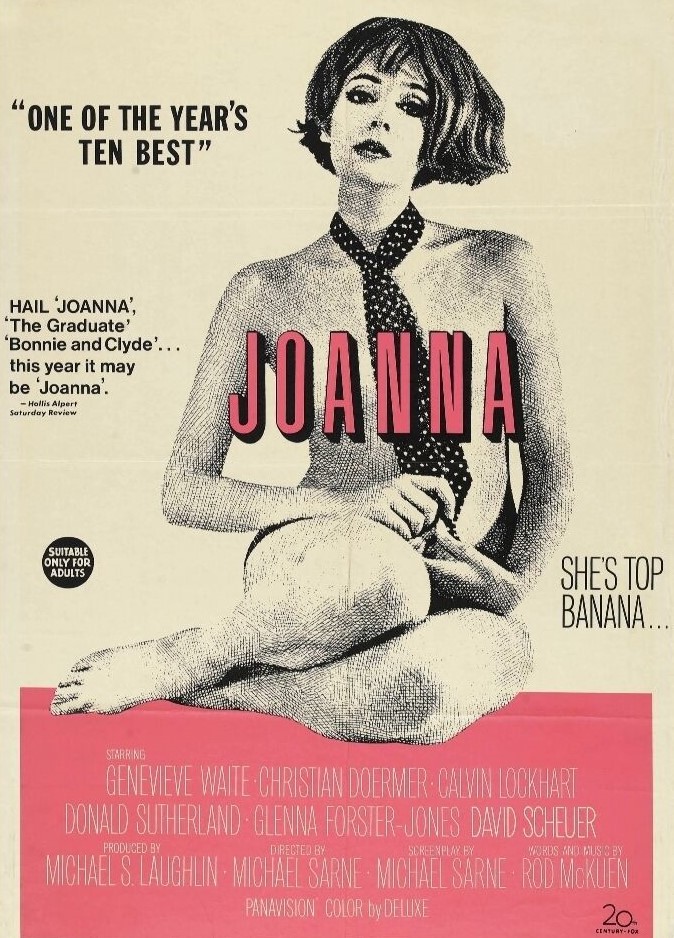
Joanna (1968) **

Mike Sarne (Myra Breckenridge, 1970) was one of those talents who ran away with himself, artistic notions indulged by the industry, until he was exposed as having little to say. Joanna is pretty empty of everything except style. And that wouldn’t be so bad if it was consistently stylish or showed a genuine flair for the visual image beyond a woman bathing in a lily pond or chasing an ambulance through a park.

And, of course, it’s never a good idea to park your inexperienced girlfriend upfront and center of your debut feature. Genevieve Waite, a model in the Twiggy fashion, had a thin, whiny baby voice, and lacked the skill to suggest any depth to the titular heroine.

The film stands up today as a shrine to misogyny, for the way in which, in the name of emancipation, women were exploited by men. Sexual freedom, bouncing along from one man to another, is the theme. “All women gained from emancipation is the privilege of being laid,” points out one (male) character. Freedom is expressed as lack of commitment. It’s kind of odd to hear young trendy men going on about commitment and expressing reservations about a flighty lifestyle, but it’s just as if the male authority figure had simply skipped a generation and was determined to keep women in their place.

Joanna, arriving from the countryside laden down with pots of home-made jam, flits through the Swinging London scene, exploring her artistic side through attending an art studio, occasionally working as a model, but more likely living off men, who are as likely to be married, and even then with another woman on the side.

She flits between artist Hendrik (Christian Dormer), nightclub owner Gordon (Calvin Lockhart) and wealthy dying toff Lord Peter Sanderson (Donald Sutherland) with a yacht in Morocco who surrounds himself with talented people because he lacks any talent himself. We don’t learn much about Joanna except her father, whom she fantasizes about cutting his throat, is a powerful enough magistrate that he can intervene when coppers are causing her boyfriend grief.

The other theme explored is racism. Gordon, a Sierra Leone native but a tax-paying British resident for eight years, is subjected to some racial abuse and later given a beating. That’s given more prominence than the miscegenation that would the following year (in 100 Rifles) attract so much controversy.

Lacking a strong narrative – mostly it’s people sitting around talking or getting into bed with each other – the film mostly hangs on a series of fantasies. Any time a new character appears, Joanna has the habit of spiriting them into a fantasy. Gordon’s sister is transformed into a maid in an English country house, Gordon becomes a Regency hero, the minute someone says sex can get you anything you desired even an elephant, lo and behold there’s Joanna sitting atop an elephant.

There’s a self-consciousness that this film can’t quite shake, the idea that somehow Sarne is holding a pillar up to society when in reality it is more a reflection of his own fantasies. The best scene comes at the end when the entire cast sings the theme song along a railway platform. The song, with no sense of irony, rhymes “top banana” with “Joanna.” And, of course, would you believe, this was all a film, director and cameras appearing at the end.

Whimsy is piled upon whimsy and that’s not enough to sustain the film. Waite offers very little except bounce, Donald Sutherland (The Split, 1968) – now coming up on 200 screen and television roles – is sorely miscast. Calvin Lockhart (The High Commissioner, 1968) brings more to the table, a polished performance that avoids the temptation to go too American. Sarne wrote the screenplay.

It’s not as bad as most films that get two stars from me but for the life of me I can’t see how it honestly earns three stars. You can sample it for free – or watch it all the way through – on Youtube.

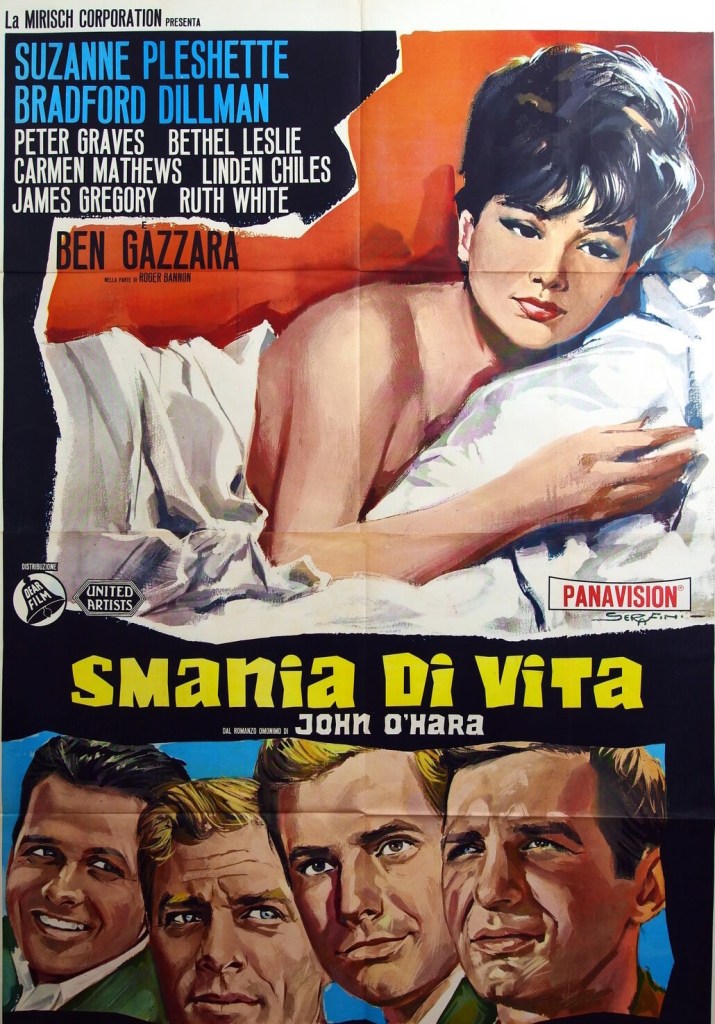
A Rage To Live (1965) ***

There was one in every town: a woman, rich (Sanctuary, 1961) or poor (Claudelle Inglish, 1961) or in between (Butterfield 8, 1960), with a predilection for sex. There were several men in every town, queuing up to take advantage. The woman was inevitably a shameful creature, the men the envy of their peers. You don’t have to look further than Frank Sinatra’s tom-catting in Come Blow Your Horn (1963) or Omar Sharif as the romantic star of the decade with two women in tow in Doctor Zhivago (1965) for an idea of the double standards in play. Welcome to hypocritical Hollywood.

Grace (Suzanne Pleshette), father dead and stuck with a domineering mother, finds escape and fulfilment in sex, and just to give hypocrisy a final tug discovers that while boyfriends are keen to help her explore such physical needs, they take the hump when they discover they might not be the first – or the only. Parents, naturally, are appalled, and discovery of Grace’s antics – and she’s not particularly particular, a passing waiter will do – leads her mother to collapse.

Having confessed to potential husband Sidney (Bradford Dillman) that he will not be marrying a virgin and almost bursting with gratitude that he is willing to overlook her behavior, Grace becomes a farmer’s wife and then a happy mother, until construction owner Roger (Ben Gazzara) comes on strong. She might well have been able to have her cake and eat it but Roger, having fallen in love,  reacts badly to being dumped and it’s only a matter of time before her world implodes.

Made a couple of years later, when the independent woman was being exalted, this would have been a different kettle of fish. Here, the boot on the other foot, the woman who picks and chooses her lovers seemed a step too far for that generation.

Before the big trouble begins, the movie does explore, though somewhat discreetly, the almost taboo notion that a woman might just enjoy sex for the sake of it. Sure, Grace likes being wanted and likes being held, but if she was around today, nobody would bat an eyelid if she just came out and expressed her preference.

Less discreetly, the subject of consensual sex comes up, but not as a question of debate, more as a matter of fact, that when Grace says no she actually means yes. There’s a very uncomfortable moment at the beginning when in a Straw Dogs-scene, though nothing like as violent, Grace appears to welcome a rape. Whether this is as bad as it sounds, or is just Hollywood hiding the blush that a woman would not seek out sex but could only discover its pleasures when forced upon her, is hard to say.

Nor is Grace a walking sex machine. She knows enough about men that she only has to put out feelers and any susceptible male will take the bait. And given the restrained times, she’s got no female pal with whom she can discuss her unseemly desires.

Of course, if this was a man, nobody would be batting an eyelid. Sure, once caught, he’d come up with all sorts of excuses, denials, begging for forgiveness, but an audience would give him a free pass. It’s only because this is a woman that it causes ructions. The movie just about gets close to what does make Grace happy and why she needs the thrill of extra marital sex but by that point the melodrama has taken over and there’s little time left for discussion, what with Roger intent on revenge and another lovelorn wife, mistakenly imagining her husband has fallen victim to Grace’s charms, also on the warpath.

Small town constraints play their part, too. Washing your dirty linen in public the worst of all offences. Author John O’Hara, on whose bestseller this is based – and whose other works Butterfield 8, Ten North Frederick (1958) and From the Terrace (1960) explored similar worlds  – knows only too well that while wealth brings freedom and privilege it comes with chains attached.

And there’s some interesting role reversal, an illicit lover falling in love with a married person normally a starting point for a movie to explore happiness and its opposite rather than being the one act Grace will not tolerate in a lover, she wants strings-free sex, not anything with encumbrance. While Grace would like to act like a man, and has the wealth to shield herself from the worst of the fall-out, as a mother she is extremely vulnerable, and in this particular era could risk losing her child if seen as maternally unfit.

While lacking the sexual combustibility of Elizabeth Taylor or Lana Turner or other Hollywood heartbreakers, Suzanne Pleshette (Nevada Smith, 1966) gives a decent enough performance especially when it comes to her straightforward attitude to sex, aware she might be causing upheaval, but finding it impossible to ignore desire, or imagine a life in which that does not play an impulsive part.

Bradford Dillman (Sanctuary) has less room for character maneuver and is mostly called upon to suck it up. He comes into his own in the movie’s latter stages when bewilderment at betrayal and public humiliation clashes with continued love for his wife. Ben Gazzara (The Bridge at Remagen, 1969), trademark leer and smug face kept in check, has a showier role especially when the violent aspects of his character explode.

Director Walter Grauman, while better known for war picture 633 Squadron (1963), had just come off another picture dealing with female trauma (Lady in a Cage, 1964) and does quite a decent job here, the camera intensely focusing on the leading actress and then as the tragic outcome unfolds drawing away from her. There’s one great piece of composition. He had used tree branches and the countryside to frame Grace and Sidney at the height of their love. And he does the same again when Grace is abandoned.

Asks some difficult questions without quite getting to grip with the real subject of female sexuality. There was a sense that Hollywood was just on the cusp of accepting the independence of women, but didn’t want to go the whole hog just yet, because, apart from anything else, where would it leave the guys?

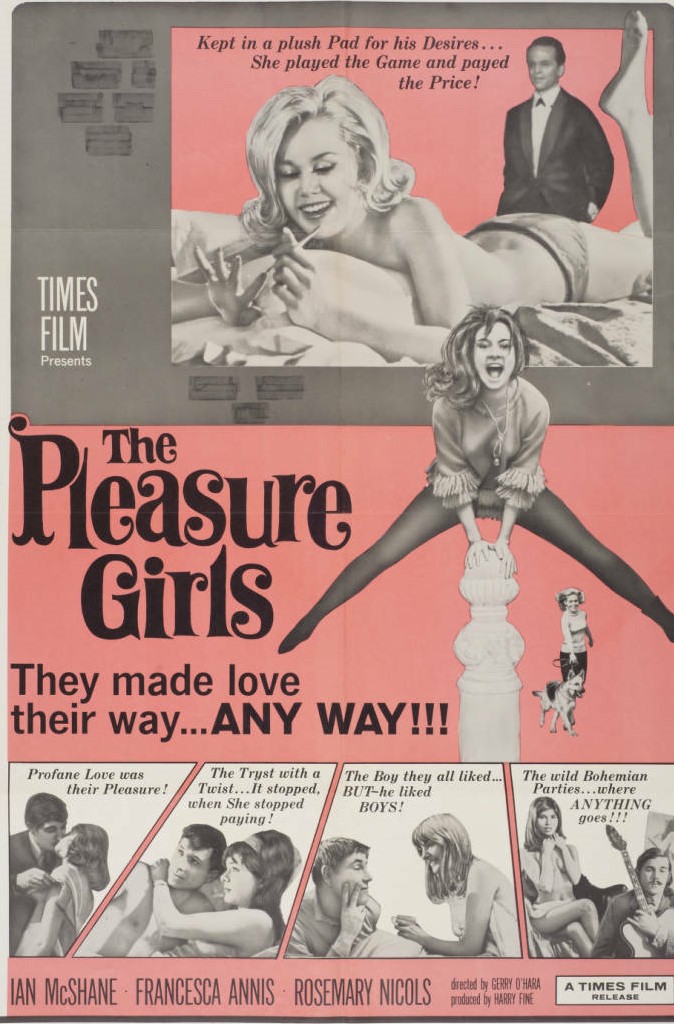
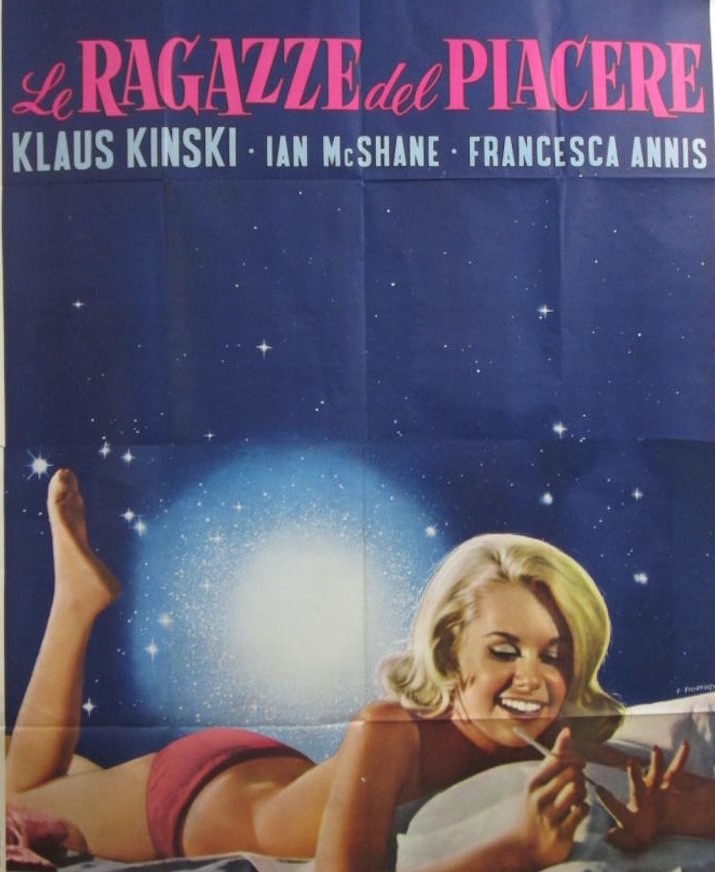
The Pleasure Girls (1965) ***

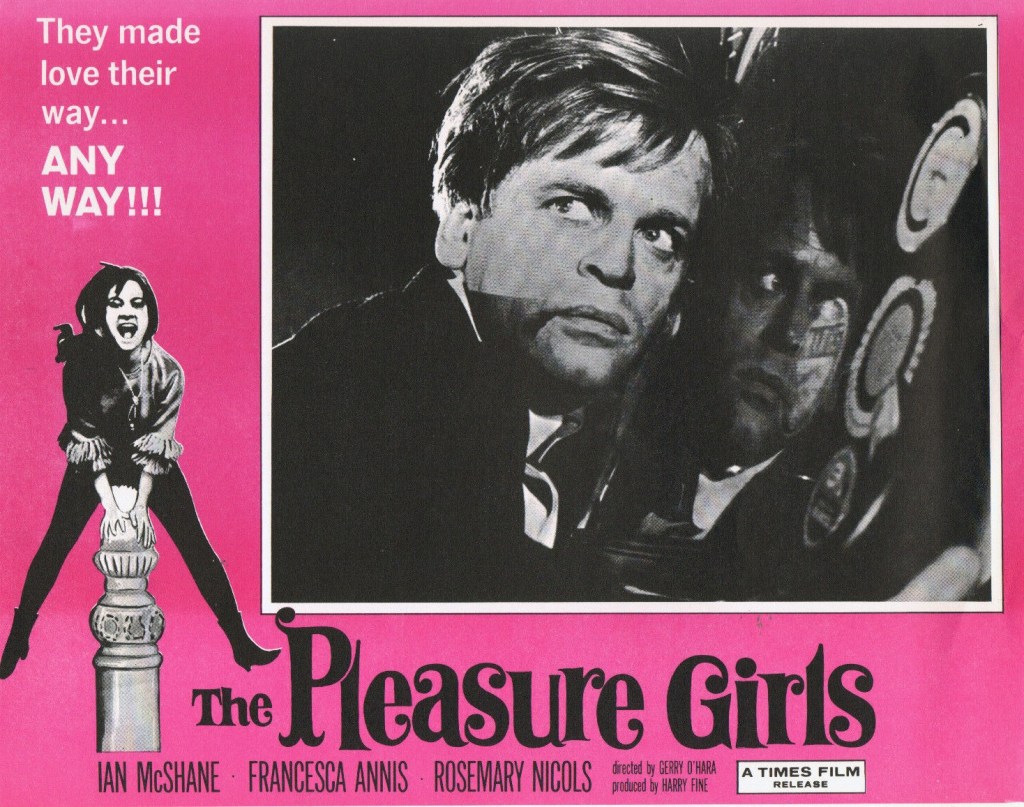
Klaus Kinski and The Pleasure Girls. What depraved mind dreamed up that concoction?

In reality, given this is early onset Kinski, before he was a fully-developed beast, and because it just precedes the British censor throwing off his shackles to accommodate the likes of Blow Up (1966) and The Fox (1967) it’s pretty tame stuff.

Klaus Kinski – what more did any B-picture of the decade need?

The girls might parade in night attire, and, should they happen to sleep in the nude, flash a bit of less rude skin, but that’s as far as it goes although at least couples are permitted to share a bed unlike the U.S. where that was outlawed by the Production Code (hence, in case you didn’t work it out, why there was so much frolicking via censor loopholes such as the outdoors or in the surf a la From Here to Eternity).

And you might find it hard to believe that John Wick’s Ian McShane has been a star for nearly half a century. Though here on the shifty side here and a shade fresh-faced his trademark cynical eyebrow is perpetually raised. He’s one of the suitors of a posse of girls sharing a house in London. A year later and a photographer like him would have had girls throwing themselves at him rather than primly trying to hold onto their virginity.

A weekend of drama awaits model wannabe and suburban lass Sally (Francesca Annis) on her arrival at the house, a whirlwind of parties beckoning, though drugs and booze in little evidence. Among her flatmates glamorous Dee (Suzanna Leigh) is mistress of slum landlord Nikko (Klaus Kinski) and while happy to be wined and dined and presented with jewellery,  fur coats and cash, draws the line at being put up in an apartment. Compliant Angela (Anneke Wills) is enmeshed with unscrupulous gambler Priddy (Mark Eden).

While there are plenty good-time girls to hand in casinos and there is some discreet nudity at a party it’s not exactly high-end stuff what with scenes set in launderettes and street markets and girls cutting themselves shaving their legs. And while proclaiming himself sex-mad, Keith (Ian McShane) is rather more romantic than he would like, prepared to wait for Sally, even while spouting self-conscious lines like “surely every girl wants you to want to even if she doesn’t want to,” the kind of hypocritical male double standard of the day.

The Sally-Keith relationship doesn’t get much beyond will she-won’t she so the real drama takes place in the lives of Dee-Nikko and Angela-Priddy and Dee’s very outgoing brother Paddy (Tony Tanner). Nikko collects debts with the help of thugs and an Alsatian, while Priddy sells his girlfriend’s precious brooch.

There’s more violence than sex. One man beaten up and tied to the hood of a car to be whipped with a belt. Another is tied to a chair and hung out a window. And, for the time, one man’s homosexuality is unusually tenderly expressed while the prospect of a career being more attractive than marriage is given a fair airing.

It’s surprisingly well acted, all the characters believable with enough development twists to keep you interested, and of course it’s not the degrading or unseemly world the posters would have you believe although in a pre-Pill world the dangers of unprotected sex are only too obvious.

Producers Tony Tenser (later founder of Tigon) and Michael Klinger (Get Carter, 1971) had made their reputations on exploitation pictures like the previously-reviewed London in the Raw (1964) and this attempts, at least for marketing purposes, to go down a similar seedy route, but is confounded by a storyline that is more Peyton Place than Bad Girls Have Sex.

It’s more an opportunity for rising stars to be put though their paces rather than characters put in their place. Ian McShane’s (Sky West and Crooked/Gypsy Girl, 1966) twinkle is never far from view and he demonstrates the charm that will keep him in demand for the next near-50 years. Klaus Kinski (Five Golden Dragons, 1967) is remarkably restrained given his later work, proving he doesn’t have to over-act to make his mark.

Of the others in the talent shop window, Suzanna Leigh (Deadlier than the Male, 1967) makes the biggest impact. It didn’t make a star out of Francesca Annis though Mark Eden (Curse of the Crimson Altar/The Crimson Cult, 1968) had marginally better luck.

Gerry O’Hara (Maroc 7, 1967) directed from his own script.

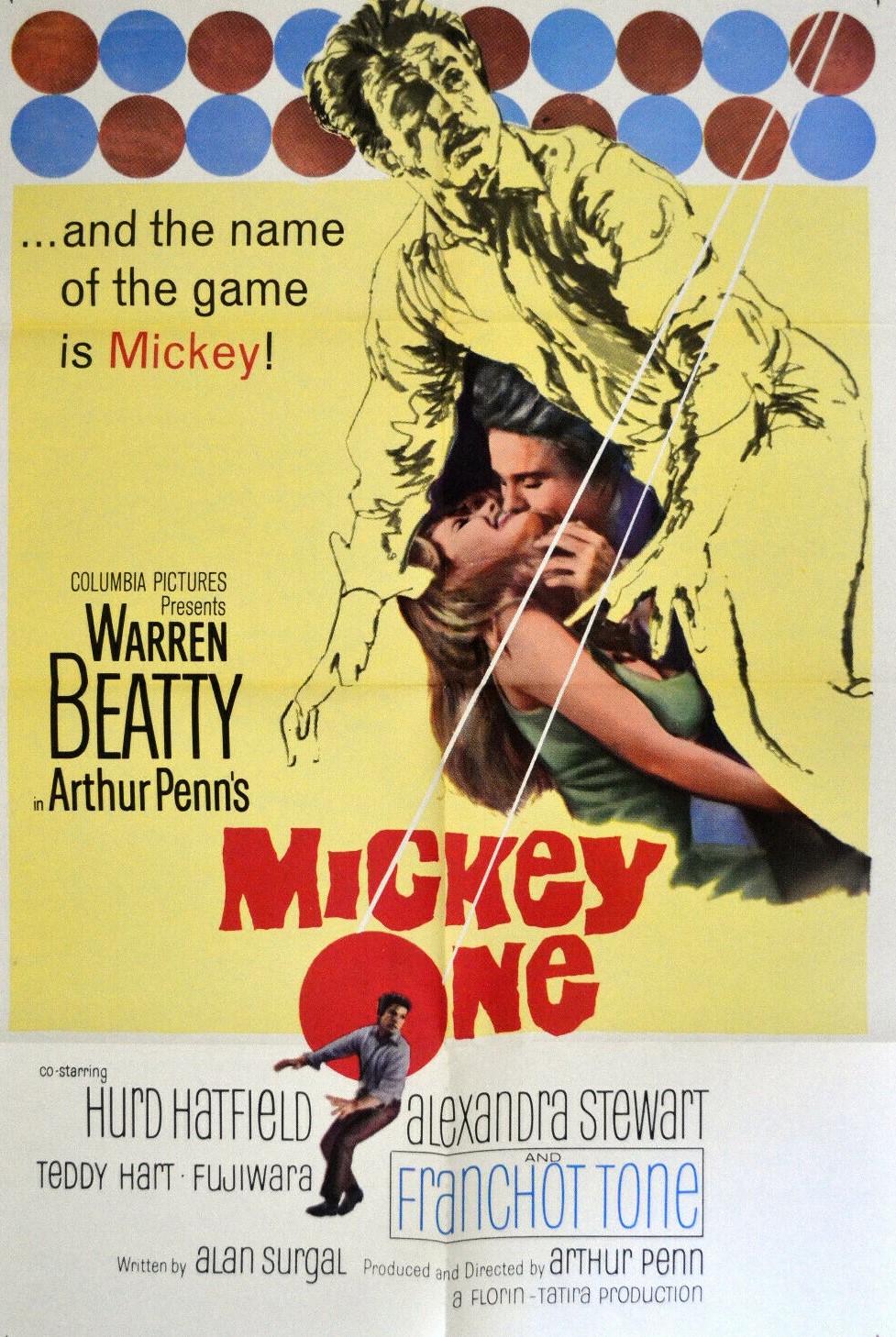
Mickey One (1965) ***

Smorgasbord of paranoia, Kafka and the surreal, set in an American netherworld. Cue trampolines, a mime, what these days we’d call installations, a comic without a decent joke, a wrecker’s yard, organic food, catering kitchens. You could call Arthur Penn (Bonnie and Clyde, 1967) a visionary director just for including some of these aspects. Or you could go for another contemporary word: “random.”

We are pretty used to people being on the run be they innocent of the crime of which they are accused or small-time hoods trying to evade punishment. The notion here is of small-time hood Mickey One (Warren Beatty) fleeing Detroit for Chicago but with no idea for what crime, though the list could include gambling debts and stealing a bigger gangster’s moll.   

A misleading tagline if ever.

His situation is spelled out often enough in case you’ve not got the picture. “Hiding from you don’t know who for a crime you don’t know you committed,”  remarks girlfriend Jenny (Alexandra Hay). In a particularly Kafkaesque moment, Mickey espouses: “The only thing I know is I’m guilty – of not being innocent.”

Smart with the words but not so smart with the actions. Even though he can just about get by  as a kitchen wash-up, he gets sucked back into his former profession of stand-up comedian, hardly the most anonymous of jobs. So he is all angst-on-fire when success in some low dive, keeping clients entertained between strippers, attracts interest from a classier joint which naturally sees marketing the new prospect as part of the deal.

Some of this paranoia might just be in his head were it not for being stalked by car-crunching cranes in the wrecker’s yard, spotlights on stage (though you could point out that’s an occupational hazard) and a silent rag-and-bone man.

It says something for the acting of Warren Beatty (Kaleidoscope, 1966) that this is in any way believable. The fast-living lothario of the opening sequence, with gals and booze aplenty, segues into a bum without missing a beat. His paranoia is consistent and he makes some attempt to find out what the heck he has done to end up this way, though it has to be said there’s no actual evidence of pursuit, just the fear of it, and the notion that he owes somebody maybe twenty grand or that the lass tempted into stripping for him was stepping out of line.

Pretty good plug from a top critic and an arthouse opening – what else could you ask for?

His breadline living is realistic, too, hitching a ride on a train, bumming food from a mission, sleeping among bags of rubbish, a world where down-and-outs steal the clothes from the back of other vagrants and his job is scraping leftover food from plates in a cafeteria. And there’s always someone at the scam, his landlady dumping another tenant (Jenny) in his tiny apartment.

Maybe less realistic that club owners are lining up to hire him when there’s nary a laugh in his schtick. The biggest joke is in the casting, some kind of infernal joke on audiences to put the likes of the uber-handsome Beatty through mental and physical torture, albeit that he’s perceived as man of abundant talent and collects with ease women willing to put up with the depressive side of his nature.  

The movie doesn’t quite fit the Kafka mold because being on stage represents freedom and nobody in Franz’s world ever had a sniff of that. And you wouldn’t call it a thriller either. And if it’s a homage to the French New Wave you’d have to watch a stack of French pictures from this decade to work out what it’s mimicking.

And it’s not like Penn’s work is always on this kind of edge, he’s not the David Lynch of his generation. Every top director is permitted at least one turkey, and this would have been Penn’s except critics in the 1990s started to give it the old reassessment treatment, Penn being a big enough name from his other works to have a stab at how this fits into his repertoire/oeuvre.

So, far from being an intolerable mess. Doesn’t quite ask the big questions Penn hopes it does. More of a curate’s egg of a picture, some interesting ideas, and an excellent performance from Beatty. Alexandra Hay (Only When I Larf, 1968) was part of the French connection, a Canadian model who had hit it big in Paris, with roles in French pictures and an affair with director Louis Malle. But actually she’s good, not the kind of submissive woman Mickey has perhaps been used to, but thoughtful and capable of challenging his illusions.

Screenwriter Alan Surgal was not prolific, this being his only movie.

Wild in the Streets (1968) ***

Far more prophetic than you would have ever thought possible in acknowledging the growing power of the young, the pandering of politicians to them, and the unexpected ability of youth to see through politicians and set their own agenda. Plus, Christopher Jones gives the kind of performance that had David Lean rushing to sign him up for Ryan’s Daughter  (1970).

It was prescient, too, of its time, not just the notion that the young could lead the way in opposition to political forces.   

And what top pop star has not believed they could harness their global following for the greater good – Live Aid the classic example – and once you’ve bedded your way through the known female universe and sampled every drug known to man there has to be something else that’s going to grab your attention. And, for once, a movie star makes a very credible pop star.

Max Frost (Christopher Jones), channelling his inner Jim Morrison, is on top of the world, a phenomenon, the biggest thing since Elvis and The Beatles. His rebellious streak emerges at an early age. And where other nutcases would torture animals or pull the legs off spiders or play with matches, he blows up the family car. But he’s something of a statistician and reacts to the notion that there are more young people than old people – 52 per cent of the population is under 25 – by writing a song about it, a song that turns into a protest that segues into a movement.

Aspiring politician Fergus (Hal Holbrook) thinks he can harness what he perceives as a dumb youngster with fans so dumb they will ape his every command. His vote-winning idea is to campaign on a platform of lowering the voting age from 21 to 18, not that revolutionary an idea since ever since American men were shipped off the Vietnam there had been similar calls along the lines of too young to vote but not too young to die.

Max pretends to back him but instead demands the voting age be reduced to 14. This being politics, there’s negotiation, and the compromise is reducing the age to 15. The ever-read Max has songs covering whatever age is agreed.

Bandmember Sally LeRoy (Diane Varsi) is elected and gets a law passed to lower the voting age. Fearing youth and somehow assuming Max will curb their worst excesses, older politicians support his bid for the Presidency (as you may know, anyone in the U.S. can become President even if they lack political experience) but once he gains power he turns on them and forces through a law making retirement compulsory at 30. And goes about, Heaven help us all, doing good, albeit with a dictatorial agenda.

But the fairly straightforward satire, puffed out with endless scenes of public demonstration, works very well, and not just because the power of youth is demonstrated everywhere today, not least among Hollywood mavens who seem unable to make anything that doesn’t appeal to that age group, but because the brain behind the scheme are actually pretty smart. The group is presented as  clever all round, their excessive income down to the business acumen of Billy (Kevin Coughlin) so the band have no chance of ending up penniless, ripped off by everyone in sight. Sally is a former child star so she’s been taken advantage of already and ain’t going to let it happen again.  There’s a clever sting in the tale that takes the campaign to its logical conclusion.

It’s great fun seeing grizzled politicians being outsmarted by Max and his cohorts and for the older population to, unwittingly, get a taste (no pun intended) of what it’s like to be young. Audiences went for this in a big way since it presented an alternative universe, part sci-fi but also with some imminently achievable aims, some of which came to fruition. Hollywood was brought to heel the following year after Easy Rider, only in retrospect anyone realizing that the rescue from box office oblivion of 2001: A Space Odyssey (1968) by spaced-out hippies was a turning point not a one-off.  The voting age was lowered a couple of years later.  These days, of course, nobody needs elected or has to pass a law for changes to be made, and far quicker than if they had to go through the political process. Developments nobody voted for have been forced through by the court of public opinion, though sometimes by the very minorities that were once outside the existing power base.

Christopher Jones (Three in the Attic, 1968) delivers his best performance in what turned out to be a very short career. Shelley Winters (A House Is Not a Home, 1964) gives another scene-stealing turn and on back-up are Hal Holbrook (All the President’s Men, 1976) , in only his second movie, Diane Varsi in her biggest role to date, Millie Perkins (The Diary of Anne Frank, 1959) and an early showing from Richard Pryor.

Barry Shear (The Karate Killers, 1967) directed from a screenplay by Robert Thom (Death Race 2000, 1975).

You could probably go through this ticking off what predictions have come true and it’s more powerful now than it was at the time.

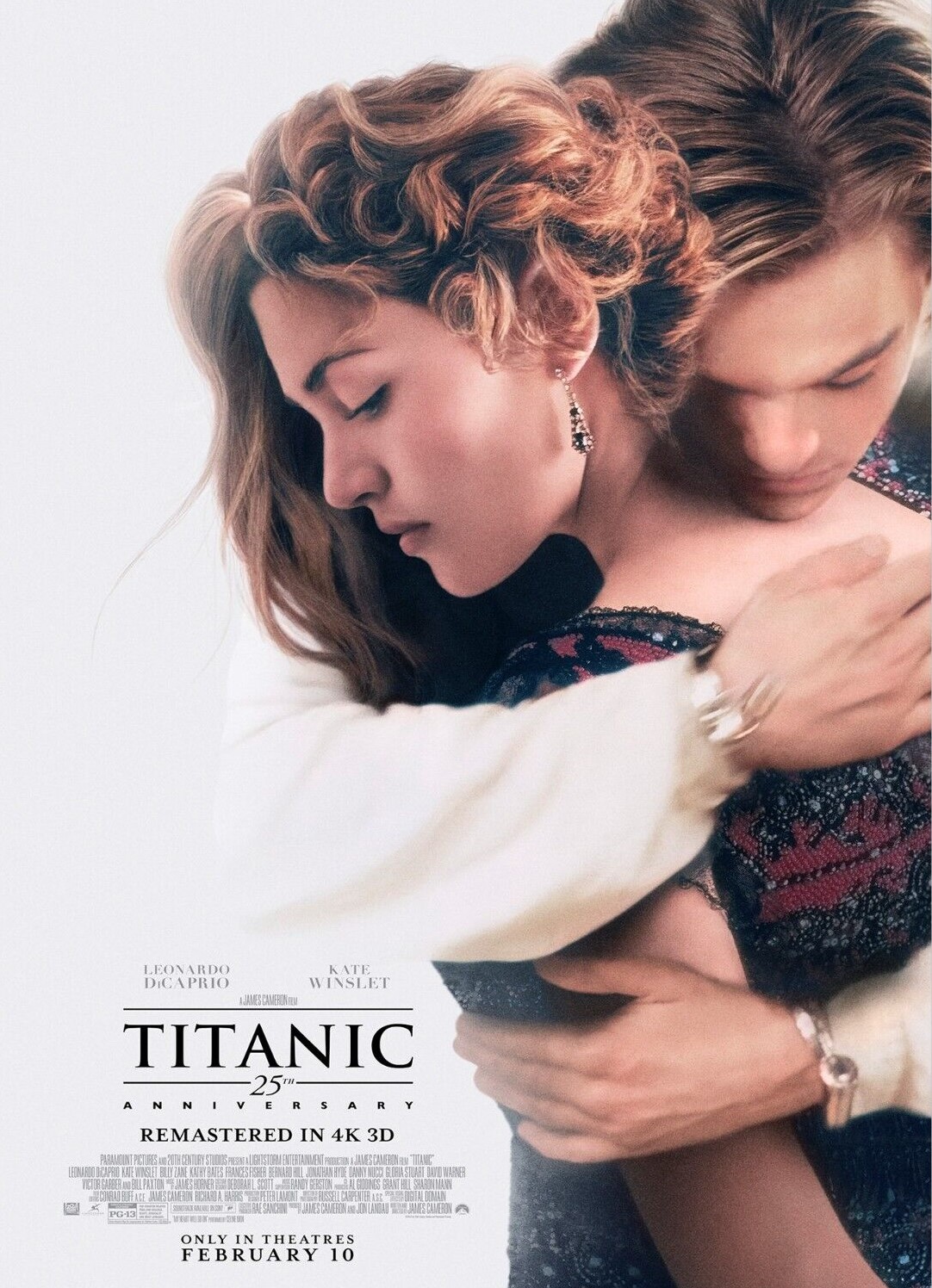
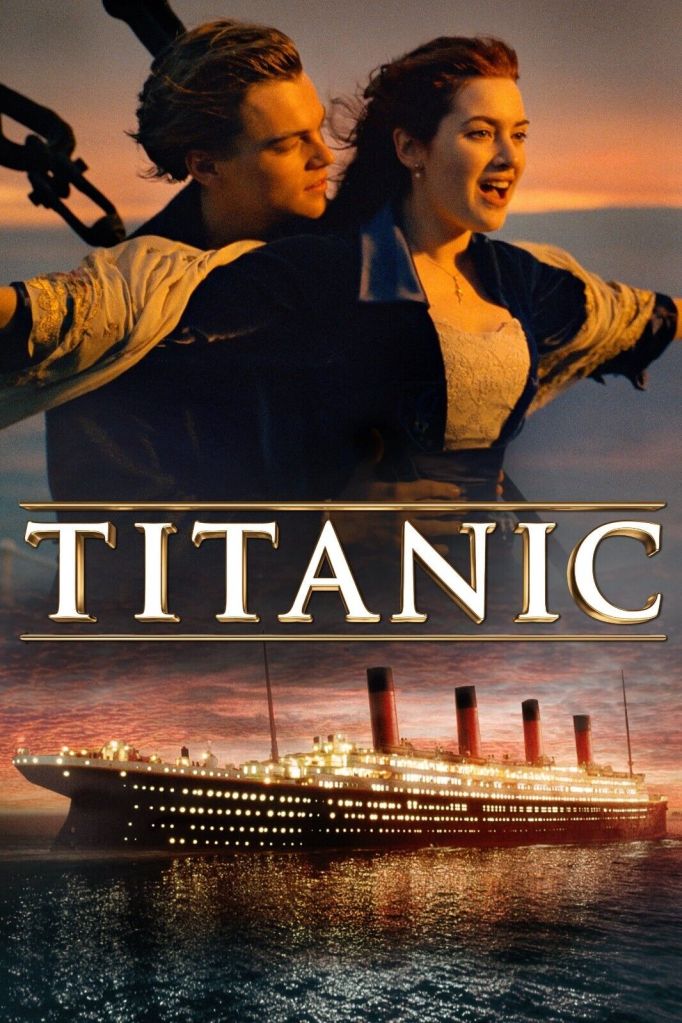
Titanic (1997) ***** – Seen at the Cinema in 3D Imax

You might have thought it the height of Hollywood hubris for James Cameron to assume Titanic could steal the Valentine’s Day crown from Humphrey Bogart-Ingrid Bergman World War Two lovelorn Casablanca (1942). But bear in mind Casablanca had replaced Doctor Zhivago (1965) as the movie’s greatest love story and that, in turn, had superseded Gone with the Wind (1939).

Each followed a similar recipe – cataclysmic event, except Casablanca epic in scope, except Gone with the Wind memorable song,  except Clark Gable introducing relative newcomers, perhaps most of all fabulous screen charisma between the male and female leads. Titanic, of course, has a late twentieth century vibe, more action than drama as the lovers, often pursued, hurtle from one potential disaster to another, and are within a lifejacket and a large enough piece of flotsam of a happy ending.

But where Rhett Butler (Clark Gable) and Rick Blaine (Humphrey Bogart) exhibited world-weary cynicism and Zhivago (Omar Sharif), though his occupation, achieved maturity, Rose (Kate Winslet) and Jack (Leonardo DiCaprio) are little more than blossoms blown on the wind, as innocent as a fresh coat of paint. Jack grows up fast, fast enough to hold his own among the upper class, strong enough to whisk Rose away from a life of servitude to a male ideal.

In some respects, to use the modern idiom, she is the ultimate Final Girl. On several occasions, she rescues him, plunging through the rising torrent to find him and cleave his handcuffs with an axe. She risks far more than he. Vengeful fiancé Cal (Billy Zane) and his ruthless henchman (David Warner) would easily chuck Jack overboard given the chance.

In essence, the story is light. Spoiled brat saved from a half-hearted suicide attempt, Jack embraced by Cal as a means of humiliating him, various attempts to smear Jack, Rose finding a freedom below stairs she never expected, shown a world of opportunity beyond her ken, taking the lead in sexual matters, lightly mocking Jack for blushing at her nudity even as she shamelessly and confidently strips.

And told against the backdrop of a ruthless caste system, where only the “better” people can survive and millionaires see “winning” as the embodiment of entitlement. Cameron holds up a mirror to the supposedly classless America and a world of enterprise where lifeboats are viewed as an obstacle to beautiful design. The two outsiders, Rose’s mother (Frances Fisher) and Molly Brown (Kathy Bates) are opposites, the latter, by dint of inheritance pushing her way brusquely into society, the former meekly trading her daughter for a life of privilege.

And the romance is given a twist when cold-blooded Cal proves to be as obsessed by Rose as Jack, the several times offered safe passage turning it down to pursue her, and not in the end as an object to be collected but as the subject of his restrained passion.

But you would need extraordinary acting to keep you glued to the screen when there were so many other astonishing visuals and even at the distance of a quarter of a century the power of DiCaprio and Winslet just blows you away. Sure, there is a bit of will she-won’t she, but once we’re past that it’s romance as a breath of fresh air, DiCaprio mixes devil-may-care with adoration, Winslet bristles, succumbs and then takes the lead, the sheer exhilaration of it all the bulwark against the drama of the slowly sinking ship.

It’s a fabulous scenario, Cameron careful to allow other elements to float into place, the officers assuming sacrificial stance, the hunt for the mythical jewel that kicks off the tale and provides meaningful coda.

I’m sure it helped that DiCaprio and Winslet were mere rising stars, otherwise I doubt if someone with more box office clout would have stood for the endless hours/days/weeks in freezing cold water (I don’t think you could heat it up even in a studio setting) and without their genuine travails it would not have worked so well.

It’s worth noting that DiCaprio went on to become – along with Brad Pitt – the last of the genuine stars and that he forsook the easy route of romantic lead for more interesting and complex characters and embraced an association with Martin Scorsese that took him to darker places than the likes of Paul Newman or Harrison Ford ever dreamed. Winslet, too, has enjoyed a memorable career, perhaps entranced too often by the arthouse, but you can hardly argue with one Oscar and six nominations.

On a personal note, I realised I had passing acquaintance with two of the actors. When I worked backstage at the Citizens Theatre in Glasgow, I would often come across Jonathan Hyde (the arrogant Ismay). One role he played quite astonished me. Not so much the role (and I can’t remember what it was) but, if you like, the preamble. When audiences entered the theatre they were faced with the sight of Hyde sitting on stage in full costume and in character, as if this was Method Acting taken to an extreme, waiting for the play to begin.

I was at university with Ron Donachie (the master at arms). We both studied Drama at Glasgow University. This course was never intended to produce actors, and mostly it set students on a path to theatre management and the like, including a friend Anne Bonnar who went on to head up Creative Scotland. But, of course, it was always a route into acting if that was your ambition. Ron Donachie and another friend Duncan Bell (British television series Heartbeat) took the opportunity. Needless to say, my stint at the Edinburgh Festival Fringe was enough to convince me that acting was not my forte.  

Bank of Dave (2023) *** / No Stars

Take One: A quite superlative courtroom scene sets the tone for this David vs. Goliath clash of a Burnley minibus dealer taking on the might of the British Establishment. In truth, my heart had sunk at the stereotypical opening – posh London lawyer sent “oop north,” his first encounter with natives unintelligible, his client first seen in a pub doing karaoke. And set against the background of the financial crash caused by arrogant and inept big banks, the stall is set out too obviously.

But, gradually, it acquires a different tone, of two outsiders fighting the system, less-than-high-flying corporate attorney Hugh (Joel Fry) trying to gain acceptance in a working-class town, working-class millionaire Dave (Rory Kinnear) battling to gain a foothold in banking circles to put forward his controversial notion of a new bank – the first in 150 years – that dealt only with small businesses.

There’s a toe-curlingly awful romance as Hugh can’t quite put into words his feelings for Dave’s niece Alexandra (Phoebe Dynevor), a Cambridge-educated NHS doctor, and she can’t quite help him along. Banking guru Sir Charles (Hugh Bonneville) has Dave in court on a trumped-up charge. Anyone Hugh trusts in the City does the dirty on him while locals he distrusts are confusingly helpful.

The Banking Powers-That-Be make up the rules as they go along, leaving Hugh with a £12 million shortfall to fill before he can get up and running.

So there’s a lot of ducking-and-diving on both sides, born publicist Dave constantly coming up with entrepreneurial wheezes, the opposition attempting to thwart him at every turn. Business pictures are a hard sell unless the product is drugs or sex, so it’s no surprise this isn’t about setting up a business, even one with righteous credentials (i.e. helping the little guy), but rather about poking a finger in the eye of Big Business, Big Banking, Big Government and anything else that isn’t Little (i.e. good).

Along the way it turns into a warm-hearted feel-good movie with characters you might recognize and situations you might appreciate and although the ending is a tad predictable I was surprised how moved I was. Rory Kinnear (Men, 2022), rarely given anything more than a supporting role, shines as the larger-than-life Dave and Joel Fry (Jasper, if you remember, from Cruella, 2021) goes from romantically inept to courtroom genius and back again while Bridgerton graduate Phoebe Dynevor has a slow-burner of a role. Debut feature of Chris Foggin from a screenplay by Piers Ashworth (Fisherman’s Friends, 2019).

At the high end of streaming material in that it was an enjoyable watch and no complaints about a big film which should have been seen in the cinema.

Take Two: But then I wanted to learn more about Dave and his banking initiative. And lo and behold very little of what you see on the screen is true. The big court case is a figment of the writer’s imagination, which means that however low Big Banking stooped it didn’t stoop this low. And so, it transpired, was the need to raise £12 million. And so was the fundraising concert by Def Leppard and so, too, I guess was the odd million thrown into the kitty at the last minute by Hugh to get Dave over the line.

So, much of Bohemian Rhapsody wasn’t true either and I was always in awe of the bar scene in A Beautiful Mind (2001) in which asking girls to dance is used to demonstrate the Zero Sum theory on which mathematician John Nash made his name, rather than some more complicated explanation. And it’s true, Dave was taking on the Establishment and nobody had set up a bank in 150 years and the financial industry was in crisis and you could ask who were these people to judge who was fit to run a bank when these were the same banking bosses who had squandered gazillions on ill-advised loans. And I’m sure it was a hell of battle. That he didn’t, in fact, win, because the bank Dave did set up is not a bank in the financial meaning of the word.

And, of course, it highlighted the inequities in a system that can reward with bonuses bankers who made a whopping loss.

So I’m really in two minds. I enjoyed it at the time but that enjoyment quickly palled when I realized it was all invention. I just wondered if there was a better and more incisive way to skewer the Big Banks than this.

On Netflix.

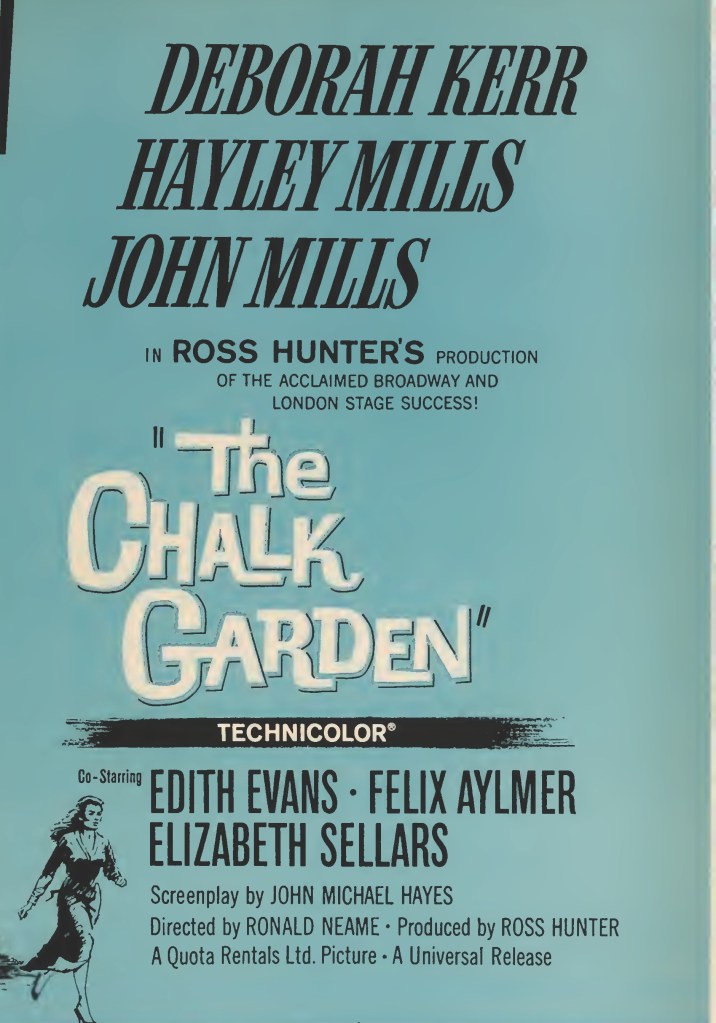
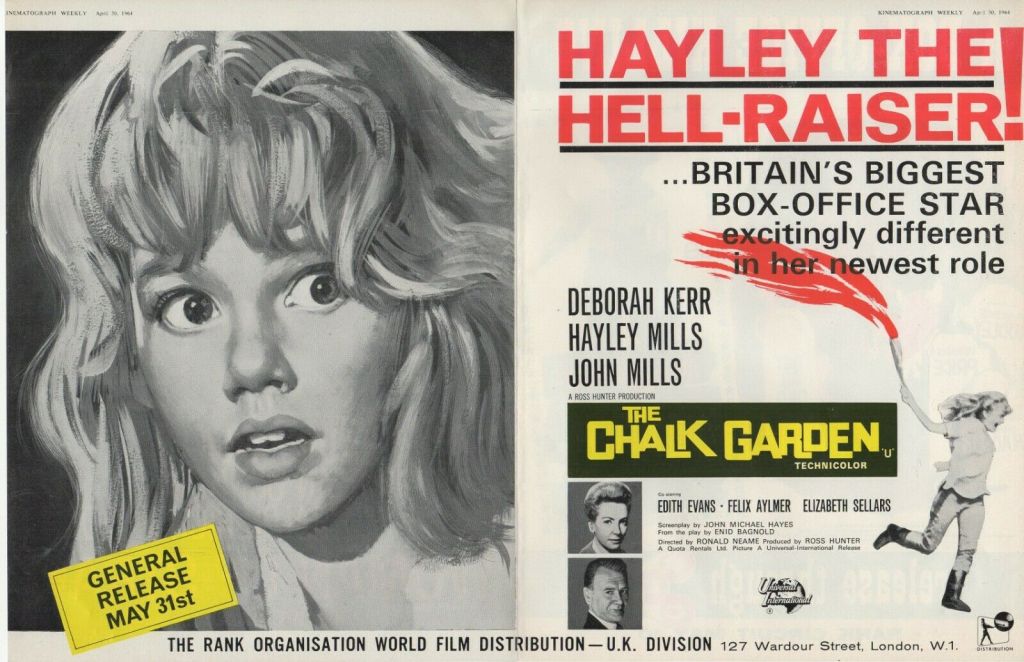
The Chalk Garden (1964) ***

You couldn’t make a movie like this now because (plot spoiler, I’m afraid) even the dottiest of old ladies would make at least a better attempt at collecting a reference from a prospective employee for fear she might be hiring someone disreputable. Though I doubt if many employers would expect a governess to turn out to be a murderess.

That this movie chimes with a contemporary trope – the criminal wanting to prevent others from following in their footsteps – makes it far ahead of its time. Made today, of course, the unruly child rather than merely threatening to unleash her arson impulses would probably have burned the house down.

So it’s more a drama of manners, if you like. Very presentable but clearly down-on-her-luck Miss Madrigal (Deborah Kerr) is taken on by Mrs St Maugham (Edith Evans) as governess for her grandchild Laurel (Hayley Mills) because nobody else wants the job. Laurel’s outrageous behavior has sent a score perfectly well qualified ladies scurrying. Madrigal is hardly fazed by anything Laurel can get up to.

But the child is clearly suffering abandonment issues, her beautiful mother Olivia (Elizabeth Sellars) having gone off with another man. Grandmother incites grandchild to hate the mother. But Olivia’s maternal instincts have kicked in and she wants her child back. While Madrigal can deal with Laurel’s tantrums she is less fortified against the child’s inveterate snooping. Finding a mysterious suitcase leads Laurel to fantasize about Madrigal’s past.

Mostly the film is a four-hander, butler Maitland (John Mills) playing a significant role in proceedings, not least in his effortless management of the wild child. Quite why a such a pragmatic and assured gentleman should end up in this remote mansion is another mystery and thankfully there is no attempt made at playing up the cliff-top location in a suspenseful manner.

Mrs St Maugham is imperious but not entirely practical, either in setting child against mother or in trying to grow flowers in such chalky soil, though Madrigal appears to have sufficient horticultural knowledge to set her straight on the latter and attempt to intervene on the former.

There’s a deadline of sorts. Olivia is coming to remove the child. Whether she goes willingly or not doesn’t matter. Madrigal sees her role as trying to prepare a child to love her mother and be more grown-up than the adults around her and forgive her.  

Madrigal’s guilt unnecessarily causes her to reveal that she had been jailed for murdering her stepsister, having been as resentful and jealous of the girl as Laurel currently is of her mother. Mrs St Maugham had called on old acquaintance Judge (Felix Aylmer ) for legal advice on how to prevent Olivia getting the child. He was the presiding judge in Madrigal’s case. Imagining he had not forgotten the trial – which of course he has – she feels duty bound to blurt out the truth before she is humiliated.  The confession helps Laurel realise how dangerous a path she is on and pushes her towards reconciliation rather than revenge.

It has all the making of a well-made play which is hardly surprising since it is based on Enid Bagnold’s Broadway success, at one time mooted as a film to star Joanne Woodward and Sandra Dee. So it moves along in the traditional three-act manner, plenty space given to establishing characters, introducing the undercurrents and leading to revelation and resolution.

So, mostly, it depends on the acting. Luckily, it is excellent. This was Hayley Mills in transition, far removed from Disney saccharine of The Parent Trap (1961) and about the same distance from the full-blown adult bottom-baring of The Family Way (1966). She projects a great deal more torment than in either of those films and comes across as believable, not exactly a young hoodlum but left to her own devices and starved of parental love only a matter of time before she would commit a crime of some kind.

Deborah Kerr hadn’t made a film in three years but her screen persona had shifted from the passionate – From Here to Eternity (1953), An Affair to Remember (1957), The Sundowners (1960) – to the repressed. Her spinster introduced in The Innocents (1961) had a great deal in common with her spinster of The Night of the Iguana (1965). But this is a different kettle of fish. Here, she exudes capability but with a self-awareness that undercuts such confidence, trying to keep a lid of emotions she struggles to handle.

John Mills (Tunes of Glory, 1960) casts a sardonic eye on the household while Edith Evans (The Whisperers) portrays a sorely wounded matriarch. Director Ronald Neame (Gambit, 1966) cleverly opens up the play, using the cliffs, gardens and rocky beach to considerable effect, but keeps the drama taut. John Michael Hayes (Nevada Smith, 1966) produced a workable screenplay.

Apologies for giving away the story, a good watch more for the acting than the twist.

Lilith (1964) *****

You couldn’t make this now. What top-ranked actor would be willing to play a character who takes sexual advantage of a vulnerable young woman? You’d find it even harder to get a marquee name to play a female with paedophiliac tendencies, predatory sexual instincts and thinks it fine to drive a lovelorn young man to suicide.

That it was feasible back in the day was largely due to the restraints imposed by the much-maligned Production Code. Most of the issues are delicately probed, the problematic themes only touched upon, so that the result is quite amazing, the director turning to the lyrical,  rendered by its intensity a metaphor for internal conflict.

War veteran Vincent (Warren Beatty) takes a job as an occupational therapist at an upmarket mental institution, the kind that looks more like a country club or grand hotel with extensive manicured grounds. Few of the inmates are of the type found in the normal hospitals for the insane, the worst cases a woman with a maniacal laugh and another who treats a doll like a baby, but he is warned insane women are more “sinister” than crazy men.

One of his charges is the withdrawn Lilith (Jean Seberg) whom he gradually coaxes out of her shell, soon believing that it is his innate skill that brings about the possibility that such a high-risk individual could possibly achieve something akin to cure, or at least a greater degree of normality. You can hardly blame him for missing the obvious – that Lilith is using him – for the young woman is every inch the winsome innocent seeking guidance from the more mature responsible male.

It’s mostly shorn of obvious metaphor but there is one scene, compelling in itself, where Vincent plays the knight on horseback, complete with lance, winning a contest of skills for his lady, that completes his idealisation in her eyes. But he is already halfway there, with unexpected dexterity he frees her hair caught in loom, the kind of scene that in an otherwise more romantically-inclined movie would be the meet-cute.

And this isn’t one of those films about a madwoman in an attic or an apparently sane person turning demented. Instead, considerable time is spent analysing the condition of the schizophrenic, either through clinical lead Dr Lavrier (James Patterson) expounding his theories or through Vincent discussing individual patients with his boss Dr Brice (Kim Hunter). The idea of opening up a new realm to an audience is crystallised in one scene where Lavrier explains that even spiders go mad, resulting in asymmetrical webs rather than the typical formations to which we are more accustomed.

And by using one of the oldest tricks in the book, an inexperienced young man negotiating a new world, disbelief is suspended. But just when we think we are seeing everything from Vincent’s perspective, we are thrown into a heightened intensity linked to the lyrical – a river, a waterfall – the madness of ecstasy, what used to be called rapture, as Lilith stares and stares at nature.

But there are warnings about the personality of both characters. Lilith bears a startling resemblance to Vincent’s dead mother. He has difficulty committing, lack of communication while away at war resulting in girlfriend Yvonne (Anne Meacham) marrying someone else.

And there is plenty that is disconcerting about Lilith that only the besotted would overlook. She leads on lovelorn Stephen (Peter Fonda) to potential disasters he cannot foresee. Angry at Vincent, “I show my love for all of you and you despise me,”  she seduces vulnerable older patient Laura (Jessica Walter). But the worst aspect of her character is that she perceives no boundaries to behavior. She exhibits inappropriate attitudes to young boys, inviting one to rub his finger along her lower lip.

However, for most of the film the skilful direction of Robert Rossen (The Hustler, 1961) has you rooting for the young lovers. Even while never falling back on the cliché of the doctor-type saving the ill person, there is enough in Vincent’s earnestness and Lilith’s innocence to make that a distinct possibility, were it not for the other discordant elements of her character.  The picture is wrapped in natural sound – the river, waterfall, a flute playing mournful tune, ping-pong ball hitting bat, reeds or branches parting, rain, footsteps, a ticking clock, and the bulk of the music emanates from Stephen’s radio. And then he will twist it slightly, reflections are seen upside-down in the river, or a shot of the waterfall is held for too long, the sound of water increasing, or Lilith standing in the river bends down to kiss the surface, or at a picnic she eats a leaf irrespective of whether it might be poisonous.

Usually, when you get so much detail it’s a surfeit, and ends up drowning the viewer. But that’s not the case here. Either it builds or expands. And there is even a throwaway that mocks the notion of containing madness in an institution. The best, most revealing, line in the  picture is not spoken by either of the two principals, but secondary character Yvonne, seen only at the beginning and end. When for unspecified reasons Vincent turns up at her house and her husband (Gene Hackman) leaves them on their own, she says, “I told you I’d never really let you make love to me until I was married,” (pause), “well, I’m married now.”

Jean Seberg (Moment to Moment, 1966) is just superb, coming across as a young woman entering adulthood full of fears and insecurities, only suggesting the darker side of her character, and never giving in to the temptation of overplaying. Warren Beatty (Kaleidoscope, 1966) can’t quite match her for subtlety or kick those acting mannerisms – lowered head, looking away – but his stupefied expression towards the end as he realizes just what he has taken on is priceless.

There’s an outstanding cast of rising stars. Peter Fonda (Easy Rider) as the preppy insecure victim is excellent while Jessica Walter suggests the qualities that would make her the prime candidate for the femme fatale in Play Misty for Me (1971). Gene Hackman, in his movie debut and still working on his trademark chuckle, provides early evidence of his immense talent.  

Robert Rossen, who wrote the screenplay (from the novel by J.R. Salamanca) and also produced, couldn’t have wished for a better epitaph. This was his final film in a relatively short career – he only directed 10 films.

Despite contemporary reservations about the content this is a beautifully observed piece and well worth a look.

Discover WordPress

A daily selection of the best content published on WordPress, collected for you by humans who love to read.

The Atavist Magazine

by Brian Hannan

WordPress.com News

The latest news on WordPress.com and the WordPress community.