Deus (2022) ** / Watcher (2022) ** – Seen at the Cinema

Luckily I had been fortified in my weekly cinema outing by the wonderful Living (2022) before entering dudsville for this double bill. Both Deus and Watcher have all the hallmarks of direct-to-DVD productions which have, to use the old parlance, “escaped” into cinema distribution.

I’m probably a bit rusty about the cost of making the kind of giant spacecraft shown in Deus, billions of dollars surely, so am assuming that big projects like this will encounter budget overruns which would account for the rationing of electricity on board, resulting in the  murky lighting. And there’s not an alien in sight unless you count the robotic crew who speak in strangely monotonous tones.

Like most sci-fi films this involves a crew on a mysterious mission awaking from hibernation to investigate a distant object, in this case a sphere. The title assumes this might be about someone playing God and so it transpires, taking a leaf out of The Avengers: Infinity War (21018) playbook with a plot to wipe out three-quarters of the Earth’s population in some kind of eco good deed.

Not only has an evil genius Vance (Phil Davis), who appears only as a hologram (natch), gone to all this bother and created a heavenly apparition but in order to achieve his ends he has had to go to all the clever bother of killing off the family of Karla (Claudia Black) in a car crash so that he can have the opportunity to insert a chip in her brain to infiltrate her imagination.

Former hitman Ulph (David O’Hara) forms part of the crew and the only measure of excitement comes when, mercifully, parts of the mother ship explode. Any action or suspense is purely theoretical with writer-director Steve Stone (In Extremis, 2017) responsible for this monstrosity.
It’s a terrible thing to say I know but I was praying for the serial killer to get a move on and wipe out dull lifeless heroine Julia (Maika Monroe) in Watcher. A former actress, now unemployed,  who has moved to Bucharest with advertising executive partner Francis (Karl Glusman) she spends all her time moping around crying wolf. Naturally, everyone ignores her if only for the fact that when she claims to be watched by a man from across the street she has facilitated such voyeurism by leaving her curtains wide open.

The serial killer is known as The Spider for obvious reasons – I guess he has either a hairy back, six arms, climbs up the outside of buildings, or is the type of arachnid who bites the head off his victims or all of the above or because newspaper headline writers had run out of murderer nicknames or were simply devoid of imagination.

As with Matt Damon in Stillwater (2021) her sense of isolation, what with hubby working all hours, is increased because only a tiny minority of the population have the courtesy to speak English.   Location-wise you know where this is going to end up because next door neighbor Irina (Madalina Anea) keeps a gun in a drawer in case her ex gets antsy, making him of course the first red herring.

For a time it looked as if this was going to turn into something a lot more interesting, a twist on a twist, for in fact she is as much a watcher as the man (Burn Gorman) – a cleaner in a strip club who stares out of the window in a break from the relentless task of caring for his aged father – accused of this crime. In a very foolish gesture she appears to be encouraging him.  

You begin to hope that, to redeem this picture, the upshot is going to be that a paranoid woman shoots an innocent man. Instead, the climax is straight of Hancock’s Half Hour, a legendary British television comedy series, where the heroine survives after losing more than a good armful of blood, probably enough to fill all arms, legs and the bulk of her body.

Maika Monroe (It Follows, 2014) has gone with the erroneous assumption that the less acting she does the more she will appear withdrawn. I felt sorry for Karl Glusman (Greyhound, 2020) in his first leading man role, given nothing to do. Oddly enough, Burn Gorman (Pacific Rim, 2013) has the best scene, demanding an apology from his accuser.

I’m not quite sure what debut director Chloe Okuna did to the original screenplay of the more experienced Zack Ford (Girls’ Night Out, 2019) to grab the main writing credit but it was far from enough.

Like The Banshees of Inisherin, too much appears to be expected of both writer-directors who might have benefitted from a stronger producer challenging their concepts and helping shape the finished material.


Living (2022) ***** – Seen at the Cinema

What is it about the British, hardly renowned these days for cinematic output, that they can confer late-onset stardom on hitherto supporting player?

To a list that now includes Olivia Coleman (The Favorite, 2018)), Lesley Manville (Mrs Harris Goes to Paris, 2022) and Jim Broadbent (The Duke, 2020) we can now add Bill Nighy best known for a rumbustious turn in The Boat That Rocked (2009).

And in a movie that is so slow, so bereft of any action, it goes in the polar opposite direction to current Hollywood offerings. Worse, it’s set in moribund England of 1953 and almost wilfully ignores that year’s great event, a hook that would undoubtedly have attracted The Crown crowd, the Coronation of Queen Elizabeth II, whose funeral barely a couple of months back generated record global television audience.

The new movie does steal this seminal image from the original “Ikiru.”

The characters all exist in that worst of all English cliches, the pin-striped bowler-hatted stiff-upper-lip brigade who exist in a world so far removed from American enterprise and vigor  that the hardest work they do is to avoid responsibility for any decision with an almost Brazil-type ability to pass the buck to another department.

And it is all done so beautifully. It’s not only the role of a lifetime for Nighy but his first leading role and he manages without once resorting to his trademark chuckle.

There’s no plot to speak off, just a gradual awareness by long-widowed civil servant Williams (Bill Nighy) that he has disappeared into a soulless existence, lacking any spark, easily matching the soubriquet “Mr Zombie” given by cheeky assistant Margaret (Aimee Lou Wood).

On receiving the news that he is dying of cancer, his reaction is to attach himself to livelier characters, Sutherland (Tom Burke) and Margaret, in the hope that by osmosis some of their joie de vivre will rub off, his attraction to the girl bordering on infatuation, which given the age gap, he luckily realises and pulls away from in time.

Unlike most downtrodden characters seeking redemption, he doesn’t immerse himself in a murder mystery, or race to someone’s rescue or confront the town villain, instead, almost secretly, devoting himself to building a playpark on behalf of downtrodden mothers who have no chance of beating the system on their own. In fact, there could not be a greater act of class rebellion for a middle-class Englishman than to connive on behalf of the lower classes to beat the Establishment.

His tiny action is against the background of a ruling middle- and upper-class who enjoy lives in the leafy suburbs far removed from the inner-city deprivation of London.

Screenwriter Kazuo Ishiguro (The Remains of the Day, 1993) – adapting Akira Kurosawa’s Ikiru (1952) – has form exploring English emotional repression, with the most delicate of touches shedding a light on the incipient hierarchical pecking order. New recruit Wakeling (Alex Sharp) is kept in his place by the slightest touch of an umbrella. And in echoes of the inmates scurrying away from the approaching Nurse Rachet in One Flew Over the Cuckoo’s Nest (1975), Williams nearly hugs the wall, head bowed, hat in hand, to allow boss Sir James (Michael Cochrane) to pass in the corridor. Another colleague is “ashamed” to see Williams beg a superior to reconsider an adverse decision, as if this was not just a dishonorable action for Williams but a humiliation for himself to witness.

Only a hint here and there is required to draw other characters, William’s son’s harpie of a wife, and Williams’ colleagues not only forced to work at the same desk all day but crammed into the same (first-class) railway carriage for the journey home.

This could easily have gone down the more aggressive narrative route of Williams kicking up a stink and confronting those creating obstacles in other departments, there could have been stand-up rows, and defeat followed by celebration, but then that would have not been British. And while Hollywood might have revelled in the creation of another champion of the common man (or in this case, woman), instead director Oliver Hermanus (Moffie, 2019) has taken the much quieter approach, much to the film’s benefit.  

There is only one directorial trick that will stop you in your tracks and a couple of lingering images, but the movie is all the better for the director restraining the impulse to go in more heavily.

Aimee Lou Woods easily makes the transition from television (Sex Education, 2019-2021) in an interesting part where her initial involvement as confidante turns into a more challenging role.

An industry, bewailing the post-pandemic absence of the older generation, will hopefully be sensible enough to accord this a platform release – word-of-mouth might even attract a younger audience – and come Oscar time Bill Nighy should be in with a shout.  

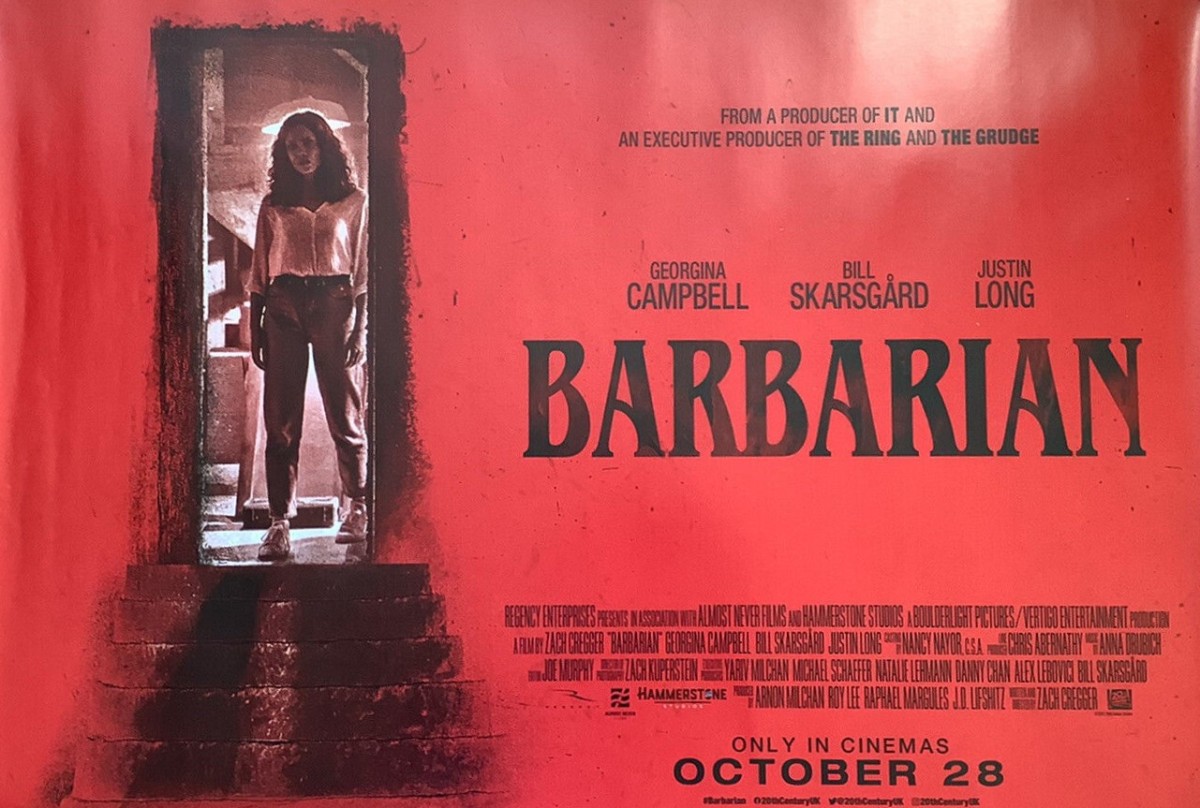
Barbarian (2022) **** – Seen at the Cinema

Slow-burn thriller geared more towards suspense than horror, turning on their heads most of the usual tropes and coming away with a fresh look at the genre.

Tess (Georgina Campbell), in Detroit for an interview as a movie researcher, turns up at  a rental only to find it already occupied by Keith (Bill Skarsgard). Cue various negotiations as she tries to find out if he’s for real and then work out a viable sharing concept – she gets the bedroom – and to some extent whether he is some skank hiding behind a handsome and charming veneer just lying in wait for a victim. This picture takes its time getting anywhere but not knowing just where it’s going only adds to the suspense. Eventually, they get to know each other enough for good vibes to kick in and there’s a moment where it could have gone all the way to sex.

Next morning she departs for her interview but not without noticing she is in one hell of an odd neighborhood. On her return, Keith is nowhere to be seen although his clothes are still there. When she investigates, down in the cellar finds a rope in a wall that reveals a tunnel and she hears him shouting. Having seen way too many horror movies she does the sensible thing  and leaves – nope, she does the next sensible thing and makes sure she can actually see where she’s going. And all this time of course you’re thinking – aha! This is what he wanted all along, he was a charming skank hiding behind a veneer, but still you don’t know where this picture is going because the director is damn good at suspense.

And once she does find out what’s going on we jump to another character, breezy actor AJ (Justin Long) belting along the highway belting out songs only to be given the bad news he is being accused of rape. Upshot is he turns up at the rental in Detroit because he’s the owner and now needs to sell it pronto so he’s absolutely delighted to discover it’s goes not just into a cellar but an extended basement that goes on and on because he’s measuring the shit out of it, just ignoring the stained mattress, camcorder and bloody handprint because, heck, the extra space could mean his property is worth a whole lot more which is ideal because he’s in for some hefty legal fees what with confessing to another dude that his accuser did in fact need some “convincing” before they had sex.

You don’t worry too much about AJ following in the footsteps of Tess because he’s mean, not in the John Wick fashion, but in the sneaky way that sneaky people have of never getting caught out. And he’s got a gun.

Naturally, there’s something a good bit meaner down there and there’s a hint that’s the reason the neighborhood is so rundown.

I’m not going to go into that aspect of the movie which in some respects is well done and in other respects not. And there’s a couple of character-driven twists that you won’t see coming and a great scene when police refuse to believe that a female running loose complaining of monsters is more likely to be a drug addict with monsters in her head rather than a genuine victim.

All in all one of the best horror films in a long while and precisely because it bends the rules without losing the shock value we come to expect from the genre. Prey for the Devil (2022) which I saw on the same day goes in more for the standard horror elements with considerably less effect and The Banshees of Inisherin, which I saw in between this pair, could have equally well been described as a horror picture, and although the bulk of the damage is self-inflicted seeing a fellow walking round with all his fingers sheared off but still with one complete hand left so he can chuck the digits at a door has all the trappings of horror.

Stick with Barbarian, a horror debut worth applauding from writer-director Zach Creggan (Miss March, 2009). He’s got the sense to let suspense build up by letting audiences do all the work, their expectation far more effective than his misdirection, and he allows his cast time to let their characters take root. Georgina Campbell (Wildcat, 2021) is an impressive lead and because the director doesn’t spend all his time putting her in situations where she can do nothing but scream she gets the chance to act. Bill Skarsgard (It, 2017) and Justin Long (House of Darkness, 2022) complete an interesting trio of performances. How rare to go to a horror picture and come away raving about the acting.

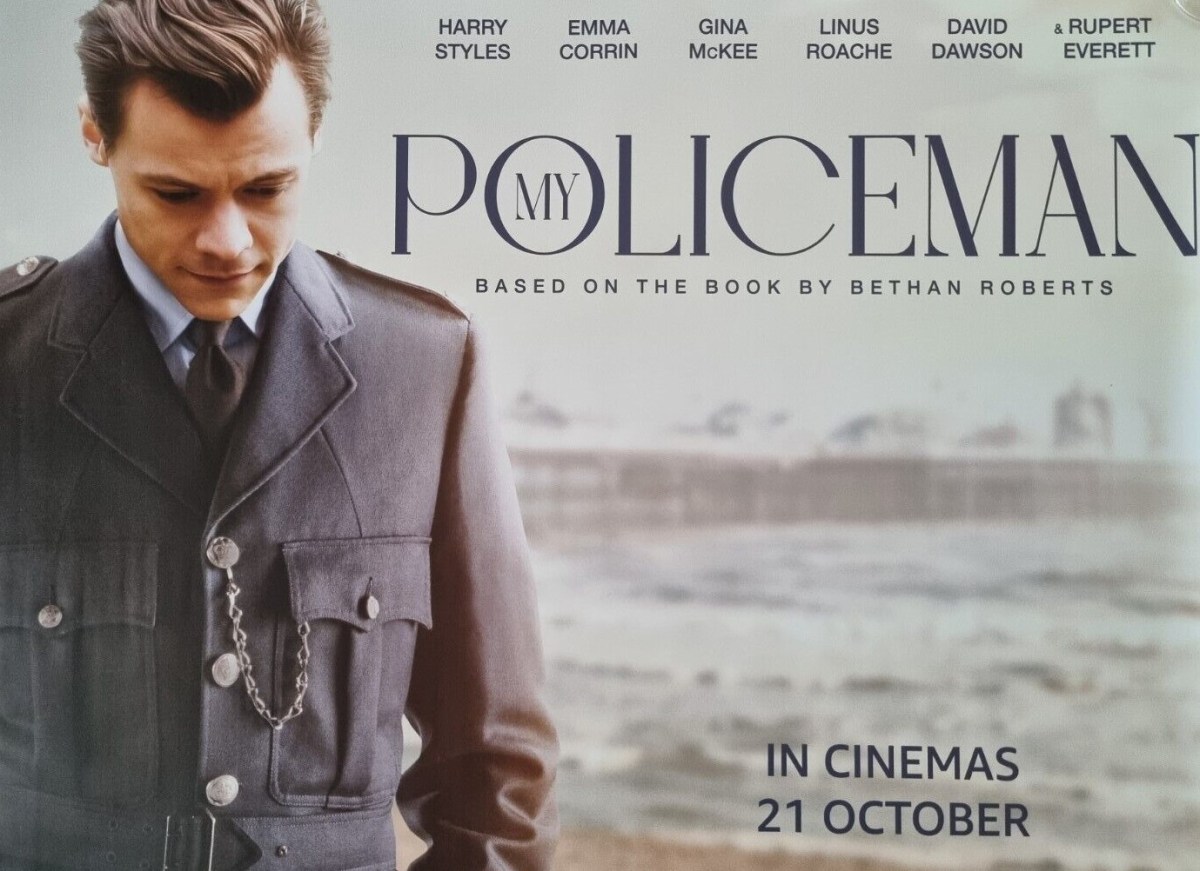
My Policeman (2022) *** – Seen at the Cinema

Understated love triangle set in the 1950s with perfectly-pitched performances and punctured by reticence, repression and regret. Not that I check reviews before I venture into a cinema but I gather this has been poorly-received, perhaps because it’s funded by Amazon, which has no great record in making movies, and partly, I guess, because it’s headed by pop star-turned-actor Harry Styles, credited with giving Don’t Worry Darling (2022) an unexpected, and for some, unfai, box office push.

But I found this to be solid stuff and despite the tragic outcome no overtly dramatic acting (unlike Emily for example), the whole enterprise pared down, soulful more than anything, and all the better for it. Mostly, it takes place in flashback.

In the 1990s, a stroke-ridden Patrick (Rupert Everett) is given accommodation in the household of married but childless Tom (Linus Roache) and Marion (Gina McKee). Tom resents the intrusion although they were all best pals back in the day. Gradually, we find out why, but the movie begins in low-key fashion, the young Tom (Harry Styles), a policeman, and Marion (Emma Corrin), a teacher, hooking up with all the innocence of that era at the beach. Tom teaches her to swim, she introduces him to art.

Turns out Tom has an arty buddy, Patrick (David Dawson), the slightly older museum curator. Soon they are a threesome, attending concerts and eating out, and while Marion appreciates Patrick’s appreciation of the finer things in life, she’s more at home with the more ordinary Tom. While he’s a bit hesitant about making advances towards her, eventually he plucks up the courage to ask her to marry him.

The movie flips between the 1990s featuring the older trio and the 1950s with young bucks in love. And part of the movie’s attraction is the innocence, it takes a while to work out what’s going on, or more correctly for the audience to be told what’s going on, which is that Tom has fallen in love with Patrick. But he is also in love with Marion and wants children and a proper family, so the suggestion that in marrying her he is seeking the perfect disguise for his sexuality is never pointedly made. Mostly, we get his confusion. Remember this is the 1950s when homosexuality in Britain was a crime that could result in a stiff jail sentence.

Gradually, Marion begins to suspect Tom has leanings and there’s a wonderful scene where she confesses this discovery to her best friend only to be told the friend is a discreet lesbian. Does this suddenly make the friend a completely different person, Marion is asked.

Of course, it’s only going to end in tragedy, and even then it’s an ongoing one, the older Tom unable to admit his preferences, married to the stoic Marion, and clearly agonising over the life he could have led had he been bolder earlier on.

I thought this was very delicately done. The scene where Tom shows his true feelings by his finger almost absent-mindedly stroking Patrick’s neck and his subsequent awkwardness at what then transpires as he comes to terms with his own suppressed emotions is subtly done.

I’m surprised Harry Styles has had such a rough ride over his performance. Perhaps I was out of the loop in the brouhaha of expectation. I thought he captured very well the character’s uncertainty regarding his sexuality, the knowledge that career (bachelors found it hard to get promotion in the police) and marriage could be jeopardized by an illicit action too many. This could not be a more different performance than the alpha male of Don’t Worry Darling. From his initial behavior I half-expected a rom-com where shyness is gradually overcome, but the implicit danger ensures we steer clear of such territory.

Emma Corrin (Netflix’s The Crown) comes across very well as the equally shy young woman of her time, anxious to appear not too forward, unaware of what to expect from the sexual side of marriage, remaining innocent until her wrath takes hold, and clearly willing to make do for the sake, in that very English manner, of appearances. David Dawson, in his first starring movie role, is excellent, rarely letting anguish get the better of him but far from the camp cliché.

Rupert Everett (The Happy Prince, 2018)  is the surprise turn, the virtually mute stroke victim, enduring the torture of living in the same house as his former lover who consistently ignores him. Gina McKee (Lies We Tell, 2017) and Linus Roache (A Call To Spy, 2019) are good as the mismatched couple, though I’m not sure I believed in her final action, a shade too romantic a gesture for a wife who one way or another has kept her husband in thrall for 40 years.

Michael Grandage (Genius, 2016) should be applauded for his sensitivity, for coaxing superb performances from his younger actors, and for falling into the trap of overloading the picture either with a sense of doom or of overplaying the dangers of the lifestyle. Ron Nyswaner (Philadephia, 1993) adapted the book by Bethan Roberts.

Well worth seeing and at last Prime might have something decent to watch.

Amsterdam (2022) **** – Seen at the Cinema

Shaggy dog story wrapped up in paranoia thriller. A shade overlong, with too many characters and too much plot but such flaws should not detract from that rare cinematic animal, a truly original movie. Brilliant screenplay, believable characters and superb acting prove an irresistible combination.

Though you can see why this sank like a stone at the box office, the all-star cast generally acting against type, idiosyncratic director given vast sums to play with, a tale that goes in too many directions at once, and the unconstitutional events of January 6, 2021, bringing this too close to home for fractured American audiences.

You don’t get this kind of writing much anymore. When individuals come together on a project – to save the world the most likely reason these days – their individuality is usually subsumed to the plot. Here, instead, the reactions of the characters remain distinct and no matter what is going on there is always time for individuality. And some of the invention is just deliciously insane, the nonsense songs for example.

Touching on the World War One aftermath of recovering from mental and physical wounds plus profiteering glee, a sense of a country racked by the Depression on the brink, mind-inducing experimentation of the political and pharmaceutical kind. A trio of war veterans, soldiers Burt (Christian Bale) and Harold (John Davidson Washington) and nurse Valerie (Margot Robbie) investigate a mysterious death, an illegal autopsy uncovering poison, only to find themselves framed for murder.

Burt is not a prime-time player according to wife Beatrice (Andrea Riseborough), and her wealthy family had dispatched him to the war in the hope he would return with bankable glory, but generally treat him as an unwanted black sheep. Valerie now makes art out of war debris, bullet shells and shrapnel, her charming brother Tom (Rami Malek) and his wife Libby (Anya Taylor-Joy) embedded in malevolence. Harold is a lawyer, for whom racism is a constant.

American and British secret service operatives, Norcross (Michael Shannon) and Canterbury (Mike Myers), float in and out. The moneyed business elite, despising White House incumbent Roosevelt, cast envious eyes at the dictatorial economic miracle of Mussolini in Italy.

On everyone’s dance card is General Dillenbeck (Robert De Niro), sought out by our intrepid trio and a mysterious cabal. All he has to do is make a speech at a veteran’s dinner. Make the right kind of speech and the trio are vindicated. Make the wrong kind and he could be assassinated.   

Like Chinatown (1974), Amsterdam is representative, a state of mind, but of freedom rather than endemic corruption. This is an intricate piece and a bit slow for today’s fast-paced generation and with more dialog than might sit well with a modern audience and flights of fancy that are far more original than anything you would find in the MCU. But it’s a hell of an intelligent thriller driven by a bunch of deadbeats.

It never goes down the obvious route. Instead of a love triangle – Valerie and Harold a pair – it’s an evocation of friendship. You don’t need umpteen clues to find the villains, they’re upfront, and they don’t think they are baddies, but cleverer people coming to the aid of the dumb masses putting too much blind faith in democracy. While this is based on a true story, in reality it’s based on the constant of the rich trying to get richer and the wealthy believing they are the best, even if unelected, candidates to run the world.

All that political stuff could have been a big turn-off if it had gone down the preachy route, but it doesn’t, instead it’s almost a miracle that it arrives at any conclusion given in whose hands the narrative has been placed. The Three Stooges would have done a better job of getting there quicker, but then you wouldn’t have had so much fun.

Not only are all the stars on their A-game but acting-wise it delivers some career-reviving turns not least from Christian Bale (Ford v Ferrari, 2019), devoid of a lifetime’s acquisition of irritating tics, John David Washington (Tenet, 2020) called upon to develop a character rather than an action-driven hero. I had to check the end credits to find out it was Mike Myers (Bohemian Rhapsody, 2018) playing the understated Canterbury and hogging the screen with none of the acting pyrotechnics that dogged previous attempts at mainstream work. Ditto Robert De Niro (The Irishman, 2019) and Rami Malek (Bohemian Rhapsody), no grandstanding this time round – don’t worry I recognized both from the off – and Anya Taylor-Joy finally delivering on the promise of The Queen’s Gambit (2020).

Margot Robbie (The Suicide Squad, 2021) is already on the rise and this will add to her growing portfolio of fascinating characters. And if you’re fed up watching any of these stars in brilliant form, there are other distractions in the form of Chris Rock (Spiral, 2021), Taylor Swift (Cats, 2019), Andrea Riseborough (The Electrical Life of Louis Wain, 2021) and Alessandro Nivolo (The Many Saints of Newark, 2021).

You often hear the term “visionary director” thrown about with indiscriminate regard, but this is the right kind of visionary, director David O. Russell (Joy, 2015) with his own way of seeing the world, and delivering it in distinctive fashion, with less of an eye on camera movement and more on dialog and motivation and staying true to a coterie of original individuals.  

I guess the money was spent on atmosphere, this is 1930s USA regurgitated in enormous detail. But you’ll forget the background, the costumes and sets, and be dazzled instead by the script and the acting, and the enveloping tale of friendship.   

Mrs Harris Goes To Paris (2022) **** – Seen at the Cinema

How is that the British, way down now in the rankings of global movie production, have come up with a successful genre all of their own – the national treasure. Maggie Smith and Helen Mirren to be sure first came to prominence in the same year, 1969, with The Prime of Miss Jean Brodie and Age of Consent respectively, but whereas Hollywood has turned its back on the ageing female contingent, the British film industry has wrapped its most famous stars in cotton wool and proceeded to give them roles they can take to the Oscar bank.

Mirren was in her early 60s when she romped home in The Queen (2006); you only have to say Downton Abbey and Smith, already two Oscars to the good, is regarded as screen royalty. And that’s before Judi Dench enters the equation, a few years older than Mirren when she nabbed the Oscar for Shakespeare in Love (1998). You can pretty much count on getting funding for any picture if you can rustle up any of this trio. Want to bring back the older crowd? Dangle these carrots!

Elevated into this category now is Lesley Manville, the 66-year-old star of the delightful Mrs Harris Goes to Paris. While largely escapist, there’s enough of a contemporary vibe, a Paris redolent of filth, the downtrodden going on strike, to provide an edge, and a narrative that continually punctures dreams any time fantasy looks like running away with itself. Set in 1950s London and Paris where the poor know their place, and are rigidly kept in it by the arrogant rich, but where aspiration can at any moment take flight.

Cleaner Mrs Harris, dreaming of buying a £500 dress – we’re talking the best part of £14,000 these days – scrimps and saves, and through a couple of more than fortuitous events, finds her way to the House of Dior where she is despised by haughty manager Claudine (Isabelle Huppert), adored by philosophic model Natasha (Alba Baptista) for having such aspirations, and manages to cast a spell, although not for the reasons expected, over rich widower the Marquis de Chassagne (Lambert Wilson).

There’s not much plot. She has to remain in Paris for a fortnight for fittings and whiles away the time helping along the romance between under-manager Andre (Lucas Bravo) and Natasha, assisted by their existentialist leanings, eventually overcoming hostility and putting everything to rights in the Dior empire. But you don’t need plot when you’ve got charm. The English notion of fair play initially comes a cropper when facing French egalitarianism out of whack, when the rich can jump the queue and basically make everyone jump to their tune. But when a character like Mrs Harris settles for second best you can be sure she’ll come up trumps. Whether it’s icing on the cake or to make a rubbish-strewn Paris more palatable, there’s a good ten minutes of oo-la-la devoted to parading the latest fashions.

Not content with conquering one city, Mrs Harris developed sequelitis and headed for New York.

And there’s not just a philosophical undertone – people not what they appear on the surface – but a feminist one, women holding the world together while men whistle. But by and large it’s joyous entertainment, a confection straight out of the Hollywood top drawer, a poor woman having her day in the sun through sheer strength of character.

Unless you’re British or a big fan of arthouse director Mike Leigh or noticed her Oscar  nomination in the largely unnoticed The Phantom Thread (2017) Lesley Manville will probably have passed you by. She nabbed a cult following as the dumped-upon lead in comedy series Mum (2016-2019) and picked up a wider audience as Princess Margaret in The Crown, but mostly she’s known for a certain kind of acting, where she can change expression 20 times in a minute without ostensibly doing anything different. Just like her predecessors, Smith, Dench and Mirren.

You can’t take your eyes off her, which is quite feat when she’s up against French screen royalty (perhaps a “tresor national”) Isabelle Huppert (Elle, 2016). Alba Baptista (Warrior Nun series) could well be the breakout star here though Lucas Bravo definitely runs her close. I saw Bravo in Ticket to Paradise (2022) and the characters there and here could not be more different. Ellen Thomas (Golden Years, 2016), Lambert Wilson (Benedetta, 2021), Anna Chancellor (For Love or Money, 2019) and Jason Isaacs (Operation Mincemeat, 2021) have smaller roles.

Director Anthony Fabian (Skin, 2008) adds deeper issues to a movie that was crying out to be all surface. He co-wrote the screenplay with Carroll Cartwright (What Maisie Knew, 2012) based on the classic Paul Gallico novel.

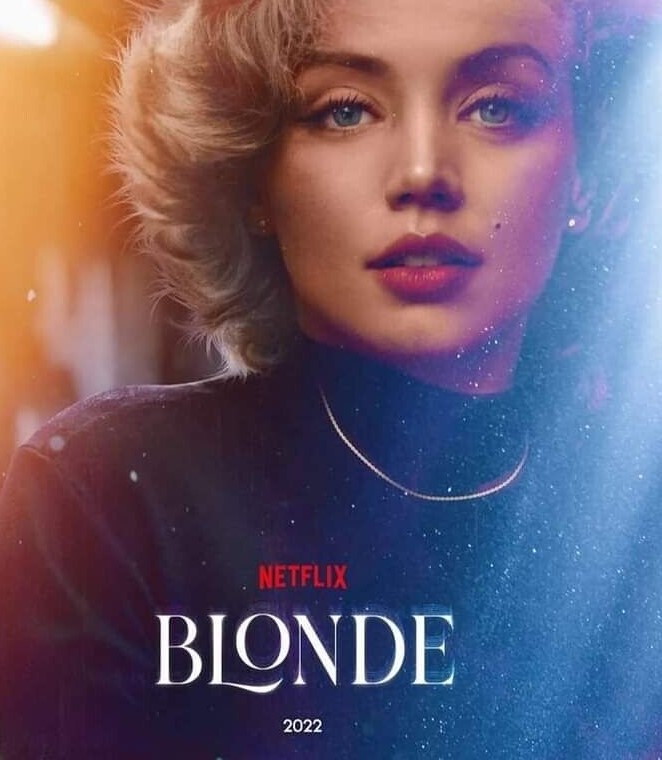
Blonde (2022) **** – Seen at the Cinema

Stream of consciousness reimagining of Marilyn Monroe’s life mainlining on celebrity, identity, mental illness and vulnerability and held together by a mesmerizing performance by Ana de Armas. Director Andrew Dominik’s slicing and dicing of screen shape, occasional dips into black-and-white and a special effects foetus won’t work at all as well on the small screen. Monroe’s insistence on calling husbands “daddy” and letters from a never-seen potential father that turns into a cruel sucker punch, threaten to tip the picture into an over-obvious direction.  

A very selective narrative based on a work of fiction by novelist Joyce Carol Oates leaves you wondering how much of it is true, and also how much worse was the stuff left out. As you might expect, the power mongers (Hollywood especially) don’t come out of it well, and her story is bookended by abuse, rape as an ingenue by a movie mogul and being dragged “like a piece of meat” along White House corridors to be abused by the President.

A mentally ill mother who tries to drown her in the bath and later disowns sets up a lifetime of instability. Eliminated entirely is her first husband, but the scenes with second husband (Bobby Canavale) and especially the third (Adrien Brody) are touchingly done, Marilyn’s desire for an ordinary home life at odds with her lack of domesticity, and each relationship begins with a spark that soon fades as she grapples with a personality heading out of control.

That she can’t come to grips with “Marilyn,” perceived almost as an alien construct, a larger-than-life screen personality that bewitches men, is central to the celebrity dichotomy, how to set aside the identity on which you rely for a living. It’s hardly a new idea, but celebrity has its most celebrated victim in Monroe.

According to this scenario, she enjoyed a threesome with Charlie Chaplin Jr (Xavier Samuel) and Edward G. Robinson Jr.  (Evan Williams) but otherwise her sexuality, except as it radiated on screen, was muted. The only real problem with Dominik’s take on her life that there is no clear indication of when her life began to spiral out of control beyond the repetition of the same problems. She remains a little girl lost most of the time.

I had no problems with the length (164 minutes) or with the selectivity. Several scenes were cinematically electrifying – her mother driving through a raging inferno – or emotionally heart-breaking (being dumped at the orphanage) and despite the constant emotional turbulence it never felt like too heavy a ride. But you wished for more occasions when she just stood up for herself as when arguing for a bigger salary for Gentlemen Prefer Blondes.

I wondered too if the NC-17 controversy was a publicity ploy because the rape scene is nothing like as brutal as, for example, The Straw Dogs (1971) or Irreversible (2002), and the nudity is not particular abundant nor often sexual. That’s not to say there is much tasteful about the picture, and you couldn’t help but flinch at the rawness of her emotions, her inability to find any peace, the constant gnaw of insecurity, and her abuse by men in power.

Ana de Armas (No Time to Die, 2021) is quite superb. I can’t offer any opinion on how well she captured the actress’s intonations or personality, but her depiction of a woman falling apart and her various stabs at holding herself together is immense. The early scenes by Adrien Brody (See How They Run, 2022) as the playwright smitten by her understanding of his characters are exceptional as is the work of Julianne Nicholson (I, Tonya, 2017) as her demented mother. Worth a mention too are the sexually adventurous entitled self-aware bad boys Xavier Samuel (Elvis, 2022) and Evan Williams (Escape Room, 2017).

While there are no great individual revelations, what we’ve not witnessed before is the depth of her emotional tumult. Apart from an occasional piece of self-indulgence, Andrew Dominik, whose career has been spotty to say the least, delivers a completely absorbing with an actress in the form of her life. Try and catch this on the big screen, as I suspect its power will diminish on a small screen.

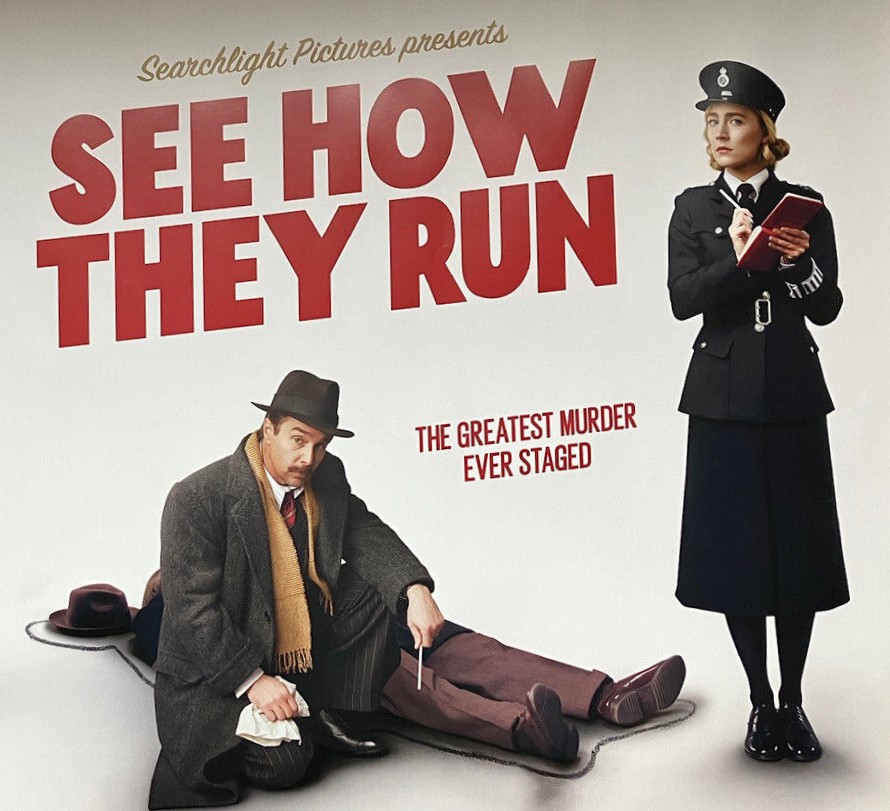
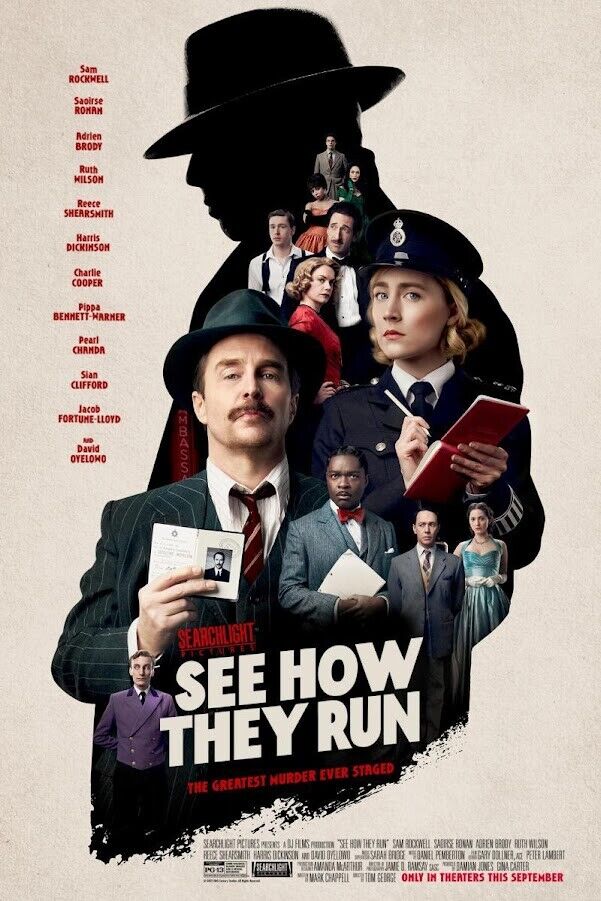
See How They Run (2022) **** – Seen at the Cinema

Kind of film that needs sold on word-of-mouth and a slow platform-release rather than being bundled out to fill the distribution gap. Let the audience sing its praises first before slinging it out in wide release. Because this is a definite audience-pleaser, a fun whodunit. Though a limiting factor might be that appeal may be restricted to those of a certain age familiar with  The Mousetrap. I wouldn’t bet my last dollar, either, on modern young audiences even having a clue who Agatha Christie was, or responding to a picture set in dull, dull, Britain in a year -1953 – when there was a significantly more glorious event that might have suited better the average Downton Abbey moviegoer: the coronation of the recently-deceased Queen Elizabeth II.

Delightful pastiche on the detective story, too much to suggest it’s a piss-take on Knives Out or the latest big-screen veneration of Hercule Poirot, but it certainly has enough going for it even if none of those connections are eventually made. Certainly, there’s some sly humor in scoring points for mentioning, a la Murder on the Orient Express, that the initial murder could have been committed by all the suspects.

Basically, out of favor war hero and alcoholically-inclined cop Inspector Stoppard (Sam Rockwell) is saddled with rookie Constable Stalker (Saoirse Ronan) – two in-jokes right there, John Stalker being a very prominent British cop, playwright Tom Stoppard the author of The Real Inspector Hound – to investigate the death of Yank Leo Kopernick (Adrien Brody), in London to turn Agatha Christie’s famed play into a movie for real-life producer John Woolf (Reace Shearsmith) who made The African Queen (1951).

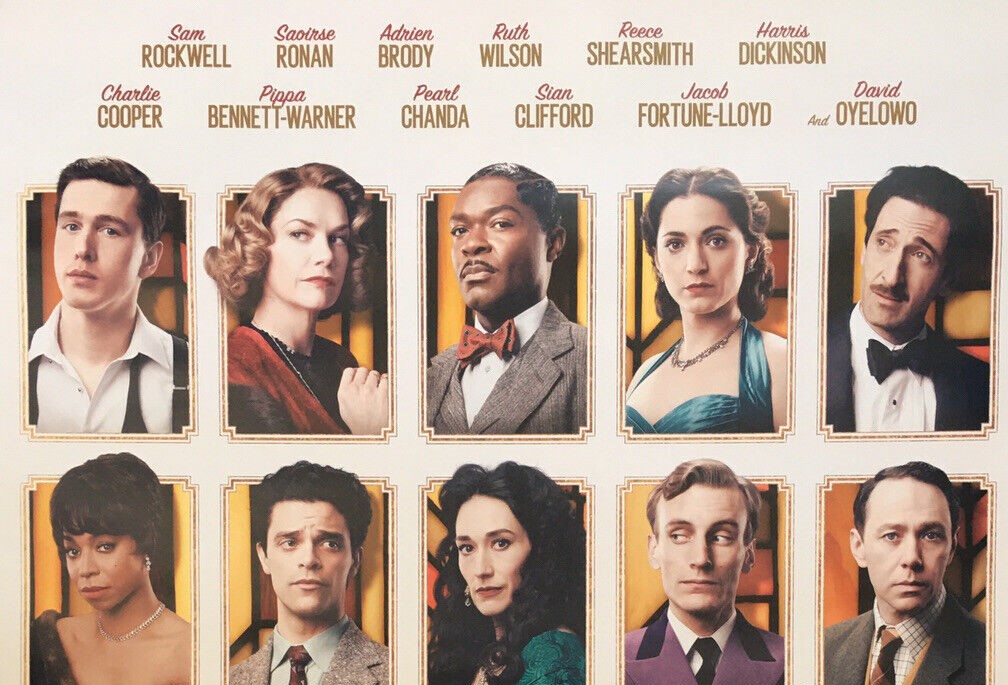
Virtually everyone associated with the play becomes a suspect. These include pompous playwright Mervyn Cocker-Norris (David Oyelowo), the play’s petulant producer Petula “Chew” Spencer (Ruth Wilson), real-life actor Richard Attenborough (Harris Dickinson) and even Agatha Christie (Shirley Henderson) is not above a bit of poisoning. Throw into the mix that the cops have assigned the bulk of their resources to tracking down the 10 Rillington Place serial killer – another in-joke, Attenborough playing the murderer in that movie.

One of the movie’s delights is that whereas both Stoppard and Stalker have considerable personal issues, we discover them in passing, and neither character makes a meal of them. Instead, their screen charisma works a treat, Stoppard dogged and the earnest Stalker inclined to jump the gun.

Even the “all-star-cast” is a spoof on films like “Death on the Nile.” The title was a popular one, movies in big-screen or small using it in 1955, 1964, 1984, 1999 and 2006.

The stage shenanigans are a hoot, puffed-up pride and ruthless machinations powering many of the sub-plots. There’s some pretty clever sleight-of-hand not to mention occasional cinematic avant-garde and there’s no shortage of laughs and that out-dated comedy fall-back – slapstick. The climax is particularly excellent, in part because it is a notion immediately discarded as the denouement of the proposed movie version of the play, one that succinctly critiques the differences between British and Hollywood approaches to movie-making.

Red herrings and cul-de-sacs abound, flashbacks remove any plot-holes, while managing to ram in a country-house finale takes some brio. And in among all the jokes, you might be surprised to find a serious point being made about reality vs fiction. Full marks to the virtually laugh-a-minute screenplay by Mark Chappell  (The Rack Pack, 2016) and director Tom George in his movie debut who brilliantly shuffles the deck.

Dramatic heavyweight pair Sam Rockwell (Three Billboards, Outside Ebbing Missouri, 2017) and Saoirse Ronan (Mary, Queen of Scots, 2018) prove a double-act to cherish. In gentle comedic roles at odds with virtually their entire portfolios, a wise producer might already be sizing them up for a re-run. Everyone else gets to be bitchy/scheming/ruthless to their heart’s content and certainly in those categories Adrien Brody (The Grand Budapest Hotel, 2014)  and Ruth Wilson (His Dark Materials, 2019-2022) win hands-down. But spare a thought for excellent performances from David Oyelowo (The Bastard King, 2020), Reace Shearsmith (of League of Gentlemen TV fame), Lucian Msamati (The Bike Thief, 2020) as the imperturbable Max Mallowan, husband of the distinctly perturbed Agatha, played with venomous glee by Shirley Henderson (Greed, 2019).

I went to see it not expecting much at all and came out singing its praises. Definitely worth a whirl.

Triple Bill Blues: Fall (2022) ***; The Forgiven (2021) **; Three Thousand Years of Longing (2022) ** – Seen at the Cinema

You may be aware that I am partial to a triple bill on my weekly Monday trip to the cinema. I’m rather an indiscriminate cinemagoer and generally just see what’s available, though it’s true return trips to view Top Gun: Maverick have helped paper over cracks in the current distribution malaise. Sometimes a triple bill can reveal unsung gems, sometimes I am rowing against the critical tide in my opinions and sometimes, not too often thank goodness, I end up seeing movies with few redeeming qualities. That was the circumstance this week.

FALL

So now I know. If I need to get a mobile phone dropped 2,000 feet without it breaking into pieces, the thing to do is stuff it inside a cadaver. That’s one of the more outlandish suggestions in this climbing picture two-hander that for most of the time is quite gripping.

So as not to have to spend the first anniversary of her husband’s death sozzled in booze and despair, Becky (Grace Caroline Currey) agrees to partner YouTube click-hound Hunter (Virginia Gardner) in scaling an extremely high disused radio mast. Becky, a mountaineer, had watched her husband fall to his death, so is pretty iffy about the expedition. When they reach the top they can’t get down again since the ladder they climbed has disintegrated. Although there was mobile phone reception at ground level, there’s none this high up. Hunter has 60,000 followers and reckons if only her phone reached the ground it would automatically activate so they toss it down in a shoe stuffed with a bra.

That doesn’t work nor does firing a flare pistol to alert two guys in a nearby RV – all they are alerted to is the girl’s vehicle which they promptly steal. The girls are trapped without water or drone, both stuck 50ft below on radio dishes. At one point you think this is going to go in an entirely different – murderous – direction after Becky discovers Hunter had an affair with her husband. But they manage to get over that hiccup. Recuing their water and drone results in Hunter being out of action as far as further climbing goes and it’s up to Becky to reach the top of the mast and recharge the drone from the power there, fending off a passing vulture.

There’s definitely one weird bit where it turns out that Hunter, who you imagined was up there all the time supporting a defeatist Becky, is already dead. But, luckily, the corpse provides the cavity in which to bury the mobile phone. I’m not sure much of a human body survives a drop of 2,000 ft, certainly not enough to safeguard a phone, but that’s the way this plays out.

A great mountaineering film is always a welcome find in my book. This isn’t great but it’s certainly passable. And while Becky is more interesting than the gung-ho Hunter, the pair, emotions almost spinning out of control, make a very watchable pair.

Grace Caroline Curry aka Grace Fulton (Shazam!, 2019) does well in her first starring role and Virginia Gardner (Monster Party, 2018) is as convincing. Jeffrey Dean Morgan (Rampage, 2018) has a small role. A novel take on the mountaineering sub-genre, it’s kudos to director Scott Mann (Heist, 2015) – who co-wrote the screenplay with Jonathan Frank (Final Score, 2018)  that I spent a lot of time wondering just how the hell they managed to make it look so realistic.

THE FORGIVEN

Note to studios, no matter how much you plan to tart up a modern version of Appointment in Samarra – aka a tale of unavoidable fate – you ain’t going to get anywhere if it’s filled with entitled obnoxious characters. The worst of it is this is well-made.

Functioning alcoholic doctor David Henninger (Ralph Fiennes) knocks down and kills young Muslim boy Driss (Omar Ghazaoui) while on the way with wife Jo (Jessica Chastain) to a hedonistic weekend party in Morocco hosted by Richard Galloway (Matt Smith) and his partner Dally (Caleb Landry Jones). There are hints that Driss was planning to hijack the tourists, but while his death is deemed an accident by the local cops, David agrees to go back with the boy’s father Ismael (Abdellah Taheri) and observe the local funeral rites and possibly pay the father off.

While her husband is away Jo has a one-night stand with serial seducer Tom (Christopher Abbott) while the rest of the party – including Lord Swanthorne (Alex Jennings) and assorted beautiful men and woman – trade bon mots and make racist and sexist remarks. While the arrogant David changes his perspective and accepts his fate, there is not, himself included, a single likeable person in the whole of the tourist contingent which makes it impossible to care what happens to anybody. Written and directed by John Michael McDonagh (Calvary, 2014) it spends all its time trying to make clever points, not realizing the audience has long lost interest.

THREE THOUSAND YEARS OF LONGING

Note to studios, if you’re going to indulge an action director in a vanity project, make sure he hires actors who don’t just drone on. It might also help if the director could decide what story he wants to tell, and not essentially present a voice-over narrative of stuff that happened in the past, no matter how exotic the timescale.

I was astonished to discover there actually is a job called narratologist. Alithea (Tilda Swinton) is a dried-up old stick of a narratologist who summons up the dullest genie/djinn in movie history known – no names, no pack drill – just as The Djinn  (Idris Elba) who proceeds to bore the audience to death with his stories of how he came to end up in a bottle.  

There’s a bundle of academic nonsense about storytelling, a swathe of tales that sound like rejects from The Arabian Nights, and a lot of unconnected characters. The invention of director George Miller (Mad Max: Fury Road, 2015) just isn’t inventive enough and the visuals just aren’t arresting enough. I’m assuming this got greenlit on the basis Miller would turn in a couple more in the Mad Max franchise.

Orphan First Kill (2022) *** – Seen at the Cinema

Evil meets its match” would have been a good tagline for this neat B-picture, a slow burn that starts off as horror before swerving into a more straightforward thriller. A prequel to surprise hit Orphan (2009) and a perverse take on the origin theme so beloved of the MCU/DC movies, this begins in Estonia where Leena (Isabelle Fuhrman) is an inmate at a psychiatric institute.

At first it looks like the tale is heading in the direction of Leena’s relationship with new art therapist Anna (Gwendolyn Collins). But that is quickly stymied when Leena, having orchestrated an escape through her manipulative and seductive powers, knocks off Anna as well, pausing only long enough to harness the woman’s computer to find a lookalike missing girl, the American Esther Albright, she could pretend to be. The wealthy Albrights, mum Tricia (Julia Stiles), devastated artist husband Allen (Rossif Sutherland) and spoiled brat son Gunnar (Matthew Finlan) live in a huge mansion in Connecticut.

And at first again, we go down another rabbit hole, this time the question of whether Esther can maintain her disguise, coming up shy at times in the old memory department. A psychiatrist is initially a bit suspicious and there’s a cop, Inspector Donnan (Hiro Kanagawa) lingering in the background. But Esther bonds with Allen over their shared interest in painting and the husband believes he has unearthed a new shining talent.

We also go down a rat-hole, so to speak, when Esther befriends a rat (an unlikely inhabitant in such a deluxe property, but there you go) whose only purpose you guess right away is to die, poisoned in one way or another. You imagine the poisoner is going to be Esther just wanting to maintain her killing skills.

Not so. The poor old rat is killed by mistake by Tricia who is, it turns out, trying to rid herself of this imposter, a lass she knows only too well cannot be her missing daughter for one very unsavoury reason which I won’t divulge but certainly took me by surprise.

So then the film switches onto a completely different tack, and one that is far more satisfying than just a deranged maniac, as in most horror pictures, going round slaughtering everyone in sight.  Donnan has re-entered the frame by this point, continuing his investigations to the point of sneakily snatching Esther’s fingerprints so he can try and do a match.

So now it’s game on and Esther is out- numbered, up against a pretty dangerous mother-and-son combo, with only the dim husband as ally. And no matter what clever stunts Esther dreams up to rid herself of this infernal duo and live happily ever after with the doting father, the equally tough Julia is quietly setting her own snares.

We were already expecting trouble the moment we set eyes on Esther, who, with her baby-faced features and size, that was a given, if ever there was a monster-in-disguise it was her. But beautiful socialite Tricia is a different story and so if there’s a “secret” this time round it’s to do with Tricia’s family, the pair involved maintaining an ongoing masquerade with the unwitting father.

Esther’s survival depends not so much on killing her way out of here but on winning over the father sufficiently should that, inevitably, if her plans work out, bereft of wife and son he will turn to her for consolation.

Isabelle Fuhrman (Orphan) is even better than she was before. Then she was a young actress playing a young maniac. Now she’s over a decade older and having to act more than a decade younger and that certainly takes some doing. But Julia Stiles (Hustlers, 2019) is the revelation, the cold-as-ice beauty, barely holding her family together after the previous tragedy, on the one hand welcoming Esther because it revitalizes her almost-dormant husband, on the other needing to exert considerable control otherwise their carefully constructed lives are going to explode. Although the surname is not new to me, the actor is, and Rossif Sutherland (The Middle Man, 2021) gives a touching performance as the grieving, brooding father finding himself, especially good in his scenes in his studio with Esther. In only his second picture Mathew Finlan (My Fake Boyfriend, 2022) isn’t given much scope as a spoilt brat son nor is Hiro Kanagawa, best known for the Star Trek: Discovery TV series.

Director William Brent Bell (The Boy, 2016) does a decent job, especially given he has to stradde the twin genres or horror and thriller with a nod in the direction of film noir. The scenes between Esther and Julia, where they realise they are adversaries, are especially well done. There are enough twists to keep the plot spiralling along and clever use of doubles to make you believe Fuhrman is a little girl.

Far from a great picture, but enough to be getting along with in the absence of a blockbuster. The hardier of the moviegoer species, people like me who pop along to their local cinema every week regardless and find something to watch, will be less picky about this kind of fare than those who get in for nothing or are sent a streamer due to their status as critics. Exhibitors have complained for over a century now that the best movies are never spread out over the year, but clustered into various time zones. Their livelihood, after all, depends on a constant string of winners. It’s a different story for cinemagoers. We just want to sit in the dark and see a film and as long as it’s reasonable enough we’re not going to complain.

In what should have been an indifferent week for moviegoing – given I had already seen Bullet Train, Nope, Top Gun: Maverick etc – I managed quite a nice triple bill on my weekly outing. This was the sandwich between the charmingly tolerable Fishermen’s Friends: One for All and documentary Girls Can’t Surf.    

Discover WordPress

A daily selection of the best content published on WordPress, collected for you by humans who love to read.

The Atavist Magazine

by Brian Hannan

WordPress.com News

The latest news on WordPress.com and the WordPress community.