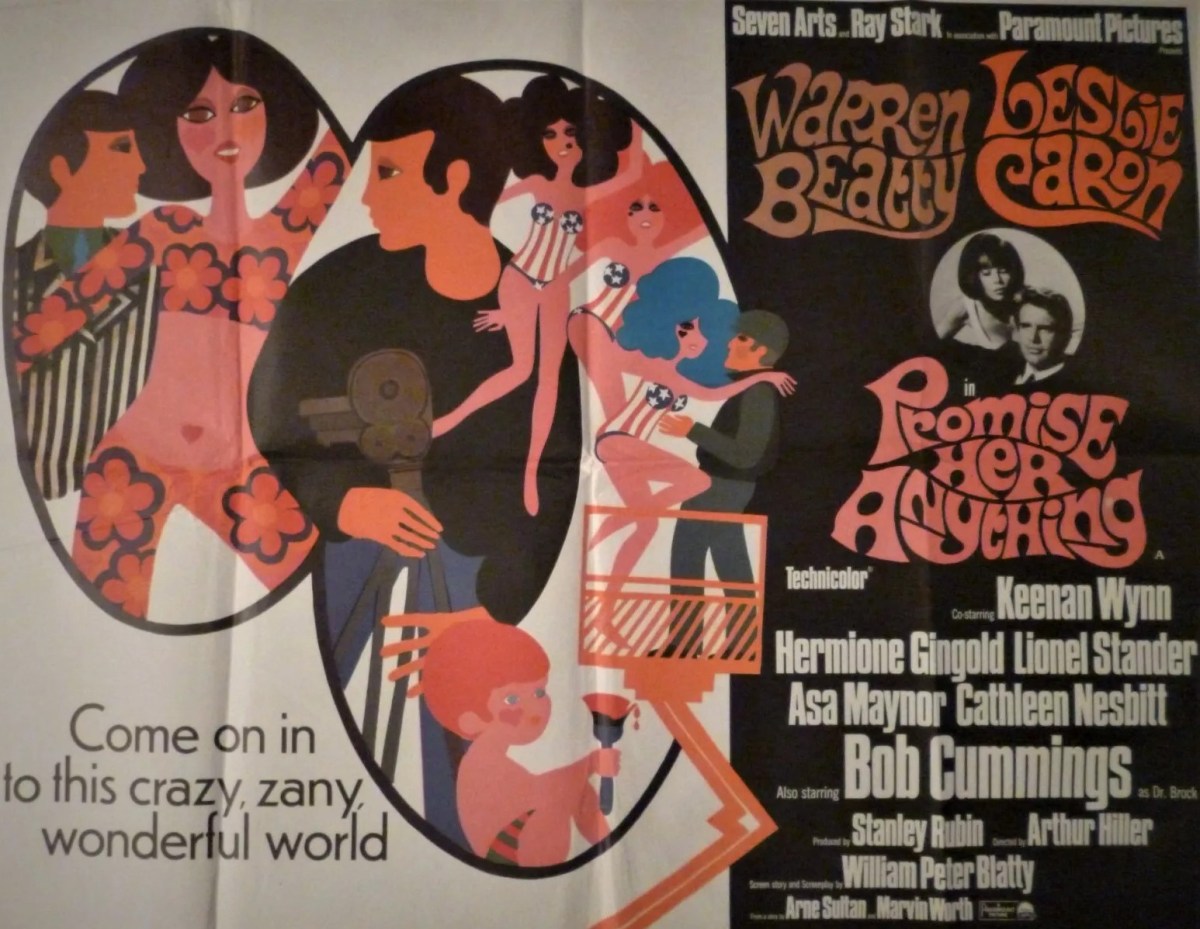
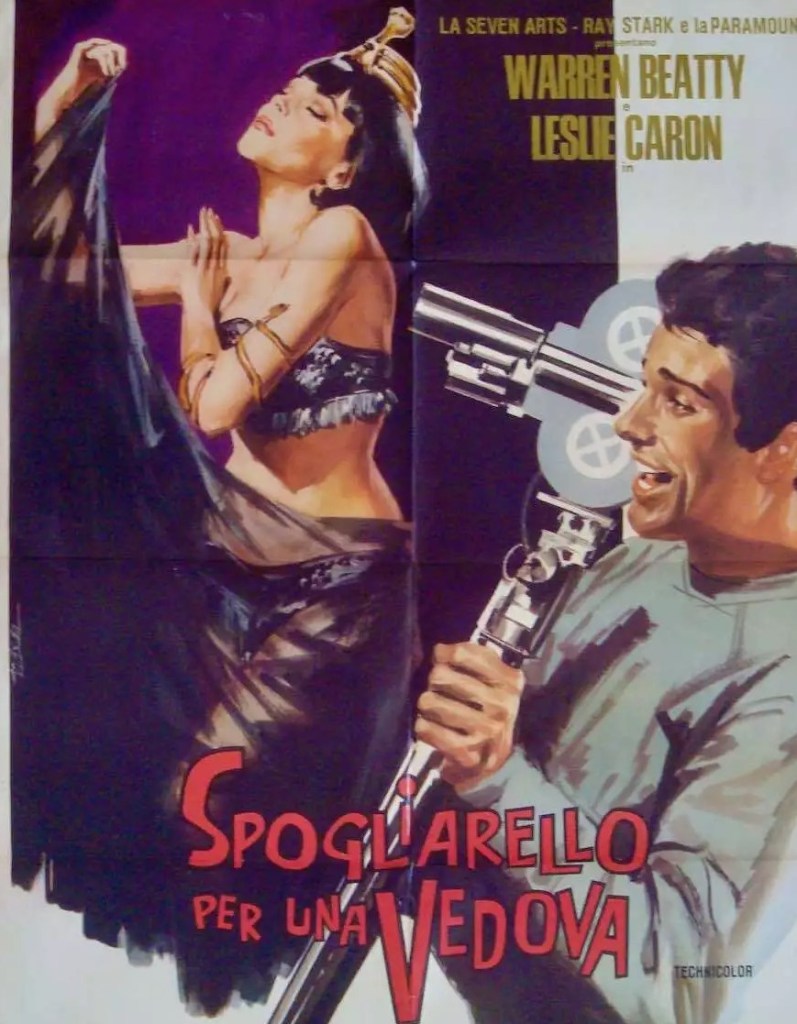
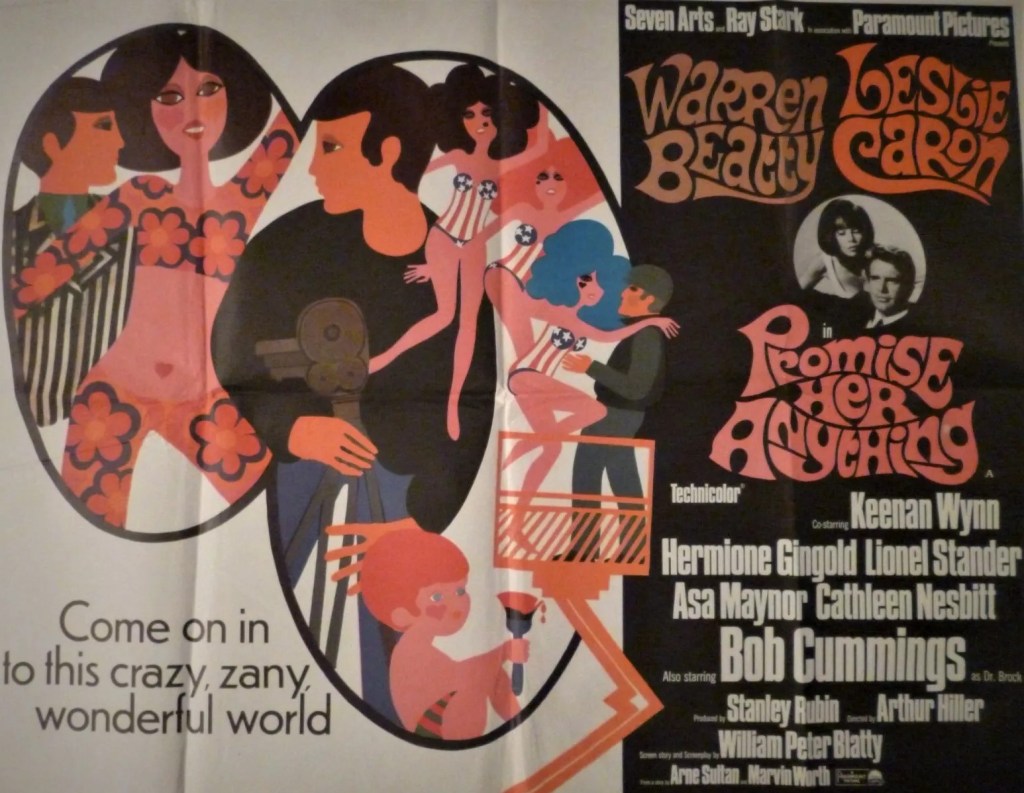
Promise Her Anything (1966) ***

You ever wonder what William Peter Blatty got up to before he scared the bejasus out of everyone with The Exorcist (1973)? He was a screenwriter, churning out somewhat formulaic comedies like this. There were two approaches to this subgenre. The potential lovers hate each other on sight and spend the rest of the film annoying each other before they discover they are actually in love. Or, they are kept apart by the simple process of one of them being in love with someone else.

Here Michele (Leslie Caron), widowed single mother, is trying to get her hooks into boss Dr Brock (Robert Cummings), a child expert, because she thinks he would make a great father. So, largely, she ignores the seduction attempts of nudie film director Harley (Warren Beatty). What Michele doesn’t know is that Dr Brock hates children – though some of his concepts (mocked at the time) seemed quite prophetic such as “corporal punishment is an admission of failure by the parents.” But, basically, she offloads the kid onto neighbors, keeping him out of the way till she gets her man.

Meanwhile, her cute baby John Thomas (Michael Bradley) is doing all the work of bringing the couple together. He more or less adopts Harley as a surrogate father and filming him turns out to be the refreshing new idea the director needs to satisfy irate backer Angelo (Keenan Wynn).

This could as easily have been entitled Babies Behaving Badly for John Thomas is introduced to the audience escaping from his mother and wrecking a jewellery story and spends most of the picture getting into trouble, for which his cuteness provides the requisite get-out-of-jail-free card. (The child’s name probably was the only thing guaranteed to raise a chortle among British audiences).

You spend a lot of time waiting for Michele and Harley to get it together, during which time neither of the alternative narratives – the Michele-Dr Brock subplot and the filming of the child – offer much in the way of sustenance. Theoretically, Harley isn’t the standard seducer of the period, the well-off kind who lives in a cool or plush pad and does something financially or artistically rewarding for a living. He lives in a crummy apartment in Greenwich Village and struggles to make ends meet, blue movies not as remunerative as you might expect.

Michele’s character is stuck in the 1950s more than the more liberated 1960s, with the ideas that a child needs a father, that you should marry for security, and that there’s nothing wrong with snaring a man by devious means. She’s pretty uptight and old school.

Warren Beatty’s career was on a distinctly shaky peg. Since his breakthrough in Splendor in the Grass (1961) he had been bereft of a commercial hit and not found critical acclaim, though there were some takers for Arthur Penn’s Mickey One (1965). Like other actors had before him, he had fled to Europe in the hope of finding better opportunities, but all he managed was this (though set in New York it was filmed at Shepperton Studios in Britian) and heist picture Kaleidoscope the following year, neither of which solved his marquee issues.

Leslie Caron hadn’t quite found her niche either. Nothing she had done had topped Gigi (1958) and though Father Goose (1964) had been a commercial success it put her in the comedy category whereas her more interesting work of the decade had been in the drama genre – Guns of Darkness (1962) and The L-Shaped Room (1962). In fact, as a Hollywood leading lady, this was pretty much her swansong.

Robert Cummings (Five Golden Dragons, 1967) is good value and the cast includes Keenan Wynn (Point Blank, 1967), Hermione Gingold (The Naked Edge, 1961), Lionel Stander (Once Upon a Time in the West, 1969), British television actor Warren Mitchell (The Assassination Bureau, 1969), Margaret Nolan (Goldfinger, 1964) , Viviane Ventura (Battle Beneath the Earth, 1967) and a blink-and-you-miss-it role for Donald Sutherland (Riot, 1969). Directed by Arthur Hiller (Penelope, 1966).

Tame stuff.

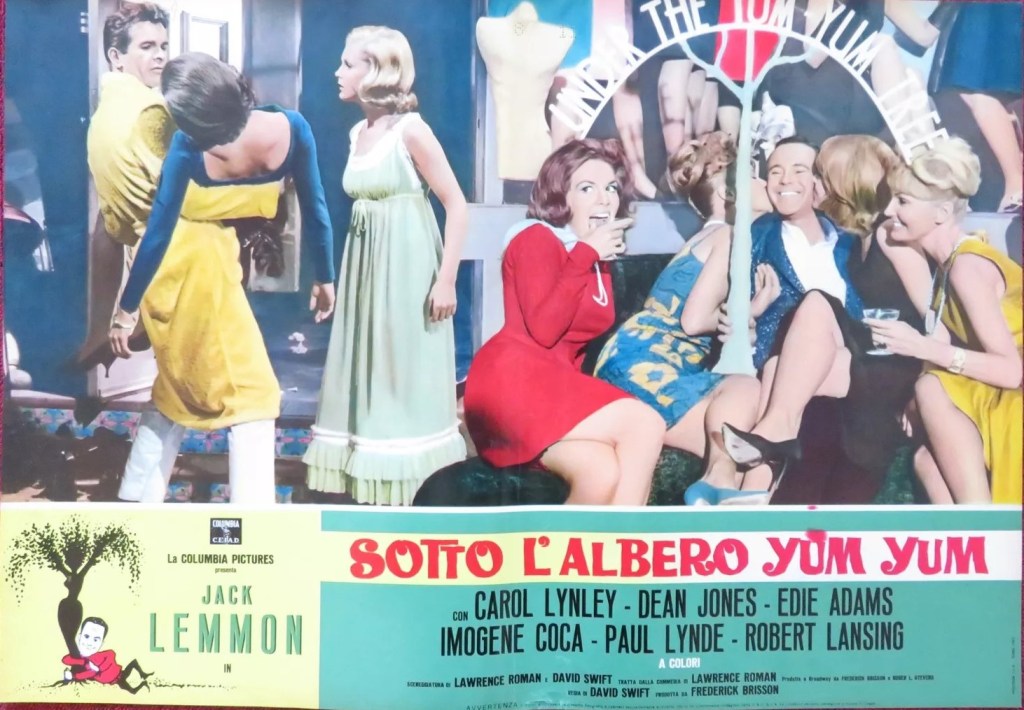
Under the Yum Yum Tree (1963) ***

Must have seemed a good idea at the time. A switcheroo from The Apartment (1960), where Jack Lemmon is the sap caught in middle of illicit affairs, to setting him up as the ace seducer with a string of girls at his beck and call. Except this won’t wash for contemporary audiences given that, effectively, he’s a sexual predator (seducer if you want to be nice about it), peeping tom (no way to dress that up) and eavesdropper (could have taught a class in  The Conversation, 1974). He lets out plush apartments to beautiful girls who either pay no rent or very low rents in return for favors granted.

He uses his own key to let himself into apartments and he’s got a telescope at the ready although that’s hardly required since all the ladies leave windows and doors open permitting him to gawk whenever he wishes.

Luckily, he’s not the mainstay of the tale. Nope, that’s breaking down another barrier, and very cleverly for the times. At this time, sex on the screen was usually the result of illegitimate affairs, involving at least one husband or wife, or it was a sex worker by any other name (Elizabeth Taylor in Butterfield 8, 1960, expects presents in lieu of cash). The idea of living in sin, as it used to be called, i.e. cohabiting without a marriage licence, was not generally on the cards.

So the deal here, to get round the snippy censor, was that Robin (Carol Lynley) and Dave (Dean Jones) set up home together to test out their compatibility but without sex entering the equation, him sleeping in a separate bed. Their apartment is let out by Hogan (Jack Lemmon), the predatory landlord. He has just been dumped by Robin’s aunt Irene (Edie Adams), hence the vacancy, and believes it’s two beautiful women moving in, not a couple. So his plan to offer two damsels a romantic meal with candles and violins (these play automatically) and a roaring fire (also electronic) falls apart.

That doesn’t prevent him from using his own key to enter the apartment at inappropriate moments and continuing his ardent wooing while trying to get rid of Dave or cause the kind of ruckus that’s going to cause the boyfriend to quit, leaving the coast clear.

Luckily, which gives the movie some acceptable life of its own, the dodgy landlord aspect takes second place to the lust vs logic argument that’s intrinsic to the idea of marriage. The couple spend most of the time arguing, and the movie is quite specific, much more than you might expect, on the ways in which a lusty young fellow can keep his ardor in check.

It’s based on a stage play, of the farce kind, so it relies on misunderstandings and misalignments and finds various ways of getting various combinations of the trio (and occasionally a quartet when Irene returns) in the room at the same time. There’s the usual problems when exchanges get heated.

Lurking in the background are married housekeeper Dorkus (Imogene Coca) and handyman Murphy (Paul Lynde), at opposite ends of the approval scale, the man even creepier than his employer.

Previously, I hadn’t found Jack Lemmon’s schtick so wearing, but his acting style is so frenetic you wonder how it ever found expression except in madcap comedy. It’s not just that his jaw constantly drops, but his eyebrows go up at the same time, and he might even be chucking in that trademark cackle. He toned it down for Days of Wine and Roses (1962) and jacked it up for The Great Race (1965) and somehow anything in between doesn’t quite work unless he’s got Billy Wilder on his tail.

But there are several pluses here. Carolyn Lynley (Bunny Lake Is Missing, 1965) proves an adept comedienne and Dean Jones was clearly in rehearsal for his later Disney pictures like The Love Bug (1967). Imogene Coca had been a legendary television staple, with her own show in the 1950s. There are fleeting glimpses of Bill Bixby (The Incredible Hulk, 1977-1982) and Variety columnist Army Archerd and James Darren (The Guns of Navarone, 1961), who died recently, sings the title song, and has a more robust voice than I had assumed for a pop singer.

David Swift (The Interns, 1962) directed and co-wrote the script with Lawrence Roman (The Swinger, 1966) from the latter’s Broadway hit.

A film of two halves. You can only cringe at the attitudes on display but enjoy the pre-marital ding-dongs between the couple.

Crooks and Coronets / Sophie’s Place (1969) **

The concept of “national treasure” – perhaps in itself a purely British conceit – wasn’t invented back in the day but if it had Dame Edith Evans would fall into the same coveted category as Maggie Smith and Judi Dench do today. She was certainly among the most honored of British thespians in the 1960s – Oscar nominations for Tom Jones (1963), The Chalk Garden (1964) and The Whisperers (1967) – so what she’s doing in this unfunny mess is anybody’s guess. She was 80 at the time and while easily the best thing in it, the switch between battiness and cleverness is hardly new.

Everyone is oh so British, including the gangsters led by Frank (Harry H. Corbett), and it should be the old trope of Yanks not coming to grips with English life and customs, which sometimes can strike a note, but instead the set-up is so dire and the acting so uninspiring. Warren Oates (The Thief Who Came to Dinner, 1973) is at his worst – when I tell you his best scene is his discomfort at having to hold a plate and cup-and-saucer at the same time, you’ll guess why. Telly Savalas attempts to be charming but it just comes off as an overheated version of his usual thug.

Story is lame. Herbie (Telly Savalas), just out of the slammer, finds he is in hock to mob boss Nick (Cesar Romero), so with buddy Marty (Warren Oates) sets off for England to fleece Lady Sophie Fitzmore (Edith Evans) only to discover that her stately pile is also in hock (you want to discover about British death duties, this is the one for you). British mob boss Frank doesn’t like the idea of the Yanks infringing on his territory, so is keeping a close watch and in the end decides to raid Sophie’s joint himself, by which time the Yank villains have become so enamored of Sophie that they’re on her side and set up the kind of defense that would have been axed from cockanamie comedies like The Great Race (1964) for not being funny enough. Sure, Edith Evans in goggles and racing in on a biplane looks good on paper but not when the thugs scatter like the Keystone Cops.

Edith Evans was exceedingly wary of the movies. She only made 14 – and just six pre-1960 and two of those in the silent era – in all those decades when she was otherwise devoting her time to the theater and best remembered by movie audiences for The Importance of Being Earnest (1952). According to Sir Laurence Olivier she only gave the movies another bash when her memory started failing her and the notion of only having to remember a few lines at a time exerted its attraction.

While she’s good fun here, she’s saddled with mutton for co-stars. Telly Savalas (The Assasination Bureau, 1969) theoretically wins his first leading role, but in fact that went to Edith Evans and better actors than him had faded away in Dame Edith’s slipstream. Quite what Warren Oates thought he could do with the part is anybody’s guess because he does nothing.

Written and directed by Jim O’Connelly (The Valley of Gwangi, 1969).

Viva Maria (1965) ****

Had it been a hit in the U.S., it could have changed the way women were portrayed on screen.

A box office smash could certainly have fired up a sequel (a key plank of the United Artists business model) and perhaps a reboot (Viva Marias! starring their daughters with or without the mamas). Could have led to the notion of Sophia Loren teaming up with Claudia Cardinale or Gina Lollobrigida and rescuing a captured male in a feminist twist on a western like The Professionals (1966). Imagine if it was Faye Dunaway and Jane Fonda carrying out the con caper in The Sting (1973).

Until Viva Maria!, two top female stars only appeared together in a movie as rivals for a male’s attention, or if one was the victim of nasty behavior from the other, or one was heading for an untimely death leaving the other to hog the screen in a tide of emotion.

Although it still remained virtually impossible to have a pair of female stars appearing together unless for weepie or noir purpose, the impact of Viva Maria was considerable. For a start, it invented the buddy movie four years ahead of that subgenre’s official inception in Butch Cassidy and the Sundance Kid (1969).

The poster preceded Clint Eastwood in pointing weaponry hardware menacingly at the potential audience, Gatling rather than a .44 Magnum. Speaking of Gatling guns, might have given Sam Peckinpah ideas for employing that weapon in The Wild Bunch (1969).

Neither molls nor victims, these women fell at the first woman’s picture trope. They were not rivals in love. Maria II (Brigitte Bardot) is of a polyamorous disposition and expresses no interest in Flores (George Hamilton) the revolutionary lover of Maria I (Jeanne Moreau). Forget Julie Christie sowing wild oats in Darling (1965) or any other of the other liberated ladies of the decade, Maria II is streets head, acquiring – and discarding – men by the bunch.

Nor is Maria II particularly interested in becoming that other female fixture of the 60s – the rebel – given that she spent most of her childhood as an accessory to her insurgent father’s violent acts, rolling out detonating wire or pressing the plunger in locales as varied as Ireland and Gibralter before watching her father died in an act of sabotage that went wrong.   

You would have thought that by this point in her career Brigitte Bardot (Shalako, 1969) could hardly get away with playing the innocent – setting aside her amoral intent – but audiences expecting titillation would have been surprised to see how quaintly she performs an accidental striptease which transforms their circus act, fortuitous really because Maria II has little sense of the rhythm required to be a stage performer.

Maria II resists becoming involved with Maria I’s messianic boyfriend but when he snuffs it she can hardly ignore his deathbed plea. The two Marias team up with the peasants to overthrow El Dictator (Jose Angel Espinosa ‘Ferrisquilla’) but not before they tangle with the Inquisition and the bad guys learn not to leave Gatling guns lying around. Would it be too much to argue that the female empowerment image of the decade is these two lasses spraying the enemy with bullets from the Gatling gun and, with more sense than Sam Peckinpah’s bunch, no intention of dying an heroic death.

It’s not a comedy in the normal sense, there’s no spoofing of revolution for a start, and it’s not so much filled with great one-liners as terrific sight gags. It’s more a drama with laffs. And, as you will be aware, revolution is good material for musicals – witness 1776 and Les Miserables, so don’t be surprised at the end to find our ladies treading the boards in Paris in a musical version of the revolution they have instigated.

Both Brigitte Bardot and Jeanne Moreau (Mademoiselle, 1966) throw acting caution to the winds, breaking out of the restraints of their screen personas, and almost as if freed from having to perform the dutiful female role of sacrifice, can turn their attention to embracing friendship and having a whale of a time doing so. George Hamilton (By Love Possessed, 1961) looks lost.

Most of what director Louis Malle (Atlantic City, 1980) attempts comes off though it might take you a little while to get to grips with the tone. Screenplay by Malle and Jean-Claude Carriere (Belle de Jour, 1967).

A blast.

Salt and Pepper (1968) ***

Dry run for the director Richard Donner’s later Lethal Weapon? A cautionary tale about what might have happened to the revered Rat Pack series had it spluttered on into the vestiges of the  “groovy” Sixties? An attempt to emulate the Bob Hope-Bing Crosby joker-crooner concoction? Or Morecambe and Wise, two idiots on the loose? Spy movie spoof? Stuffy Brits in the firing line?

All of the above. If you are comfortable with the sexist agenda that was almost de rigeur for the times, don’t mind the movie’s lurching tone, or the scattergun gag approach, the glib approach to violent death, and don’t cringe at the running racist jokes (making fun of racism, you understand) you might well find enough to like.

Especially as this was something or an audition. A way to check whether, in Hollywood marquee terms, stars Sammy Davis Jr. and Peter Lawford could cut it. For such a renowned celebrity, this was one of only two films where Sammy Davis Jr. was top-billed. And for Peter Lawford, an eternal supporting actor, this was the highest billing he ever achieved outside of the Italian-made The Fourth Wall (1969).

Salt (Sammy Davis Jr.) and Pepper (Peter Lawford) – that’s your first joke, right there, the names, work it out – are under investigation by the London cops for their Soho night club, which doubles as a gambling joint where the croupiers are not only, unusually, female (strike one for feminism) but topless (strike out for feminism). Both consider themselves lotharios and have a running bet on who will be the more successful (so that’s all right then).

But they’re not that bright when it comes to women (so one in the eye for those James Bond types), as neither could spot a femme fatale is she had those words branded on her forehead (the forehead the last female feature they’re interested in), and the prospect of an inert female lying on the office floor is so inviting to them that it doesn’t occur to them they’re trying to chat up a corpse.

Anyways, the dead woman Mai Ling (Jeanne Roland) is a spy and soon our boys are caught up in an espionage tale that dithers between hard-nosed Soho thugs with requisite scars (and a twitch), posh villain with piratical eye-patch, Downing St and duff British officialdom, real and fake Prime Ministers and Home Secretaries, public schools (and a gag about “fags”) and car chases in a Mini-Moke stacked with standard 007 extras like machine guns and oil-spraying devices.  

So it’s one wildly imaginative situation after another, interrupted by stage turns by Sammy Davis Jr. (presumably to remind people this was a Rat Pack rip-off), with the cream of the British character acting fraternity being permitted to go way outside the stiff-upper-lip British box.

Fits neatly into the spy spoof, or the Eurospy spoof (which tended to be overloaded one way or another). Shame about the wayward direction and outlandish script because Sammy Davis Jr. and Peter Lawford do make a fine screen comedy pair, matching each other in ineptitude, and with Davis coming top of the Swinging Sixties Fashion Faux Pas Top Ten, with the kind of outfits that only attention-seeking nutjobs or villains would consider wearing.   

Plenty of fun watching the supporting cast play around with their screen personas. John Le Mesurier (Midas Run, 1969), Michael Bates (Hammerhead, 1968), Robertson Hare (All Gas and Gaiters series, 1966-1971), Graham Stark (The Plank, 1967) and Ernest Clark (Arabesque, 1966) are getting paid to have fun. Ilona Rodgers (Snow Treasure, 1968) makes her movie debut.

You kind of get the idea that Michael Pertwee’s screenplay fell into the wrong hands. That it was intended as a vehicle for Morecambe and Wise (Pertwee wrote The Magnificent Two, 1967) and somehow ended up with American stars.

If your familiarity with the 1960s espionage genre runs only to James Bond, Matt Helm, Harry Palmer and that big-budget ilk and your idea of a spy spoof is limited to Casino Royale (1967), this will fill you in on the breadth of inanity tolerated.

Successful enough to generate a sequel, One More Time (1970).

The Reivers (1969) **

Vanity project. Two words to strike fear into the heart of a studio executive. Generally means a star has got the worthy itch. Determined to attach himself to a movie of Shakespearian proportions. Something with literary heft. Wants to break clean away from the persona that made him a star.

Experienced studio honcho, scenting red ink a mile off, rejects the proposal, or agrees to it on the condition said star first makes two, maybe even three, of the studio’s more straightforward movies. (Warner Bros had Steve McQueen on a six-picture contract). On the other hand, out there, in the Hollywood hinterland, there’s always some less well-known producer willing to pony up an enormous fee as the price of making his name. Or, in this case, a nascent mini-major, the kind that thinks it will become an ”instant major” should it sign a contract with the biggest name on the planet after the rip-roaring box office of Bullitt (1968). Step forward Cinema Center, the movie arm of CBS television, desperate to make a Hollywood splash.

Am sure the pitch wasn’t: “comedy about a thief and a sex worker.” More likely the plus point was William Faulkner, America’s most famous living writer (along with John Steinbeck), winner of the biggest award in literature, the Nobel Prize, whose short story provided the source material. Faulkner also, as it happened, had a decent movie pedigree having adapted Bogart-Bacall vehicles To Have and Have Not (1944) and The Big Sleep (1946) while an adaptation of his short stories into The Long, Hot Summer (1958) hit the box office jackpot.

Admittedly, The Sound and the Fury (1959) and Sanctuary (1961) had been less successful, but Fox had also turned The Long, Hot Summer into a television series that ran for two seasons, so the author’s name would be fresh in the audience mind.  

It’s always a worry when an actor changes his hair style. Means he’s going method or “acting.” Here, Boon (Steve McQueen) sports a bushy blond barnet. And spends most of the time in “aw shucks” mode, whirl-winding his arms, contorting his features, doing most of the things a decent director would have told any other actor to cut it out. It would take a lot more acting talent than Steve McQueen, pushing 40, can tap into to successfully convince as a guy in his 20s

At least, he’s acting enough to allow himself to be covered head-to-toe in mud, something a major star would generally avoid. The comedy is as broad as you can get and director Mark Rydell (The Fox, 1967) shows little aptitude for it, not least in knowing when to stop milking a scene.

Biggest problem is that Boon, in narrative terms, is not the star, merely the conduit. The story actually concerns 11-year-old Lucius (Mitch Vogel) growing up, as he’s lured into a scheme hatched by Boon to borrow his employer’s spanking new automobile (this is 1909, by the way) and head off for the local whorehouse. Along the way, the child becomes a jockey riding a race Boon must win.

Sex worker Corrie (Sharon Farrell) has the other major story strand and the biggest element here is the relationship between herself and the boy. When he brings out her mothering instincts, she is ashamed of her profession and she plans to quit. The boy sees a naked woman for the first time – a painting, not in person – loses his worship of Boon and doesn’t “quit” as if he’s in a hard-tack B picture.

Pretty much glossed over is the rape. You can’t have rape in a comedy, can you? But for various reasons Boon and his black buddy Ned (Rupert Crosse) and the ladies from the whorehouse have ended up in jail. Price of freedom is Corrie having sex with corrupt cop Butch (Clifton James). Corrie has the best scene, the look of humiliation on her face, when released from the cell to be raped by the cop. And this was a film sold as “a lark.”

And, of all things, Boon is purportedly in love with Corrie, but not so much that he doesn’t plan on having sex with one of the other girls, given he visits the whorehouse three times a week and Corrie, in a bit of a tizz, has turned him down.

Small wonder this has never been the subject of an anniversary revival. Hard to see how the attitudes reflected here would connect with the contemporary audience. Scarcely believable that McQueen could get himself involved, even for the privilege of being linked, at some remove, with William Faulkner.

Chances are what originated from the Faulkner pen as a more somber coming-of-age tale was altered by screenwriters Irving Ravetch (doubling up as producer) and Harriet Frank Jr (The Dark at the Top of the Stairs, 1960) to fit in with McQueen’s ambitions. The star had not wanted to make Bullitt, having an aversion to cops, and this looks like his attempt to make up for it.

Actually, it did well at the box office, Rupert Crosse and composer John Williams nominated for Oscars and McQueen and Mitch Vogel for Golden Globes.

A different McQueen, to be sure, but the subject matter is objectionable and the comedy is forced.  

Bedtime Story (1964) ***

Con men at opposite ends of the grifter divide face off in a duel over territoriality in the French Riviera. Freddy Benson (Marlon Brando) is a low-level scam artist who is happy to scrounge a meal or talk his way into an innocent damsel’s bed. Lawrence Jameson (David Niven) is his polar opposite, posing as an impoverished aristocrat to relieve gullible women of their wealth, seduction an added extra.

Initially, Jameson gets the better of their encounters until Benson realizes just what a killing the Englishman is making. Initially, too, Benson is happy to pair up with Jameson, although that involves demeaning himself as a supposed mad brother kept in a dungeon, until the Englishman dupes him out of his share. Eventually, they agree a winner-take-all battle – whoever can swindle heiress Janet Walker (Shirley Jones) out of $25,000 shall inherit the shyster kingdom.

Benson takes the sympathy route to the woman’s heart, turning up in a wheelchair, while James adopts a psychological approach, persuading Ms Walker that Benson’s illness is psychosomatic for which he has the cure for the small consideration of $25,000. And then it’s one devious twist after another as the pair attempt to out-maneuver, out-think and generally embarrass the other. Both have a despicable attitude towards women, whom they view as dupes, but it is woman who proves their undoing.

Most comedies rely on familiar tropes and you can usually see the twists coming, but this is in a different imaginative league and once the pair are in their stride I defy you to work out what they will come up with next. It is full of clever quips and small dashes of slapstick and because neither actor chases the laughs but plays their roles straight it is a very effective and entertaining morsel.

Director Ralph Levy in his movie debut knows more than where to just point a camera since he had decades of experience extracting laughs in television with top comedians like Jack Benny and Bob Newhart. Brando (The Chase, 1966) free of the shackles of the angst he normally incorporates into his dramatic performances, looks as if he is having a ball and while teetering occasionally on the edge of mugging never quite overplays his hand.

David Niven (Prudence and the Pill, 1968) was born with a stiff upper lip in his mouth and while this kind of aristocratic character is a doddle for an actor of his stature the portrayal here is much more like the sharpest tool in the box. While oozing charm, Niven exhibits deadly spite.

Screenwriters Stanley Shapiro and Paul Henning had previously collaborated on Lover Come Back (1961) and Shapiro particularly made his bones on the Doris Day-Cary Grant-Rock Hudson axis so it is interesting to see him shift away from the romantic comedy cocoon into something that is a good deal sharper.

Enjoyable and original with excellent performances from the two principles and great support from Shirley Jones (The Music Man, 1962) as the mark and Egyptian Aram Stephan (55 Days at Peking, 1963) as an only too congenial French policeman.

Good fun, stars in top form.

Do Not Disturb (1965) ***

Takes a good while to come to the boil, perhaps as a result of trying to find the right chemistry between Doris Day and her latest 1960s partner Rod Taylor, after her highly successful pairings with Rock Hudson in three films. Her turn with Cary Grant (That Touch of Mink, 1962) was also successful, but finding another pairing proved dificult. There was a single outing with David Niven (Please Don’t Eat the Daisies, 1960),  a pair with James Garner (The Thrill of It All and Move, Over Darling, both 1963) plus a couple of ventures outside the comedy genre, thriller Midnight Lace (1960) with Rex Harrison and musical Billy Rose’s Jumbo (1962).

One of the curiosities was her billing status, credited below Rock Hudson and Cary Grant, but above all the others. Hudson, Grant, Garner and Niven demonstrated a clear knack for comedy, less so the rest. So one of the elements facing any screenwriter or director was how to make a pairing fizzle. With the top-billed stars, there was more of a guarantee of equal playing time so that they could spark off each other. In the remainder, more reliance on the actress’s pratfalls and slapstick and being some kind of fish out of water.

Here, the Ameican fish is let loose in London waters and good chunk of the opening section is taken up with the oddities of England from an American perspective. First of all, it’s the coinage. A simple transaction with a cab driver soon involves a policeman what with her difficulty in getting to grips with “too many coins”, most of which to add to the confusion often have a nickname, resulting in her paying eight shillings and sixpence for every subsequent ride since that’s the one amount she’s mastered.

Then it’s the problems of driving on the wrong side of the road, using a different gearbox, and the peculiar nature of village names, that either result in a crash or getting lost or both. The difference between electrical plugs lends itelf to electrocution jokes, and the inefficiency of the British telegram system tops off a scene. There’s not much magic even a Doris Day in her prime can add to such standard situations.

She comes into her own somewhat by standing up to the masters of a fox hunt and their snarling hounds. But somehow sheltering a fox appears to give her some affinity with animals and before you know it her country house is awash with unsuitable beasts such as goats.

Still with me? That’s kind of the feeling I had about a third of the way into the picture. So here’s the set-up: businessman Mike (Rod Taylor) and wife Janet (Doris Day) have moved to London. He details her to find an apartment, meaning in central London close to his office. Instead, she lands them in a country cottage, and he immediately resents being so remote from the city and with the extra travelling time plus the evening functions (held in the company flat) in his schedule soon the couple are heading towards estrangement.

He has a pretty secretary Claire (Maura McGiveney) in tow and the functions are meant to be wife-free zones, and when Janet tests out her suspicions she is initially brought down to earth with a thump.

But, of course, suspicion grows horns and with the encouragement of interfering  landlady Vanessa (Hermione Baddeley) she decides to play him at his own game. Once handsome Frenchman Paul (Sergio Fantoni) hoves into view she pretends to take up with him to bring her husband to heel. This involves a romantic trip to Paris where, of course, Doris Day is in her comedic element, desperately trying to avoid the advances of her suitor and getting drunk in the process. Day makes an excellent drunk and inebriation cue for many of her best sequences.

Much of the seduction is driven by the foreigner and the secretary so husband and wife find themselves in one compromising position after the other. However, this narrative ploy means the two stars are often apart and the success of the picture depends on two separate individuals rather than the teaming as with the Hudson and Grant movies. To use the old cliché, it’s game of two halves, three-thirds really since the opening section is mostly the fish out of water stuff. They’re an odd combination from the outset, a wife who does the opposite of what her husband wants then complains when, tied down with business, he doesn’t want to live in the country.

There’s an occasional belly laugh but it seems such routine fare that you wonder why Day got involved in the first place – blame husband Martin Melchior for signing her up.

After original director Ralph Levy (Bedtime Story, 1964) – you could view this as a reversal of Bedtime Story with the principals target for seducation rather than doing the seducing – took ill, George Marshall (Advance to the Rear, 1964) finished it off. Written by Milt Rosen (movie debut), Richard L. Breen (Captain Newman M.D., 1963) and William Fairchild (Star!, 1968)

For completists only.

The Adventures of Bullwhip Griffin (1967) ***

All studios believed in their brand name. That the sight of the  MGM lion or the Twentieth Century Fox searchlight or the Paramount mountain represented a quality mark that would buffer expectation and reassure an audience they were not going to be rooked. That might have been the case decades before when the Warner Brothers logo might mean gangster pictures or socially aware movies or MGM, with more stars than there are in heaven, pictures with top-notch talent, or Universal determined to scare the pants of you with its horror catalog.

But that was no longer the case, most studios so desperate for survival that they would fork out for whatever trend seemed most likely to make money and the industry lurched from western to musical to adventure and back again whenever a big hit appeared. The only studio which still retained genuine marquee appeal was Disney. As studios dipped into more unsavory fare, according to the older generation, and the prospects of sending your children to the movies without having to check out the picture in advance diminished, a Disney film was a guarantee of fret-free entertainment.

Throughout the decade adults as much as kids swarmed to the Disney repertoire. In 1961 the studio scored a box office triple whammy when The Absent-Minded Professor, The Parent Trap and Swiss Family Robinson took three of the top four slots in the annual box office race. In the following years Bon Voyage (1962), Moon Pilot (1962), Son of Flubber (1963), In Search of the Castaways (1963), The Sword in the Stone (1964), The Misadventures of Merlin Jones and especially Mary Poppins (1964) kept the studio buoyant, not to mention the string of pictures starring Hayley Mills and a stack of animated classics it could reissue at the drop of a hat.  

Disney ruled the lightweight world, its films often driven by a simple plot device. And as the rest of the industry coveted sex and violence, exhibitors relied on Disney to bring in the kids (and adults) during holiday periods. It would end the decade on a whopping high with The Love Bug (1969).    

Here, the ploy is as old as the hills, a fish out of water, in this case an English butler. Disney had rung the changes on that particular sub-genre through the governess in Mary Poppins, steadfastly ignoring a trend towards more sinister servants as demonstrated by The Servant (1963) and The Nanny (1965). But Disney did have the ability to hook name actors for its child-friendly movies, here Roddy McDowall (Lord Love a Duck, 1966), Oscar-winner Karl Malden (Nevada Smith, 1966) and Suzanne Pleshette (A Rage to Live, 1965).   

If you are expecting whiplashing escapades of the Indiana Jones variety, you will be in for a disappointment. Eric Griffin (Roddy McDowall) is the aforementioned butler escorting a child Jack (Bryan Russell) on a treasure hunt through the gold fever American West. When his charge runs away, Griffin finds the boy stowing away on a ship. The ever-genteel Griffin has skills that see him through any situation, working as cook on the ship, setting up his stall as barber on the mainland, and occastionally employing a devastating right hook to knock seven bells out of giant bully Mountain Ox (Mike Mazurki).

The plot, such as it is, revolves around recovering a treasure map stolen by swindler Judge Higgins (Karl Malden) and eventually when the movie needs some zap the feisty Arabella Flagg (Suzanne Pleshette), Griffin’s bankrupt employer who as it happens fancies the bulter, turns up.

There’s enough action to keep the picture on a steady keel, a storm at sea, a stagecoach hold-up, prizefight and a climactic town-wrecking fire. There are, perhaps surprisingly, a few choice lines.

But there’s a misinterpretation at the center of the movie so it’s as well its made with kids in mind. The fish-out-of-water notion would play better if historically movies fielded idiot butlers rather than ones who tended to take command when things get tough, though it’s unliklely kids would be aware of previous entries in the sub-genre. So, theoretically, it’s a surprise when Griffin outfights the lummox and outwits the swindler.

If the kid isn’t cute enough there are compensations elsewhere, a decent support in Harry Guardino (The Pigeon That Took Rome, 1962) and Hermione Baddeley (Harlow, 1965). Roddy McDowall at least is in a movie that suits his screen persona and deceptively languid acting style while Suzanne Pleshette takes a feminist slant to the Wild West. Whether British comedian Tony Hancock – he was sacked during filming – would have added much to the proceedings is open to debate.

It’s worth remembering that, outside of Hayley Mills offerings, Disney comedies of this period revolved around adults coping with bizarre situation. This doesn’t quite have the gimmicks that drove Son of Flubber, The Ugly Dachshund (1966, also headlining Pleshette) and Lt Robin Crusoe U.S.N. (1966).

Adequately directed by James Neilson (Dr Syn Alias the Scarecrow, 1963) from a screenplay by Lowell S. Hawley (Swiss Family Robinson) drawn from the novel The Great Horn Spoon! by Sid Fleischmann.

I remember seeing this as a kid and feeling pretty content coming out of the cinema, so since it did what it says on the tin, I’m loathe from an adult perspective to take it to pieces.

A movie that says – lighten up!

The Pigeon That Took Rome (1962) ***

Netflix would know how to sell this. Append the “based on a true story” credit and you’ll attract a global audience. I’ve no idea how true this tale is though I assume that at certain points in war using a pigeon may have been the most efficient method of communication. If this had been under the Netflix aegis there would surely have been a scene to explain that you can’t just point the bird in any old direction but that it automatically returns to its home, that aspect being pivotal to the movie, the reason it was made in the first place.

That is, if you believe in the rather fanciful notion, as shown in what appears to be an official newsreel, of said pigeon being presented with a medal for its part in the Allied invasion of Rome in World War Two. Luckily, there’s more to this picture than the intricacies of homing pigeons.

Not much more, I hasten to add, because the other significant plot point, which I suspect has a more substantial basis in truth, is that passing American soldiers had a tendency to  impregnate (and abandon) Italian women. If you were to argue that Elsa Martinelli (who had just put John Wayne in his place in Hatari!, 1962) is what saves the picture you wouldn’t be far wrong. But you can’t complain about Hollywood churning out lightweight movies in the 1960s since a chunk of the current output falls into that category.

For no apparent reason, no espionage experience for example, Yank soldiers Capt MacDougall (Charlton Heston) and Sgt Angelico (Harry Guardino) are delegated to sneak into Rome, disguised as priests, and spy on the Germans. They are put up in the household of Massimo (Salvatore Baccaloni), an underground figure, but his daughter Antonella (Elsa Martinelli) takes against the pair since they are extra mouths to feed and if only the Americans would hurry up and enter the city the populace wouldn’t be starving. However, she makes nice when her sister Rosalba (Gabriella Pallotta) reveals she is pregnant by a previous Yank (whether he was the espionage business, too, is never revealed) and is desperate need of a husband.

The sergeant is quite happy to romance the girl since a couple smooching in the park makes good cover for him transmitting messages by radio. And when that form of transmission becomes too dangerous, the Americans rely on pigeons. Soon Angelico realises his feelings for Rosalba are real and proposes to her, even after she reveals her condition. But that means celebration to announce their forthcoming nuptials.

Short of any food, Antonella slaughters the pigeons, convincing MacDougall that the meal consists of squab. To cover up, the Italians steal a bunch of pigeons from the Germans. Of course, as you’ll have guessed, that means the pigeons will return to the enemy. But once MacDougall works this out, he starts sending the Germans false messages that prove (apparently) pivotal to the Germans hightailing it out of the city (hence the medal awarding).

Pretty daft and inconsequential sauce to be sure, but Antonella keeps matters lively, knocking back MacDougall at every turn, taking every opportunity to condemn men for starting wars, and presenting herself as something of a conniver, possibly willing to lead on the Germans in return for food (MacDougall when burglarizing a German villa comes across her naked in the shower). Her occasional swipes give the picture a harder edge than you’d expect, but, her fiance killed in the war, she leads MacDougall a merry dance in the manner of the romantic comedies of the day. Otherwise, the comedy is for the most part lame, the old hitting your thumb with a hammer one such moment.

Despite co-starring with Wayne and here Heston and later Robert Mitchum (Rampage, 1963), Martinelli didn’t fit into the Hollywood pattern of taking European stars and slotting them into the female lead opposite a succession of top male stars. Think Sophia Loren with Heston in El Cid (1961), with Gregory Peck in Arabesque (1966) and with Marlon Brando in The Countess from Hong Kong (1967) and headlining a few pictures on her own. Gina Lollobrigida led Rock Hudson by the nose in Come September (1961) and Strange Bedfellows (1965) and Sean Connery a merry dance in Woman of Straw (1964).

Martinelli seemed to fade too quickly from the Hollywood mainstream which was a pity because she’s the glue here. Charlton Heston (Number One, 1969) spends most of the time looking as if he wondered how he managed to allow himself to be talked into this. You want to point the finger, then Melville Shavelson’s (Cast a Giant Shadow, 1966) your man – he wrote, produced and directed it.

Worth it for Martinelli.

Discover WordPress

A daily selection of the best content published on WordPress, collected for you by humans who love to read.

The Atavist Magazine

by Brian Hannan

WordPress.com News

The latest news on WordPress.com and the WordPress community.