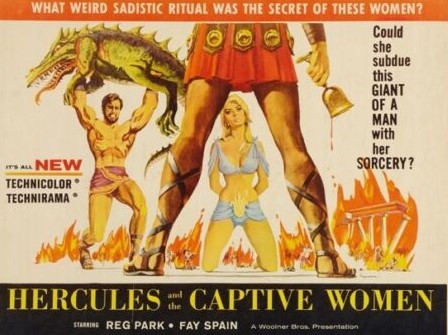
Hercules and the Captive Women /Hercules Conquers Atlantis (1961) ***

Something of a cult in the peplum vein, Hercules (Reg Park), wanting to enjoy domestic life with his wife and son, is instead drugged by Androcles, King of Thebes (Ettore Manni) and spirited away by ship to Atlantis whose Queen Antinea (Fay Spain) is intent on global domination and the resurrection of the dethroned god Uranus to his rightful place in the heavens.

This isn’t your normal Hercules, either, not that keen on demonstrating his strength, preferring to sleep or lie around. It’s not your normal ship either, Androcles, unable to persuade his senate to properly fund the expedition, has crewed his ship with renegades who are inclined to abandon Hercules on the nearest island  And unbeknownst to Hercules, his son has come along for the ride.
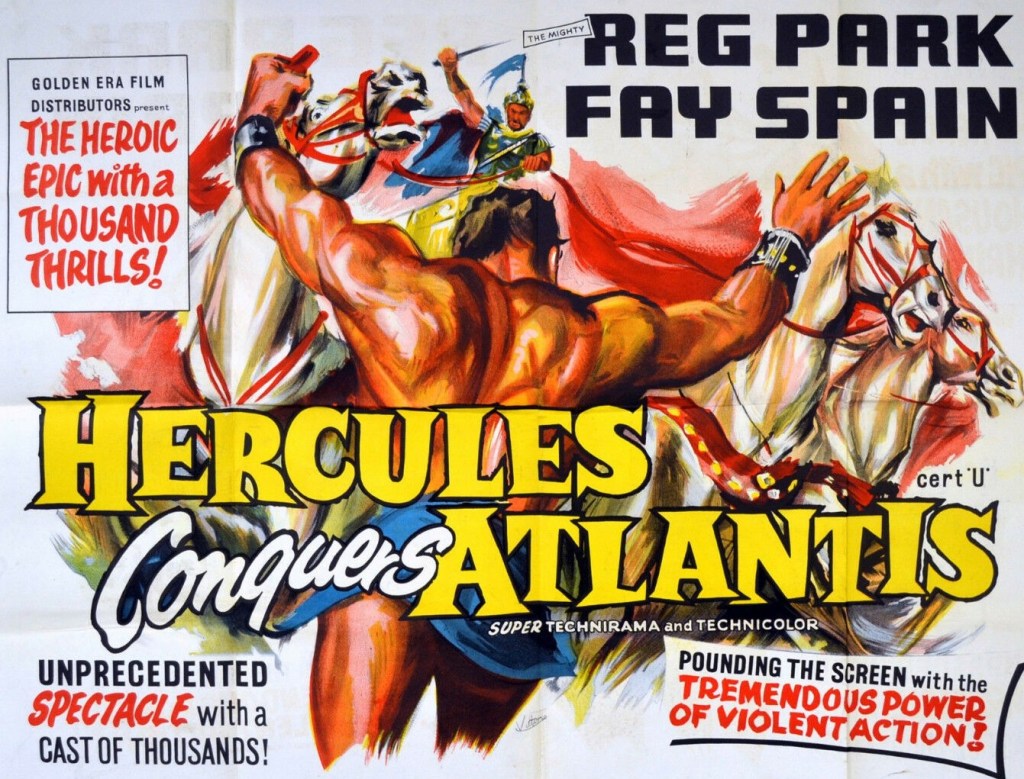
Of course, nothing goes according to plan and Hercules is soon shipwrecked on an island where he finds Ismene (Laura Efrikian) imprisoned on a rock as a sacrifice to the gods. Rescue never being simple, Hercules has to first withstand fire then tackle in quick succession snake, lion, eagle and a giant lizard. Ismene turns out to be Antinea’s daughter and the Queen, rather than being delighted at her return, is appalled for, according to the way the ancient world works with all its prophecies and religious ritual, the girl must be sacrificed to prevent the destruction of Atlantis.

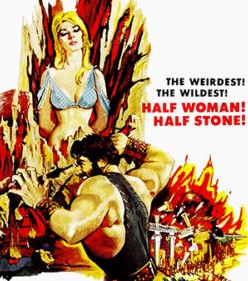
Nor is Atlantis your usual kingdom. Even setting aside the peculiarities that mark the Greek world, this is a place where abnormality rules. Hercules finds Androcles, whom he believed died in the shipwreck, but it turns out to be a vision, or some kind of shape-shifting being. The Queen believes she can subjugate nature and has a tendency to throw those who disappoint her into an acid bath. There is a fiery rock that controls life and death.

Like most of the peplum output, you have to accept a standard of production lower than the Hollywood norm, and the terrifying beasts sent to test the hero are not at all convincing, but on the plus side are feats of imagination that mainstream American studios would never conjure up, unless it was something that fitted into the swashbuckling genre. You pretty much have to go with the flow and accept what is offered in terms of narrative oddity. Bear in mind, too, that there is no one dressed in as skimpy a costume as suggested by the poster.
You also need to be get hold of a good copy. Several versions are available, some for free, where the colors are so washed out you can hardly determine what is going on never mind enjoy the costumes, creatures and sets as intended. This was filmed in Technirama 70, shot in 35mm but blown up to70mm widescreen for exhibition, so should generally be of a high technical standard – this was the process used by Spartacus (1960).

It’s not a film to fit into the so-bad-it’s-good category, but of course imagination too often exceeds budget which renders the filmmaking somewhat random at times and like the bulk of the peplums acting skill is not at a premium. As you might expect, the British-born Reg Park was a bodybuilder first – three times winner of the Mr Universe title – and an actor second. He played Hercules again another three times and Maciste once but outside this narrow comfort zone made no other films. But he was Arnold Schwarzenegger’s inspiration, so that was probably enough. American Fay Spain (The Private Life of Adam and Eve, 1960) never got  beyond bit parts as a B-movie bad girl and television, although she was seen in The Godfather: Part II (1974). Italian Laura Efrikina made her debut here and cou would later spot her as Dora in the Italian television mini-series David Copperfield (1966).

Director Vittorio Cottafavi was steeped in peplum, from The Warrior and the Slave Girl (1958) to Amazons of Rome (1961) but although he worked consistently in television made only one other picture, 100 Horsemen (1964).
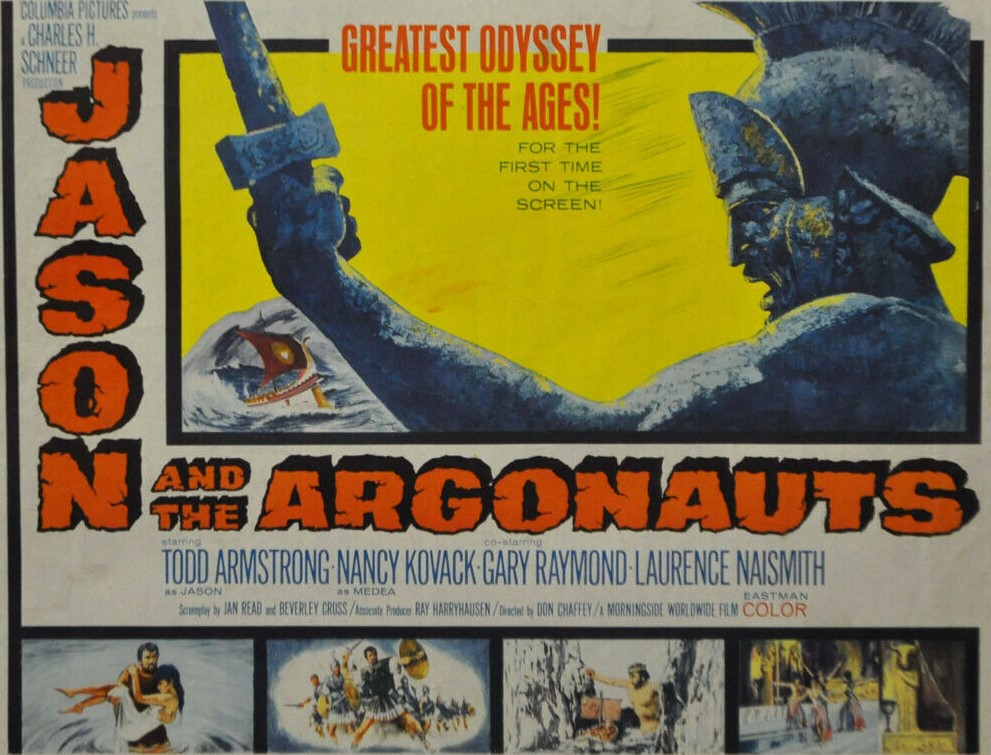

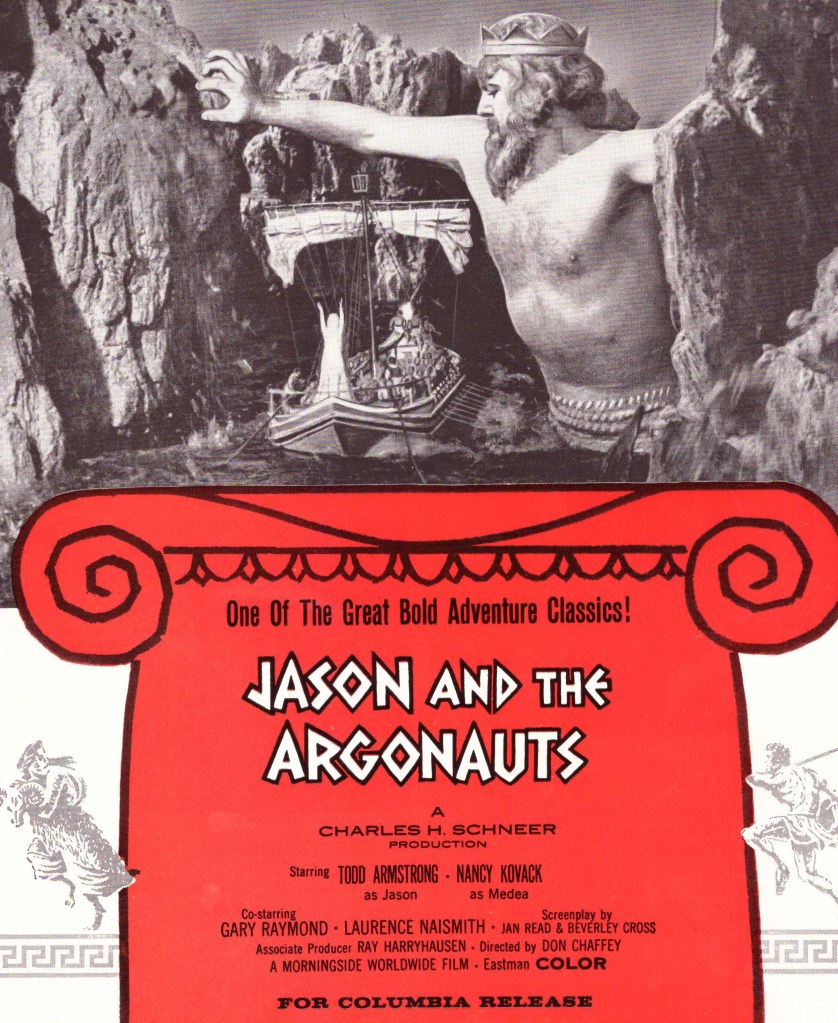
Jason and the Argonauts (1963) *****

An absolute delight, great storytelling married to groundbreaking special effects produces an adventure picture of the highest order. Though mostly known for its Ray Harryhausen stop-motion animation, its success also relied heavily on the direction of Don Chaffey (The Viking Queen, 1967) and a great script. It’s one of the few films to benefit from not being viewed in its original size, the small screen minimizing the flaws of the special effects. In essence it’s a combination of three genres – the Italian peplum, the men-on-a-mission picture and the classic detective story. 

Plus there are interesting stabs at philosophy – if man refuses to believe in the gods, do they cease to exist? And if the golden fleece brings peace and prosperity to a nation what will happen to that country when it is stolen?  And if various people call on their own gods for help will that not create conflict in heaven as much as on earth? And the ultimately question – what can man achieve without celestial interference?

While the episodic structure derives from the clues meted out piecemeal to hero Jason (Todd Armstrong) during his long voyage to find the golden fleece these often come minus vital pieces of information ensuring that surprise remains a key element.

Without doubt special effects are the triumph, although some work better than others. The highlights for me were the towering bronze statue of Talos and the skeleton warriors. I can’t be the only one who thinks that some of the visuals in Game of Thrones were inspired by the sight of Talos astride two land masses separated by the sea. Talos is not so much a man-mountain as an actual mountain, first viewed coming round the corner of a cliff top, his head topping it. But where, except for cunning Jason, the crewmen are viewed primarily in miniature in relation to the giant Talos, the skeletons are the same size as the adventurers and the fight scene all the more impressive as the ensuing battle appears completely real.

Scale allows Harryhausen to wriggle out of the problems of contact. If the creatures are out of reach anyway, there’s little need to attempt to bring them into close proximity. The way the Harpies are utilized, close enough to strip clothes from a blind man but otherwise hovering just out of reach, is a classic example of clever direction. The multi-headed Hydra, on the other hand, is the least convincing monster simply because it is impossible for Jason to get close to the beast. Scale is also one of the film’s best weapons. The scenes where a miniaturized Jason is transported to Mount Olympus to face the gods are well done as are the occasions when the gods peer down on tiny man.

Outside of the special effects and the varying degrees of excitement aroused, in the background there is constant intrigue. Jason is the son of the King of Thessaly slain by the usurper Pelias (Douglas Wilmer) and his crew includes Acastus (Gary Raymond), son of Pelias, whose task is to cause trouble and if Jason succeeds in his endeavor to kill him. On top of that, there is a heavenly battle over Jason’s fate. Jason, having defied Zeus (Niall MacGinnis) by first of all refusing to believe he exists and that his life is determined by fate, becomes enmeshed in a battle between the king of the gods and his wife Hera (Honor Blackman) who grants Jason a get-out-jail-free card, the ability to call on her help, but only five times.

Jason determines to recruit his own team and in the manner of The Guns of Navarone (1961) and The Professionals (1966) they are all experts in their fields but unlike that film and The Dirty Dozen (1967) are willing conscripts. The team also includes Hercules (Nigel Green) and Hylas (John Cairney) and in the first of the film’s many surprises and reversals, the weedy latter is able to beat the muscular former in a contest of strength.

There is enough incident to keep the story ticking along but Don Chaffey fills in the blanks with montage, the various essentials of a ship – sails, oarsmen, sides, stern, figurehead, pace set by drumbeat  – and a full color palette from the bright blue sky, to dawn and dusk and sunset and night, a wonderful image of rowers at sunset on the sea the pick. He also makes great use of the sea – pounding surf, storms, the sea turned tempest by the clashing rocks, a shipwreck. And we have dancing girls, colorful costumes, ancient backdrops and the sense that the budget has been well spent

Some scenes call for immense skills in coupling special effects with real characters. For the clashing rocks sequence five elements are simultaneously in play: the crew in danger, a tempest, rocks crashing into the water, the ship itself and Neptune.

And the romance is well handled dramatically: if Jason rescues Medea (Nancy Kovack) then she too rescues him. Love produces conflict. To love Jason, Medea must betray her country. There is hardly a moment when Jason, confronted either by monsters or kings, does not face death.  

In addition, there is a stunning score by Bernard Herrmann (Psycho, 1960).

Any top-notch acting would have been over-shadowed by the special effects. Which is just as well because the entire cast is drawn from the lower strata of the stardom ladder. Todd Armstrong, from the Manhunt tv series (1961), needs only not to mess up, which he manages adequately. Nancy Kovack (Diary of a Madman, 1963) does well to make an impact given she does not appear until the final third. This did not turn out to be much of a star-making vehicle for either. Honor Blackman drops the slinky persona with which she had made her name in The Avengers tv series (1962-1964) and instead plays a confident goddess willing to out-maneuver husband Zeus.

The rest of the cast comprises a regiment of future movie supporting actors – Nigel Green (Tobruk, 1967), Niall MacGinnis (The Viking Queen, 1967) and Douglas Wilmer (The Brides of Fu Manchu, 1966). Future television stars range from Patrick Troughton (the second Dr Who) and Scottish actor John Cairney (This Man Craig, 1966-1967) to Laurence Naismith (The Persuaders, 1971), Gary Raymond (The Rat Patrol, 1966-1968), Mike Gwynn (Poison Island, 1965) and Andrew Faulds (The Protectors, 1964).

The screenplay was written by Jan Read (First Men on the Moon, 1964) and Beverley Cross (The Long Ships, 1964), husband of Maggie Smith. Cross returned to ancient worlds again for producer Charles H. Schneer for Sinbad and the Eye of the Tiger (1977) and Clash of the Titans (1981)

Although the ending appeared to leave the door open for a sequel, none was made. A huge box office hit in Britain, it did not repeat its success elsewhere.

I first saw this film as a boy and was so enthralled I wouldn’t have noticed if there was anything awry with the special effects. I have not seen it since. Coming at with some degree of skepticism I found that attitude misplaced. I was equally enthralled.

Seven Seas to Calais (1962) ***

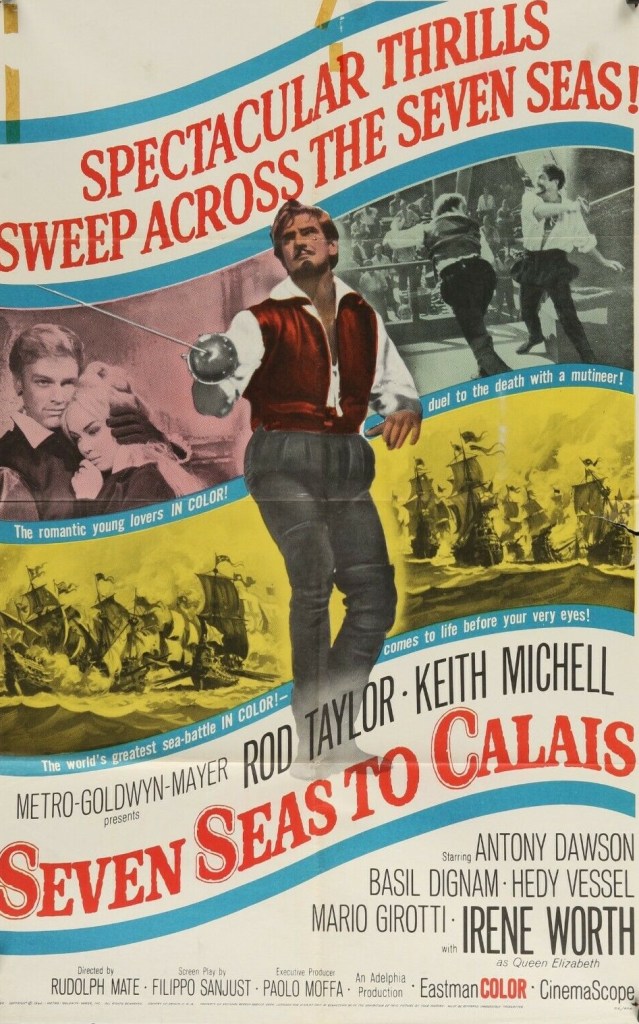
In between hi-hat Hollywood endeavors The Time Machine (1960) and The Birds (1963) Rod Taylor made a couple of pit stops in Italy. Here, he tries his hand at a swashbuckler and does a pretty good job of it, depicting famed English naval hero Sir Francis Drake, in a story that covers about a dozen years from him circumnavigating the globe to masterminding the defeat of the Spanish Armada in 1588.

Not content with glorifying tales of his derring-do as he robs the Spanish of their gold, the producers also mine a rich seam of political intrigue as Spanish King Philip II (Emberto Raho) seeks to nullify the English threat first by a treaty and then by conspiracy before full-blown invasion seems the better option.

Queen Elizabeth (Irene Worth) proves a political maestro, telling the Spanish what they want to believe and condemning Drake’s activities in public while in fact privately financing his expedition and waiting for his pirate gold to underpin her navy. 

After putting down a potential mutiny, most of Drake’s time is spent plundering Spanish galleons or gold mines. When not pillaging, Drake takes time out from his adventures to discover potato and tobacco and for a romantic dalliance with what appear to be Native Americans (judging from the feathers they wear) including a young woman called Potato (Rossella D’Aquino). It is left to his number two Malcolm Marsh (Keith Michell) to carry the main subplot which has French beauty Arabella (Edy Vessel) in his absence taking up with Babington (Terence Hill), a traitor with an eye to freeing the imprisoned Mary, Queen of Scots (Esmeralda Ruspoli).

There are more than enough swordfights for purists and Drake employs a certain amount of cunning and bravado in his various piratical enterprises. Clever filming renders the ships  realistic enough though in long shot they do resemble toys. In making it look as though Drake has returned from his voyage in the nick of time to save Elizabeth from the Spanish aggressors, the producers neatly kaleidoscope the actual time frame. Elizabeth takes no prisoners and there are spicy exchanges between the queen and the pirate.

Rod Taylor presents a more muscular and athletic screen person than in any of his previous pictures and exudes authority but he also has a lightness of tone that would become a trademark. However, American stage actress Irene Worth – in her sole movie role of the decade –  just about plays him off the screen, her regal bearing hiding an agile mind.  Keith Michell (The Hellfire Club, 1961) makes a strong impression as does future spaghetti western star Terence Hill, (They Call Me Trinity, 1970) credited here as Mario Girott. Edy Vesssel (The Thief of Baghdad, 1961) only made two more films, although one was Fellini’s (1963). This was the second film outing after Antonioni’s L’Avventura (1960) for Esmeralda Ruspoli

Strangely enough, given the part Drake played in English history, he has been dealt a poor hand in the movies. A British television series Sir Francis Drake (1961-1962) starring Terence Morgan was unlikely to have instigated this picture, so it is odd to rely on Italy for the only movie, regardless of its veracity.

In the portfolio of veteran director Rudolph Mate (When Worlds Collide, 1951), this immediately followed on from The 300 Spartans (1962) but lacks that film’s rigor and vigor.. The script was dreamt up by Filippo Sanjust (also Morgan the Pirate).

Deliverance (1972) ****

Packs a considerable punch even at the remove of half a century. In fact, the reversal of the ultimate male-domination trope – rape – will reverberate even more in a contemporary society more attuned to abuse. A quartet of macho posturing guys – except for one more at home overseeing a barbecue pit – not only get their come-uppance but have to sit on a very thin fence when the morality clause comes into play.

Much of the patronising attitudes towards the poor and bereft will not have evaporated with time. The better-educated, the very ones who should know better, still make fun of the less well-off and their accents – such scoffing by the privileged recently made headlines in the UK. The hillbillies represented here are not making fashion statements with their clothing or attribute their scrawny physiques to weight-loss therapy. This is poverty in the raw – and yet our quartet treat the wilds as a playground.

You want swagger?

Presumably expecting campfire singalongs Drew (Ronny Cox) has brought his guitar, forgetting it might not be so easily transported through the rapids, but he thinks he’s made contact with the inhabitants when he duets with a banjo player (Billy Redden). Macho Lewis (Burt Reynolds), easily identified as the toughest of the quartet by his visible chest hair and archery set, is at one with nature, assuming that the beasts he presumably intends to kill are okay with that. He believes he’s got one-up on the natives when he beats a local down to $40 for moving their cars to the finish-point, not considering for a moment that the fellow would probably have done it for half.

Ed (Jon Voigt) is the calm one, the peacemaker, keeping the volatile Lewis and the nervous Bobby (Ned Beatty), inclined to poke fun, in check. Turns out the locals don’t take kindly to this kind of invasion and two ambush Ned and Bobby, rape the former, but before they can work their way round to the latter, are interrupted by Lewis who puts an arrow through one of the mountain men. The toothless one escapes.

This is where it gets tricky. Lewis, inner Clint Eastwood to the fore, justifies his slaying. Chances are, if he’d fired a warning shot, the rapists would have scarpered. The chances, too, of Bobby reporting the crime are a big fat zero because the humiliation would be unendurable, even if the local cops accepted a crime like male rape even existed, and given the general lack of police interest in female rape no guarantee it would even be investigated.

Course, you kill one of “them” and you’re setting yourself up as a target for revenge. Our quartet would skedaddle but the only way out is downriver. Drew, in complete shock, topples overboard and drowns, the canoes crash into each other, Lewis breaks his leg, leaving Ed to lead them to safety.

He climbs a cliff, armed with the archery kit, in case they are being stalked by the other hillbilly.  When he spots him, he fires, killing the hillbilly. So Ed has to get the injured Lewis and the useless Bobby to safety and hope nobody finds the bodies, one buried in the ground, the other dumped into the river. The cops do come calling, but the trio brave it out.

And the audience is left with a moral quandary – an even more resonant one these days. Are the killers morally justified? In, they presume, a lawless patch, where men are as likely to rape their own gender as women, are they permitted to take the law into their own hands? Stand up for themselves? Be a man? Rather than waiting for someone else to clean up their mess.

Or are they obnoxious over-entitled tourists who can pillage their way through the countryside? They had assumed that the hillbillies would not call in the law in case the cops were hunting for illicit stills. As if the mountain men didn’t have families who would hold them dear, no matter their crimes.

Sure, they get away with it, but don’t the rich always get off scot-free, one rule for the wealthy, another for the poor? Back in the day, I’m sure Americans feared these kinds of hinterlands, where mountain men ran wild, and the idea of ecology was a whistle in the wind. Our guys aren’t campaigning against the loss of the wilderness, but enjoying one last trip before the scenery is flooded.

Some standout moments – the duelling banjos (a hit single), “squeal like a pig,” the white water canoeing, Ed ramming his fingers in the corpse’s mouth to check for give-away missing teeth, the nightmare at the end that set a trend for what today would be termed a post-credit sequence.

Director John Boorman (Point Blank, 1972) easily sits astride his own fence. If all you’re looking for is action in an unusual setting and the Western trope of pacific man roused to anger, then you can go home happy. If you’re sniffing around for something deeper, for the ease with which the morally upright defend the indefensible, then you’ll have plenty to talk about. Poet James Dickey, author of the original unexpected bestseller, turned in the screenplay.

Tough thriller that asks tough questions.

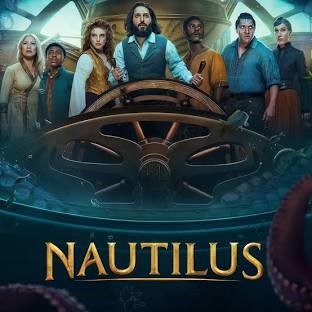
Nautilus (2024) ***

I thought Game of Thrones had got rid of the Lost narrative style wherein characters had mysterious pasts which unfolded episode by episode. In Game of Thrones characters were defined upfront – ambitious, mean, savage, stupid, honourable – and the surprise generally came in the form of idiots being even more idiotic or the brutal indulging in excessive savagery. That nice wee blonde lass, for example, with the wee pet dragons ended up destroying a town – but her vengeful nature was signposted all the way through.

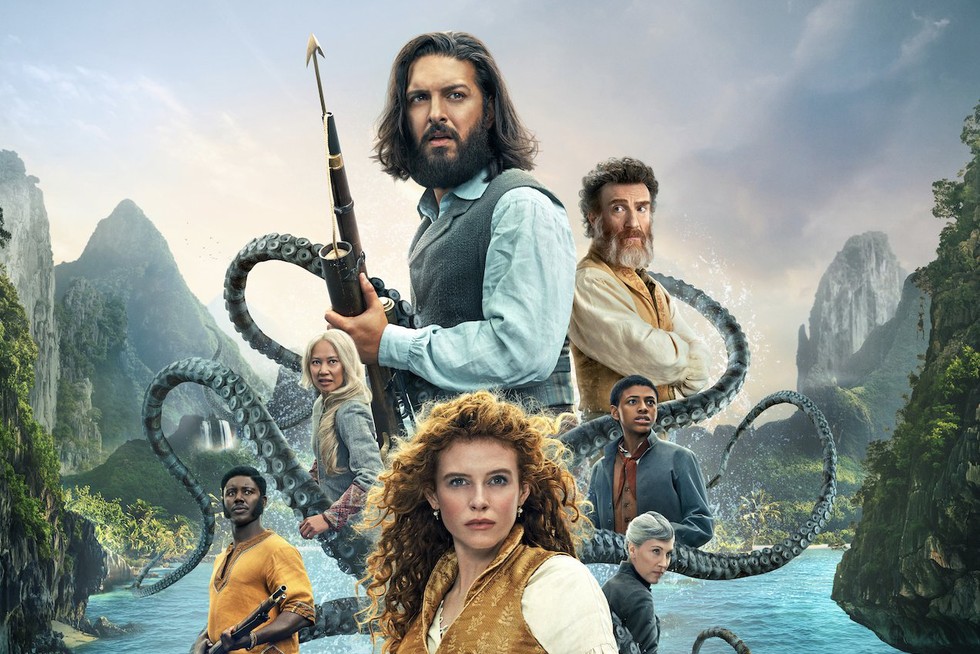
However, Lost-style storytelling has resurfaced in Nautilus. So we discover that Captain Nemo (Shazad Latif) in this version is closer to the original Jules Verne prototype than the sleek James Mason of the Disney feature 20,000 Leagues under the Sea (1954). He’s of Indian heritage, seeking revenge on the East India Company – the nineteenth-century equivalent of a global industrial power that’s bigger than nations – which has killed his family. Anyway, he hijacks the aforesaid company’s latest invention, the submarine Nautilus, complete with razor sharp upper deck for ripping open the hull of ships.

The company, not inclined to take kindly to such theft, sends the iron-clad Dreadnought, the latest in the warship line, complete with depth charges, after them. There’s a surprising amount of invention – ice-cube-making machines also appear – and engineers on hand to make things work or, conversely, know how to sabotage machines.

On board the Nautilus the motley bunch of characters with a job lot of mysterious pasts comprises primarily prison escapees, though Frenchman Gustave (Thierry Fremon) has engineering credentials. Posh Humility (Georgia Flood) and Loti (Celine Manville) are refugees from a shipwreck and there’s also, as you might expect, a dog, and stowaway Cuff (Edward Hardie).

There’s no sign, of course, of a whale hunter like Ned Land (Kirk Douglas in the Disney version). No, this is ecologically-sound, and instead Nemo has harpoon-removing skills and the whales – repaying such kindness apparently – come in handy to save the submarine from a giant squid.

Thank goodness for the squid and the later giant spiders and other fantasy-type creatures that originated in the original’s sequel Mysterious Island. Because this is a genuine oddity, and not necessarily in a good way. The writing is mostly sharp, some characters, especially the women, introduced in great style, and there’s some vivid comedy, and the action very well rendered indeed. The depth charges are used to usual effect but the torpedo launched by the Nautilus fulfils a different, surprising, purpose. Occasionally, it relies on flashback to explain elements better left unsaid – Nemo can hold his breath for a long time underwater, great, a modest super power, but, in fact, the result of being bullied at school.

There are some clever reversals. Humility, trying to save the cabin boy being punished for stealing biscuits, intervenes to say she told him to fetch them. Disbelieving faces all round as she’s handed one. It’s loaded with weevils. At the start we are led to believe that Humility is an ace with cards until we discover it’s actually Loti.

And you can’t really complain about the direction. But the acting is woeful. Whether blame lies with the casting director or the actors themselves and the lack of character depth who knows. Humility is feisty and clever, and can use a hairpin to a variety of ends, pick a lock, sabotage a submarine, and every time she promises not to escape you can be sure she’ll do the opposite. But Georgia Flood (Blacklight, 2022) does little more than speak her lines, nothing much going on behind the eyes. I suppose Shazad Latif (Rogue Agent, 2022) could blame his beard for getting in the way of facial expression.

That’s until they come up against Richard E. Grant as a sly white rajah and he shows just what you can do with a role. Admittedly, he’s not up against much competition but he easily steals the show.

You won’t be surprised to find it weighted down with virtue signalling – female empowerment, rebellion, saving rather than killing whales – and the one area where typically such adventure films from The African Queen (1952) to Romancing the Stone (1984) excel – the male-female verbal duelling –  is all one-sided.

Lower your expectations and accept some stiff-upper-lip Saturday matinee fun and you won’t go wrong. I did, and now at episode four, I’ll probably keep going.

The Vengeance of She (1968) ***

Sequels boomed in the 1960s mainly thanks to multiple spy spin-offs in the James Bond/Matt Helm/Derek Flint vein but for every From Russia with Love (1963) and In Like Flint (1967) there was a more tepid entry like Return of the Seven (1966). One of the prerequisites of the series business was that the original star reappeared. But Ursula Andress who played the title character in Hammer’s She (1966) declined to reprise the role.

John Richardson did return from the first picture but in a different role, as the immortal Killikrates within the lost city of Zuma. So Hammer brought in Andress lookalike statuesque Czech blonde Olinka Berova (The 25th Hour, 1967), even emulating the Swiss star’s famous entrance in Dr No (1962), although instead of coming out of the sea Berova is going in and substituting the bikini with bra and panties, but the effect is much the same.

Story, set in the 1960s, has supposed Scandinavian Carol (Berova) mysteriously drawn south against her will and driven by voices in her head conjuring up the name Ayesha. We first encounter her walking down a mountain road in high heels only to be chased through the woods by a truck driver. It transpires she had unusual powers, or someone protecting her has, for the lorry brake slips and the truck crushes the driver. Next means of transport is a yacht owned by dodgy drunken businessman George (Colin Blakely) and before you know it she is in Algeria, assisted by Kassim (Andre Morell) who attempts to forestall those trying to control her mind, but to no avail.

Philip (Edward Judd), whose character is effectively “handsome guy from the yacht,” follows as she continues south and eventually the pair reach Kuma, where she is acclaimed as Ayesha aka She. Kallikrates’ immortality depends on her with some urgency crossing through the cold flames of the sacred fire. There’s a sub-plot involving high priest Men-hari (Derek Godfrey) promised immortality for returning Ayesha to Kuma and further intrigue that comes a little too late to help proceedings. You can probably guess the rest.

There’s no “vengeance” that I can see and certainly no whip-cracking as suggested in the poster. Berova, while attractive enough, lacks the screen magnetism of Andress and the mystery of who Carol is and where she’s headed is no substitute for either pace or tension and Berova isn’t a good enough actress to convey the fear she must be experiencing. The script could have done without weighting down the Kuma high priests with lengthy exposition explaining the whys and wherefores. Neither a patch on the original nor the expected star-making turn for Berova, this is strictly Saturday afternoon matinee fare and the slinky actress, despite her best sex-kitten efforts, cannot compensate.

Director Cliff Owen (A Man Could Get Killed, 1966) assembles a strong supporting cast, headed by Edward Judd (First Men in the Moon,1964) and Colin Blakely (a future Dr Watson in Billy Wilder’s The Private Life of Sherlock Holmes, 1970). You can also spot Andre Morell (Dark of the Sun, 1968), George Sewell (who later enjoyed a long-running role in British television series Special Branch, 1969-1974) and television regular Jill Melford. 

Curious change of pace for writer Peter O’Donnell, best known at this point for creating another sultry heroine, Modesty Blaise (1966).

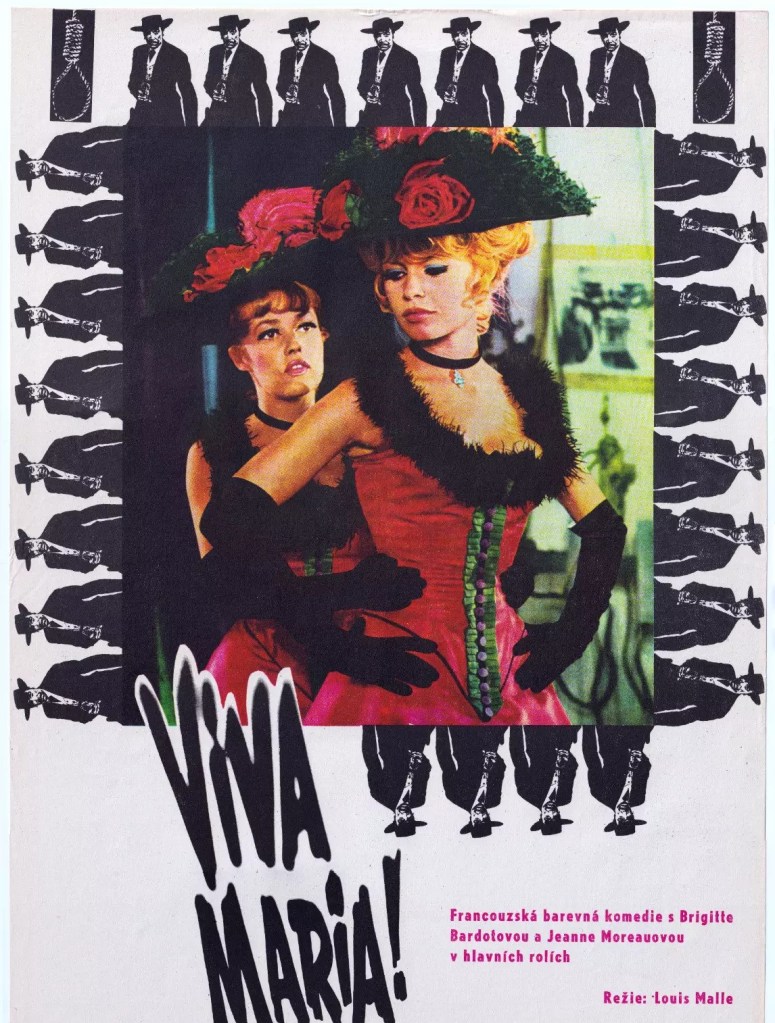
Viva Maria (1965) ****

Had it been a hit in the U.S., it could have changed the way women were portrayed on screen.

A box office smash could certainly have fired up a sequel (a key plank of the United Artists business model) and perhaps a reboot (Viva Marias! starring their daughters with or without the mamas). Could have led to the notion of Sophia Loren teaming up with Claudia Cardinale or Gina Lollobrigida and rescuing a captured male in a feminist twist on a western like The Professionals (1966). Imagine if it was Faye Dunaway and Jane Fonda carrying out the con caper in The Sting (1973).

Until Viva Maria!, two top female stars only appeared together in a movie as rivals for a male’s attention, or if one was the victim of nasty behavior from the other, or one was heading for an untimely death leaving the other to hog the screen in a tide of emotion.

Although it still remained virtually impossible to have a pair of female stars appearing together unless for weepie or noir purpose, the impact of Viva Maria was considerable. For a start, it invented the buddy movie four years ahead of that subgenre’s official inception in Butch Cassidy and the Sundance Kid (1969).

The poster preceded Clint Eastwood in pointing weaponry hardware menacingly at the potential audience, Gatling rather than a .44 Magnum. Speaking of Gatling guns, might have given Sam Peckinpah ideas for employing that weapon in The Wild Bunch (1969).

Neither molls nor victims, these women fell at the first woman’s picture trope. They were not rivals in love. Maria II (Brigitte Bardot) is of a polyamorous disposition and expresses no interest in Flores (George Hamilton) the revolutionary lover of Maria I (Jeanne Moreau). Forget Julie Christie sowing wild oats in Darling (1965) or any other of the other liberated ladies of the decade, Maria II is streets head, acquiring – and discarding – men by the bunch.

Nor is Maria II particularly interested in becoming that other female fixture of the 60s – the rebel – given that she spent most of her childhood as an accessory to her insurgent father’s violent acts, rolling out detonating wire or pressing the plunger in locales as varied as Ireland and Gibralter before watching her father died in an act of sabotage that went wrong.   

You would have thought that by this point in her career Brigitte Bardot (Shalako, 1969) could hardly get away with playing the innocent – setting aside her amoral intent – but audiences expecting titillation would have been surprised to see how quaintly she performs an accidental striptease which transforms their circus act, fortuitous really because Maria II has little sense of the rhythm required to be a stage performer.

Maria II resists becoming involved with Maria I’s messianic boyfriend but when he snuffs it she can hardly ignore his deathbed plea. The two Marias team up with the peasants to overthrow El Dictator (Jose Angel Espinosa ‘Ferrisquilla’) but not before they tangle with the Inquisition and the bad guys learn not to leave Gatling guns lying around. Would it be too much to argue that the female empowerment image of the decade is these two lasses spraying the enemy with bullets from the Gatling gun and, with more sense than Sam Peckinpah’s bunch, no intention of dying an heroic death.

It’s not a comedy in the normal sense, there’s no spoofing of revolution for a start, and it’s not so much filled with great one-liners as terrific sight gags. It’s more a drama with laffs. And, as you will be aware, revolution is good material for musicals – witness 1776 and Les Miserables, so don’t be surprised at the end to find our ladies treading the boards in Paris in a musical version of the revolution they have instigated.

Both Brigitte Bardot and Jeanne Moreau (Mademoiselle, 1966) throw acting caution to the winds, breaking out of the restraints of their screen personas, and almost as if freed from having to perform the dutiful female role of sacrifice, can turn their attention to embracing friendship and having a whale of a time doing so. George Hamilton (By Love Possessed, 1961) looks lost.

Most of what director Louis Malle (Atlantic City, 1980) attempts comes off though it might take you a little while to get to grips with the tone. Screenplay by Malle and Jean-Claude Carriere (Belle de Jour, 1967).

A blast.

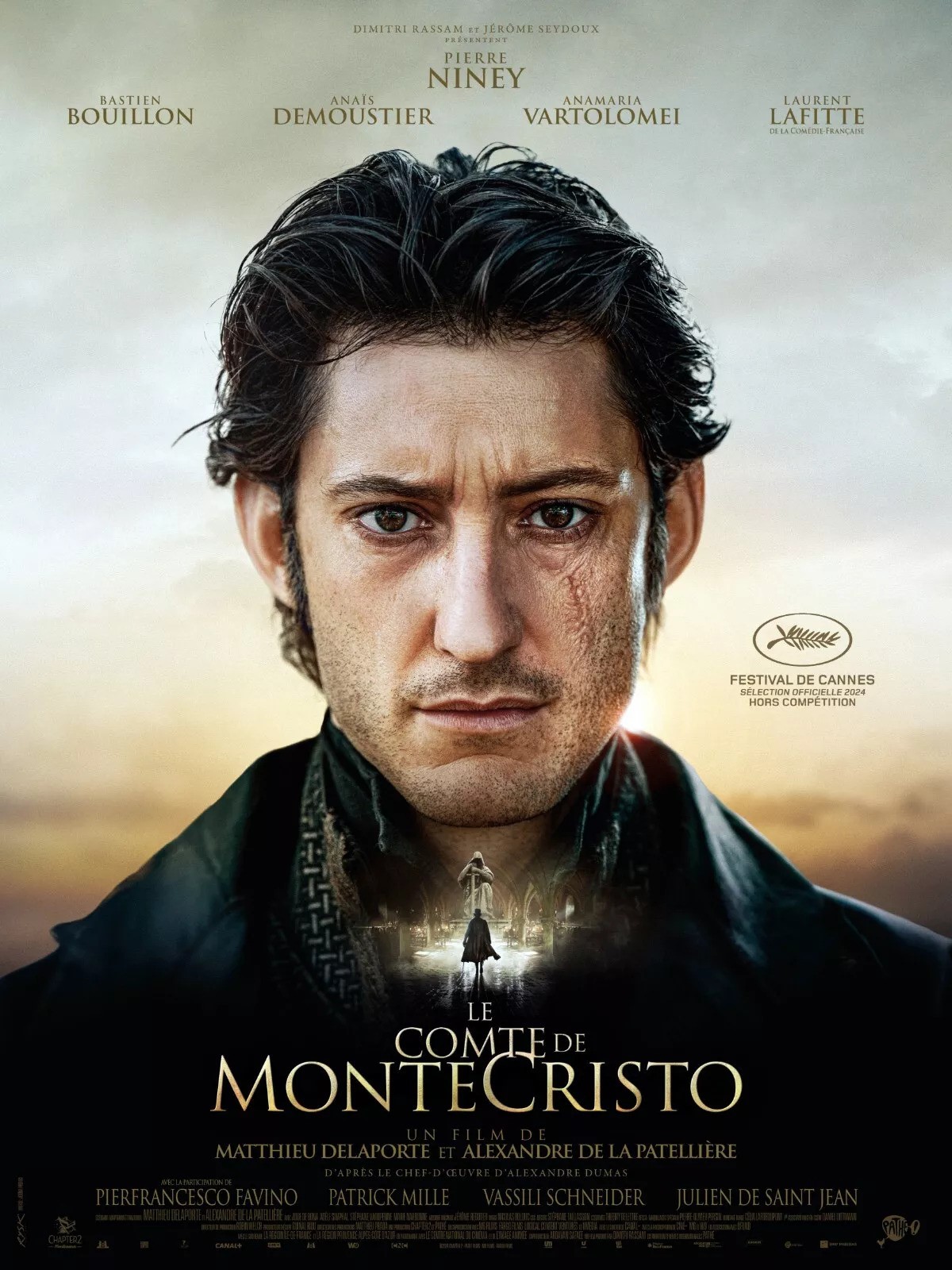
The Count of Monte Cristo (2024) **** – Seen at the Cinema – Twice

Napoleon, shipwreck, false imprisonment, baby buried alive, corruption, audacious jailbreak, the Knights Templar, hidden treasure: enough for a pulsating soap opera for sure but lifted way out of that genre by the driving revenge narrative, and the personal price paid for such unmitigated ruthlessness. I confess I’m not familiar with the Alexandre Dumas classic and I’m not sure I’ve even seen any earlier screen versions, but I did come to this expecting swashbuckling in the manner of  the recent The Three Musketeers. Whether it’s the 2023 double bill, or the versions from 2011, 1993 or 1973, those movies were swordplay heavy. So I was somewhat surprised to find this was lean on the old swash and buckle.

In fact, it’s better described as The Godfather of period adventure, three hours long, where the aspiring sea captain, much in the way of the gangster Michael, transforms from idealistic to  classy ruthless killer, with the idea in his head than his rampage is justified because, as with the Coppola classic, he is fighting corruption in high places. And it’s a three-act picture, coming perilously close to tragedy, for sure, and thoroughly engrossing.

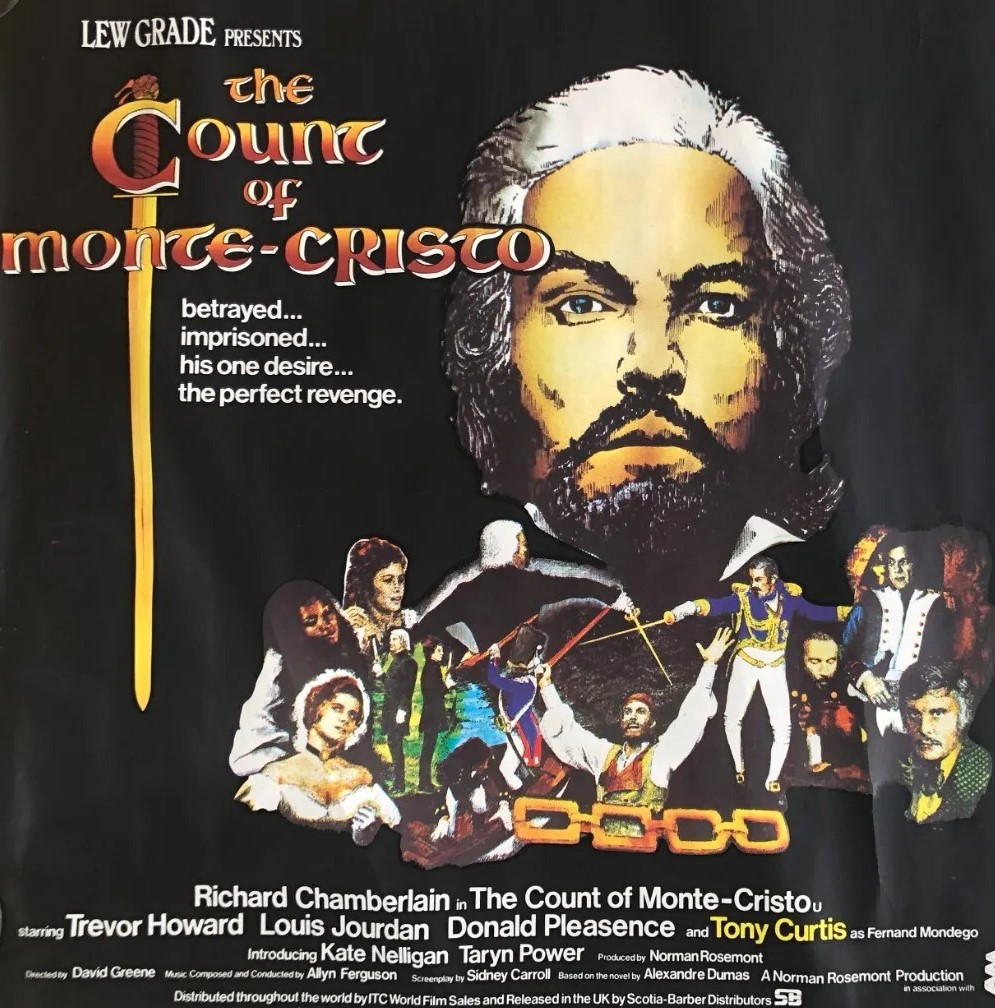
There were over 30 previous versions – this one starring Richard Chamberlain.

Seaman Edmond Danton (Pierre Niney) saves a young woman, Angele (Adele Simphal) from drowning only to discover she is a spy for Napoleon, just entering exile. Back home, this discovery prevents him from marrying his lover Mercedes (Anais Demouster) and with the connivance of ship’s captain Danglars (Patrick Mille), love rival Count de Morcef (Bastien Bouillon) and prosecutor Gerard de Villefort (Lauren Lafitte) he is arrested on his wedding day and sent to the notorious Chateau d’If  prison where everyone is in solitary. During his long confinement he befriends Abbe Faria (Pierfrancesco Favino), who turns out to have secreted a horde of treasure.

Using the clever ruse of pretending to be a corpse, Danton escapes, finds the gold, and returns to Paris as the Count of Monte Cristo to take his revenge on the three men. To that end he recruits a younger generation – Andrea (Julian De Saint Jean), bastard son of Villefort, and Turkish lass Haydee (Anamaria Vsrtolomei) whose father was betrayed by Morcef. The vengeance is all very clever stuff, ruses involving false news, stock market manipulation, and infiltration of emotion. Danton is dab hand with disguises, too, best of all his spluttering Englishman. Audience manipulation, too, reaches a high bar. Naturally, we are behind Danton in his quest for vengeance, we want to see the bullies brought to heel, and so we are sucked in to believing that, like The Godfather, any means is acceptable. And it’s only as we come to the end that Danton is brought up short by the realization of how badly he has infected the innocent with his malice.

I’ve not read the book so I’ve no idea how faithful it is to the Dumas. I’m more inclined to suspect previous versions slashed away at the story to concentrate on the incarceration and the swashbuckling. Given critical obsession with length – an odd preoccupation given that most people will happily binge on three or four episodes of a television series at one sitting – it seems that here it’s justified, each section given due space to develop, Danton shifting from elation to despair and then, supposing erroneously that revenge will return him to a rapturous state, takes most of the third act to work out that it won’t and also that, even when opportunity arises, he cannot replicate the original true love, allowing for a realistic ending.

All the acting is top-notch because the characters are so well-drawn in the first place. And the actors age. in the opening section, they all display the brio of youth. Two decades on, that has dissipated and they are more covert creatures, the prosecutor in particular has a suspicious eye. And they all face emotional reprisal, the narrative so well worked that every character has a high point. Some of the set pieces are just terrific – the telling of a ghost story at dinner, the trial.

Directors Alexandre de la Pateliere and Mathieu Delaporte are well established in this milieu, having written the screenplay for both parts of the recent The Three Musketeers. But if that was a dress rehearsal, they have certainly learned a lesson in how to ground a movie, depending more on genuine drama and character development than flashing blade and conspiracy. Some interesting camerawork, too, long tracking shots reversing back or moving in close.

I enjoyed it so much I went out and bought the book – all 1200 pages of it.

Update: it’s on the shortlist to be considered as the French entry for the Best Foreign Picture category at the Oscars.

Thoroughly absorbing.

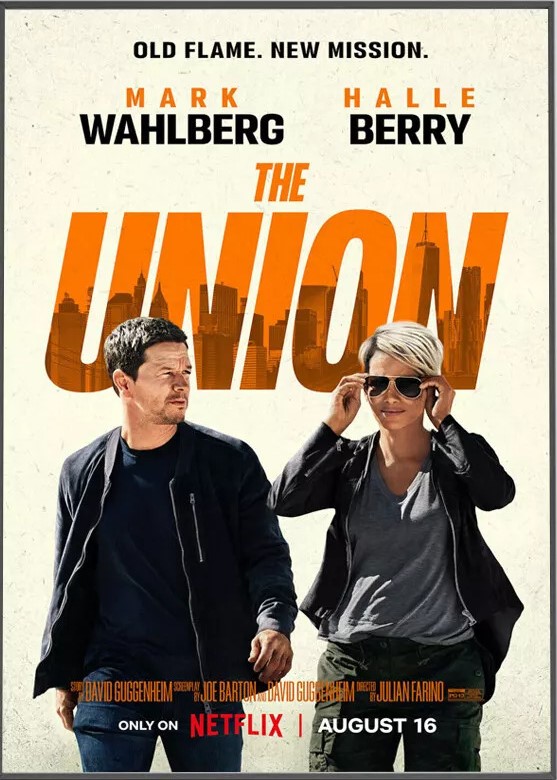
The Union (2024) ****

Wahey! At long last Netflix gets it right (almost). Admittedly, the narrative depends on a very slippery MacGuffin, the kind that would take gold at the MacGuffin Olympics and still come back for more. That aside, it’s got pretty much what audiences are looking for in a fresh take on the hoary old espionage combo. Mark Wahlberg has been long under-rated, can do action (Planet of the Apes, 2001, Uncharted, 2022), caper (The Italian Job, 2003), comedy (Ted, 2012) and drama (Father Stu, 2022). Half the time he’s the driving force behind his projects, 44 credits as producer, which means he’s pretty independent and often turns in the type of picture you think he shouldn’t do or won’t work and sometimes it does and sometimes it doesn’t.

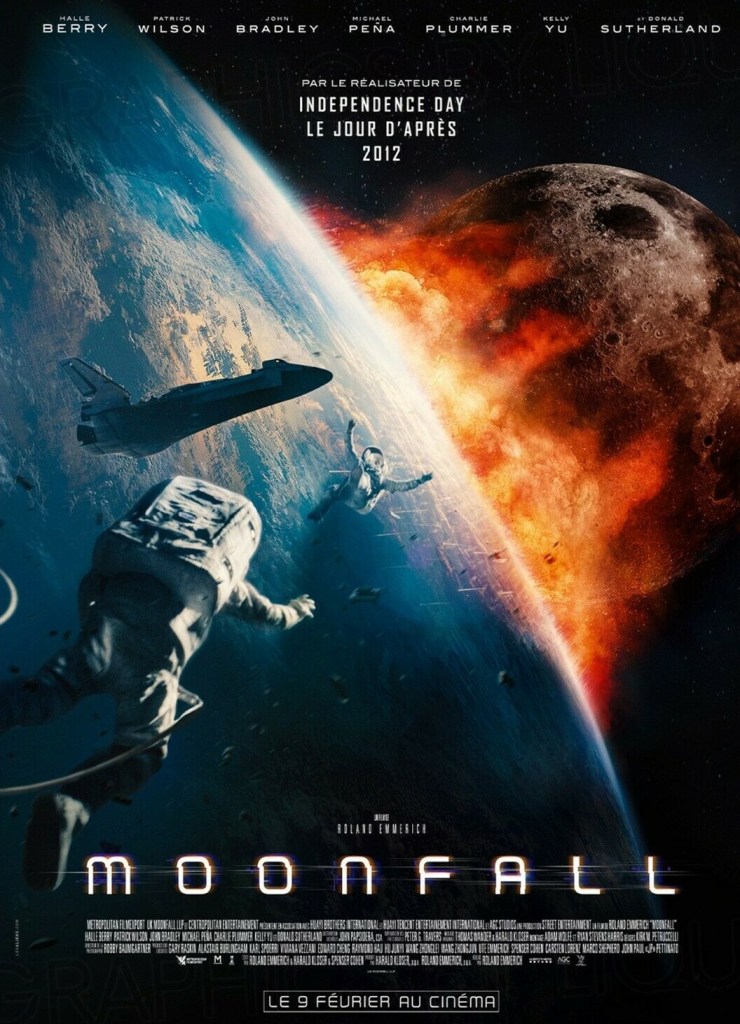
He’s wearing the producer’s jacket for this one and you’d be surprised how well it spins because this is a team effort, very much dependent on the chemistry created with Halle Berry, who you have to agree you wondered where the hell she had gone beyond the lead in the financially disastrous Moonfall (2022), supporting parts in the likes of John Wick 3: Parabellum (2019) and Kingsman: The Golden Circle (2017) and some worthy but ignored pictures.

Netflix is pretty mean when it comes to posters so here’s another with Mark Wahlberg
that I reviewed before.

Well, she’s back and yes she’s kicking ass, but that’s not what makes this movie tick any more than Mark Wahlberg punching and shooting. What makes it sizzle is their chemistry, every bit as solid as Glen Powell and Sydney Sweeney in Anyone But You (2023). And if you recall, that worked because Powell and Sweeney bickered all the way through it. Maybe this is what contemporary romance has come to: a quarrelsome couple.

It certainly keeps this pair on their toes. There’s been any number of fish-out-of-water action scenarios that have sunk like a stone (Argylle, anyone?) because the director didn’t hit the correct tone. Here, English director Julian Farino, best known for television, strikes exactly the right tone between incipient romance, action and comedy.

Middle-aged Mike (Mark Wahlberg) isn’t exactly hero material or Brad Pitt. He goes for the cougars, and we first come upon him in the bed of his Seventh Grade school teacher while his mother (Lorraine Bracco) is always one step ahead of her cocky son. We meet secret agent Roxanne (Halle Berry) in the middle of a disastrous operation of which she’s the only survivor.

You have to pass over the logic of how ultra-secret Government agency The Union comes to recruit construction worker Mike, setting aside that Roxanne once had the hots for him. Anyway – MacGuffin alert – the Government has lost the biggest MacGuffin of All Time and have to get it back by way of lots of things that don’t make much sense, but we’ll let that go as well. Anyways, Mark gets trained up in a mighty peculiar and highly entertaining fashion and becomes her sidekick as they hit the MacGuffin trail which takes them to foreign spots.  

I was one of the few people who liked “Moonfall” with Hally Berry so I don’t mind giving it another plug.

There’s supposedly a mole in the Union and the finger points at their boss Tom Brennan (J.K. Simmons) but there’s a whole bunch of other secrets and twists in the mix and not much time what with the frenetic action to work out what exactly is going on beyond said MacGuffin running riot.

But there are some terrific set pieces and Mike’s girder-balancing skills come in handy when there’s even a moment when the action stays relatively still because most of the time it’s hurtling all over the place, chase upon chase, and normally that would spell the kiss of death, as we discovered with Argylle et al, except somehow here, with the chemical interplay between the two leads and supporting characters more interesting than most – look out for Jackie Earle Haley and Jessica De Gouw – and some zingy lines, it’s just dandy.

The ending sets up a sequel so bring it on. Top marks to Mark Wahlberg in his producer’s capacity for seeing this over the line and also, as with Uncharted, not trying to hog the picture and happy to accept that even as the denoted hero he’s going to be outfought and outsmarted a good chunk of the time and better not think he’s ever going to get the better of the Halle Berry character.

Wahlberg is as good as I’ve seen him and this is Halle Berry back on top form, with a lot more to do than in previous action outings where her character got stuck in first gear. As I said, super chemistry between the pair. J.K. Simmons (Spider-Man: No Way Home, 2022) tones it down from his normal over-acting to splendid effect. Jessica De Gouw is one to watch. Joe Barton (Girl/Haji TV series, 2019) and David Guggenheim (Safe House, 2012), in places with their tongues firmly in their cheeks, knocked out the screenplay.

Highly entertaining, even if the MacGuffins are a bit rampant.

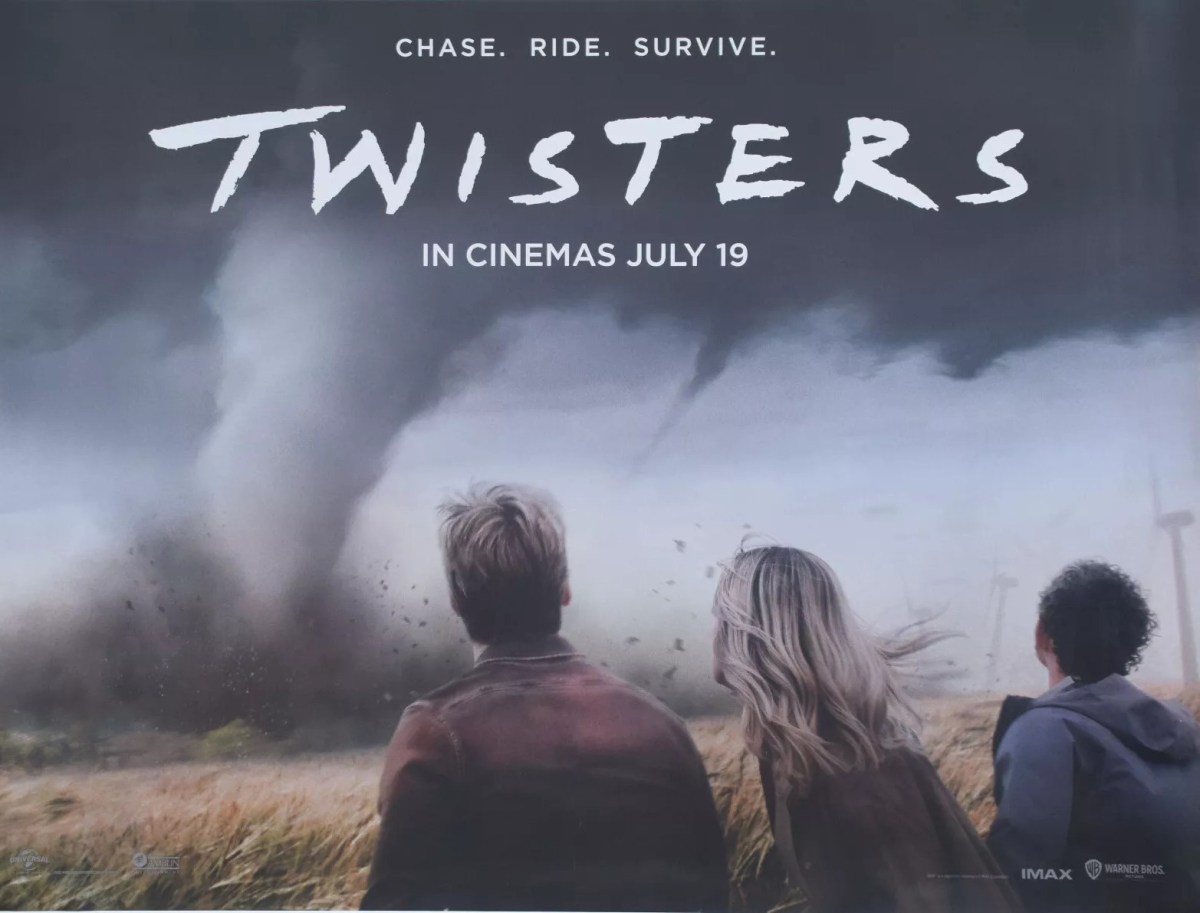
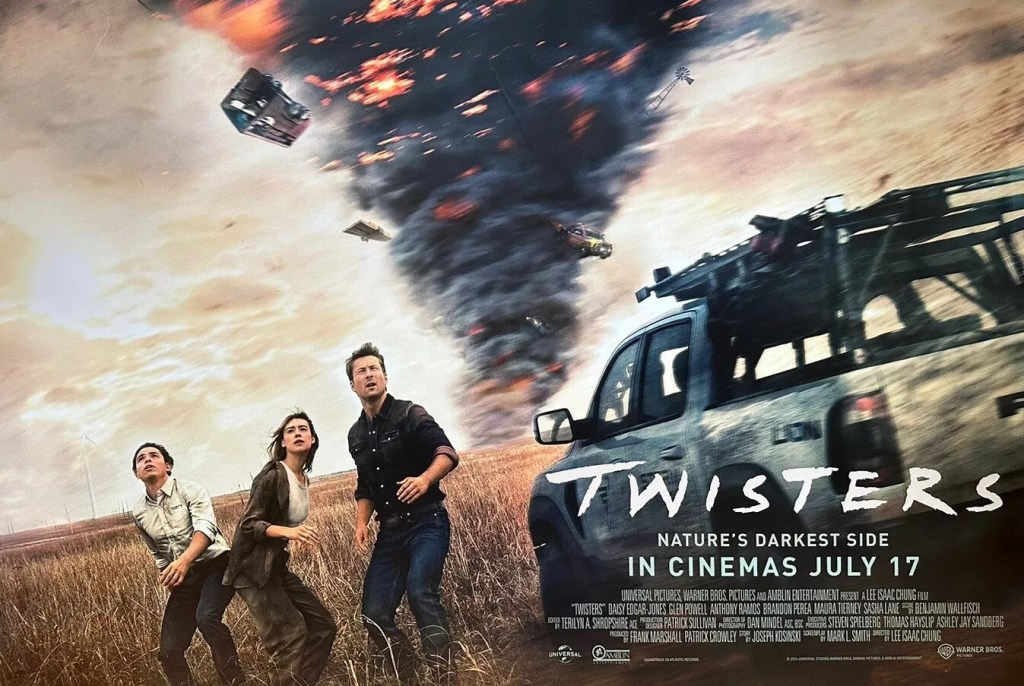
Twisters (2024) **** – Seen at the Cinema

Now we’re talking. The summer blockbuster has arrived. The high octane movie bringing more carnage and destruction than two teams of superheroes duking it out thanks to stunning special effects that will have you gasping at the awesome power of a tornado. Forget the flying cow in the 1996 original. When you see how easily a tornado sucks out people hidden in the tightest spot then you’ll know how foolish it is to tangle with twisters, either for the hell of it or for purported scientific reasons.

On top of this and if it hadn’t been for those tornadoes racing around all over the place, we’d be watching the cutest romance this side of Anyone But You (2023) and blow me down if this doesn’t feature the fella from that, Glen Powell, in full-on cocky arrogant mode and the kind of shit-eating smile we haven’t seen since Josh Lucas in his prime.

But here’s the kicker: no matter how much Powell’s character nearly steals the show, it’s not his picture.

Daisy Edgar-Jones (When the Crawdads Sing, 2022) is not only billed ahead of him, and therefore the denoted star, but the movie follows her narrative arc. She’s in the stunning opening sequence and she’s the one – on her own – to tackle the killer twister at the end. She’s the one with the guilt – friends died following one of her plans – she can’t shift, not him. He merely tucks in alongside as she leads the way, gently, and initially rebuffed at every turn, trying to woo her.

And here’s another kicker. It’s sodden with science. The kind of information that has audiences looking for the exit. But the scientific psychobabble is delivered so well that you hardly have a moment to object and I’m sure if you held a pop quiz for moviegoers coming out I’m sure they’d be able to tell you exactly how twisters formed and what they needed to not only survive but grow.

The save-the-planet element is miniscule, hardly gets a breath, the idea that climate change is causing more twisters. And instead, we get a more cunning subplot, entrepreneur financing tornado research because he can move in on survivors and snap up land on the cheap. And if that’s not a poke at the greedy big business coming under fire for unwelcome philanthropy, I don’t know what is.

So Kate (Daisy Edgar-Jones) is out of the game after causing the death of friends and lover until former buddy Javi (Anthony Ramos) winkles her out of her safe New York job to help him better test her pet theory – that there’s a way to tame twisters. Sure, that’s malarkey but it’s interesting malarkey. So she gives him a week and pitches in with his team, financed to the hilt by a businessmen to whom they feed tips about where the next twister will land.

She’s immediately put in charge of twister detection, demonstrating her instinctive knowledge of where a tornado might head or which cloud formation is most likely to turn nasty. These are the PhD po-faced professionals, all working, apparently, for the benefit of mankind.

Into their world charges Tyler (Glen Powell), YouTube broadcaster with a million subscribers, dressed like a cowboy who has his own line in merchandise and chases after twisters like Lt Killgore (Robert Duvall) in Apocalypse Now (1979), music blasting, though rock rather than classical. For entertainment value, he’s got on board weedy English journalist Ben (Harry Haden-Paton) whose job is to look terrified when the seasoned pros head into harm’s way with little concern. As I mentioned, mostly Tyler gets rebuffed when he tries his equally seasoned moves on Kate until her mum (Maura Tierney) comes to the rescue in a sequence that allows him to become better acquainted with her revolutionary tornado-taming theory.  

There’s a heck of a lot of the will-she-won’t-she palaver that you could get in a genuine rom-com but it’s very gently done and it’s more old-fashioned than Anyone but You, more like Sleepless in Seattle (1993) where kindred spirits take a heck of a long time to decide they might be suited. Mostly the business of chasing after those darned tornadoes keeps them apart, beyond the initial dislike that’s par for the course, and luckily the screenwriters haven’t tried to shoehorn in a scene of them having to snuggle up together in the middle of nowhere after a tornado’s blown the world apart.

The stars exude screen chemistry and if the question after Anyone but You was when were the two principals there going to make another film together the question here will be just the same. Daisy Edgar Jones is a dead ringer for a young Helen Mirren, the same innoent intensity, and brings the kind of acting skills to a blockbuster that sets it apart while Powell shines once again with studios already acclaiming him the next new big male star.

Shout-out for Anthony Ramos (In the Heights, 2021) and Downton Abbey find Harry Hadden-Paton who looks like he’s set for a career’s worth of interesting character acting.

Director Lee Isaac Chung (Minari, 2020) takes the leap from arthouse to blockbuster in his stride, that previous background helping flesh out characters, and he lands this behemoth in style. Screenplay by Mark L. Smith (The Boys in the Boat, 2023).  

My only disappointment is that I didn’t catch this in Imax. But that will be rectified soon.

Go see.

Discover WordPress

A daily selection of the best content published on WordPress, collected for you by humans who love to read.

The Atavist Magazine

by Brian Hannan

WordPress.com News

The latest news on WordPress.com and the WordPress community.