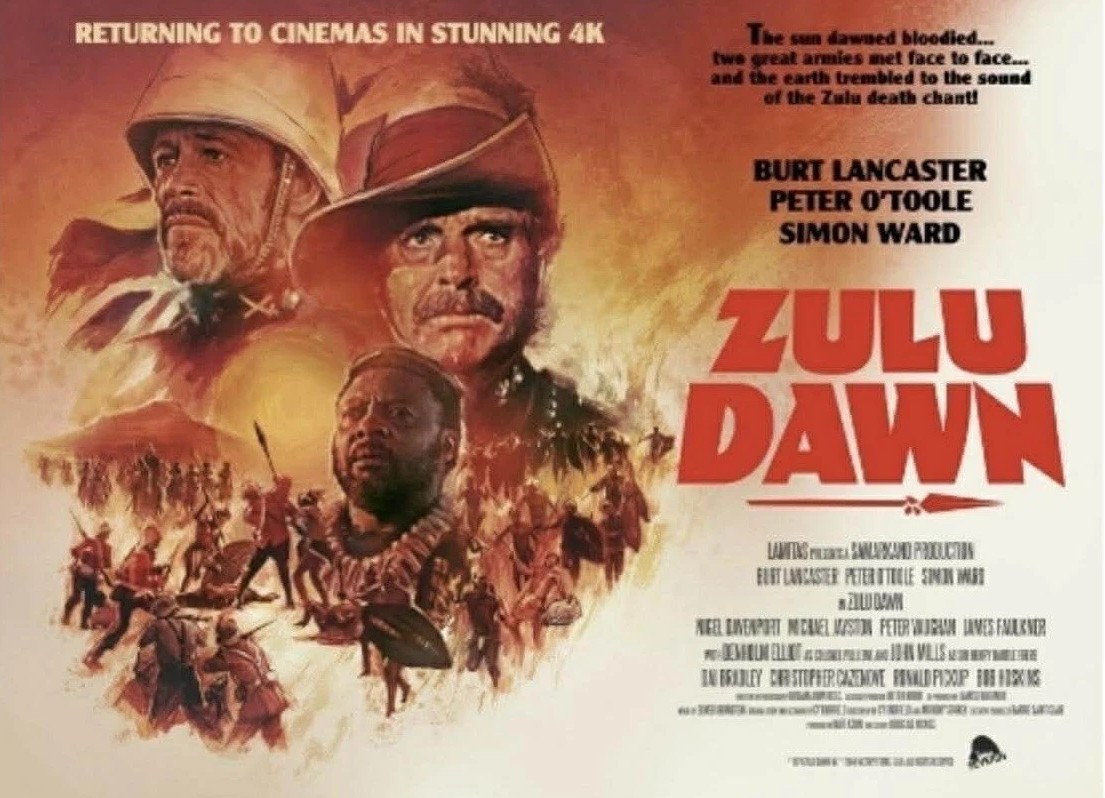
I’m delighted to announce that Munro Films has reissued Zulu Dawn on the big screen in a stunning 4K restoration.
Dates for UK showings you can find here:
https://www.munrofilmservices.co.uk/movie/zulu-dawn
Check out my review here:
I’m delighted to announce that Munro Films has reissued Zulu Dawn on the big screen in a stunning 4K restoration.
Dates for UK showings you can find here:
https://www.munrofilmservices.co.uk/movie/zulu-dawn
Check out my review here:
I’m still trying to work out why I enjoyed the Rat Pack’s last hurrah so much. Sure, it’s the knockout debut of “My Kind of Town,” the last tune Frank Sinatra performed on the big screen and one that would have epitomised Ol’ Blue Eyes had it not been supplanted a few years later by “My Way.” And Bing Crosby, also in top crooning form, would have stolen the show except for Peter Falk’s gangster and Barbara Rush weaving a seductive web around all the males. But, actually, it’s mostly because this one time, far more than in the three preceding pictures, there’s a match between story and stars, as if at last the whole idea has come together. The gimmick of transplanting the Robin Hood legend to 1920s Prohibition Chicago works a treat, a gentle spoof rather than an awkward one.
The notion that you would bring together three of the greatest singers – Sinatra, Dean Martin and Sammy Davis Jr. – of their generation and deny audiences the chance to hear their voices was anathema to audiences. As if nobody could make up their mind which way a Rat Pack vehicle was headed, Martin and Davis were accorded tunes in Oceans 11 (1960) but the next two pictures, westerns of one kind or another, appeared tuneless. Robin and the 7 Hoods is a proper musical, all the stars sing, some even get to dance, and the story carries a lot more heft than your usual musical, some decent running gags, and an affectionate nod to the old Warner Brothers gangster pictures.

Guy Gisborne (Peter Falk), having taken control of the city by rubbing out his rival, comes up against Robbo (Frank Sinatra) refusing to bow the knee. Naturally, both decide the only solution is to bust up each other’s joints. Even more naturally, this ends in stalemate. Cue the entrance of Marian (Barbara Rush), the dead mob boss’s daughter who wants her father avenged. As a by-product of her involvement, Robbo ends up donating $50,000 to the poor, a good deed turned into public relations bounty by orphanage chief Allen A. Dale (Bing Crosby), reviving the legend of the outlaw who stole from the rich and gave to the poor.
Complications arise when Robbo refuses to fall for Marian’s wiles and is framed for the murder of a corrupt Sheriff Glick (Robert Foulk). Marian proves far smarter than her male counterparts and when bribery, seduction and corruption fail she turns to politics.
While Sinatra’s rendition of “My Kind of Town” is the standout, tunesmiths Sammy Cahn and Jimmy van Heusen showcase some terrific numbers, in particular the gospel-style “Mr Booze” performed by Bing Crosby, “Style” involving Sinatra, Martin and Crosby, a Martin solo “Any Man Who Loves His Mother,” Sammy Davis with “Bang! Bang!” and even Peter Falk makes a decent stab at “All for One and One for All.” Once Sinatra, Martin or Crosby wrapped their larynxes round a particular song, they claimed ownership for life, you can’t imagine anyone else doing it better. And so it proved here.

In acting terms Sinatra, Martin and Davis are on cruise control, although Sinatra, the butt of the conspiracy, tends to have to work a little harder. The supporting cast relish the opportunities presented. Peter Falk (Penelope, 1966) makes the most of a made-to-order role as the back-stabbing mob chief, his fast-talking style little match for more superior brains, and you can see a screen persona develop in front of your eyes. Bing Crosby (Stagecoach, 1966) starts out as a joke with his outlandish language but soon comes to represent a different perspective on legitimate illegitimate moneymaking schemes. Barbara Rush (Come Blow Your Horn, 1963) is quite superb as the conniving sophisticate, all long dresses and innovative ideas.
Although Gordon Douglas (Stagecoach, 1966) would hardly be your go-to director for a musical, he acquits himself very well, incorporating a great deal of the style he evinced in Claudelle Inglish (1961). There are two marvellous running scenes. The first is that whenever the municipality sees fit to lay the foundation stone of some great new building you can be sure the block contains a corpse. But the second is just wonderful. Any time Marian has a man in her lounge, she goes round switching off the lamps until the room is in darkness. Each time, the scene is played in exactly the same way and of course the minute she starts switching off the lights, moving as sinuously as a spider from lamp to lamp, you know where this scene is going. I should also mention the “Mr Booze” sequence in which an illegal nightclub is transformed into a gospel meeting.
Edward G. Robinson (The Biggest Bundle of Them All, 1968) has a cameo and also look out for Oscar-nominated Victor Buono (What Ever Happened to Baby Jane, 1962). Songs aside, David R. Schwartz (The Bobo, 1967) penned this one.
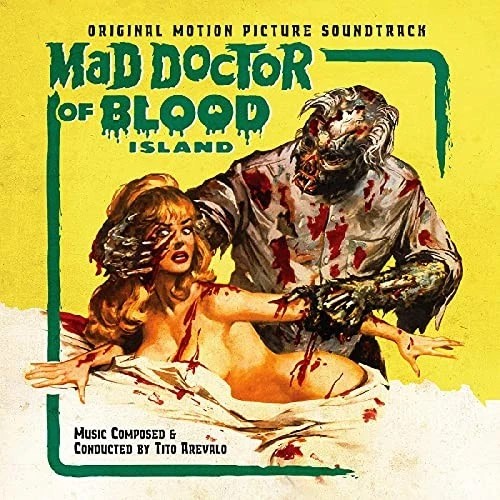
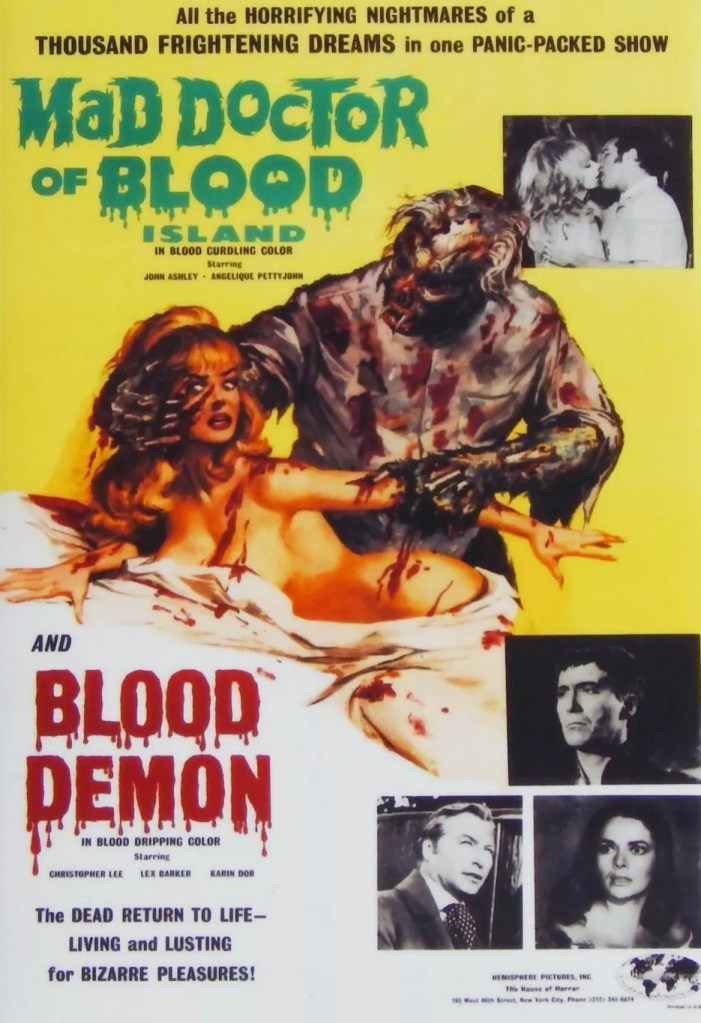
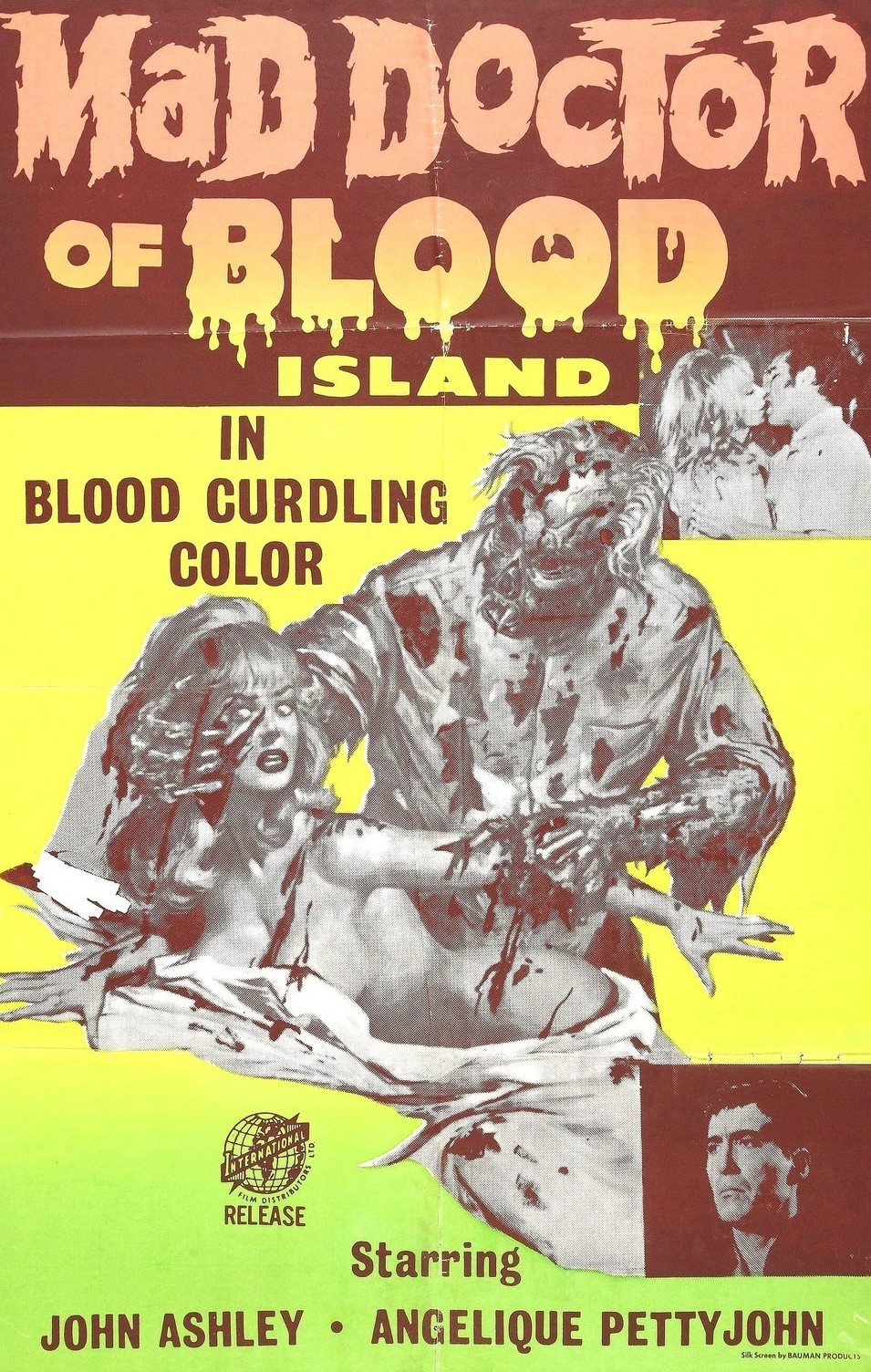
Not a direct sequel to Brides of Blood (1968) but in today’s vernacular this would be taking place in a “Bloodverse”. Swap human sacrifice for erotic ritual, eliminate the man-eating trees and giant insects, throw in buckets of green blood and women who can’t pass a waterfall without diving in naked, a voyeur, add a touch of estrangement, remove any mention of radiation, and while there’s clearly a monster on the loose a strange doctor appears as much of a liability. To keep the exploitation audience onside, there’s more nudity, plus sex. To keep the arthouse fans happy there’s innovative camera use, a kind of shuddering disorienting effect as the camera jumps back and forward.
This time round our visiting scientist, pathologist Dr Bill Foster (John Ashley), is investigating a strange disease that’s broken out on the island. Accompanying him are non-scientists Sheila Willard (Angelique Pettyjohn) looking for her father (Tony Edmunds) and Carlos (Ronaldo Valdez) who’s planning to persuade his widowed mother (Tita Munoz) to leave. Dr Lorca, the local authority, welcomes the visitors.
None of the new arrivals have much luck. Sheila’s father is a hopeless alcoholic and doesn’t view with any interest reuniting with his daughter while Carlos’s mother refuses point blank to leave. Worse, his father, it transpires died in mysterious circumstances several years before. Dr Lorca is generally obstructive.
It takes a good few sightings of the monster, not a giant as such beings often are, but the size of a normal human with skin a funny color and extremely mottled, to keep things going. Generally speaking, said monster, as in the previous film, has a predilection for naked women, though their nudity doesn’t always seem linked to skinny-dipping under a waterfall.
Finally, the monster becomes more inquisitive and invades the house where the guests are staying. Sheila, who makes the mistake of wandering out into the jungle alone, is attacked by the monster but escapes.
Carlos discovers his father’s coffin is empty. Sheila and Bill hit it off, sufficiently enamored of each other that they make love in a cave. About the only contribution Bill makes, apart from being one-half of the love interest, is to track the monster to a cave where people are being kept prisoner.
The warder is Dr Lorca who has been carrying out experiments on the natives, one of his earliest victims being Carlos’ father Don Ramon who is the current monster. For no apparent reason, except he’s a monster, Don Ramon kills his wife and then because he’s not completely a monster but still has human feelings lets his son go free, instead turning his vengeance onto Dr Lorca and in the carnage that follows apparently killing himself.
But not so fast. As had already been demonstrated in the 1960s, success could breed instant further success, franchises now abounding, not just James Bond, Matt Helm, Harry Palmer and Derek Flint but The Magnificent Seven and The Pink Panther, so nobody was going to pass up the opportunity to make a few more bucks. The door is opened for a sequel when the final shot picks out the hand of the monster hiding in a lifeboat on the ship ferrying away the survivors.
This is more of a cliché than Brides of Blood and some scenes such as the erotic ritual and dalliance at waterfalls and in caves seemed intent on hooking an audience other than horror. Once again, it’s the female lead who steals the picture – though it’s not much of a fight. Angelique Pettyjohn (Heaven with a Gun, 1969) has not just the heaving bosom of her predecessor and her sassiness but a more solid emotional journey.
You’re not going to expect much genuine emotion in a horror picture of the period but in that respect Pettyjohn and, surprisingly, the monster come off best.
Again directed by Eddie Romero and Gerardo De Leon from a script this time round by Reuben Canoy (The Passionate Strangers, 1966).
Passable.
Being this was the age of the Lothario, what with James Bond and Matt Helm and Co surrounded by adoring women, you were hardly going to find many males in the audience feeling that sex addiction was a bad thing. Nor was commitment phobia likely to be high in the agenda of the females in the audience.
Really, there’s no real reason to go to any trouble to come up with justification for bedroom farce that borders just occasionally on screwball comedy. Let men be caught with their trousers down and women in various stages of deshabille and let’s hope there are enough jokes in between to keep the pot boiling.

The main problem here is that while Peter O’Toole shows a fine and unexpected gift for comedy, the two actors for whom comedy is supposed to be their metier mostly fall flat, Peter Sellers resorting to over-acting and Woody Allen in his movie debut trying to steal every scene and the best lines (he wrote the script) to boot.
There are a couple of cracking set-ups. In one a language teacher who gets her class of foreigners to repeat what she says finds that they are parroting every word of a crazy fight she is having with her lover. And a strip club, even one as high-falutin as The Crazy Horse in Paris, has rarely provided so many laffs. And in an echo of Cyrano de Bergerac, a man wakes up an entire apartment block trying to woo the lover of his friend.
Michael James (Peter O’Toole) seeks advice from psychiatrist Dr Fassbender (Peter Sellers in a dreadful wig) as to how to temper his sexual instincts. He is under siege from lover Carole (Romy Scheider) who is desperate to marry him. The repressed married doctor is mad keen on Renee (Capucine) but the minute she sets eyes on Michael she can’t get enough of him.
To make Michael jealous Carole flirts with Viktor (Woody Allen), her nervous wreck of a chum.

Soon Michael is juggling four lovers, Liz (Paula Prentiss) and Rita (Ursula Andress) as well as Carole and Renee. Eventually, for no great reason except it must have seemed a good idea at the time and it’s the ideal location for a bedroom farce, they all end up in a small hotel, where Michael has his work cut out, dashing from room to room, to assuage all his lovers, while Fassbender and Viktor try to snap up his leftovers.
This all takes place against a background of La Dolce Vita involving a revolving cast of fashionistas and disco dancers. Michael drives an antique car straight out of Chitty Chitty Bang Bang (1968) and he carries off style with great elan. Wherever he is, Michael is the center of attention, in a disco resorting to striptease, and you can hardly blame him for being unable to resist so many gorgeous women throwing themselves at him.
While Peter O’Toole (The Lion in Winter, 1968) seamlessly holds it together, Peter Sellers (The Pink Panther, 1963) and Woody Allen (Annie Hall, 1977) threaten to pull the flimsy structure apart, the latter in particular determined to turn it into a Woody Allen picture. But Peter O’Toole is sheer delight and, as misogynistic as it sounds, carries off with aplomb the central conceit of a poor fellow who just can’t get enough of women. His comedy instinct is first-rate, far better employed here than in How to Steal A Million (1966) and his drunken scene is a joy.
Peter Sellers appears to be spoofing himself while Woody Allen, years away from solidifying his screen persona, is, as usual, just himself.
It’s left to the female cast to add depth and virtually all come out of the experience with bonus points, Romy Scheider (Otley, 1969) and Paula Prentiss (Man’s Favorite Sport, 1964) in particular while Ursula Andress (She, 1966) and Capucine (Fraulein Doktor, 1968) raise the glamor stakes to a new high.
Director Clive Donner (Alfred the Great, 1958) does his best to keep the picture on an even keel while allowing it to lurch sideways whenever the comedy requires. Written by Woody Allen.
Good fun in parts.
There was a time when movies had charm. An easy grace. A fluidity. The ability to hold an audience in the palm of their hands with the simplest of narratives. Sadly, that time is long gone. I doubt if any Hollywood director – so raddled now by self-indulgence and self-importance – would even know how to make this kind of souffle.
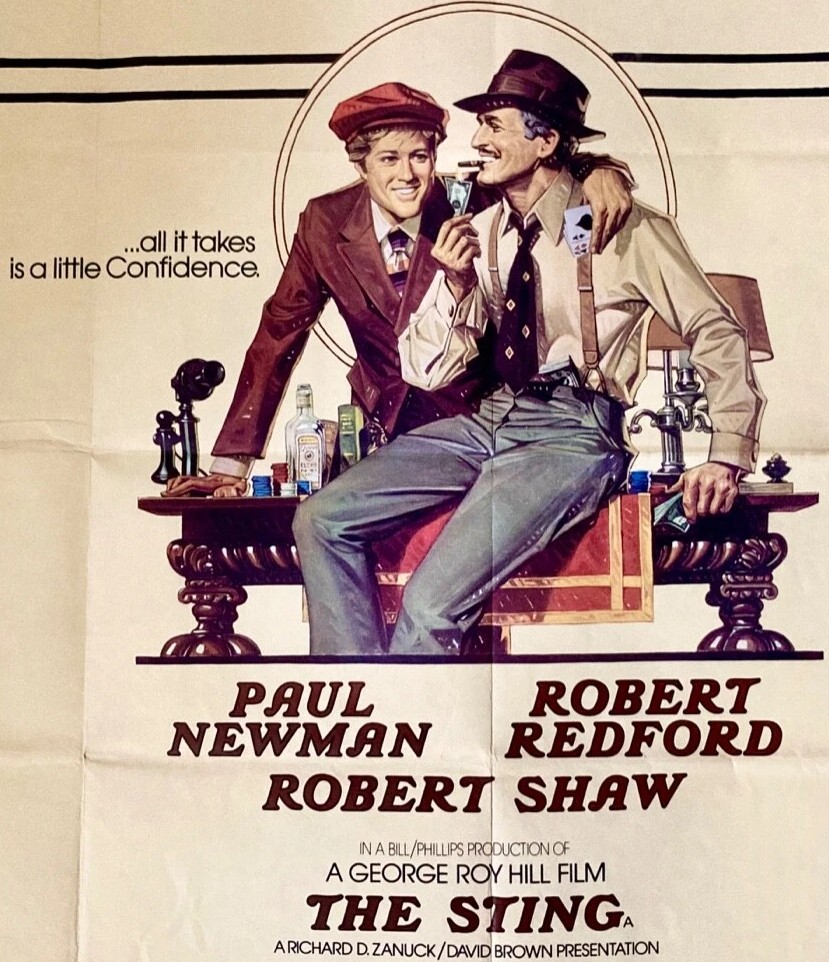
I haven’t watched this movie in decades. And I fully expected to dismiss it as having aged badly. Instead, I just adored it. In part that is due to what is surely the greatest male screen partnership ever. It wasn’t uncommon then and now for two top stars to be paired together, but usually the narrative had them in conflict. That’s not the case here. There’s a reason why Paul Newman and Robert Redford were credited in Butch Cassidy and the Sundance Kid (1969) with inventing the buddy movie. Their screen personas just dovetail and they appear so comfortable with each other.
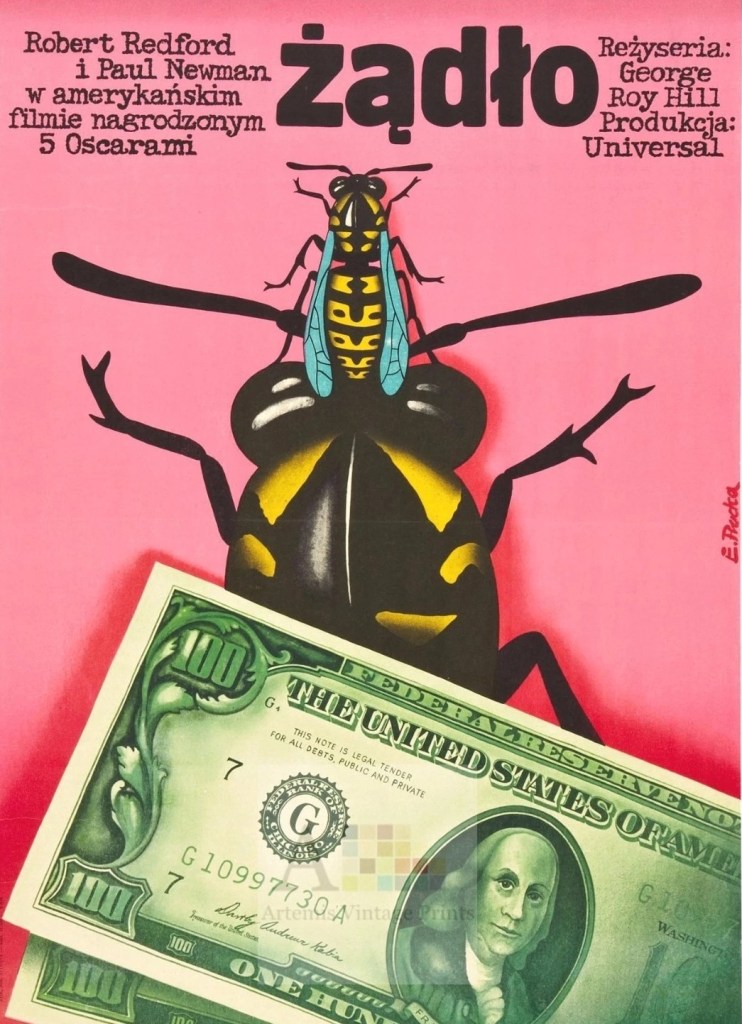
Sure, the story is a cracker, and the direction is impeccable, what with using long-gone techniques like the wipe, and the chapter headings, and, of course, the adaptation of the Scott Joplin music and audience exposure to the techniques of pulling the “big con” and the secret nose-stroking by which fraudsters identified each other. But while this premise would surely have worked with another duo, it would not have worked half as well.
This was Robert Redford’s annus mirabilis. It’s impossible these days to comprehend his impact, for the simple reason that stars rarely release two movies in the one year. Following Butch Cassidy and the Sundance Kid, Redford had been there or thereabouts without quite taking the final step required to become a box office sensation, indulging himself in worthy pictures like The Candidate (1972) and Jeremiah Johnson (1972), but the latter was decidedly under-performing until Warner Bros sent it long after initial release down the “four-wall” route that would prove pivotal to The Exorcist (1973), whereby a studio hired theaters to show a movie, paying a flat fee that covered an exhibitor’s costs and some profit rather than splitting the proceeds on a percentage basis.
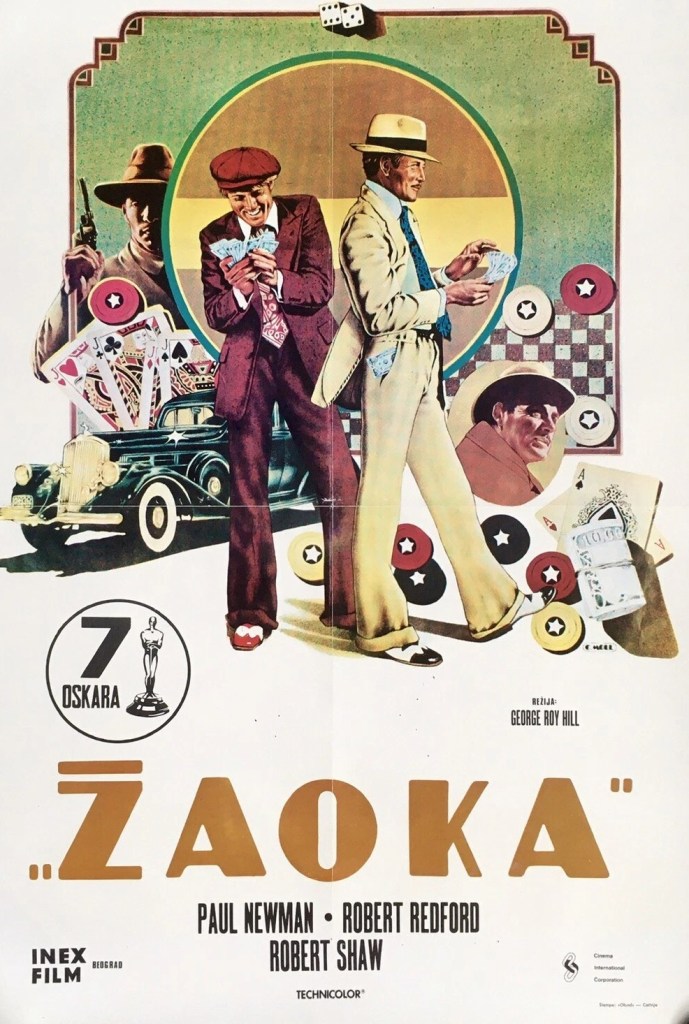
But the double whammy of The Way We Were (1973) and The Sting sent Redford’s marquee value into the stratosphere. And he’s not the big romantic lead that he was in the Streisand picture, if anything he comes up short in the romantic department, dumb enough to seduce a female assassin. He’s always one way or another needing to be rescued from a self-induced calamity rather than the confident gunslinger of Butch Cassidy and the Sundance Kid with an adoring woman hanging on his every word.
There are a couple of other memorable pieces of acting that I’d like to draw to your attention. The first is Reford’s thumbs, which always seem to stick out, the reason for which is never explained and possibly they’ve been beaten by previous malfeasance into that position. The second isn’t Robert Shaw’s pronounced limp, but his menacing catchphrase “You follow?” which must be the toughest two words outside of swearing ever spoken by a gangster.
Seeking revenge on underworld kingpin Doyle Lonnegan (Robert Shaw), on-the-run con man Johnny Hooker (Robert Redford) teams up with the more experienced Henry Gondorff (Paul Newman). The plan is to rook Lonnegan of half a million dollars. They’re going to do it with a racing scam, where they know the results of a race before anyone else.
But first Gondorff needs to find finance and needle Lonnegan enough to bait the hook. He achieves both by stealing Lonnegan’s wallet before using that cash for his wagers and cheating better than Lonnegan at poker.
Then Hooker has to pretend that he’s fallen out with Gondorff and willing to work with Lonnegan to screw two million bucks out of Gondorff. Meanwhile, to spice up the plot, maverick cop Snyder (Charles Durning) is on the trail of Hooker and the FBI are on the trail of Gondorff.
The payoff is so brilliant that audiences at the time reputedly cheered and I have to say I felt like doing so myself.
Robert Redford was nominated for an Oscar but I think the acting honors were even with Newman. The movie won the Best Film Oscar and Best Director for George Roy Hill (Hawaii, 1966) and usually when you come to re-evaluate Oscars you tend to mark down many of the choices because they don’t really hold up. This was up against The Exorcist, American Graffiti, Ingmar Bergman’s Cries and Whispers and the comedy A Touch of Class, so it wasn’t as though there was another better contender.
I like to think it won for bravura. Elan. In every department. Fresh and innovative, oozing charm and with the greatest double act in American cinema.
Director George Roy Hill (Hawaii, 1966) was on a roll and the screenplay by David S. Ward (Steelyard Blues, 1973) hit a home run.
There’s hardly been a more enjoyable Oscar-winner.
Producer Walter Mirisch could have afforded to rest on his laurels – he’d won the Oscar for In the Heat of the Night and been responsible for classics like The Magnificent Seven (1960) – and three sequels – and The Great Escape (1963). The 1970s had proved tougher, resulting initially in a string of pot boilers before hitting a home run with Mr Majestyk (1974) with Charles Bronson and knocking the ball out of the box office park with war picture Battle of Midway (1976), the former pulling in $20 million in rentals on a $2 million budget, the latter $50 million in rentals on a $7 million budget.
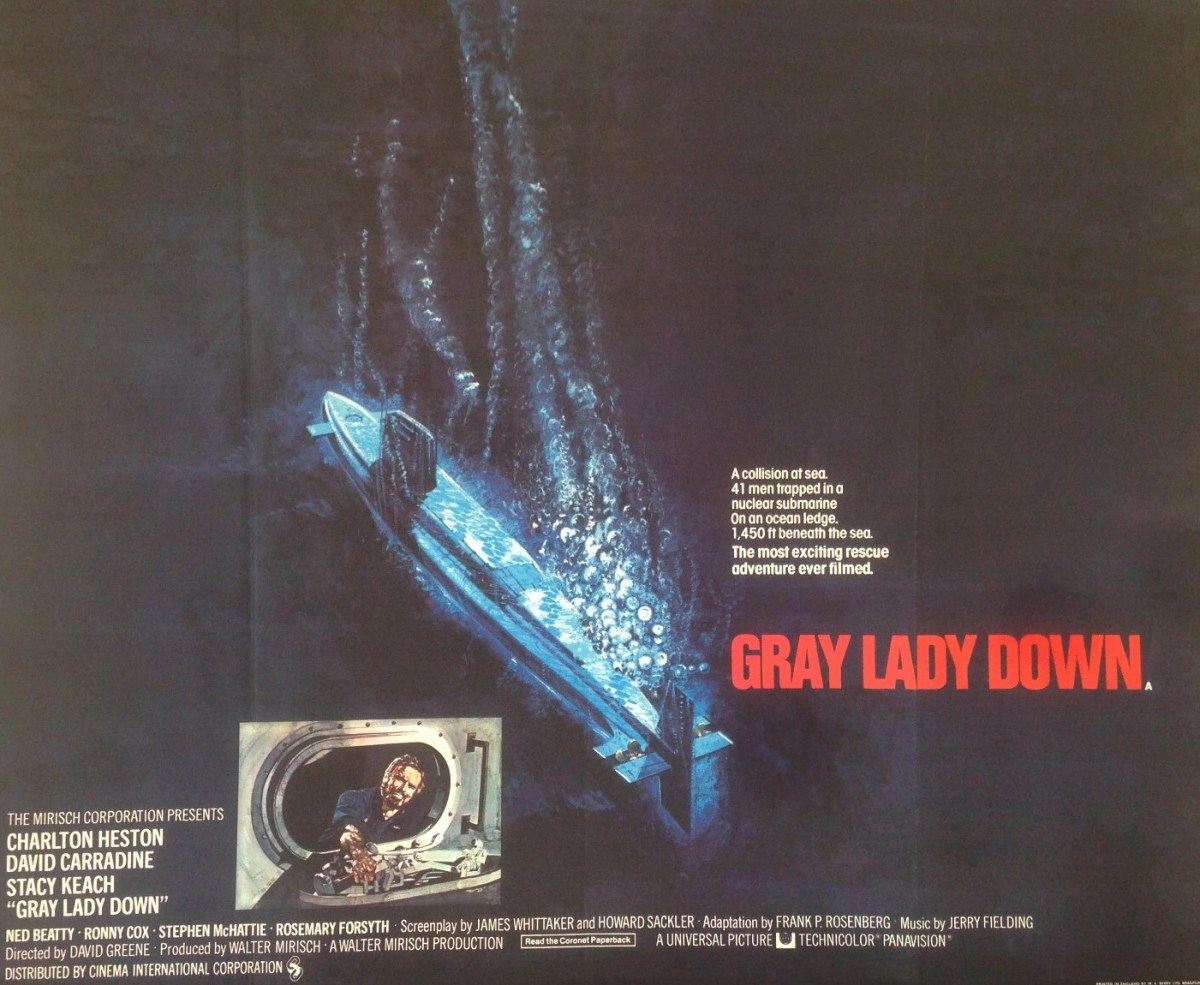
He had parted company with United Artists after nearly two decades in partnership and tied up a five-year deal with Universal. With Midway under his belt, he was the go-to producer for pictures on a naval theme. He had been sent a screenplay by James Whittaker about a submarine stranded at the bottom of the ocean. However, it turned out there was already a novel on the same subject, Event 1000 by David Lavallee, which result in various negotiations to determine the screenwriter credit, especially after playwright Howard Sackler (The Great White Hope, 1970) had completed a rewrite.
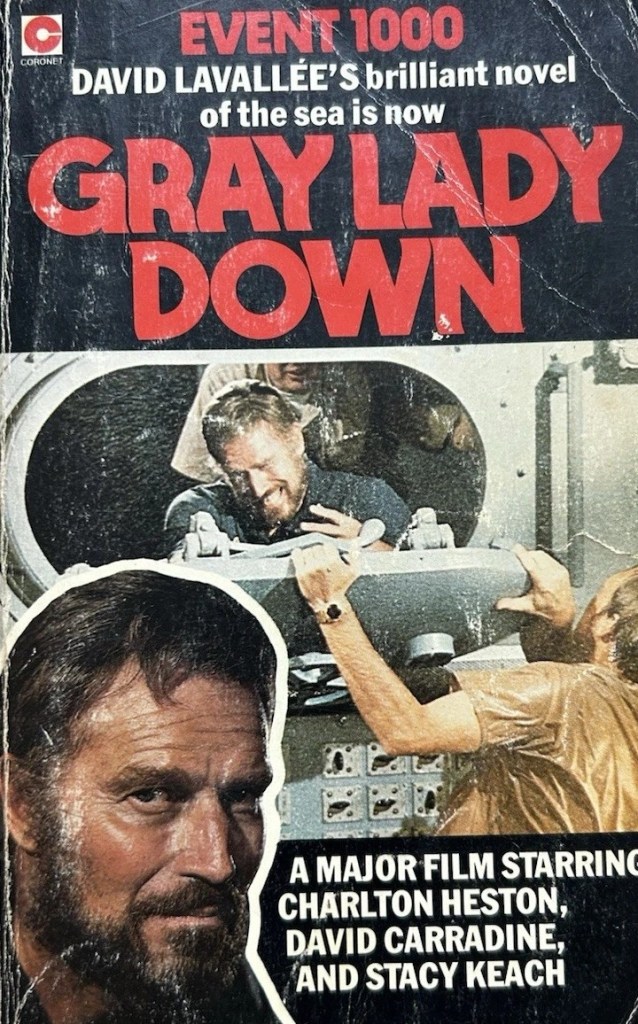
Charlton Heston, on a box office roll after Airport 1975 (1974), Earthquake (1974), Battle of Midway and Two Minute Warning (1976), was the obvious choice for the lead. But Mirisch had originally contemplated teaming Heston with Sidney Poitier (In the Heat of the Night). “He’s now backing away” from the idea, noted Heston in his diary in February 1976, “though I’m not sure why, save the cost of having us both in the film.” Heston was in strong demand, and turned down The Omen (1976) and The Pack (1977).
The film was slow coming together, “not much progress on the script…casting still slow” and there was the possibility of further delay to “mull” over the project. No director had been assigned by the end of February 1976. Following the Battle of Midway, the U.S. Navy was only too delighted to be involved. As well as following a disaster picture template, the movie was also tech heavy, featuring up-to-date ideas on rescue at sea.
The interior of the submarine, the main set, was constructed on a gimbal so that it could be tilted to achieve the effect of the sailors being thrown about as the sub sunk to the bottom and rolled over on a deep sea trench. Howard Anderson oversaw special effects work with models in a 44ft deep water tank which was filmed at CBS. Exteriors were shot at Universal with some work aboard a Navy escort vessel. Some material was also repurposed from Ice Station Zebra (1978).
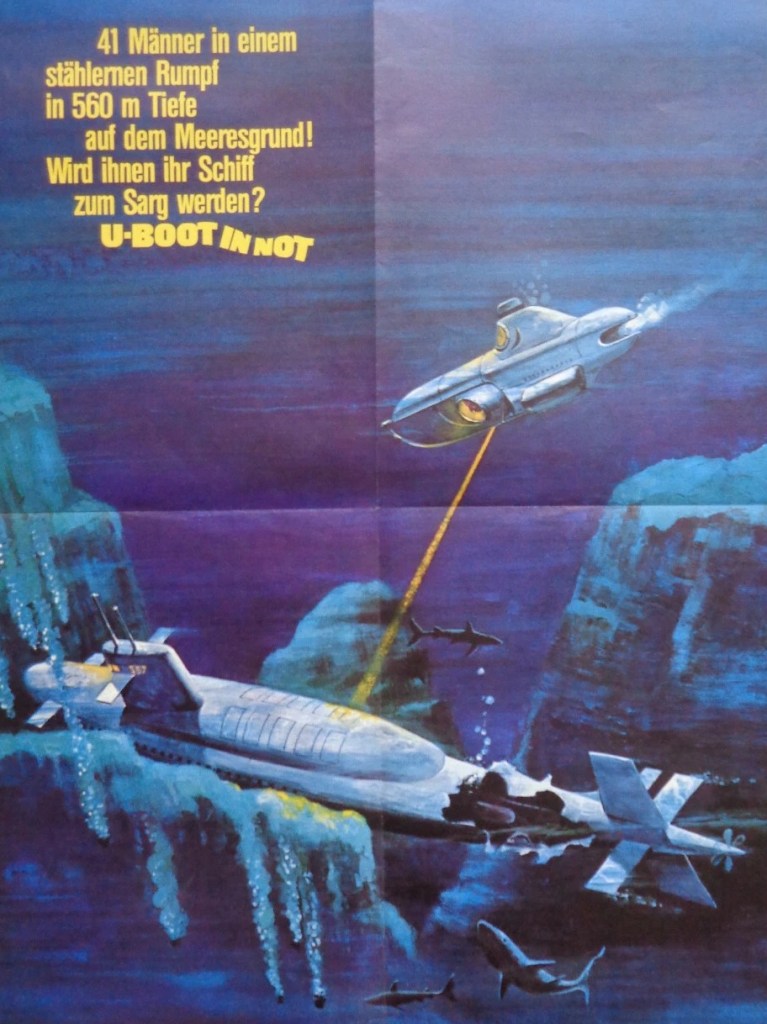
To soak up the atmosphere of a real nuclear sub, Heston spent the day on USS Gurnard under the Pacific off San Diego. “I got a lot of useful little stuff,” commented Heston, “about the look and sound of submarine officers at work…the kind of thing nobody could tell you.” The sub contained a “vast array” of disparate and complex technology. “It was a very strange feeling to spend hours charging about under the ocean running mock torpedo attacks on surface vessels.” The experience also included drills for fire and flooding.
As shooting approached, Mirisch still had not done a deal for second lead Stacy Keach (Fat City, 1972). He was, however, “anxious” to recruit Ronny Cox (Deliverance, 1972). Ned Beatty, also form that film, came on board. David Carradine (Bound for Glory, 1976) and future Superman Christopher Reeve were added. Michael O’Keefe (The Great Santini, 1979) also made his movie debut.
Filming began on September 11, 1976. “I had very little to do,” noted Heston, “which was just as well, breaking in on a new film.” He played his only scene with Keach, “the tag of the picture and a key scene.” British director David Greene (Sebastian, 1968) was applauded for being as meticulous as William Wyler. More importantly, “he gives the actors a great deal and I find myself stimulated by almost all the suggestions he makes,” commented Heston. At one point, Greene decided to reshoot a major scene, bringing back offstage actors Heston thought he could do without. On the minus side, “he runs a rather loose ship.” Of his own contribution, the actor said, “I became preoccupied with giving an efficient performance rather than a creative one. The pressures I feel to be a consummate professional make me focus on getting it right.”
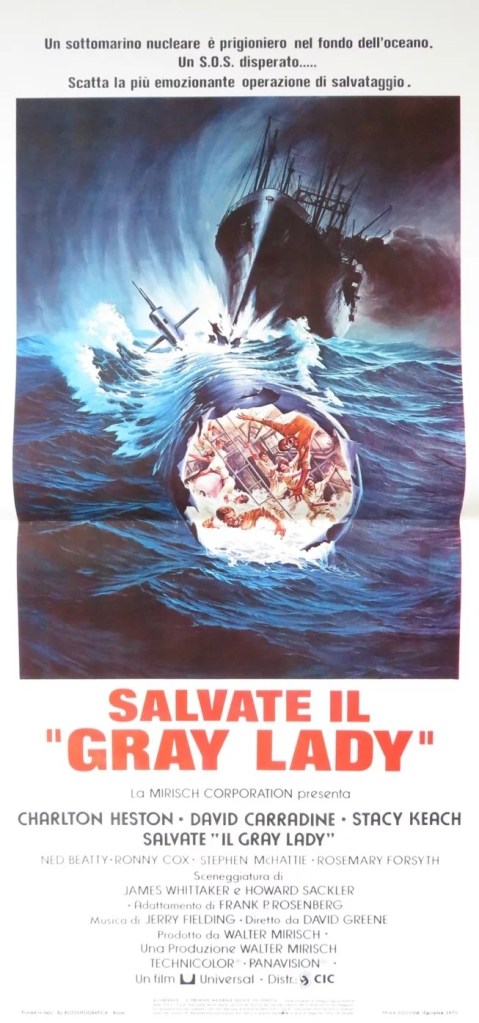
Filmed on a budget of just $5.25 million, it proved a huge hit, pulling in $19 million in rentals.
SOURCES: Walter Mirisch, I Thought We Were Making Movies, Not History (University of Wisconsin Press, 2008) p339-341; Charlton Heston, The Actor’s Life (Penguin, 1980) pp464-481.
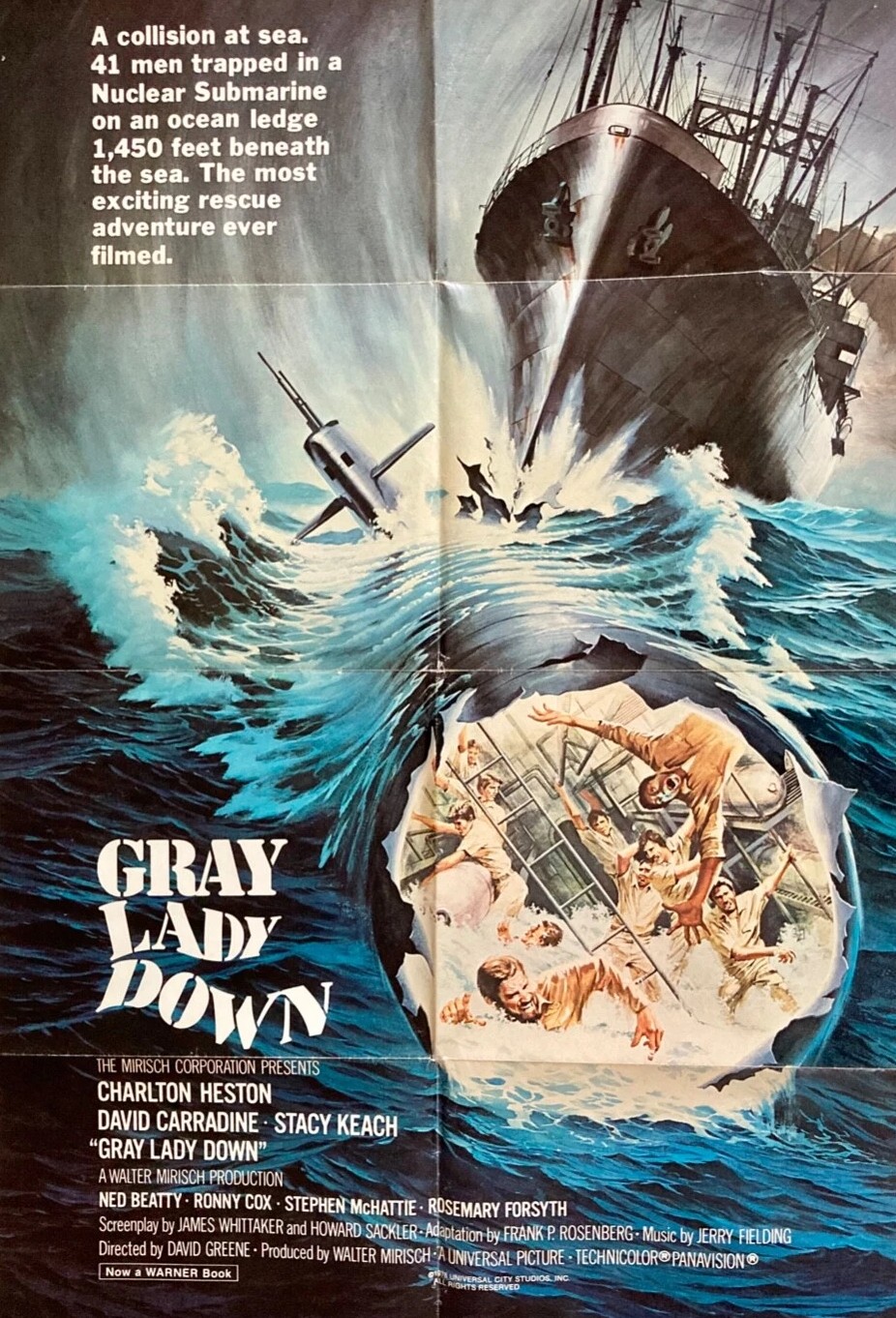
The best of the late 70s disaster pictures and possibly the best of the whole short-lived genre, mixing technology, hair-rising tension and restrained emotion on top of a belter of a concept, sailors trapped in a submarine on the seabed with oxygen running out. But what lifts this above the norm is that it doesn’t follow the normal disaster picture template. Men do not rise easily to this challenge. Courage drains away as fast as time. Tempers flare and more than one of these hardy men collapse under the pressure.
The best scene in the picture is a man dealing wordlessly with loss and being a male of a certain era unable to shed a tear. So it’s all on the face. Capt Blanchard (Charlton Heston) has to shut himself away to grieve. And there’s a somber tone throughout. Corpses, covered only in a blanket, are laid out alongside the injured in an improvised sick bay. More than one person cracks. Even in a major crisis, bureaucracy gets in the way.
Blachard isn’t exactly the strong-jawed hero. As the situation grows more serious, his equanimity fails and he gets very snappy with the crew. And he’s also dealing with a heavy dose of guilt. Luckily, his major failing isn’t exposed to the crew, but his second-in-command points the finger.
Although the sub has been sent to the bottom courtesy of a collision in thick fog with a merchant ship boasting faulty radar, the accident should never have occurred. The sub shouldn’t have been on the surface. The only reason for that was Blanchard’s pride. This is his final voyage and he wanted to sail into harbor with is vessel atop the waves.
Now the sub is laid up in a deep trench and subject to “gravity slides”, the technical term for rock falls, which not only shift its position every now and then, pushing it deeper into the trench, but seal up the top of the escape hatch.
So the U.S. Navy’s new-fangled DSRV (Deep Submergence Rescue Vehicle) can’t do its job and an even more new-fangled experimental submersible, operated by Captain Gates (David Carradine) and his sidekick Mickey (Ned Beatty) is called in. But its operation is sabotaged when officious Capt Bennett (Stacy Keach), tasked with the rescue mission, insists on one of his own men going down instead of the more experienced Mickey.
The underwater scenes are thrilling, and there’s plenty of technical know-how on view and a bunch of impression jargon spouted, as the sub slips further away and the submersible moves into more perilous depths. In the days before CGI, this is superb stuff. And since the sub is now upside down you certainly see more than normal of your typical submarine.
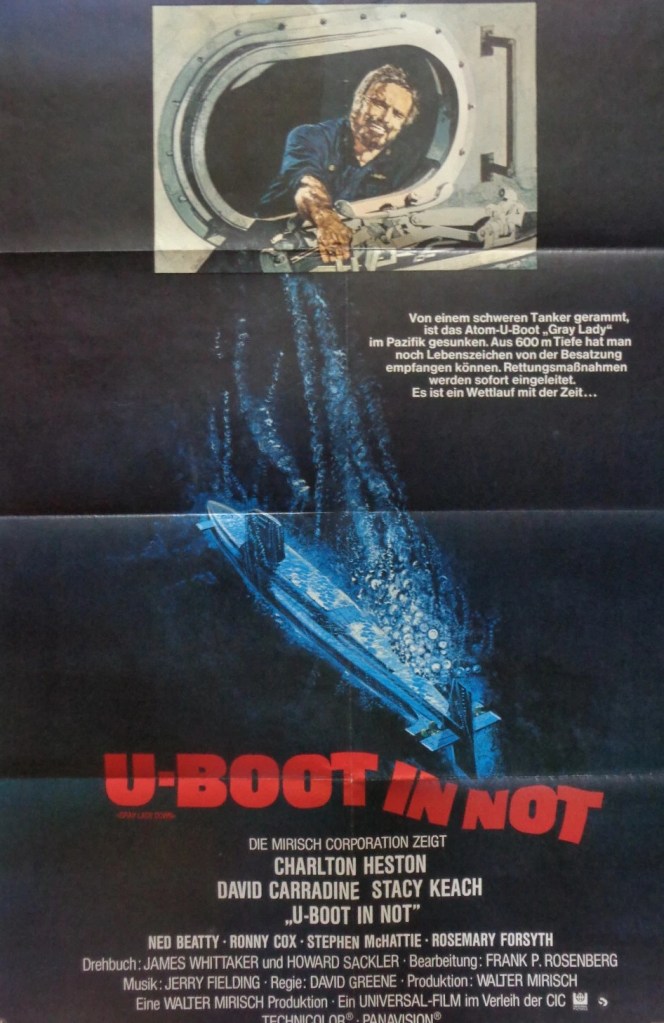
Unlike earlier disaster numbers like Airport (1970), The Poseidon Adventure (1972) and Towering Inferno (1974), no time is wasted setting up the various characters, usually embroiled in emotional entanglement, and for sure there’s no nuns or pregnant women to get in the way of a tight narrative. Comic relief, if that’s what you’re looking for, is provided by the chirpy Mickey.
But when you get right down to it, this holds all the narrative aces. You know rescue is going to get complicated. The unexpected always gets in the way.
But the men under pressure a thousand feet blow the surface are really under pressure and it’s not long before the cracks begin to show and widen.
Unfortunately, this came at the tail end of the disaster cycle when public interest was waning, and perhaps precisely because there was a lack of male-female interaction and no nuns it proved less appealing.
Charlton Heston (Will Penny, 1968) is very impressive, especially when he strains to hold it together and the scene I mentioned is one of his most best pieces of acting. Ned Beatty (Deliverance, 1971) also has a top-notch stiff-upper-lip scene.
Topping the supporting cast are David Carradine (Heaven with a Gun, 1969) and Stacey Keach (Fat City, 1972). You can spot Christopher Reeve (Superman, 1978) in an early role. Rosemary Forsyth (The War Lord, 1965) has a small part, but onshore.
Ably directed by David Greene (Sebastian, 1968) from a screenplay by James Whittaker (Megaforce, 1982) and Howard Sackler (The Great White Hope, 1970) based on the book by David Lavallee
If you’re in the mood for a thrilling ride, hang on to your hat.
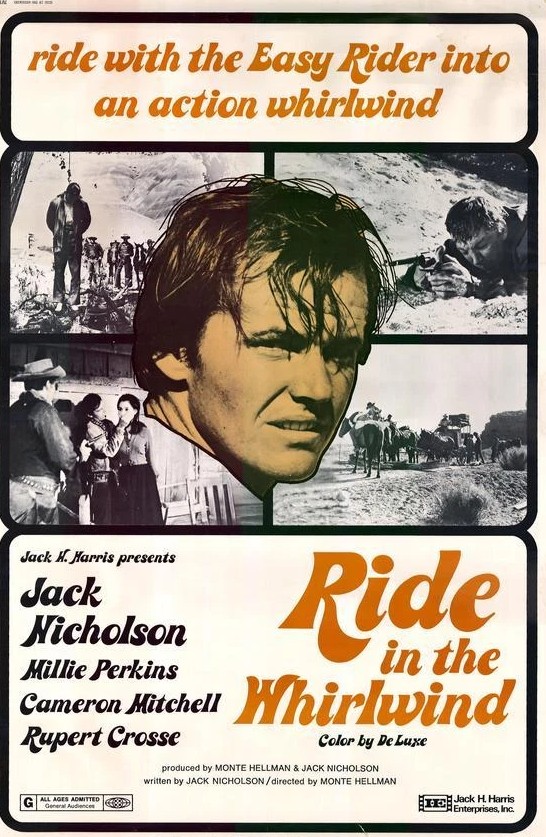
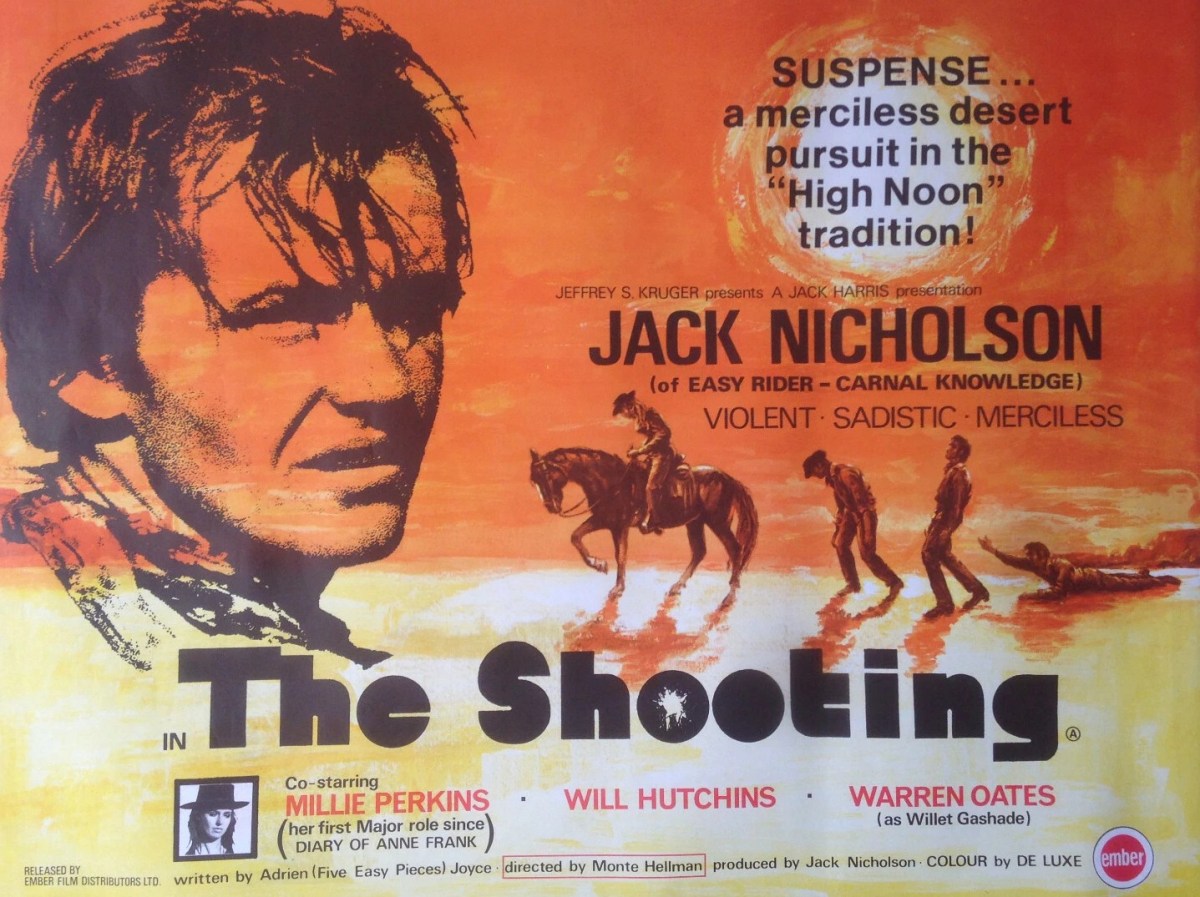
Lightning didn’t strike once never mind three times as with Monte Hellman’s predecessor The Shooting (1966) and all the flaws of that picture are multiplied without either the free pass of being classed as existential or a central performance such as that of Millie Perkins to give it an boost and, as importantly, to provide it with a contemporary edge.
All it proves is that Jack Nicholson should stick to acting rather than screenwriting. Most of the dialog in trying to be authentic just doesn’t ring true and the story is muddled with many too many characters. Calling this offbeat is doing it a favor.
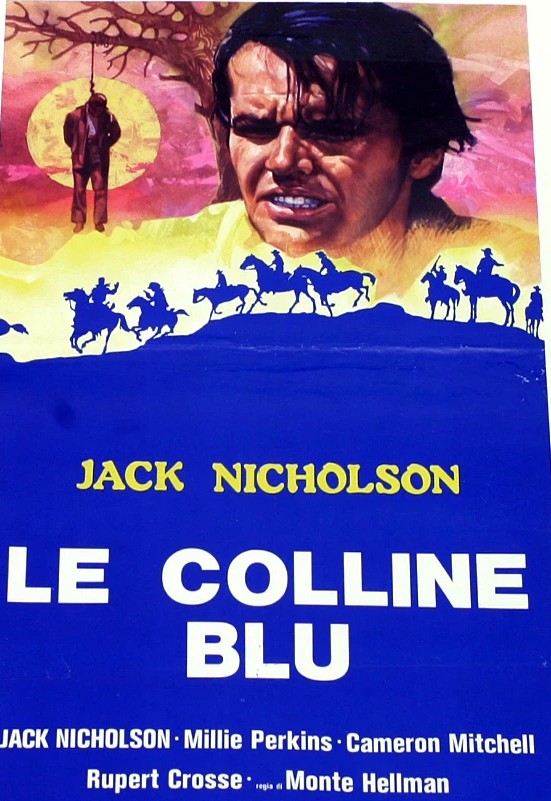
And although, in any poster or copy of the picture you’re likely to see now, Jack Nicholson is top-billed, he’s far from the main act – though the movie dodges around so much it’s hard to find a central character to focus. And if you came to this expecting another acting tour de force from Millie Perkins, you had to wait a good hour before she appeared.
Theoretically, Monte Hellman was inheriting the Budd Boetticher mantle, but that only went as far as making do with a low budget. Though there’s the occasional striking visual, he can’t match Boetticher in terms of composition nor in clarity of narrative. But this was the era when the waters were being muddied between good guys and bad guys, so in a sense, taking Hellman as pre-empting that particular charge, he scores some points there.
Budget deficit led to the other element of authenticity to which this can lay claim. It’s noisy. I mean, noise of the wind – perhaps hence the title – constantly intrudes. Cinema verite perhaps but more likely lack of proper sound equipment.
A bunch of outlaws led by Blind Dick (Harry Dean Stanton) who’s only half-blind, patch over one eye, robs a stage and holes out in a cabin in the hills. A meandering trio of cowboys – Vern (Cameron Mitchell), Wes (Jack Nicholson) and Otis (Tom Filer) – looking for shelter encounter them. For a time it looks like the outlaws are just going to shoot them and be rid of the intruders. Instead, they feed them beans and biscuits and liquor.
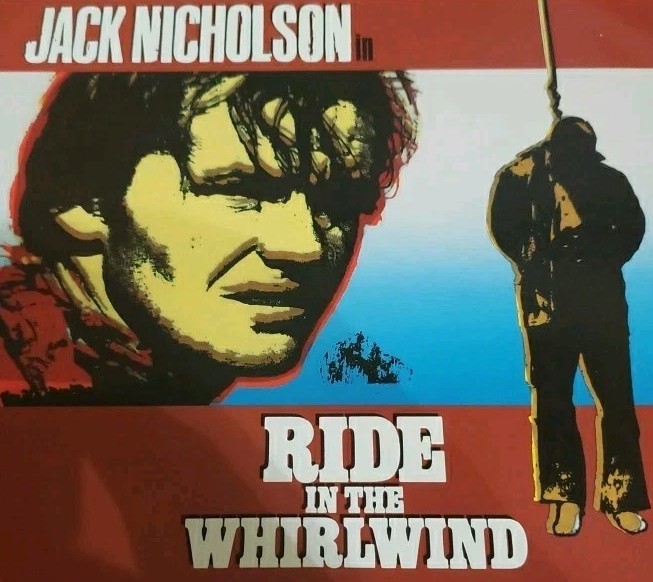
Next morning a posse turns up and starts shooting at anyone in sight, including Vern and his buddies. They burn out the cabin and hang Blind Dick. Otis is shot but now, thanks to guilt by association, Vern and Wes are wanted fugitives. Requiring refuge, and although innocent they lean into guilt by commandeering the house of farmer Evan (George Mitchell), wife Catherine (Katherine Squire) and daughter Abigail (Millie Perkins) and hold them hostage.
Doesn’t take long for them to be rumbled by a member of the posse. They escape but Vern is wounded and Wes kills the farmer. Now they are reduced to one horse. The dying Vern does a self-sacrificial number and holds off the posse until Wes can escape on the horse.
Although I’m sure many an innocent person was killed in the Wild West, and it didn’t take much for people to cross over into criminality, especially when threatened (Wes would now be wanted for murder), and so it is interesting on that score, it’s just so muddled it lacks any real weight.
We are introduced to way too many characters as a result of lack of narrative cohesion. On this performance I doubt if you would have tagged Jack Nicholson as the breakthrough performer of Easy Rider (1969) and Millie Perkins is given nothing on which to build from what should have been her breakthrough turn in The Shooting.
In fact, most of the honors go to old-timer Cameron Mitchell (Blood and Black Lace, 1964) who’d had to head to Italy to get some decent top-billed work. If you were looking for the Jack Nicholson of the gleaming teeth and distinctive diction, then you’ll find him here but not much else. Monte Hellman would go on to find some mainstream credibility, though still erring on the offbeat, in the likes of Two-Lane Blacktop (1971) and Cockfighter (1974). But this is embryo work.
File under disappointment.
Director Monte Hellman struck lucky three times. In the first place French critics took such a shining to this disjointed elliptical western that they tabbed it a work of existential genius. Then Jack Nicholson, who only has a small part, became a global star and it picked up a second head of steam. And now, with grief porn the latest craze thanks to the likes of Hamnet (2025) and Wuthering Heights (2026) I reckon it’s worth reassessment. But not for that wallowing in grief aspect so popular these days, but for the way genuine grief works its way out in cantankerous maddening fashion.
You’d have thought the performance of Millie Perkins would have been highlighted long before now for its feminism. Her un-named woman runs contrary to the notion of the female star in a western. She doesn’t come on all sexy in a Raquel Welch fashion, nor does she fall victim to a predatory male. But she is a heck of a creation.
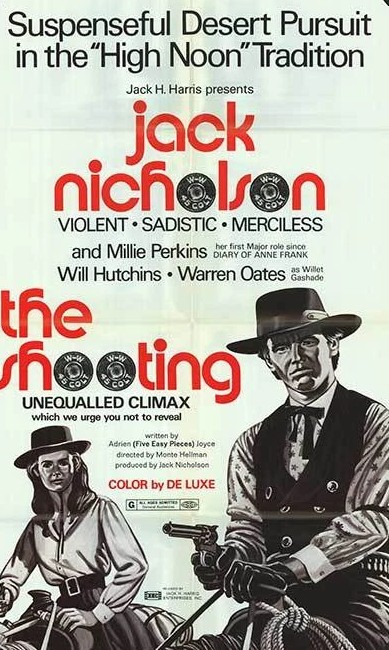
She doesn’t play by any of the man-made rules in this male-dominated world. She gets what she wants by foul means and she doesn’t give a hang about whose feelings she tramples underfoot. She’s not interested in seduction, nor in finding a man, so strike out any thoughts of sex or romance, and she’s domineering, rude and contrary.
Given the western is weighted down with enigma, you have to work hard to find out what it’s all about and what’s she’s after. And her introduction tells you she’s trouble. She kills her own horse so she can appear to two cowboys running a defunct mine as a woman needing help. The younger Coley (Will Hutchins) would be easily duped by any woman with an ounce of the smarts. The older Willett Gashade (Warren Oates) is less easily led, though when the woman offers $500 if they help her reach the nearest town, they’re ready to oblige.
But she wants to make haste, while Willett wants to ensure they are equipped for the journey, so saddling up an extra mule to carry their supplies. But a mule slows them down, so she finds a way to stampede it off. And every now and then she lets off a random shot, Willett working out she’s trying to attract someone’s attention. The someone turns out to be gunslinger Billy Spear (Jack Nicholson). When she insists on going off-trail Gashade works out she’s hunting for someone.
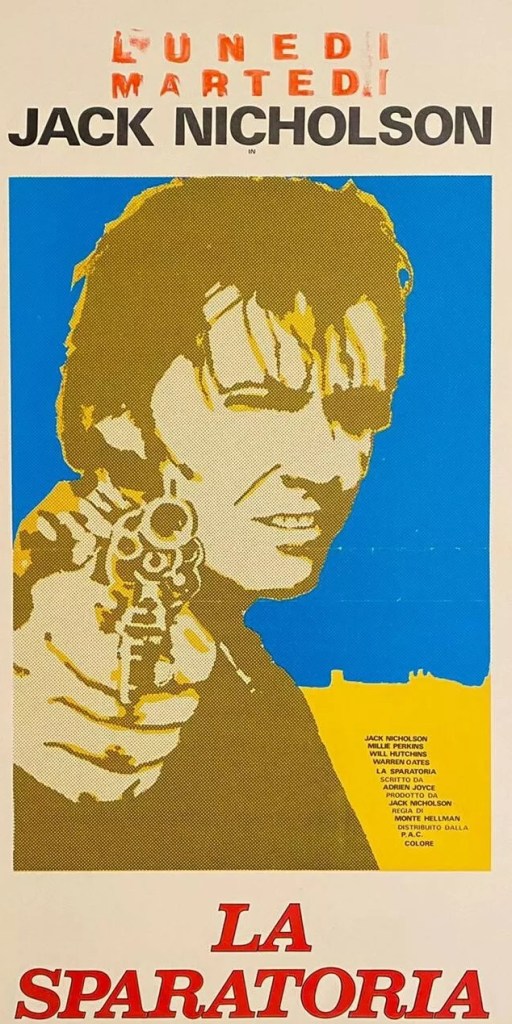
That’s another elliptical moment. She’s hunting the killer of her son. Even though it was an accident, she wants revenge.
And that’s the grief spelled out in a variety of ways but never with the usual emotional baggage, not even a tear. Eventually, we’re in Treasure of the Sierra Madre (1948) territory where men are going mad. Here, they keep going after their horses die and trek over desolate merciless country until they find their quarry, who turns out to be Gashade’s brother.
Turns out, too, she hardly needs her entourage. She finishes off her nemesis while Spear and Gashade struggle behind. She only needed the men for their tracking skills.
So what we have instead of the existential is something considerably more solid and worth far more than falling in with some arthouse accolade. This is both an exceptional study of grief and an exceptional study of a woman, possibly the first in the feminist line if you discount Barbara Stanwyck who still, generally, was better off with a man at her side.
All her deriding of the men, her mental cruelty, her whimsical actions, make every bit of sense when you realize these are all expressions of grief. Except for her murderous intent, she’s almost stoical in her grief, never allowing wanton emotion to get in the way, and even when turning tearful might work in winning men over she doesn’t give in to the temptation. She can twist Coley round her little finger anyways and she knows how to handle Gashade, teaching him in no uncertain terms who’s boss.
In some respects Monte Hellman (Ride the Wild Whirlwind, 1966) is the inheritor of the Budd Boetticher mantle, purveyor of lean westerns short on running time with a principled hero, here read heroine. But Hellman lacks Boetticher’s compositional artistry and could do with putting some more work into the storytelling department.
If you’ve come looking for the Jack Nicholson of Chinatown (1973) you’ll be disappointed. He’s hardly in it, though he is an exemplar of that mantra in The Housemaid (2025) of teeth being a privilege. Warren Oates (The Wild Bunch, 1969) is a better bet, providing a foretaste of his grizzly characters to come.
But Millie Perkins (Wild in the Streets, 1968) tears up the screen. From her bold introduction to the savage conclusion she presents a vivid characterization of a woman expunging her grief with violence. Written by Carole Eastman (Five Easy Pieces, 1970).
Well worth a look.
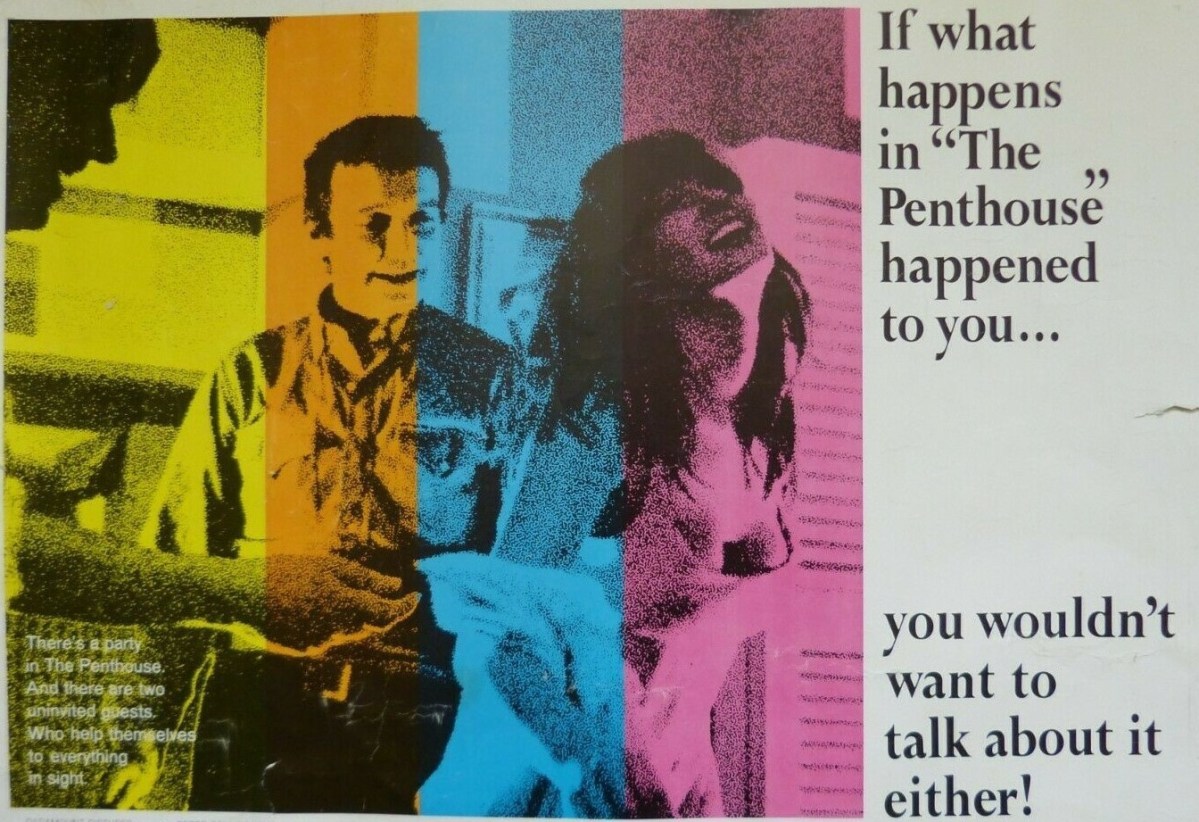
Visceral home invasion thriller that ignited the genre and triggered later more controversial offerings like The Straw Dogs (1971) and A Clockwork Orange (1971). Made virtually on one set for the indescribably minute sum of £100,000, it is charged with Pinteresque dialog and aberrant philosophy. The genre splits into those pictures where the occupants have more than a good chance of avoiding their fate, the focus on the invaded pitting their wits against the invaders – classic examples being The Straw Dogs or more recently Panic Room (2002) – and those where the victims are mercilessly tormented, such as, in grueling detail, here.
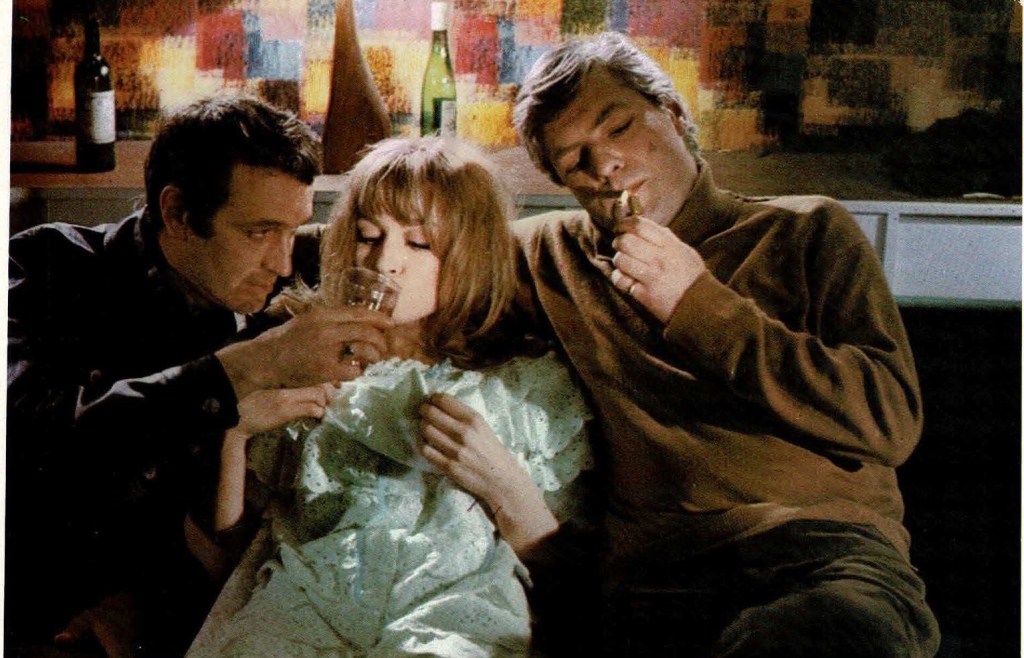
As one of the perks of his job cocky married real estate agent Bruce (Terence Morgan) takes advantage of an expensive unoccupied apartment on his company’s books – “in the happy position to take advantage of my clients’ generosity in their absence” as he puts it – to enjoy an illicit tryst with mistress Barbara (Suzy Kendall). But when she answers to the door to two men coming to read the gas meter, their lives are turned upside down.
Tom (Tony Beckley) and Dick (Norman Rodway) are, of course, bogus and armed with a knife quickly take control, trying up Bruce and pouring alcohol down Barbara’s throat. As part of the overall creepiness, there is a sense that this is no casual visit, but that it has been planned, as if someone somewhere is familiar with the set-up, and there a debt, if only a moralistic one, to pay as a deterrent to the era’s permissiveness. Minus the knife, they would have passed as harmless. But never was their such difference between word and action, except for what they are capable of you could easily be persuaded that are in fact camp and bitchy.
The bound Bruce’s is spun round in a chair and can only watch as the men begin to strip Barbara. His only defence is verbal, trying to set the two men against each other, suggesting that Tom treats Dick as his assistant. But the relationship between the two criminals constantly shifts as if they were in passive-aggressive relationship. You don’t learn much about them until the end, so basically you have to rely on what they say about themselves, which is very little. They are prone to philosophic observation or interrogate Bruce about his possessions or extract from Barbara an unexpected ambition to be a painter.
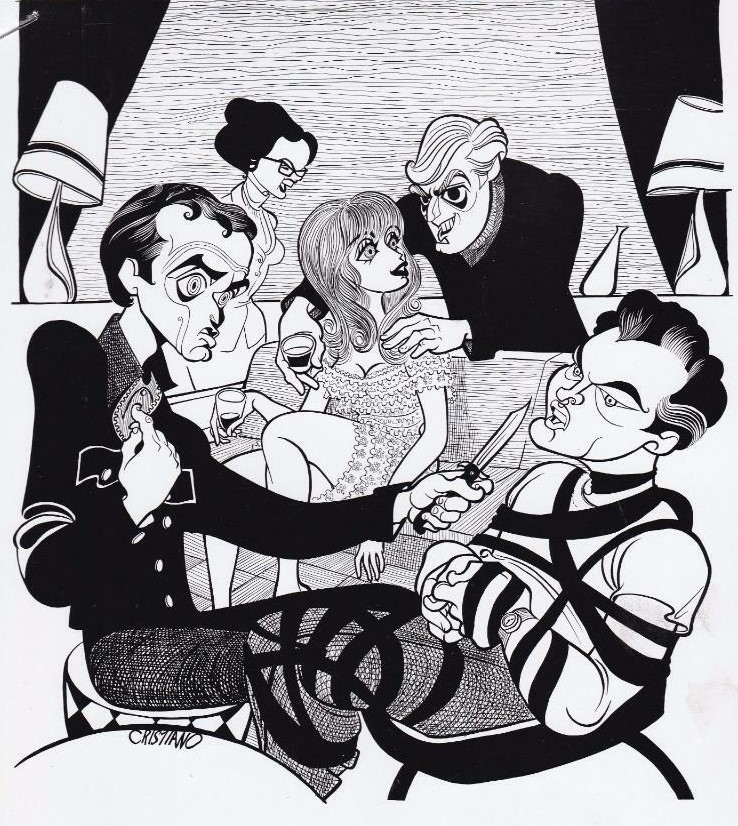
The men take it in turns to torment Bruce while the other is in the bedroom with Barbara. Where Bruce resists verbally, Barbara gives in almost right away, but there is never the sense that this is in any way consensual, just that she is too drunk to defend herself – the first drink is a full glass of whisky forced down her throat – and the men have a knife. The invaders make constant reference to a character called Harry. That person’s eventual appearance provides a whole new range of twists.
It’s a film full of menace. Sexual tension, mind games, claustrophobia and the threat of physical violence never dissipate. Because it is rationed out, the brutality is all the more shocking. But it is brilliantly directed. In his debut British director Peter Collinson (The Italian Job, 1969) uses the camera to suggest we are in anything but an enclosed space. In one long sequence the camera does not move, in another scene it turns 360 degrees – Antonioni’s use of this device in The Passenger (1975) was credited as innovative – and at other times it twists and turns as if turning the characters inside out, suggesting some of the dizziness, the dramatic speed of change of feelings, that the stunned victims are enduring. At times it feels like an arthouse movie. At other times like a deranged B-picture.
The cast are all excellent. Tony Beckley (The Lost Continent, 1968) makes the best of a role of a lifetime, Norman Rodway (Four in the Morning, 1965) the more quietly psychotic sidekick. Terence Morgan (The Sea Pirate, 1966) has less to do but Suzy Kendall (Fraulein Doktor, 1969) is superb as the enigmatic girlfriend. Look out for Martine Beswick (Prehistoric Women, 1967) in a small part. Collinson wrote the screenplay based on a play The Meter Men by Scott Forbes.
Cultural note: “Tom, Dick and Harry” are considered such quintessentially British names that anyone familiar with this would understand immediately that they were a) pseudonyms and b) intended as a twisted kind of joke.
No sign of this being available on Amazon. Ebay is probably your best bet. There’s a copy on YouTube but it ain’t a good print.
A daily selection of the best content published on WordPress, collected for you by humans who love to read.
by Brian Hannan
The latest news on WordPress.com and the WordPress community.


 The Magnificent 60s