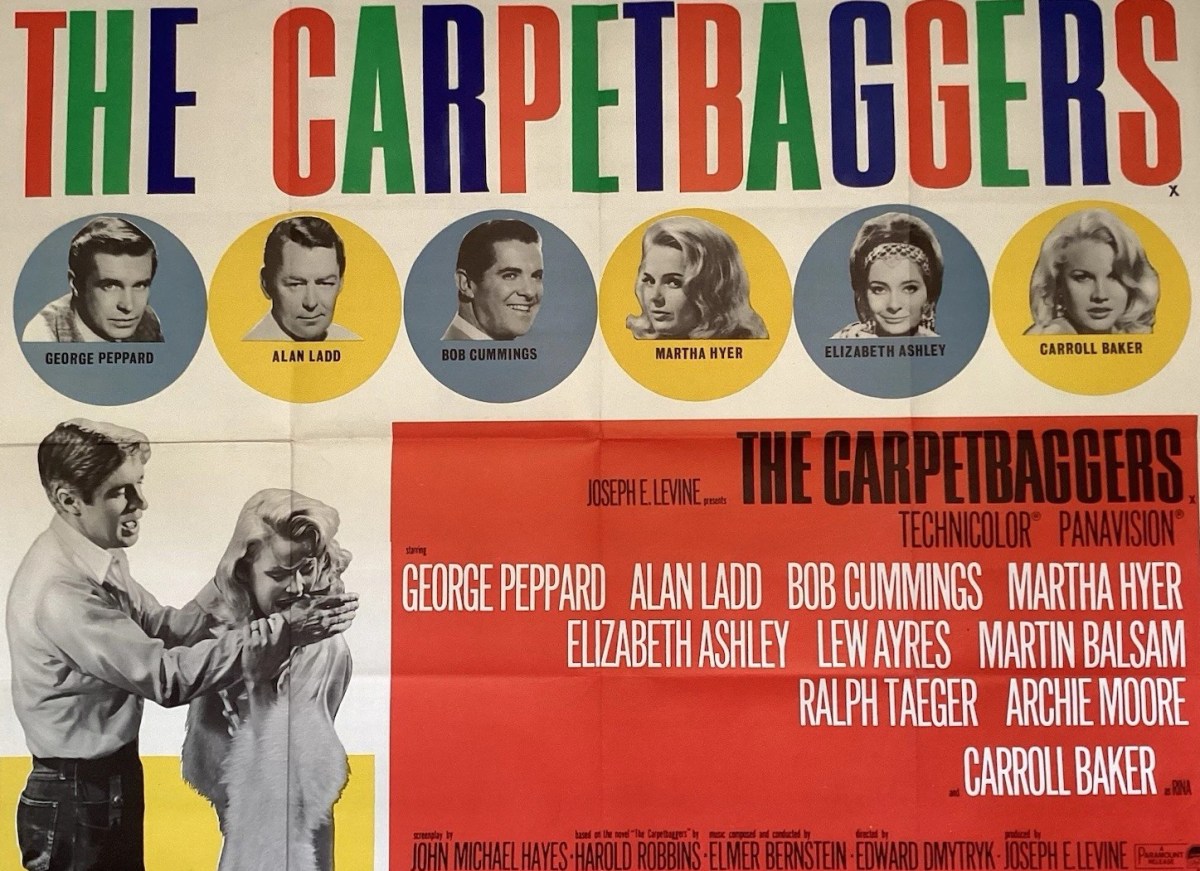
Likely because the gigantic bestseller by Harold Robbins (Stiletto, 1969) on which this was based made it impervious to critics, the critics determined to slaughter it. Which was a great shame because if they had been at all open-minded, not to mention fair, they would have recognized, outside of a terrific tale with a spellbinding performance by George Peppard (The Blue Max, 1966), a master class in screenwriting from double Oscar nominee John Michael Hayes (Butterfield 8, 1960).
There’s hardly a slack line in the entire ensemble and given he was adapting a monster of a book he cuts to the chase with infinite guile. Scenes demonstrate instant characterization and are littered with quotable lines and the story, even at two-and-half-hours, is told at breakneck speed.
No sooner are we introduced in the opening two scenes to the reckless, arrogant and bedhopping Jonas Cord (George Peppard) than his father has dropped dead and Cord has not only inherited the company but immediately turned from louche spoiled brat into hard-nosed businessman, not just tough but determinedly mean especially in the area of revenge. In a superb scene with his father’s widow Rina (Carroll Baker), we learn that she dumped Jonas for his richer father, and although Jonas appears to be leading her on, that’s only until he can humiliate her by exposing her innate greed.
Despite her wayward sexuality, Rina is a savvy businesswoman, enough to make sure she is set up for life, although the other men she gravitates towards are not as weak as Jonas’s father, nor as nasty as Jonas, and Nevada Smith (Alan Ladd) has the wisdom to led her down gently when he enters her seductive web. The Nevada Smith backstory, which takes up a hefty chunk of the novel, is dealt with in one clever scene, which could act as a trailer for the later film starring Steve McQueen.
And early on there’s a superb scene, akin to the madwoman in the attic, where Jonas opens a locked door containing a derelict bedroom strewn with children’s toys that belonged to his brother. The reason for the locking away is never explained but it’s the only time Jonas gives in to his vulnerable side.
Both Rina and Nevada segue into successful film careers and eventually have an affair. Cord becomes a movie mogul.
Though it certainly enters soap territory in the second half it’s so true to the characters that it plays out in hugely enjoyable fashion. Jonas remains ruthless – and unhappy – while Rina powers her way through men and booze, the latter leading to her death. Nevada doesn’t turn into a superstar, Jonas abandons wife Monica (Elizabeth Ashley) and child, begins an affair with former porn star Jennie (Martha Hyer) and destroys her.
You will be surprised to learn this has a happy ending. I can’t confess to have read the book so no idea whether or not this was tacked on to keep the studio happy. Whatever, it’s a terrific ride, full of punchy lines and sharply-wrought scenes and enough of the pell-mell structure of the book to keep an audience riveted.
This proved the career breakthrough for George Peppard – Breakfast at Tiffany’s (1961) had done considerably less for his career than it had for Audrey Hepburn – and he offered Hollywood mavens a new kind of hero, not just a tough guy in the Steve McQueen mold, but a mean tough guy that would open the door for the likes of Lee Marvin.
As you will know I’ve got a soft spot for Peppard, who’s generally been under-rated as an actor. This performance, despite the depths he showed, was equally dismissed, but it’s the turn of this career.
Carroll Baker (Harlow, 1965), too, has a part with real meat and makes the most of it, not just a slinky sex god, but devious and smart, and vulnerable. Alan Ladd (Shane, 1953) in his final picture is well out of his comfort zone and might have looked forward to an extended career playing a different kind of character except for his untimely demise.
The females are uniformly good, especially as they all have underlying reasons for their attraction to the wealthy Jonas, Monica desperate to save her father’s business, Jessica desperate to hide her past.
Edward Dmytryk (Mirage, 1965) doesn’t put a foot wrong, allowing insecurities in tough characters to creep through, but the star of the show for me is John Michael Hayes who turns what could have been a routine blockbuster with a built-in audience into a cracking entertainment.
One to catch.

 The Magnificent 60s
Here is some:
“According to a 30 Aug 1961 Var item, motion picture rights to Harold Robbins’s bestselling novel The Carpetbaggers were initially owned by entertainment executive Matthew M. Fox. The project was rumored to be the first of four films produced by singer-actor Eddie Fisher for Warner Bros. Pictures, and an earlier DV report from 7 Jul 1961 claimed that Fisher’s then-wife, actress Elizabeth Taylor, would co-star alongside Rock Hudson. When Fisher’s option expired, Fox decided to auction the novel for an asking price of $300,000. On 8 Sep 1961, DV announced that rights had been acquired by Joseph E. Levine of Embassy Pictures. Planning a lavish production, Levine told the 31 Jan 1962 Var that the budget would likely exceed $5 million. The 3 Oct 1962 Var explained that this arrangement was made possible by Paramount Pictures, which agreed to cover negative costs in exchange for worldwide distribution rights. A 25 Sep 1962 DV news story indicated that the studio had also allocated an advertising budget of $1 million.
The 16 Jul 1962 DV indicated that Levine met with Joseph L. Mankiewicz before Edward Dmytryk was signed as the film’s director.
Once John Michael Hayes completed work on the screenplay, casting began in the spring of 1963. Although a 22 Sep 1961 DV brief claimed Robert Stack was interested in playing “Jonas Cord, Jr.,” the leading role eventually went to George Peppard. Various DV casting announcements during the spring and early summer reported the names of several actors in consideration to star, including Eddie Albert as “Dan Pierce,” Jerry Van Dyke as “Buzz Dalton,” Anne Francis as “Jennie Denton,” Suzanne Pleshette, Stella Stevens, Ray Milland, and Arthur O’Connell. The 10 Jun 1963 edition claimed that singer Nat King Cole was once attached for the role of “Jedediah,” but dropped out to fulfill prior nightclub commitments. Similarly, the 31 Jul 1963 Var indicated Tony Bill was replaced by Tom Lowell due to scheduling conflicts. Additional casting announcements listed performers whose involvement could not be confirmed, or may have been uncredited: David Bailey, Larry Barton, Ruth Packard, Sue Casey, Kathleen Gately, James Sikking, and Fred Zendar. According to the 24 Jul 1963 Var, dialogue coach Frank London also appeared onscreen in a non-speaking role. Items in the 21 Aug 1963 Var and 22 Aug 1963 DV stated that radio-television personality Virginia Graham, and disc jockeys Gene Week and Roger Christian of the Los Angeles, CA-area radio station KFWB, were selected to play radio reporters in the film.
Principal photography began in mid-Jun 1963, although contemporary sources offered conflicting information regarding the exact date. The 10 Jun 1963 DV announced that the unit had arrived for two days of location shooting in the Mojave Desert town of Boron, CA, while a 14 Jun 1963 DV production chart and LAT story claimed filming did not begin until 11 Jun or 13 Jun, respectively. Interior shooting took place on the Paramount studio lot in Hollywood, CA, and additional scenes were reportedly filmed in Pasadena, CA. The 7 Aug 1963 Var announced that principal photography was scheduled to conclude on 28 Aug 1963. Despite Levine’s initial estimates, the 8 Aug 1963 DV listed a budget closer to $3.5 million. According to a 13 Jun 1963 LAT brief, Carroll Baker’s wardrobe alone cost $40,000.
The 23 Jul 1963 DV noted that men’s fashion retailer Sy Devore contributed to the costumes.
As The Carpetbaggers entered post-production, filmmakers encountered complications depicting the excessive sex, nudity, and sadism of Robbins’s original novel. Although the 19 Dec 1962 NYT suggested that Production Code Administrator Geoffrey M. Sherlock reviewed the finished script before the start of production, the film received extensive publicity for a nude scene featuring Carroll Baker. In a 14 Jun 1964 interview with the NYT, Baker described the sequence, in which “Rina Marlowe” sits alone at her bedroom vanity after bathing. She claimed it was her idea to shoot the scene in the nude, and defended the choice by asserting that her character would not have worn a robe. The 25 Aug 1963 LAT stated that the scene was filmed on a closed set with a limited crew.
Public and industry disapproval sparked a broader debate about the content being presented in films, and whether Paramount would oppose the censors and withdraw from the Motion Picture Association of America (MPAA), as United Artists (UA) had done to release The Man with the Golden Arm (1955, see entry) without a Code Seal. However, on 15 Oct 1963, NYT reported that Levine had decided to back down, and would remove all nudity from the cut submitted to the MPAA for review. A few weeks later, the 8 Nov 1963 DV confirmed that Levine had obtained the PCA’s seal of approval by substituting alternate angles that obscured any nudity.
According to an 8 Apr 1964 Var article, a special engagement in Denver, CO, was set to launch the following day with a $50,000 premiere event at the Paramount Theatre. The studio spent the next few months rolling out an extensive publicity campaign before the West Coast premiere on 4 Jun 1964. A Var item published that day revealed that the gala took place at Hollywood’s Grauman’s Chinese Theatre, which began regular bookings the morning of 5 Jun 1964. The release was then set to expand to 400 venues around the country over the next two months, some of which featured 70mm presentations. The film was a box-office success, as the 9 Jul 1964 NYT reported earnings of $1,612,428 from twenty-three New York City area theaters since its local debut on 1 Jul 1964.
The Carpetbaggers marked the final feature film of actor Alan Ladd, who died on 29 Jan 1964. Before production even began, the 1 Feb 1963 LAT announced that Levine intended to reunite with John Michael Hayes to develop Nevada Smith, a prequel about Ladd’s character of the same name, which was released in 1966 with Steve McQueen in the title role.”
LikeLike