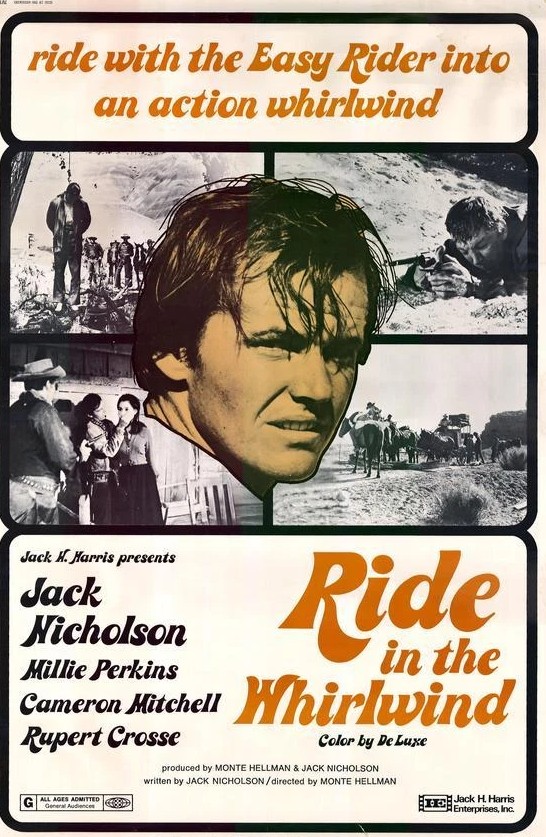
Lightning didn’t strike once never mind three times as with Monte Hellman’s predecessor The Shooting (1966) and all the flaws of that picture are multiplied without either the free pass of being classed as existential or a central performance such as that of Millie Perkins to give it an boost and, as importantly, to provide it with a contemporary edge.
All it proves is that Jack Nicholson should stick to acting rather than screenwriting. Most of the dialog in trying to be authentic just doesn’t ring true and the story is muddled with many too many characters. Calling this offbeat is doing it a favor.
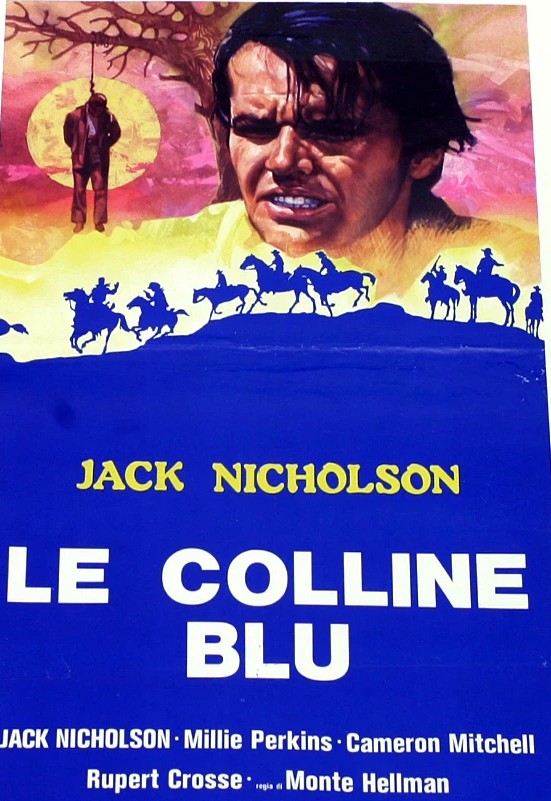
And although, in any poster or copy of the picture you’re likely to see now, Jack Nicholson is top-billed, he’s far from the main act – though the movie dodges around so much it’s hard to find a central character to focus. And if you came to this expecting another acting tour de force from Millie Perkins, you had to wait a good hour before she appeared.
Theoretically, Monte Hellman was inheriting the Budd Boetticher mantle, but that only went as far as making do with a low budget. Though there’s the occasional striking visual, he can’t match Boetticher in terms of composition nor in clarity of narrative. But this was the era when the waters were being muddied between good guys and bad guys, so in a sense, taking Hellman as pre-empting that particular charge, he scores some points there.
Budget deficit led to the other element of authenticity to which this can lay claim. It’s noisy. I mean, noise of the wind – perhaps hence the title – constantly intrudes. Cinema verite perhaps but more likely lack of proper sound equipment.
A bunch of outlaws led by Blind Dick (Harry Dean Stanton) who’s only half-blind, patch over one eye, robs a stage and holes out in a cabin in the hills. A meandering trio of cowboys – Vern (Cameron Mitchell), Wes (Jack Nicholson) and Otis (Tom Filer) – looking for shelter encounter them. For a time it looks like the outlaws are just going to shoot them and be rid of the intruders. Instead, they feed them beans and biscuits and liquor.
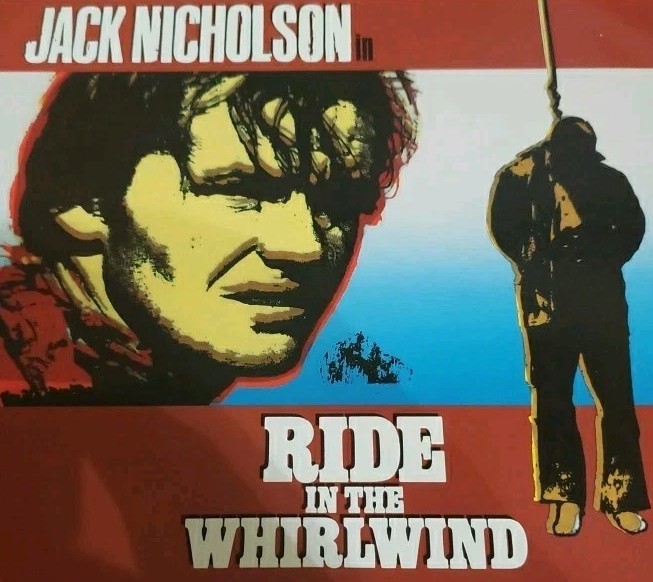
Next morning a posse turns up and starts shooting at anyone in sight, including Vern and his buddies. They burn out the cabin and hang Blind Dick. Otis is shot but now, thanks to guilt by association, Vern and Wes are wanted fugitives. Requiring refuge, and although innocent they lean into guilt by commandeering the house of farmer Evan (George Mitchell), wife Catherine (Katherine Squire) and daughter Abigail (Millie Perkins) and hold them hostage.
Doesn’t take long for them to be rumbled by a member of the posse. They escape but Vern is wounded and Wes kills the farmer. Now they are reduced to one horse. The dying Vern does a self-sacrificial number and holds off the posse until Wes can escape on the horse.
Although I’m sure many an innocent person was killed in the Wild West, and it didn’t take much for people to cross over into criminality, especially when threatened (Wes would now be wanted for murder), and so it is interesting on that score, it’s just so muddled it lacks any real weight.
We are introduced to way too many characters as a result of lack of narrative cohesion. On this performance I doubt if you would have tagged Jack Nicholson as the breakthrough performer of Easy Rider (1969) and Millie Perkins is given nothing on which to build from what should have been her breakthrough turn in The Shooting.
In fact, most of the honors go to old-timer Cameron Mitchell (Blood and Black Lace, 1964) who’d had to head to Italy to get some decent top-billed work. If you were looking for the Jack Nicholson of the gleaming teeth and distinctive diction, then you’ll find him here but not much else. Monte Hellman would go on to find some mainstream credibility, though still erring on the offbeat, in the likes of Two-Lane Blacktop (1971) and Cockfighter (1974). But this is embryo work.
File under disappointment.

 The Magnificent 60s
Brian, well, I’m somewhat surprised at your critical write-up of RIDE IN THE WHIRLWIND(filmed 1965, released 1966) after reading your take on THE SHOOTING(filmed 1965, released 1966). We’ll just have to agree to disagree on this one. Needless to say, I like this Western movie more than you do. It would be a boring world if we all liked the same things. I first viewed RIDE IN THE WHIRLWIND on Memphis, Tennessee’s WREC Channel 3 EARLY MOVIE in 1973 two weeks before I first viewed THE SHOOTING which was also on the WREC Channel 3 EARLY MOVIE. Compared to THE SHOOTING, RIDE IN THE WHIRLWIND is a somewhat more conventional straight forward traditional Western movie. Although, I’ll do it a favor and call it an offbeat one.
I look at RIDE IN THE WHIRLWIND from a different angle. First, I like the story which has three drovers caught up in an extraordinary happening of not their making. The photography by Gregory Sandor of the beautiful, rugged reddish and white streaked landscapes of northern Arizona and southern Utah are breathtaking. The acting is okay and they all did what was required. I think Cameron Mitchell’s performance was the standout, but Director/Producer/Editor Monte Hellman preferred to tell the story visually with less dialogue, in other words, show and don’t tell, and I think he succeeded in that regard. I liked the look and feel of this very tense movie. It’s not afraid to show the harshness of the West, or the blurriness of vigilante justice.
RIDE IN THE WHIRLWIND is a very realistically made movie, and I think realism combined with fabulism and history can make for a very entertaining movie. Jack Nicholson went to the Los Angeles Public Library and researched diaries, journals, letters, dime novels, and history books written by Westerners of the 19th Century. Most notably Nicholson used THE VIGILANTES OF MONTANA: POPULAR JUSTICE IN THE ROCKY MOUNTAINS(1866) by Thomas J. Dimsdale. Dimsdale wrote his account to provide a “correct and impartial narrative” and justify the vigilantes’ use of “popular justice” in the absence of effective law enforcement. Also, THE BANDITTI OF THE PLAINS, OR THE CATTLEMAN’S INVASION OF WYOMING IN 1892: THE CROWNING INFAMY OF THE AGES(1894) by Asa Shinn Mercer. This book is a blistering laid bare telling of the Johnson County War that includes a description of the siege and burning of the KC Ranch. Nicholson used this in the movie. At about ten minutes into the movie Vern(Cameron Mitchell) calls Wes(Jack Nicholson) by his last name Mercer, which could be a homage paid to the writer of the book.
RIDE IN THE WHIRLWIND had its world premiere in Canada at the Vancouver International Film Festival on September 14, 1966. It was advertised as “A new look at the American western starring Cameron Mitchell.” Both RIDE IN THE WHIRLWIND and THE SHOOTING were shown at the San Francisco Film Festival New American Directors Series on September 22 and 23, 1966 respectively. Hellman and Nicholson took it to other film festivals, but no USA distributor was interested. In the meantime, Executive Producer Roger Corman, who financed the two movies, sold the domestic rights to the Walter Reade Organization. Reade subsequently believed that these two offbeat Westerns would be a hard sell theatrically, so he bypassed theaters and licensed them directly to television stations as part of a larger film package for showing. New York City’s WNBC Channel 4 first aired THE SHOOTING on its late movie the SUNDAY FILM FESTIVAL on March 31, 1968. RIDE IN THE WHIRLWIND first aired on WNBC Channel 4’s late movie SUNDAY FILM FESTIVAL on December 1, 1968.
Meanwhile back with Monte Hellman and Jack Nicholson. In late 1966 they sold the foreign rights to a French producer, but that producer went bankrupt. The bankruptcy occurred shortly thereafter, and the film cans were stuck in bond at the Paris airport. After considerable legal maneuvering, Hellman and Nicholson successfully reclaimed the rights. According to Hellman, he initially managed these theatrical showings without a distributor, effectively self-distributing to get them on screens. THE SHOOTING premiered at the Studio Git-le-Coeur Theatre in Paris on June 21, 1968. This small art-house theatre in the Latin Quarter became the primary venue for the movies’s unexpected French success. THE SHOOTING played for a year at the Git-le-Coeur Theatre. The massive word-of-mouth success attracted formal industry interest and Marianne Productions a company led by producer Raymond Danon stepped in to handle the broader theatrical rollout. RIDE IN THE WHIRLWIND had its theatrical premiere at the Studio Medicis Theatre on September 11, 1968. It played for six months. Its success at the Studio Médicis and other Parisian theatres led to it being championed by the influential movie magazine CAHIERS DU CINEMA, which included it in its top ten movie list for the year, coming in at number nine. French critics, particularly those writing for CAHIERS DU CINEMA, hailed Hellman as a master of the “existential western,” comparing his style to Irish playwright Samuel Beckett. These two small budget B-Westerns playing on the Parisian movie circuit cemented Monte Hellman and Jack Nicholson’s reputations in Europe well before they were known names in the USA.
Jack Nicholson became a star in the USA by way of a supporting role in EASY RIDER(filmed 1968, released 1969), which he was nominated for an Academy Award for supporting actor and FIVE EASY PIECES(filmed 1969-70, released 1970), which he was nominated for best actor by the Academy. So, in 1971 after Nicholson had become a major movie star Jack H. Harris Enterprises and Favorite Films purchased theatrical rights to these two almost lost B-Movie Westerns. Finally they began their theatrical run in walk-in and drive-in theaters in the USA. This is an amazing story of two almost lost B-Movie Westerns and the story doesn’t end in 1971.
LikeLiked by 1 person
Even though we disagree, thanks very much for filling me in on the artistic intentions.
LikeLike
Brian, you’re most welcome.
Keep writing these good write-ups, which I enjoy reading.
LikeLike