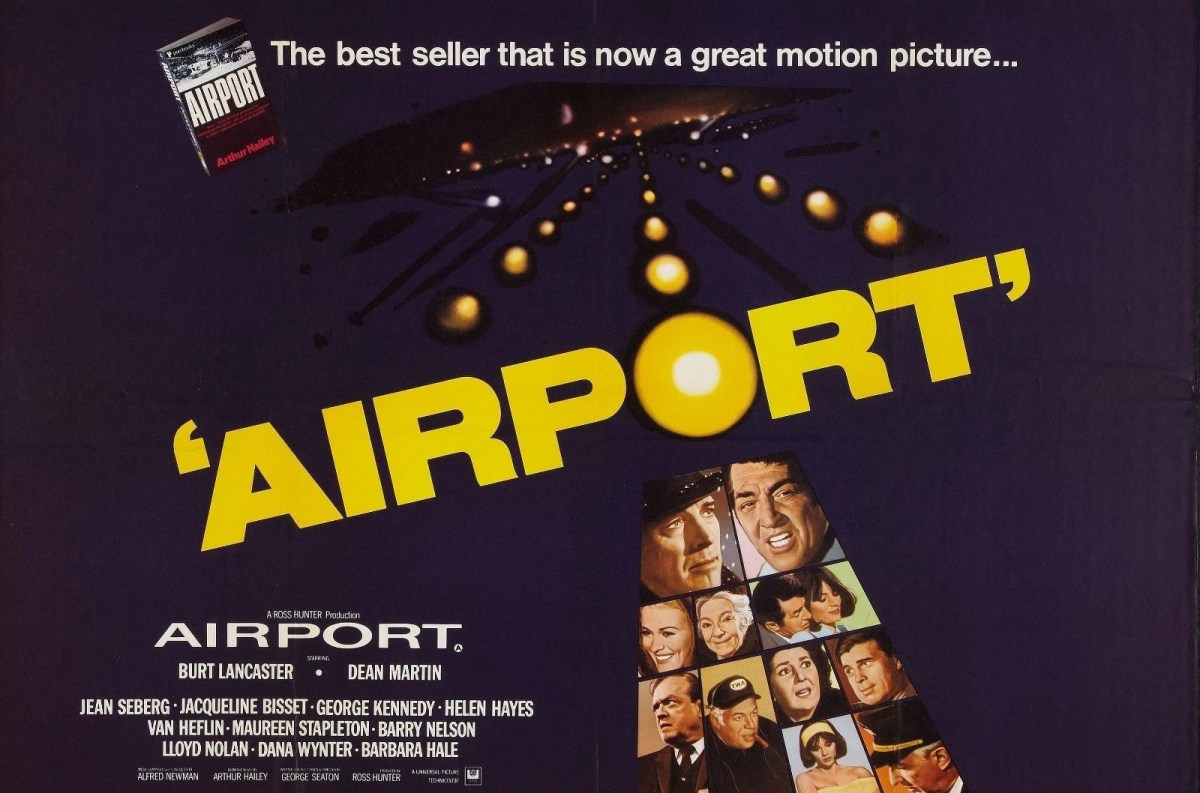
Thundering entertainment from an era when they made movies to appeal to audiences and not to placate the overweening ego of over-entitled directors. I first saw this in 1970 when it was selected as one of three films (the others being Cromwell and The Virgin and the Gypsy) to open the new Odeon triplex in Glasgow, and, thanks to my own in-built movie snobbery, haven’t seen it since. So this was a revelation.
Let’s start with the running time. Made now this would be an overblown 150 minutes (at least) stuffed full of extraneous scenes. But let’s start with the opening. The screen is dark. Yes, absolutely dark. What? Is this some kind of arthouse venture? And it remains dark for about 20 seconds though by now sound has been added, a general hubbub of commotion. Are you sure this isn’t arthouse? Had this been directed by Scorsese or Coppola (who, in fact, used a similar device to open The Godfather, 1972) critics would have picked it up.
John Frankenheimer for Grand Prix (1966) and Norman Jewison for The Thomas Crown Affair (1968) were praised for their use of the split screen, another aspect ignored here by critics. Yet split screen is not only impressively utilized, but, on occasion, it has a humorous quality, as the screen not only splits in two but accommodates other shapes in between or round about. Did anyone mention the use of the wipe? A cinematic technique scarcely employed in the mainstream since Seven Samurai (1954).
Several narrative plates regarding relationships spin in the air while the movie sharpens focus to concentrate on resolving three major incidents involving airplanes. The first is shifting a jet stuck in the snow during a huge snowstorm and blocking off one entire runway. The airport is already under pressure, what with the storm curtailing other flights and forcing others to dive for cover. Then we have a bomber, planning to wreck the plane mid-ocean to claim on the insurance, but when his plan goes awry and he blows out the toilet of the plane, the crew have to bring it down, safety jeopardized by the jet stuck on the ground.
You always know how disaster pictures are going to end, maybe the only guesswork concerns who will actually survive, and it’s an incredible credit to this movie that I felt the tension constantly rippling through me as we hit the various climactic episodes.
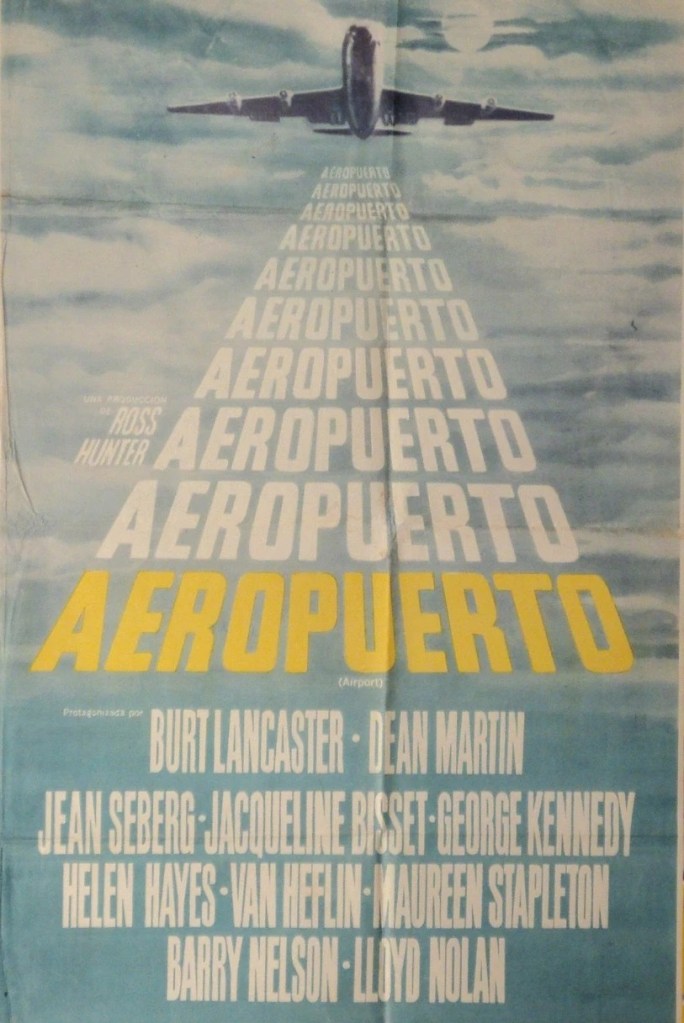
On the ground airport manager Mel (Burt Lancaster) is trying to shift the stuck aircraft while dealing with irate wife Cindy (Dana Wynter) and keeping on track his illicit relationship with PR manager Tanya (Jean Seberg). This is on top of a) wrangling with an airport executive who refuses to expand the airport to meet overwhelming demand and whose only reaction to impending crisis is to close the airport down, b) dealing with local citizens furious that plans are rattling their houses, and c) taking flak from brother-in-law and ace pilot Vernon (Dean Martin).
Up in the air Vernon has his work cut out coming to terms with the pregnancy of girlfriend Gwen (Jacqueline Bisset) – always having used his marriage as an excuse not to get emotionally involved with his string of girlfriends – and with a 70-year-old stowaway Ada (Helen Hayes) and bomber D.O. Guerrero (Van Heflin) and then bringing in the stricken plane.
We’re tossed a few red herrings on the passenger manifest. Spot a nun and a priest in a disaster picture and you’re generally in for cliché overload. Here, instead, they are used for humor, the nun taking a swig of whisky under pressure and the priest whacking a belligerent passenger. And the charming Ada is on land given very sympathetic treatment given the thousands of dollars she’s conned out of airlines over the years, but that’s only to set her up for some harsh treatment on board.
There’s an unexpected twist with the bomber. For a few minutes it looks like the crew are going to win the day but then calamity strikes. Meanwhile, on the ground troubleshooter Joe (George Kennedy), huge cigar constantly in place in the mouth, has taken charge of shifting the stuck plane and in the end has to take drastic action.
And in little telling snippets director George Seaton plays fair with the wives who lose out, Mrs Guerrero (Maureen Stapleton) and Mrs Demerest (Barbara Hale) while allowing Mrs Bakersfield to deliver a come-uppance to her errant husband – she’s been playing away too.
The decision to pack this full of more genuine stars than you ever got in a roadshow – mostly the cast list was padded out with newcomers or stars past their best (Lawrence of Arabia, 1962) – reversed this with genuine stars in supporting roles and newcomers in the leading roles) Both Oscar-winning Burt Lancaster (The Professionals, 1966) and Dean Martin after the Matt Helm series and a bunch of westerns were genuine top-notch marquee names. Jean Seberg had just hit a career box office high with Paint your Wagon (1969). After Bullitt (1968) Jacqueline Bisset’s star was on the rise. Oscar-winner George Kennedy (Cool Hand Luke, 1967) was top-billed in Guns of The Magnificent Seven (1969).
And there was a heck of a strong supporting cast: Van Heflin (Once a Thief, 1965), Dana Wynter (Sink the Bismarck!, 1960), Barbara Hale (Perry Mason series, 1957-1966). Oscar-winner Helen Hayes (she won in 1932) and Maureen Stapleton (Bye, Bye, Birdie, 1963) proved the pick, the former here winning a second Oscar, the latter nominated. Apart from Van Heflin, Seaton had gone for character actors rather than stars – Wynter hadn’t made a movie in a decade, for Stapleton it was seven years, for Hayes 14 years and Hale one film in over a decade.
You’d be laughed out of town these days if (outside of sci-fi) you tried to saddle a star with chunks of exposition or technical detail, but here the force of the screen personalities of Lancaster, Martin and Kennedy makes you hang on their every word.
They didn’t have prizes in those days for ensemble acting, but if they had this would surely be in contention, as director George Seaton, in his capacity as screenwriter, ensures that no one is left out and even if it’s only with a look we learn everything we need to know about a character’s emotional life.
Given this was – to use Christopher Nolan’s favorite phrase – “shot in camera” this is a terrific technical achievement in terms of the airplane action especially the stuck plane trying to hirple it way out of trouble.
Director George Seaton (36 Hours, 1964) took ill during production and exterior sequences were filmed by Henry Hathaway (True Grit, 1969). A mention, too, for the driving score by Alfred Newman, in his last screen assignment. It was nominated for 10 Oscars including Best Picture.
More than demands a reassessment.

 The Magnificent 60s
saw this at widescreen weekend festival in Bradford .. was the highlight of the weekend
LikeLiked by 1 person
I had wanted to see it at Braford but couldn’t go at the last minute. In 70mm it must have been awesome.
LikeLike