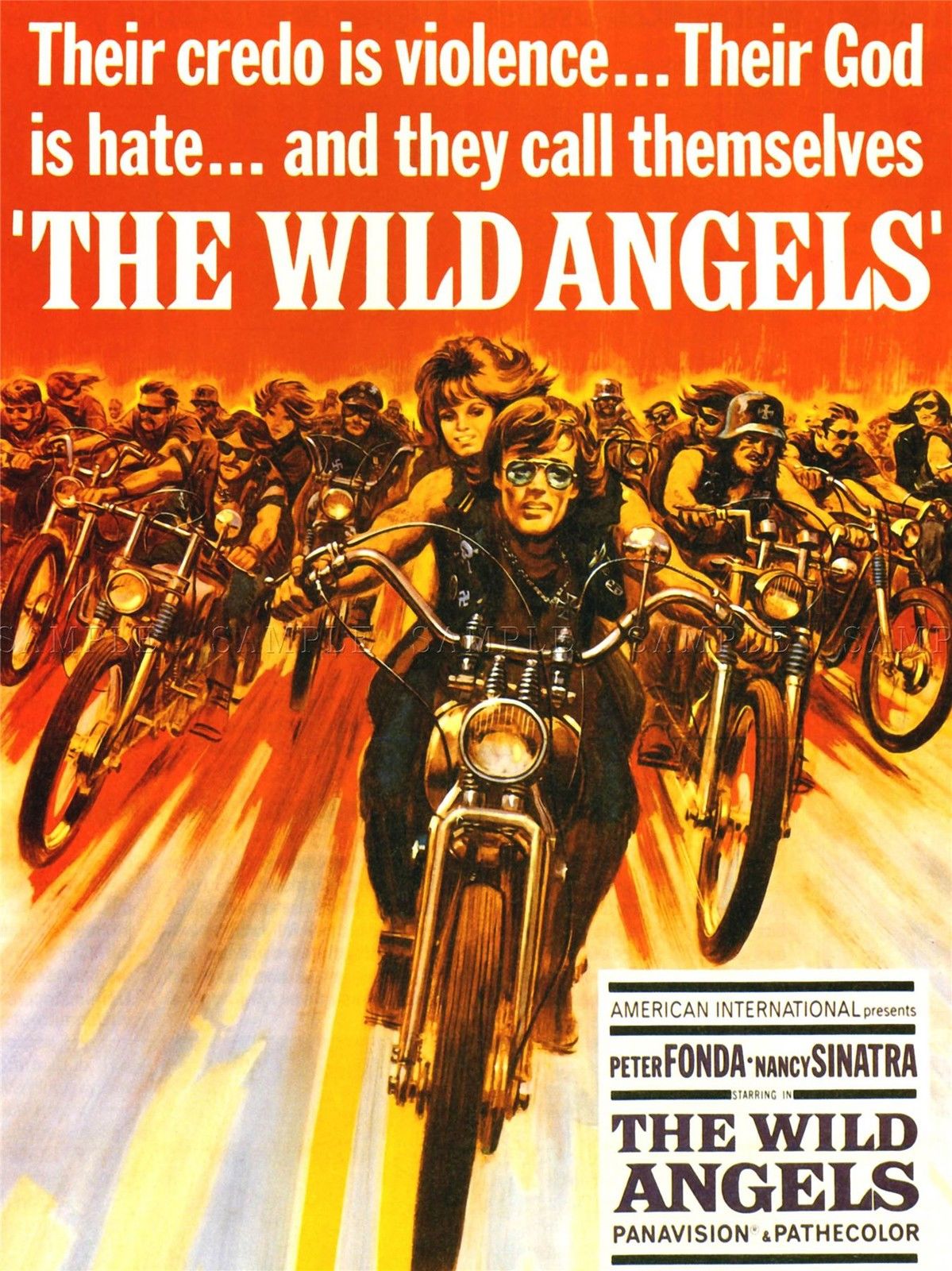
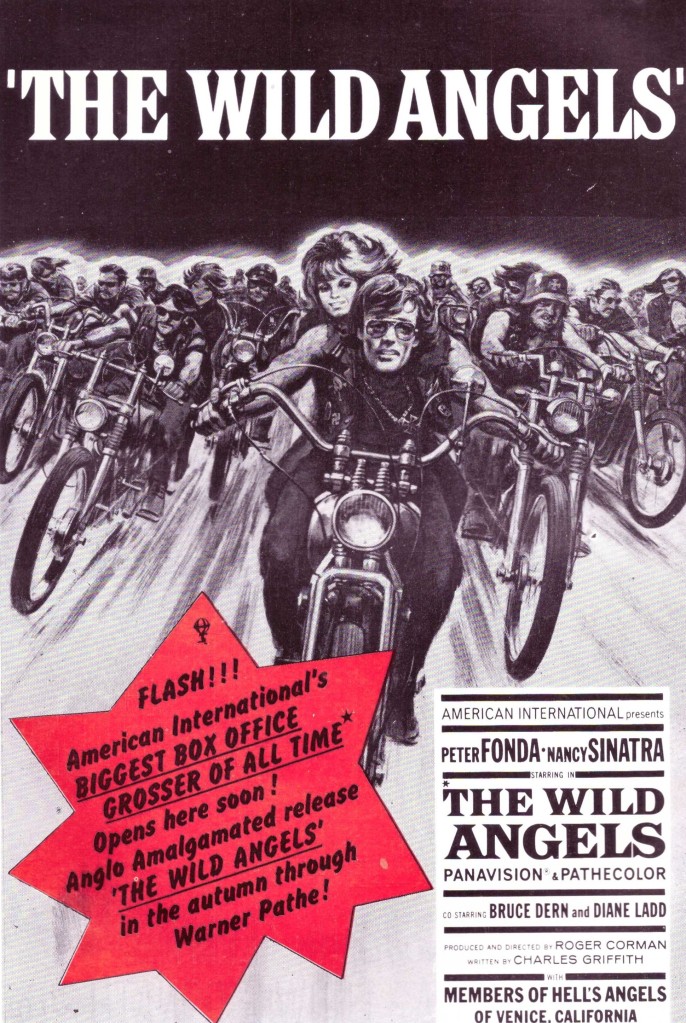
Riders stretched out across a sun-baked valley – you could be harking back to the heyday of the John Ford cavalry western instead of the biker picture, the first in the American International series, that sent shockwaves through society and laid the groundwork for the more philosophical Easy Rider (1969) a few years later. Long tracking shots are in abundance. You might wonder had director Roger Corman spent a bit more on the soundtrack, the bikers just worn beads instead of swastikas, and been the victims rather than the perpetrators of violence how this picture would have played out critics- and box office-wise.
The Wild Angels set up a template for biker pictures, one almost slavishly followed by Easy Rider, a good 15 per cent of the screen time allocated to shots of the Harley-Davidson riders and scenery, and a slim plot. Here Heavenly Blues (Peter Fonda), trying to recover a stolen bike, leads his gang into a small town where they beat up a bunch of Mexican mechanics, are pursued by the cops, hang out and indulge in booze, drugs and sex, and then decide to rescue the badly-injured Joe (Bruce Dern) from a police station. This insane act doesn’t go well and after Joe dies they hijack a preacher for a funeral service that ends in a running battle with outraged locals and the police.
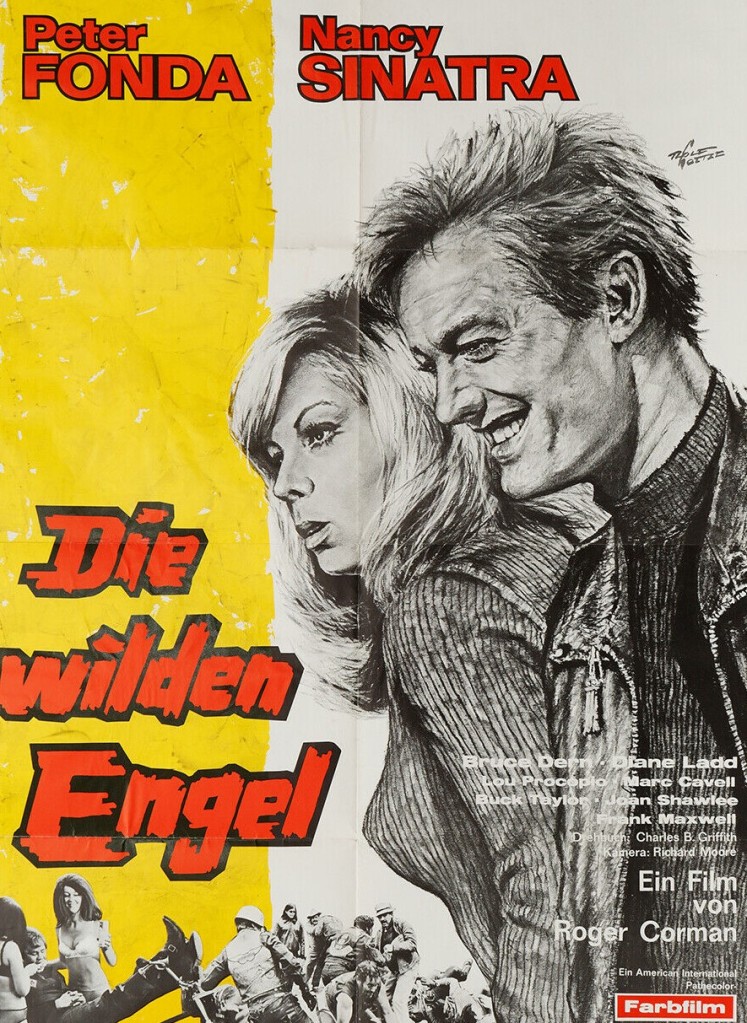
One of the weirdest posters of all time – at first sight it looks like Nancy Sinatra is holding the decapitated head of Peter Fonda in front of her.
There’s an odd subplot, given the lifestyle of freedom and independence, of Monkey (Nancy Sinatra) trying to get a romantic commitment out of Heavenly. Conversely, Heavenly, rejecting the traditional shackles of love, finds himself trapped by grief, eventually and quite rightly blaming himself for Joe’s death, and apparently turning his back on the Angels to mourn his buddy. The decline – or growing-up – of Heavenly provides a humane core to a movie that otherwise takes great pride in parading (and never questioning) excess, not just the alcohol and drugs, but rape of a nurse, gang-bang of Joe’s widow (Diane Ladd), violence, corpse abuse, and wanton destruction.
A ground-breaking film of the wrong, dangerous, kind according to censors worldwide and anyone representing traditional decency, but which appealed to a young audience desperate to find new heroes who stood against anything their parents stood for. In a decade that celebrated freedom, the bikers strangely enough represented repression, a world where women were commodities, passed from man to man, often taken without consent, and racism was prevalent.
Roger Corman (The Secret Invasion, 1964) was already moving away from the horror of his early oeuvre and directs here with some style, the story, though slim, kept moving along thanks to the obvious and latent tensions within the group. If he had set out to assault society’s sacred cows – the police, the church, funeral rites – as well as a loathing of everything Nazi, he certainly achieved those aims but still within the context of a group that epitomized some elements of the burgeoning counterculture.
In retrospect this appears an ideal fit for Peter Fonda, but that’s only if viewed through the prism of Easy Rider for, prior to this (see the “Hot Prospects” Blog) he was being groomed as a romantic leading man along the lines of The Young Lovers (1964). Bruce Dern (They Shoot Horses, Don’t They, 1969) was better suited, his screen persona possessing more of the essential edginess while Michael J. Pollard (Bonnie and Clyde, 1967) was the eternal outsider.
Rather surprising additions to the cast, either in full-out rebel mode as with Nancy Sinatra (The Ghost in the Invisible Bikini, 1966) or hoping appearance here would provide career stimulus as with movie virgins Diane Ladd (Chinatown, 1974) and Gayle Hunnicutt (P.J. / A New Face in Hell, 1968). Sinatra certainly received the bulk of the media attention, if only for the perceived outrage of papa Frank, but Hunnicutt easily stole the picture. Minus an attention-grabbing role, Hunnicutt, long hair in constant swirl, her vivid presence and especially her red top ensured she caught the camera’s attention.
Charles B. Griffiths (Creature from the Haunted Sea, 1961) is credited with a screenplay that was largely rewritten by an uncredited Peter Bogdanovich (The Last Picture Show, 1971).
If you’re not Alfred Hitchcock with carte blanche to scare the pants off the audiences every which way but loose and you’re not launching a B-movie sexploitation drama, then you’ve got to take a more sensible path to selling a picture headlined by the world’s greatest hero Gregory Peck elevated to such a position by the extraordinary success of The Guns of Navarone (1961) which topped the annual box rankings in the USA.
So while your taglines can emphasize “shock and suspense” what you’re selling cinema managers is quality. So, in the Pressbook/Marketing Manual, Peck is portrayed as a “celluloid perfectionist” and “four-time Oscar nominee” so multi-talented he’s a triple hyphenate – writer, producer, actor. Such a perfectionist he’s known “to spend a week or more preparing for one small scene.”
He is a class act not some sleazy B-movie bum. “He not only completely absorbed all the dialog, its various nuances and shadings, but also probed the psychological and physiological motivations of the attorney he portrays,” notes the Pressbook.
And it’s not just Peck who’s to be praised. “Seldom has such an outstanding array of talent been so tellingly marshaled for such a dramatic thunderbolt.”
The messianic tone is evident throughout. Headlines claim “Bob Mitchum’s career reaches a new high,” Lori Martin has the “top role” of her career, Barrie Chase is “praised as top talent discovery” and “Telly Savalas termed top talent find by Peck.”
Polly Bergen “emerges as an actress of great sensitivity and insight.” Lori Singer, in her movie debut, “graphically attests to the polish she has achieved through her work as child lead in the video (television) series National Velvet.” Although Martin had another reason for turning up word perfect – so that she could get off early and go ice skating.
And the praise doesn’t stop there. “A whole new career should open for sultry Barrie Chase, one-time dancing partner of Fred Astaire.” She is “sensationally good as the casual pick-up ensnared by Mitchum.” The talent pickers had no doubt she was “destined to become one of the foremost dramatic talents of the industry. The very quality which made her such an outstanding dancer – her tireless attention to even the minutest detail – has helped turn her into a magnificent actress.” The marketeers were convinced her “masterpiece” performance would result in an Oscar nomination.
Peck had appointed himself the “tub-thumper” for Savalas after seeing him play Al Capone” in the television series The Witness (1960-1961) calling him “one of the finest new talents of the last 10 years.”
According to the Pressbook, director J. Lee Thompson “deliberately imparted…a distinctively British touch.” Claimed Thompson, “There emerges in the best of the British pictures a certain warmth and credibility which are looked upon as the English hallmark. Such an impression is achieved, it seems to me, through the simple technique of emphasizing character development.”
For journalistic snippets there’s not much beyond that Peck was so impressed with the location in Georgia that he purchased a plot of land on Sea Island to build a beach house. Plus that he’s turned into a noted photographer, now onto his seventh camera with a fast lens. Polly Bergen was creating a nightclub act. Robert Mitchum was thrown three times on his first film horse.
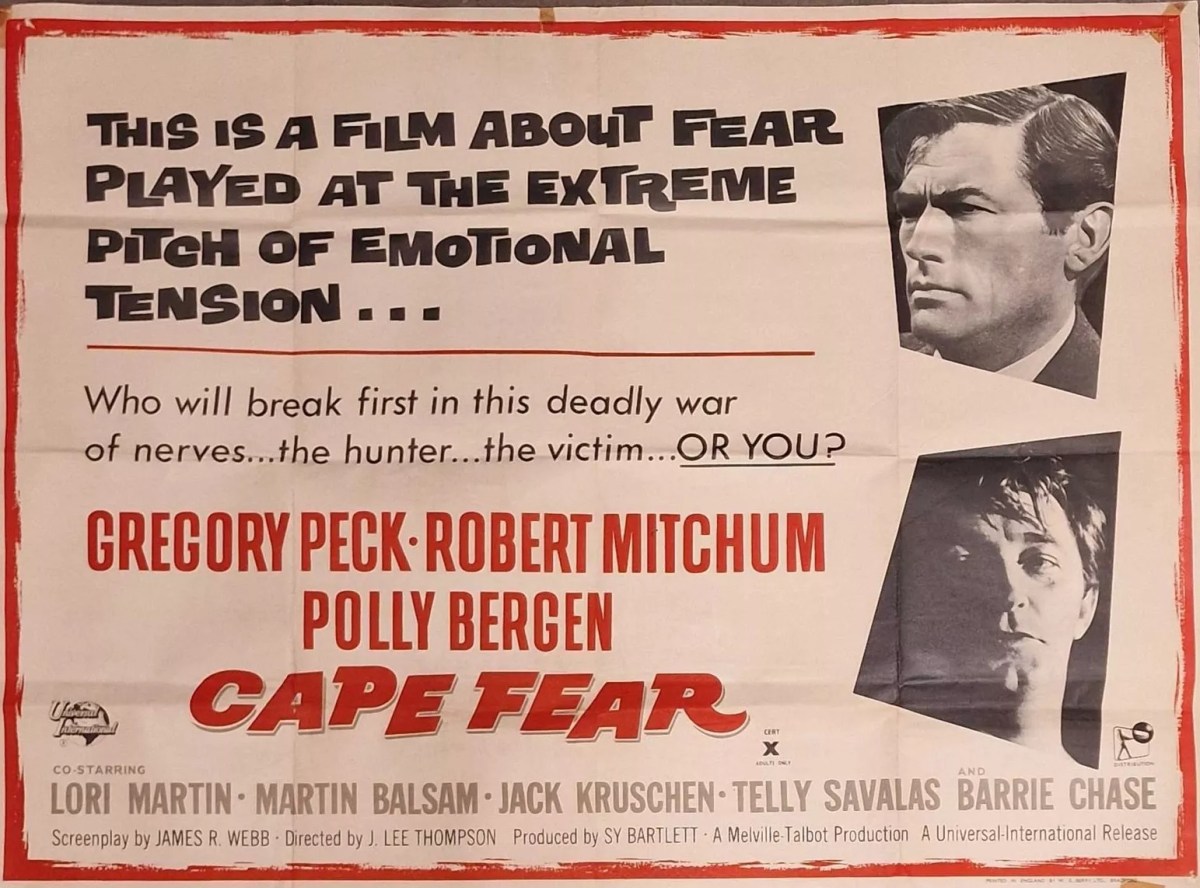
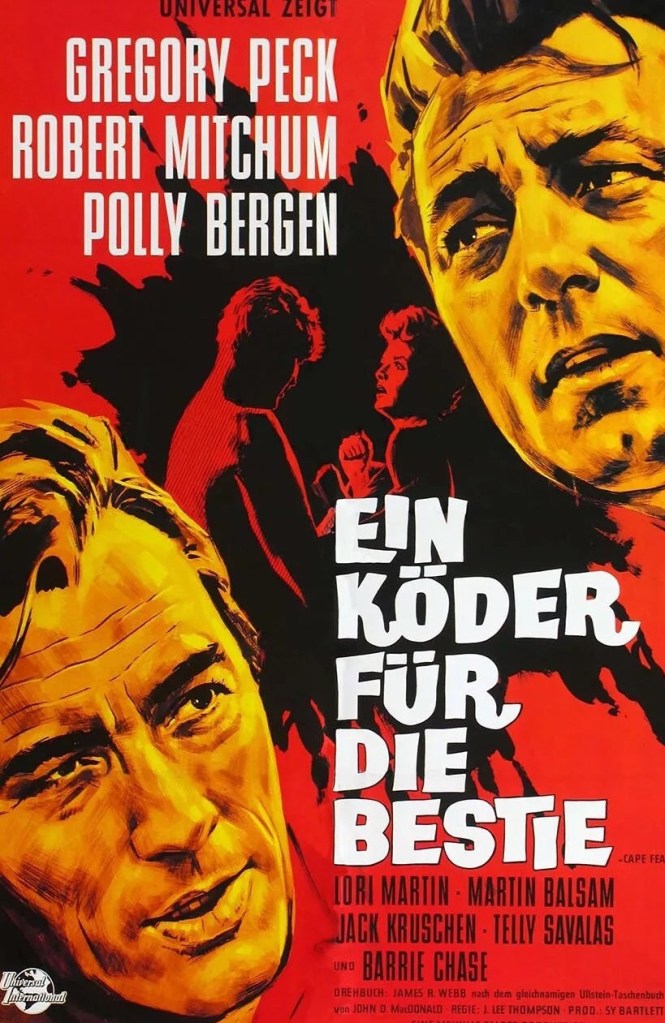
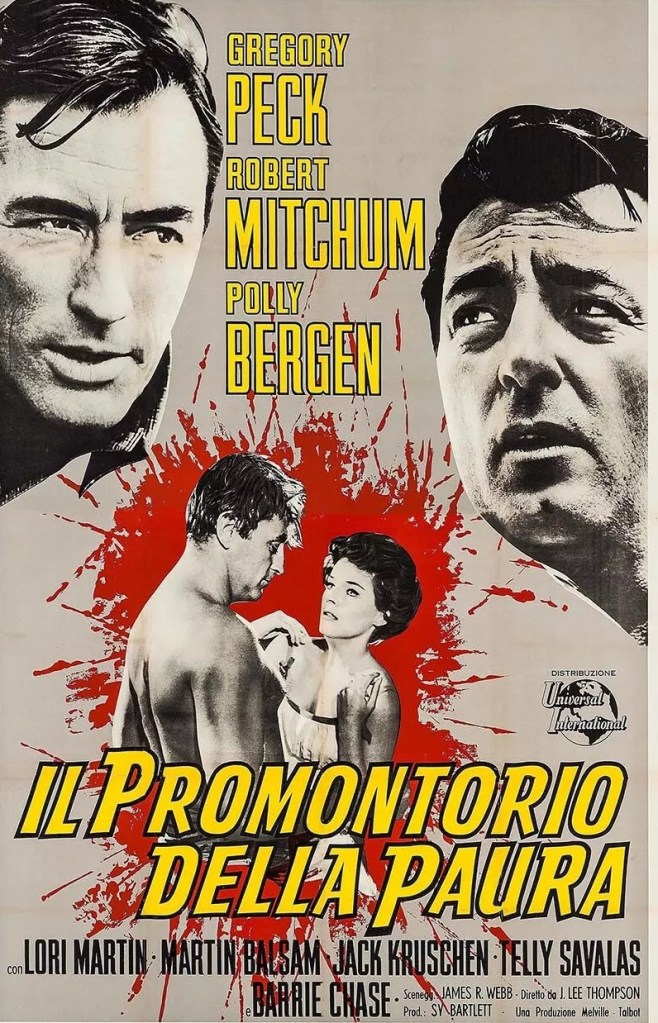
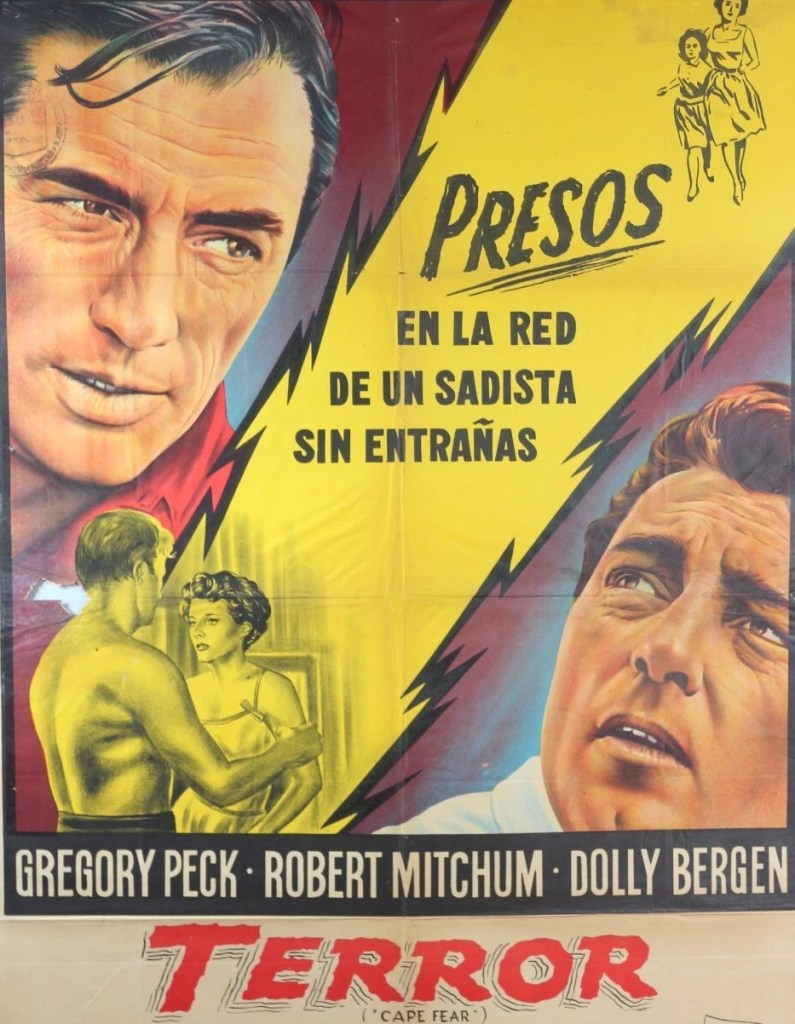
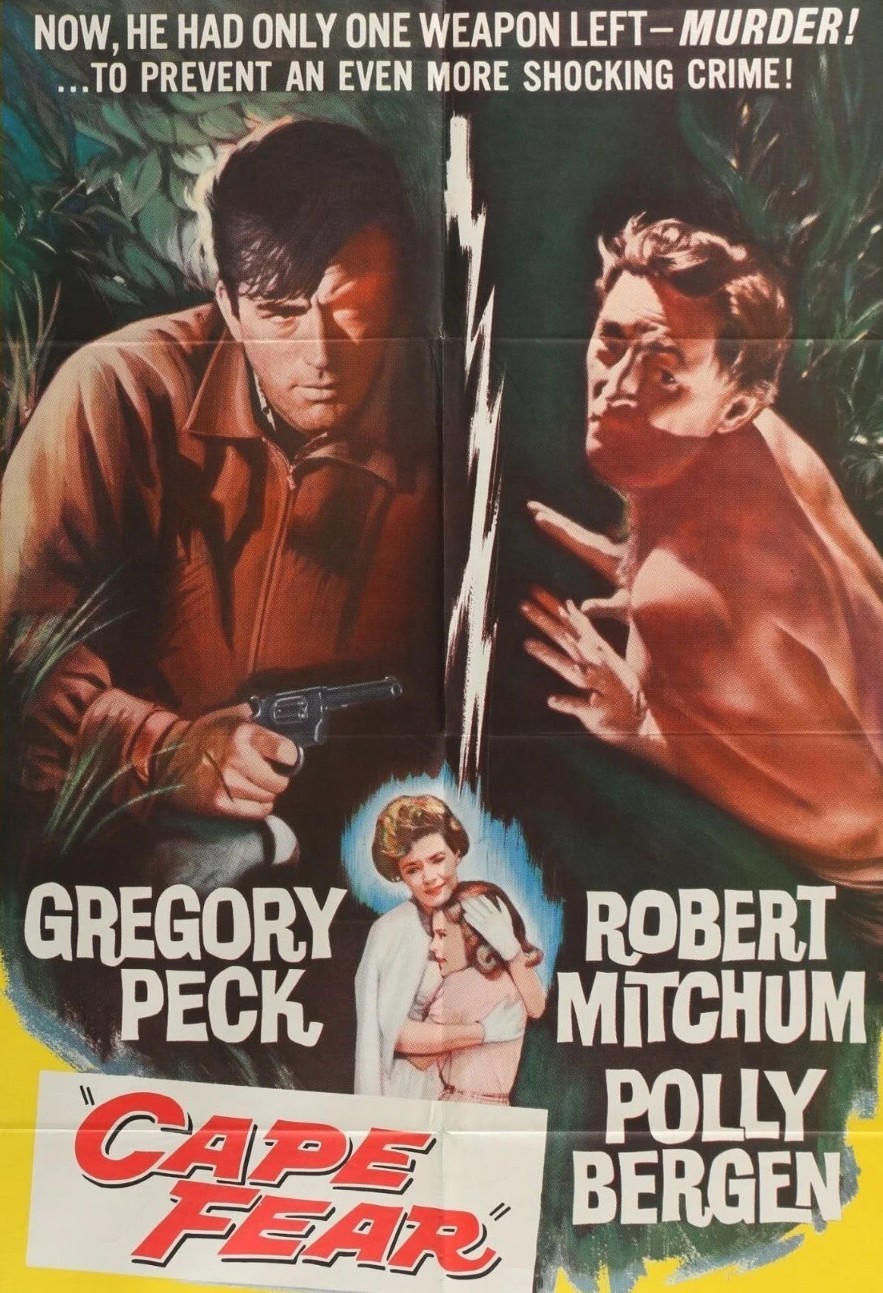
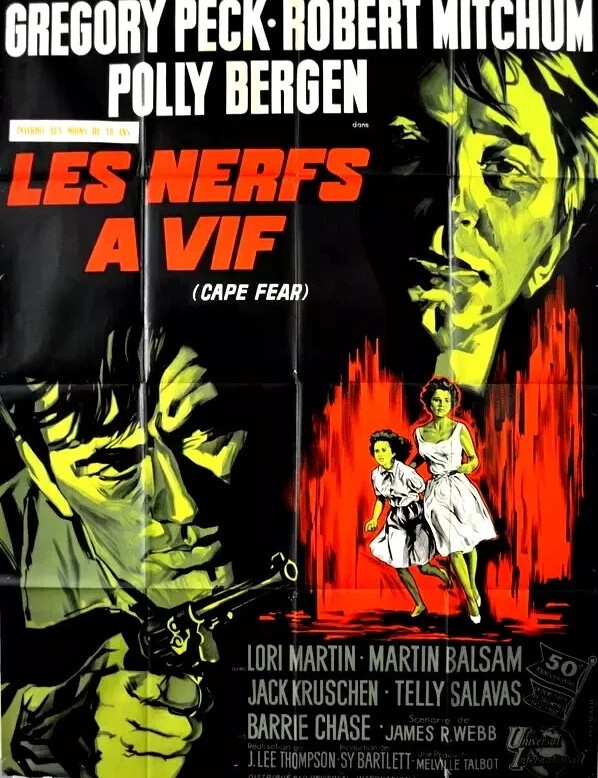
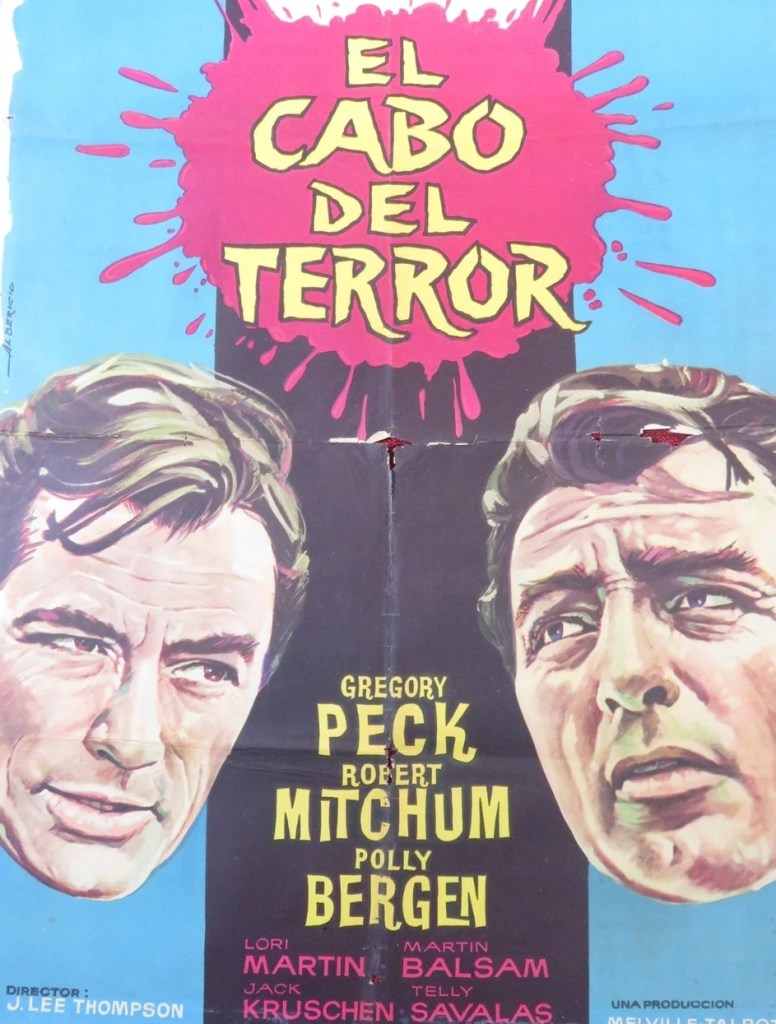
But it was unlikely that cinema managers would find a way of passing on to audiences the idea that this was a “quality sleaze” picture populated by proven and up-and-coming talent. The public had to make do with posters and taglines to get a feel for what was on offer. And in that respect the marketeers pulled few punches.
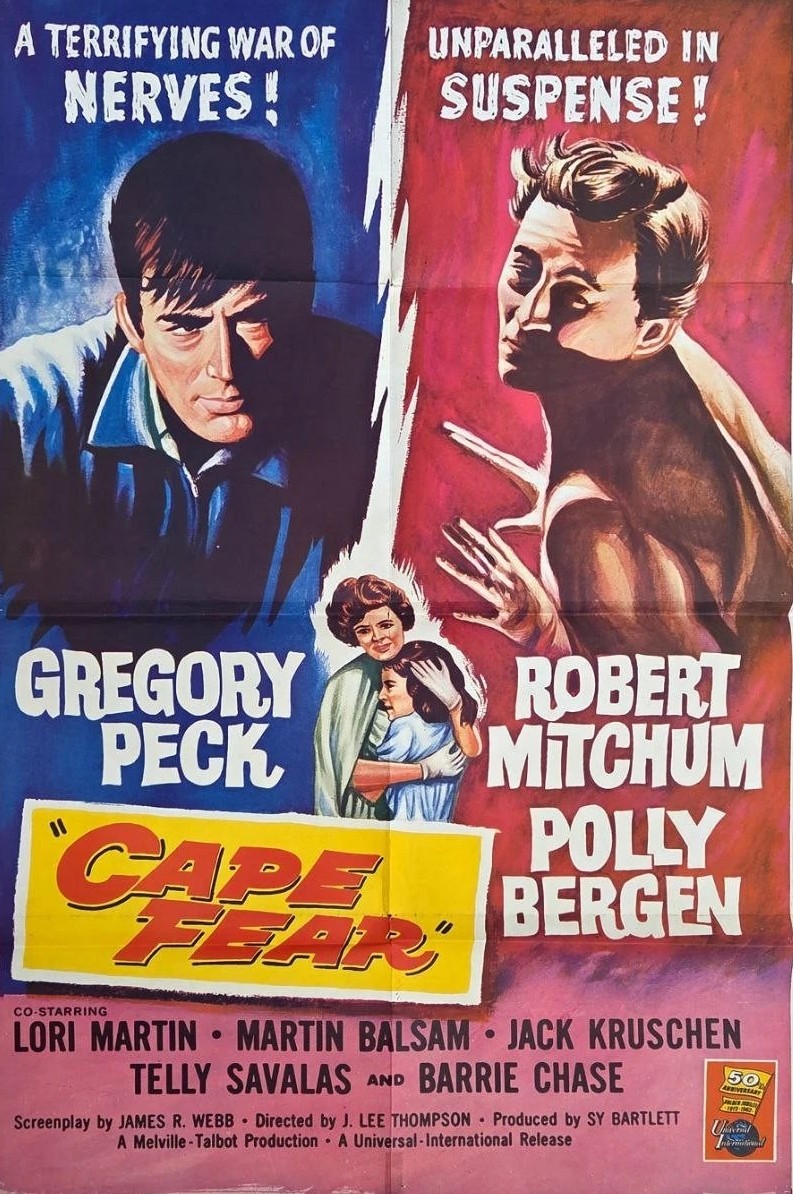
As usual, cinema managers were offered a plethora of choice when it came to the posters. Mostly, Peck and Mitchum were shown on opposite sides of the poster with in between an image intended to conjure up menace – the bare-chested Mitchum confronting Bergen, Bergen comforting her daughter, mother and daughter running, Mitchum tangling with the daughter.
Taglines spelled it out in a variety of ways: “A terrifying war of nerves unparalleled in suspense!” with a sub-tag of “A man savagely dedicated to committing a crime shocking beyond belief! A man desperately determined to end his ordeal of terror…even if it meant using the ultimate weapon – murder!”
Exclamation marks were in full flow. “Now, he had only one weapon left – murder…to prevent an even more shocking crime” was backed up by “the drama of an unrelenting war of nerves…and the helpless lives that were caught in its terrifying crossfire!”
Or try this – “The savagely suspenseful story of an unspeakable crime…and the man, the woman, the helpless people it touched with terror. From the moment they meet the tension is explosive. An electrifying war of nerves unrelenting in suspense!”
In case you didn’t get the message, here it is in more subtle form: “What happens to them in an adventure in the unusual!” That understatement is followed up with “So daring in theme…so frank in treatment…that it frightens while it fascinates and gives a terrifying new meaning in suspense!”
And there were variations of the above: “A terrifying war of nerves unparalleled in suspense! The Watched…who can only run so far before coming face-to-face with The Watcher…who waits for the moment when the woman and her daughter will be alone.”
And – “Now the nightmare was about to become a terrifying reality… the whispered threat a crime unspeakable. So daring in theme…so frank in treatment. What happens to them is an adventure in the unusual!”
Plus – “Their ordeal of terror triggers the screen’s most savage war of nerves! Unparalleled suspense…as one becomes a target for nightmare, the other becomes his target for execution.”
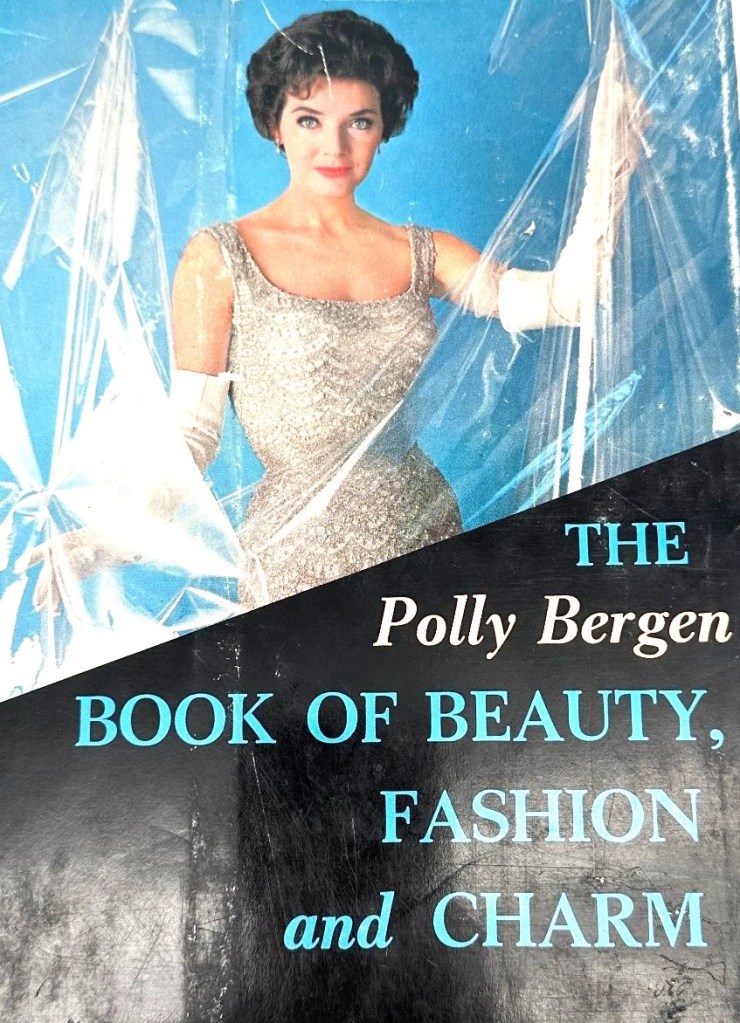
Unusually, there were a host of promotional items. As well as a motion picture paperback edition from Fawcett, “hot off the press” was the Prentice-Hall hardback The Polly Bergen Book of Beauty, Fashion and Charm, including stills from Cape Fear. Books were a major source for marketing, given there were over 100,000 outlets in specialist shops, drug stores, railway and bus terminals and carousels on newspaper stands.
Virtually any homely element of the movie was co-opted for promotional purposes. A scene taking place at a United Air Lines terminal counter provided opportunity for tie-ins with travel agents and ticket offices. Bowling “palaces” might be happy to display posters and promotional material given there’s a scene set in a bowling alley. Distributors of a Chris Craft boats, Chrysler station wagons, Larson speed boats and Scott outboard motors – which all appear in the movie – could be targeted.
Like many an ambitious – not to say greedy – actor, Gregory Peck had decided to go into the production business. In theory, there were two good reasons for this: actors could take control of their careers and they could make vanity projects. In reality, there were other over-riding reasons: after years in the business they thought they knew better than their Hollywood bosses and, more importantly, with a bigger stake in a picture they thought they could make more money. First of all came the tax advantages. As a producer, they could spread income over a number of years rather than just one. And they could take advantage of a loophole in the tax laws by making movies abroad. And then if all went as well as the actor imagined, they would get a bigger share of the spoils. If it proved a flop, then the studio carried the can and the actor walked off scot-free.
In 1956 Peck set up Melville Productions with screenwriter Sy Bartlett, with whom he had worked on Twelve O’Clock High (1950). They signed a two-picture deal with United Artists, the go-to studio for actors wanting to become producers. The first projected ideas fell by the wayside, Affair of Honor based on a Broadway play that subsequently flopped and Thieves Market – with William Wyler on board as director – whose commissioned script didn’t meet Peck’s standards. Also on the agenda was Winged Horse with a script by Bartlett and James R. Webb.
Instead, Peck set up The Big Country (1958) through another production shingle, Anthony Productions, and co-produced it with director William Wyler’s outfit, World Wide Productions. The budget rocketed from $2.5 million to $4.1 million, which limited the potential for profit.
Melville Productions launched with Korean War picture Pork Chop Hill (1959). When that flopped it was the end of the UA deal. Peck moved his shingle to Universal. The production company lay dormant while Peck returned to actor-for-hire for Beloved Infidel (1959) and On the Beach (1959), both flops, before jumping back into the top league with the biggest hit of his career The Guns of Navarone (1961) directed by J. Lee Thompson.
Melville Productions was resuscitated for Cape Fear. Peck and Barlett had purchased in 1958 a piece of pulp fiction (novels that bypassed hardback publication and went straight into paperback) by John D. MacDonald called The Executioners. Bartlett passed on screenwriting duties which were handed to James R. Webb (How the West Was Won, 1962).
Director and star had bonded on The Guns of Navarone. “We were working so well together,” recalled Thompson that when Peck handed him the script of Cape Fear he was intrigued. “I liked the book very much,” said Thompson. “Greg had a script prepared, we signed the contracts, and I came to make my first picture in Hollywood.” (The Guns of Navarone had been filmed in Greece and London).
Though author John D. MacDonald had written a hard-boiled thriller with a merciless killer, screenwriter James R. Webb (Pork Chop Hill) racked up the tension and added a thicker layer of predatory sexuality in the vein of Psycho (1960). The final touch was a Bernard Hermann (Psycho) score brimming with menace.
Ernest Borgnine (Go Naked in the World, 1961) was first choice to play psychopathic killer Max Cady. Rod Steiger (The Pawnbroker, 1964), Jack Palance (Once a Thief, 1965) and Telly Savalas (Birdman of Alcatraz, 1962) were also considered. “We actually tested Savalas and he gave a very good test for the part,” explained Thompson. “But these were character actors or at least secondary actors compared to Greg. At some point discussing it together we began to talk about having the villain played by an actor of equal importance, making it a much stronger match-up from the audience’s point of view and (Robert) Mitchum immediately came to mind.”
But Mitchum had essayed a similar venal character in Night of the Hunter (1955) and didn’t want to repeat himself. However, he liked the way the tale showed just how corrupt law enforcement could be and how easily the cards were stacked. Mitchum understood the character from the outset. “The whole thing with Cady is that snakelike charm. Me, Officer, I never laid a hand on the girl, you must be mistaken.”
“When we heard Mitchum’s thoughts,” noted Thompson, “we were more convinced than ever he would be terrific for the role. And I think by the end of the meeting he now realized that himself.” But he still held back, unsure. The producers sent him a case of bourbon. He drank the bourbon and signed up. There was the additional inducement of sharing in the profits by being made a co-producer which involved nothing more taxing than signing on the dotted line. Universal took it on as the first in two-picture deal with Melville.
Mitchum’s career was following its usual up-and-down course, a couple of flops always seemed to be followed by a big hit. His acclaimed performance in Fred Zinnemann’s The Sundowners (1960) had offset The Night Fighters / A Terrible Beauty (1960) and Home from the Hill (1960). His latest picture, The Last Time I Saw Archie (1961) was filed in the negative column.
Peck and Mitchum had opposite approaches to their profession, the former diligent and serious, the latter not able to get off a set quickly enough, not even bothering to learn his lines because thanks to a photographic memory he could scan his lines just before a scene began and be word perfect.
Locations were scouted in the Carolinas where MacDonald had set the book, but failing to find anything suitable exteriors were switched to Savannah in Georgia. Where Peck rented a house and went home every night, Mitchum took a room in the DeSoto Hotel and when work was finished for the day went out drinking, an assistant director taken along as ballast to keep him out of trouble. The town held bad memories for Mitchum. Last time he had visited he had been arrested for vagrancy and did a stint on a chain gang, which recollection possibly put steely bitterness in his portrayal of the ex-convict. Although he hated the town, he liked the idea that on his return everyone was kowtowing to the big movie star, including a bevy of hairdressers in town for a convention.
Fortunately, the Savanah sojourn was short, bad weather getting in the way, barely two weeks before the unit repaired to Hollywood (some of the boat scenes were filmed around Ventura but the climactic fight took place on the studio lake) where the production overshot its schedule by a month, wrapping on July 5 instead of June 8, and racking up $2.6 million in costs.
Mitchum appeared determined to demonstrate quite how different their approaches were. In one scene, off camera, Mitchum stripped naked to get a reaction from the stolid co-star, who remained immune to such provocation. In reality, Mitchum was very professional. “He would work perfectly,” said Thompson. “He just goes in and does it. He was superb.”
Though far from a Method Actor, Mitchum was chillingly close to the part. “I live character and this character drinks and rapes,” he confessed. During the scenes of violence he worked himself up. “He made people frightened,” acknowledged Thompson.
And that included Peck, especially during the slugfest in the water which took nearly a week of a night shoot to complete. Despite warmers being put in the water, it was freezing. “Sometimes, Mitchum overstepped the line,” said Thompson. “He was meant to be drowning Greg and he really took it to the limit…but Peck never complained.”
The final scene filmed was the rape of Polly Bergen playing Peck’s wife. Bare-chested and sweating, Mitchum built himself up into a fury. “You felt any moment he would explode,” said Thompson. “But there was no rehearsal, so nobody really knew what to expect. Thompson improvised the business with the eggs. But Mitchum was more brutal with the eggs than could ever be shown in a cinema, smearing the yolk over Bergen’s breasts. He cut his arm flailing wildly and he used the actress to break open the cabin door, so she finished the scene with the front of her dress sodden with egg yolk and the back covered in blood.”
While Peck expressed confidence in director J. Lee Thompson and could count on Mitchum’s experience to see him through, female lead Polly Bergen was making her first film in eight years, after a small part in western Escape from Fort Bravo (1953) starring William Holden. She had come to wider attention for winning an Emmy for The Helen MorganStory (1958).
“Greg spent an enormous amount of time with me,” said a nervous Bergen, “He was wonderful and he was very, very supportive.” She added, “I wouldn’t have let anyone know how insecure and frightened I was. But he, I think, knew that instinctively and was there to set me at ease and be helpful and nurturing.”
Peck had no worries about Thompson, the situation helped by the director appearing to take the line the producer-star wanted. When it came to editing, Peck played fair with Mitchum, resisting the temptation to tone down his co-star’s performance which threatened to overshadow his own.
The censors were livid. They eliminated all mention of the word “rape”, removed most of Mitchum’s ogling of Peck’s daughter and cut to the bone the sexual assault.
While critics tended to agree that Mitchum stole the show, the movie was mauled by the New York Herald-Tribune as a “masochistic exercise” and the New Yorker took Peck to task for becoming involved in “an exercise in sadism.”
Initially, it appeared to be doing well enough. There was a “big” $37,000 in New York, a “giant” $29,000 in Chicago, a “fancy” $14,000 in Cleveland, a “rousing” $18,000 in San Francisco and a “proud” $14,000 in Boston. But the “expectancy of lush performance” did not materialize. Final tally was $1.6 million in rentals, a poor 47th in the annual box office rankings, so there were no profits for Peck or Mitchum to share.
The British censor demanded five minutes of cuts. Thompson made headlines by claiming that 161 individual cuts, a record, had destroyed the film but censor John Trevelyan argued it was just 15. Despite claiming the movie would not be shelved until the controversy had died down, in fact it lost its May 1962 premiere slot at the Odeon Leicester Square in London’s West End and was held back until the following January when it opened at the less prestigious Odeon Marble Arch, setting a record for a Universal release. Bergen was furious at the cuts in her role. “I really blasted British censorship.”
Ironically, Peck made more money from selling the rights to Martin Scorsese for the 1991 remake, in which he had a small part, and whether it’s the Peck estate or Scorsese who benefits there’s a 10-part mini-series on the way starring Patrick Wilson (The Conjuring: Last Rites, 2025) as the attorney, Amy Adams (Nightbitch, 2024) as his wife and Javier Bardem (Dune, Part Two, 2024) as their tormentor.
SOURCES: Gary Fishgall, Gregory Peck, A Biography (Scribner, 2002) pp197-198, 208, 225-228; Lee Server, Robert Mitchum, Baby, I Don’t Care (Faber & Faber, 2001) p43-437; “Peck-Bartlett Spanish Pic Halts,” Variety, February 13, 1957, p2; “U Gets Melville Pair,” Variety, July 29, 1959, p18; “U Repacts Bartlett,” Variety, September 28, 1960, p4; “Director of Cape Fear Claims British Censor Demands Too Many Cuts,” Variety, May 9, 1962, p26; “Censor Replies to J. Lee Thompson,” Kine Weekly, June 28, 1962, p6; “Classification-Plus-Mutilation,” Variety, December 19, 1962, p5; “Your Films,” Kine Weekly, February 7, 1963, p14. Box Office figures: Variety April-May 1962 and “Big Rental Pictures of 1962,” Variety, January 9, p13,
Portraying legal poster boy Atticus Finch in To Kill A Mockingbird (1962) might well have been an act of redemption for Gregory Peck after his portrayal, a few months earlier, of this attorney who has little compunction in walking down the same mean streets as the criminals he wishes to see put away. And it just goes to show how thin the line is between upstanding façade and killer, no matter the excuse or provocation.
Attorney Sam Bowden (Gregory Peck) isn’t permitted as much leeway as you might expect when ex-con Max Cody (Robert Mitchum) turns up in his small town. This could as easily have played out as the virtuously good guy and family being hounded by a thug who would have spent most of his life being prosecuted for crimes except his victims usually failed to bring charges on account of their fear of retribution. Trigger the animal in him for sexual purposes and you’re lighting a fuse that leads directly to violence.
From the audience perspective, the cards should have been stacked against the villain, but that’s not the case here, not when the good guy begins to act more and more like a bad guy, persecuting him, through his police connections, with a string of arrests for crimes of which he is innocent, unable to put the finger on him for the vicious assault he does commit and generally been outwitted by a fella who knows the law a damn sight more than the lawyer.
Bowden isn’t your usual harassed victim, standing up stoutly against criminality, but a man crumbling under pressure and the frustration of being out-thought by the enemy and itching to get it over with the easiest way possible by finding an excuse to kill the perpetrator.
So, yes, if you’re that way inclined, you can view it as an attack on the American justice system that allows villains with criminal intent not to be incarcerated for considering committing a crime. But that’s not the way it plays out, not when Bowden uses every sleazy trick in the legal book to head off Cody, eventually attempting bribery, and when that doesn’t work hiring a gang of thugs to beat him up and when that also fails planning how to draw him into the kind of trap that would allow legal assassination.
So, now Bowden’s every bit as devious as his pursuer and much worse because he’s willing to stake out wife and daughter as bait for a known sexual predator. He seems to have no inkling of the fate that could be in store for his family should his clever plan go wrong and little compunction or remorse about the criminal intent in his own mind.
Back in the day it would have been easier to accept this kind of narrative, that you can step outside the law to protect your family (a trope that would burn through the 1970s once the vigilante was represented by the likes of Charles Bronson and others), but a contemporary audience is more likely to take a more jaundiced view of the good guy “forced” into bad action. Instead of hiring a private detective (Telly Savalas) to keep tabs on Cody, Bowden could as easily invest – and he has more than enough money – in a security guard to watch over the house and family.
So, even as we’re fearing for wife Peggy (Polly Bergen0 and teenage daughter Nancy (Lori Martin) we’re beginning to put the blame for their plight plumb on the shoulders of the upstanding lawyer who thinks he’s smarter than the most dangerous villain this side of Hannibal Lecter.
If there’s a happy ending, you’re left with wondering just what the heck that’s going to look like. Bowden has allowed his wife to be raped and his daughter scared so witless she’ll be mentally scarred for life, and him unemployable, courtesy of being struck off for breaking the law.
And this is all filmed in classic noir style, moody lighting, shadows and darkness squeezing out what little light there is, emphasizing the danger that lurks on the dark side. And a terrific showdown on a boat. But director J Lee Thompson (The Guns of Navarone, 1961) does just as well without going down the obvious noir route. Robert Mitchum never just strolls. He walks with intent, combining panther walk and erect carriage. So, the tracking shots of him approaching the camera, and therefore some potential victim, are enough to give the audience the message.
Robert Mitchum (The Sundowners, 1960) steals the show with his quiet menace and soft drawl. This appeared before How the West Was Won (1962) where Gregory Peck played a con man and after The Guns of Navarone (1961) where he played the action hero’s hero, so this would be the first audience had seen of a switch in the actor’s screen persona. Usually, he’s the guy who can handle pressure.
Polly Bergen (Kisses for My President, 1964) is excellent as is Lori Martin (The Chase, 1966) whose default early on, for narrative purposes, is fear. Look out for Martin Balsam (The Anderson Tapes, 1971) as a complicit cop and Telly Savalas (The Assassination Bureau, 1969).
Superbly directed by J. Lee Thompson. Written by James R. Webb (How the West Was Won) from the novel by John D. MacDonald (Darker than Amber, 1970).
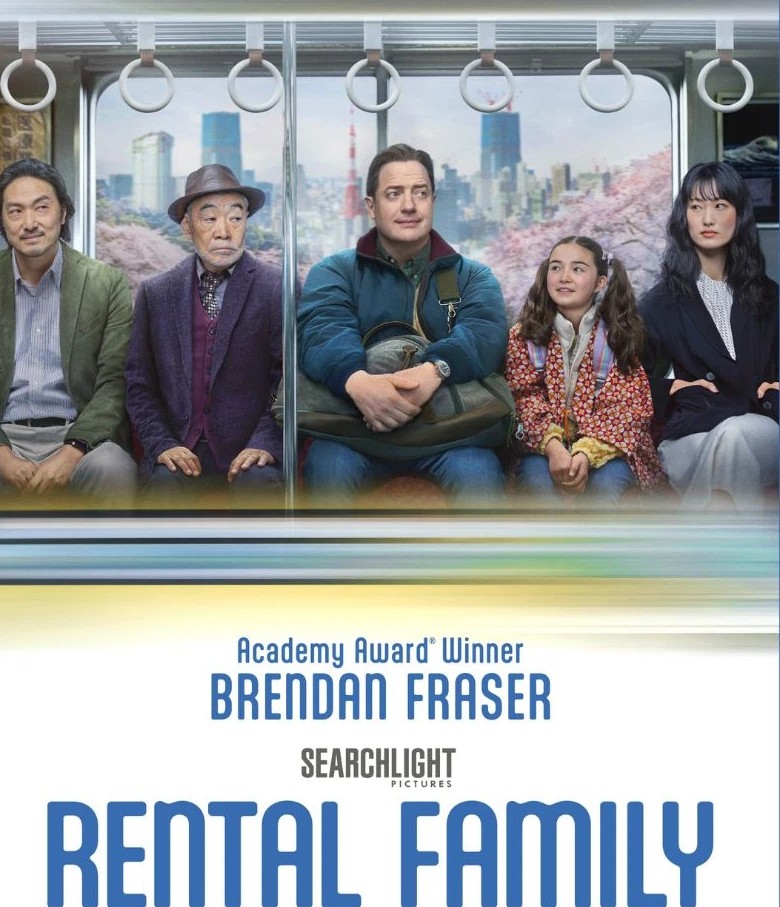
Gaming the system takes on a new meaning in this unlikely hybrid. What sets out to be a hard satire of the rigidity of Japanese culture is compromised by the need to turn it into a feel-good dramedy courtesy of importing American sometime star Brendan Fraser. There’s an awful trade-off here and I think the film suffers as a result of the compromise. I’m no big fan of movies that arrive in my multiplex courtesy of picking up accolades at a film festival, but, as it happened, I only saw print ads for this after I had seen it at a Secret Screening” so had no idea it had actually come via film festivals.
Take the Yank, Brendan Fraser at his puppy-dog best, out of the equation and concentrate on either his boss Shinji (Takehiro Hira) or colleague Aiko (Maru Yamamoto) and you would as easily have come to the same emotionally satisfying conclusion. Sold as a hard-edged indigenous Japanese satire I think it would easily broken out of the arthouse ghetto.
Apart from anything else it’s been, out of desperation I guess, sold as a kind of Mrs Doubtfire, imposter bonding with a young child, but in fact that’s a small part of the overall story, and in trying to make it the central element, goes off-piste.
Let me tell you what a rental family is, in case you are as unfamiliar with the term as I was. Apparently – I looked this up – this phenomenon arrived in Japanese culture in the 1980s and there are about 300 companies currently employing in selling human fraud to various clients.
So if, for example, you are gay but are fearful of denying your parents the opportunity to see you settled in a traditional male/female marriage, then you simply hire a husband for the day of the wedding and then once the ceremony is over you go back to your true love. Or, if, for example, you’d really like to experience your own funeral you can hire an actor to play a corpse while you listen to the nice things people say about you. Or if you want to keep your father, a retired famous actor, think he hasn’t been forgotten you hire an actor to play a reporter to provide him with the adoration you think he deserves.
Or, should you be a single mother and think that will prevent your daughter getting into the school of your choice you simply hire an actor to play the daughter’s long-lost father. That’s taking the helicopter parent to an extreme, I’d say. Still, in between playing all his other roles, which include befriending a geek who likes to visit strip clubs, the aforesaid American actor Philip (Brendan Fraser) drops into the life of the appealing daughter and does the kind of things dads do with young children, hardly much of a stretch since this child is nowhere near the kind of parent-hater she’d be when she hit her teens.
Not much thought has gone into what the idea of the extremely brief appearance of a fake dad will do to a vulnerable child, but hey-ho, that gives Philip the chance to fill the kid in on the realities of life. “Adults lie,” he states crassly and the kid is so desperate to have a dad, she’ll go for a fake one, and doesn’t hate him any more for his cruel deception.
There are some other sections I didn’t really understand. Shinji’s specialty appeared to playing a boss who reduced aberrant employees to gibbering wrecks. It wasn’t clear if this was some kind of fetish – a person who wanted to be screamed at – or a dress rehearsal for an employee who would have to grovel before his employers for embezzlement or somesuch. And it’s not entirely clear why Aiko has to don a blonde wig and sit in a bar and wait for a woman to come in and whack her across the face – a proper slap, one that leaves a bruise – for stealing away (supposedly) her husband.
And it beggars belief that Philip would become so enmeshed in his role of reporter that he would agree to accompany the old actor on a two-day cross-country journey to some shack in the middle of nowhere where the old fella grew up, clearly forgetting that the old fellow’s daughter would be going out of her mind with worry.
But take Philip out of the equation and there’s far more dramatic nuggets as the supporting cast do more than enough to satisfy emotional demand. You might wonder why – except for filling in the time and offering a contrast to Philip’s lonely existence – we are given a glimpse of Shinji’s home life, where his happy wife greets him with a beer and a lovely meal and he can set his son’s troubled mind to rest. But in easily the best scene in the film, we discover wife and son are fakes, that Shinji is living the kind of fantasy he sells.
Structurally, Philip is presented as our window on this odd world. But it jars when he’s seen as putting it right – white savior and all that – and also when you consider he has his own fantasy, paying for love by the hour.
Directed by Hikari (37 Seconds, 2019) who shared screenplay credits with debutant Stephen Blahut.
On oddity for sure, the satire works but the feel-good is limp.
This hasn’t been released yet in Japan – though it premiered some months back at the Tokyo International Film Festival – which has, confusingly, the same acronym as the Toronto International Film Festival, so don’t mix up your TIFFs – and I’d be interested to know how it was received by the public there.
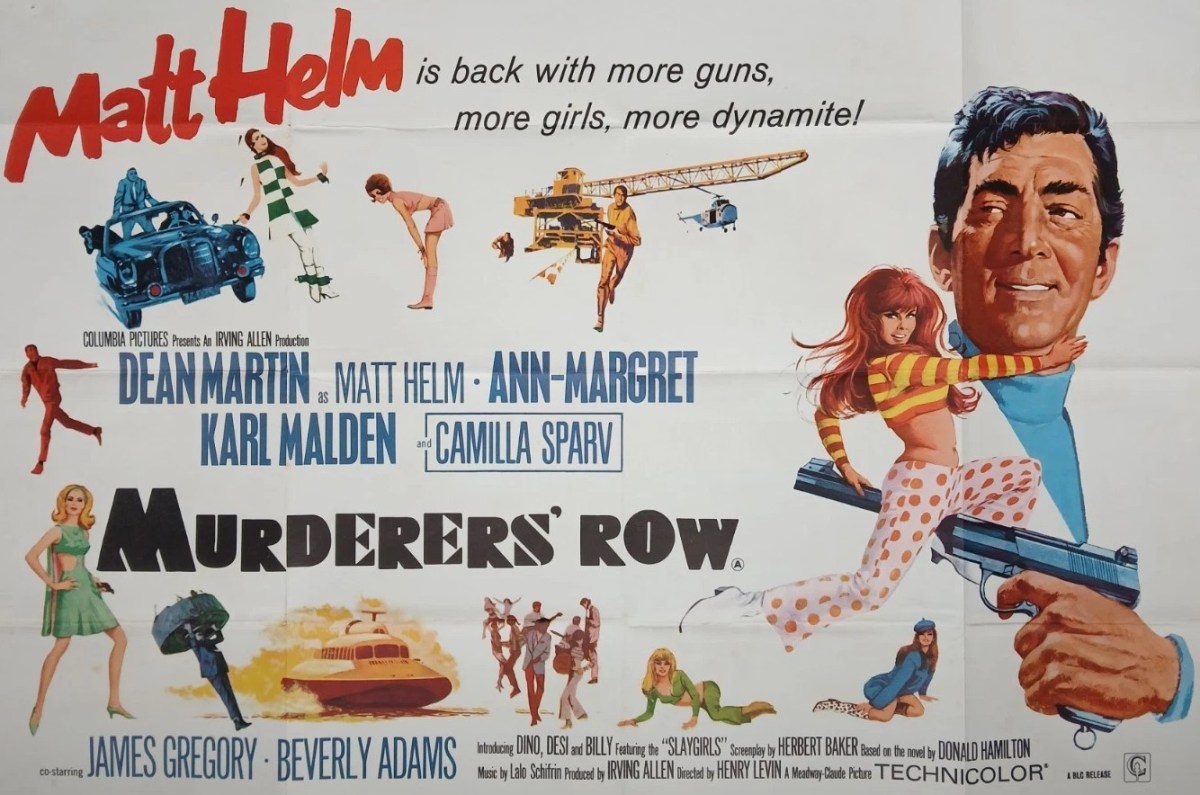
Chucklesome brew. It’s easy to get wrong idea about the Matt Helm series, what with the onslaught of girls in bikinis, a hero majoring in seduction and madmen wanting to take over the world. You could be hoodwinked into thinking this had something to do with espionage rather than a platform for the non-stop delivery of deadpan one-liners and wry visual gags. The star prevents anyone taking anything seriously with a rat-tat-tat quip a minute. The plot’s hooey and the female stars scarcely register. But who cares. The audience has buckled up for a fun ride.
Apart from the dialog the narrative is distinctly lazy. Assuming it’s what audiences want, the action takes time out to note parades of passing girls in bikinis and occasionally stops dead should there be the opportunity to watch youngsters dancing wildly. With humor to the fore, you could probably have gone for a dozen other storylines as good – or bad – as this one and nobody would have noticed.
Matt Helm (Dean Martin) is forced to interrupt photographing a bevy of beautiful girls in order to save the world from madman Julian Wall (Karl Malden) who plans to use the power of the sun to destroy Washington D.C. “Operation Scorch” relies on the brain of scientist Dr Solaris (Richard Eastham), who has been kidnapped to persuade him to hand over his formula.
This takes Helm, masquerading as a Chicago mobster, to Monte Carlo where he almost immediately faces a charge of murder. Tracking down Wall and his squeeze Coco (Camilla Sprav) proves easy. In rather desultory fashion Helm hooks up with local beauty Suzie (Ann-Margret) and until we discover that her father is Solaris her presence is mostly redundant as, for once, neither love nor lust is in the air.
Like any self-respecting madman Wall hangs out on an island where he is putting the final details to his plan and torturing Solaris. With Suzie in his wake, Helm easily infiltrates the rather desultory hideout, is captured, Solaris surrenders the secret formula once his daughter is threatened, and Suzie comes into her own by disabling the infernal machine by the simple device of a hairpin. This leads to a rather desultory happy ending.
I’m not entirely sure why Ann-Margret chose this vehicle, since she is called upon to do very little except shake her trademark booty. If she had gone up in critical estimation after her turns in Once a Thief (1965) and Stagecoach (1966) she plummeted back to earth here. You could say the same for Camilla Sparv – all the hard work in gaining reasonable notices for The Trouble with Angels (1966) and especially heist thriller Dead Heat on a Merry-Go-Round (1966) undone. She has even less to do than Ann-Margret. Eye candy is too good a word for them and they are unfairly underused.
Karl Malden (Nevada Smith, 1966), who usually attempts to humanize his characters, avoids that idea and goes straight for cartoon villain.
So it’s left to Dean Martin to keep the enterprise afloat which he does with tremendous chutzpah. As well as the verbal drollery there are some excellent visual gags, including the use of a giant magnet to render defenseless menacing thug Ironhead (Tom Reese), so called because has a large metal plate on his skull. Virtually every line produces a rejoinder from Dean Martin, and that lightness of delivery matches the souffle nature of the picture, a sequel to The Silencers (1966), both big box office hits.
Director Henry Levin (Genghis Khan, 1965) gives himself no airs or graces, sensible enough to stick the camera on Dean Martin and let him do the rest. Written by Herbert Baker (Hammerhead, 1968) from the bestseller by Donald Hamilton.
The big news in a slack weekend at the box office is that the re-release of The Lord of the Rings trilogy – each film showing for just one day over Jan 16-Jan 18 – has taken $5 million in advance sales. Sure, the fanboys have been putting down their dollars as you might expect in appreciation of their favorite fantasy threesome, but it’s pretty certain that the trio will put in a far better showing by the end of the weekend. Old films are in the renewal business once again, with revenues showing a steady increase over the past five years and then a remarkable jump from 2024 to 2025.
But there’s nothing new in putting old movies back to work. They’ve been chucking old films back into the distribution pot since 1914 – at least according to the whopper of a book (now recognized as the authority on the subject) I wrote a decade ago about the history of the Hollywood reissue. After World War One, old films had struck box office gold during periods of marked low production such as post-WW2, the 1970s, and currently; and on the back of the Director’s Cut; or reinvention through a premium vehicle such as IMAX.
Theoretically, reissues should be dead in the water. Fans of any major or cult motion picture are most likely to own a DVD or can catch it easily enough for free on a streaming outlet without paying big bucks to watch it on the big screen. But reissue has also been reinvented on the back of an anniversary and through restriction. Used to be, an old movie would be thrown into the distribution maw in the same way as any other movie, running for any multiple of one week at your local multiplex. But then some smartass decided that restricting opportunity would increase demand. “For One Day Only” became a marketing tool, except in rare instances. Anniversaries – the dates shown below are the giveaway – remain the most common reason for oldies seeing the light of day, but occasionally it’s to cash in on a forthcoming addition to a long-running series.
You might be surprised to learn that the reissue is actually booming in terms of box office. Last year’s overall take of $138.8 million was more than double the previous year’s $58.4 million which was just ahead of the 2023 tally of $56.4 million. And that was also up on the 2022 total of $46.4 million which was light years behind the 2021 figure of $115 million. So in the space of a few years, reissue receipts have remained constant and you can see why cinemas, faced with such low box office figures for Oscar-bait, are turning to oldies.
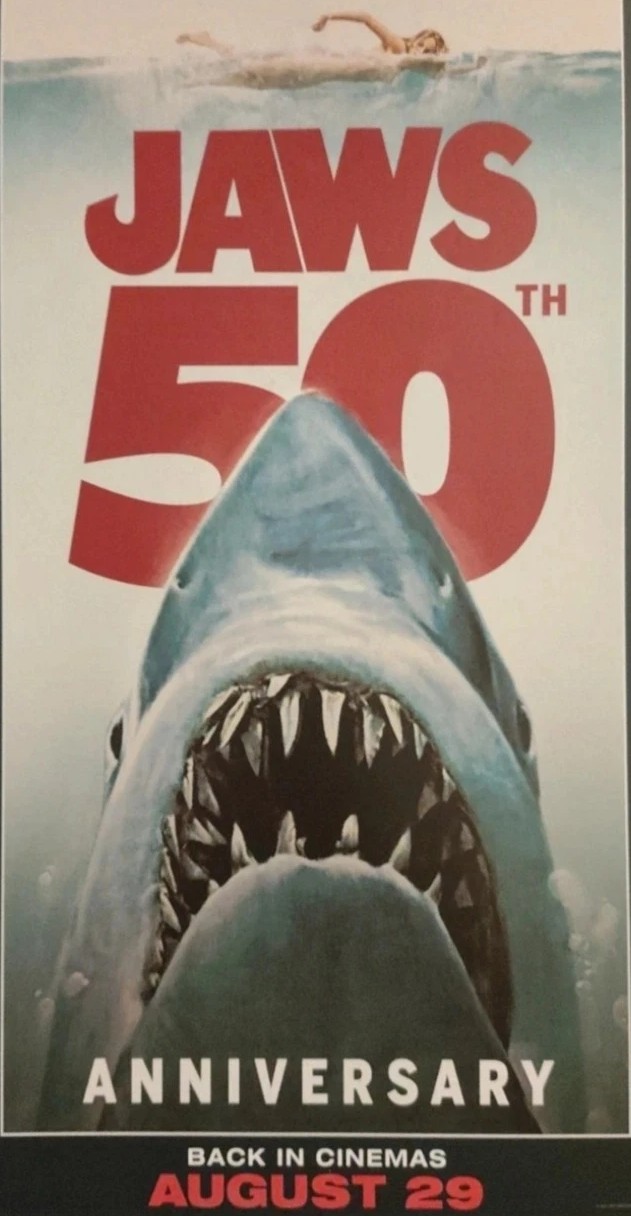
The biggest hit in 2025 was Star Wars Episode III: Revenge of the Sith (2005) on $34 million followed by The Twilight Saga: Breaking Dawn – Part 2 (2012) with $19.9 million and The Twilight Saga: Breaking Dawn – Part 1 (2011) on $19.7 million. Jaws (1975) came next biting off $16.1 million then James Cameron sequel Avatar: The Way of Water (2022) on $13.8 million, Back to the Future (1985) on $13.1 million, Pixar’s Toy Story (1995) on $11.4 million and Japanese animated classic Princess Mononoke (1997) on $10.8 million.
In 2024 Christopher Nolan’s Interstellar (2014) led the way with $15.2 million, chased by Star Wars: Episode 1 – The Phantom Menace (1999) on $13 million, Tim Burton’s The Nightmare Before Xmas (1993) with $6 million, Columbia’s 100th anniversary bunch on $6 million and animated sequel Shrek 2 (2004) on $3.4 million. The Lord of the Rings trilogy knocked up $8.1 million, cumulatively, Howl’s Moving Castle (2004) was on $2.3 million, Ridley Scott’s unsurpassed space horror Alien (1979) on $2.3 million and Disney’s The Lion King (1994) drumming up $2.1 million.
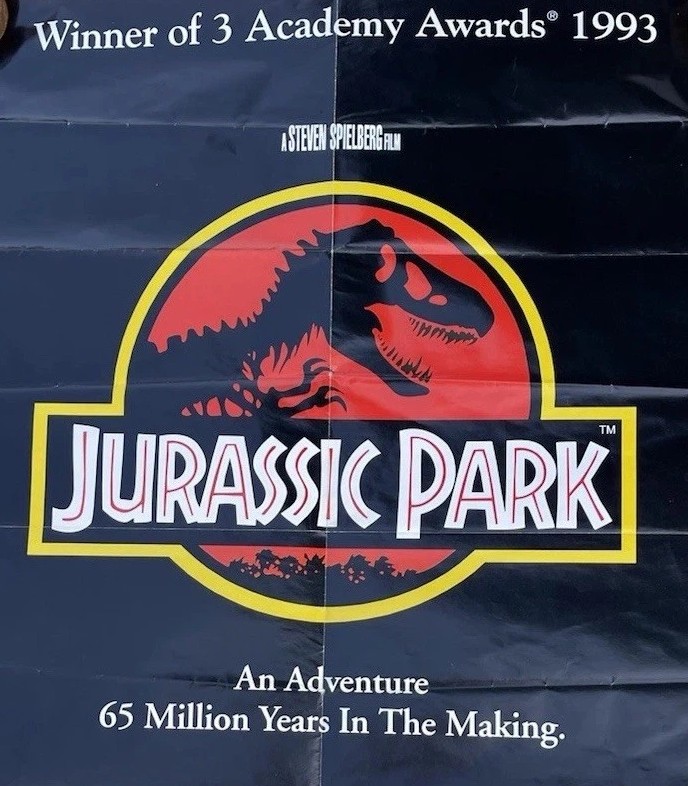
The top re-release in 2023 was another James Cameron epic Titanic (1997) with $15 million followed by The Nightmare before Xmas clocking up $10.2 million and Star Wars: Episode VI – Return of the Jedi (1983) with $7.2 million. Henry Selick’s adaptation of the Neil Gaiman dark fantasy novel Coraline (2009) dished up $7.1 million, Bette Midler bewitchment Hocus Pocus (1993) spelled out $4.9 million, Talking Heads live performance film Stop MakingSense (1983) nabbed $4.8 million, Steven Spielberg’s SFX-driven Jurassic Park (1993) chewed up $2.9 million, Bruce Willis in Die Hard (1988) clobbered $2 million, Coen Brothers cult favorite The Big Lebowski (1988) bowled $1.2 million and TheLord of the Rings: Return of the King (2003) netted $1.1 million.
In 2022 James Cameron again came out on top with Avatar (2009) heading the list on $24.7 million, followed by Jaws – minus any anniversary hullabaloo – on $5.1 million, another Spielberg E.T. – the Extra Terrestrial (1982) on $2 million, perennial revival It’s A Wonderful Life (1946) with $1.4 million, Francis Ford Coppola gangster classic The Godfather (1972) on $1.4 million, Rogue One: A Star Wars Story (2016) on $1.3 million and Howl’s Moving Castle $1.2 million.
Avatar again led the way in 2021 with $57.9 million followed by John Carney romance Begin Again (2013) with $21.3 million, Harry Potter and the Philosopher’s Stone (2021) on $15.8 million, The Lord of the Rings: The Fellowship of the Ring (2001) with $8.9 million and Japanese classic Love Letter (1995) on $7.4 million.
Most of these are reissues are already reissues, the various Star Wars episodes going through a reissue mill over the decades, the Disney cartoons receiving a reissue hoopla when they went out on 3D or Imax. The Lord of the Rings trilogy in an “Extended Edition” should set the target to be matched for this year.
SOURCES: Box Office Mojo “Worldwide Top 200” annual charts; Brian Hannan, Coming Back to a Theater Near You, A History of Hollywood Reissues, 1914-2014 (McFarland, 2016)
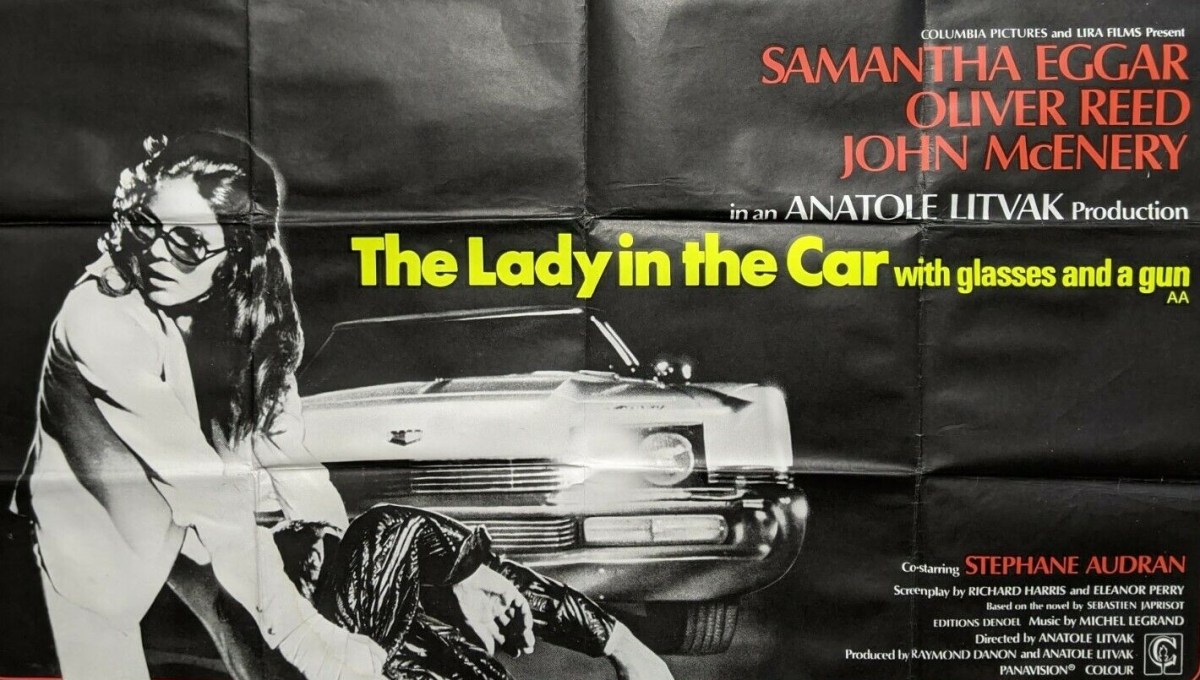
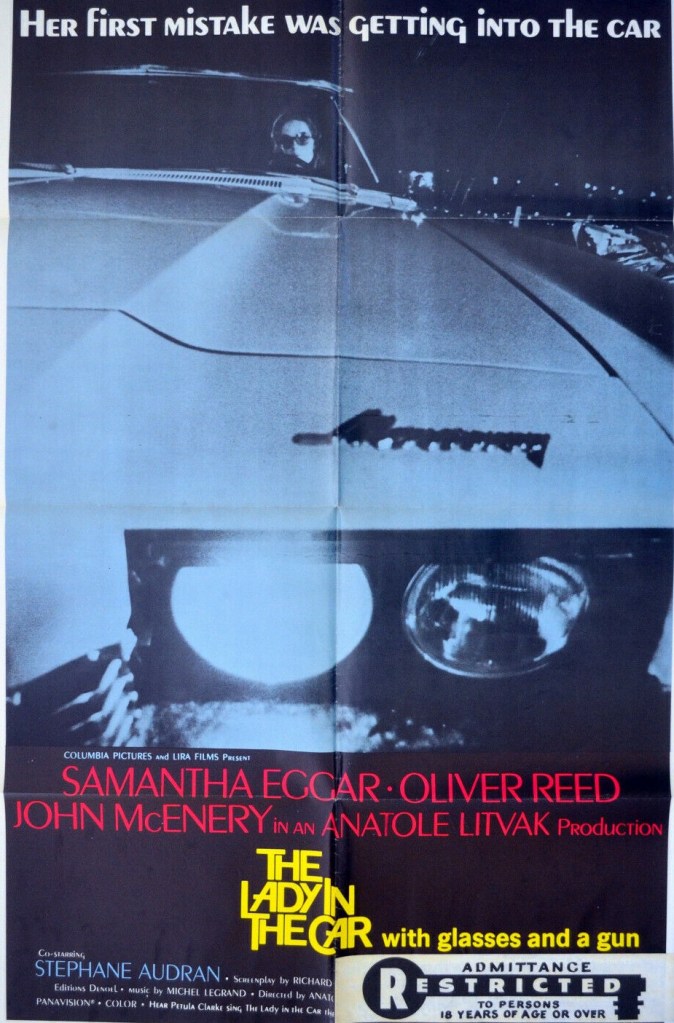
Samantha Eggar (The Collector, 1965) in her first top-billed role and an adapatation of a novel by French cult item Sebastian Japrisot (Adieu L’Ami/Farewell Friend, 1968). You couldn’t get a better mix.
Fashion photographer Danielle (Samantha Eggar) sets off on road trip from Paris to the south of France only to discover everywhere she goes a doppelganger has been there first. She’s on edge anyway because she’s “borrowed” the car of employer Michael (Oliver Reed) and once police start recognizing her she gets jumpier still. The discovery of a body in the boot and the titular gun (a Winchester rifle) don’t help her frame of mind. But instead of reporting the corpse to the police – she’s a car thief after all – she tries to work it out herself. Amnesia maybe, madness because she keeps having flashes of memory – a spooky surgical procedure – or something worse?
She’s got a battered hand she doesn’t know how. Michael’s wife Anita (Stephane Audran) says she’s not seen Danielle in a month though she is convinced she stayed with the couple the previous night. A drifter Philippe (John McEnery) starts helping her out. Eventually she ends up in Marseilles none the wiser.
It’s a tricksy film and like Mirage (1965), recently reviewed, being limited to her point of view means the audience can only work out everything from her perspective. The string of clues sometimes lead back to the original mystery, other times appear to provide a possible solution. The explanation comes in something of a rush at the end.
Despite being the first top-billed role for Samantha Eggar (Walk Don’t Run. 1966), she would not scale that particular credit mountain again until The Demonoid (1981) but she is good in the role of a mixed-up woman struggling with identity. But since it’s based on a novel by Sebastian Japrisot (The Sleeping Car Murder, 1965) there’s a sneaky feeling a French actress might have been a better fit. Oliver Reed (Women in Love, 1969) is not quite what he seems, a difficult part sometimes to pull off, but he succeeds admirably.
Stephane Audran (Les Biches, 1969), jealous of Danielle, a friend whom she views as a rival for her husband’s affections, has the most intense part, using Danielle as an unwitting cover for betraying Michael. John McEnery (Romeo and Juliet, 1968) could almost be a London spiv, blonde hair, impecunious, clearly using women wherever he goes. Watch out for French stalwarts Marcel Bozzuffi (The French Connection, 1971) and Bernard Fresson (The French Connection II, 1975).
There’s certainly a film noir groove to the whole piece, the innocent caught up in a shifting world, and that’s hardly surprising since director Anatole Litvak began his career with dark pictures like Sorry, Wrong Number (1948) while previous effort Night of the Generals (1967) also involved murder. Litvak and Japrisot collaborated on the screenplay.
I expected a project laced with more atmosphere and a host of original characters. In truth, this is less atmospheric than the other two Japrisot adapatations , the interplay between the characters not so tightly woven, nor the climax so well-spun but it was enjoyable enough.
There was a remake in 2025 starring Freya Mayor (The Emperor of Paris, 2018).
British outfit Talking Pictures has embarked on an educational program. Back in the day this would have been termed a “retrospective”, a coveted description indicating that a director or actor’s portfolio was worth reassessment. However, Talking Pictures has taken something of an outlier approach on this one. What it seems intent on educating us about is the U.S. “skinflick”.
You might not be aware of the difference between movies made in the U.S. and anywhere else that appealed to the lowest common denominator in the 1960s. Movies that featured nudist camps were generally acceptable to the British censor. And although major filmakers continually challenged the censor everywhere during the decade, that generally came under the auspices of artistic merit.
When permissiveness got the upper hand, the British seemed somewhat suspicious of abundant nudity and tended to overload it with comedy – Confessions of a Window Cleaner (1974) and Adventures of a Taxi Driver (1976) – and titles majoring on the double entendre like Keep It Up Downstairs (1976). There was a censor to keep everything in check.
In the U.S. it was different. You could avoid censorship simply by refusing to submit your film to the Production Code. And there were plenty cinemas only to0 keen to show the worst anyone could come up with in terms of sex and nudity.
The pair I’m reviewing here are not just the worst films I have ever seen but the worst films to be shown on a highly reputable channel, British outfit Talking Pictures TV. As you may be aware this channel has often been a first port of call in finding rare British pictures, often of the crime variety, especially the output from Renown. So pretty much I’m a sucker for anything they turn up dating from the 1960s even if it’s a new movie to me since I admit my knowledge of that era still has gaps. I’m the kind of sucker that never does any research on unknown titles, just trusts that TPTV is taking me down an interesting route
So if I’m unfamiliar with the picture, I generally give it the benefit of the doubt as I assume the people who run Talking Pictures will have done the hard yards. But now I’m not so sure.
Admittedly, there’s a fine line between cult and trash. A great deal of what passes for cult these days was dismissed as trash back in the day, so often it depends on your point of view. But it’s hard to make any justification for screening either of these movies.
At the time of their release neither would have been shown without extensive cuts in the UK and would have been shown in US cinemas minus a Production Code seal of approval.
Admittedly, too, I am making this damning judgement – deeming them worse than the awful Orgy for the Dead (1965) which was redeemed if only just by its campness – without having watched much of either picture. A 20-minute sample of each was as much as I could take.
It’s not just that they are devoid of any cinematic or even technical merit – there’s no dialog for a start, just a monotonous voice-over – but basically that they are an excuse for an endless parade of nudes. Skin flicks in the American vernacular, movies for the dirty raincoat brigade the British equivalent.
Take Me Naked purports to be the more artistic of the pair given it’s set in a derelict area of New York filled with alcoholics and bums. But really, it’s an excuse for a rancid low life to spy on a naked woman (Roberta Findlay) and imagine what’s he’s going to do to her. That’s pretty much it, apart from an unsavory violent aspect.
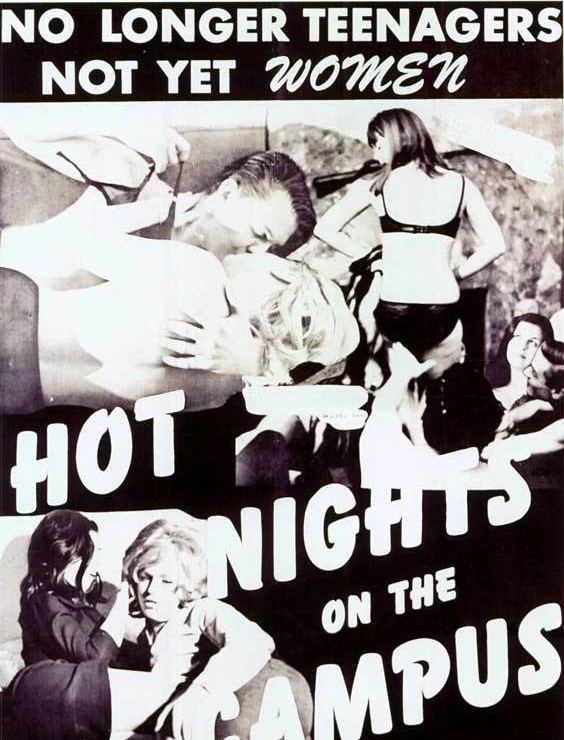
Hot Nights on the Campus has less nudity. But that’s it’s only saving grace. Again, there’s no dialog, just voice-over. Sally (Gigi Darlene) is a farm girl who is led astray at college and her education mostly comprises orgies, lesbianism and seduction. There’s at least an attempt at narrative since Sally’s adventures incur pregnancy and abortion, but like the rest of the picture their purpose is purely exploitational.
Take Me Naked was directed by Michael and Roberta Findlay, the latter making a name for herself helming exploitation, sexploitation and hardcore porn. Hot Nights on the Campus was written and directed by Tony Orlando who made three others in the same vein.
Shameless, I know. Egotistical? I plead guilty. But since there’s no financial reward in writing this Blog, I take pleasure in its increasing popularity. I started writing this Blog in 2020 and my first year’s figures amounted to a scant 1,648 views. Certainly nothing to write home about and definitely no inkling that I would hit a grand total of 565,000 views over the six years of the Blog’s existence. I would have been happy to settle for a regular 10,000-20,000 a year.
Luckily, readers had more faith than me and by my third year I was staring at an annual total of just short of 50,000. The following year I topped 75,000 and in 2024 it was a shade below 125,000.
Then came a bonanza. For the year 2025 I registered a phenomenal 301,000 views, more in that single year than cumulatively for the previous five years.
People often ask me why I latched on to the 1960s for the core of my reviews. It’s a question I often ask myself. Although the 1960s were my formative years, I didn’t spend much time at the cinema. I grew up in the new town of Cumbernauld in Scotland which didn’t have a cinema, even though the town planners must have been aware that Scotland had the highest cinema attendance per head of population in the whole of Europe. When I moved to Dumbarton, which had two cinemas, one burned down. Although I remember taking a detour on my journey home from school to stare at the stills on display outside the Rialto, incursions inside were rare. So maybe I’m just catching up on what I missed.
And although I’d written several books on films of the 1960s – one each about The Magnificent Seven (1960), The Guns of Navarone (1961) and Lawrence of Arabia (1962) and another devoted to the westerns of 1969, it wasn’t until I watched all the movies that comprised The Magnificent 60s: The 100 Most Popular Films of a Revolutionary Decade that my appetite was whetted for more.
I’ve got a huge DVD and VHS arsenal so that was a good place to start. I didn’t have any plan. I just watched what I fancied. Occasionally, I’d plunder TCM, Talking Pictures and other television channels and streamers. Since I still attend the cinema on a Monday, I add to the mix with reviews of contemporary films.
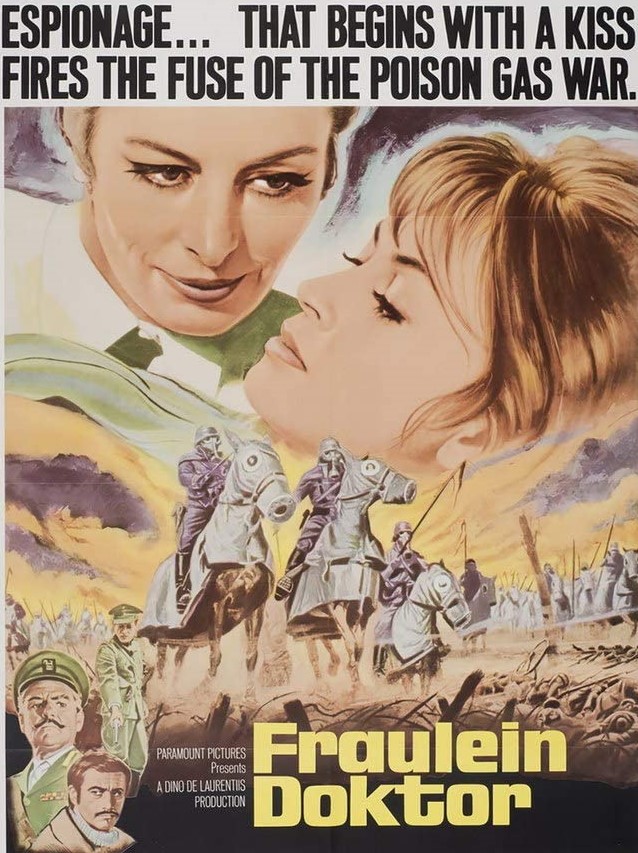
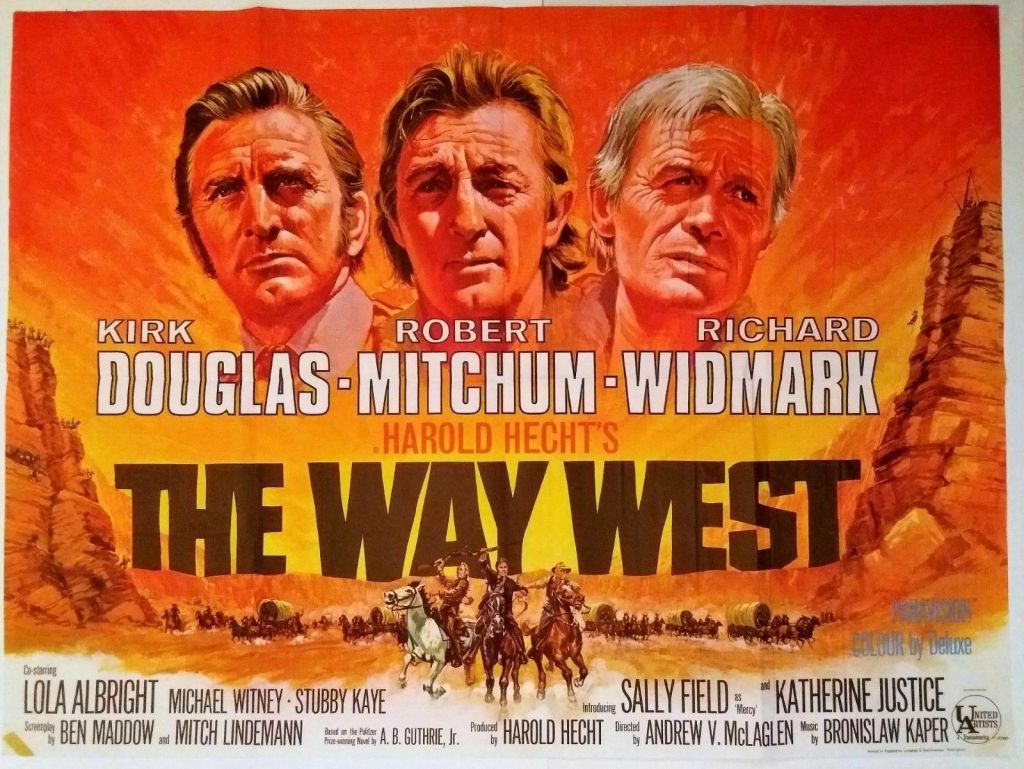
In this indiscriminate fashion, I’ve got to know a huge number of movies that I would probably never had an initial inclination to watch. Pictures such as Fraulein Doktor (1968) or A Dandy in Aspic (1968) or Invitation to a Gunfigfhter (1964) or Guns of Darkness (1962) or The Way West (1967), all underrated at the time – and since, which I am delighted to give a positive fillip. As such films turn up intermittently on streamers or television stations I find I am often the first port of call for people wanting a review of such pictures.
Because several of my books had been about the making of movies, I decided to sporadically investigate, on a smaller scale, how certain pictures were made and those “Behind the Scenes” articles have become a very popular element of the Blog.
Where do my fans come from? United States leads the way followed by China, then the United Kingdom, Thailand, Australia, Canada, India, Spain, Germany and Singapore. But I’ve got at least one reader in virtually every country in the world.
I’ve no idea how people find this Blog because I’m not on social media. The Blog isn’t represented on X or Facebook or Instagram so I can only assume it’s a version of word-of-mouth.





 The Magnificent 60s