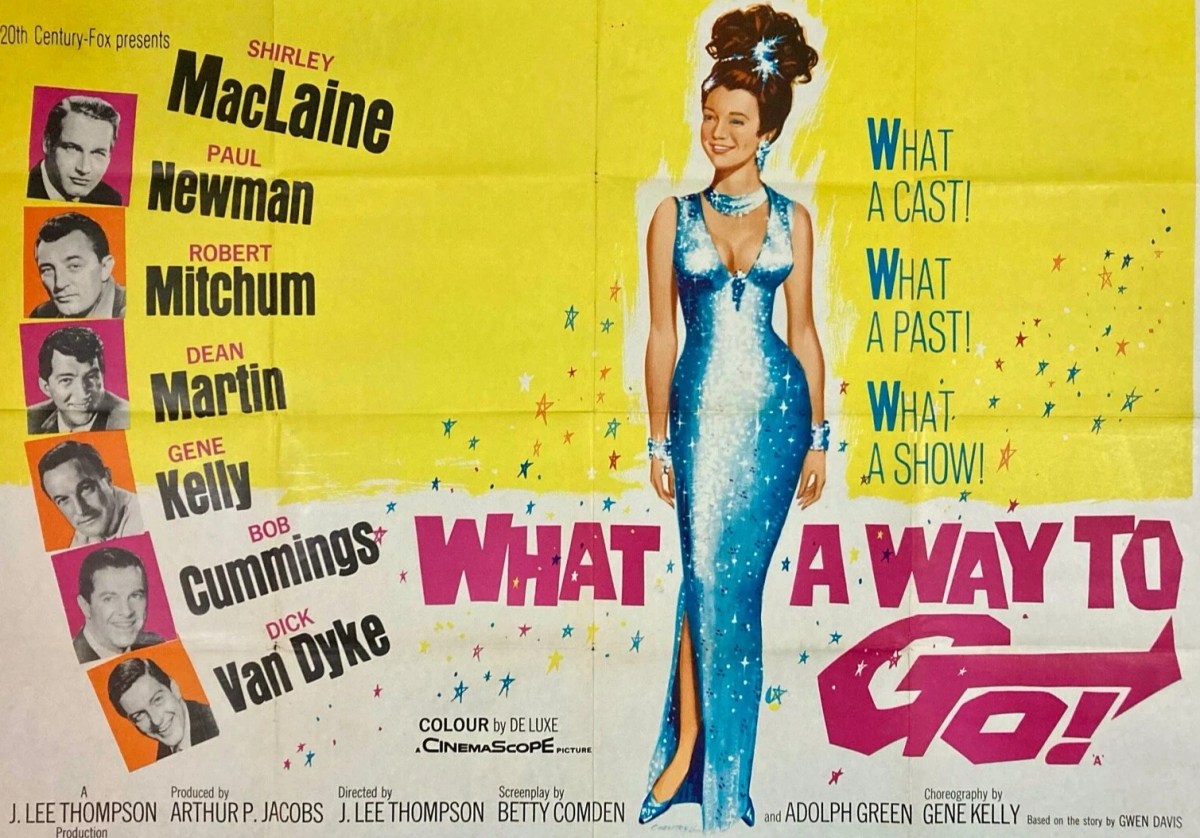
Daftest picture I’ve ever seen. Not the funniest, not by a long chalk, but highly enjoyable if you go with the flow and let wash over you the deluge of costume changes, the satire-a-go-go, a smattering of slo-mo and fast-mo, the worst fake beards and moustaches, and sanctimonious Hollywood rubbish that money isn’t everything and we should all be hankering after the Henry Thoreau approach to life. So wacky and far-out that if it had been made today J. Lee Thompson (The Guns of Navarone, 1961) would be in with a shout of being hailed as a “visionary” director.
The all-star cast snookers you in. Everyone acts – or should that be over-acts – against type, even Shirley MacLaine (Gambit, 1966), casting aside her ditzy screen persona in favor of sense and sensibility. The generally hapless Dick Van Dyke (Divorce American Style, 1967) demonstrates what happens when his manic energy is put to purpose. Add more or less top hat and tails to the commanding stride and imposing figure of Robert Mitchum (The Way West, 1965) and he could grace boardrooms with a venom the participants in Succession would envy. Dean Martin (Rough Night in Jericho, 1967) explores his villainous side. and you do wonder what would have happened to these stars’ careers had studios taken note of these side hustles, only Dean Martin would have the opportunity to tackle a similar character, though less cartoonish, again.
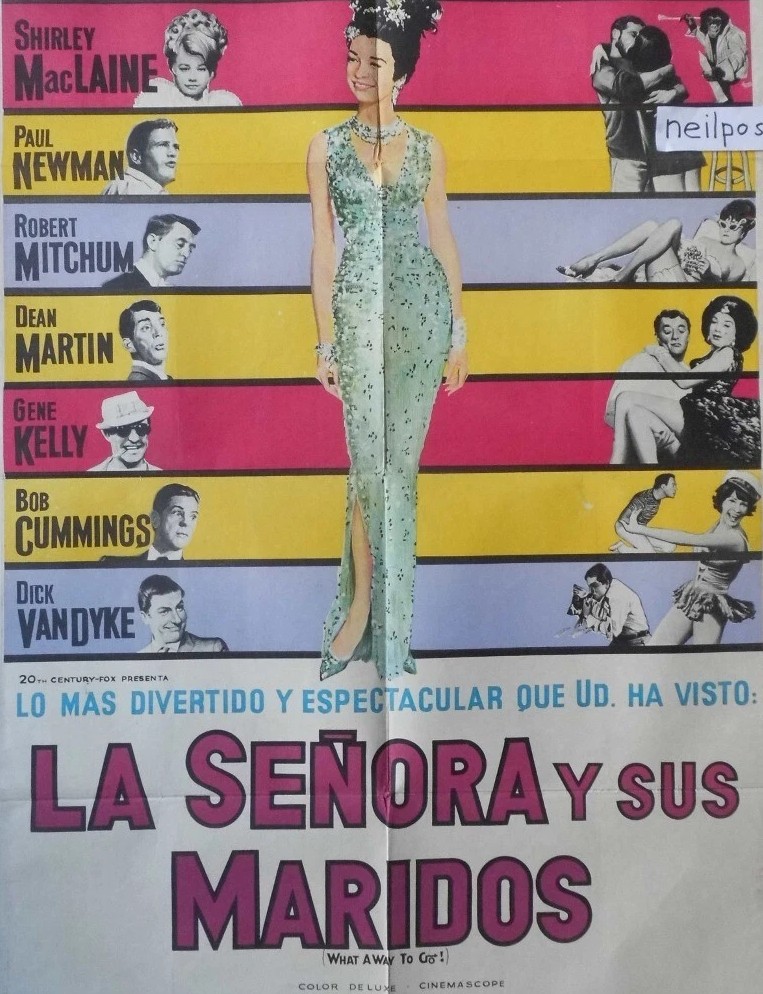
And it’s loaded with visual gems. J. Lee Thompson’s version of The Incredible Shrinking Man/Honey, I Shrunk the Boss is a treat. Watch out for the rows of secretaries slumped over their typewriters, Dick Van Dyke swamped by money, a drunken farmer trying to milk a bull, and contemporary sci-fi fans would dig the machines going crazy. That’s not to forget the monkey not just painting masterpieces but expecting applause on completion. There are spoofs galore – the contemporary (1960s) art scene, the musical, the wealth that opens doors and cannot ever be shut down no matter how hard you try.
Essentially a portmanteau as perennial widow Louisa (Shirley MacLaine) explains to a psychiatrist Dr Stephanson (Bob Cummings) how her four husbands met their demise. Louisa, daughter of a grasping greedy mother and ineffectual father, yearns for the simple life, far removed from the trappings and temptations of money. Ruthless businessman Leonard (Dean Martin) wants to marry her for the simple reason that she’s the only lass in town who doesn’t want to marry him.
Instead she marries financially-challenged Edgar (Dick Van Dyke) who discovers, much to his surprise and her annoyance, that he has a good business brain, enough to drive Leonard into the ground and ignore his new wife, until he drops dead due to the pressures of wealth. Next up is Parisian artist Larry (Paul Newman) whose biggest attraction is his poverty and simple lifestyle. Unfortunately, he could be Dick Van Dyke in disguise having invented a wacky machine that will do all the painting for him. Unfortunately, that makes him rich and leaves Louisa home alone once again until the machines take revenge on their creator.
Billionaire Rod (Robert Mitchum) is so taken with Louisa that he determines to get rid of his fortune only to discover that even when left unattended money just grows. Eventually, he sells up and becomes a happy, if inebriated farmer, but, unfortunately, can’t tell a cow from a bull and ends up dead.
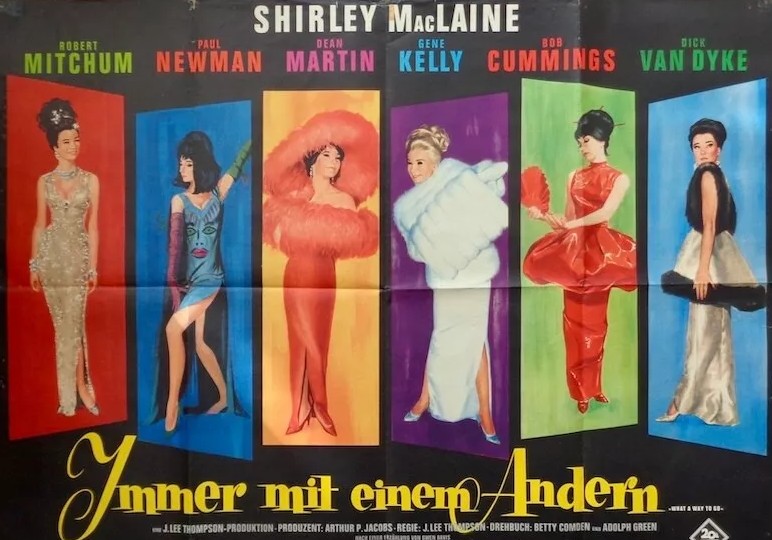
Last up is another impoverished character clown Pinky (Gene Kelly) whose nightclub act is a stinker until he discovers his dancing feet. Once he passes, it’s full circle as Louisa again encounters Leonard, now impoverished and repentant, and marries him and they settle down. There’s a fine twist at the end when wealth once again beckons.
Shirley Maclaine doesn’t have to do a great deal except hold it together and wear a hundred costumes. Robert Mitchum is the pick but Paul Newman (The Hustler, 1961) is to be applauded for sending up so riotously his screen persona. And it could easily have degenerated into a lazy spoof, the actors giving nothing at all. Instead, once it gets going it’s just huge fun.
J. Lee Thompson displays an inventiveness not seen before. This works because it is so indulgent. Written by the team of Betty Comden and Adolph Green (Bells Are Ringing, 1960) from the bestseller by Gwen Davis.
Critics slammed it but audiences lapped it out. I was in both camps. Started out hating it, ended up adoring it.

 The Magnificent 60s
Some info:
“According to a 15 Sep 1963 NYT article, publicist-turned-producer Arthur P. Jacobs initially acquired Gwen Davis’s original story I Love Louisa for Marilyn Monroe, one of his close, longtime clients. Shortly after Monroe’s death, however, the 4 Sep 1962 NYT reported that Jacobs intended to move ahead with another actress and director J. Lee Thompson, with production scheduled to begin once Thompson completed photography on Kings of the Sun (1963, see entry). In addition to Jacobs’s and Thompson’s personal companies (Apjac Productions, Inc., and JLT Productions), the 17 Oct 1962 DV announced the involvement of The Mirisch Company as part of a recent non-exclusive pact with Jacobs. United Artists (UA) was confirmed as distributor.
While Adolph Green and Betty Comden began working on the screenplay, the 19 Oct 1962 DV named Peter Sellers for the role of psychiatrist “Dr. Stephanson.” Elizabeth Taylor consented to play the leading role for the same fee she received on Cleopatra (1963, see entry)—$1 million against ten percent of the eventual gross—although a UA executive told the 11 Dec 1962 DV that such a deal had still not been signed. The 19 Oct 1962 LAT indicated that offers for the six supporting male roles had been sent to Richard Burton, Rex Harrison, Kirk Douglas, Rock Hudson, Cary Grant, Frank Sinatra, and Tony Curtis, but only Sinatra was confirmed by other contemporary sources. The 26 Dec 1962 Var alleged that some of these characters were expanded for the approval of Sinatra, Marlon Brando, and David Niven, who all agreed to appear.
By the spring, the title had changed to What a Way to Go!, but Taylor was no longer mentioned as the star. Shirley MacLaine quickly entered negotiations to replace her, provided she could secure legal clearance in relation to an upcoming lawsuit against producer Hal B. Wallis. MacLaine’s casting was officially announced in the 9 Jul 1963 LAT, with Robert Mitchum, Paul Newman, Dean Martin, Dick Van Dyke, Gene Kelly, and Fred MacMurray named as her onscreen husbands. All but MacMurray appear in the final film. Items in the 15 Apr 1963 LAT and 22 Apr 1963 DV noted that Steve McQueen and Brad Dexter were also among the actors considered.
Simultaneous with Taylor’s departure, What a Way to Go! shifted to Twentieth Century-Fox Film Corp., as the 25 Apr 1963 DV reported that Thompson entered discussions with Fox president Darryl F. Zanuck to establish a future contract at the studio.
With the cast and studio secured, the 9 Aug 1963 DV announced the start of principal photography that same day. Despite earlier plans to complete some background work abroad, the 31 Jul 1963 DV stated that foreign locations were reconstructed on the Fox studio lot in Westwood, CA, as part of the seventy total sets used for the film. The 5 Sep 1963 DV indicated that shooting also took place at Los Angeles International Airport.
Several sources reported on the extravagance of the production design, most notably MacLaine’s seventy-two costume changes, which the 26 Aug 1963 DV estimated at $375,000, including a $10,000 fox fur coat and diamonds by Winston. A DV report three days earlier claimed that shopping and sewing work was split between teams at Fox and Paramount Pictures, both of which hired extra staff to support those under designer Edith Head. An 18 Aug 1963 LAT article also described the “cauliflower ear” and broken nose makeup effects used to emphasize the appearance of professional fighter Lou Nova, who portrayed a boxer in the film. The 25 Mar 1964 Var estimated the final negative cost at $5 million.
The 26 Aug 1963 DV stated that Paula Lane was selected to portray a Marilyn Monroe look-alike, but the role was excised during production. Several additional DV items throughout shooting named the following actors in the expansive supporting cast whose participation could not be confirmed: Arlene Harris, Leonard Yorr, Ken Hooker, Chuck Bale, Bert Whaley, Richard Kenn, Phil Nesbitt, Diane Hartley, Lynn Borden, Bob Leonard, Richard Jury, Max Mellinger, Richard Steffens, Marcel Dallimore, Gary Brown, Mark Bailey, Myrna Ross, Hans Moebus, Russ Peak, Todd Mason, John Clark, Phil Hartman, Alan Craige, Armando Gonzalez, Steven Condit, H. E. West, Eunice Pollis, John Lawrence, Hugh Lawrence, Beppy Devries, Carole Cook, Beatrice Greenough, Janine Grandel, Naji Sujata, George Dega, George Beekman, Albert Carrier, Jacques Foti, Jean Del Val, Jacques Roux, Marcel Hilaire, Milton Frome, Jose Portugal, Yetty-Marie Luckenbach, Saul Gross, Wally Rose, Tom Steele, Pat O’Moore, Opal Euard, and Justin Smith. The 16 Sep 1963 DV claimed that Jacobs approached Phil Silvers for a cameo appearance, while the 10 Sep 1963 LAT reported that the director hoped to cast MacLaine’s daughter, Sachi Parker, as the nine-year-old version of “Louisa.” MacLaine, however, did not want Parker to be removed from school.
The 12 Sep 1963 DV indicated that Chuck Dodds was intended to write songs for the picture, but music credit was ultimately shared between writers Betty Comden and Adloph Green and Jule Styne.”
LikeLiked by 1 person
Thanks once again. I appreciate all your digging.
LikeLike