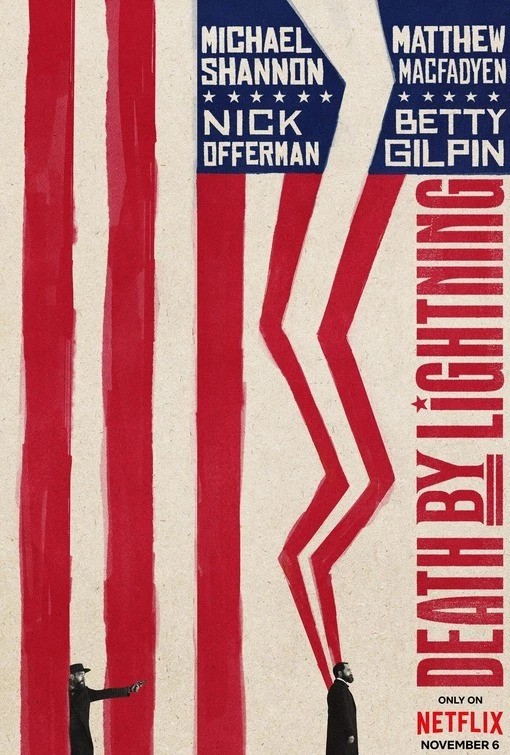
Death By Lightning (2025) ***** – Netflix Hits A Home Run, At Last

Streaming at its best. Take an obscure subject, a long-forgotten character, an incident that’s a mere blip in history, actors of less than middle rank in box office terms, and by breaking it down into easily consumable parts turn a history lesson that might be an indigestible three hours on the big screen into a riveting, enthralling drama of the highest quality that takes a no-holds-barred approach to politics

Small wonder you won’t have heard of U.S. President James Garfield (Michael Shannon) given he held office for around three months. Or of his misfit assassin Charles Guiteau (Matthew Macfadyen), less than a footnote in history for making the grave mistake of gunning down a President nobody had ever heard of.
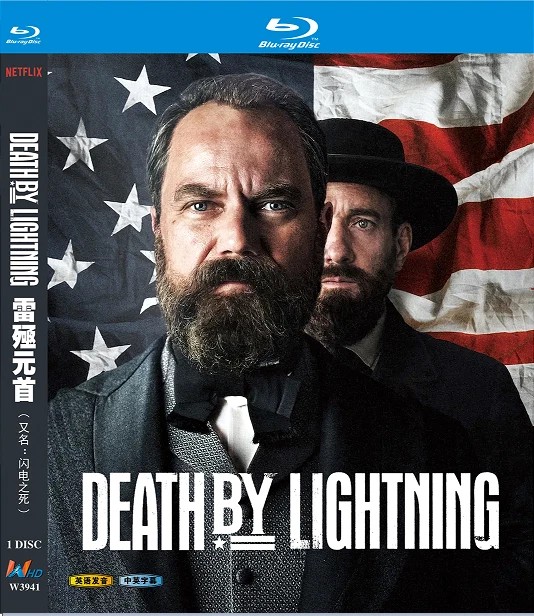
Garfield shouldn’t even have been President. A mid-level politician on the verge of retirement, he wasn’t even in the running for the Republican nomination, which should have gone to Civil War hero Ulysses S. Grant. But in one of those quirks of politics, the voters liked what they heard of Garfield and in a grass roots rebellion shooed him in. He won the Presidential election by a whisker.

And then his troubles started. He was too honest for the job. Unwilling to follow the standard corruption and hand out highly-paid posts to rank-and-file unfitting for the job, he found himself up against the New York political powerhouse headed by Roscoe Conkling (Shea Whigham) who controlled the bulk of the revenue entering the country. And the battles with Conkling would have easily made a House of Cards-style series in itself as the dueling politicians attempt to outwit each other.

But in the background, and weaseling his way into the foreground, is con man, thief, forger, misfit Guiteau with as much entitlement as could sink a battleship who, nonetheless, grasps the key essential of politics of the era which is that helping to grease the greasy pole is all you need to reap the benefits. Except his efforts to become anyone’s righthand man fall way short, as his ambition and lack of any relevant skills are widely mocked – he expects to be handed an ambassadorial role although he speaks no foreign languages – despite occasionally finding an opening.

Having been dismissed by the President himself, he decides Garfield is totally the wrong person for the highest position in the land and takes it upon himself to rid the nation of this burden. Even the assassination is ham-fisted and Garfield would have survived except for the efforts of the ham-fisted surgeon who killed him through septic poisoning.

That’s the climax to a thoroughly involving mini-series where no punches are pulled as far as politics are concerned. Conkling doesn’t mind being the man behind the throne as long as he gets credit for pulling the strings. Political wheeling-and-dealing has never been so ruthlessly exposed.
But it’s not as if Garfield is an innocent in that department. While not stooping to corruption, he pulls the legs from under Conkling by appointing Conkling’s righthand man Chester Arthur (Nick Offerman) as his Vice-President, a scheme that while initially backfiring eventually pays dividends. And it’s ironic that Conkling’s demise is down to a thwarted mistress.

The narrative switches on like a thriller, twists and turns every inch of the way. But as much as the riveting narrative, the joy of this is in the performances. Matthew Macfadyen, double Emmy award-winner for Succession (2018-2023), is rightly going to be considered to have landed the plum role, a fellow so much of a misfit that in a “free love” community nobody wants to have sex with him. But it’s a close-run thing. Michael Shannon (A Different Man, 2024) is outstanding, and Shea Whigham (F1, 2025) has immense fun especially with his eyebrows and dominating curl, while Nick Offerman (Civil War, 2024) in shifting from oaf to man of honor has a peach of a role, not forgetting Betty Gilpin (The Hunt, 2020) as the straight-talking wife of the President.

None of these are stars, not even of the indie persuasion, and yet it’s amazing what they can do with their characters.

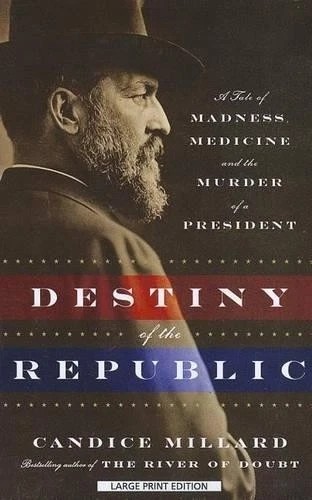
Directed with effortless style by Matt Ross (Captain Fantastic, 2016) from a script by Mike Makowsky (Bad Education, 2019) adapting the bestseller Destiny of the Republic by Candice Millard.

Outstanding.
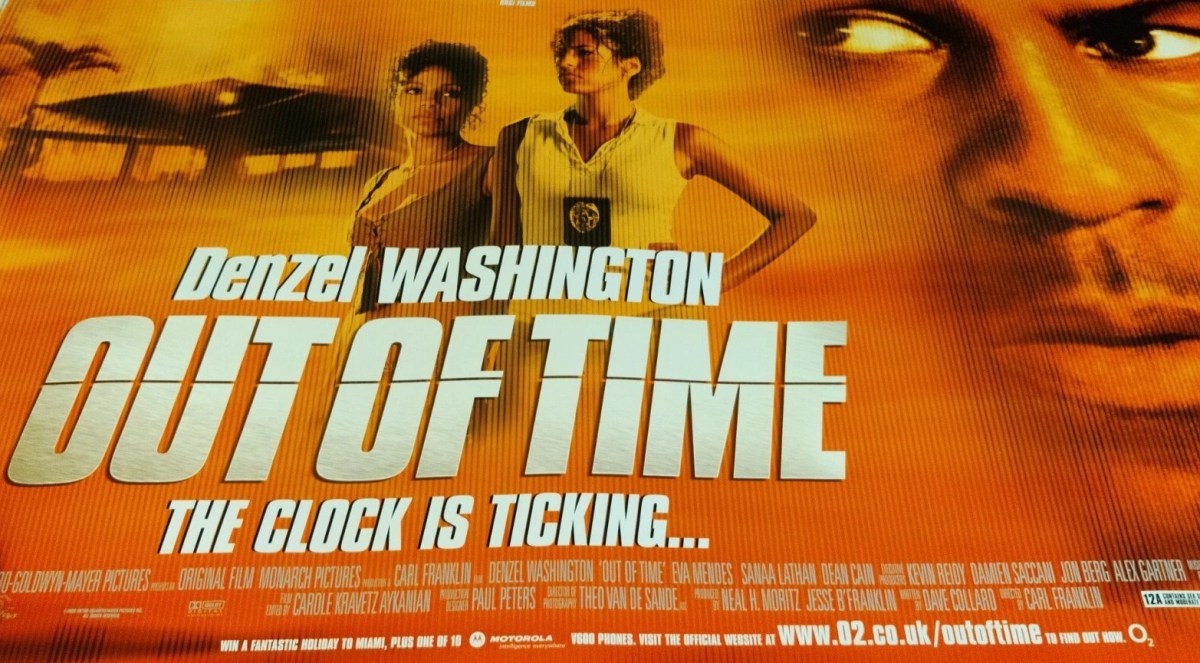
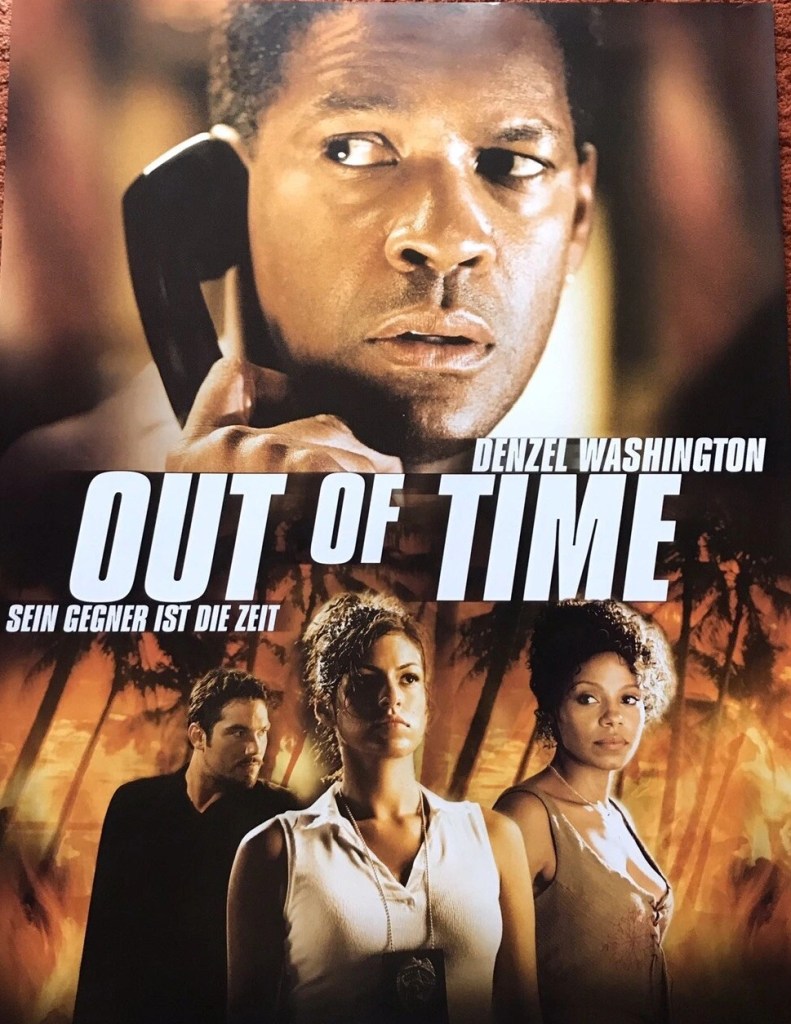
Out of Time (2003) *****

The most tension-filled thriller this side of The Day of the Jackal (1973). Stone-cold classic in my book. Admittedly not a big box office success in its day nor critically acclaimed, but this nod to film noir with cop taking a stroll for his own convenience down the wrong mean streets and an old-fashioned femme-fatale male-dupe scenario coupled with witty dialog and terrific set pieces suggests to me this is long overdue for reappraisal.

This was really the start of Denzel Washington as action hero – Crimson Tide (1995) was more a straightforward drama albeit with characters facing the ultimate consequence – and it probably helps that I’m looking back at this through the prism of more than two decades of the actor whizzing along in the derring-do department especially in his turn as The Equalizer (2014) – and sequels – where he demolishes opponents in seconds. Apart from the occasional side hustle as a bad guy, he’s generally been a good guy, the sort of dependable hunk that Tom Hanks would aspire to if he wanted to add brawn to his guy-next-door persona.

Matt Whitlock is the top law enforcement officer in a Florida slumber town (pop 1300) but he’s not as clean-cut as he looks given his affair with married Ann Harrison (Sanaa Latham) who bursts his romantic bubble by announcing she has just six months to live thanks to a cancer so advanced that only some new-fangled treatment could save her. I smelled a rat, I have to confess, the minute she decided she was going to make him the beneficiary of her million-dollar insurance policy.

So what’s a decent guy to do but steal the $500,000 drugs money he’s holding in his police safe, that’s liable to sit untouched for years to come, in order to fund her treatment on the assumption that the insurance policy acts as his insurance. How dumb can you be?

So when Ann and husband Chris (Dean Cain) die in a horrific fire, his world unravels, especially as detective soon-to-be-ex-wife Alex (Eva Mendes) is in charge of the murder investigation and the Feds arrive out of the blue looking for the drugs cash. So basically he’s an old-fashioned “running man”, diving from one hole to the next, barely keeping ahead of the cops and the FBI, fingered twice by witnesses, discovering that the specialist who diagnosed the cancer is an imposter, and not just being made to look the biggest fool who ever fell in love with the wrong woman but liable to pay for his error with a lengthy jail sentence.

Alex begins to suspect he knows more than he’s letting on, he’s desperate to trace the bogus doctor, all the while, in a nod to No Way Out (1987), desperately trying to stop a tsunami of telephone evidence – arriving via fax and computer – that links him to the supposed dead woman.

There are verbal confrontations galore and a couple of physical ones, a chase through a hotel culminating in a brawl on a balcony, and possibly a second murder charge.

It’s not just a terrific tale, mostly consisting of twists and narrow escapes, I counted half a dozen twists in the last ten minutes alone, but offers some terrific dialog. In a diner, the relationship between Matt and Chris is spelled out in style: Matt recommends the crab, Chris points out he’s allergic to crab. “I know,” retorts Matt. The movie opens with some decidedly salty goings-on between Matt and his lover and the verbal duel between Matt and Alex has the underlying Tracy-Hepburn classic squabbling.

For all that Matt is smart enough to chase down the missing cash and hold the Feds at arm’s length long enough, he’s still, when you come down to it, only going from dumb to dumber and the shock when he realizes just how well he’s been duped is a cracker.

So, obviously, the key is that the audience wants him, guilty though he is of theft and stupidity, to get away with it or at least be thrown a get-out-of-jail-free card and that’s part of the hook, and that element is brilliantly done. I had no idea how he was going to get off with it, as one avenue of escape after another was rigorously shut down, until the very end.

There’s a whole stew of those reversals that screenwriters throw at audiences who think they are one step ahead of the game.

It’s a great cast. Denzel Washington is superb, Eva Mendes (Training Day, 2001) is an excellent sparring partner, Sanaa Latham (AVP: Alien vs Predator, 2004) as slinky as femme fatale as you’ll find. Look out for television’s Superman Dean Cain and especially character actor John Billingsley.

Director Carl Franklin (Devil in a Blue Dress, 1995) piles on the tension and kudos to screenwriter Dave Collard (Annapolis, 2006) for creating the blueprint.   

I caught this on Amazon Prime but be quick about it because it’s in the section that the streamer calls “leaving in 30 days.”

An absolute classic.

Behind the Scenes: “The Learning Tree” (1969)

I am indebted to one of my regular correspondents, who goes by the name of “Fenny100,” for the following “Behind the Scenes” report:

 The working title of the picture was Learn, Baby, Learn. Based on his 1963 autobiographical novel, The Learning Tree, it marked the feature film debut of Gordon Parks, who was the first African American staff photographer for Life magazine. With the making of The Learning Tree, Parks became the first African American to direct a major theatrical motion picture. Parks had previously directed “several short film subjects and two one-hour features for National Education Television” (New York Times, 2 April 1968). The project was five years in the making (Variety, 17 April 1964), the writer-director in talks with producers interested in optioning his book. Two independent producers first acquired film rights (New York Times, 17 August 1969) but they were unable to raise the necessary funds. Another producer allegedly offered Parks $75,000 to adapt the script, with the stipulation that he must rewrite the black characters as white. Parks declined.

At some point, Bob Hope’s daughter, Linda Hope, was interested in producing the adaptation, (Variety, 7 November 1968). Parks’ friend, filmmaker John Cassavetes (Shadows, 1958), introduced his work to Kenneth Hyman, an executive at Warner Bros.—Seven Arts, Inc., which ultimately funded the production, although Cassavetes accidentally gave Hyman a copy of Parks’ 1966 memoir A Choice of Weapons rather than The Learning Tree. Hyman became enthusiastic about working with Parks and reportedly struck a four-picture deal with him within a fifteen-minute meeting. The Warner Bros.—Seven Arts deal (Variety, 1 April 1968) referred to Parks as “the first negro in film history to direct a major feature for a major film company.”

 Also a well-respected musician, Parks was set to write the score, which (Variety, 12 July 1968) entailed a four-movement symphony. The production budget was set at slightly less than $2 million (Variety, 25 June 1969) and Parks was slated to receive twenty-five per cent of any profits (Los Angeles Times, 19 October 1969).


Principal photography was scheduled to begin on 30 September 1968 in Parks’ hometown of Fort Scott, Kansas, (“Production Chart,” Variety, 27 September 1968). Problems arose when the film crew, including six African Americans, began shooting in the town (Variety, 7 November 1968), a report which implied that the difficulties arose from racial tension. A later article (Variety, 25 June 1969) noted that there were twelve black crew members, not six, and blamed the tension between locals and filmmakers on the fact that Fort Scott residents wrongly assumed The Learning Tree was a “dirty film.” Parks said that shooting there eventually worked well, and that the local Elks Club admitted African Americans for the first time at a party thrown for the cast and crew. Parks was given a key to the city by local officials, and “Gordon Parks Day” was declared in early November 1968.


Following five-and-a-half weeks in Fort Scott, cast and crew moved to the Warner Bros.—Seven Arts studio lot in Burbank, California, where another two-and-a-half weeks of principal photography was scheduled, beginning in mid-November 1968. On 11 December 1968, Variety confirmed that filming had been completed.


Although William Conrad acted as executive producer throughout the shoot, his name was removed from the credits (Variety, 19 June 1969), though it was later explained that Conrad had agreed to help but wanted no credit, since The Learning Tree was “Gordon’s story.”


In discussing the small contingent of African Americans on his crew, Parks said (New York Times, 17 August 1969), “I hired 12 Negroes to work on the production. It was a fight, because the Hollywood unions are all white, but I got enormous cooperation from Warners.” The studio hired a black electrician, Gene Simpson, for the first time in its history (Los Angeles Sentinel, 13 March 1969), while publicist Vincent Tubbs – the only black union head as the president of the Hollywood Publicists Guild – worked on the film. Parks’ son, Gordon Parks, Jr., acted as still photographer. Seven African American craftsmen worked on the film (Box Office, 28 October 1968).


The Learning Tree was first screened on 18 Jun 1969 at a Warner Bros.—Seven Arts press junket held in Freeport, in the Bahamas (Variety, 18 June 1969). Following its debut there, Variety (25 June 1969) suggested that Parks’ “viewpoint on America and its racial problems” in the 1920s-set film might be negatively received by “black militants and other radical types.” Parks contended that black militants had been purposely planted in preview screenings, and although they had sometimes laughed at inappropriate times, they had generally congratulated him for his accomplishment. Parks stated, “But actually, I don’t care what they think. This is my story. I believe that in the black revolution there is a need for everyone.”


Despite the film’s perceived innocence, it received an M-rating (suggested for mature audiences) from the Motion Picture Association of America (Variety, 16 July 1969). It was due to have its world premiere on 6 Aug 1969 at the Trans-Lux East and West arthouses in New York City (Variety, 30 July 1969). Early reviews were mixed. Although the studio had initially planned a slow rollout of the film in arthouse theaters, its success at the more commercial Trans-Lux West – and relative failure at the Trans-Lux East – indicated the picture would play better at larger, inner-city theaters (Variety, 10 September 1969). A new “playoff pattern” was devised to take advantage of its box-office potential at theaters known for action films and other commercial fare.

Within seventeen weeks of release,  cumulative box office gross topped $1.327 million from just 27 theaters (Variety, 5 November 1969).

At Los Angeles at Grauman’s Chinese Theatre, where The Learning Tree opened on 20 August 1969, a large fiberglass sycamore tree  – which the studio planned to donate to the Crippled Children’s Society of Los Angeles County once the film’s run was complete  – was built around the box office (Variety, 18 August 1969)

The Learning Tree was the U.S. entry at the Edinburgh Film Festival running 24 August – 7 September 1969. It won the Blue Ribbon Award from the National Screen Council in the U.S. for the month of September. The film went on to garner accolades including the National Association for the Advancement of Colored People (NAACP) Image Awards for Best Picture (in a tie with Joanna, 1968) Best Director, Best Actress in a Feature (Estelle Evans), and Most Promising Young Actor and Actress (Kyle Johnson and Alex Clarke).

Parks received an Annual Achievement Award from the Foundation for Research and Education in Sickle Cell Disease of New York City; an Achievement Award from the city of Cleveland, Ohio, presented by Cleveland Mayor Carl Stokes on the 24 September 1969 Cleveland premiere; and a Certificate of Merit from the Southern California Motion Picture Council, which also named the film a “Picture of Outstanding Merit.”

On the commercial front, the picture was a solid hit, raking in $1.5 million in rentals (what the studio earns after cinemas have taken their cut) in the annual box office chart (“Big Rental Films of ’69,” Variety, 7 January 1970).

Parks received  honorary degrees from Boston University and Fairfield University in Connecticut. A week-long Gordon Parks Festival, also featuring Shaft (1971) and Shaft’s Big Score (1972), ran at Kansas State University in 1973.

Twenty years after its release, in 1989, it became one of the first twenty-five films selected for inclusion in the Library of Congress’ newly founded National Film Registry.

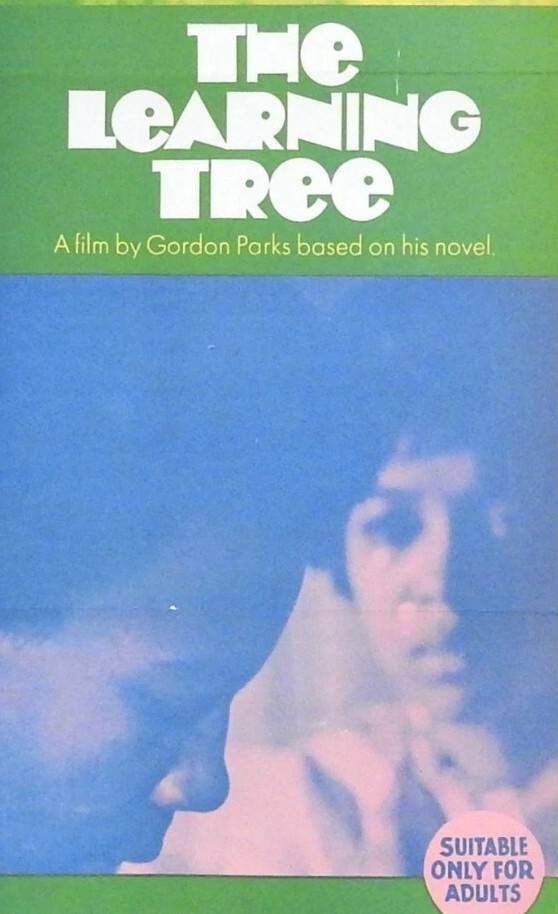
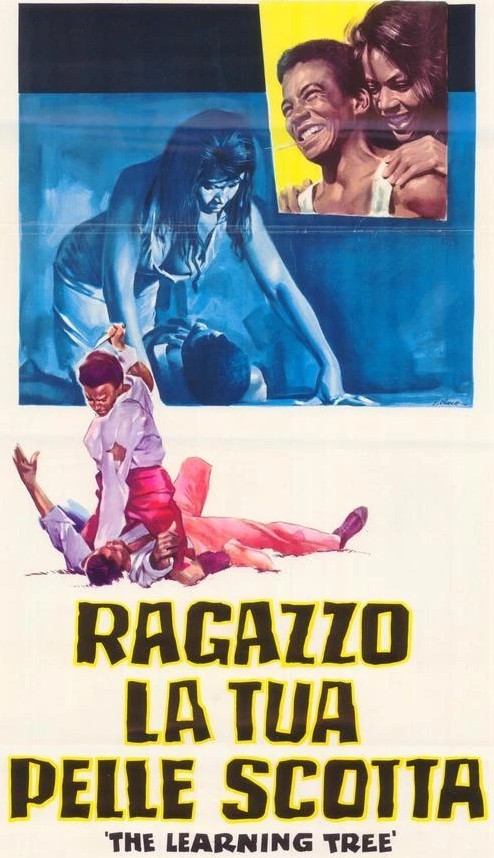
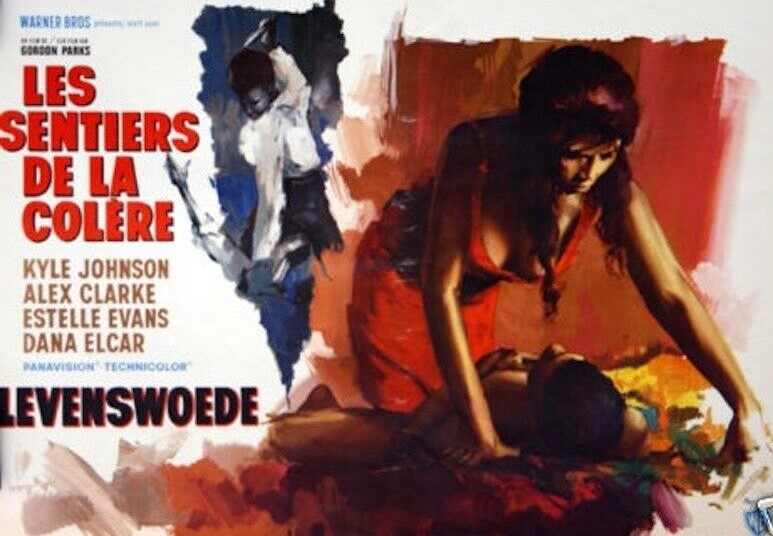
The Learning Tree (1969) ****

Director Gordon Parks made a big noise a couple of years later with Shaft (1971), Richard Roundtree shooting to fame as a slick and sexy private eye, memorable score by Quincy Jones. But The Learning Tree had possibly a bigger impact on the Hollywood consciousness, the first movie released by a major studio (Warner Brothers) that was directed by an African American. Although actors like Sidney Poitier and Jim Brown had smashed the Hollywood glass ceiling, directors lagged far behind. And this would have been an interesting tale in its own right of adolescence in 1920s Kansas had the leading character Newt (Kyle Johnson) and buddy Marcus (Alex Clarke) not faced such blatant racism.

Told today, the story would take a different route, concentrating on the dilemma of Newt in coming forward with the evidence that could convict Marcus’s father Booker (Richard Ward) of murdering a white man, not just the guilt at sending another African American to the electric chair but fear of the killing spree that must follow from enraged whites. Instead, that aspect comes at the tail end of a story that sees Newt and Marcus react in different ways to white supremacy. It’s not that Newt is spineless, toeing the line, but that Marcus, filled with venom, sees violence as the only way to establish any kind of equality.

When Newt, a reasonable enough scholar, though hardly in the genius class, is marked down by his teacher on the grounds that it’s a waste of time going to college when he will still end up a cook or a porter, the young man responds, “You hate us colored kids, well, we hate you, every one of you.” Marcus has a similar mantra, “this town don’t want me and I don’t want this town.” That underlying endemic racism contrasts with the more overt vicious bullying of local cop Kirky (Dana Elcar) who casually shoots any African American who sensibly runs away at his approach and who ends every sentence with the word “boy.”

What makes this so powerful is that for long stretches there’s just the ordinary coming-of-age tale of Newt falling in love with Arcella (Mira Waters), sneaking a kiss, finding their own special place among the daffodils, buying each other Xmas presents, the romance conducted among summer picnics, winter snow, rowing on the river, the young man showing his beloved every respect even given that he is not a virgin, having unexpectedly lost his cherry while sheltering from a tornado.  He has a conscience, too, going to work voluntarily for a farmer whose apples he stole.

It’s not just Newt’s equable temperament that’s prevents him from reacting like Marcus to the unfairness of the white-dominated world. He has the ability to get the best out of situations. A born negotiator he manages to triple the reward offered by Kirky for helping bring up a dead man from a river, and, having been taught to box, earns good money in a match. Marcus goes to jail for beating up a white man who attacked him with a whip and this not being a sanitised version of the African American world on release ends up working in a whorehouse while his father steals a supply of hooch.  

Even so this is a hierarchy even a prominent white person cannot overturn. When a judge’s son invites Marcus and Arcella into a drug store, the other two must take their drinks outside.

A staff photographer for Life magazine, director Gordon Parks, adapting his autobiographical novel,  avoids the temptation to pack the movie with brilliant images, instead concentrating on core coming-of-age aspects to drive forward the narrative. He doesn’t have to do much to point up the injustice. That’s inherent in the material.

It probably helped that the three young principals were inexperienced, although at the time of course roles for African Americans, except in cliché supporting parts, were hardly abundant.  Kyle Johnson (Pretty Maids All in a Row, 1971) was 16 when playing the 14-year-old, Alex Clarke (Halls of Anger, 1970) pushing 20 and making his debut as was Mira Waters (The Greatest, 1977). There’s no straining for dramatic acting effect. Everyone plays it straight.

Others involved are Estelle Evans (To Kill a Mockingbird, 1962), Dana Elcar (Pendulum, 1968), Richard Ward (Black Like Me, 1964) and Russell Thorson (The Stalking Moon, 1968). Not only did Parks write, produce and direct but he supplied the music too.

It’s an absorbing, if at times difficult, watch. It’s an accomplished picture for a beginner. And you can’t help but wondering how four decades after this story takes place little had changed for ordinary African Americans and another five decades after the film’s release the battle for equality has not been resolved.

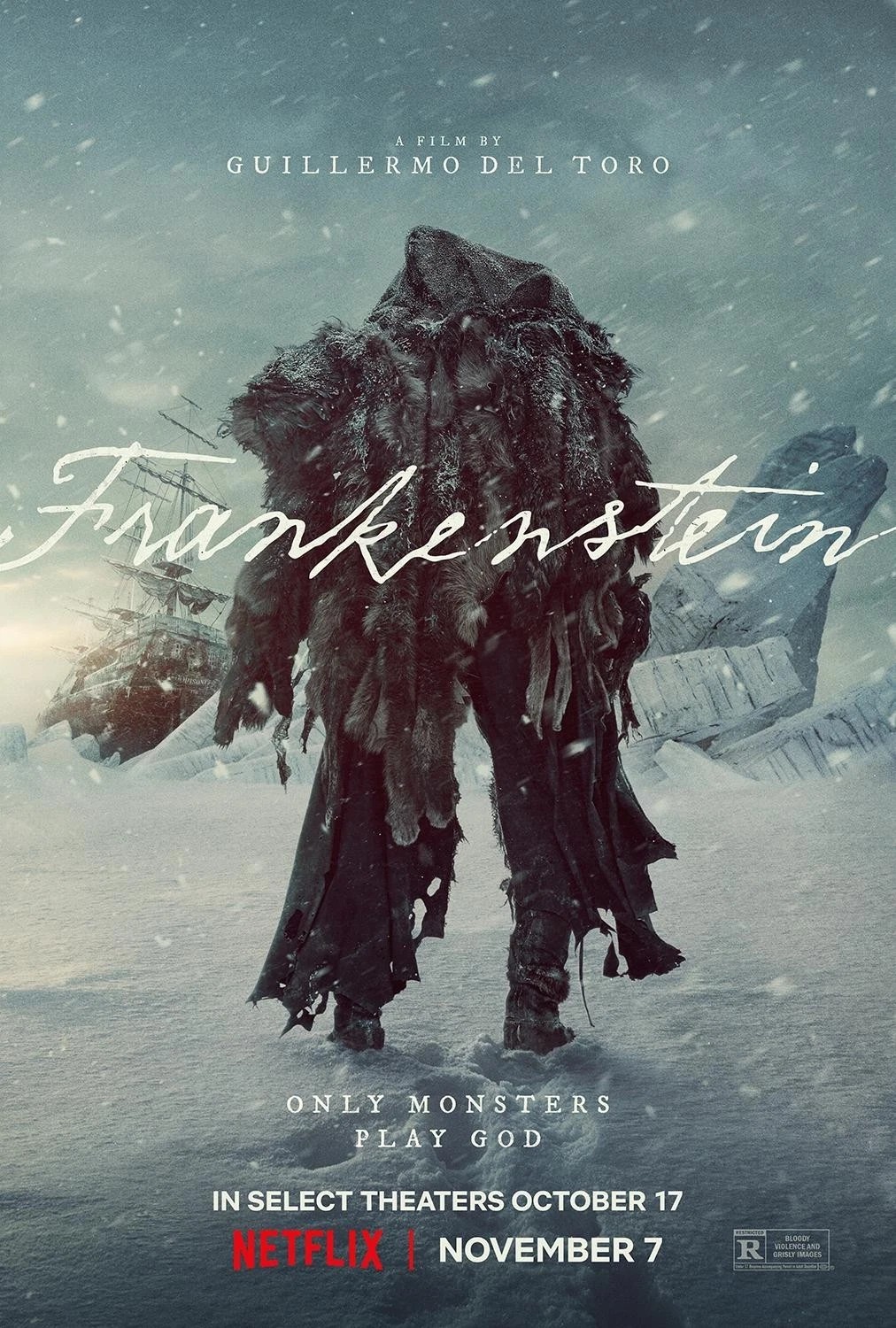
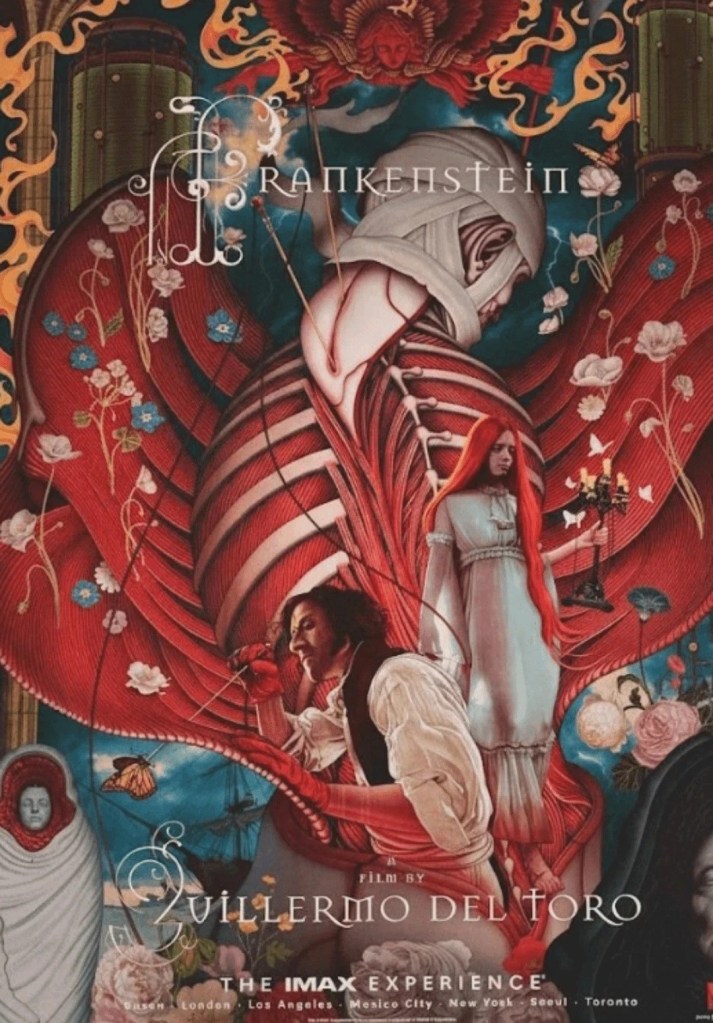
Frankenstein (2025) **** – Seen at the Cinema

I came at this with a bucketload of reservations. First was the length. I grew up with versions of this tale that were around a good hour shorter. Ninety minutes seemed to be the ideal length not a stonking 150 minutes. Secondly, I’m not a huge fan of director Guillermo del Toro and excepting Pacific Rim (2013) – an outrider in his portfolio – and The Shape of Water (2017) felt his reach was not matched by his grasp. He was the kind of director whose work I was supposed to like and invariably responded less well than I had expected. And third of course was, even with the trend for reimaginations and remakes and in the hands of a “visionary director” (a vastly over-used term), I had seen this story so often before I wondered what else he could bring to it.

So I was very pleasantly surprised to find an emotionally satisfying thoroughly enjoyable work that did not outstay its welcome. Moreover, it doesn’t rely on the tropes of outraged villagers carrying torches and as far as I can gather without me going back to the sacred text whatever changes have been made to the original appear logical and true. Both the creator and the monster at various points will touch your heart.

One of the aspects I most enjoyed was the creation. The detail involved was in keeping with heist movies where robbers work out their plan in minute detail or war films where the audience is filled in on the strategy and tactics involved in battles as though they were adults who could understand the importance of long scenes of dialog rather than treating them as children who preferred to go straight into the action regardless of whether they understood what was going on or not.

Here, we begin in the Arctic where an exploration vessel trapped in ice comes upon a very ill Victor Frankenstein (Oscar Isaac) who is being pursued by the monster (Jacob Elordi) of his creation.

Then we’re in flashback mode. Victor is son of a famous but tyrannical surgeon (Charles Dance) whose adored mother dies in childbirth giving birth to a more favored brother William (Felix Kammerer).

Then we shift to a medical disciplinary court where Victor is on trial for his experiments in reanimating corpses, for playing God in a society where the Supreme Being was still considered in charge of everything on Earth. But no matter how clever the corpse appears, capable of apparently playing catch, the case goes against him and his dreams, and career, would be in tatters except for the intervention of wealthy arms dealer Harlander (Christoph Waltz), uncle of Elizabeth (Mia Goth) the fiancée of William.

She’s intellectually advanced for a woman of the era, studying insects, and more than a match for Victor and for a while it looks like we’re in for an awkward love triangle. Meanwhile, Victor is harvesting bits and pieces of fresh corpses from battlefields and stitching them together in a way that maintains the body’s unique nervous system while Harlander happily stumps up the enormous cost.

The experiment, which takes place in a remote castle and costs the life of Harlander, is a success but given the monster’s size (Jacob Elordi) Victor keeps him in chains in the castle’s vast cellar. But he soon becomes exasperated by the creature’s lack of intellect, speech limited to repeating his creator’s name (and his own as it turns out).

When Elizabeth discovers the creature, she falls in love with it and turns against the scientist and keeps the gift of a leaf the creature has given her pressed inside the pages of a book. Since the creature is fit for no more than a circus exhibit rather than acclaimed as an experiment, and needing someone to blame for Harlander’s death, Victor fits up the monster, blaming him for setting fire to the castle.

Victor escapes, takes refuge in a cottage where he is educated by a blind man, and discovers his own emotions. Hounded out of there, he sets out to find Victor who is attending his brother’s wedding. The monster’s plea for a female companion is derided by Victor and in a melodramatic moment he accidentally shoots Elizabeth. The monster carries the dying woman out of the wedding pieta style.

So the hunt is on. Victor flees to the frozen north and eventually when the monster engineers a confrontation, he is able to attempt reconciliation with his creator.

The question asked – who is the monster? The creator or the result of his tampering with nature?

The acting is top notch, Jacob Elordi (Saltburn, 2023) should have walked off with the acting plaudits except that Oscar Isaac (Dune, Part One, 2021) elicits our sympathy and then our horror and Mia Goth (Maxxine, 2024) excels in a role where she is not called upon, as so often before, to overact. As far as Christoph Waltz (No Time to Die, 2021) and Charles Dance (The First Omen, 2024) are concerned their roles are minor variations of characters both have played before.

Praise is very much due to writer-director Del Toro for not losing my interest for a minute.

Since this is a Netflix production I could have saved myself a few bucks and waited till it appeared on the small screen. But unlike other big budget works by “visionary” directors, this will work very well on the smaller screen because, despite some arresting visuals, it’s essentially a chamber piece involving a handful of characters.

The highest praise I can give any director of an epic is the ability to not lose my interest for a single minute. So all praise Del Toro.

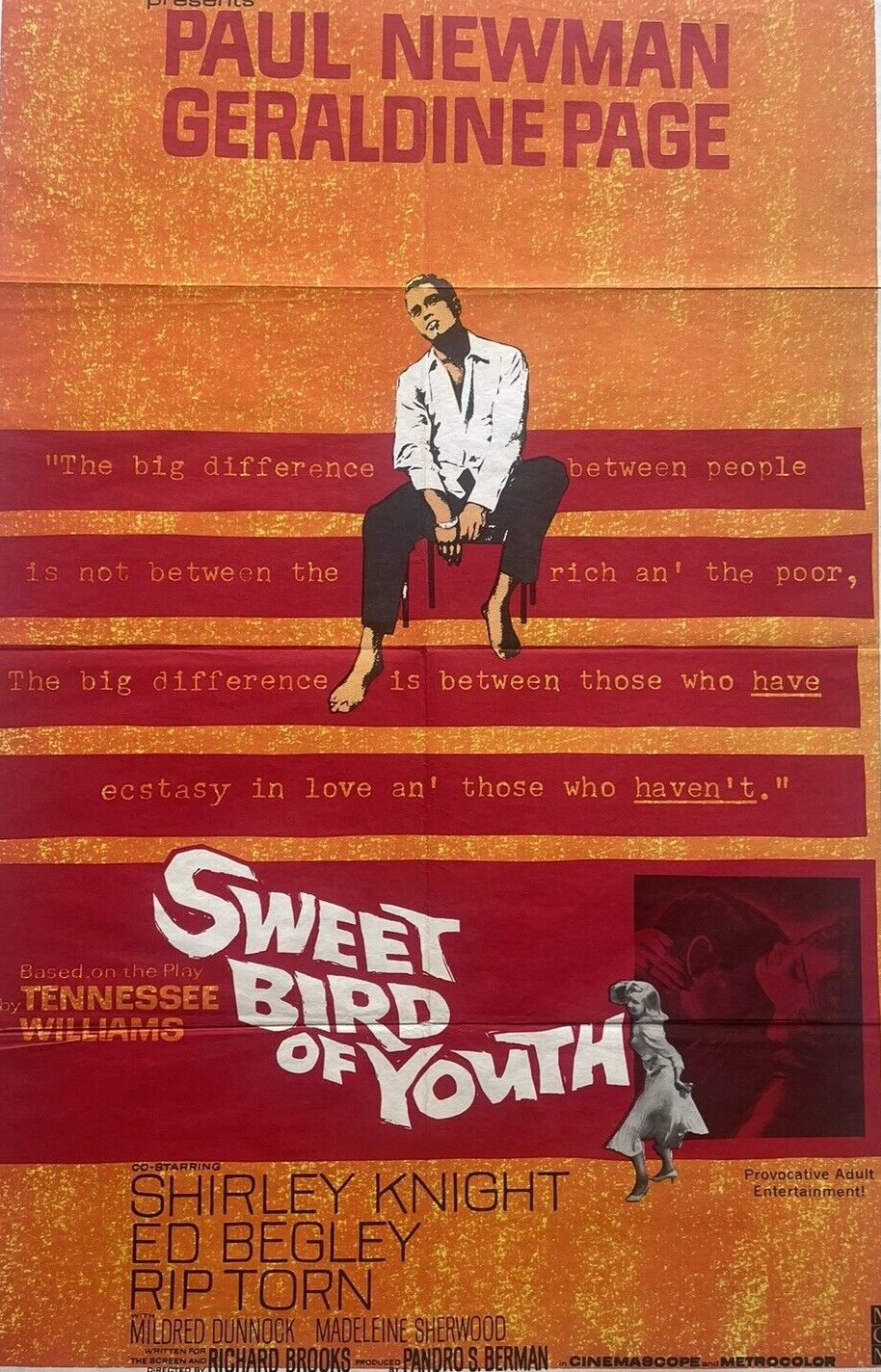
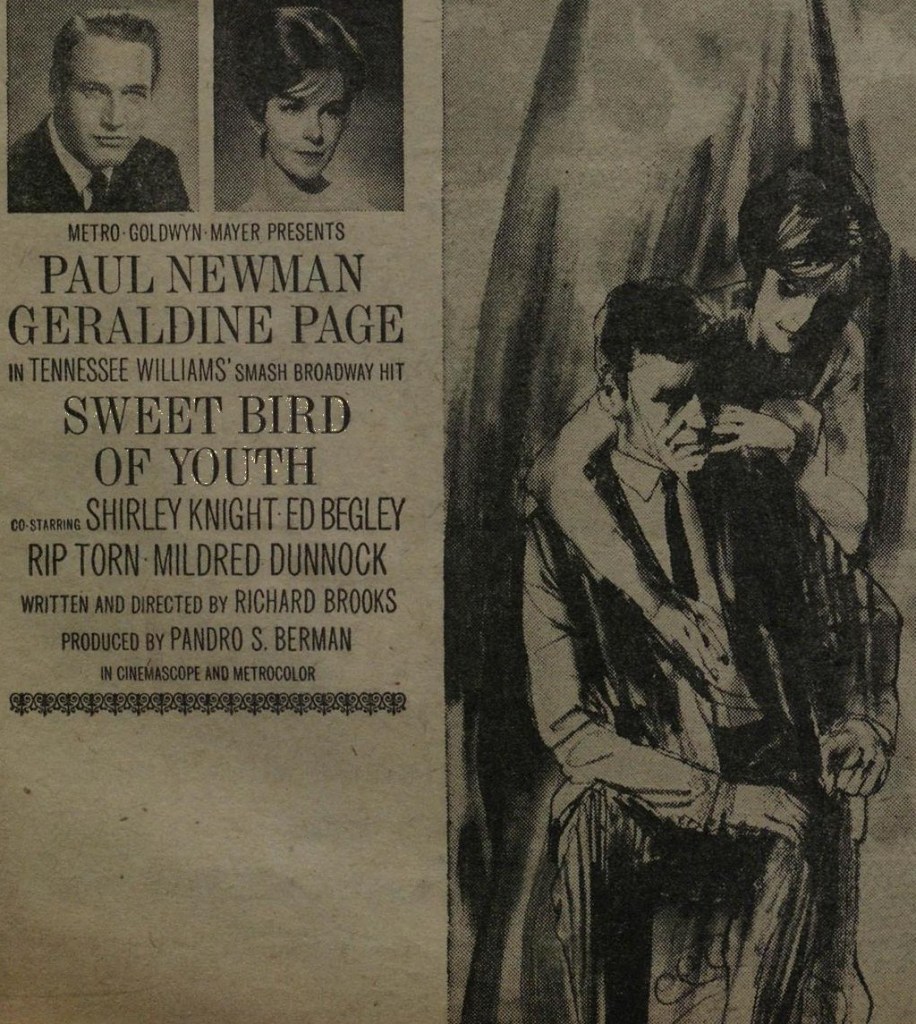
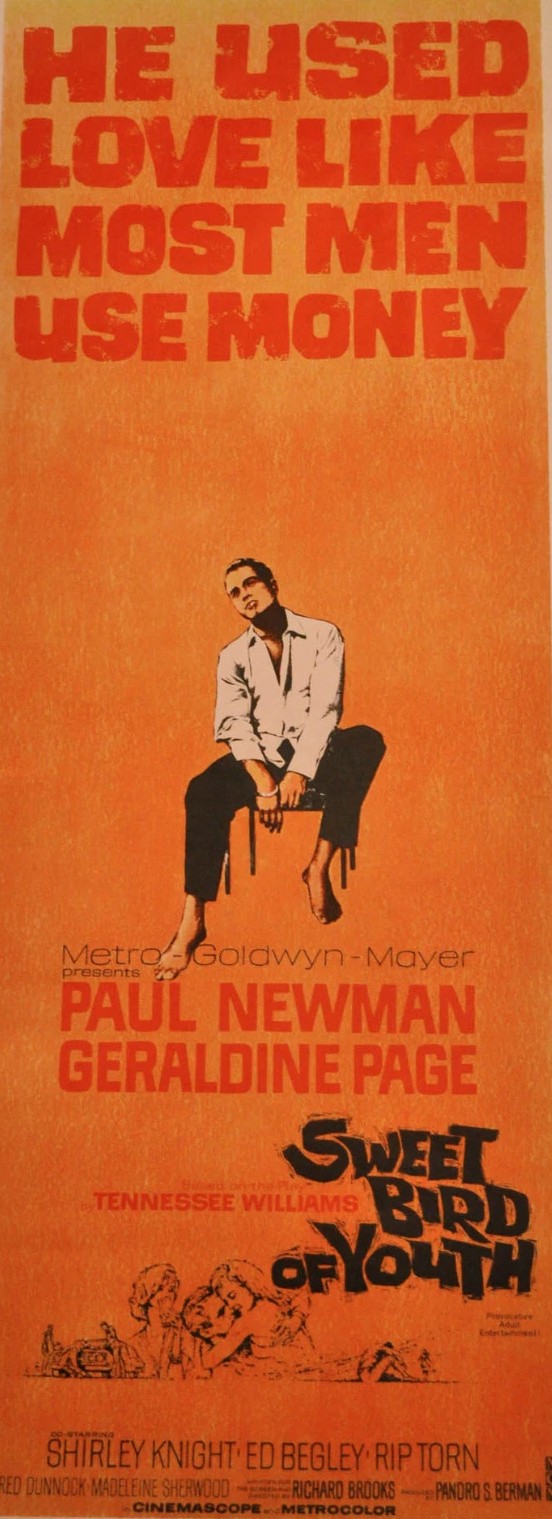
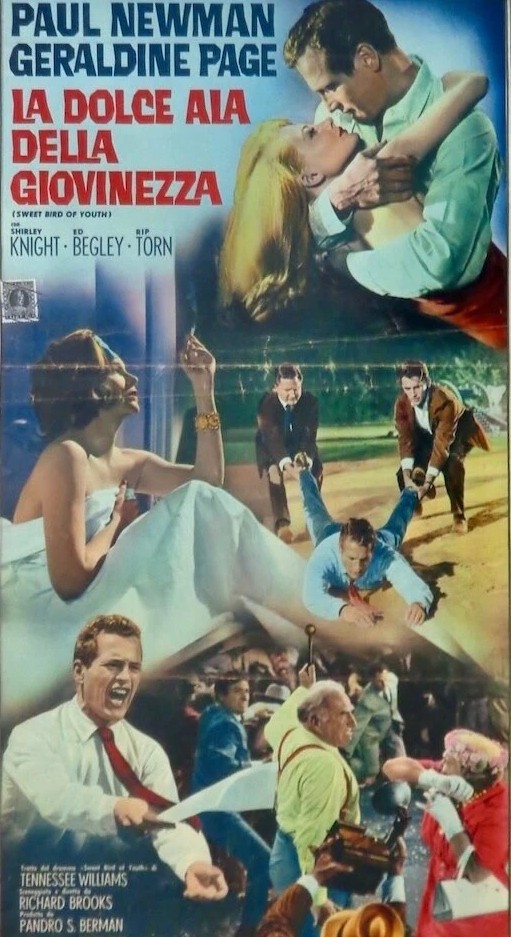
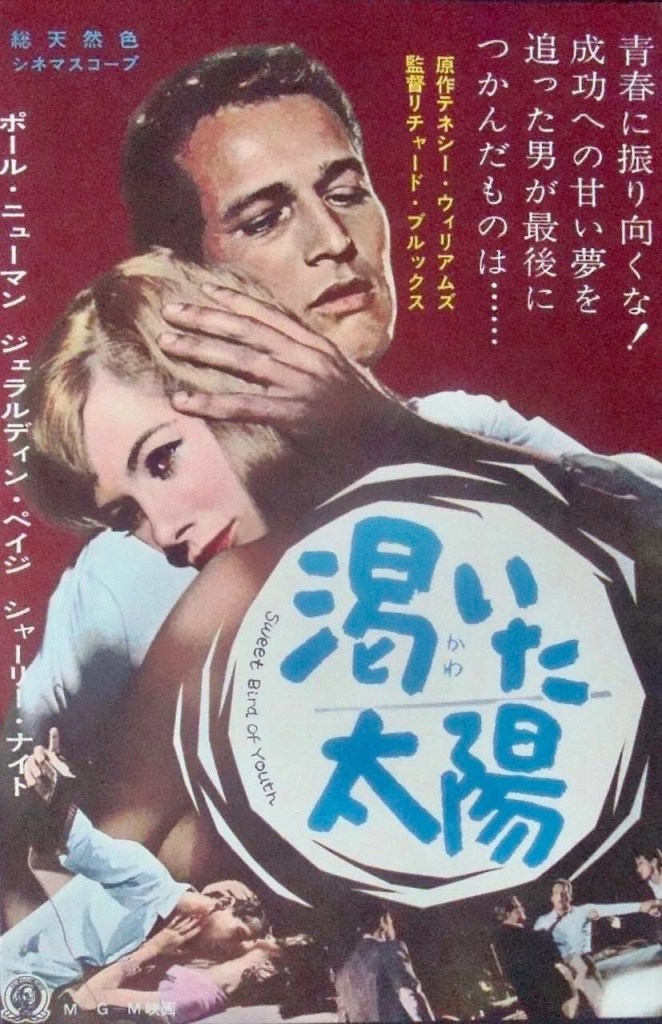
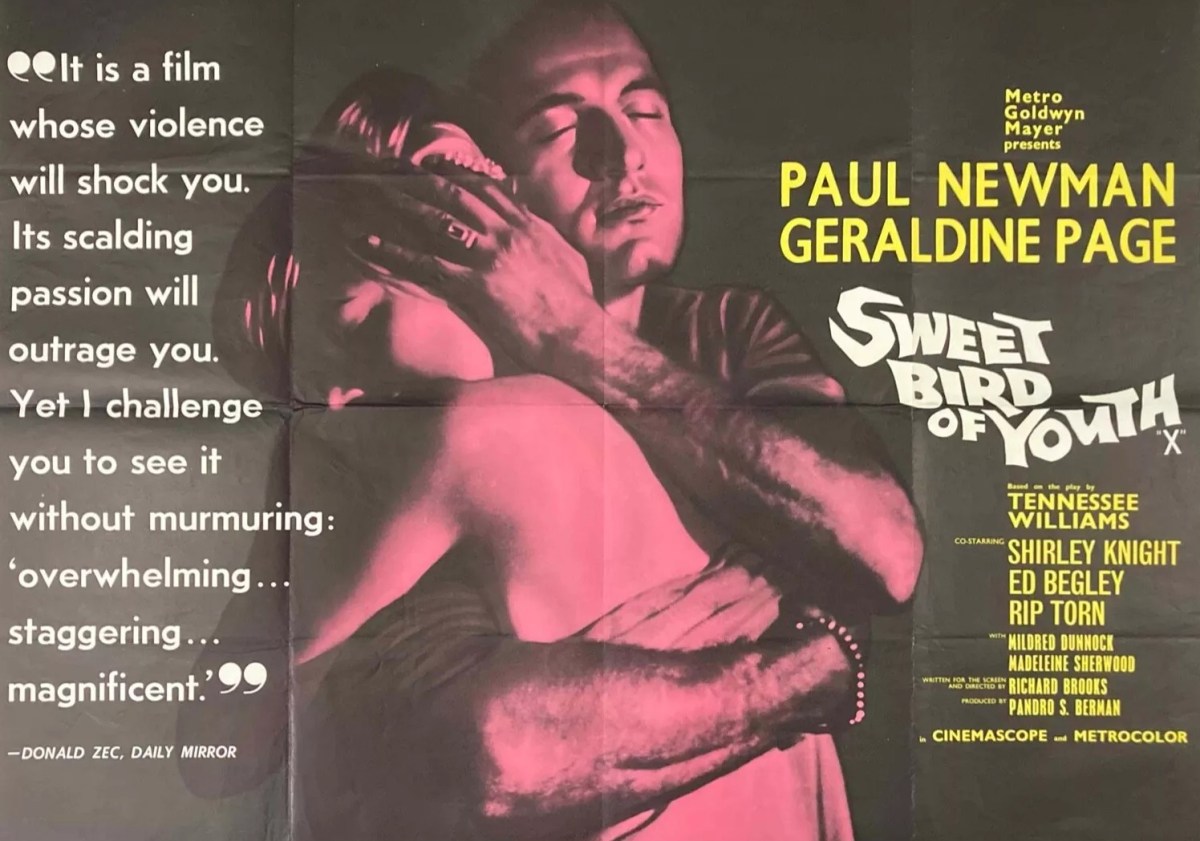
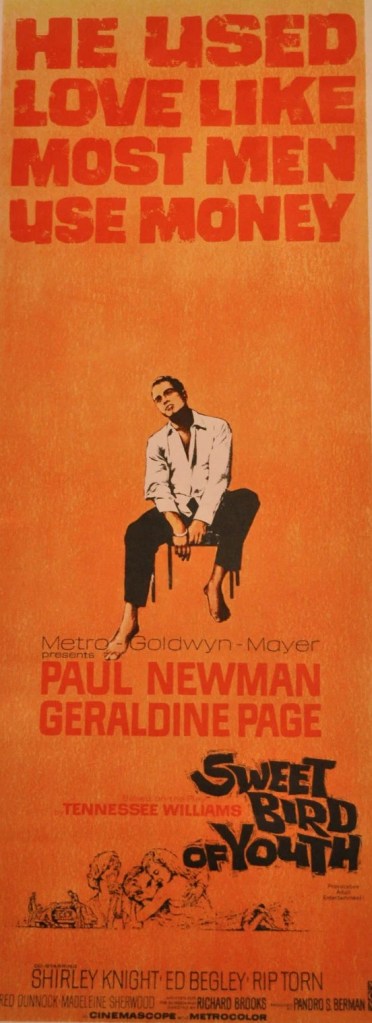
Selling Paul Newman: Pressbook for “Sweet Bird of Youth” (1962)

The big buzzword in movie marketing back in the day was “pre-sold.” The reason Hollywood pumped so much money into buying up the rights to bestsellers and Broadway hits was the notion that they came with a built-in audience, either of readers of theater-goers, and without any substantive proof made the connection that anyone who had read the book or seen the play or musical would be only too desperate to see what a movie maker made of the piece. In the 1960s, as I pointed out in a previous article, Hollywood had discovered the paperback tie-in, which marketing hacks perceived as free advertising, since those book covers would go on display in over a 100,000 book outlets across the country.

Even so, it comes as something of a surprise to see how dependent the marketeers writing the 16-page A3 Pressbook/Marketing Manual were on drawing cinema managers’ attention to the fact that Sweet Bird of Youth had originated on the stage. The three main articles in the Pressbook either went with “repeats role” or made mention in the headline of its origins. Admittedly, it had been a hit on Broadway, and with Paul Newman attached, ran for over a year – its poor performance on tour was naturally omitted. The opening article sensibly went to promoting Tennessee Williams. This was deemed “one of his greatest hits” and moviegoers would certainly be aware of his name thanks to Cat on a Hot Tin Roof (1958) and Suddenly, Last Summer (1959), both big hits.

However, given that Geraldine Page was the female lead and Oscar-nominated the previous year for Summer and Smoke, it seems odd that more column inches are devoted to third female lead Madeleine Sherwood with second female lead Shirley Knight overlooked except for a couple of postage-stamp-sized photos.

The “distinguished cast” notion was pushed much in the same way as trailers these days will promote anyone with the slightest brush with the Academy Awards.

“People have wondered why I had to work so hard to repeat a role I had done for more than a year in New York,” said Newman. “My only answer is that during the entire Broadway run of the play, Geraldine Page and I worked and rehearsed every day as if we were preparing for first night.” Despite his box office success he nurtured other ambitions. “ I want to be behind the camera. I’ve got my sights on directing. But I’ll start only when I think I know enough.”

The first stab at artwork was less sensational than the final posters.

The marketeers fell in line with the notion now being touted in Hollywood that, despite leaving Geraldine Page out in the cold for seven years after she starred opposite John Wayne in Hondo (1954), was “a major talent to be reckoned with by fans and critics alike.”

Commented Page, “I played Sweet Bird and Summer and Smoke on stage for long so that I felt I knew the heroines Alexandra Del Lago (Sweet Bird of Youth) and Alma Winemuller (Summer and Smoke) as well as if they had been sisters of mine. This long-lived familiarity with a part might make some actresses feel cluttered but but it was a great comfort to me…You can work with them forever and never get bored…the longer you get to know them the more you become fascinated with them.”

And what was it, exactly, that was so fascinating about Madeleine Sherwood? It was the fact that she was a method actress, as though this was still big news after being known for over a decade. She explained that “emotional memory” as proposed by Lee Strasberg, method acting’s most famous proponent, was the key to her acting.

Pressbooks always tax the ingenuity of the marketeers who have to dream up snippets which might interest a local newspaper editor. Here we learn that virtually all the cast were blue-eyed, “associated with genius” according to the Pressbook team. For the scenes in which Newman drove a car – on a sound stage no less – he drove 600 miles without hitting a real road. We learned that Newman once wore a beard in a stage show in his early years and that Page once played an old crone also on stage. Also that Page was a dab hand a wearing a negligee, having spent time in her “lean years” working as a model in a negligee factory on Seventh Avenue.

It would appear that there was a difference of opinion when it came right down to it about which advert – there were four to choose from – would lead the advertising pack. The Pressbook led with the tagline – “the big difference between people is not between the rich an’ the poor. The Big difference is between those who have ecstasy in love and those who haven’t.” Instead the team responsible for the posters went with the shorter, “He used love like most men use money.”

That tagline originated from a longer one, that more or less told the story of the movie. “Here he is right up on top of the gaudy world he swore he’d conquer. He’s got a movie contract in his pocket, a fish-tailed convertible in the hotel garage and a dame in his room payin’ for the drinks. He’s Chance Wayne who used love like most men use money!”

The speedboat that makes a brief appearance was central to the marketing campaign. Theater owners were urged to arrange tie-ins with local distributors of not just boats but boat engines. This was on the back of the Dumphy Boat Co of Oshkosh, Wisconsin, providing a $10,000 luxury speed boat for the shoot and because the Scott Racing Team supplied the $200,000 engine that powered it. Claims that the movie contained one of the greatest-ever telephone calls ever committed to celluloid provided the marketeers with an excuse to suggest a tie-in with a local telephone company.

Some ideas were more random. Because Newman wore a watch and Page a fur, tie-ins were suggested with those manufacturers. For no particular reason, except that she used them in her ordinary life, Shirley Knight was associated with cosmetics, perfumes and sportswear

A bit more imaginative was the idea of running a one-act play  competition with a local dramatic group. A “Tennessee Williams Week” could be promoted through local libraries. A paperback version of the play had been published by the New American Library.

Actually, the biggest element of the Pressbook was the advertising. Twelve pages out of the sixteen were devoted to adverts in various shapes and sizes, that variety important because in those days cinema owners simply cut out the advert they required and passed it on to a newspaper to make up the advert to run there.

Behind the Scenes: “Sweet Bird of Youth” (1962)

Writer-director Richard Brooks had built a reputation adapting heavyweight literary works – ranging from Dostoevsky’s The Brothers Karamazov (1958), Tennessee Williams play Cat on a Hot Tin Roof (1958) and Sinclair Lewis’s evangelism opus Elmer Gantry (1960) – the last two box office and critical hits –  and though he had Joseph Conrad’s Lord Jim in his sights he had a hankering after more simple fare. He planned to go out on his own and had paid $30,000 to acquire Arthur Woolson’s Goodbye, My Son focusing on mental health and $70,000 on The Streetwalker, written anonymously by a sex worker, and more nitty-gritty than the current stream of high-end good-time-girl pictures. The Streetwalker would take a semi-documentary approach. Brooks aimed for budgets around the $700,000 mark.

But in the end, he fell for the blandishments of producer Pandro S. Berman, for whom he had made Cat on a Hot Tin Roof, one of MGM’s biggest hits, and Paul Newman, who had played the part of Chance in the original Broadway play. It had run for nearly a year and the cast included Geraldine Page, Rip Torn and Madeleine Sherwood who reprised their roles in the film. Ed Begley had worked with Brooks on Deadline USA (1952).

By this point Newman was rid of the shackles of his Warner Bros contract and spread his wings artistically and commercially, following up Exodus (1960) with Martin Ritt’s Paris Blues and the first of his iconic roles in Robert Rossen’s The Hustler. Newman was paid $350,000, half the total sum allocated to the cast. The play cost a total of $600,000 against a budget of $2.8 million. Even so, Newman’s stock was not as high as later in the decade and even with his name attached a film based on John Hersey’s The Wall about the Warsaw Uprising failed to get backing.

Brooks was reluctant to get back into the ring with Tennessee Williams, still smarting from the “repeated sniping” that followed Cat on a Hot Tin Roof. Brooks recalled that “during filming I talked with Tennessee on the phone a number of times and all was peachy.” But later the author complained Brooks had “butchered” the play. He was especially incandescent because Williams pocketed $1.4 million while the director made do with just $68,000. Brooks demanded “a signed letter written by Williams and published in Variety to the effect that he (Williams) liked the film version” before he agreed to helm Sweet Bird of Youth.

There’s no sign that Williams acquiesced and Brooks proceeded with his version which turned into flashbacks some of the incidents dealt with on stage through dialog.

“Most people go out to Hollywood with a seven-year contract to work,” noted female lead Geraldine Page, wryly, “It looks like I had a seven-year contract to stay away.”  A rising star when selected for the female lead for John Wayne 3D western  Hondo (1954), she didn’t make another movie for seven years, largely as the result of not being considered photogenic enough. For Hondo, a scene had been added, “in which she was called upon to acknowledge that she was not beautiful,” and that designation, although intended purely to reflect a self-deprecating character, stuck. Although another explanation for her absence was that she was blacklisted for her association with Uta Hagen, but it’s unlikely that noted right-winger Wayne would have employed her in the first place has that been the case.

Despite an Oscar nomination for Hondo, she made her way on the stage instead, to critical approval, New York Drama Critics Award and Tony nomination for Sweet Bird of Youth. After an Oscar nomination for another Williams adaptation Summer and Smoke (1961), her career was revived, after the industry “found out how to employ one of the top performing talents of the last decade.” No surprise, however, that she wasn’t MGM’s first choice. The studio preferred the likes of Ava Gardner, Lana Turner and Rita Hayworth, who would be doing little acting to portray themselves as fading stars.

“When I saw how they fixed me up (for Sweet Bird),” said Page, “I said, look at me I’m gorgeous.” Brooks made her get rid of “those fluttering gestures” that he reckoned “subconsciously were efforts to cover her face.”

Shirley Knight didn’t have to audition. She and Brooks met at the Oscar ceremony. All he asked of her was that she lighten and grow her hair.

“He was a man who really knew what he wanted,” recalled Knight, “He wanted you to do a certain thing and was clear about the look of it.” She was so in thrall to the director that she followed his instruction to the steer a boat in one direction even though she knew it would lead her to smash straight into a dock.

Given the controversial nature of the play, there were concerns the entire project would be blocked by the Production Code, the U.S. censorship body. But Berman was quick with the reassurance. He claimed it would be “the cleanest picture ever made…clean as any Disney film.”  To achieve that would require considerable trimming as the play involved abortion, hysterectomy and castration. Berman ensured these elements were eliminated. Brooks changed the ending.

Commented Williams, “Richard Brooks did a fabulous screenplay of Sweet Bird of Youth but he did the same f…ing thing (as Cat on a Hot Tin Roof.) He had a happy ending. He had Heavenly and Chance go on together which is contradictory  to the meaning of the play. It was a brilliant film up to that point.”

Actually, Brooks was undecided about the ending. He wanted to shoot two endings, one as unhappy as the play. “But once the ending was on film – the one the studio wanted – production was shut down.”

Newman was more relaxed about any changes. “You have to make peace with the idea when you make a motion picture version of a play, it’s so difficult and it’s no sense struggling with things that were in the play.” With enough controversy riding on the picture, the studio banned the actors from talking to the media.

Initially, box office expectations were high when the movie hit first run. A $72,000 first week take in New York was considered “boffo.” It scored “a lusty” $28,000 in Chicago, a “bang-up” $15,000 in Buffalo, a “brilliant” $28,000 in Los Angeles, a “lush” $14,000 in Pittsburgh, a “bright” $16,000 in St Louis, and a “wow” $17,000 in Detroit. It generated a “loud” $4,500 in Portland, a “wham” $15,000 in Minneapolis and was “sockeroo” in Washington DC with $21,000.

But once it left the rarified atmosphere of the big cities, it stumbled. There was precent, the touring production of the play had also flopped once it left the environs of Broadway. Variety reckoned the timing was to blame as audiences showed “more aloofness to this type of fare” than they did a couple of years before.

The movie limped to $2.7 million in rentals – and a lowly 30th spot on the annual rankings – at the U.S. box office though foreign was more promising, ninth overall in France and 10th in Italy.

SOURCES: Douglass K. Daniel, Tough as Nails, The Life and Films of Richard Brooks (University of Wisconsin Press). pp146-154; Daniel O’Brien, Paul Newman (Faber and Faber, 2005), pp86-7; Shawn Levy, Paul Newman, A Life  (Aurum Press, 2009), pp169-171; “Folks Don’t Dig That Freud,” Variety, May 9, 1960, p1; “Metro Hot for Brooks,” Variety, June 15, 1960, p2; “Sweet Bird of Youth Will Be Ok for Kiddies,” Variety, September 13, 1961, p5; “Brooks Prostie and Psycho Indies,” Variety, September 13, 1961, p4; Vincent Canby,  “Seven Years After Her Film Discovery, Geraldine Page May Be Accepted,” Variety, November 15, 1961, p2; “Picture Grosses”, March-May 1962, Variety; “Fun-Sex Plays, ‘Sick’ Slowing,” Variety, August 8, 1962, p11; “Big Rental Pictures of 1962,” Variety, Jan 9, 1963, p13; “Yank Films,” January 23, 1963, p18.

Sweet Bird of Youth (1962) ***

Tennessee Williams wrote better parts for women than he did for men. You can start with Vivien Leigh, Oscar-winner for A Streetcar Named Desire (1951) – Marlon Brando only nominated – and Anna Magnani Oscar-winner for The Rose Tattoo (1955) with Maria Pavan nominated and star Burt Lancaster left out of gong consideration. Carroll Baker and Mildred Dunnock were nominated for Baby Doll (1956) with star Karl Malden ignored. Paul Newman did receive an Oscar nomination for Cat on a Hot Tin Roof (1958) as did Elizabeth Taylor.

Montgomery Clift was frozen out of Oscar consideration for Suddenly, Last Summer (1959) while both Elizabeth Taylor and Katharine Hepburn scored nominations.  Marlon Brando received no Oscar recognition for The Fugitive Kind (1960). Ditto Laurence Harvey for Summer and Smoke (1961) though Geraldine Page and Una Merkel received nominations. Lotte Lenya was recognised with a nomination for The Roman Spring of Mrs Stone (1961).

So the omens were not particularly good for Paul Newman when he repeated the role he had essayed on Broadway of Chance Wayne in Sweet Bird of Youth. In the stage version, while he received respectable notices, it was Geraldine Page who picked up the glory, winning the New York Drama Critics Award and nominated for a Tony.

So it was going to be a long shot that Newman could outshine her in the film version, even though he received considerably more screen time – Page and Shirley Knight were nominated, Newman was not.

The flaws in the tale are more obvious in the screen version. On stage, sheer force of personality can win over an audience, on screen that’s more difficult. And in truth Chance was another of Williams’ male losers. The main difference between Williams’ male and female characters is that not only are the women more reflective and aware of their shortcomings while the men simply bulldoze ahead but they are more able to express their feelings without dialog.

Chance is a failed actor turned gigolo taking advantage of alcoholic over-the-hill movie actress Alexandra Del Lago (Geraldine Page), running away from what she believes will be her final and calamitous movie, who half the time doesn’t know where she is or who he is. Chance has dreams of using her to hustle his way into the movie business, blackmailing Del Lago over her drugs abuse to front a new picture, and begins knocking on doors, but long-distance, since he’s returned to his home town in the hope of winning back his childhood sweetheart Heavenly Finley (Shirley Knight), planning to set her up as a movie star.

Expectations that there might be a welcome for a young man made good are dashed when everybody continues to treat him as the waitperson he once was or wants to run him out of town. To protect his daughter from such an unworthy suitor, the town’s most prominent citizen and political heavyweight Tom Finley (Ed Begley) had previously managed to pay Chance to leave town. His son Tom Jr (Rip Torn)  shares his father’s aspirations.

Despite the odds Chance determines to woo Heavenly but his Hollywood dream is scuppered when Del Lago realizes that her last picture looks like becoming an unexpected success and she can once again write her own ticket rather than rely on a con man like Chance.

It doesn’t end well though, for reasons best known to him, writer-director Richard Brooks tacked on a happy ending – the play had an unhappy ending – that doesn’t ring true.

There’s nothing wrong with Paul Newman’s acting even if it didn’t attract the attention of the Oscar voters, but there’s not enough meat on the character. On the other hand, Geraldine Page and Shirley Knight (The Group, 1966) in part excel because their characters are better written. Rip Torn (Beach Red, 1967) develops his screen menace. Ed Begley’s (Warning Shot, 1966) over-the-top performance snagged him an Oscar.

The story’s just too thin and the hard edges of the play have been trimmed back so it was less appealing to an audience.

Lacks the usual Tennessee Williams bite but the female performances are well worth a watch.

I’m doing a Behind the Scenes article tomorrow so look out for that.

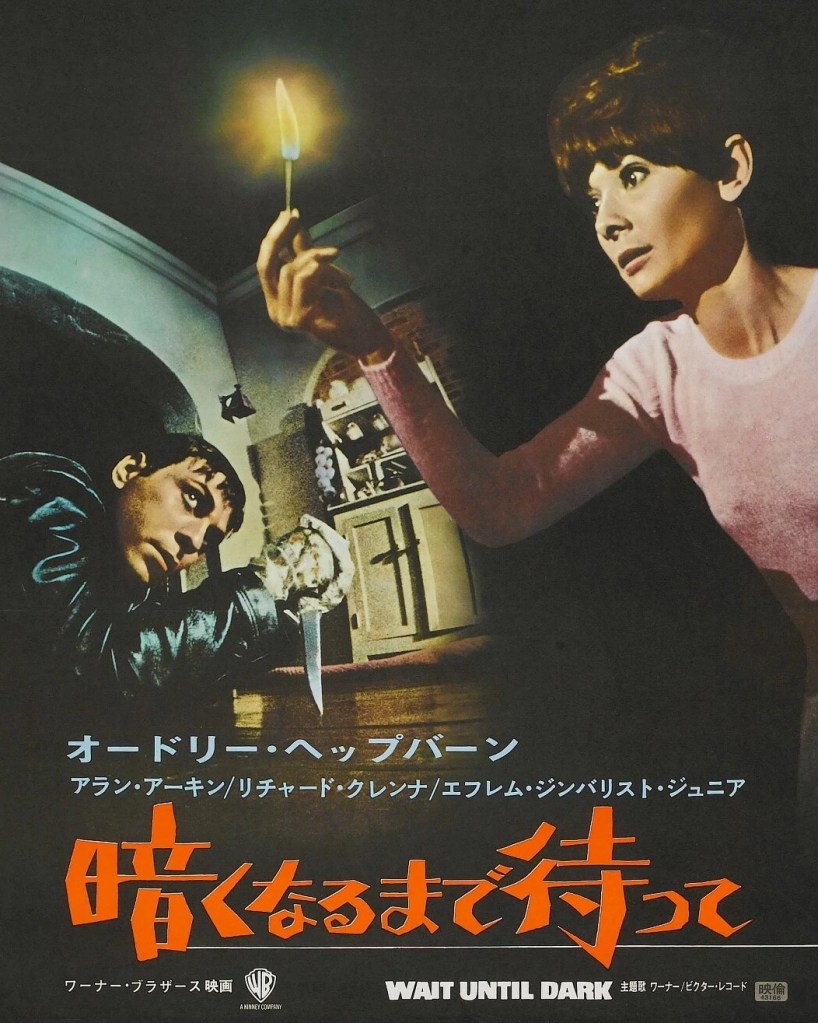
Wait Until Dark (1967) ****

You wouldn’t have figured Audrey Hepburn – she of the model looks (Breakfast at Tiffany’s, 1961)  and upmarket twang and belonging to the highest echelons of the movie business – for a Scream Queen. But there were precedents – Doris Day had at times been screaming fit to burst in Midnight Lace (1960) and Lee Remick, though not in either’s marquee league, had been terrified to bits in Experiment in Terror / The Grip of Fear (1962). By this point in pictures, the screen was awash with Scream Queens, courtesy of lower-budgeted efforts from Hammer, AIP and Amicus, so asking a top star to exercise her lungs in similar fashion might have been career suicide.

As it was, which would have come as a surprise to her legion of fans, this turned out to be pretty much the star’s swansong. She wouldn’t make another movie in nearly a decade and only another three after that. But here she certainly hits a dramatic peak.

The story’s a bit muddled and initially requires unraveling. Drug mule Lisa (Samantha Jones) passes a doll packed with heroin to fellow passenger Sam (Efrem Zimbalist Jr.) on a plane. She had been planning to steal the dope and set up on her own with Mike (Richard Crenna) and former cop Carlino (Jack Weston). There’s a bit missing from the tale but you have to assume that somehow Lisa got talking to Sam and he gave her his address and that she has turned up at his apartment looking for the doll, which wasn’t there.

Mike and Carlino turn up and have no luck searching the apartment. They don’t look hard enough because if they’d looked in the closet they’d have found the corpse of Lisa, killed by her employer Roat (Alan Arkin) who arrives to confront the pair and then hire them to help him find the heroin and dispose of the body.

So with all that out of the way we come to the meat of the story. And it follows the same premise as Man in the Dark / Blind Corner (1964) –  though, luckily, so few people saw that it wouldn’t be at the forefront of the audience mind at the time – of not so much a blind person being terrorized in their home but being largely played for a fool. The audience knows more than the blind person does and much of the story is not their vulnerability but just how long it will take for them to twig what’s going on.

In the case of Susy (Audrey Hepburn), as with the composer in Man in the Dark, her ears are her radar. She is on the alert after hearing the same pair of squeaky shoes on different people and wondering why people are opening and closing her blinds so often. Mike and Carlino masquerade as good guys, cops investigating the murder of Lisa for which her husband Sam is a suspect. She helps them tear apart the apartment looking for the doll.

She trusts Mike implicitly, less so Carlino, and when she starts to put two and two together she has an ally, teenager Gloria (Julie Herrod) who lives upstairs – they communicate like jailbirds by banging on the pipes. Although her eyes are denied sight, they still express her emotions – trust, relief, gratitude, fear.

But there’s not just one game of cat-and-mouse. There’s three. You know damn well that Mike and Carlino plan to squeeze Roat out of the equation just as you know damn well that he is planning to play them for patsies, apt to take revenge when double-crossed.   

Gradually, her suspicions ramp up. She’s pretty smart working out the various clues. And then we hit two dramatic peaks. Firstly, when she discovers Mike is a bad guy. Secondly, when Roat kills Mike and turns on her, splashing petrol about the place, exploiting her terror of fire. She’s still got a couple of moves to turn the tables, at least temporarily but when absolute darkness does descend – she’s smashed all the lights out – and theoretically they are both in the same boat, and advantage her because of her keener hearing, it doesn’t quite work out the way she’s expected because he knows how to exploit sound.

I won’t tell you where the doll is hidden because that’s a very clever twist in itself, but apart from the few plotholes at the outset (how did Lisa manage to break into Susy’s apartment for a start and leave no trace, for example) once the narrative takes hold it exerts a very strong bite.

Audrey Hepburn is on top form. Alan Arkin (The Russians Are Coming, The Russians Are Coming, 1966) and Jack Weston (Mirage, 1965) are a bit too obvious for me, but the smoother Richard Crenna (Marooned, 1969) is excellent.

Directed with both an eye to character and tension by Terence Young (Dr No, 1962) and adapted by Robert and Jane-Howard Carrington (Kaleidoscope, 1966) from the Broadway play by Frederick Knott (Dial M for Murder, 1954).

Top notch.

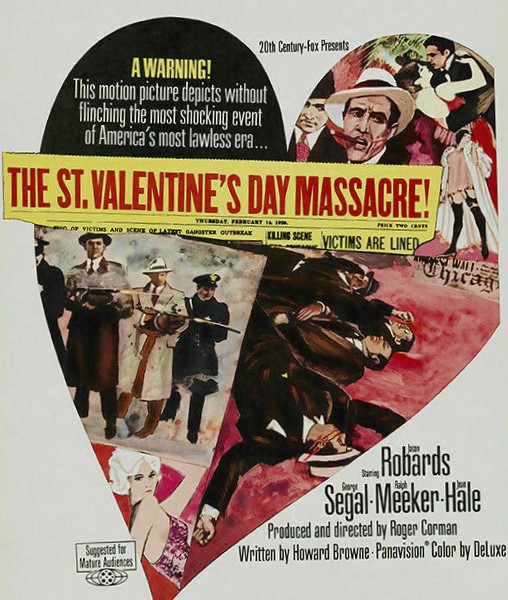
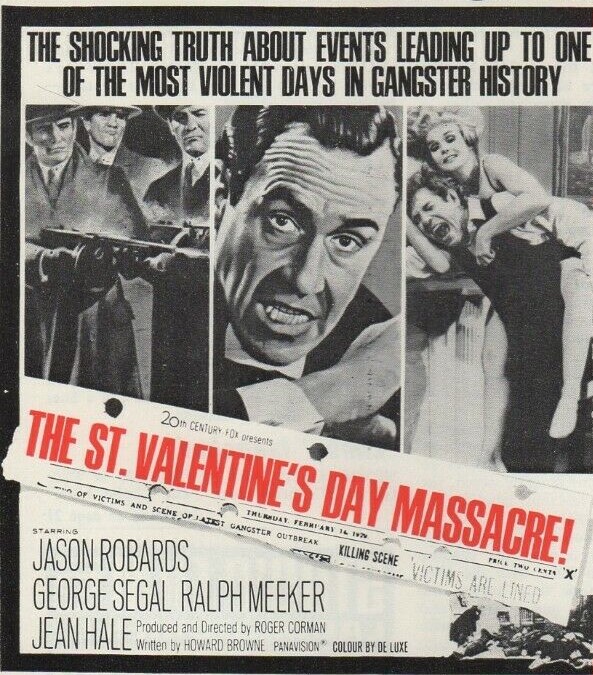
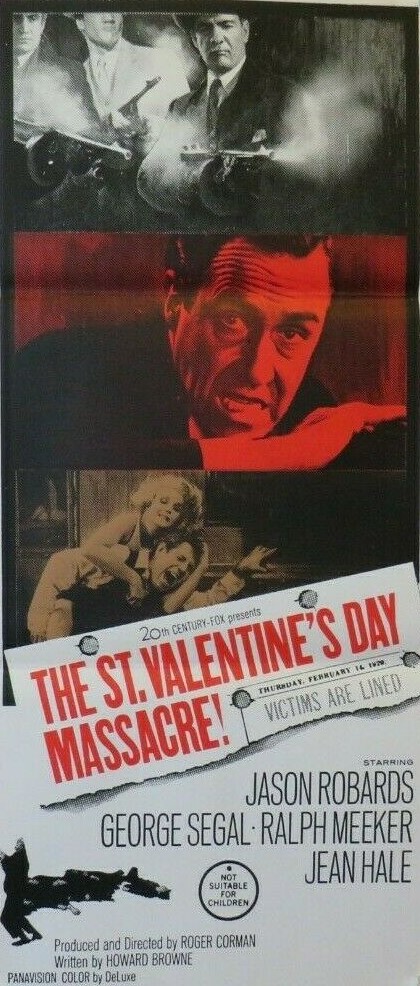
The St Valentine’s Day Massacre (1967) ***

I didn’t realise that the Prohibition gangsters who invented the drive-by shooting were perfectionists. Just to be make sure of completing the job, I found out here, they might send a dozen cars one after the other rolling past the chosen restaurant/cafe, machine guns spouting hundreds of bullets. Nobody could survive that, you would think. But there was a flaw to the idea. If someone just lay down on the floor, the bullets would pass over their head. Strangely enough, we never got a potted history of the drive-by shooting in this docu-drama because otherwise we found out just about everything we needed to know about the infamous massacre.

But I did wish that the narrator would shut up once in a while. I kept on thinking we were going to be examined afterwards. Every dumb schmuck that made even a brief appearance on screen got the full bio treatment, including when – and how (not always by violence) – they died. That annoying feature aside, it was certainly a forensic examination of the whys and wherefores of the infamous gangland slaying. Rival Chicago mobsters Al Capone (Jason Robards) and Bugs Moran (Ralph Meeker), both concluding that the other was not open to negotiation, decided instead to rub him out and the movie basically follows how each develops their murderous plan.

All the big gangster names are here – it’s like a hit man’s greatest hits – Frank Nitti (Harold J. Stone), massacre mastermind Jack McGurn (Clint Ritchie) and Capone enforcer Peter Gusenberg (George Segal) – and the movie reprises some of the classic genre tropes like mashing food (sandwich this time rather than grapefruit) in a woman’s face and Capone taking a baseball bat to a traitorous underling. And there’s the usual lopsided notion of “rules,” Capone incandescent that a ganster was murdered in his own home.

Capone’s plan is the cleverest, involving recruiting people with little or no criminal record including the likes of Johnny May (Bruce Dern in a part originally assigned to Jack Nicholson), renting a garage as the massacre venue, and dressing his hoods up as cops. The film occasionally tracks back to set the scene. And the ever-vigilant narrator makes sure to identify every passing gangster but come the climax seems to run out of things to say, a good many sentences beginning with “on the last morning of the last day of his life.”

Since there’s so much money washing around, it makes sense for the ladies to try and get their share. Gusenberg’s girlfriend (Jean Hale) casually, without seeking permission, swaps one fur for another four times as expensive. A sex worker as casually steals from her client’s wallet before demanding payment for services rendered.

The only problem with bringing in so many bit characters – either those doing the murdering or being murdered – into play is that it cuts down the time remaining to cover Capone and Moran, so, apart from the voice-over, we learn little of significance, most of the drama amounting to outbursts of one kind or another. But it’s certainly very entertaining and follows the Raymond Chandler maxim of when in doubt with your story introduce a man with a gun, or in this case machine gun. The violence is episodic throughout.

Despite the authenticity, punches are pulled when it comes to the physical depiction of Capone. The man universally known as “Scarface” shows no signs of such affliction as played by Jason Robards (Hour of the Gun, 1967). Certainly, Robards shows none of the brooding intensity with which we associate Godfather and son Michael in the Coppola epic, rather he has more in common with Sonny. He delivers a one-key performance of no subtlety but since the film has no subtlety either then it’s a good fit. Ralph Meeker (The Dirty Dozen, 1967) has the better role, since being the junior gangster in terms of power he has more to fear. I felt sorry for Oscar-nominated George Segal (No Way To Treat a Lady, 1968) since although his character is there for obvious reasons there is no obvious reason why he should be allocated more screen time. And given more screen time, nobody seems to know what to do with it.

There’s a superb supporting cast including Jean Hale (In Like Flint 1967), Bruce Dern (They Shoot Horses, Don’t They, 1969), Frank Silvera (Uptight, 1969), Joseph Campanella (Murder Inc., 1960) Alex Rocco (The Godfather, 1972), future director Gus Trikonis and future superstar Jack Nicholson.  

After over a decade of low-budget sci-fi, horror and biker pictures, this was director Roger Corman’s biggest movie to date – his first for a major studio – and, excepting the voice-over, he does an efficient job with the script by Howard Browne (Portrait of a Mobster, 1961) who was presumably responsible for the intrusive narration.

CATCH-UP: This isn’t really a good place to start with the acting of George Segal and you will get a better idea of his talent if you check out the following films covered so far in the Blog: Act One (1963), The New Interns (1964), Invitation to a Gunfighter (1964), King Rat (1965), Lost Command (1966), The Quiller Memorandum (1966), No Way to Treat a Lady (1968), The Bridge at Remagen (1969) and The Southern Star (1969).

Discover WordPress

A daily selection of the best content published on WordPress, collected for you by humans who love to read.

The Atavist Magazine

by Brian Hannan

WordPress.com News

The latest news on WordPress.com and the WordPress community.