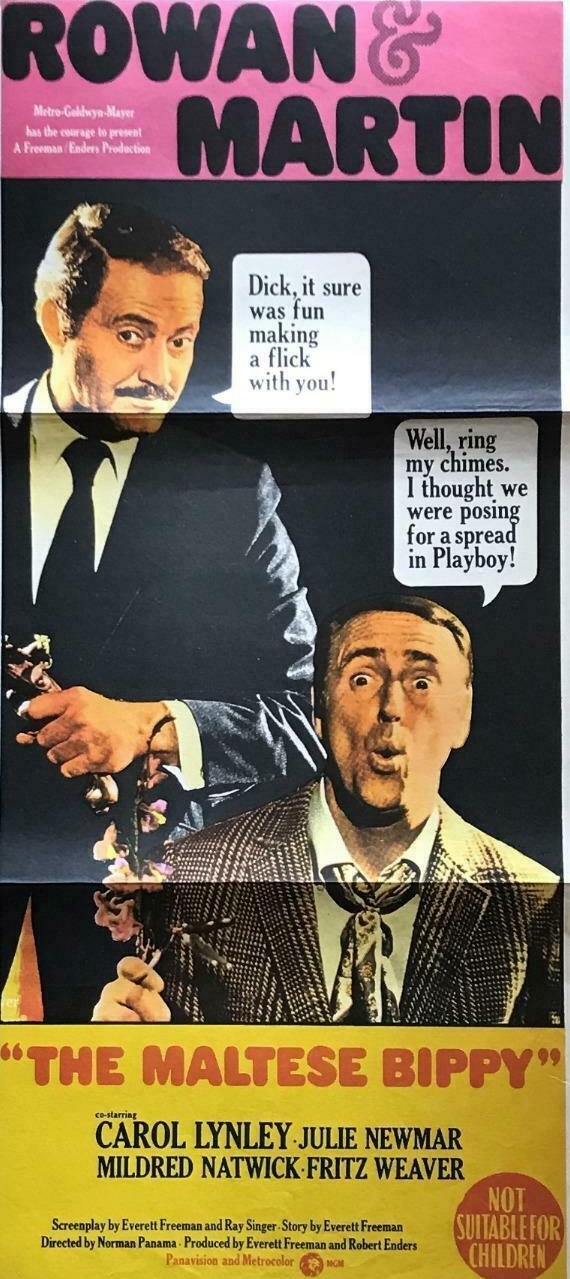
The start is promising. Three decent laughs in the first three scenes, all jests at the expense of Hollywood. But when the movie settles down to a werewolf spoof, there’s a nary a chuckle to be found. It was rare in the 1960s for television shows to be given a big-screen outing, but it did occasionally happen. This came two years into the six-year run of Rowan and Martin’s Laugh-In television show, an innovative mixture of gags, punchlines and sketches stitched together in random fashion. A huge hit in the U.S., it was considered a slam dunk to turn it into a movie. Perhaps if they had stuck to the same format it might have worked.
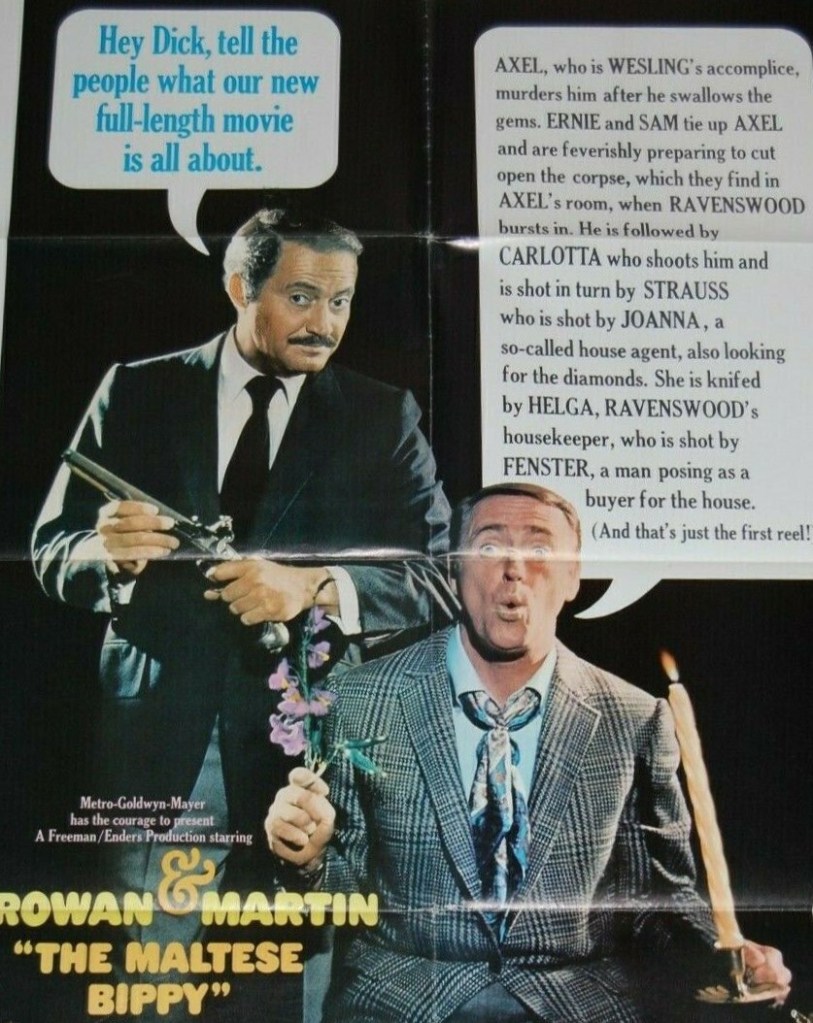
Sam Smith (Dan Rowan) and Ernest Grey (Dick Martin) are down-on-their-luck soft-porn movie makers living in a mansion on the edge of a cemetery. After suffering a bite on the neck, Dick turns into a werewolf. You can see the comic possibilities, I’m sure. Either Rowan and Martin failed to find them or lacked the expertise to turn the material into laughs. Sure, there’s a creepy family, the Ravenswoods, next door who could be auditioning for The Munsters but that goes nowhere except the obvious and certainly not in the direction of laughs.
A few good actresses – Carol Lynley (Danger Route, 1967), Julie Newmar (Mackenna’s Gold, 1969) and Mildred Natwick (Barefoot in the Park, 1967) – were snookered into this alongside Fritz Weaver (To Trap a Spy, 1964) without hope of redemption. It was almost as though the picture was conceived as a piece of merchandising that Rowan and Martin just had to put their names to and not do much else.
It was strange it was so awful because director Norman Panama had a track record in comedy. Among other pictures he had made The Court Jester (1955) starring Danny Kaye – “the vessel with the pestle” – displayed an abundance of great comic timing and in some respects was a spoof of the historical genre. He had also directed Bing Crosby and Bob Hope in The Road to Hong Kong (1962) so you would expect him to be familiar with the workings of screen comedic partnerships.
The laughs were meant to be supplied by Everett Freeman (The Glass Bottom Boat, 1966) and Ray Singer, a specialist in television sitcom and creator of Here’s Lucy (1968-1974). But either they couldn’t come up with sufficient gags or Rowan and Martin’s delivery was out of key with the lines. Or something.
Maybe nostalgia was what was missing from my viewing of the picture. I don’t recall holding any particular affection for the television show, though I was aware it provided a star-making platform for performers like Goldie Hawn (Cactus Flower, 1969), Judy Carne (All the Right Noises, 1970) and Lily Tomlin (Nine to Five, 1980) and that John Wayne put in a guest appearance.
But don’t take my word for it. Variety called the picture “as zany and fast a funfest as has come down the pike in years” and a “ cinch for heavy box office reception.” Mainstream critics were less kind, four out of the most prominent five giving unfavorable reviews. Even though the stars made the cover of Life magazine and the film received a seven-page spread inside, the movie barely made a ripple with audiences, a total of just $22,000 garnered in its opening week in two cinemas in New York with a total capacity of over 2,000 seats. British kids film Ring of Bright Water made more at a 360-seater.
The expected audience did not materialize, either from poor word-of-mouth or because customers resisted paying for something they could get for free every week on the small screen. So poorly did it perform that its initial run was truncated and a few weeks later when it went wide in a Showcase opening in New York MGM stuck on a reissue of Grand Prix (1966) as the support. Variety estimated it barely took $1 million in rentals (the amount returned to studios once cinemas take their share of the box office). Final proof of its unpopularity was being sold to television a couple of months after its debut.

 The Magnificent 60s
There were deades where SNL stars were put in movies that we’re intended for international audiences, who had no idea who the stars were; the shackles have been loosened in the last ten years, but if your stardom is Stateside, humour often doesn’t translate well over here..
LikeLiked by 1 person
One of the few lessons Hollywood never learned. But many of the SNL stars did go on to big international players.
LikeLike
The 22 Jul 1968 DV announced the provisionally titled The Incredible Werewolf Murders as the first of three films from Freeman-Enders Productions, to star the comedy team of Dan Rowan and Dick Martin. The comedians assured the 12 Aug 1968 DV that the picture would be a departure from their weekly television series, Rowan & Martin’s Laugh-In (NBC, 22 Jan 1968–12 Mar 1973). A news item in the 11 Nov 1968 DV revealed that Rowan and Martin had appeared several months earlier in a short public service film produced at Metro-Goldwyn-Mayer (MGM) Studios, which also featured comedian Don Knotts and musician Herb Alpert. Impressed with team’s performance, MGM, in conjunction with producers Robert Enders and Everett Freeman, offered them a contract. The picture was re-titled The Maltese Bippy, combining a nonsense word created by Rowan and Martin, and The Maltese Falcon, the 1929 novel by Dashiell Hammett that was the basis for at least two feature films (1931 and 1941, see entries).
The 5 Jun 1969 LAT noted that the screenplay was completed 1 Nov 1968, after which MGM began pre-production.
According to the 22 Nov 1968 DV, Enders and Freeman flew to New York City, hoping to hire actress Pearl Bailey, who expressed interest in the role of Dick’s housekeeper. At the time, she was starring in the Broadway musical, Hello, Dolly! in which she played the lead. Six weeks later, the 9 Jan 1969 issue reported that Bailey was unable to take the two-week hiatus required for her participation. The following day, DV noted that Enders and Freeman were returning to New York City to scout locations.
The 8 Jan 1969 DV and 20 Jan 1969 LAT credited Stanley Ross with contributing “special material” to the screenplay. The following month, a two-page advertisement in the 24 Feb 1969 DV announced the title as The Strange Case of…!#*%? but it proved to be temporary. Principal photography began that day, as stated in a 28 Mar 1969 DV production chart. Four weeks into filming, the 26 Mar 1969 issue noted that the company was three days ahead of schedule, which director Norman Panama attributed to Rowan and Martin’s “ultimate” professionalism. He went on to describe a scene in which Dan Rowan completed a close-up shot while waiting for the wardrobe department to deliver his trousers.
The 9 Apr 1969 LAT revealed that Rowan and Martin had already declined an offer from Twentieth Century Fox Studios to make a feature-length version of Laugh-In. The article also noted their displeasure with the title, stemming from their fear that the public would expect their film to resemble the series. Other provisional titles included Who Killed Cock Robin? and The Coogle Affair. The plot was intended as a tribute to such classic comedy-mysteries as Scared Stiff (1953), The Cat and the Canary (1939), and Hold That Ghost (1941, see entries). The article also stated that the Victorian house used in the film, located on the MGM back lot in Culver City, CA, had previously appeared in Meet Me in St. Louis (1945, see entry). Rowan and Martin controlled fifty-percent of the production, according to the 5 Apr 1969 LAT. Freeman planned two more pictures for the team, The Money Game and The Servant Game, to be filmed in 1970.
The 18 Apr 1969 DV reported the end of production, six days ahead of schedule. As stated in the 5 Jun 1969 LAT, the $2.5 million picture was completed in eight weeks, followed by six weeks of post-production. Scenes were shot in sequence, enabling two teams of editors to assemble the picture while it was still being filmed. Composer Nelson Riddle wrote musical themes to accompany the four basic moods in the story and delivered his score ten days after viewing the final edit. The score was recorded in one day by a fifty-two-piece orchestra.
As MGM’s only major summer release, the picture was rushed into theaters with the hope of attracting Rowan and Martin’s television audience while their series was on hiatus. The studio ordered 433 prints at $500 each, to be distributed to 350 cities. Theater bookings were confirmed while production was still underway. The premiere was scheduled for that day at the Picwood Theatre in Los Angeles, CA, approximately fifteen weeks from the start of photography.
An article in the 21 May 1969 Var noted that the invitational premiere would feature several famous comedians “roasting” Rowan and Martin, with excerpts to be rebroadcast on The Joey Bishop Show (ABC, 17 Apr 1967–26 Dec 1969). The 9 Jun 1969 LAT listed Greer Garson, Edward G. Robinson, Buddy Hacket, Greg Morris, and Anne Baxter, as attendees, along with Laugh-In cast members Goldie Hawn, Ruth Buzzi, and Arte Johnson. A pictorial article promoting the film appeared in that week’s edition of Life magazine. Following the premiere, Rowan and Martin were due in Philadelphia, PA, for a 6 Jun 1969 concert at the Spectrum sports arena.
The picture opened 18 Jun 1969 in New York City. Reviews were mixed: While the 9 Jun 1969 DV described The Maltese Bippy as “prime comedy,” the 19 Jun 1969 NYT argued that the film was an insult to the classics it was supposed to emulate.
Although the film was listed among the top fifty releases in the 2 Jul 1969 and 13 Aug 1969 issues of Var, news items in the 23 Oct 1969 LAT and 17 Apr 1970 DV revealed that it was a commercial failure.
Box-office reports in the 20 May 1970 Var indicated the picture’s continued run as a second feature to Goobye, Mr. Chips.
LikeLiked by 1 person
Apart from the fact that it was a flop, I didn’t know wnay of this except for assuming MGM was trying to cash in on th series. Thanks.
LikeLike