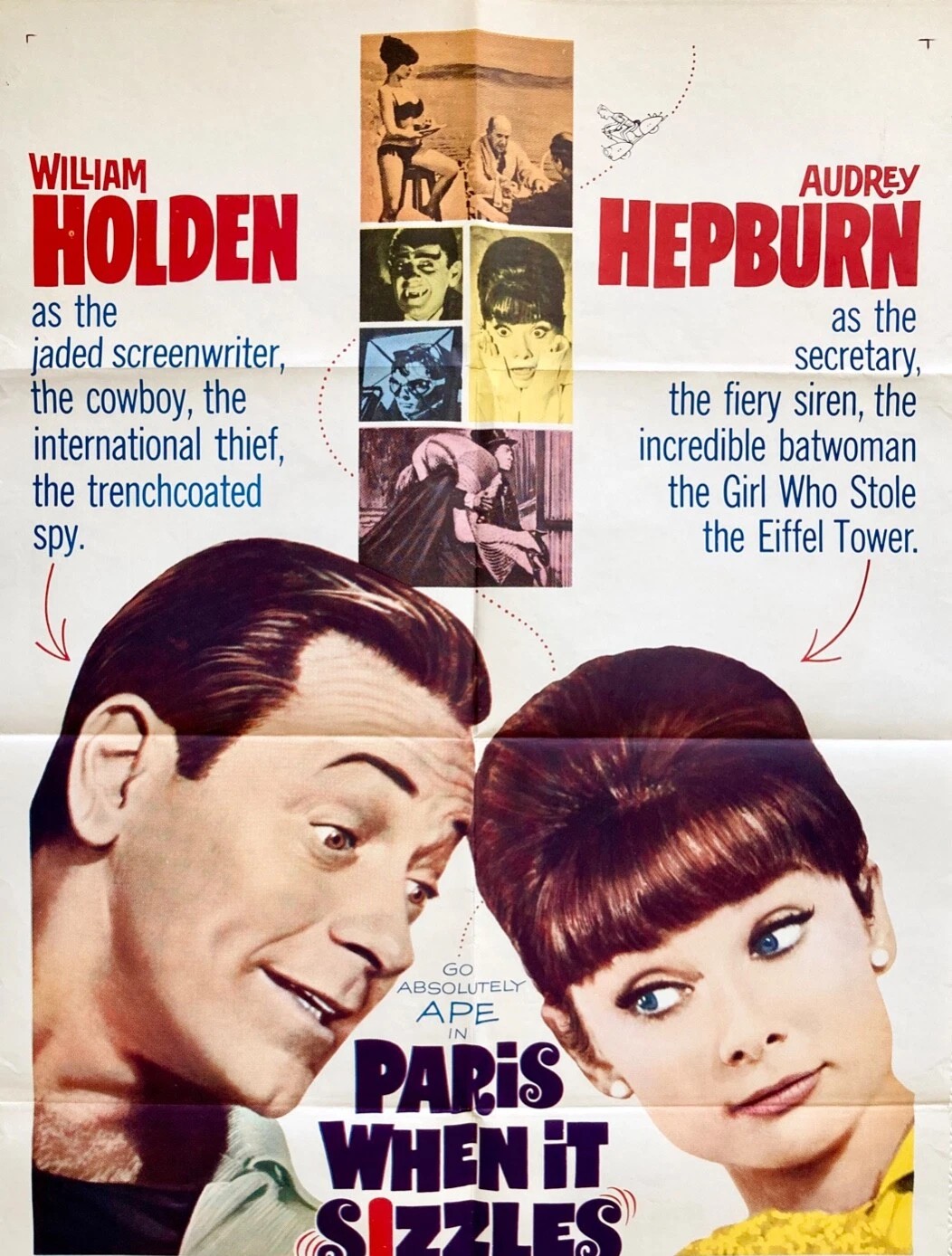
Screen charisma can only get you so far. The pairing of William Holden and Audrey Hepburn must have seemed certain to create a box office tsunami given they had worked together before on the hit Sabrina (1954) and were coming off hits, the former in The World of Suzie Wong (1960) and the latter having reinvented herself as a ditzy fashion icon in Breakfast at Tiffanys (1961). But clearly studio Paramount knew something about the outcome of this production that it was keeping to itself, otherwise how to explain that a movie completed in 1962 languished on the shelves for nearly 18 months.
By the time it appeared Hepburn was still a big box office noise after Hitchcockian thriller Charade (1963) but Holden’s flame was dying out following three successive flops, The Devil Never Sleeps, The Counterfeit Traitor and The Lion all released in 1962. Had the studio played an even longer waiting game and held off release until the end of 1964 when Hepburn was enjoying sensational success with My Fair Lady, audiences might have been more likely to be suckered in to this romantic comedy. Although whether they’d be any more appreciative is doubtful.
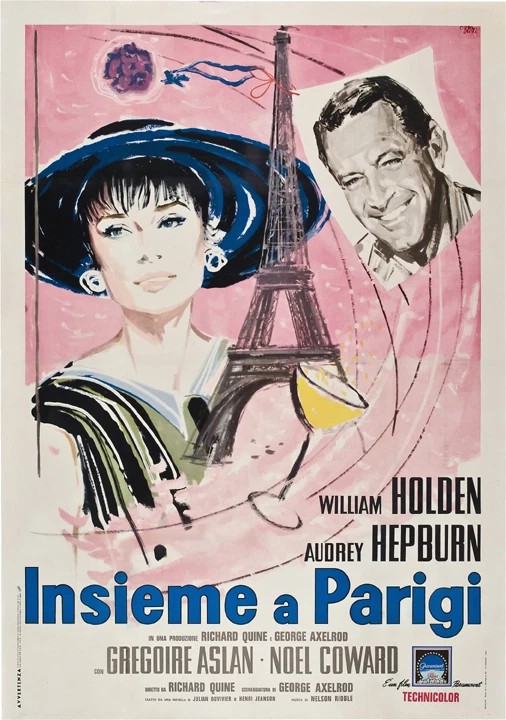
Problem is, the narrative hardly exists. And what remains is too clever by half. It might have appealed as an insight into how Hollywood works, but it lacks backbone and is more of a series of spoofs as we wait inevitably for the two stars to fall in love.
Alcoholic Richard Benson (William Holden) has writer’s block and having frittered away his time drinking, traveling and romancing, now has two days to deliver a screenplay for producer Meyerheim (Noel Coward) – who incidentally seems to spend his time in the sunshine drinking and surrounded by beautiful women. Benson hires typist Gabrielle (Audrey Hepburn) both to speed up the process and have someone to bounce ideas off.
Primarily a two-hander and virtually contained on a single set, his swanky apartment in Paris, it only ventures out to assist his imagination by playing out various concepts in which the pair act out various scenes in what turns into a relatively ham-fisted satire of the movie business. The only really interesting Hollywood expose is when Benson explains the tricks of the screenwriting trade, the various reversals (they were called “switches” in those days) and conflicts to keep the audience on their toes and prevent the potential lovers getting to the actual loving stage too quickly.
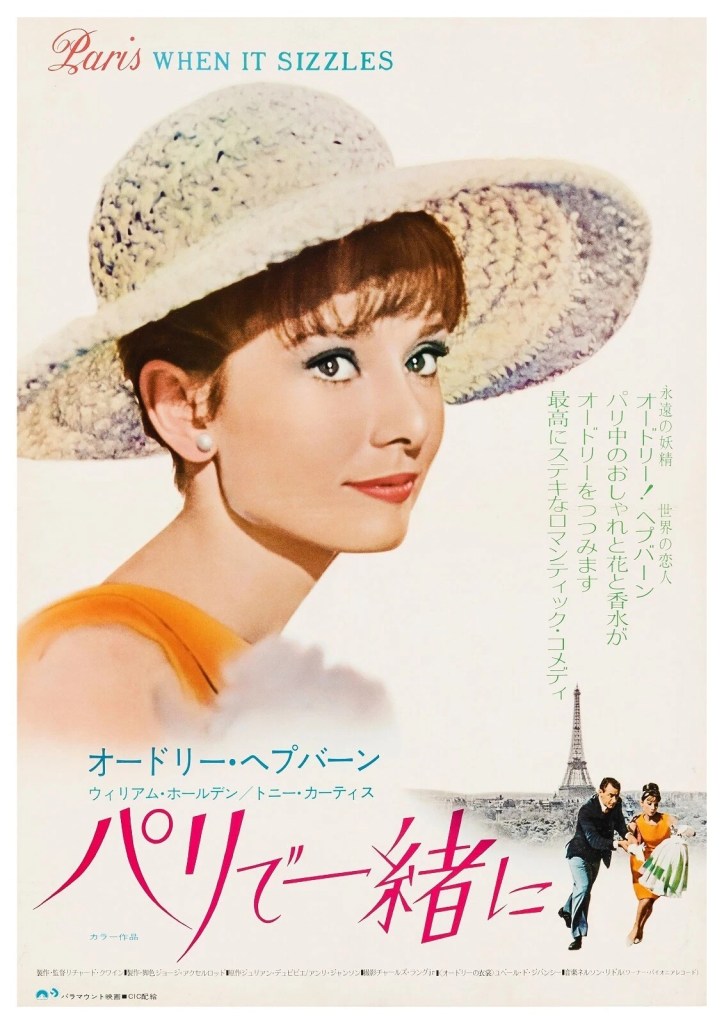
So we watch Gabrielle initially fending off his moves before becoming entranced and ridding herself of a carapace of dustiness before transforming into a flighty fun lass. But when the dialog often centers on arguments over the meanings of words there’s not a great deal for the audience to get its teeth into.
The concept, such as it is, allows Richard and Gabrielle to act out various scenarios, rattling through the genres – spies, musical, the jungle, horror, whodunit and western – while they manage to find a way to turn his title The Girl Who Stole the Eiffel Tower into a movie.
Even though the last thing this needs is further levity – any more froth and it would disintegrate – Tony Curtis (The Boston Strangler, 1968) has a recurrent role in a variety of cameos and you can spot an uncredited Marlene Dietrich (Judgement at Nuremberg, 1961) and Mel Ferrer (Brannigan, 1975). Perhaps the most unusual angle was that it was a remake of the French La Fete a Henriette (1952) directed by Julien Duvivier. Or that it was the first screen credit for Givenchy, who devised Hepburn’s clothes.
While both Holden and Hepburn are very easy on the eye, the actor often topless, and Hepburn going through the fashions, it only works if you want to see screen chemistry at work and are not remotely interested in narrative or if you are so unaware – and of course genuinely interested – in the screenwriter’s craft that you are find out how words on paper are translated into images on the screen. It might well be an audience’s first encounter with such gems as “Exterior:Day.”
Oddly, both Holden and Hepburn are good and it’s solidly directed by Richard Quine (The World of Suzie Wong) from a script by George Axelrod (Breakfast at Tiffany’s) adapting the previous film.
A harmless trifle, you might say, but just too bad that with the talents involved it doesn’t even rise to a soufflé.

 The Magnificent 60s
Some info:
Paris When It Sizzles was based on the 1952 French film La fête à Henriette, which was released in the U.S. as Holiday for Henrietta in 1955. According to the 4 Feb 1962 NYT, Audrey Hepburn would reteam with Sabrina (1954, see entry) co-star William Holden and Breakfast at Tiffany’s (1961, see entry) screenwriter George Axelrod to develop the remake at Paramount Pictures. While the final release title was borrowed from a line in the Cole Porter song, “I Love Paris,” several contemporary sources listed the following working titles throughout pre-production: Holiday in Paris; Together in Paris; and The Girl Who Stole the Eiffel Tower, which is the name of the screenplay Hepburn and Holden’s characters write within the film.
According to a 13 Jul 1962 DV production chart, principal photography began 18 Jun 1962 in Paris, France. The 11 Aug 1962 LAT claimed that neither Hepburn nor Holden were satisfied with Axelrod’s script, and hired writer-director Charles Lederer, who was vacationing in Paris, to compose a new draft. Lederer supposedly received $25,000 for one week’s work. During this time, Holden “disappeared” from the production for three weeks, but approved the rewrites upon his return. An 8 Aug 1962 LAT news item suggested that this absence may have been attributed to minor eye surgery to remove a cyst, after which he was required to re-shoot several scenes. However, as Tony Curtis explained in his 2008 memoir, American Prince, Holden had been forced to check into a rehabilitation clinic to be treated for alcoholism. Curtis’s character was subsequently written into the script in order to relieve screentime from Holden, who drank heavily throughout production. By contrast, an 11 Sep 1962 LAT news story publicly claimed that Curtis’s involvement resulted from the filmmakers’ dissatisfaction with the French actors who auditioned to play Hepburn’s onscreen boyfriend, described in the script as a “Tony Curtis type.” The story alleged that Curtis himself volunteered for the role while on vacation in Paris.
Around this time, the 29 Aug 1962 Var reported that director of photography Claude Renoir quit the project after Hepburn, feeling that her scenes were “somewhat lacking in polish,” had invited Charles Lang, Jr. to supervise his work. When Lang assumed the position, several members of the crew wanted to leave in solidarity with Renoir, who convinced them to remain with the project.
An article in the 23 Sep 1962 NYT reported that Paris-area locations included Place Dauphine, Ile de Cité, Bois de Boulogne, Champs-Elyseés, Avenue Matignon, the Quai du Voltaire hotel, a terrace apartment on the Avenue George V, and Les Yvelines, outside the city. The 8 Aug 1962 LAT stated that rain prevented the crew from filming the annual Bastille Day ceremonies at the Place Dauphine, so the celebration was recreated on a soundstage at the Studios de Boulogne.
Several French actors appeared in the picture, including Michel Auclair, who played the leading role in La fête à Henriette. While he may not have been credited onscreen, the 15 Aug 1962 NYT reported that he portrayed a French newspaperman in the American version. A 3 Jul 1962 DV brief also noted that Jonathan Harris had been signed for a co-starring role, but his involvement in the final film could not be determined. According to the 26 Aug 1962 LAT, local casting directors struggled to find two Native American Indians to be featured in a chase sequence through the Bois de Boulogne. Filmmakers reportedly approached two Seminole tourists from Florida, but they were unable to participate.
Contemporary reviews, including the 18 Mar 1964 Var and 9 Apr 1964 NYT, noted that several members of the cast also perform roles in the film-within-the-film, while the voice of Frank Sinatra can be heard singing a line of a song for The Girl Who Stole the Eiffel Tower, intended as a parody of opening title themes. Hepburn’s husband Mel Ferrer, Marlene Dietrich, and Noël Coward also made uncredited cameos, and Fred Astaire sings offscreen.
The 29 Jun 1962 DV stated that William Holden’s teenage son, West Holden, served as a still photographer on the set.
Despite plans for a summer 1963 release, the 24 Jul 1963 Var announced that Paramount had pushed the opening to early 1964, citing the need for a more elaborate advertising campaign. Items in the 18 and 23 Sep 1963 DV reported that “sneak” previews were held in San Francisco, CA, the weekend of 21-22 Sep 1963. Conflicting accounts in the 7 Feb and 25 Mar 1964 editions indicated that a 300-400-theater release was expected for the Easter weekend, but the film did not debut until 8 Apr 1964.
LikeLiked by 1 person
Great. I’m covering the Pressbook tomorrow.
LikeLike