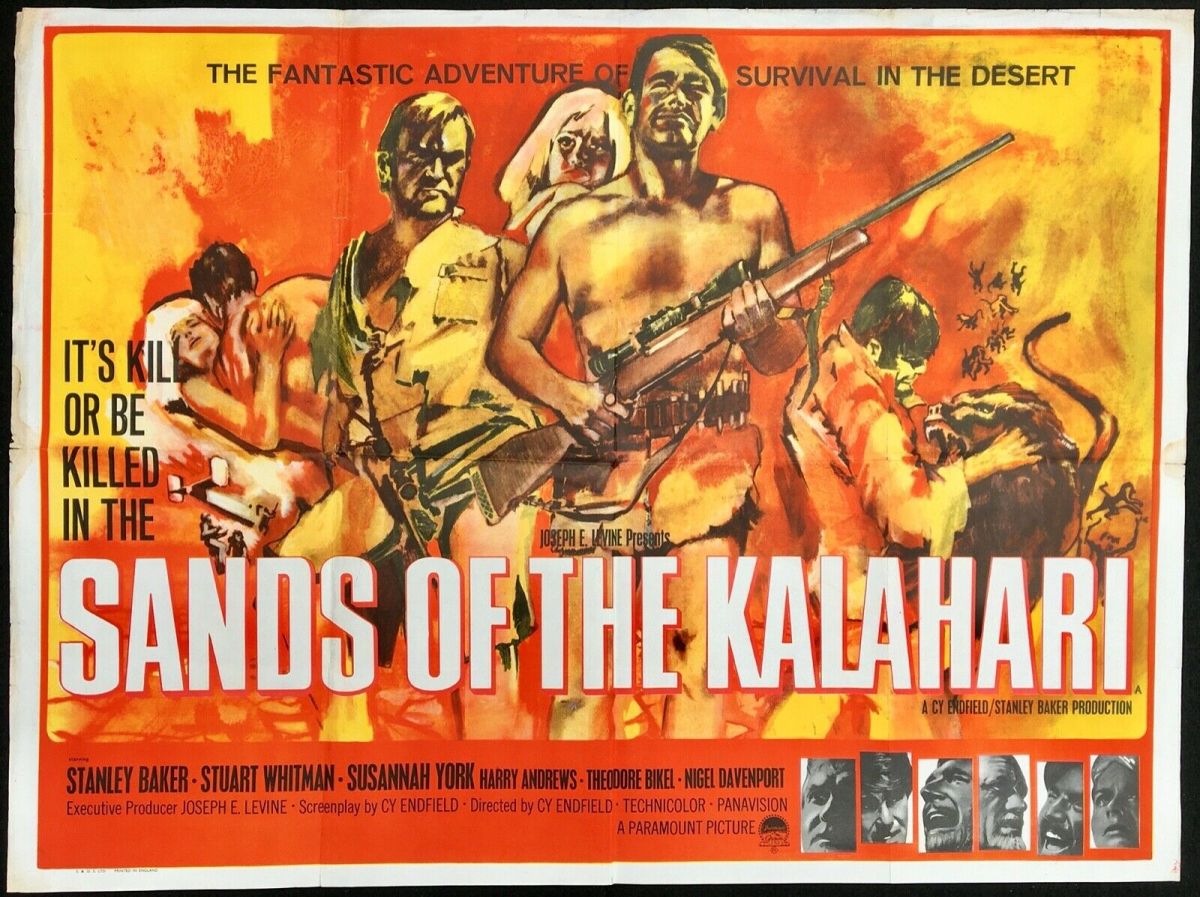
You know the score: plane crashes in inhospitable territory (in this case a desert), personalities clash as food/water is rationed, tempers run high and/or depression sets in as attempts to attract attention fail, someone goes for help, someone else has an ingenious idea and eventually everyone rallies round in common cause. That template worked fine in The Flight of the Phoenix (1965).
It doesn’t here. This is not quite as inhospitable. There is water. Caves offer shelter from the blazing sun. There is food – lizards trapped, game hunted with telescopic rifle. But the food is lean, not fattened through farming for human consumption. And you have to watch out for marauding baboons not to mention scorpions. And this group is split, two alpha males intent on exerting dominance with little interest in common cause.
without close examination of the picture’s content.
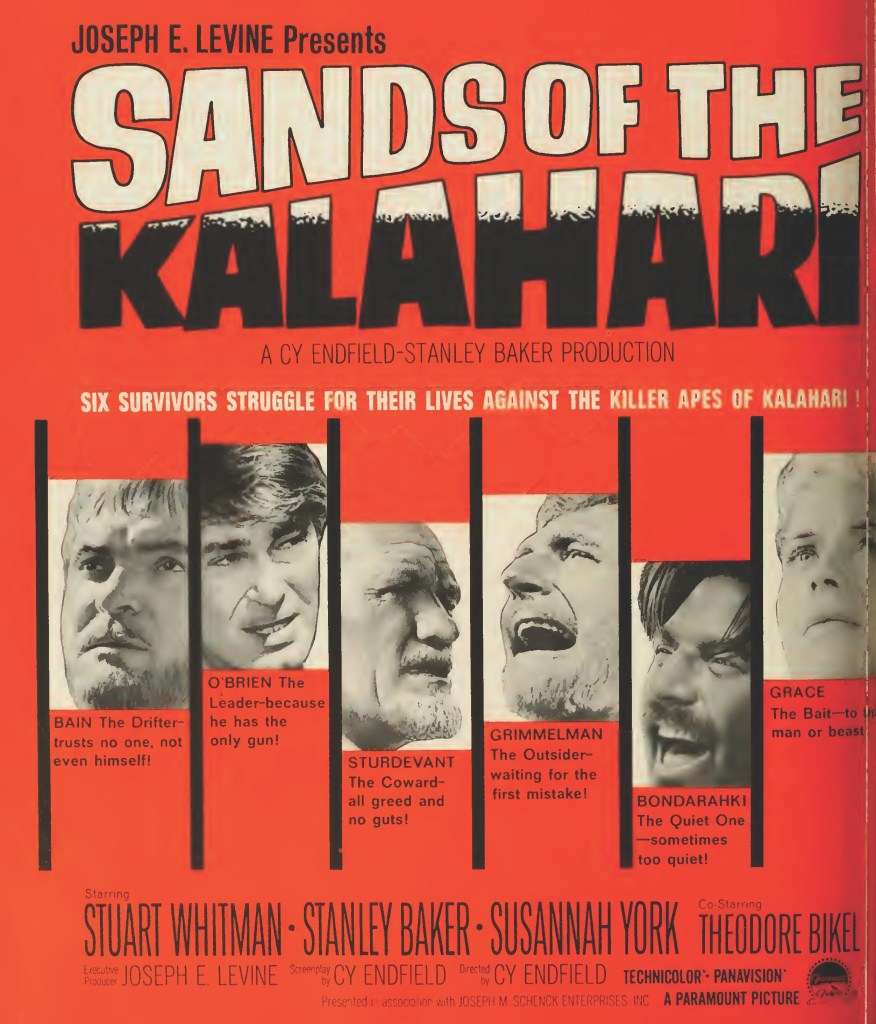
Of the six survivors of this crash, Sturdevan (Nigel Davenport) decides his leadership status entitles him to sole claim over the only woman, Grace (Susannah York). But when he accepts the genuine responsibilities of leadership, he sets off across the desert to get help. That leaves Grace to fall into the hands of O’Brien (Stuart Whitman), so alpha he could be auditioning for Tarzan, shirt off all the time.
It soon transpires O’Brien has a rather unusual idea of survival – getting rid of his companions so that he will have no shortage of food until rescue arrives. It takes a while for the others to catch on to his plan. And then rather than common cause and camaraderie, it becomes every man/woman for himself, a battle for individual survival, a return to the primeval.
The most likely challenger to O’Brien’s authority is Bain (Stanley Baker), but he has been badly injured in the crash and no match for the other man’s brawn or his weapon. So it becomes a game of cat and mouse. Except it’s in the desert, it’s the law of the jungle and the rule of autocracy brought home with sudden force to people accustomed to the comforts of civilization and democracy.
The movie’s structure initially takes us down the obvious route of common purpose – Grimmelman (Harry Andrews) knows enough survival lore to devise a method of water transportation that would permit the group to escape the desert, Dr Bondrachai (Theodore Bikel) formulates a method of trapping lizards, and O’Brien, at least at first, appears willing to take on the role of protector, warding off baboons with his gun.
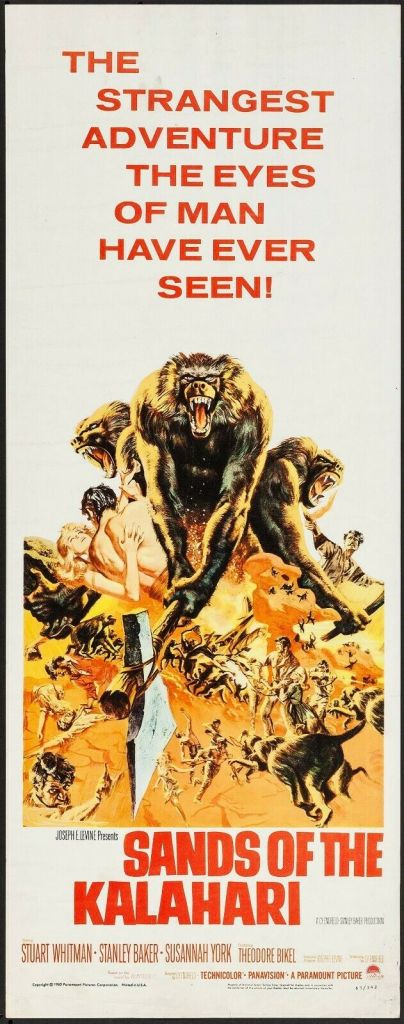
The change into something different is subtle. While the others are desperate to escape, it becomes apparent that O’Brien has found his metier. We discover little about the lives of each individual prior to being stranded. Whatever O’Brien’s standing in society, it would not have been as high as here, where his superior skills stand out. Reveling in his supremacy, he doesn’t particularly want to go home.
Like any psychopath Bain knows how to manipulate so at first it seems his decisions are for the greater good. And only gradually does it emerge that he blames others for his own mistakes and intends to eliminate his rivals for the food supply one by one. Because he is so handsome, it is impossible to believe he could be so devious or so evil.
The three principals all play against type. Stanley Baker (Zulu, 1963) and Stuart Whitman (Murder Inc., 1960) made their names playing heroic types. Here Baker is too ill for most of the picture to do any good and Whitman plays a ruthless killer. But Susannah York (Sebastian, 1968) is the big revelation. Audiences accustomed to her playing glamorous, perhaps occasionally feisty, gals will hardly recognize this portrayal of a coward, not just abjectly surrendering to the alpha male but seeking him out for protection and guilty of betrayal.
Even though this picture is set in the days before gender equality and the independent woman was a rarity, Grace’s acquiescence to the powerful male is disturbing, in part because it takes us back to the days when a woman was impotent in the face of male dominance. Such is York’s acting skill that rather than despise this woman, she earns our sympathy.
While for the most part Harry Andrews (Danger Route, 1967) and Nigel Davenport (Sebastian, 1968) appear in their usual screen personas of strong males, here their characters both are changed by the circumstances. Theodore Bikel (A Dog of Flanders, 1960) has the most interesting supporting role, the only one who takes delight in the adventure.
Director Cy Endfield (Zulu) – who also wrote the screenplay based on the William Mulvehill novel – delivers a spare picture. There is virtually no music, just image. Aerial shots show tiny figures in a landscape. The absence of character background frames the story in the present. As a reflection on the animal instinct, how close to the primordial a human being still operates, no matter how enlightened, this works exceptionally well, and melds allegory with thriller.

 The Magnificent 60s
Every poster looks like a different film…York was a great player, interviewed her in 2006. She had a very varied career…
LikeLiked by 1 person
Did she like this film?
LikeLike
Really like this one and a solid cast though I was disappointed with Baker’s inactivity for the most part. I have the one sheet for this and it’s a beauty with that artwork of the chimps and the axe atop a mountain.
LikeLiked by 1 person
It was odd casting. His character was ill half the time. I suspect if he had been his normal screen self the alpha males would have battled it out sooner.
LikeLiked by 1 person
A wee bit:
“On 14 Aug 1961, DV announced that Joseph M. Schenck Enterprises had purchased screen rights to William Mulvihill’s 1960 novel, The Sands of the Kalahari, and one year later on 6 Aug 1962, DV reported that the film would be produced in association with Joseph Levine’s Embassy Pictures. At that time, Schenck Enterprises’ Bernard Schwartz was set to executive produce the film, along with Troy Film producers Phil Hazelton and Alex Singer in the recent Troy-Schenck three-picture deal with Columbia Pictures. Screenwriters Irene and Louis Kamp were working on the adaptation.
By early February 1964, Levine replaced the original production team with Cy Endfield and Stanley Baker after their success on Embassy Pictures’ Zulu which was released several weeks earlier in London, as noted in a 4 Feb 1964 DV news item. The following day, Var stated that Baker had verbal agreements from Richard Burton and Elizabeth Taylor to star in Sands of the Kalahari, and Baker intended to perform in the movie, himself. A 20 Mar 1964 DV column confirmed the couple’s casting, but a 24 Jun 1964 Var item reported that their demand of a combined $1.5 million salary, as well as a large profit share in the film’s gross, was not acceptable to the filmmakers. Carroll Baker was hired for Taylor’s role (Baker was later replaced by Susannah York) and Robert Mitchum was being courted to step in for Burton. Albert Finney, Marlon Brando and Warren Beatty were also under consideration for roles, according to the 24 Jul 1964 DV, and George Peppard was scheduled to perform as of an 8 Dec 1964 DV piece. Peppard left the production after two days on set, the 25 Mar 1965 DV announced, and Alan Bates was in talks to replace him. However, the 3 May 1965 DV confirmed Stuart Whitman’s casting.
An 18 Jun 1965 DV production chart reported that filming began 10 Mar 1965 in South Africa, with Paramount Pictures as distributor. (One year earlier, a 1 Apr 1964 Var article referred to Paramount as a co-producer). Locations included the Skeleton Coast, Namibia. In a column by Whitman in the 20 May 1965 DV, the baboon sequence was shot the day before, and the production was set to move to London on 24 May 1965 for three weeks of interiors at Shepperton Studios.”
LikeLiked by 1 person
Brilliant stuff. Peppard would have been my choice for the lead.
LikeLike