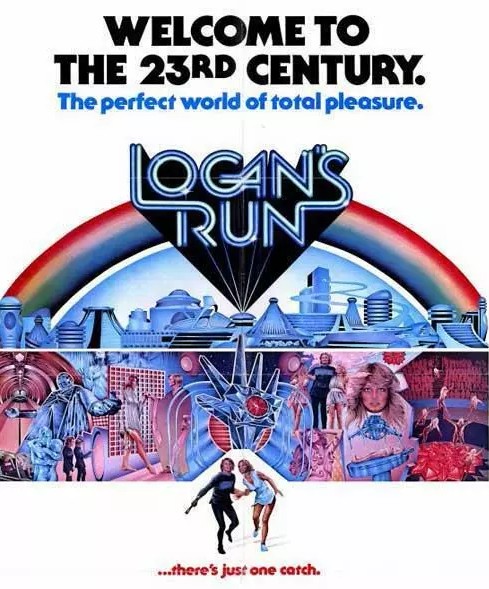
Shortly after this appeared the movie sci fi world imploded/exploded with the release of Star Wars (1977), followed by Close Encounters of the Third Kind (1977) and Alien (1979), which probably accounts for why this is such a throwback joy to watch and now very much a cult item. Takes in ageism, obsession with youth, death cult, the pleasure principle written in capital letters, some kind of primitive Tinder (where women place themselves on “the circuit”), Terminators, runaways, dystopia, escapees, eco-friendly food, mobile phones, computers in charge, lasers, plastic surgery, cannibalism, robots, an icy tomb, nuclear holocaust and the Lincoln Memorial.
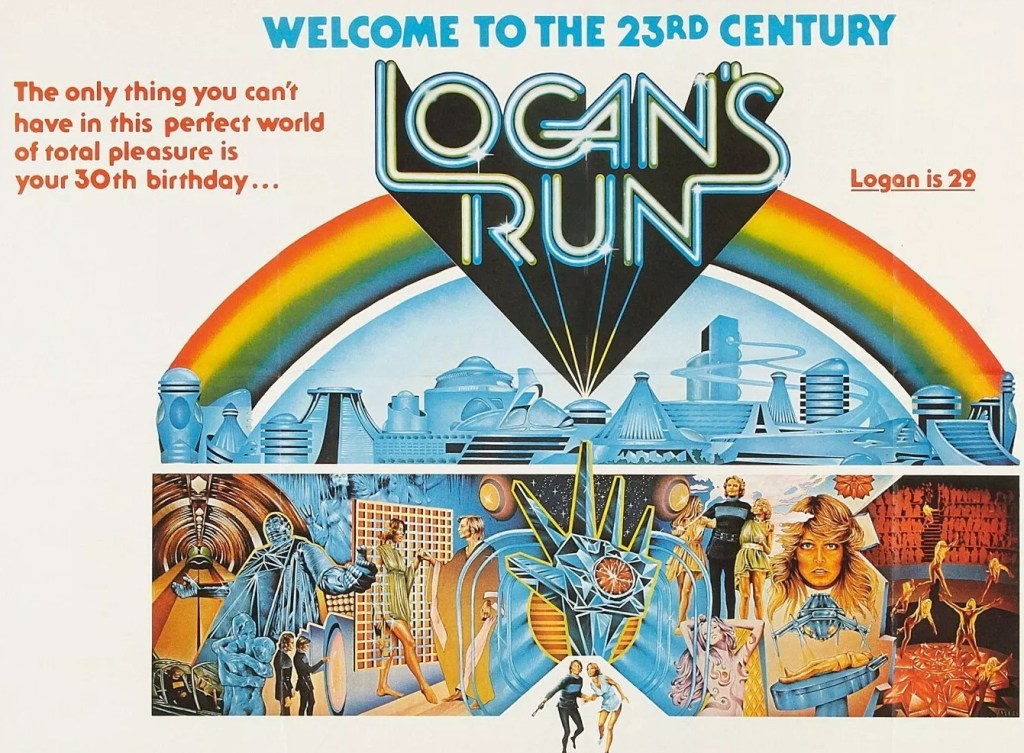
There’s some shooting with futuristic weaponry but these handguns are virtually useless given how poor their accuracy – though that may be down to the incompetence of their users – and a couple of fist fights. And while the remainder of Earth’s population enjoys an idyllic life in a series of sealed domes, there is, as the posters point out, a catch. When you reach the age of 30 you are killed, although this occurs in the guise of rebirth in a ritual known as the Carrousel.
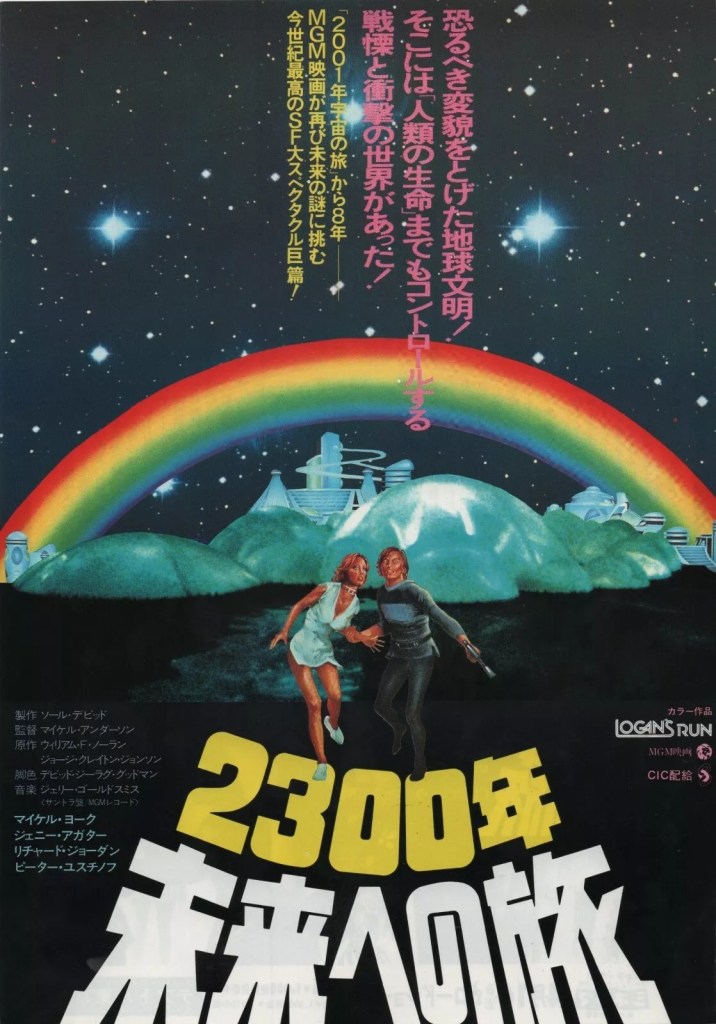
There’s no individual responsibility. Children are separated at birth from their parents and brought up in communal fashion. They eat, drink and have sex – there’s even a section set aside for sexual pleasure, full of naked writhing bodies. But generally, sex is on tap, any woman signing up to be on “the circuit” literally delivered to your door.
In this fashion Logan 5 (Michael York) encounters Jessica 6 (Jenny Agutter). He’s a terminator, chasing after runaways, she’s a virgin and much to his annoyance proves not an easy conquest, in fact sex doesn’t take place at all. However, she wears an ankh. And he’s just picked up an ankh from a runaway he just totaled. So he asks the computer for advice about the emblem. Turns out it’s worn by a rebel group – there are over 1,000 of them living in a “sanctuary” in the city – and Logan is delegated to pretend to be a runaway and with Jessica’s help infiltrate the radical organization. Unfortunately, his buddy Francis 7 (Richard Jordan) is suspicious and follows him.
After many adventures and escaping from Francis and the robot Box (voiced by Roscoe Lee Brown) who wants to freeze them, they emerge into a land that while it shows signs of devastation is not uninhabitable. They meet an old man (Peter Ustinov) and realize that it’s possible to live beyond the age of 30 and that somehow their apparent utopia is actually a dystopia. Furthermore, once outside the tomb, the internal clocks that dictate the date of their death automatically switch themselves off.
The prisoners of the dome are freed shortly afterwards.
There’s a kind of innocence about the sci fi world portrayed. Everyone dresses in primary colors, both sexes wear flimsy outfits all the easier to remove when pleasure appears imminent. Taking place three centuries on from the date of the movie’s release, the world is the kind that would be dreamed by illustrators imagining the future for an Exposition with everything streamlined.
There’s no time and really no effort to make a serious point about any of the issues raised and it’s more a smorgasbord of ideas – quite a few of which have come to fruition. The two main characters are likeable rather than charismatic and the onset of sudden romance appears narrative contrivance rather than “across a crowded room.” Logan’s dilemma, that he is switched from having four years to live to being at death’s door, gives him incentive to escape, not to complete his mission. And at times the dialog is cumbersome but equally often just flies – that cats have three names, for example.
I never saw this on initial release and didn’t hire it on VHS or DVD but gradually it acquired cult status and I was keen to see why.
It works, is the real reason for that. It exists outside the Star Wars/Close Encounters/Alien dynamic. I liked the jigsaw nature of the ideas and that they are thrown together and at you like you were on a rollercoaster, and you can pick and mix. The conversations with the computer sound very contemporary.
Michael York (Justine, 1969) and Jenny Agutter (East of Sudan, 1964) are pleasant company to spend time with. While Richard Jordan (Valdez Is Coming, 1971) is not much short of an eye-rolling villain, Peter Ustinov is remarkably good value in a role that could easily have been cliché. You might spot Farrah Fawcett-Major (newly-inducted as one of Charlie’s Angels, 1976-1980).
Directed by Michael Anderson (The Shoes of the Fisherman, 1968) and written by David Zelag Goodman (Straw Dogs, 1971) from the novel by William F. Nolan and George Clayton Johnson.
Any notion that it was intended to be groundbreaking was knocked on is head by Star Wars et al, and it’s for that very fact that it’s so watchable, as in, the direction sci fi could have gone had lightsabers and Death Stars, creatures phoning home and monsters erupting from stomachs, not entered the Hollywood universe.
Surprised how much I enjoyed it.

 The Magnificent 60s
“The following written statement appears in the opening credits: “Sometime in the 23rd century…the survivors of war, overpopulation and pollution are living in a great domed city, sealed away from the forgotten world outside. Here, in an ecologically balanced world, mankind lives only for pleasure, freed by the servo-mechanisms which provide everything. There’s just one catch: Life must end at thirty unless reborn in the fiery ritual of carrousel.”
The end credits include a mention of the use of Kenworthy Snorkel Camera Systems, then offer thanks to the Texas Film Commission, Dallas, Texas, Diane Booker, Executive Director; and W.E. Cooper, President, Dallas Market Center, Dallas Texas. This is followed by the statement: “Grateful acknowledgment is made for filming in OZ Restaurant, Dallas Texas, in National Health Studio, Arlington, Texas, and at the Ft. Worth Water Gardens, Ft. Worth, Texas.” There is also an acknowledgement given to Old Possum’s Book of Practical Cats by T.S. Eliot that is quoted by permission.
Although a 30 Jan 1968 HR news item announced that the film was set to be produced by George Pal and written by Richard Maibaum, neither man is credited on screen. Similarly, a 7 Mar 1968 DV brief stated that Gabrielle Scognamillo was hired as art director with Duane Alt as illustrator, but neither Scognamillo or Alt remained with the project. Later that year, Metro-Goldwyn-Mayer (MGM) exercised its $100,000 option of Logan’s Run. according to a 20 Nov 1968 HR news item. While the 30 Jan 1968 HR reported principal photography was scheduled to begin Sep 1968 and a 27 Feb 1969 DV news item announced that filming was planned for Brasilia, Brazil, the project remained in limbo over the next several years, with MGM considering its placement at another studio or shooting it as an independent film as stated in a 27 Feb 1969 DV news item.
A 16 Nov 1973 DV article stated that Saul David and Stanley Greenberg were hired to co-produce and co-write the picture with a $3 million budget. Several days later, a 20 Nov 1973 HR news item listed David as the producer and Greenberg as the writer; however, Greenberg is not credited in the film.
A news item in the 28 Oct 1975 DV stated that new anamorphic lenses were developed by Todd-AO for Logan’s Run. The lenses were capable of photographing up to 128 degrees, which is almost the scope of the three-strip Cinerama process.
Per an article in the 30 Oct 1975 LAHExam, David and two special effects men, Gerald Ender and Charles Elmendorf were injured while filming the dome city exploding. David sustained minor injuries, while Elmendorf was taken to the hospital and then released. Ender suffered first and second degree burns to his arms and hands and was hospitalized.
The novel differs from the movie in that earth’s population hits critical mass in the year 2000 a.d. and, by 2126 a.d., “Lastday” is set at the age of twenty-one, where a person is brought to a “Sleepshop” and killed by inhaling a pleasure inducing gas. Also in the novel, Francis is revealed to be “Ballard” a forty-two year old man who helps runners escape. Sanctuary is an old earth colony on Mars that Ballard helps them to escape to on a rocket.
The film opened on 23 Jun 1976 to mixed reviews. Vincent Canby in the 24 Jun 1976 NYT praised the film’s special effects, but found the script lacking.
Confronting charges that the film is racist, David stated in the 7 Aug 1977 LAT that he attempted to cast thirty percent of the film’s extras with actors representing different minority groups, but he was unable to procure such actors from the Screen Extras Guild (SEG). David’s claim was confirmed by SEG. David also dispelled rumors that extras in the carousel scene acted in ‘blackface,” noting that black makeup was used around the actor’s eyes because they were wearing white masks.
A 31 Dec 1976 Entertainment Today article stated that Logan’s Run was named best science fiction film of 1976 by the Academy of Science Fiction, Fantasy and Horror Films. The Academy had previously give individual “Golden Scrolls” to the film for cinematography, art direction, set decoration, costuming, makeup and publicity.
Logan’s Run was made into a television series. Fourteen episodes were broadcast on Columbia Broadcasting System (CBS) from Sep 1977 to Feb 1978.
A 5 Mar 2005 HR article announced that Logan’s Run was in development for a remake at Warner Bros. with Bryan Singer as director and Joel Silver as producer. Singer was hired to write the script with Ethan Gross and Paul Todisco, and Gy Dyas was set to be the production designer. However, the project remained unproduced due to Singer’s scheduling conflicts. HR reported on 1 Dec 2010 that Carl Rinsch was hired as director, but left the picture to direct 47 Ronin and, again on 11 Nov 2011, that Nicholas Winding Refn was set to direct, with Andrew Baldwin rewriting the script. Although actor Ryan Gosling had contracted to star in the remake, he left the project in Oct 2012.”
LikeLiked by 1 person
Terrific research. Thanks again.
LikeLike