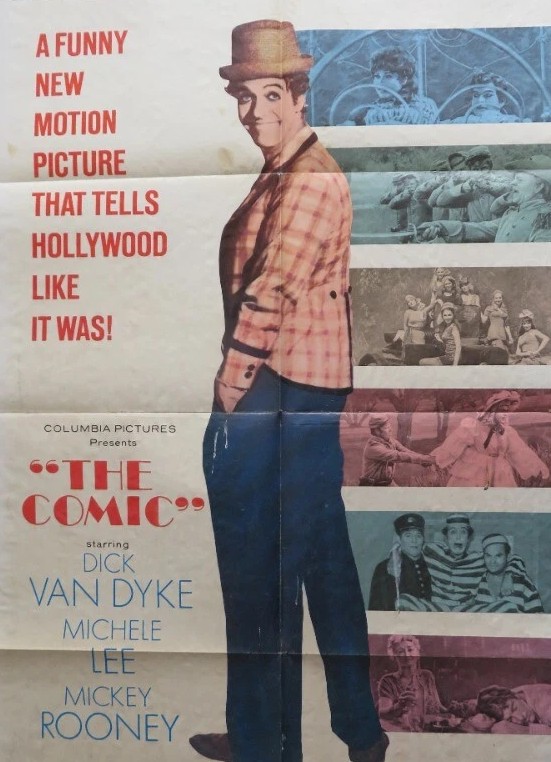
It’s a Hollywood trope that successful screen comedians invariably want to test their mettle in more dramatic circumstances. Studios tend to cave in to such self-indulgence, usually with the proviso that the star makes another couple of laff fests with them, but audiences tend to give such enterprises the thumbs down. Dick Van Dyke (Divorce American Style, 1967), on a commercial roll for most of the decade, took the, theoretically at least, easier option of limiting the drama on this one.
Silent films were also on a commercial roll, the oldies having made a comeback via compilation reissues and through slapstick homages such as It’s A Mad, Mad, Mad, Mad World (1963) and The Great Race (1965) so setting the picture in that era in Hollywood’s history seemed a sure thing.
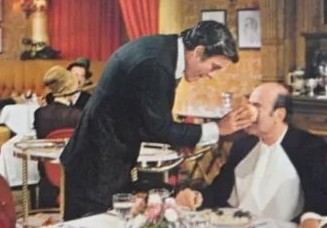
And it starts off bang on the money. A eulogy delivered at a funeral is interrupted by a pie in the face and (as seen above) that device can be utilized at any point.
I’d be telling you to give this complete misfire a miss if it wasn’t for an exceptional final third. The first two-thirds is made up of far too many silent film sequences starring Billy Bright (Dick Van Bright) who goes from vaudeville clown to major star complete with, at the height of his fame, being accorded the honor of a having a clockwork toy made of him.
When it’s not diverted into yet another silent movie sequence, which only serves to show that a modern comedian lacks whatever smarts the silent movie comedians had, the drama takes roughly the same approach, with scenes that could have come from a silent movie if not quite to the utmost.
Thanks to a multitude of affairs Billy burns his way through marriage to Mary (Michele Lee) and thanks to an overfondness for the bottle nearly kills off his career before the arrival of the talkies does that for him.
Eventually, and suddenly, we switch to an entirely different picture, a proper drama, very bold indeed for the time for its portrayal of old age and loneliness – a representation that would chime very much with today’s audiences. You don’t quite warm to this old fella because he wasn’t particularly sympathetic to begin with, but still, in its rawness, this section exerts a very emotional pull.
And, indeed, for Dick Van Dyke it was an incredible piece of acting. He morphs from young, tall, and fit with a head full of hair to an old bloke, bent over, shuffling and with the kind of comb-over that would put Bobby Charlton to shame. He’s been abandoned by everyone except sidekick Martin (Mickey Rooney) whose career has also gone south. They tell lies to each other to keep up their spirits.
The highlight of Billy’s life is getting a set of false teeth and setting the alarm for 4.30am so he can get up and watch reruns of his old movies on television. He lives on boiled eggs and milk.
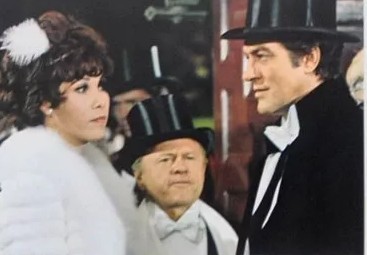
And he’s still dumb enough to be rooked by a gold-digger. He’s placed an ad in Variety, drawing attention to the fact that he’s still alive, which wins him a spot on a TV chat show which turns into a gig for a commercial which leads a much younger woman to think he must be loaded. He ends up marrying her while in an oxygen tent, but she vanishes when she discovers his newfound fame has led to nothing.
In theory, this is about the side effects of fame, the temptations which few can avoid, and the sudden collapse in income and public awareness when the well runs dry. But, in reality, setting aside the Hollywood overtones, the last third could have been about any lonely old man.
A film of three thirds for the star, in the first two there’s nothing much to hold onto, in the last one he excels. Nobody else has much to do. Directed by Carl Reiner (The Jerk, 1979) and written by him and Aaron Ruben. Reiner had been the writer of The Dick Van Dyke Show so presumably that played a part in him getting the gig.
Died an absolute death at the box office. Not released outside America for decades and then only on DVD.
If it hadn’t been for the final third this would have been rated a one-star effort, it’s such an ill-conceived concept, and disastrous in its execution, but that final third makes it very worthwhile indeed if you can stick with it.

 The Magnificent 60s
I was completely unaware of this movie. Van Dyke made the occasional homage to silent and classic film comedians on “The Dick Van Dyke Show” that were perfectly enjoyable in a low-stakes, TV way. Inflating that self-indulgence into a more dramatically inclined feature film sounds really iffy. I’ll give it a shot if it ever falls in front of me.
Van Dyke had a likeable enough small screen presence and almost translated that to the big screen. I think the right project just never came his way.
LikeLike
Found this:
“The 3 May 1968 DV reported that actor-filmmaker Carl Reiner and his writing partner, Aaron Ruben, recently completed the first draft of a screenplay for actor Dick Van Dyke. The working title was Billy Bright, Silent Film Comedian, Dead at 78. Production charts in the 28 Jun 1968 DV stated that filming was scheduled to begin 19 Aug 1968. However, production was delayed by the departure of producer Harold Hecht, as noted in the 16 Jul 1968 DV. The 7 Aug 1968 DV reported that Reiner and Ruben replaced Hecht as producers.
According to the 21 Aug 1968 DV, Dick Van Dyke was hoping to cast his former television co-star, Mary Tyler Moore, as his leading lady, but she had a previous obligation to appear in A Change of Habit (1969, see entry). One week later, the 28 Aug 1968 DV announced actress Michele Lee for the role of “Mary Gibson.” The 28 Aug 1968 LAT revealed that Lee postponed a singing engagement at the Century Plaza Hotel in Los Angeles, CA, to make the picture. She was currently attending wardrobe fittings and rehearsals at Columbia Studios. An item in the 3 Sep 1968 DV stated that both Lee and Van Dyke would appear to age forty-eight years during the course of the picture. Several silent-film comedians were expected to appear in cameo roles, along with writer-producer-director Reiner as “a rotten agent.” Principal photography was set to begin 11 Sep 1968, according to production charts in the 30 Aug 1968 DV. The title was shortened to Billy Bright.
The 3 Nov 1968 LAT reported that Columbia Pictures initiated the production, hiring Reiner to direct Dick Van Dyke in a proposed screenplay titled Baggy Pants. After Reiner brought Ruben onto the project, the pair viewed “hundreds” of early silent comedies at New York City’s Museum of Modern Art. Reiner insisted that the title character was not based on any particular silent comedian, intending the film as a “commentary” on the entertainment industry, in which careers rise and fall very quickly. However, some critics speculated that “Billy” was based on Buster Keaton.
At the time of the article, location filming was underway at Paradise Cove in Malibu, CA, a popular location for silent comedies because of its steep cliffs. Veterans of the period were included among the cast and crew, such as diminutive character actor Billy Curtis, and director of photography W. Wallace “Wally” Kelly. Kelly revealed that he was filming some of the silent comedy footage at eighteen frames per second, rather than the standard twenty-four, to simulate the “old jerky movements” of early cinema. Four weeks later, the 1 Dec 1968 LAT printed a letter from filmmaker and historian Peter Bogdanovich, who explained that, while silent pictures were filmed at fewer frames per second, they were also projected at those speeds, and therefore “had no ‘jerky movement’ or speedup action (unless it was desired).” Bogdanovich went on to blame “uncaring or unknowing film and television producers” who “have continued and popularized this myth.” Despite Bogdanovich’s concerns, silent sequences in the film were projected at their correct speed.
From 30 Sep through 4 Oct 1968, a series of quarter-page advertisements appeared in DV, each with a different image of Van Dyke as “Billy Bright,” soliciting work for the forgotten comedian.
The 16 Oct 1968 DV noted that actress Jeff Donnell, cast as a nurse in the film, recently completed a course in practical nursing at Midway Hospital in Los Angeles, CA.
The picture marked the final screen appearance of veteran actress Pert Kelton, who died of a stroke on 30 Oct 1968, only days after completing her scenes. Two weeks earlier, Kelton told the 17 Oct 1968 DV that she accepted the role despite her preference for the stage, saying “Actors are like fruit pickers. They go where the fruit is.” It was only her third screen role in the past thirty years.
The 24 Jan 1969 DV noted that Reiner was in the process of editing the film. Columbia included the title among its “continuing” publicity campaigns in the 28 Jan 1969 DV. On 14 Feb 1969, DV reported that the studio, pleased with Reiner’s work, was in negotiations for a new production deal with the filmmaker.
According to the 27 Feb 1969 DV, Michele Lee was summoned to the Columbia lot for an additional scene, three months after the completion of principal photography. The pregnant actress anticipated mostly close-up shots. Van Dyke was also called back to add voice-over narration. On 29 Apr 1969, DV announced that the title was changed to The Comic. While vacationing in AZ, Van Dyke recorded his voice-over at the radio station he owned in nearby Phoenix. The film received an “M” rating from the Motion Picture Association of America (MPAA), as noted in the 25 Jun 1969 Var.
The Comic opened 19 Sep 1969 in New York City. While the 5 Nov 1969 DV argued that the picture would appeal only to members of the entertainment industry, the 5 Nov 1969 LAT declared it a work of art, adding that Van Dyke’s performance could have won him an Academy Award if the Columbia had provided sufficient publicity to accompany the release.
Four weeks later, Reiner complained to the 3 Dec 1969 Var that the film was not adequately publicized. After being “rushed” into New York City and Los Angeles, CA, openings as part of a double feature with The Desperados (1969, see entry), it was relegated to second billing within the first two weeks. By the time the picture began garnering positive reviews and “word-of-mouth,” it was virtually out of circulation. Reiner noted that critics and movie professionals were generally uninformed of the few preview screenings sponsored by the studio, and cited the LAT review, which blamed Columbia for its inadequate promotion. Countering Reiner’s accusations, Columbia executive Richard Kahn claimed the picture was given the same consideration as any other release, adding that the filmmaker was directly involved in planning the campaign. Despite their efforts, critical and public response “proved disappointing.”
Casting announcements appeared in several periodicals during the course of production. Among them were Irene Tedrow as Billy Bright’s mother (12 Sep 19 DV), Mel Berger as “Fatso” (18 Sep 1968 Var), Peter Brocco as a preacher (3 Oct 1968 LAT), Manton Moreland (16 Oct 1968 Var), Maurice Dallimore (17 Sep 1968 DV), Vic Christy (25 Sep 1968 DV), Sheila English, Syleste Michaels, and Christopher Ross (30 Sep 1968 DV), Bill Zuckert and Scott James (10 Oct 1968 DV), Ottola Nesmith and Suzie Kaye (11 Oct 1968 DV), Frank Mathias, Patrick Campbell, and Dick Winslow (17 Oct 1968 DV), Joyce Easton (21 Oct 1968 DV), Alvin Hammer, Brick Huston, and Priscilla Garcia (24 Oct 1968 DV), Bob Rhodes (28 Oct 1968 DV), Linda Burton (11 Nov 1968 DV), Harry Fleer and Lou Kane (15 Nov 1968 DV), and Howard Dayton (20 Nov 1968 DV).
“Film Assignments” in the 25 Sep 1968 DV included the following crew members: Joe Ellis, second assistant director; John Poer, trainee assistant director; Richard Johnson, camera operator; Gene Liggett and Frank Hale, camera assistants; Bill Todd, assistant film editor; Bill Hamilton , boom; Hank Edds and Mark Reedall, makeup; Susan Germaine, hairstylist; Dick Butz, Bob Grimm, Edna Taylor, and Kathryn Towne, costumers; Paul Stewart, special effects; Tom Coleman and Ronnie De Waay, properties; Frances McDowell, script supervisor; Roberta Sherry, script supervisor apprentice; John Monte, still photography; Joe Sawyer, transportation; Eugene Posateri, leadman; Harold Hansen, gaffer; William Hodgins, best boy; Carl Manoogian and Howard “Stormy” Boyles, grips; Albert “Red” Ducharme, crane operator; Bob Lawless, painter; Art Jones, craft service; Bob Fender, unit publicist; Dutch Hoge, cableman.”
LikeLike