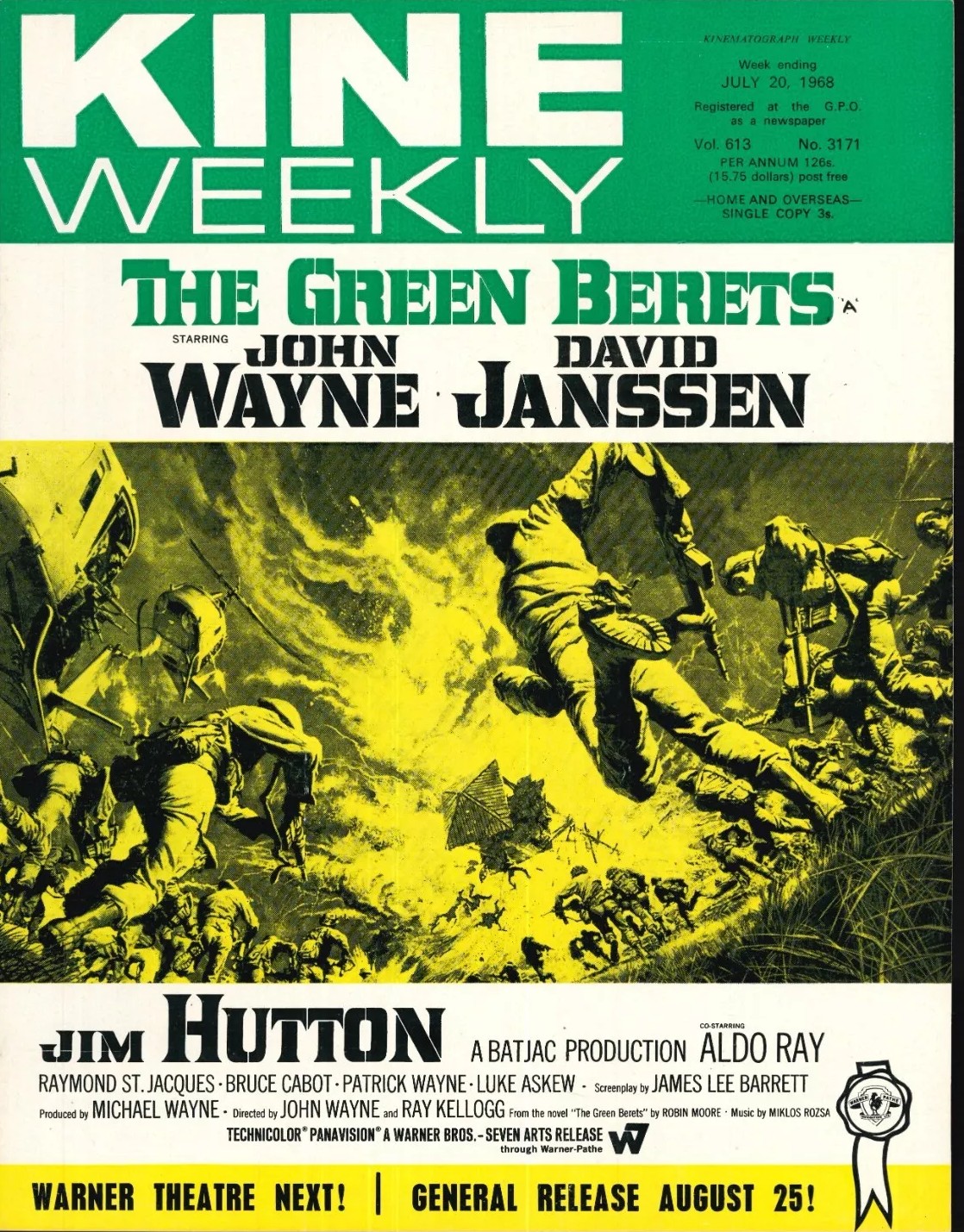
Apart from attempts to justify the Vietnam War and a hot streak of sentimentality, a grimly realistic tale that doesn’t go in for the grandiosity or self-consciousnesss of the likes of Apocalypse Now (1979), The Deer Hunter (1978) and Platoon (1978). It’s been so long since I’ve watched this that my DVD is one of those where you had to turn the disc over in the middle.
The central action sequence is a kind of backs-to-the-wall Alamo or Rorke’s Drift siege. There’s no sense of triumphalism in the battle where the best you can say is that a reasonable chunk of the American soldiers came out alive but only after evacuating the staging post they were holding, more like Ridley Scott’s Black Hawk Down (2001) where survival is all there is to savor. It’s all pretty brutal stuff, the Americans handicapped by having to also look after the fleeing Vietnamese villagers taking refuge in their camp.
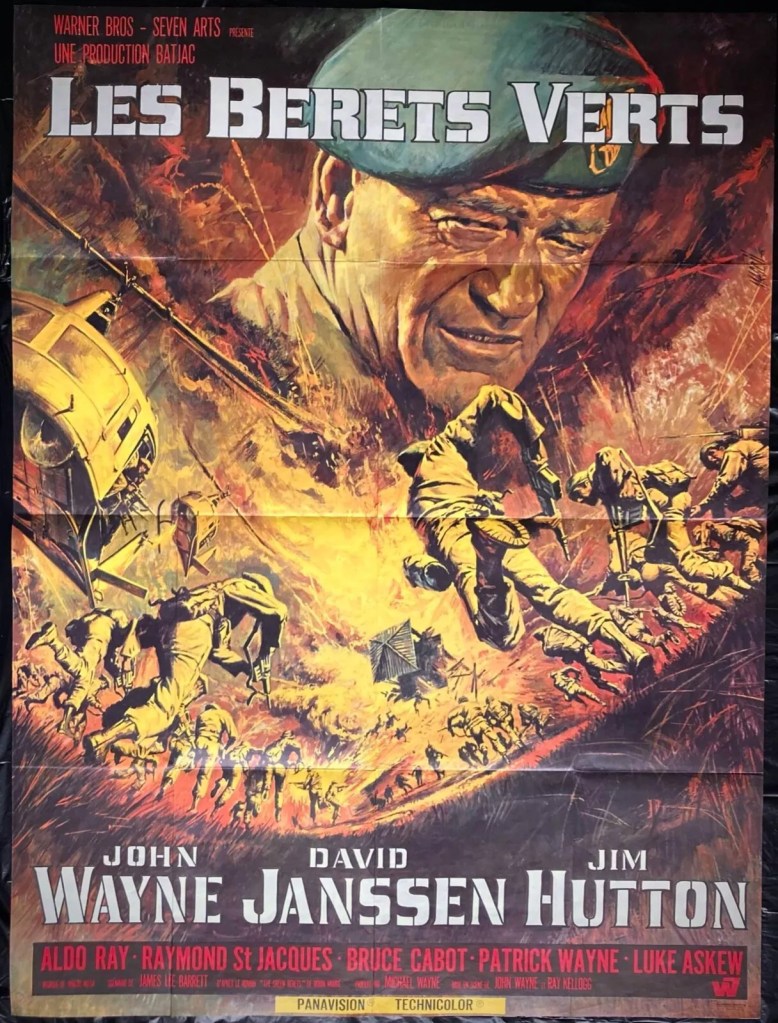
There are plenty grim reminders of how war has become even more devastating in the aftermath of World War Two. The Vietcong take, literally, no prisoners, seen as killing civilians as easily as soldiers. The Americans, for their part, have no compunction in using more sophisticated weaponry, with the addition of targeted air strikes.
Into the mix, somewhat unnecessarily, comes left-wing journo George (David Janssen) whose main job is to change his mind about the work the soldiers are doing, though admitting that to report the truth will lose him his position. He’s slung into the middle of a defensive action headed up by Col Kirby (John Wayne) to hold a position under threat against superior (in numbers) forces. There’s a fair bit of the detail of war but virtually zero about the strategy, whether that’s the U.S. Army’s plan to defeat the enemy or this individual unit’s method of defending this position. Apart from extending the perimeter of the camp to create a more effective killing zone, it’s hard to work out what the heck is going on, no matter how often orders are barked through field telephones or walkie talkies. There are squads out in the field and units in the camp and how the whole operation is meant to mesh is beyond me.
There’s not much time to flesh out the characters, save for “scrounger” Sgt Peterson (Jim Hutton) who adopts an orphan, Vietnamese soldier Capt Nim (George Takei) and Sgt Provo (Luke Askew). The rest of the motley bunch are the usual crew of monosyllabic tough guys and friendly medics and whatnot.
Though the emotional weight falls on Lin (Irene Tsu), fearing shame and being ostracized by her family for befriending the Vietcong general who killed her father and for whom she now lays a honeytrap, Kirby expresses guilt at having to kill anybody.
Despite being sent out to reinforce the position, the Americans are forced to retreat and enjoy only a Pyrrhic victory when the cavalry, in the shape of an airplane, arrives to mow down the enemy after they have captured the position.
The fighting is suitably savage, and there is certainly the notion that the Americans are not only being out-fought but out-thought and that no amount of heavy weaponry is going to win the day.
Possibly to prevent the idea of defeat destabilizing the audience, the movie shifts into a different gear, more the gung-ho commando raid picture that the British used to do so well, where Kirby heads up an infiltration team to capture the Vietcong general who has been seduced by Lin. This sets up a completely different imperative, all stealth and secrecy, the kind of operation that in the past would have been a whole movie in itself rather than the tag-end of one.
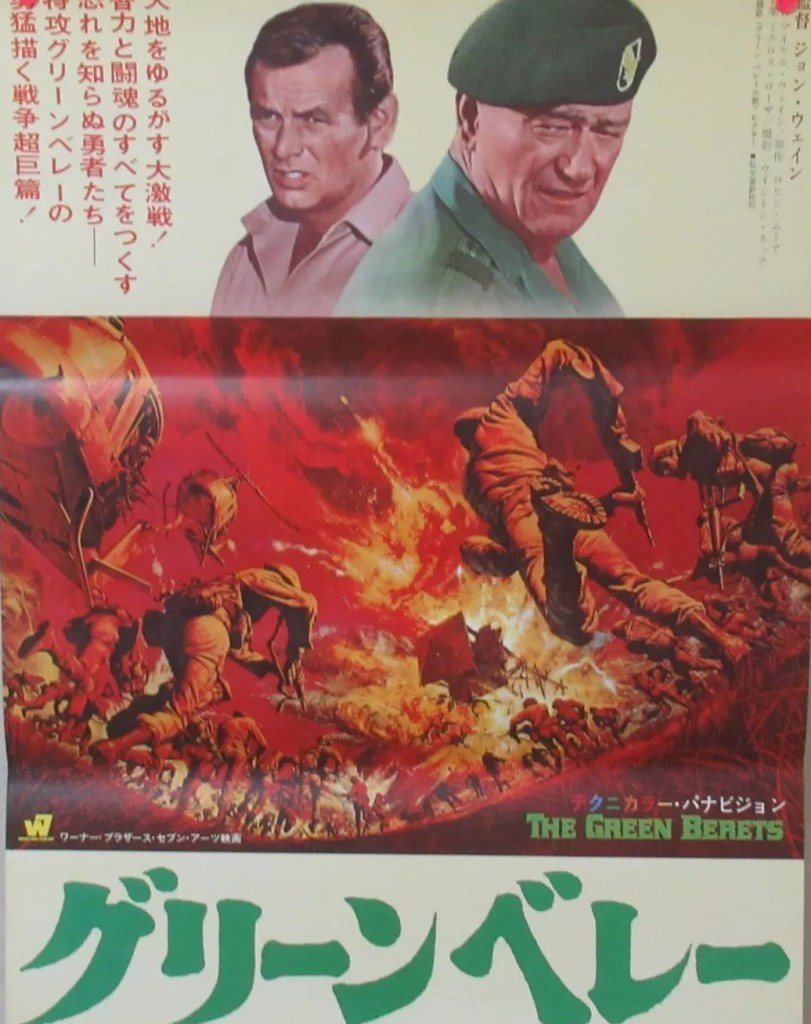
While the prime aim of this is to have the audience leave the cinema happier than if they had just witnessed the retreat from the camp, in fact it also serves two purposes. One is worthwhile, to emphasize the sacrifices made by the Vietnamese. Lin, having agreed to prostitute herself, fears being cast out as a result. But the other outcome of this mission is to kill off Sgt Peterson thus leaving the little Vietnamese lad even more orphaned than before.
John Wayne (The Sons of Katie Elder, 1965) doesn’t attempt to gloss over the weariness of his character. Jim Hutton (Walk, Don’t Run, 1966) shifts with surprising ease from comedy to drama. Even as a cliché David Janssen (Warning Shot, 1966) is underused. Watch out for Aldo Ray (The Power, 1968), George Takei (original Star Trek series), Raymond St Jacques (Uptight, 1968), Luke Askew (Flareup, 1969) and Irene Tsu (Caprice, 1967).
Three hands were involved in the direction: John Wayne, veteran Mervyn Leroy (Moment to Moment, 1966) and Ray Kellogg (My Dog, Buddy, 1960). Written by James Lee Barrett (Bandolero!, 1968) from the book by Robin Moore. Worth pointing out the score by triple Oscar-winner Miklos Rosza (The Power, 1968) especially the low notes he hits to provide brooding tension.
Certainly a mixed bag, the central superb action sequence weighted down by the need to find something to shout about.

 The Magnificent 60s
Here you go:
“On 15 Sep 1965, Var announced that producer David Wolper and United Artists (UA) had made “a handshake deal” with Robin Moore to purchase screen rights to his 1965 novel, The Green Berets, despite opposition from the U.S. Department of Defense, which disapproved of the book’s “top secret disclosures” about the U.S. Army’s Special Forces (a.k.a. Green Berets). At the time, Columbia Pictures had a competing project, for which it had already registered the title, The Green Beret.
Numerous contemporary sources, including the 10 May 1967 Var, discussed the fact that no major films about the Vietnam War had yet been produced. The Green Berets was set to be the first; however, according to Robin Moore in an interview aired on CBS-Radio’s Mike Wallace at Large, the Department of Defense fought to stop it. Moore claimed that David Wolper was threatened with “reprisals” by the Department of Defense’s Assistant Secretary of Defense for Information, Arthur Sylvester, and forced to renege on his deal. Moore also stated that Metro-Goldwyn-Mayer (MGM) had considered the project and was similarly scared away. Moore believed that the Department of Defense not only disliked the novel’s content, but the fact that it popularized the Special Forces unit at a time when the Pentagon was considering cutting the Green Berets entirely. Further angering the Department of Defense, according to Moore, was the popularity of a song he co-wrote with Barry Sadler, titled “The Ballad of the Green Berets.” Wolper, UA, and MGM denied Moore’s account, citing more banal reasons for dropping the project, such as Columbia’s ownership of The Green Beret title, and general lack of enthusiasm. Although not directly related to the film, Columbia chief Mike Frankovich gave credence to Moore’s assertions when he acknowledged that the Department of Defense had approached him about his Green Beret project, to make sure it was not based on Moore’s novel, because “they didn’t think it was good for the war.”
After David Wolper relinquished the rights to Moore’s novel, John Wayne purchased them for $50,000, as stated in a 24 Dec 1967 NYT article. Wayne’s Batjac Productions, Inc. initially had a difficult time finding a studio to finance the project, according to the 27 Sep 1967 NYT. However, by mid-Jun 1966, Wayne had made a deal with Universal Pictures to make The War Wagon (1967, see entry) and The Green Berets, as noted in the 24 Jun 1966 LAT. In preparation for the picture, Wayne and screenwriter James Lee Barrett made trips to Vietnam, the 6 Jul 1966 and 31 Aug 1966 DV reported. Wayne, who visited wounded soldiers while on a three-week tour there, was vocally in support of the war. The 1 Oct 1966 NYT also described him as strongly opposed to antiwar protestors.
Wayne was able to get the support of the Pentagon by writing a letter to President Lyndon B. Johnson. With the help of Johnson’s aides, he and his son, producer Michael Wayne, visited the Department of Defense in Washington, D.C., and assuaged their fears by promising the film would not actually be based on Moore’s book, and would only include a few of its action sequences. Michael Wayne was quoted in the 10 May 1967 Var as saying, “In Washington, they have known my father for many years, and they had confidence in his part in this.”
Universal Pictures fell out of the project over creative differences with Wayne, who then took it to Warner Bros.—Seven Arts, Inc., where the film was set up as of mid-Jun 1967, as announced in the 22 Jun 1967 DV. The production budget was estimated to be between $7 and $8 million in the 27 Sep 1967 NYT and 23 Oct 1967 LAT.
Mervyn LeRoy was brought on to co-direct with John Wayne and Ray Kellogg, the 9 Sep 1967 LAT reported. Although later sources confirmed LeRoy’s involvement, the 28 Dec 1967 DV stated that LeRoy’s name had been removed from directing credits on Warner Bros.—Seven Arts’ latest press releases.
Principal photography began 9 Aug 1967, as announced in that day’s Var. The bulk of filming took place at Fort Benning, a U.S. Army base near Columbus, GA, which stood in for Vietnam. Filming was scheduled around the clock, according to the 22 Oct 1967 LAT, which stated that a daytime crew worked until dinner, at which point a nighttime crew relieved them. The 27 Sep 1967 NYT stated that Kellogg oversaw action sequences filmed at night (roughly thirty percent of the picture), while LeRoy handled scenes in which Wayne was required to act. Despite his disappointment in the screenplay, Robin Moore visited the set, and was enticed to play a cameo role. The 1 Nov 1967 Var noted that Moore also voluntarily performed stunts, which resulted in a broken collarbone. Production was still underway in Georgia as of 23 Oct 1967, as stated in an LAT item published that day. An article in the 24 Dec 1967 NYT noted that when tree leaves turned brown due to a “premature frost,” filmmakers were forced to build a costly twenty-acre jungle in Hollywood, CA, to finish shooting.
The 3 Aug 1967 LAT named Bruce Dern as a co-star. Paul Genge was listed as a cast member in the 28 Aug 1967 LAT, and the 14 Sep 1967 LAT noted that Eddy Donno was performing stunts on the picture. According to a 2 Dec 1967 LAT brief, Vera Miles was cast in the role of “Col. Mike Kirby’s” wife. In an interview published in the 8 Dec 1967 LAT, Raymond St. Jacques noted that two or three actors rejected the role of “Doc McGee” before it was offered to him, and although it was a small part that had been written off by some as “a token,” the role was built up.
Costs were kept down with the help of the U.S. Army, which provided weapons, airplanes, and personnel, in addition to the use of Fort Benning, as stated in an article by Joan Barthel in the 24 Dec 1967 NYT. While some soldiers took leave to appear as paid background actors, others were allegedly “detailed to the movie set in place of their usual duties.” A platoon of Hawaiian soldiers were said to have taken administrative leave from Fort Devens, MA, to work on the film, which, according to NYT, meant that taxpayer money had funded their participation. The government’s financial support of the film sparked controversy, including a letter to the editor that was published in the 14 Jan 1968 NYT, in which a reader expressed outrage at Barthel’s reporting, and accused the filmmakers and the government of legal and moral corruption. Soon after, John Wayne published a statement on the picture in the 28 Jan 1968 LAT, in which he did not respond to accusations of corruption but did point out that he and his fellow filmmakers were “not debating whether it is right or wrong for the United States to be in this war. We are showing the mettle of the American fighting men.” A year after the film was released, the 27 Jun 1969 DV stated that Representative Benjamin Rosenthal, a Democrat from New York, revealed that the Department of Defense had only charged Batjac Productions $18,623, while the costs the film imposed on the U.S. Army were closer to $1 million. Rosenthal further accused the Pentagon of supporting the film as propaganda. Michael Wayne responded that the filmmakers paid adequately, and also made $150,000 worth of improvements to Fort Benning.
The Green Berets premiered on 19 Jun 1968 at New York City’s Warner Theatre, and was met with consistently negative reviews. Renata Adler’s criticism of the film, published in the 20 Jun 1968 NYT, was noted for being particularly scathing, and likened, in the 26 Jun 1968 Var, to Judith Crist’s notorious review of Cleopatra (1963, see entry). The picture became a target for antiwar protestors, beginning with the 19 Jun 1968 premiere, when thirteen out of 150 picketers were arrested, according to the 21 Jun 1968 DV. Earlier that day, rumors of bomb threats to the Warner Theatre had circulated, according to the 20 Jun 1968 DV, although the theater had denied any such threats and the premiere had proceeded as planned. As noted in the 3 Jul 1968 Var, protests were still underway, organized by members of such groups as Youth Against War & Fascism, the U.S. Committee to Aid the National Liberation Front, Veterans & Reservists to End the War in Vietnam, and The Bond newspaper for American servicemen. The 26 Jun 1968 Var noted that, while some demonstrators supported Wayne’s right to free speech, they opposed the use of soldiers who were given no choice but to work on the film as part of their duties. In response to the ongoing opposition, two city policemen were stationed outside the Warner Theatre, located in Times Square.
The film provoked protests in Germany when it opened there on 30 Aug 1968. Within days, it was pulled from exhibition at two theaters in Frankfurt and Munich, after demonstrators had incited scuffles with moviegoers and had hurled tomatoes and rotten eggs at the screen, as reported in the 11 Sep 1968 Var. German reviews were reportedly as negative as American ones, citing similar critiques such as “oversimplification of the issues, naïve portrayal of the American heroes and Viet Cong villains, and strong militarism.” The 25 Sep 1968 Var stated that the German Peace Association had appealed to the West German Ministry of the Interior, asking that the government ban The Green Berets and all other John Wayne films. Additionally, German newspaper Stuttgarter Zeitung published an editorial against the film, likening it to the Third Reich propaganda film, Kolberg (1945).
In the wake of critical backlash and protests, an 8 Jul 1968 DV brief noted that the picture had recently set two house records at theaters in Minneapolis, MN. The 12 Jul 1968 DV added that The Green Berets achieved an “opening day record” for Warner Bros—Seven Arts when it opened on 10 Jul 1968 at twenty-nine New York City theaters, and grossed $56,754 in one day. By 8 Jan 1969, Var reported that the movie had grossed $8.7 million in film rentals, to date.
John Wayne made a personal appearance at the Atlanta, GA, opening on 4 Jul 1968 at the Fox Theatre, and also at that day’s “Salute to America” parade in the city, the 26 Jun 1968 Var stated. According to the 28 Jun 1968 LAT, Wayne commissioned a monument to the Green Berets that he planned to present to the Special Forces commander at the Atlanta premiere, to later be installed at Fort Bragg in North Carolina.
The 17 May 1968 LAT stated that Robin Moore and Barry Sadler’s song, “The Ballad of the Green Berets,” would play over the titles.
Ben Wetzler worked as a camera operator on the set shortly before his death on 12 Feb 1968, according to his obituary in the 21 Feb 1968 Var.”
LikeLiked by 1 person
Thanks for that.
LikeLike
Thanks.
LikeLike
Back in the late 90’s, a producer and I were at Fort Benning for some never to be made project. Along with us was Robin Moore the author of THE GREEN BERETS novel that the movie was based on. Fascinating guy though a bit in his cups he was by then. I peppered him with questions about his movie past. Some on THE GREEN BERETS but mostly on INCHON which he was more intimately involved with.
LikeLiked by 1 person
Now there’s a forgotten movie – Inchon.
LikeLike