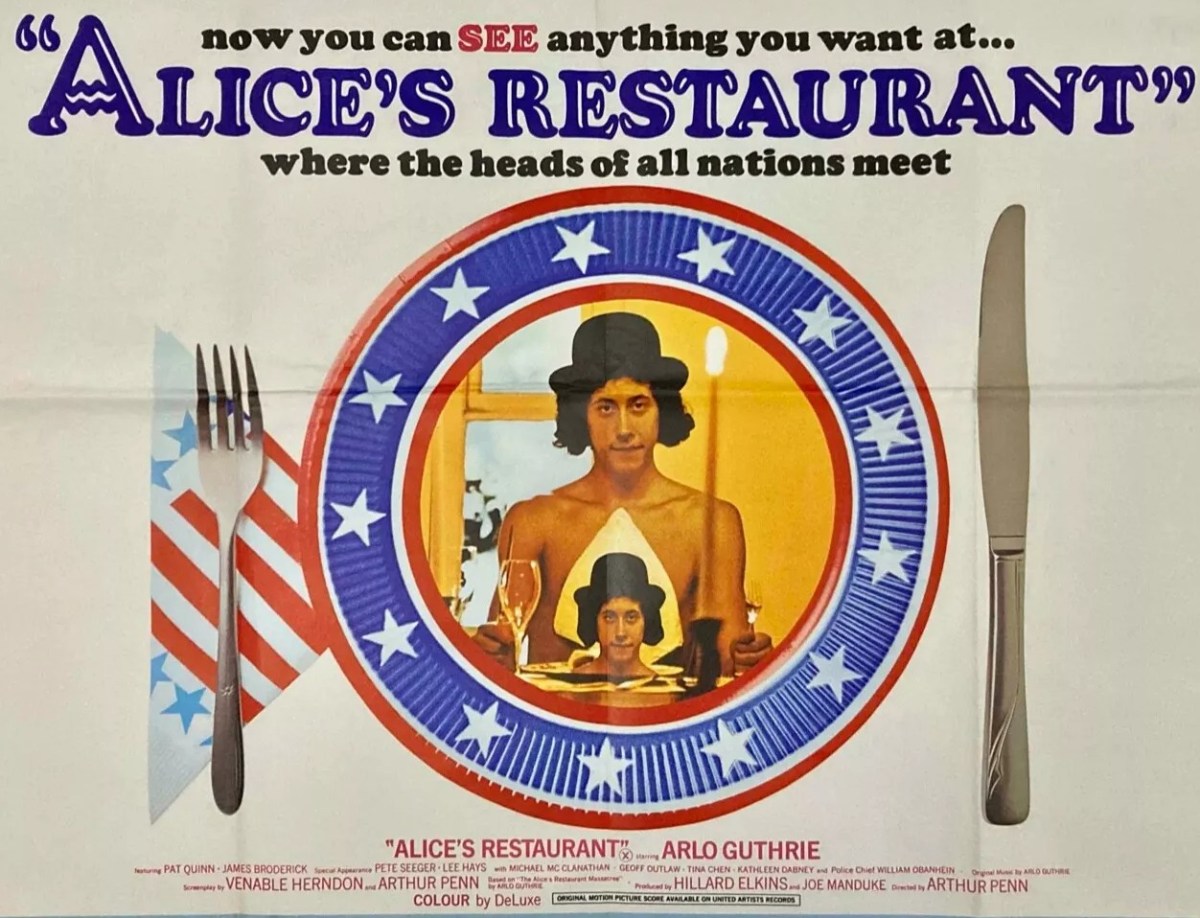
It might have been better if I’d come to this in a hazy glow of nostalgia. But I’d skipped this back in the day and although I’m a big fan of Arthur Penn I was never sparked to seek this out on VHS/DVD. So I’m coming to it for the first time. And I’m sorry to say it just feels like an indulgent mess.
It’s hard enough getting novelists to hack about their sacred texts sufficiently to turn them into workable screenplays, never mind putting the author center stage and not only have him narrate his tale but act it out. And when you discover that he’s not much of an actor, you’re not left with much but almost a documentary with drama coming from outside, from the forces of authority trying to shape the rebellious young to fit the pre-existing mold.
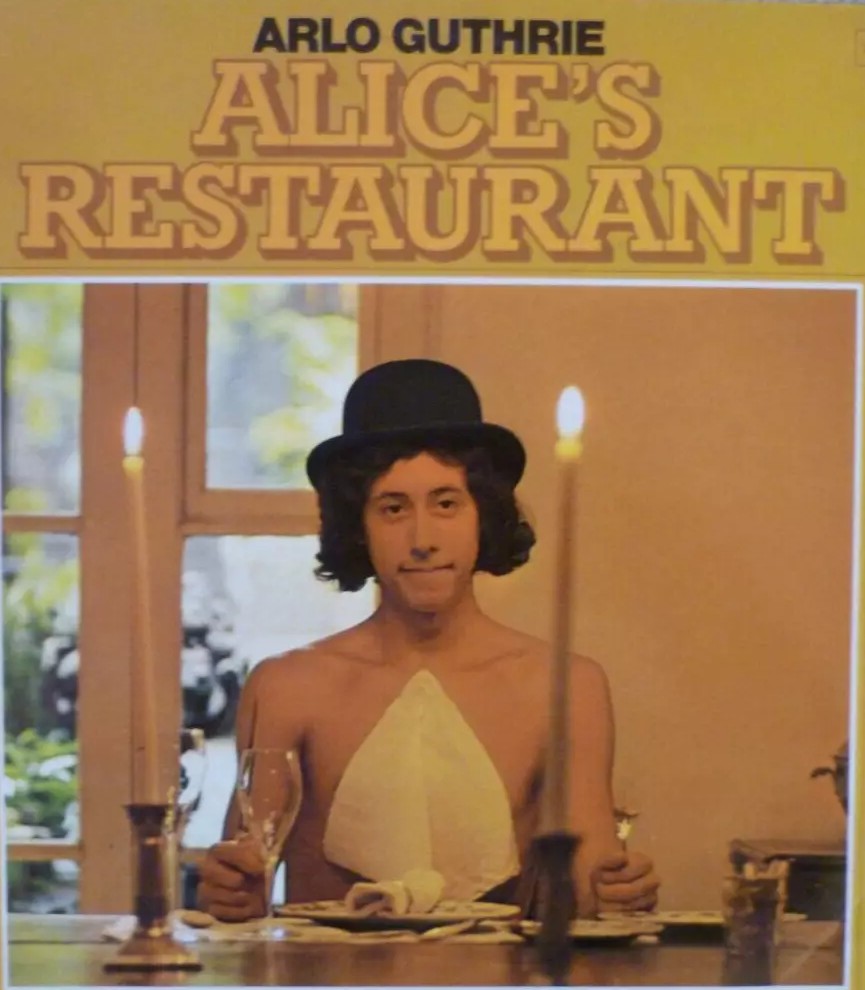
I have to confess I was never a big fan of folk music, excepting Bob Dylan I guess and you can argue he was only a folkie at the outset of his career. I was only vaguely aware of Woody Guthrie and don’t remember in the late 1960s his son ever touching the public consciousness overseas. So this might simply be one of those American movies that didn’t travel, like comedy or most musicals which had trouble matching up with foreign appreciation of those genres which tended to be nationalistic.
The narrative drive is Arlo Guthrie (Arlo Guthrie) dodging the draft. This was a right-of-passage especially for all young creatives, who would tend to be the most openly rebellious, but equally for a whole generation of young men who didn’t want to get themselves killed in a war they saw as senseless and who had gone off the idea of war altogether.
In Britain national conscription had ended in the late 1950s but there were no tales of people trying to dodge the draft. Elvis Presley had done his duty in America but Cassius Clay (later Muhammed Ali) did not – and was stripped of his World Championship. But away from all these high-profile cases, youngsters could avoid the draft by enrolling in colleges or universities, or pretending to have homosexual tendences, or shooting themselves (literally) in the foot, or claiming, as Guthrie did, that he had inherited a genetic illness – his father was dying of Hodgkins Disease – and when that doesn’t work acting mad, which doesn’t either.
What does get Arlo off national service is his involvement in a bizarre incident which made headlines at the time when he was arrested for littering and fined. When he reiterates his lack of objection to littering to the draft board, he is deemed unfit and is let off, as satirical a comment on the war between youth and authority as much as on the Vietnam conflict.
There’s a story in here somewhere but it’s so ramshackle that, at the remove of over half a century, it doesn’t even appeal to those who worship the alternative lifestyle. After being chucked out of college, he heads off to join friends Alice (Pat Quinn) and Ray Brock (James Broderick) who have taken over a deconsecrated church in Massachusetts with Alice planning to set up nearby her eponymous restaurant, and not entirely for philanthropic reasons, Arlo composing a jingle to pull in customers.
Alice, disgruntled with lack of attention from Ray, begins an affair with Shelly (Michael McClanathan), an artist and ex-heroin addict, and every now and then Arlo returns to New York to visit his father Woody in hospital (Arlo is nowhere to be seen in A Complete Unknown). There’s a motocross race, and Shelly later dies in a motorbike crash. Woody dies too and Alice and Ray get married in a hippie-style wedding.
But most of this seems viewed even then through a time capsule as if Penn is assiduously recording a counter culture. The commercial success of this film and Easy Rider the same year triggered a cycle of youth-oriented movies that put Hollywood into an even deeper financial hole
Sorry, folks, this just didn’t click. Maybe I was expecting too much. But the desultory narrative and the lack of any real acting made me switch off. While it has some of the offbeat vibe of Arthur Penn’s Mickey One (1965), it lacked that film’s compelling drive. Written by the director and Venable Herndon in his debut based on the Arlo Guthrie book.
Major disappointment

 The Magnificent 60s
Found this:
“On 17 Mar 1968, NYT announced that producer Hillard Elkins and director Arthur Penn had obtained screen rights to folk singer Arlo Guthrie’s eighteen-minute song, “Alice’s Restaurant Massacree.” Released in 1967, the record sold nearly one million copies by spring 1969, according to the 27 Apr 1969 NYT. The semi-autobiographical song was based on Guthrie’s experiences living in Stockbridge, MA. Arthur Penn—a resident of Stockbridge, himself—identified with the setting and was familiar with the real-life Alice’s Restaurant and its proprietors, Alice and Ray Brock, who were friends of Guthrie’s, the 8 Sep 1969 LAT noted.
Guthrie was cast as himself, as was police chief William Obanhein, who made his only feature film appearance in Alice’s Restaurant. The roles of “Alice Brock” and “Ray Brock” were played by Pat Quinn and James Broderick, respectively, while the real-life Alice Brock played “Suzy” and Ray Brock served as a background actor, according to the 27 Apr 1969 NYT. Geoff Outlaw, who played Guthrie’s best friend, “Roger,” was said to be Guthrie’s actual best friend, and Outlaw’s wife, singer Tiger Outlaw, was slated to make her motion picture acting debut in an unspecified role, as stated in the 12 Mar 1969 Var. Tensions arose on set between actors and their counterparts, as indicated in a 28 Oct 1969 LAT interview with actress Pat Quinn, who stated, “It was always a movie, always artificial, but the real people didn’t want to realize I was an actress; they wanted me to become part of the family.” Penn reportedly avoided casting amateurs in major roles due to the technical demands of the shoot. It was also noted in the 27 Apr 1969 NYT that Alice and Ray Brock were finalizing their divorce while production was underway.
The 1 Oct 1968 DV reported that filming began that day in Stockbridge. Other Massachusetts locations included the city of Pittsfield, where filmmakers converted an old paper factory into a studio, according to a 13 Jul 1969 LAT article. The twelve-week shooting schedule was set to conclude with a final week of shooting in New York City, and on 18 Dec 1968, a Var brief confirmed that cast and crew were relocating to Manhattan, where the majority of production was set to take place on the Lower East Side, with at least one sequence to be shot at Washington Square Park, as indicated in the 13 Jul 1969 LAT. Following principal photography, some additional shooting in Massachusetts was required.
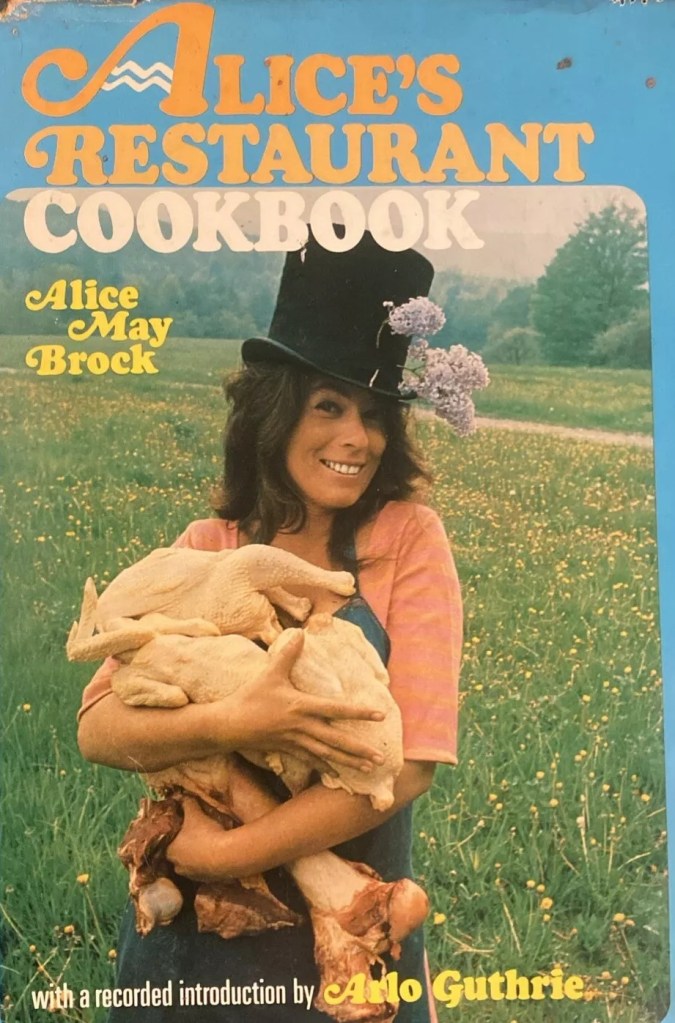
As a promotional tie-in, the 17 Aug 1969 LAT noted that first-time film producer Hillard Elkins had taken part in establishing an Alice’s Restaurant franchise, with locations planned in Los Angeles, CA, Chicago, IL, and New York City. Elkins also reportedly suggested the Alice’s Restaurant Cookbook, which Random House published in 1969.
A world premiere was scheduled to take place on 19 Aug 1969 at the Sack Cheri I cinema in Boston, MA, as noted in the 20 Aug 1969 Var. Following largely positive reviews, Arthur Penn received an Academy Award nomination for Directing. The film, which cost an estimated $2 million, fared well commercially according to the 6 Jan 1970 DV, which stated that the box-office gross was nearing $12 million, to that time.
In its initial release, Alice’s Restaurant was rated R by the Motion Picture Association of America (MPAA), restricting viewers under sixteen years of age unless accompanied by an adult. United Artists appealed the rating at least twice, and on 14 Oct 1970, Var announced that the MPAA had assigned a re-rating of GP (parental guidance suggested).
AFI student Jeff Young served a six-month apprenticeship under Penn while he was making the movie, as noted in a 30 Oct 1968 Var brief.
Alice’s Restaurant marked the feature film acting debuts of Arlo Guthrie and Pat Quinn.
LikeLiked by 1 person
That’s filled in a lot of gaps in my knowledge. Thanks.
LikeLike