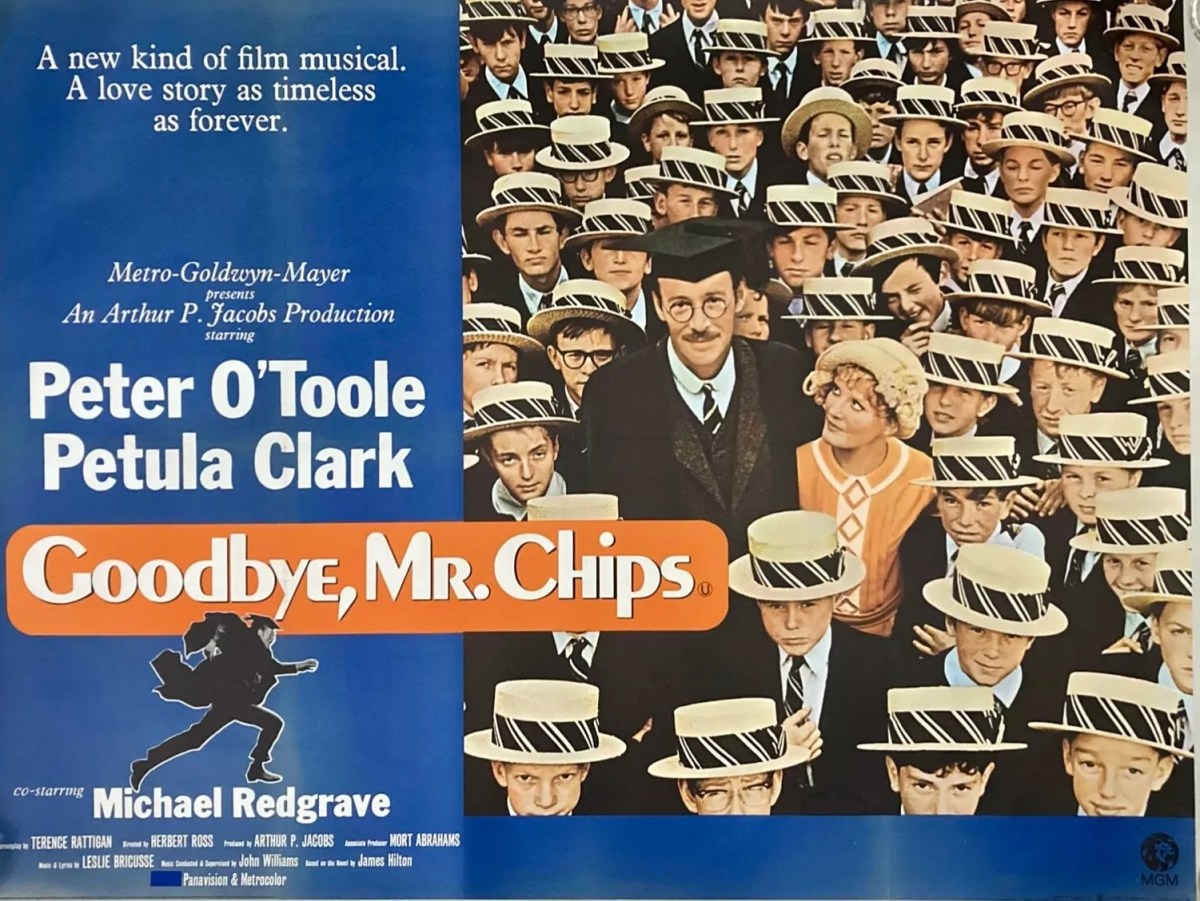
Stunning revelatory performance by Peter O’Toole (The Night of the Generals, 1967) and unexpected screen chemistry with former British child star turned pop singer Petula Clark (Finian’s Rainbow, 1968) lift a relatively humdrum musical remake of the 1939 classic. Musicals entrusted with roadshow-sized budgets usually came with the proviso that they had already conquered London’s West End or Broadway – The Sound of Music (1965), Oliver! (1968) et al – and so came with an inbuilt audience. A movie musical original with little audience familiarity was always a risk.
There had been a trend away from the choreographic splendor, star exuberance and lightweight narratives that held the key to the golden era of Hollywood musicals. The movie musical had embraced both the introspective and weightier tales – Camelot (1967) the most obvious example. Male stars who couldn’t sing could simply “talk” their way through a tune following the example of Rex Harrison in My Fair Lady (1964).
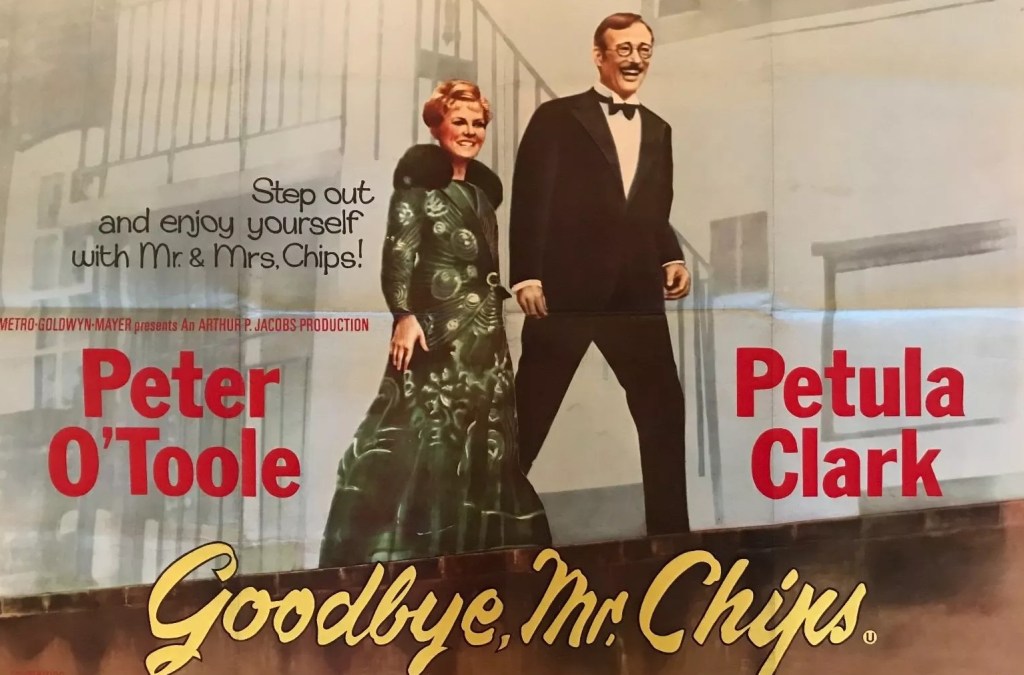
The proper stretching of vocal chords is sensibly left to Petula Clark, but none of the songs by Leslie Bricusse (Doctor Dolittle, 1967) leave much of an imprint, and you might question why MGM was in such a hurry to commission a remake at all except for O’Toole’s Oscar-nominated turn. By now audiences were well aware of the actor’s screen tics and the intensity he could bring. But moviegoers might as well have been embracing a new star because everything you ever knew about O’Toole was left at the door.
In some respects the realism of his performance plays against the picture, which, effectively, save for the ending, has a lightweight narrative. There’s nothing remotely charming about his characterization of Arthur Chipping. He’s not the kind of eccentric fuddy-duddy that was a common feature of the British movie. Duty has got in the way of likeability. We are introduced to him denying a poor lad the opportunity to become a school tennis champion on the last day of term simply because the match had been scheduled to take place within teaching hours. Small surprise that he is actively disliked, although he takes that, in some respects, as a mark of his teaching prowess.
Unexpectedly, he is introduced to music hall singer Katherine (Petula Clark). What would be the standard meet-cute turns into a meet-awful as unintentionally he delivers a series of insults. Unexpectedly, they meet again, this time in the kind of surroundings that suit his mentality, a Greek amphitheater where he can demonstrate his academic skill, filling her on the acoustics and on the fact that sound travels upward so it’s easier for the person seated above to hear the person standing below than the other way round. Cinematically, this is superbly done, the best scene in the picture from a visual perspective.
Even though, initially, he has no recollection of their previous meeting, a spark is lit and catches fire so that when he returns to school it’s with a somewhat “unsuitable” bride. The best scene in the movie from an emotional perspective is driven by Katherine as she injects some verve into the stodgy school hymn so much so that she soon has the entire school singing with gusto and as though they have for the first time understood the lyrics.
It’s not long before her influence softens the harsh schoolmaster. But she is not a welcome addition in many eyes, her background not what would be expected of a schoolmaster’s wife, and a couple of sub-plots revolve around the impact of her unsuitability on her husband’s career. There’s not much more to go on beyond the sad ending and as I said the songs are treated in low-key fashion rather than full-on energy with dancing schoolboys in the background.
But you don’t really need the songs to enjoy this. Peter O’Toole’s sensational performance more than justifies the remake while the pairing with Petula Clark works surprisingly well.
Herbert Ross (Play It, Again, Sam, 1972) makes his directorial debut. Terrence Rattigan who had previously delved into the public school system to find lonely teachers with The Browning Version (1948) updates the original tale by James Hilton. This is not the performance Peter O’Toole fans would generally nudge you towards, because it’s such an oddity in his portfolio, but, truly, this deserves much wider appreciation

 The Magnificent 60s
One thought on “Goodbye, Mr Chips (1969) ****”