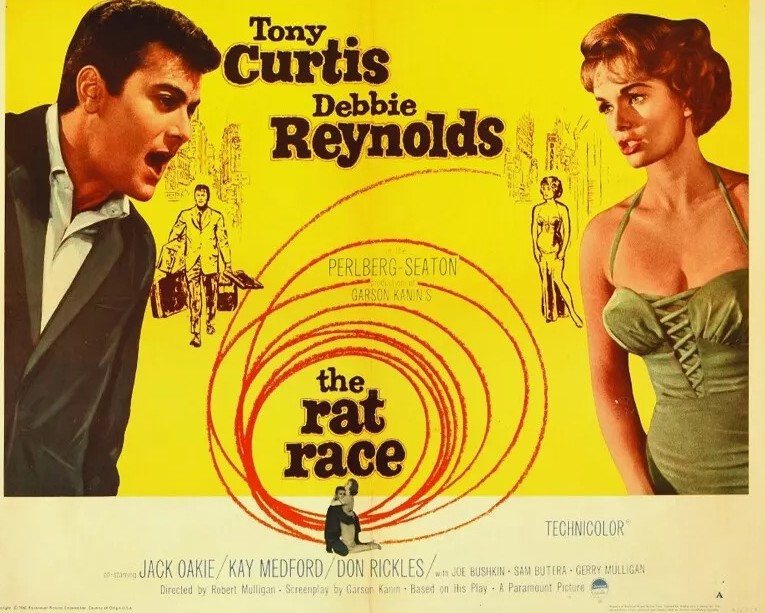
Surprisingly hard-edged tale with Debbie Reynolds giving the performance of her career and with a steely contemporary relevance. Snookers the audience into thinking it’s a standard romance, mismatched characters thrown together by circumstance, various rows and incidents to keep them apart before the expected happy ending. If screenwriter Garson Kanin had held his nerve, there wouldn’t be the get-out of a happy ending. As it is though, a formidable drama that doesn’t pull its punches.
From the title I expected a movie set in the world of big business, but instead we’re looking down on the lowest tiers of the entertainment business and, effectively, it’s a piece about the price paid for dreams. There are laffs, some good one-liners, but even these have a sourness to them.
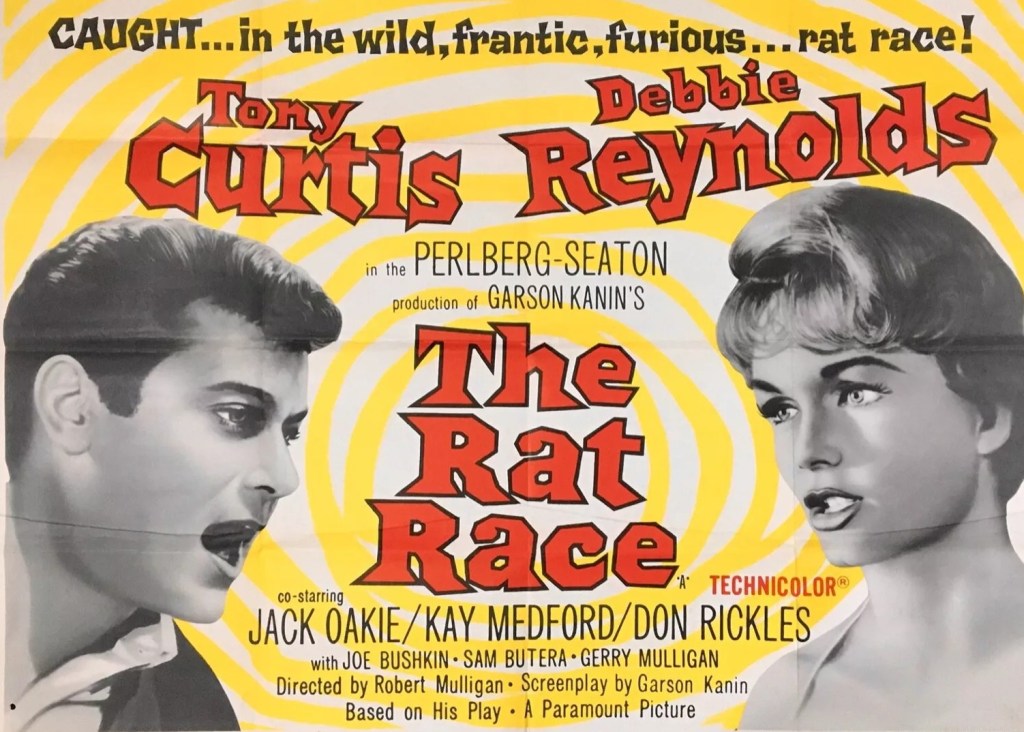
Pete (Tony Curtis) leaves Milwaukee for New York seeking fame and fortune as a saxophonist, not realizing he’s more likely to join the thousands of out-of-work musicians already resident, dreams dashed but determined to avoid the ignominy of going home with their tails between their legs, not just to face the mundane life that awaits but seared through with the guilt of failure. Through circumstance he ends up sharing an apartment with model-cum-dancer Peggy (Debbie Reynolds), who’s already given up on her dream once, but couldn’t stand more than a few minutes of the home she’d clearly been desperate to leave.
Peggy is clean out of modelling assignments and hasn’t made it to Broadway, either, not even to a chorus line. Instead, she earns not much of a living as a taxi dancer, more innocent than it would be now in the era of the lap-dancer but still seedy enough with roving male hands. She’s paid to dance with complete strangers, the kind of deadbeats unlikely to ever get on the dance floor with a beautiful woman in the normal course of events.
She’s about to lose her phone, but not above leading on the creepy repairman (Norman Fell) to believe he’s onto a promise should he give her a break. Only pride prevents her solving her financial problems – as well as not making her rent she owes cash to her sleazebag boss Nellie (Don Rickles) – by going down the sex worker route.
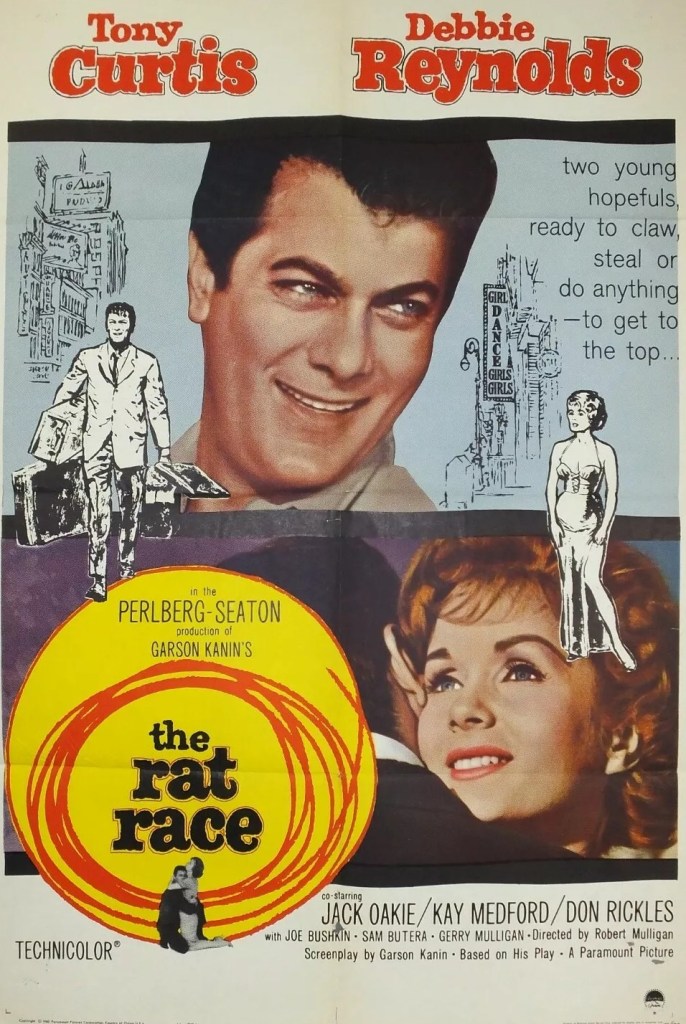
Pete thinks he’s got the smarts but in fact he’s afflicted with dumbness and gets ripped off for a mink coat made of cat fur and then loses a complete set of brand-new musical instruments to another scam. When he’s thrown the lifeline of a gig on a cruise ship, Peggy stumps up to buy him a new sax and the requisite tux. She’s paying for this with a promise to Nellie to enter the prostitution game, not quite spelled out as that but as close to the knuckle as you’re going to get in this era, the kind of soft-soap approach that worked for Butterfield 8 (1960).
When Peggy fails to deliver, Nellie humiliates her in the worst possible way. Beginning with her jewellery he strips her down to undergarments to show how much he owns her and just how good he is at playing hardball. It’s a gut-clenching scene. Sure, you know there’s not going to be any nudity, not in this period before the Production Code got flattened, but even so, it works extraordinarily well, especially as clearly Peggy doesn’t know just how far he will go and that he might not, in his quiet fury, be above turning her out into his club starkers.
Meanwhile, to ensure we get to the ending that audiences expected, Pete, on board the ship, has been ignoring any other romantic opportunities, and sending her a heartfelt letter a day, which she appears determined to ignore, knowing that the “rat race” isn’t the kind of world that accommodates long-term romance.
Suffice to say, when Pete manages to bail her out, that changes her mind, though the genuine Peggy would still have balked, knowing that, with their levels of talent, they were only going to become more wasted by lack of fulfilment.
So, yeah, happy ending, but you feel that’s been grafted on to allow audiences to take the rest of the tougher storyline. The MeToo campaign has exposed the pitfalls of the entertainment business, so what happens to Peggy wouldn’t come as a surprise to a contemporary audience.
By this point Debbie Reynolds (Goodbye Charlie, 1964) wasn’t known for drama, more for a spunky or sparky screen persona in a series of lightweight comedies or romances, this showed Hollywood what it was missing. Tony Curtis (Goodbye Charlie) had proven he could do comedy or drama and here he mostly plays it straight.
Director Robert Mulligan (The Stalking Moon, 1968) is probably responsible for maintaining the harder edge. This was originally a Broadway number, so I doubt if the sharpness would have worked so well in that medium. Garson Kanin (Where It’s At, 1969) and an uncredited John Michael Hayes (Nevada Smith, 1966) knocked out the screenplay based on the former’s play.
Worth it for Reynolds alone.

 The Magnificent 60s
2 thoughts on “The Rat Race (1960) ****”