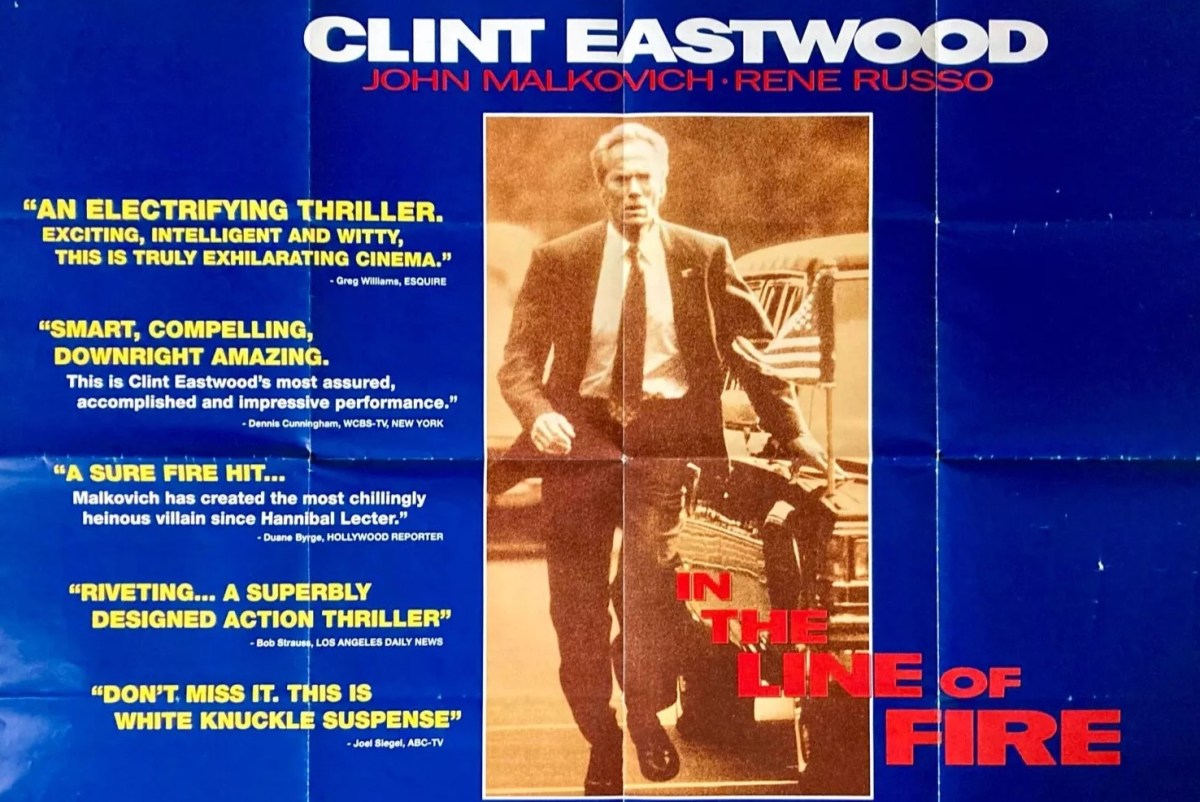
Outside of the top-billed trio of Julia Roberts, Sandra Bullock and Meg Ryan, Rene Russo stole the limelight as the decade’s leading lady, bolstering the credentials of such supposedly superior marquee names as Dustin Hoffman (Outbreak, 1995), Mel Gibson ( Lethal Weapon 3, Ransom and Lethal Weapon 4, 1992, 1996 and 1998), John Travolta (Get Shorty, 1995), Kevin Costner (Tin Cup, 1996) and Pierce Brosnan (The Thomas Crown Affair, 1999) – an almost unprecedented, for a female star of the period, roster of hits.
Not only that, but she had also come to the game late, 35 at the time of her debut in Major League (1989) and therefore well into the most dangerous age for a female star in Hollywood, her 40s, by the time she came to work with some of the industry’s biggest names. By comparison Julia Roberts was 23 at the time Pretty Woman (1990) was released, Meg Ryan 28 when she captured hearts in When Harry Met Sally (1989) and Sandra Bullock 32 when she snazzed Sylvester Stallone in Demolition Man (1993).
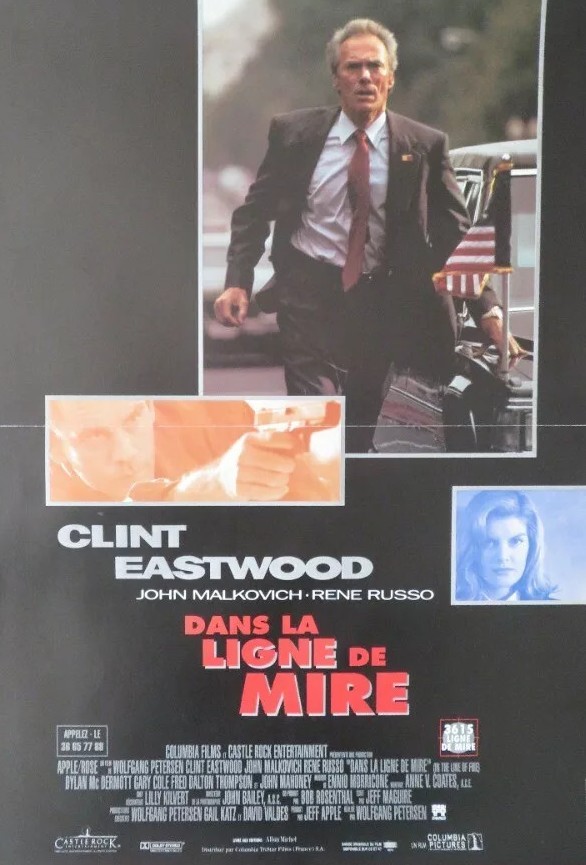
It’s worth remembering that Eastwood, the previous decade washed away with insipid box office, was entering a late career halcyon period, his critical and commercial esteem boosted by the Oscar-winning Unforgiven (1992). Previous male superstars close to retirement age weren’t called upon to put in a sprint or two. Sure, John Wayne and James Stewart could land a good punch, but that was generally in a confined space and nobody was calling on their athletic skills. But, here, Eastwood set the tone for later pictures like Taken – and he was a decade older than Liam Neeson in that one.
Russo, an MTA, oozed class and maturity, never looked as if she was out of her depth or if she would come off second best to any of the macho males she was generally surrounded with. This isn’t her greatest role – her duel with Brosnan takes that accolade – but comes pretty close.
As Lilly Raine, she nurses ageing Secret Service agent Frank Horrigan (Clint Eastwood) over the line. Frank isn’t just perennially out of puff, but catches bad colds and makes such a basic error that he’s chucked out of the presidential protection elite, though kept on by boss Sam (John Mahoney) in a bid to track down assassin Mitch Leary (John Malkovich).
This is nuts-and-bolts action, a lot of time spent in basic detection, following up insignificant leads, but it’s also a classic hunter vs. hunted duel, with for the most part the assassin getting the upper hand, running rings round the entire Secret Service with his disguises and ability to remain more than one step ahead. Instead of a car chase, there’s a rooftop chase.
Horrigan is the kind of imperturbable cop who doesn’t mind partner Al (Dylan McDermott) being suffocated half to death if it gives him an edge on a villain. He’s got a chequered past, maligned by the Warren Commission in the Kennedy assassination report, feeling his age, but when life gets too tough tinkers away at the piano.
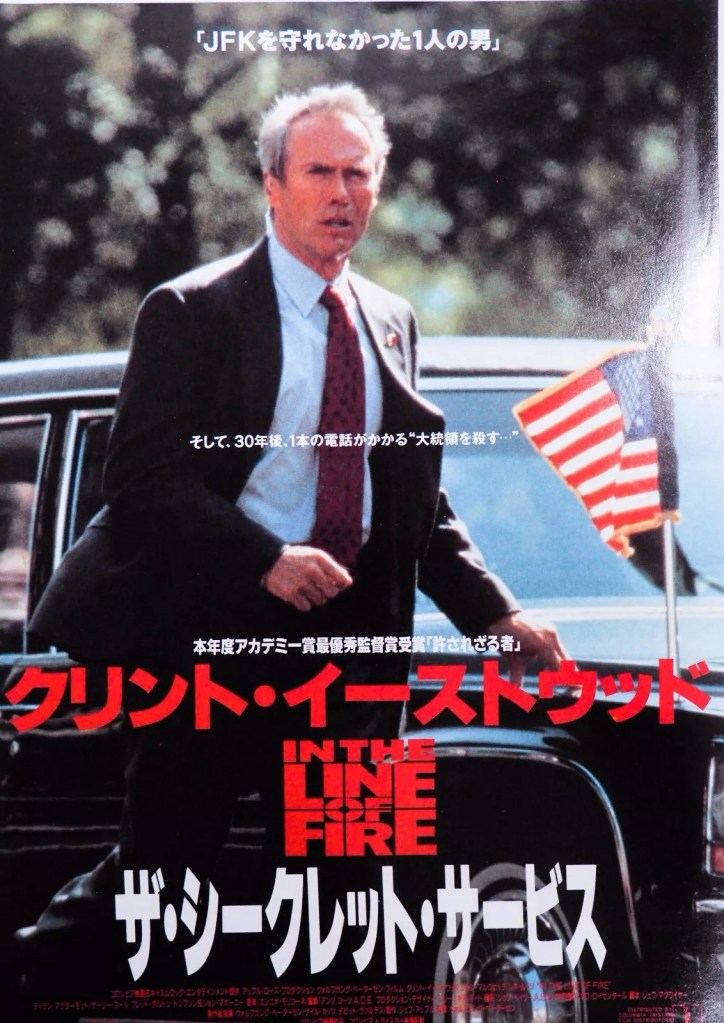
He has spicy exchanges with Lilly, taking sexism to what was an acceptable limit back in the day (now of course he’d be in the same dinosaur category as James Bond), and in due course, in quite oblique narrative fashion, wooing Lilly. The sex scene is treated as comedy, the first items to hit the carpet in the undressing malarkey are not panties and bra, but handcuffs and pistols. Hot romance is put on the back burner, which is just as well because Horrigan has his hands full not just with Leary but with a variety of superiors what with his inability to bite his tongue.
Meanwhile, we follow Leary as he coldly disposes of two men and two women in separate instances who have inadvertently caught him out. And he’s not going to make it easy for Horrigan. This isn’t the one-plan-man of previous assassin pictures, he doesn’t just have a back-up, instead employing all sorts of strategies to mislead and misdirect. And he’s not your usual nutter either. Clearly, he’s a worthy opponent, matching the enterprise, initiative and imagination of the anonymous killer of Day of the Jackal (1973). And in those days, what with developments in technology, an assassin can assemble his own gun rather than handing the task, as in Day of the Jackal, to a denoted weapons expert.
The stunning key sequence, astonishing in character terms, is when Horrigan passes up the option of shooting the assassin stone dead in favor of saving his own life – resulting in the irony (as Leary points out) of good guy being saved by bad guy. And in avoiding such action Horrigan condemns his partner to death. There’s as good a scene where I could swear Horrigan’s chin wobbles as he wonders if he could have prevented Kennedy’s death.
Sure, this is a variation on the serial killer trope of someone tormenting a potential victim, but the connections Leary attempts to build with Horrigan aren’t as far short as the cop would like to believe.
Director Wolfgang Peterson (Outbreak) is due considerable praise especially for his pacing, fitting in a complex narrative in a shade over two hours, building tension in myriad ways, but not being afraid to take a laid-back approach with the camera, long, lingering shots establishing mood and occasionally character. The sequence where Horrigan waits, somewhat wistfully, for Lilly to look back from a considerable distance after they have enjoyed an ice-cream together on a national monument is in many ways one of the finest nods to incipient romance ever put on celluloid.
Terrific acting all round. Written by Jeff Maguire (Victory, 1981).
Superb stuff. Top notch.


Found this:
According to a 13 Jul 1993 LAT article, producer Jeff Apple, a former student of director Martin Scorsese at New York University (NYU) in the early 1970s, was struck by the “imposing” nature of U.S. Secret Service agents during a 1964 motorcade of President Lyndon B. Johnson in FL, which he attended as a fifteen-year-old boy. Apple later hired his classmate at NYU, Ken Friedman, to write a script about Secret Service personnel. On 16 Dec 1983, HR announced that Apple and co-producer Bob Rosenthal’s company, Apple/Rose Productions, acquired “independent financing“ from private investors based in Connecticut to develop four projects, including In the Line of Fire, which was a yet unfinished script by Friedman. The film was reportedly in development for over nine months prior to the deal, and production was scheduled to begin summer 1984. A 4 Jan 1984 Var news item formally announced Friedman’s role as screenwriter.
As stated in LAT, director Michael Apted was intrigued by the project in its early stages of development but requested revisions. At the same time, actor Dustin Hoffman contracted to play the starring role. Hoffman’s association with Columbia Pictures facilitated a deal for Columbia to produce the film, but when executive David Puttnam took over as the studio’s chairman several weeks after the contract was signed, Hoffman pulled out because of “reported bad blood” between himself and Puttnam. Nearly two years later, Hoffman arranged for Warner Bros. Inc. to produce In the Line of Fire but, according to Apple, Hoffman had lost interest in the project by that time and decided to pursue a role in Rain Man (1988, see entry) instead. With the loss of Hoffman, Apple was unable to find a studio to back the film.
After another two years, Scott Immergut, an executive at Hollywood Pictures, expressed interest in the picture and asked for rewrites, provoking Apple to abandon Friedman’s original script and hire Jeff Maguire to write an entirely new version. At the time, Maguire had only one credit as screenwriter on a theatrically released feature film, the Canadian picture Toby McTeague (1986). According to LAT, Apple conceived the lead character, “Frank Horrigan,” and the historical backdrop of President John F. Kennedy’s assassination on 22 Nov 1963, when Maguire took over the script. A 4 Jul 1993 LAT article reported that Horrigan was “loosely based” on Clint Hill, a Secret Service agent who clambered onto J.F.K.’s limousine during the assassination in an attempt to save the president. The 13 Jul 1993 LAT stated that Maguire’s script was offered to Robert Redford, Sean Connery and Warren Beatty, but Apple was unable to secure a new star and Hollywood Pictures lost interest. Although Imagine Entertainment was intrigued by the project, the studio requested that Horrigan be rewritten for a younger actor, effectively removing the character’s association with J.F.K. Before changes were considered, however, in Apr 1992, Hollywood Pictures renewed its interest and Maguire, who did not have an agent, was quickly picked up by the United Talent Agency (UTA). According to LAT, the momentum sparked a bidding war and it took less than two days for the property to be purchsed by the independent studio Castle Rock Entertainment for approximately $1.4 million. Pre-production started two months later in Jun 1992. A 6 Apr 1992 DV article reported that the sale was notable because it marked one of the highest prices paid for a speculative script at the time and because two talent agencies worked together to engineer the auction, Maguire’s UTA and Apple’s Creative Artists Agency. DV stated that bidding began only hours after the script was sent to studios, and Walt Disney Studios, Paramount Pictures, Island Pictures and Warner Bros. were included among the bidders. According to DV, Castle Rock’s purchase of In the Line of Fire, which was a “polished” albeit speculative script, was unusual because the studio was known for developing screenplays in-house.
LAT stated that actor Clint Eastwood signed to star in the picture only several days after the deal with Castle Rock solidified, and the actor had “final approval” of its director. A 10 Jun 1992 DV article announced that Wolfgang Petersen was hired to direct at the behest of Eastwood and a sixty to sixty-five day shooting schedule was set to begin at the end of Sep or beginning of Oct 1992 in Washington, D.C., Los Angeles, CA, and Chicago, IL. According to HR production charts on 15 Oct 1992, principal photography began 3 Oct 1992. As noted in LAT, Castle Rock approached New Line Cinema for financing, but New Line was unwilling to support a budget of approximately $40 million and Castle Rock instead negotiated a deal with Columbia Pictures. DV noted that Columbia bid “aggressively” early on in the sale of the script, but withdrew in order to avoid competition with Castle Rock as Columbia was the domestic distributor of Castle Rock productions. Although Castle Rock executives told LAT that Columbia’s involvement with the film’s production and content was minimal, Columbia representatives claimed that their studio played a collaborative role. Siding with Castle Rock, Maguire stated that although Columbia’s contibutions to the production were few, the studio made several suggestions that were adopted into the film, including a change in the ending, which gave the character “Lilly Raines,” played by Rene Russo, a more active role. Columbia also pushed for Russo’s casting, according to LAT, although a 22 Jun 1992 Var news item reported that Sharon Stone was also considered for the role. On 14 Aug 1992, Screen International announced that actor Vincent D’Onofrio was cast as the film’s villain, “Mitch Leary,” but the part eventually went to John Malkovich.
According to studio production notes from AMPAS library files, shooting began on Washington D.C.’s Pennsylvania Avenue, where a parade was staged to represent the campaign trail of the film’s incumbent president. The two-day shoot took over an eight-block radius, required weekend traffic to be rerouted and involved 2,000 extras. Other Washington, D.C., locations included Lincoln Memorial, the United States Treasury, Dulles Airport, the Corcoran Art Center, Ebbitt Grill on 15th Street, and various neighborhoods surrounding the city. Los Angeles locations included Los Angeles International Airport, the Bonaventure Hotel, the Biltmore Hotel, Universal Amphitheater, Pasadena Art Center, Apple’s Bar and soundstages at Sony Pictures Studios in Culver City, CA. The interior of Air Force One was duplicated with close attention to detail and included the Presidential seal on objects not captured on film, such as the seat belts. Although Chicago was listed in DV as a possible location, the city was not mentioned in production notes or HR production charts.
A 24 Jun 1993 L.B. Press-Telegram news item reported that Eastwood performed his own stunts during the rooftop chase sequence, which required him to dangle from a building’s sixth-story ledge. Petersen stated that it was “the scariest shot” he ever directed, but added that Eastwood was protected by a safety harness and wire. In the 4 Jul 1993 LAT article, Petersen expressed that the film was shot during the 1992 presidential campaign, and because of the filmmakers’ association with the Secret Service, they were allowed to film at real rallies. According to a 13 Aug 1993 L.A. Weekly article, one such rally was during Bill Clinton’s visit to Denver, CO. Digital technology was used in post-production to erase images of speakers and insert footage of the film’s actors, as well as altering texts on placards. Production notes reported that the film wrapped in Los Angeles on 11 Jan 1993.
As noted in the 6 Jul 1993 DV review, the film marked Eastwood’s first picture away from Warner Bros. since 1979, when he made Escape from Alcatraz for Paramount, as well as his first performance in a film that he did not direct, himself, since Pink Cadillac (1989, see entry). Although Eastwood was not credited with any of the film’s music, he did play piano in the role of Horrigan, himself, according to a 21 Nov 1993 Parade brief. However, the Epic Records soundtrack album versions of the songs were performed by professional musician Jay Rosenthal.
According to various contemporary sources, including the 4 Jul 1993 LAT and a 16-22 Jul 1993 Los Angeles Village View article, the film marked the first time the U.S. Secret Service cooperated in the development and production of a Hollywood film. Apple told Los Angeles Village View that while he was working on the first script with Friedman in 1983, he approached the Secret Service’s head of public affairs, Robert Snow, and convinced him that they were “attempting for the first time to show a realistic movie about the Secret Service, as opposed to the caricatures that have normally been created in other movies and television.” Apple reported that Snow, who was credited as the film’s technical advisor with the title “Assistant director, U.S. Secret Service,” was intimately involved with the writing process to check for errors and misrepresentations. As stated in the 16 Dec 1983 HR article, Apple also hired Jack Warner Jr., a retired U.S. Secret Service agent who worked closely with many presidents, including President Kennedy, as an advisor just after he secured funding from independent investors in Dec 1983. In Los Angeles Village View, Apple expressed that he was struck by the agents’ “impartiality,” both politically and emotionally, and their “willingness to take a bullet on a leader’s behalf.” In response to an inquiry about whether the weapon used by Leary in his assassination attempt was authentic, the 26 May 1995 Reader reported that “no gun made made entirely out of plastic is currently available” but may be “feasible… in a matter of time.”
In a flashback sequence, Eastwood was protrayed as a younger man at J.F.K.’s assassination. According to Los Angeles Village View, the effect was created by combining footage of Eastwood from the 1971 film Dirty Harry (see entry) with newsreel footage of the motorcade in Dallas, TX. Digital effects were used to manipulate the lighting, motion and perspectives in order to make the scene appear realistic and, according to Apple, the process was “painstaking, expensive and time-consuming.” Apple told L.A. Weekly that the picture marked “the first use of digital special effects… not for a science-fiction film” and, in the assassination scene, Eastwood was given “the first digital haircut.” In Los Angeles Village View, Apple noted that Eastwood was always his first choice for the role of Horrigan, but Maguire denied writing the part with the actor in mind.
According to an 11 Jun 1993 HR brief, In the Line of Fire was released on nearly 2,000 screens nationwide and HR’s Cinemascore Movie Report on 13 Jul 1993 stated that ninety-five percent of opening-night audiences gave the movie an A or B grade. As noted in a 25 Jul 1993 L.B. Press-Telegram brief, President Bill Clinton praised the movie in a Larry King interview for the television network, CNN, but Petersen decided against using the President’s comments in the film’s advertisements because he was unsure whether it would “help” or “hurt” box-office appeal. According to the 13 Jul 1993 LAT, the film grossed over $15 million in ticket sales its opening weekend.
The film was nominated for the following Academy Awards: Actor in a Supporting Role (John Malkovich), Film Editing (Anne V. Coates) and Writing (Screenplay Written Directly for the Screen for Jeff Maguire.
LikeLike
Wow. Fabulous piece. Thanks a lot for all your work.
LikeLike