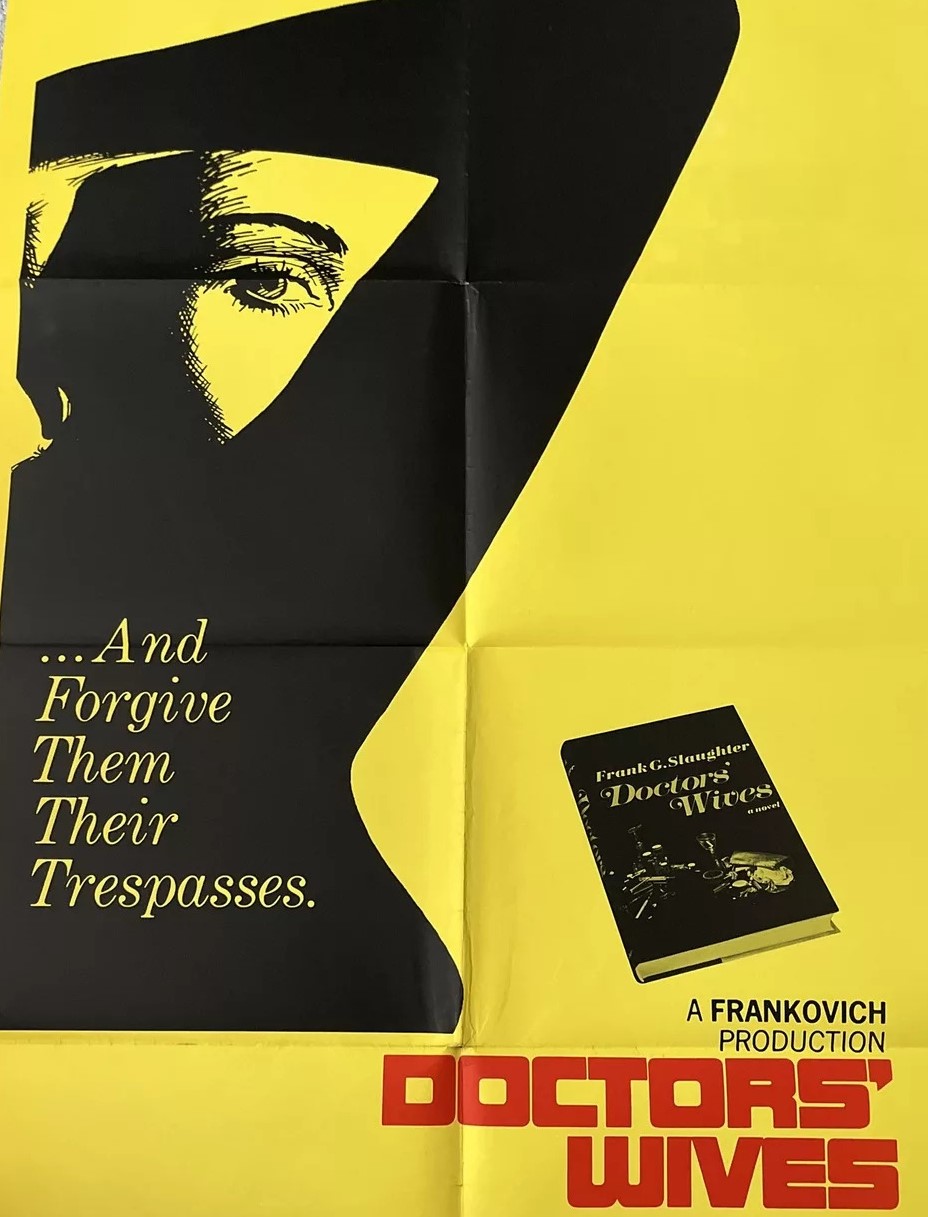
Doctors Wives (1971) ***

Five-star so-bad-it’s-good. Every now and then, especially approaching the annual touting of earnest films for Oscar consideration, we need reminded of just how good Hollywood is at producing hugely enjoyable baloney. Excepting the proliferation of recent MCU disasters, cinematic train wrecks don’t come along nearly often enough. Such botched jobs are always better if they are stuffed full of the worthy – Oscar recipients or nominees. Gene Hackman, Dyan Cannon, Rachel Roberts, Ralph Bellamy and screenwriter Daniel Taradash fulfil that requirement here.

A cross between Sex and the City and ER, with a third act that takes off like a rabbit desperately seizing on any convenient narrative hole. And a first act that pulls the old Psycho number of killing off the star before the picture really gets going. That old murder MacGuffin works every time.

“I’m horny” is about the third line in the movie, announced by sex-mad Lorrie (Dyan Cannon) to a tableful of over-refreshed doctors wives playing sedate poker in a country club at one table while at another table where you would expect the doctor husbands to be telling dirty jokes and whispering inuendoes they are boring each other with shop talk.

Unable to get the others to engage in revealing snippets about their sex lives, Lorrie rounds off the evening by informing the ladies that she plans to have sex with all their husbands to tell them where they are all going wrong, meanwhile gaily proclaiming she’s halfway there already. Which, of course, sets off a round of suspicion and accusations from wives to husbands.

Just to keep you straight on the who’s who: Lorrie is married to Dr Mort Dellman (John Colicos), Dr Peter Brennan (Richard Crenna) to Amy (Janice Rule), Dr Dave Randolph (Gene Hackman) to Della (Rachel Roberts), and Dr Paul McGill (George Gaymes) to Elaine (Marian McCargo) while Dr Joe Gray (Carroll O’Connor) and his ex- Maggie (Cara Williams) still hang around with the group.

As you might expect, every marriage is already in trouble, except, apparently, Lorrie’s because her husband, equally sex-mad Mort, appears to indulge his wife’s whims. Except, he’s not so easy-going, given he puts a bullet in her back when he discovers her making love to one of his colleagues.

Exactly which one remains a mystery for just long enough for the wives to rack up the suspicion level, and all the audience has to go on is the naked arm waving limply trapped under the naked dead weight of the corpse.
You might think, what with Dyan Cannon’s name being top-billed and she quite the rising star after an Oscar nomination for Bob & Carol & Ted & Alice (1969), that we’re going to flip into a series of flashbacks to accord her more screen time. But, no, all we get is that opening risqué scene and her naked corpse.

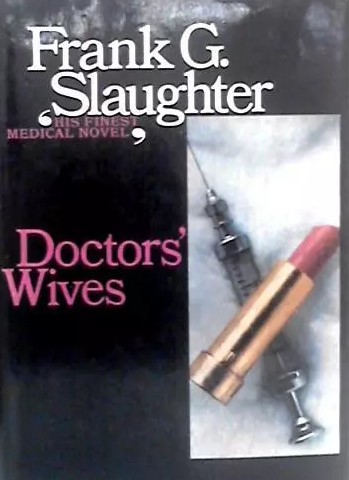
Before ER’s creator Michael Crichton came calling a couple of decades later, the surgical profession was mostly represented in formulaic soap opera of the Dr Kildare small screen or The Interns (1962) big screen variety. But author Frank G. Slaughter, himself a practising physician,  had made his name with a series of bestsellers that went into the intricacies of surgery and involved genuine medical jargon. So, before the identity of the illicit lover can be revealed, his life has got to be saved – after all he’s got a bullet in his heart. Cue even bloodier surgical shenanigans than kept fans of Mash (1970) hooked.  

By the time we discover the victim was Dr McGill any chance of his wife stomping around in a huff at his infidelity is already off the menu because she’s been dallying with an intern.

I won’t go into all the all-round marital strife – triggered by alcoholism, drug addiction, infertility, ambition – that allows Oscar winners and nominees to try and act their way out of trouble because this picture has another absolute zinger to throw at you.

The murderer blackmails all four doctor pals for having a fling with his wife. To that cool $100,000 he adds quarter of a million from Lorrie’s wealthy dad Jake (Ralph Bellamy) for agreeing to make no claim on his wife’s estate. You kind of wonder what the heck use is all this dosh going to be in the slammer or Death Row. But that’s before you consider the zinger.

Mort’s a specialist and there happens to be a young patient desperate for his surgical skills. Young lad is son to head operating nurse Helen (Diana Sands) who is having an affair with Dr Brennan. So, a deal is done – you can’t wait for this humdinger, can you – wherein the D.A. is agreeable to release Mort from custody so he can perform this emergency operation while Dr Brennan and Jake – wait for it – agree to help him escape abroad.

As everyone knows you can’t tell one masked surgeon from another, so the first part of the plans works and while the cops keep a close eye on the fake Mort as he emerges from the operating theater the real Mort escapes in a parked car with the keys in the ignition. Except Jake isn’t quite a dumb or gullible as Dr Brennan and removes the keys so the killer can’t escape. Which was a shame because this picture could have gone on for another bonkers 20 minutes or so watching Mort outwit the cops.

As it is, there’s more than enough to fill in the time. Amy, something of a clothes horse with an extraordinary array of clothes and especially hats, goes all slinky in what looks like day-glo leggings to perform a bizarre seduction on her husband. Which elicits the movie’s best line, Nurse Helen complaining, “I don’t appreciate you sleeping with your wife.”

Unbeknownst to her, Lorrie has a female disciple who seduces every male in sight for research purposes, tape-recording every moment of the activity, so her victims are pretty much always in the coitus interruptus position.

And I can’t let you go without mentioning that Lorrie was also bisexual and counted among her conquests Della.

Except for the unlikely success of The French Connection later in the year which offered a different route in top-billing, Gene Hackman, had he continued taking on roles like this,  might have ended up a perennial third potato. Bear in mind he already had two best supporting actor nominations in the bank when, third-billed, he took this on. Maybe he never read the whole script. Maybe this was the best offer going.

He’s not even the best thing in it. Too earnest for a start. Husband-and-wife murderer-victim tag team John Colicos (Anne of the Thousand Days, 1969) and Dyan Cannon take the honors. Directed by George Schaefer (Pendulum, 1969) and scripted by Daniel Taradash (Castle Keep, 1969). .

An absolute hoot.

Juror # 2 (2024) ****

Last hurrahs are rarely as sweet. But I’m beginning to wonder if the Warner Brothers very restricted U.S. domestic release isn’t a clever publicity ploy. You know the kind, attract the ire of critics who like nothing better than painting studios in a bad light and hope for a tsunami of social media outpourings. It’s now beginning to look more like a standard platform release, the kind employed to win Oscar favor.

Directors are often declared geniuses because they have a particular facility with visuals, can use the sweep of the camera or a particularly vivid composition, tackle controversial subjects, or build up a distinctive oeuver by returning again and again to a theme or genre. This is well outside Clint Eastwood’s comfort zone. For a start he’s not acting in it, it’s not a western and it doesn’t concern on-screen violence of any kind. His most common screen persona was of the man with a past trying to live a quiet life who is roused into anger and violence.

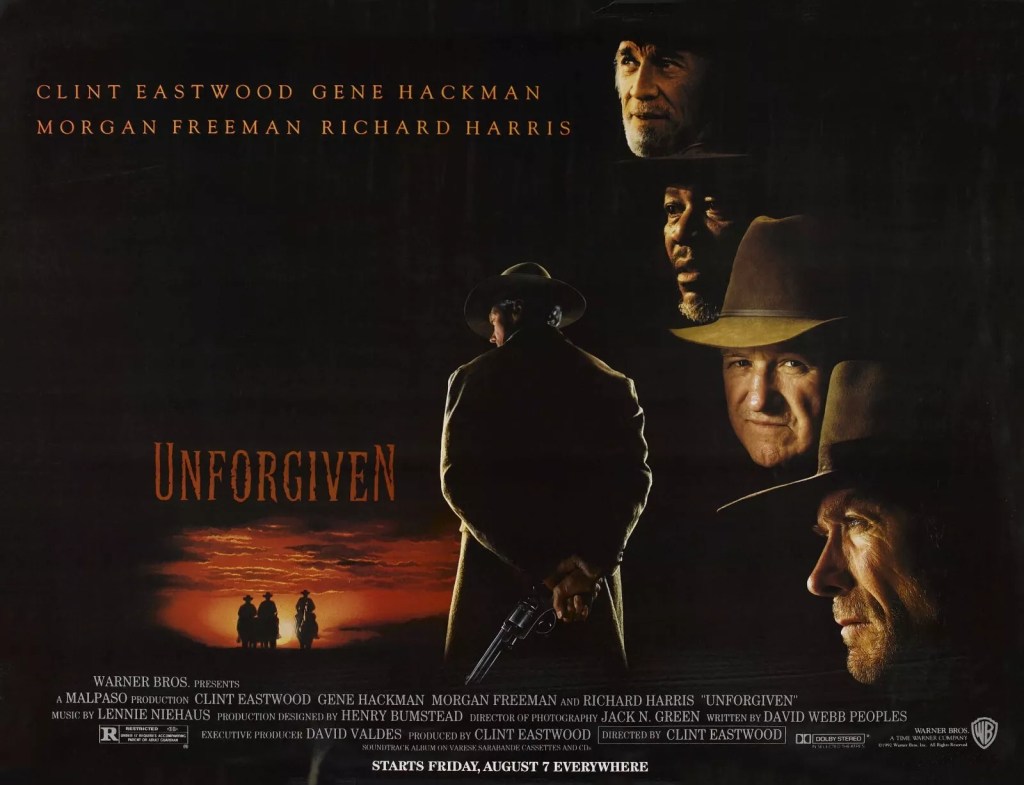
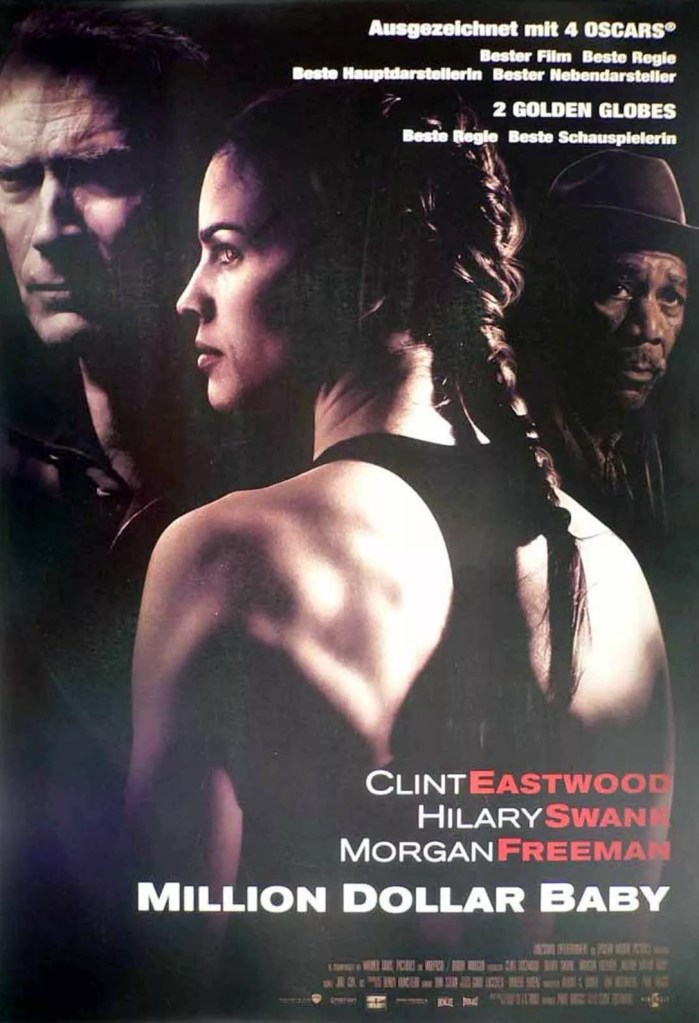
WB has been sparing on the poster front but you may notice a certain visual
similarity between this old poster and the new one.

There’s none of that here. In fact, this all seems deliberately damped down. The tale is not told in faux documentary style and there’s no grandstanding. And yet this is one of the best directed movies I’ve ever seen. With no scene-stealing, it flies, and when it lands it’s with a thoughtful air. Just when you think it’s going to head off in he direction of one of two cliches – the high-risk pregnant wife giving birth at a dramatic juncture in the trial, or some zealous cop undertaking an equally dramatic last-minute investigation that tips the trial ass over tip – it damps down on those two.

The set up is ingenious. Recovering alcoholic Justin (Nicholas Hoult) discovers in the course of the murder trial on which he is a juror that he not only knows more about the incident in which the girlfriend of accused is killed, he may even be the accidental cause of her death. On the night in question he was nursing a drink in a bar and noticed the couple having an argument. Driving home on a wild and stormy night, he has a recollection of hitting something, knows it’s not, as he told he told partner Allison (Zooey Dutch), a deer.

Because, after several years of sobriety,  he should never have been in a bar in the first place, and because there’s no evidence to the contrary – a field sobriety test should he have reported the incident – it’s automatically assumed that he would have consumed the whisky he bought in the bar. The hint of DUI would condemn him to 30 years in prison and not the new life as a father he has fought hard for.

Hello darkness would be the design theme.

So, in a ironic twist on Twelve Angry Men (1957), he’s the only person who stands up for the accused, but out of guilt rather than as with Henry Fonda an uplifted sense of morality. Guilt has certainly struck deep. For it’s insane for him to fight for the man’s innocence, to even raise questions of doubt, when everyone else is convinced he’s the killer.  If the man is convicted, Justin will be let off. A hung jury might be a better outcome. A second trial would likely still end in conviction, as the circumstantial evidence and the accused’s drug-running background count against him, but at least Justin will not blame himself for sending an innocent man to prison.

The thing is, we don’t want Justin to be guilty. It’s an accident. Could have happened to anyone. At worst, had he fessed up at the time he would be cleared of any accusation of DUI, given the benefit of the doubt, what with the driving conditions and the fact that the victim was inebriated. He’s turned his life around. He adores his wife and looks forward to fatherhood.

He’s not the only one conflicted. Some of the jurors just want the trial over as fast as possible to get back to more pressing domestic issues. One character is dead set against anyone with anything to do with drugs. Overworked prosecutor Faith Killibrew (Toni Collette) is more concerned with a political future, running for district attorney. Ex-detective Harold (JK Simmons) commits the grievous sin – for a juror – of doing a bit of investigation on his own and is chucked off the jury.

What little information he does collect ends up with Faith. As a prosecutor she wants people put away, not let off. And she’s amassed sufficient evidence against the accused to get him sent down. So she’s not inspired with a desire for justice, the kind of firebrand character that would turn up in any other courtroom drama, digging away for an eternity, refusing to accept guilt as presented. She’s not a beacon for doing the right thing. Rather, the kind of person who doesn’t like the idea of nagging doubt upsetting her well-ordered life.

Given how many Clint Eastwood pictures end in violent showdown, perhaps his biggest directorial coup here is finishing the picture without that episode, it’s more reminiscent of the scene in American Gangster (2007) where Denzel Washington emerges from church to be confronted by a battalion of cops.

Couple of flaws – forensics so derelict there’s no suggestion that the blunt instrument that killed the victim could be a car is explained away by overworked scientists. That Faith doesn’t notice the photos of Justin sprayed around the house of Allison during her investigation reveals just how cursory a box-ticking exercise the detection is in her eyes.

Most of this plays out in the tortured eyes of Justin and in the unseen mind of Faith. With Justin, conflict is upfront, with Faith buried deep, laboriously roused from slumber.

Apart from Toni Collette and Nicholas Hoult, reunited after over two decades from their mother-and-son turn in About a Boy (2002), there is some distinctive playing – though under-playing would be more appropriate – from JK Simmons (Whiplash, 2014) and Kiefer Sutherland (The Lost Boys, 1987).

The boldness of the narrative – debut from screenwriter Jonathan Abrams – takes your breath away, avoiding the obvious route of concentrating on the innocent man, or on devious counsellors (all is played straight here) and the usual courtroom theatrics.

Absolutely superb performance from Hoult, who virtually has to do everything through his eyes. Had he been more over-the-top, Oscar would certainly have come calling, but deprived of that it’s an even more convincing performance. The low-ball direction swings this into a different class of courtroom picture, putting the audience in the situation of wanting the “bad guy” to get off.

Go see. Let Clint make you day (for likely) one last time.

The Cincinnati Kid (1965) ****

Steve McQueen had little trouble identifying with this role. He was the Hollywood contender, trying to knock current kingpin Paul Newman off his perch, and in Norman Jewison’s tense, often heart-stopping, drama he has the ideal vehicle. For the most part this is a winner-take-all face-off, as much a showdown as any western shootout, in darkened rooms under the harsh light of a New Orleans poker table between a rising star always referred to as The Kid (Steve McQueen) and the unofficial world champion, the urbane cigar-smoking Lancey Howard (Edward G. Robinson).

Broadened out in the initial stages to include scenic diversions – the Mississippi at dawn, a cockfight, some jazz – plus romance and intrigue, this is essentially pure sport, a game of stares, where bluff holds the ace and women exist on the perimeter only to fill in the time before the next hyped-up encounter. There’s no trophy to be won, not even glory, just the right to call yourself “the man.” The Kid feels the pressure of punching above his weight, Lancey of getting old.

Farmer’s daughter and arty-wannabe Christian (Tuesday Weld) is the Kid’s main squeeze until she gets between him and his game. When she takes off, he makes do with Melba (Ann-Margret), girlfriend of dealer Shooter (Karl Malden) somewhat preoccupied with giving the Kid more than a helping hand to satisfy the vengeful Slade (Rip Torn), a rich businessman.

Although it finally comes down to a confrontation between the Kid and Lancey, subordinate characters like sweating poker player Pig (Jack Weston) and stand-in dealer Ladyfingers (Joan Blondell) help dissipate the tension. But in fact anything that occurs only seems to increase the tension as it comes down to the one big final hand. 

This is McQueen (The Magnificent Seven, 1960) in transition, from the loner in The Great Escape (1963) to an actor exuding charisma and on top of his acting game. While on the face of it little more than a sporting lug, the Kid is an appealing character, engaging with a little shoeshine boy, winning over Christian’s truculent parents with what appears a card trick but is actually a demonstration of the phenomenal memory necessary to excel in his chosen field. There’s a winsome child in there among the macho persona. The poker face that McQueen developed would become one of his acting traits over the years.

Edward G. Robinson (Seven Thieves, 1960) gives a rounded performance as the reigning poker champ accepting emotional loss as the price for all his financial gains. Tuesday Weld is an appealing waif. Karl Malden (Pollyanna, 1960) essays another tormented soul and Rip Torn (Sol Madrid, 1968) a sleazy one. Also look out for a host of great character actors including Jack Weston (Mirage, 1965), Oscar nominee Joan Blondell (Advance to the Rear, 1964) and Jeff Corey (Once a Thief, 1965) plus composer and bandleader Cab Calloway.

Ann-Margret (The Swinger, 1966), all eye-shadow and cleavage, is in her best man-eater form. But, thankfully, there is more to her character than that. It is unclear whether she simply latches on to a potential winner or is pimped out by Shooter, but just hooking up with him makes her interesting, since looks are far from his attraction. Her ruthlessness is spelled out in simple fashion. She is determined to win, even at solitaire and she slams the wrong pieces into a jigsaw just for the satisfaction of making it look complete. You can sense depth in this character which the film does not have time to fully explore.

Although often compared to The Hustler (1962), and in many eyes considered both its inferior and a crude rip-off, this is in some respects a greater achievement. At least in The Hustler, there actually was action, players moving around a pool table, clacking balls racing across the surface.  Poker is all about stillness. Any gesture could give away your thoughts. Unlike any other sport, poker requires silence. There is no roaring crowd, just people slotted round the room, some with vested interest if only through a wager, some wanting to say they were there when a champion was toppled.

So the ability to maintain audience interest with two guys just staring at each other, interspersed with minimal dialog, takes some skill. Building that to a crescendo of sheer tension is incredible.

The first four pictures of Canadian director Norman Jewison (Send Me No Flowers, 1964) did not hint at the dramatic chops, confidence, composure and understanding of pacing, especially as he was a last-minute replacement for Sam Peckinpah, to pull this off. That he does so with style demonstrated a keen and versatile talent that would come to the boil in his next three films: The Russians Are Coming, The Russians Are Coming (1966), In the Heat of the Night (1967) and The Thomas Crown Affair (1968). 

The former blacklisted Ring Lardner Jr. (Tracy-Hepburn comedy Woman of the Year, 1942) was credited with his first screenplay since The Forbidden Street in 1949 and he shared the chore with another iconic figure, Terry Southern (Dr Strangelove, 1964), basing their work on the original novel by Richard Jessup. Mention should be made of a terrific score by Lao Schifrin.

Gripping.

Check out the Blog for both a Behind the Scenes article on this film and a Book into Film article.

Pressure Point (1962) ****

Central to this under-rated tale of psychopathy and racism is one extraordinary scene, possibly the most exceptional bar-room sequence ever filmed. In the annals of imaginative repulsion, it ranks alongside the rape committed by Alex and his “droogs” in Stanley Kubrick’s A Clockwork Orange (1971). It begins with mere intimidation as an unnamed young man (Bobby Darin) begins to etch into a bar-counter the lines and symbols of Tic-Tac-Toe (aka Knots & Crosses or Noughts and Crosses). Discovering tins of paint, the man and his gang proceed to cover the entire bar – floor, walls, ceiling, even tables – with the same symbols.

The humiliation is ratcheted up a notch when, after forcing the tavern owner (Howard Caine)  to lie on the floor behind the counter, the bar hostess (Mary Munday), rigid with fear, is tormented. Using lipstick rifled from her handbag, the young man decorates her face in the same fashion before pulling down the back of her dress and doing the same there. Fortunately, the scene – although unlikely the reality – ends at this point.

Other potent scenes show how the man arrived at his crazed state, smothered with affection by a weak mother (Anne Barton) who has taken to bed by choice in order to escape his drunken, raucous father (James Anderson) who taunts his ineffective wife by flaunting to her face his casual pick-ups and making love to them in the same room. Indicative of the lonely child’s disturbed personality is that when he invents an imaginary playmate, it is to have someone to subjugate, making his fictional friend lick his boots.

Imprisoned during the Second World War for sedition, the man, suffering from blackouts and nightmares – in which he imagines himself clinging to the edge of a giant plughole before being swept away by a torrent of water from the taps – becomes a patient of a young, also unnamed, doctor (Sidney Poitier) whom he subjects to racial abuse.  The doctor, physically bigger and more imposing than the patient, would like to simply give him a good thumping, but his profession necessitates that he treats this objectionable person as just another patient. And eventually they come to enough of a concord that the patient accepts treatment although the doctor suspects that his core personality has not changed.

The movie is layered with themes other than psychopathy and psychiatry. While the racist element is to the fore, including the doctor’s need to prove himself in a white man’s world, director Hubert Cornfield also explores the growth of right-wing extremism among the disaffected who see no contradiction in still espousing traditional American values, for example giving the Nazi salute while singing in all sincerity the national anthem. The African American doctor has to come to terms with lack of objectiveness when dealing with such an abhorrent person.

The movie flits between scenes between the two protagonists staged in a stagey manner and  expressionistic almost dreamlike sequences representing the patient’s upbringing such as being menaced by his butcher father among the swinging carcasses of the store. The patient flashbacks are shown without dialog, explanation given in voice-over – far more potent use of this device than in Nothing but the Best (1964) – by either the patient or the doctor.

Reliance on visual dexterity, however, detracts from the tension and director Hubert Cornfield (The 3rd Voice, 1960) is also hampered by an unnecessary framing device which results in the story being told in flashback – and a conflation of flashbacks: of Poitier’s problems as a young doctor dealing with a difficult patent and the patient’s own life story. So the pressure indicated by the title is often undercut and does not build as much as you might expect. Critical reaction in those days pivoted on the racism elements, but a contemporary audience is almost certainly going to be more influenced by sequences involving the patient, so the picture automatically becomes more involved and Cornfield’s visual mastery more appreciated.

You can detect the influence of producer Stanley Kramer. In his capacity as director he had explored psychiatric therapy and antisemitism in Home of the Brave (1949) and racism in The Defiant Ones (1958) also with Poitier. As producer he was responsible not only for selection of the original material, based on a short story The Fifty-Minute Hour by Robert M. Lindner, but also imposing the present-day framing device, which Kramer wrote, on the picture. Those scenes relate to another psychiatrist (Peter Falk) coming to a much older and experienced Poitier for advice after hitting a brick wall with a similarly repugnant patient, Poitier telling the story of his treatment of the Bobby Darin patient as a way of showing that even the worst patients are treatable.

This is quite a different Sidney Poitier than you might be used to. Wearing suit and tie, and spectacles, this is a more restrained, measured performance. Poitier’s taboo-busting Oscar nomination for The Defiant Ones had not progressed his career that much, still restricted to starring roles in low-budget pictures. But Kramer broke another taboo in Poitier’s favor with this one, casting him a role not initially written as an African American.

Bobby Darin (Come September, 1961) had parlayed his status as hit recording artist into a burgeoning movie career but does not quite display the menace necessary for a fully-fledged psycho. Peter Falk (Machine Gun McCain, 1969) has a small one-tone role. The jazz-nuanced music by Ernest Gold (Exodus, 1961) is worth a listen. And if someone can tell me who designed the striking credit sequence, I would be very pleased.

Incidentally, the title of Lindner’s short story is ironic. Patients pay for one hour of a psychiatrist’s time but in reality only receive 50 minutes in order for the professional to achieve a swift turnaround and keep his/her appointment timetable scheduled to the hour.

Tic-Tac-Toe, in case you are unfamiliar with this two-person childhood game, consists of drawing lines to create nine squares and filling those with either a zero or a cross. The object of the exercise is to create a complete line of either symbols.

Still very powerful.

Behind the Scenes: Charlton Heston – The Roads Not Taken

Charlton Heston started the 1960s if not as the biggest star in the world then at least the star of the biggest film in the world, Ben-Hur, released in the last month of the previous year, and ushering in the roadshow era. One of eleven Oscar winners for the picture, Heston’s career was at all-time high. While he wouldn’t ever enter the Steve McQueen/Robert Redford universe of being offered every conceivable script, he was still a huge marquee draw. And it’s interesting to see not so much just what he chose but what he rejected and why.

Often an automatic choice for epics in the vein of El Cid (1961), 55 Days at Peking (1963), The Agony and the Ecstasy (1965) and Khartoum (1966), he was versatile enough to play in westerns like Major Dundee (1965) and Will Penny (1967), ground-breaking sci fi Planet of the Apes (1968), war Counterpoint (1967), drama Number One (1969) and even leave room for some comedy The Pigeon That Took Rome (1962). When you were as big as Heston, you had choice and could vary your projects.

In 1960 while dithering over a poor screenplay for El Cid, Heston turned down By Love Possessed (1961) made by John Sturges, and From the Terrace (1960) which Mark Robson filmed with Paul Newman. Heston’s judgement was that both scripts were inferior to even what was currently being put before him for El Cid. While the Sturges flopped, the Robson did well.

The next year Samuel Bronston, producer of El Cid – and later 55 Days at Peking – attempted to tie Heston down to a picture about William the Conqueror and The Fall of the Roman Empire (1964). Nicholas Ray, who would direct Heston in 55 Days at Peking, wanted him for a picture about the Children’s Crusade. Twentieth Century Fox offered him a three-picture deal, beginning with western The Comancheros (1961). Heston “was leery” and rejected the project – and the overall deal – when the directors Fox initially suggested were too “routine” for Heston’s taste. Presumably, neither was legendary Warner director Michael Curtiz who made the picture with John Wayne.

Heston felt “a slight pang of guilt” turning down the opportunity to work with Laurence Olivier on an adaptation of Graham Greene’s The Power and the Glory because while it would receive cinematic distribution abroad it would be shown on television in the U.S. That went ahead with Olivier and Frank Conroy in the Heston role but with very limited overseas distribution.

He was very keen on Otto Preminger’s Advise and Consent (1962). It appealed “without reading the script.” However, he was offered the part of Brig Anderson, which he disliked. “I’m not put off by the homosexual angle,” he confided to his Journal, “but the part isn’t very interesting.” He pushed for Senator Cooley but Preminger was already chasing Spencer Tracy for that role and, when he passed, happy with second choice Charles Laughton.

Heston dithered over Easter Dinner because he didn’t want to work in Rome. Director Melville Shavelson suggested filming in Paris with Charles Boyer or Maurice Chevalier as co-stars. An alternative title was Americans Go Home. It became The Pigeon That Took Rome (1962) but a chunk was filmed on the Paramount lot.

Perhaps the most interesting prospect was a remake of Beau Geste (1939) with Dean Martin and Tony Curtis. Also on the table was The View from the Fortieth Floor from the bestseller by Theodore H. White.

In 1962 he became enamoured of a project he had previously rejected. The Lovers by Leslie Stevens (who would later create The Outer Limits television series) was a Broadway play starring Joanne Woodward in 1956. Heston now envisaged it as an ideal movie vehicle. He would spend the next few years trying to put it together; it became The War Lord (1965). He turned down a Renaissance film from Arthur Penn (The Chase, 1966), The Royal Hunt of the Sun (1970) and a similar Orson Welles project on Cortez (never made).

In 1963 he received three scripts in one day. A pair were presented as a two-picture deal from Twentieth Century Fox. While Heston was keen on The Agony and the Ecstasy (1965) he was less impressed by Fate Is the Hunter (1964). The other script, from the Mirisch Bros, was The Satan Bug (1965) from the Alistair MacLean thriller, which went ahead with name director John Sturges but no-name star George Maharis. He rejected Lady L (1965) opposite Sophia Loren and Morituri (1965), wryly commenting that Brando “should have passed too.”  He was very tempted by a “very funny” script for The Great Race (1965) but “taking it would mean pushing back War Lord again.” Tony Curtis stepped in.

Twentieth Century Fox was pushing in 1964 for him to become involved in a film about General Custer. He declined. “It doesn’t seem like a good idea to me.” He also turned down Hawaii (1966) “with a few regrets, it has too much plot and not enough people.”

In 1965, another Alistair MacLean project came his way with Ice Station Zebra (1968). “Good script but I don’t like the part.” He was also offered a “curious comedy” Twinkle, Twinkle, Killer Kane by unknown William Peter Blatty, later author of The Exorcist (1973). This was filmed as The Ninth Configuration (1990), directed by the author. He mulled over Sam Peckinpah script  Hilo (never made), an unnamed Mirisch western, The Quiller Memorandum (1966) – “modern story and a simple part” – and The Way West (1967). A second effort was made to enrol him for the  Beau Geste (1966) remake with him playing the sadistic sergeant.

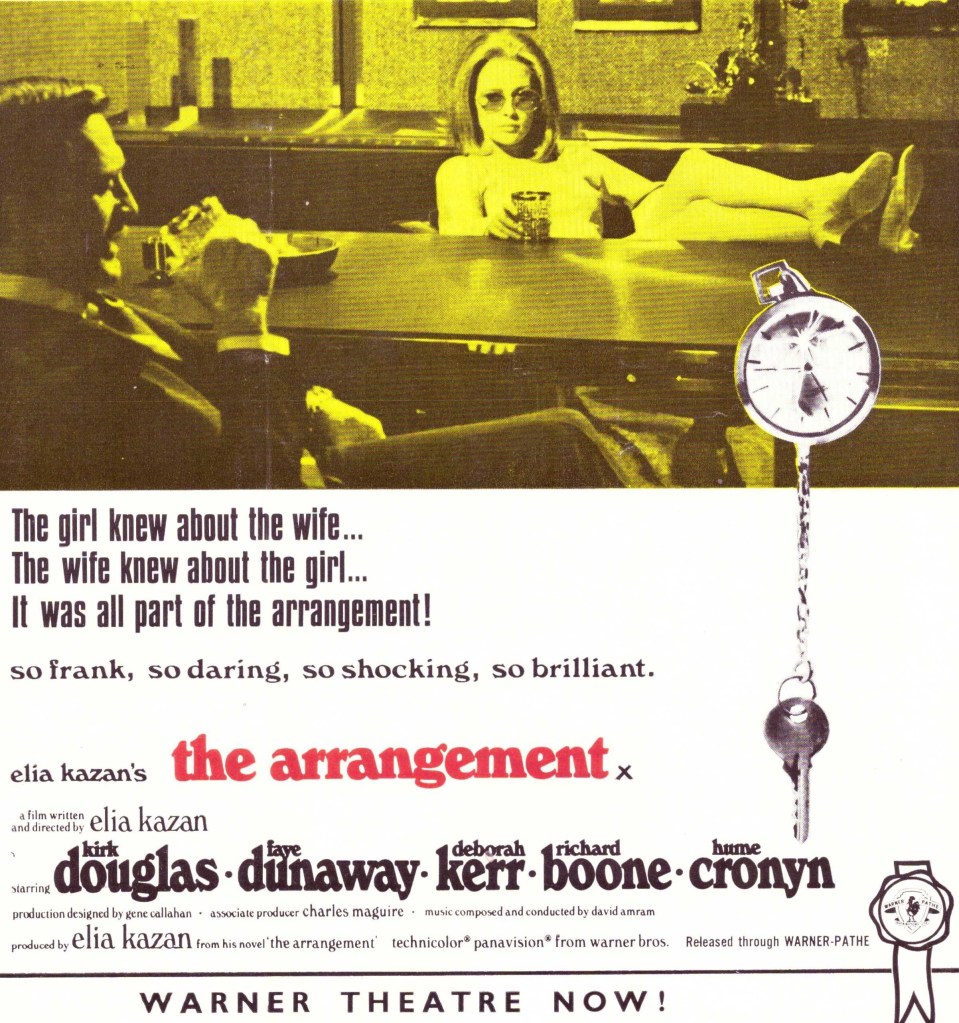
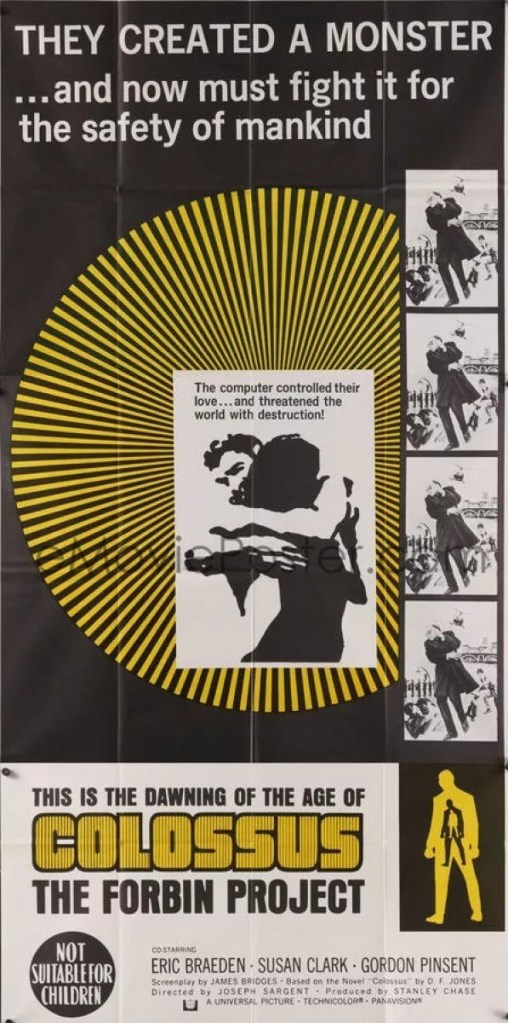
Vittorio De Sica came calling in 1966 for a film with Shirley MacLaine Woman Times Seven (1967). He was “flattered to be asked” to star in Heaven’s My Destination to be directed by Garson Kanin based on the bestseller by Thornton Wilder. There was short-lived attempt in 1968 to mount Eagle at Escambray to be directed by Sandy Mackendrick. He turned down Elia Kazan’s The Arrangement (1969) – “don’t care for it…loser for a protagonist” – Colossus: The Forbin Project (1970), a science fiction picture about a giant computer, and a western by Elliott Silverstein (Cat Ballou, 1965) called The Marauders.

Beyond The Great Race and perhaps Hawaii, unlike some stars – come in Steve McQueen and  Robert Redford – he doesn’t appear to have turned down anything that subsequently became a major commercial or critical hit.

SOURCE: Charlton Heston, The Actor’s Life, Journals 1956-1976 (Penguin, 1979).

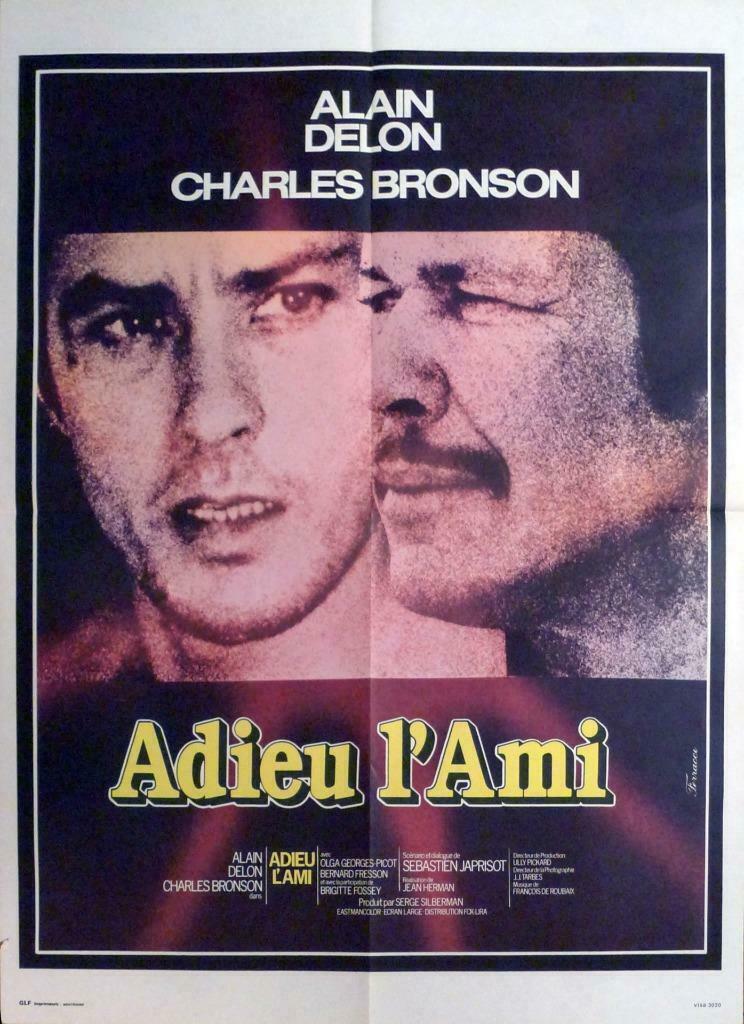
Farewell, Friend / Adieu, L’ami (1968) ****

This heist picture made Charles Bronson a star, though, like Clint Eastwood a few years previously, he had to go to Europe, in this case France, to find an audience appreciable of his particular skill set. This was such a box office smash in France that it was the reason that Once upon a Time in the West (1968), a major flop virtually everyone else, turned into a huge hit in Paris. After a decade as a supporting actor, albeit in some quality offerings like The Magnificent Seven (1960), The Great Escape (1963) and The Dirty Dozen (1967), Bronson developed a big following, if only initially in Europe.

It could also lay fair claim to stealing the title of  “first buddy movie” from the following year’s Butch Cassidy and the Sundance Kid (1969) because, apart from the heist that is central to the story, it is essentially about the forging of a friendship. But it wasn’t released in the U.S. for another five years, in the wake of Bronson’s Hollywood breakthrough in The Valachi Papers (1972), and then under a different title, Honor Among Thieves.

And you can see why it was such a star-making vehicle. Bronson goes toe-to-toe with France’s number one male star Alain Delon. He had the walk and the stance and the look and he was given acres of screen time to allow audiences to fully appreciate for the first time what he had to offer. Like Butch Cassidy, the duo share a lot of screen time, and after initial dislike, they slowly turn, through circumstance and a shared code of honor, into friends.

Dino Barran (Alain Delon) is the principled one, after a final stint as a doctor in the French Foreign Legion, originally turning down Bronson’s overtures to become involved in a separate major robbery. Franz Propp (Charles Bronson) is an unsavory customer, making his living as a small-time thief who uses a stripper to dupe wealthy marks. Barran agrees to rob a corporation’s safe during the three-day Xmas holiday of two million dollars as a favor to the slinky widow Isabelle (Olga Georges-Picot) of a former colleague, for whose death he retains guilt. Propp more or less barges his way into the caper.

It’s a clever heist. Isabelle gets Barran a job as a company doctor whose office is next door to the giant vault. But there’s a twist. Surveillance reveals only three of the seven numbers required to open the vault. But Barran reckons three days is sufficient to try out the 10,000 possible combinations.

Barran and Propp despise each other and pass the time playing juvenile tricks, locking each other into a room, stealing all the food from the one dispensing machine, winding each other up, while they take turns trying different combinations. But it opens after only 3,400 attempts and they face a shock. The vault is empty. They have been set up to take the fall for a previous robbery that must have been completed before the building closed for Xmas.  

And there’s no way out. They are in lockdown, deep in a basement. The elevators can only be opened by a small squadron of guards upstairs. Food long gone, they are going to run out of water. If they use a lighter to see in the dark, or build a fire to get warm, the flames will eat up the oxygen they need to survive in the enclosed space. So the heist turns into a battle for survival and brute force, facing a deadline to escape before the building re-opens and they are discovered, exhausted and clearly guilty.

But that’s only the second act. There is a better one to follow, as their friendship is defined in an unusual manner. And there are any number of twists to maintain the suspense and tension. Butch Cassidy and the Sundance Kid were close friends when that western began. Here, we see the evolution of a friendship between two forceful characters who express their feelings with their fists.

Delon was a known quantity, but Bronson really comes to the fore, more than holding his own against a top star who oozed charisma. This is Bronson in chrysalis, the emergence of the tough guy leading man screen persona that would turn him into one of the biggest stars in the world. Surprisingly, given his later penchant for the monosyllabic, here he does a lot of talking, perhaps more actual acting than he ever did later when his roles tended to fall into a stereotype.

He has the two best scenes, both character-defining, but in different ways. He has a little scam, getting people to gamble on how many coins it would take for an already full-to-the-brim glass to overflow when a certain number of coins were dropped in. While this is a cute, it’s that of a small-time con artist, but watching it play out, as it does at critical moments, is surprisingly suspenseful. The second is the strip scene which shows him, as a potential leading man, in a very poor light, and although thievery is the ultimate aim, it is not far short of pimping, with Bronson standing back while the woman (Marianna Falk) is routinely humiliated. It’s the kind of scene that would be given to a supporting actor, for whom later redemption was not on the cards. It says something for Bronson’s command of the screen and the development of his character that by the end of the picture the audience has long forgotten that he could stoop so low.

It is a film of such twists I would not want to say much more for fear of giving away too much, suffice to say that Olga Georges-Picot and her friend, mousy nurse Dominique (Brigitte Fossey), are also stand-outs, and not just in the sense of their allure.

Director Jean Herman, in his sophomore outing, takes the bold step of dispensing with music virtually throughout, which means the audience is deprived of the usual musical beats, indicating threat or suspense or change of mood, during the critical heist sequence, but which has the benefit of keeping the camera squarely on the two leading characters without favoring either. Most pictures focusing on character rely on slow-burn drama. In the bulk of heist pictures characters appear fully-formed. Here, unusually, and almost uniquely in the movie canon, character development takes place during an action film.

Even without Bronson, this would have been a terrific heist picture. With him, it takes on a new dimension.

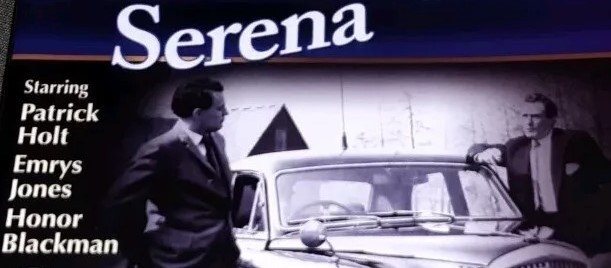
Serena (1962) ***

Might have been pitched higher had it appeared after Honor Blackman Moment to Moment, 1966) began her stint as Cathy Gale in hit television show The Avengers. As it is, still a neat job. Few stylistic flourishes – a zoom shot (highly unusual), use of silhouette, camera swivel, substantial location work and some judicious use of the overhead camera. But mostly a crime picture that delivers in tidy fashion. As another plus point, it’s short.  

Ideal support material, the kind of movie that was easy to get off the ground in the U.K. because of the Eady Levy (a tax break) and the quota system whereby cinemas had to show a certain percentage of home-grown movies. Films capitalizing on this were known as “quota quickies” and most deserved to disappear from view shortly after being made.

This is an exception, and damned clever it is too, and though a few of the “clues” wouldn’t register with a contemporary audience, it piles on the twists and turns so it’s one narrative beat after another.

Detective Inspector Gregory (Patrick Holt) and Sergeant Conway (Bruce Beeby) come calling on artist Howard Rogers (Emrys Jones) with news his wife has been murdered. They’re separated three years, divorce unlikely due to the wife’s Catholicism.  Howard is putting the finishing touches to a painting of voluptuous brunette model Serena, who subsequently can’t be found to substantiate his alibi.

The blonde wife’s face has been blown apart by shotgun pellets so there’s a question-mark over her identity. So when said wife Ann (Honor Blackman) turns up, it’s clear someone else is dead. Ann is all set for reconciliation and the couple plan to head off for France to live off the £280,000 left in her father’s will.

Soon becomes apparent to the doughty investigation team that the murderer has killed the wrong woman. Ann, fearing she was being followed and worried about her safety, had called in old chum Cathy, an actress, also a blonde, to dress up in her clothes and pretend to be the wife. Clothes are found in the river. The finger of suspicion points at the missing Serena, in love with the artist and perhaps wanting to bump off her rival.

The clues, such as they are, are infinitesimal, though of course in those days there was little recourse to forensics. But they don’t mount up to much and their importance to the investigation – a modest piece of sleight of hand – is kept from the audience, spared the endless poring over red herrings to be found in modern detective tales, so it’s only at the end that the culprits are found.

And you can see why the director withheld crucial evidence because the climax is exceptionally well done. Ann’s lawyer is executor of the will, so, perforce, she would have had several meetings with him.

When the police arrive as the reconciled couple are packing their bags before hopping over the Channel, the ever-helpful cops offer them a lift to the train station. But, in fact, plan to take them to the police station. In the car for no apparent reason is the lawyer. But no words of greeting are exchanged between him and the wife.

Ergo, she’s not the wife.

That’s Serena in the car. Howard and Serena conspired to kill the wife. Clever use of wigs turned Serena into the brunette model and then the blonde wife. Two clues – plus the continued absence of the model – had led Insp Gregory to this conclusion. They found spirit-gum on the clothes found in the river, and that’s used to attach wigs, and in church the false Ann was seen crossing herself with her left hand rather than her right, de rigeur for that religion even if you were left-handed.

So, as I said, tidily done, mystery stoked high until the end.

Peter Maxwell (Impact, 1963) was mostly a jobbing television director only afforded a handful of movies, and all of these B-pictures, into which he injects the occasional stylistic touch, but which fitted well into the supporting picture category.

Patrick Holt reminded me of Peter Finch (The Legend of Lylah Clare, 1968), same build, haircut, stolidness and pursing of the lips, but he’s not asked to plumb any emotional depths. You might well have forecast a bright future for Honor Blackman after this movie but she was already established enough, making the transition to adult roles from child star, and since she’s not called upon to play a femme fatale, there’s not much for her to get her teeth into either. Emrys Jones (The Trials of Oscar Wilde, 1960) is good as the schemer.

Quite a few hands involved in tricking out the screenplay including the director, Edward and Valerie Abraham (Dominique, 1978) and Reginald Hearne (The Sicilians, 1964) .

One of the best examples of the “quota quickie.”

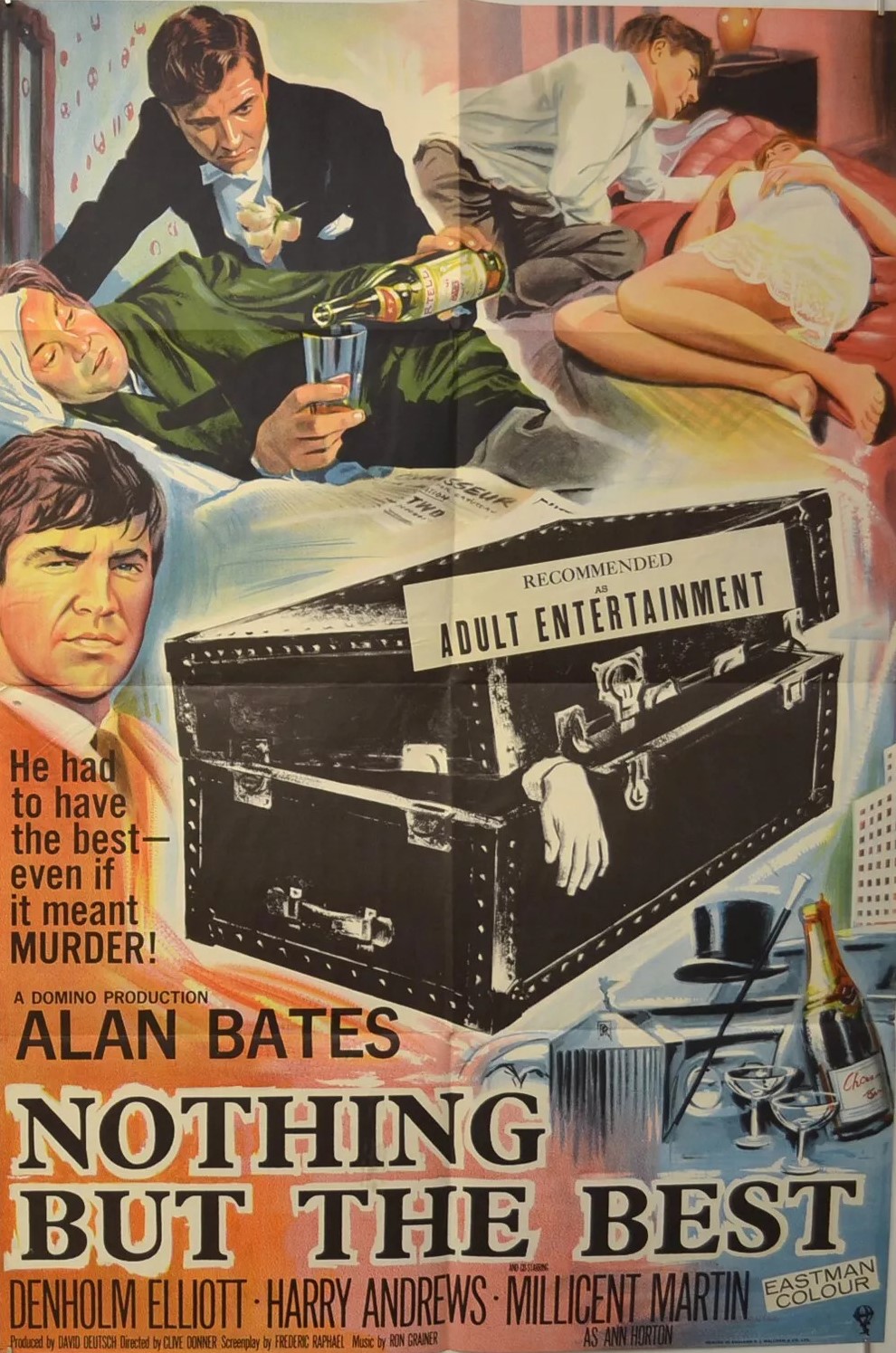
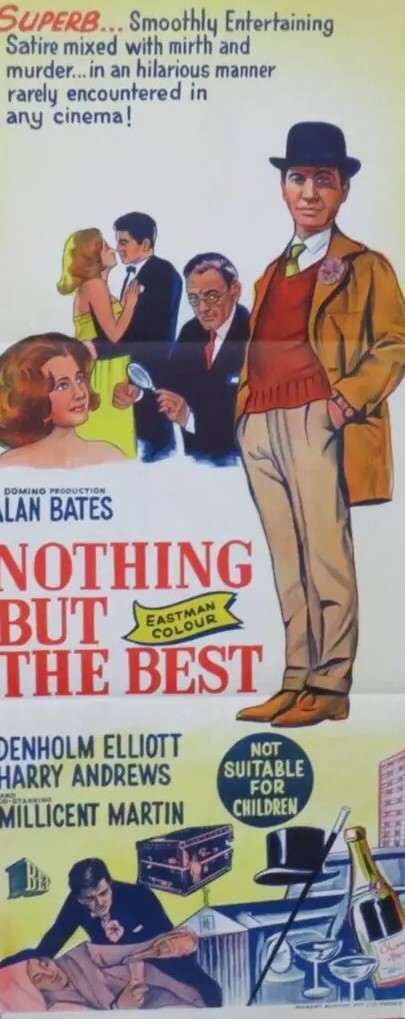
Nothing but the Best (1964) ***

Hardly surprising Denholm Elliott comes a cropper in this delicious British upper class black comedy – he steals the show from denoted star Alan Bates. Had he kept going any longer you would hardly have noticed Bates even featured, such was the clever impact of Elliott’s insiduous playing.

The toff version of Room at the Top (1958) meets Alfie (1966) as “ambitious young yob” Jimmy Brewster (Alan Bates) manipulates his way to the top. Too many people not coming up to scratch for his upwardly mobile purposes are cast aside – or strangled. Arrogance and bluff are the key to getting ahead in the upper-class world towards which he pivots. Doing absolutely nothing at all also works wonders in high society as does dismissing one’s hugely expensive education.

Jimmy is initially helped on his way, given an insider’s guide, by dissolute layabout toff Charles (Denholm Elliott) with a marked predilection for forgery, and other minor criminal schemes, but whose chief skill appears to be sponging off everyone else. Jimmy is a lowly executive in an upmarket estate agent, fighting for promotion against people with silver spoons rattling around every part of their anatomy and who have the genuine class their business appears to call for.

Every now and then the satire still contains contemporary bite, the difference between universities still relevant, as is that most people are not swayed by actual knowledge but by the fact that you can toss out the names of various academics. But, mostly, it’s bluff that opens the doors. Jimmy misses an appointment with an important banker, a dereliction that should have scuppered his chances of negotiating a better deal for his client. But, in fact, the banker takes this as Jimmy having gone elsewhere and immediately offers a better deal.

When confronted by a colleague for ignoring another appointment, Jimmy merely vaguely waffles on about being detained by “Sir Charles,” true identity left shrouded in mystery, contentious colleague silenced by either not being on speaking terms with the person mentioned or unwilling to admit his ignorance.

Having seduced every secretary within reach – none of whom meet his lofty standards – Jimmy manages to wangle his way into catching the eye of wealthy boss Horton (Harry Andrews) and his attractive daughter Ann (Millicent Martin), whom he marries.

While this would have been sharp as a tack in satirical terms back in the day, most of that weaponry is now out-dated. Suffers because none of the upper-class characters show any sense whatsoever – they can’t all be duffers and most seem to have tumbled out of central casting’s idea of an upper class twit. Charles is the exception, but even he is something of an innocent, not quite aware of what ruthlessness he has unwittingly set afire.

The lower classes aren’t much better. Secretaries and switchboard girls fall at Jimmy’s feet, handsome beggar that he is, though his landlady Mrs March (Pauline Delaney) appears to have his measure and is not above indulging in hypocrisy.

The voice-over works to the detriment of the picture. Because that device is doing so much of the heavy lifting, filling in the audience on Jimmy’s true feelings, the actor doesn’t have to do much acting and we’re presented with a kind of wooden figure who hides behind a mask. Of course since he’s masking his feelings, you might be inclined to give Alan Bates the benefit of the doubt.

And it would work very well if there wasn’t Denholm Elliott giving a master class in duplicity. He exhibits genuine charm.

I’m guessing that the voice-over was already there in Frederic Raphael’s script and not added to compensate for Alan Bates’s one-note performance. So if it was, that certainly presented a problem for the actor since most of what made his character interesting was at one remove, not presented in dialog or confrontation as would be the norm.

Alfie solved the problem by breaking the fourth wall – all the rage these days – and having the character directly address the audience, which allowed Michael Caine to present his own case.

So, if Alan Bates felt limited in what he could show on screen, he certainly does a good job of maintaining the façade. But Denholm Elliott (Station Six Sahara, 1963) steals the show. Harry Andrews (The Charge of the Light Brigade, 1968) is permitted no nuance to his normal bluff persona, singer Millicent Martin (Alfie, 1966) sparkles, and a bunch of British character actors including James Villiers (Some Girls Do, 1969) and Nigel Stock (The Lost Continent, 1968) put in an appearance.

Directed with some glee by Clive Donner (Alfred the Great, 1969) from a script by Frederic Raphael (Darling, 1965) adapted from a short story by Stanley Ellin (House of Cards, 1968).

Not as coruscating now as originally intended.

Day of the Jackal (1973) *****

The original – and unlikely ever to be topped no matter the best intentions of Sky’s current remake. Possibly the greatest thriller of all time, certainly in the top two or three, and broke every rule going. No music, excepting the first few minutes, for a start. Could easily have been packed with the easily-recognizable all-star-cast found in roadshows, a few British acting knights thrown in for good measure, but instead has a no-name cast.

You would have had to be particularly vigilant as a moviegoer to have even heard of Edward Fox, too old (aged 36) at this point to be considered a rising star, and without the portfolio (outside of a Bafta supporting actor nomination for The Go-Between, 1971) to suggest he had ever particularly shone.   

Didn’t realize there was a 70mm version.

Apart from their job, every character, especially the chameleon-like Jackal (Edward Fox), is anonymous, virtually nothing of home life intrudes in the sharply-drawn story. The brilliant script by Kenneth Ross (The Odessa File, 1974) jettisons every unnecessary detail, and the even better editing pares every scene down to the bone.

That there is even an iota of tension given we know the outcome is quite extraordinary, but, as with the book, it is wound up taut. Not will he-won’t he, but how, when, where? Every time the police get a lead, they discover he is one step ahead.

What director Fred Zinnemann (A Man for All Seasons, 1966) has the good sense to retain is much of the fascinating detail that author Frederick Forsyth packed into his runaway bestseller. How to create a false identity, how a nibble of cordite can make you look old, where to conceal a rifle in the chassis of your car, and my favourite, how to wind a rope round a tree to ensure your shooting arm is steady.

And, except for the gunman and the rebels he represents, not a maverick in sight. None of this Dirty Harry, Madigan, nonsense, nobody railing against authority, but still the dead weight of bureaucracy, the high-ups only too happy when the moment comes they can dismiss an underling who might steal a sniff of glory.

This shouldn’t work at all, there’s far too much of the dogged detective, cops on both sides of the Channel tearing through reams of paperwork, hundreds of hotel registration cards, lost passport forms, birth certificates, death certificates. Cops stopping every blonde male of a certain height. Most of the minions you never see again, regardless of the vital tasks they fulfil. Virtually the only way characters are permitted emotion is to take a longer drag on their cigarette.

The only feeling permitted is the reaction of the would-be femme fatale Denise (Olga Georges-Picot) when her superior burns the love letters and photographs of her French soldier boyfriend killed in action. The late twist to that element of the story, when one of the politicians is discovered to have fallen into her honey-trap, comes when the cabal of politicians realises that French detective Lebel (Michael Lonsdale) has tapped all their phones.

There’s a constant sense of peak and trough, every breakthrough a dead end, yet endless accumulation of tiny detail allows for maneuver at the end, when we discover that the Jackal is not, as we have been led to believe, an Englishman going by the name of Charles Calthorp.

Given the intensity, there’s still space for nuance. The other murders the Jackal commits are visually discreet. None of the extended hand-to-hand combat of Jason Bourne and John Wick. A karate chop for one victim, another ushered out of view, the hand of a compromised lover grows limp. The torture scene is visually classic. The tortured man, seen from behind, tries to duck away from the glaring light and when he succeeds that light glares in the face of the audience leaving backroom staff to glean his tape-recorded words in between his screams

The money Zinnemann saved on star turns probably went on achieving French cooperation which minimized outlay on building on a set to show the parades and all the military razzamatazz that went with a realistic depiction of Liberation Day, a major French event. The assassin’s target, French President De Gaulle, was dead by the time the movie was made, so could not object, and since the assassination failed in part due to the brilliance of the French police perhaps it was felt this was one movie worthy of such collaboration.

Edward Fox is superb at the chilling bisexual assassin but the support cast is excellent – Cyril Cusack (Fahrenheit 451, 1966) as a gunsmith, Michael Lonsdale (Caravan to Vaccares,1974), a young Derek Jacobi (Gladiator, 1999), Barrie Ingham (A Challenge for Robin Hood, 1967), Alan Badel (Arabesque, 1966) as a snooty minister, Olga-Georges Picot (Farewell, Friend / Adieu L’Ami, 1968) and Delphine Seyrig (Accident, 1967).

Based on his Oscar-heavy record – two wins, four nominations – you wouldn’t have picked Fred Zinnemann for such populist fare. Unless you recalled that he followed From Here to Eternity (1953) with musical Oklahoma! (1956). He had never made a thriller before, but he instinctively knows how to make the material sing.

Hollywood went down the remake route once before with indifferent results despite a top-class cast of Bruce Willis, Richard Gere and Sidney Poitier in The Jackal (1997). The current television series is getting a good vibe but it will have to go some, even with around eight hours to play with, to match this.

Masterpiece.

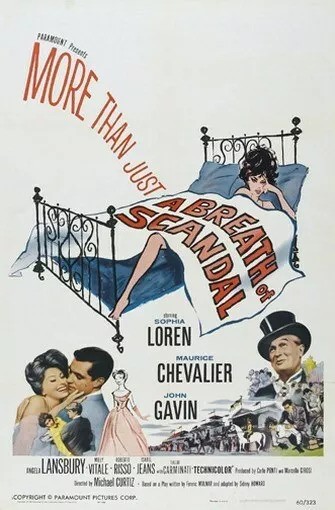
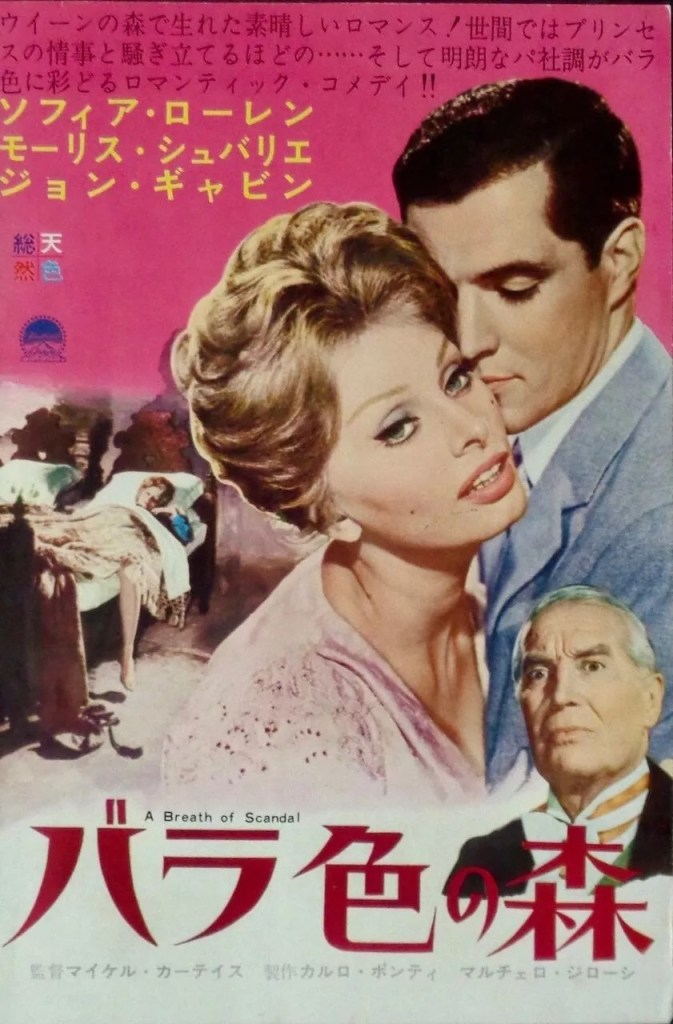
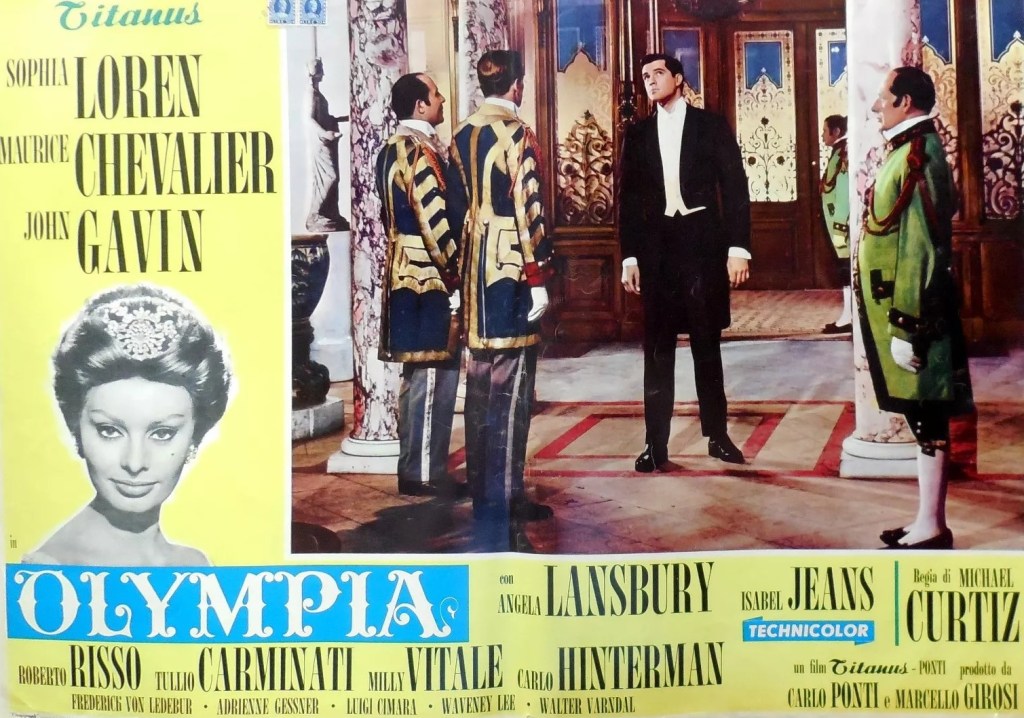
A Breath of Scandal / Olympia (1960) ***

Sophia Loren in playful mood. Not every serious actress could whip up a confection as light as this. She was in the middle of a romance period embracing both comedy and drama that began with Houseboat (1958) and rattled through to The Millionairess (1960) before embarking on a half-decade of more serious stuff starting with her Oscar-winning performance in Two Women (1960).

Easy to dismiss her here as all pout and bosom, but there’s a distinct egalitarianism on show, especially given it’s set in early stuffy 20th century Vienna, where protocol reigns, making life difficult for a lass who wishes an active sex life outside the constrictions of marriage.

There’s not much to the story, in fact it’s as flimsy as heck, but the kind of picture that a top star can swan her way through and charm the audience with her.

When we meet Olympia (Sophia Loren) she’s been exiled to the countryside for one scandal too many and to ease her boredom takes potshots at anyone visiting her quaint castle. Out horse-riding, she tangles with a motor car driven by Yank businessman Charlie Foster (John Gavin) and engineers that they spend the night in a nearby hunting lodge, leading him to believe she’s an ordinary peasant girl and not a princess.

Summoned back to Vienna by her father Prince Philip (Maurice Chevalier) and mother Princess Eugenie (Isabel Jeans) because they’ve found a prospective suitor in Prince Ruprecht (Carlo Hintermann), she encounters Charlie again because he’s trying to sell her father on some business deal.

On the sidelines causing trouble is (Angela Lansbury) who threatens to dish the dirt on Olympia and Charlie and cause a great scandal. And, really, that’s all there is to it except, as had become somewhat de rigeur in his pictures, Maurice Chevalier chips in with a song.

But the settings are glorious and costume design takes the top prize. While everyone else has a whale of a time, John Gavin (Midnight Lace, 1960) looks lost, wooden and out of his depth, unable to respond to the mischievous sparkle of La Loren. This could easily have been devised to show Loren at her marquee best, the belle of the ball, but with a cunning mind, quick repartee, and surprisingly feminist in her approach.

It was one of those Hollywood-Italian co-productions that were starting to take off with little regard for national gridlines. Though set in Austria, the female lead was Italian, male lead American, Maurice Chevalier (Jessica, 1962) as French as they come, Isabel Jeans (The Magic Christian, 1969) is English and director Michael Curtiz (The Commancheros, 1961) Hungarian.

It’s hardly demanding and since Gavin doesn’t step up to the plate lacks the necessary sizzle but all that means is Loren can steal the spotlight. Walter Bernstein (The Magnificent Seven, 1960) and Ring Lardner Jr (The Cincinnati Kid, 1965) turned the Frederic Molnar play into a screenplay.

Easy to criticize if you’re wanting something more demanding, but otherwise effortlessly enjoyable.

Perfect Saturday afternoon matinee material.

Discover WordPress

A daily selection of the best content published on WordPress, collected for you by humans who love to read.

The Atavist Magazine

by Brian Hannan

WordPress.com News

The latest news on WordPress.com and the WordPress community.