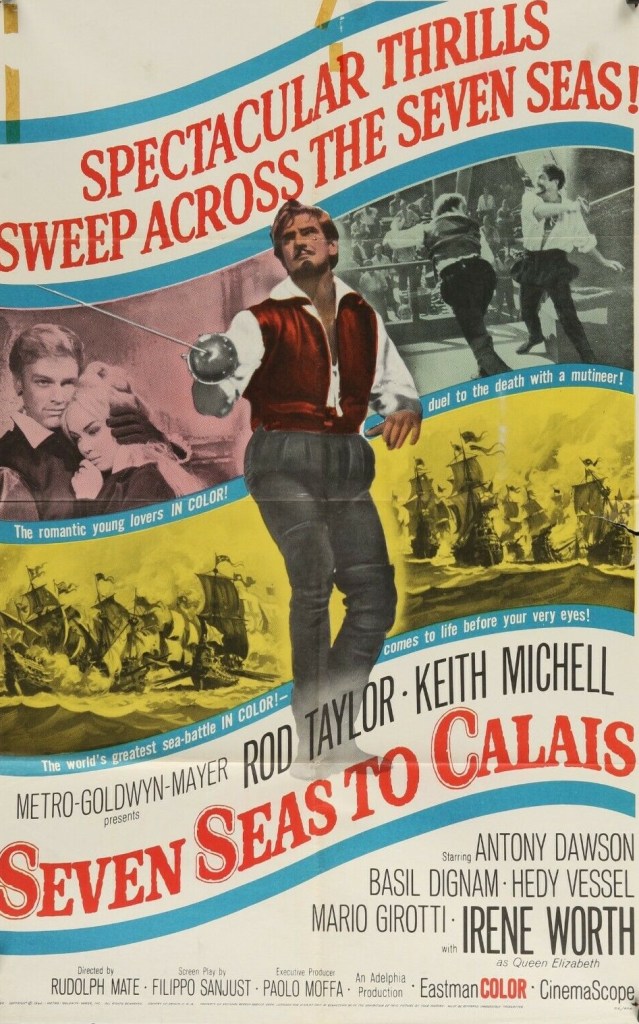
In between hi-hat Hollywood endeavors The Time Machine (1960) and The Birds (1963) Rod Taylor made a couple of pit stops in Italy. Here, he tries his hand at a swashbuckler and does a pretty good job of it, depicting famed English naval hero Sir Francis Drake, in a story that covers about a dozen years from him circumnavigating the globe to masterminding the defeat of the Spanish Armada in 1588.
Not content with glorifying tales of his derring-do as he robs the Spanish of their gold, the producers also mine a rich seam of political intrigue as Spanish King Philip II (Emberto Raho) seeks to nullify the English threat first by a treaty and then by conspiracy before full-blown invasion seems the better option.
Queen Elizabeth (Irene Worth) proves a political maestro, telling the Spanish what they want to believe and condemning Drake’s activities in public while in fact privately financing his expedition and waiting for his pirate gold to underpin her navy.
After putting down a potential mutiny, most of Drake’s time is spent plundering Spanish galleons or gold mines. When not pillaging, Drake takes time out from his adventures to discover potato and tobacco and for a romantic dalliance with what appear to be Native Americans (judging from the feathers they wear) including a young woman called Potato (Rossella D’Aquino). It is left to his number two Malcolm Marsh (Keith Michell) to carry the main subplot which has French beauty Arabella (Edy Vessel) in his absence taking up with Babington (Terence Hill), a traitor with an eye to freeing the imprisoned Mary, Queen of Scots (Esmeralda Ruspoli).
There are more than enough swordfights for purists and Drake employs a certain amount of cunning and bravado in his various piratical enterprises. Clever filming renders the ships realistic enough though in long shot they do resemble toys. In making it look as though Drake has returned from his voyage in the nick of time to save Elizabeth from the Spanish aggressors, the producers neatly kaleidoscope the actual time frame. Elizabeth takes no prisoners and there are spicy exchanges between the queen and the pirate.
Rod Taylor presents a more muscular and athletic screen person than in any of his previous pictures and exudes authority but he also has a lightness of tone that would become a trademark. However, American stage actress Irene Worth – in her sole movie role of the decade – just about plays him off the screen, her regal bearing hiding an agile mind. Keith Michell (The Hellfire Club, 1961) makes a strong impression as does future spaghetti western star Terence Hill, (They Call Me Trinity, 1970) credited here as Mario Girott. Edy Vesssel (The Thief of Baghdad, 1961) only made two more films, although one was Fellini’s 8½ (1963). This was the second film outing after Antonioni’s L’Avventura (1960) for Esmeralda Ruspoli
Strangely enough, given the part Drake played in English history, he has been dealt a poor hand in the movies. A British television series Sir Francis Drake (1961-1962) starring Terence Morgan was unlikely to have instigated this picture, so it is odd to rely on Italy for the only movie, regardless of its veracity.
In the portfolio of veteran director Rudolph Mate (When Worlds Collide, 1951), this immediately followed on from The 300 Spartans (1962) but lacks that film’s rigor and vigor.. The script was dreamt up by Filippo Sanjust (also Morgan the Pirate).
You couldn’t make it like that now, so the ill-informed tale goes. Actors doing their own paddling in canoes, climbing a cliff. But anyone who has watched Leonard DiCaprio and Kate Winslet half-drowning in Titanic (1997) is well aware that it’s just not always possible to use a stand-in for key sequences. Or, for that matter, William Holden breaking in a horse in Wild Rovers (1971).
For a start, there actually were four stunt men on Deliverance, one who was star Jon Voigt’s stunt double. None were credited in the picture, not so unusual in those days, and anyone who knows anything about filming climbing scenes, not least the one where actors are actually crawling across a floor, or where there are, out of sight of cameras, safety facilities underneath, will know that the actors here, though it might get a tad tough, were not risking life and limb. Greater injuries were endured by the stars during the storm scenes of The Guns of Navarone (1961). That said, the movie does benefit from sufficient shots of the actors braving the waters and Ned Beatty nearly drowned and Burt Reynolds cracked his tailbone.
But, of course, danger in moviemaking is relative. There’s scarcely any equivalent to the numbers of deaths that occur in other professions, mining, for example, or industry, and I’m always suprised how easily the Hollywood PR machine is so easily accepted by the public when the peril mentioned is rarely actually perilous at all.
For the scene where the canoe broke, director John Boorman had found a more serene location on a river which was dammed, so he was able to close the sluice gates and lay a rail on the river bed. However, in the event, the sluice gates were opened too soon and the actors engulfed in an avalanche of water.
Should any of the actors show temerity, Boorman would leap into a canoe himself, and paddle downriver over and around various obstacles to show how easy it was.
Deliverance was an unexpected bestseller in 1970, the author an unlikely candidate to hit the commercial jackpot or even to pen such a tale. Ex-adman James Dickey was known for his poetry. Warner Bros bought the book pre-publication about “four decent fellows killing to survive” for $200,000 and more for Dickey to pen the screenplay without working out how it could be filmed. The studio was going through a major transition. In 1970 only three releases had cleared $1 million in rentals; in 1971 the number tripled and the studio was high on a release slate that included Death in Venice, A Clockwork Orange, Summer of ’42, Klute, The Devils, Dirty Harry and Billy Jack.
The studio alighted on John Boorman because he had made Hell in the Pacific (1968) starring Lee Marvin and Toshiro Mifune, that, while a certified flop, was made under arduous physical conditions in the western Pacific.
After the surprise success of Point Blank, British director Boorman had helmed two flops, Leo the Last (1970) being the other, so he was in the market for the kind of hard-nosed project with which he had made his name. Warner “felt I was the man to take it on,” explained Boorman.
At one point, Warner Brothers planned to team up Jack Nicholson (hot after Easy Rider, 1969, and Carnal Knowledge, 1971) and Marlon Brando, still largely in the pre-The Godfather wilderness. The studio tried to tempt Charlton Heston, who turned it down (“I probably won’t have time to do it”) but consoled himself that WB considered him “employable.” Donald Sutherland also gave it a pass. Dickey agitated for Sam Peckinpah to direct and Gene Hackman to star while Boorman was keen to work a third time with Lee Marvin. Theoretically, Robert Redford, Henry Fonda, George C. Scott and Warren Beatty were considered, but such big names would hardly be compatible with the lean budget.
The final budget was a mere $2 million, not sufficient to attract big name – or even to pay for a score. WB had reservations about a picture without any women in lead roles. Jon Voigt was not a proven marquee name, despite the success of Midnight Cowboy (1969). He only had a bit part in Catch 22 (1970) and his other films, Out of It (1969) and The Revolutionary (1970) had performed dismally while The All-American Boy was sitting on the WB shelf, only winning a release to cash in on Deliverance.
Despite a less than buoyant career, Voigt was reluctant to commit. He resisted making the movie till the last minute. Even after trying to convince himself about the film’s worth by reading out the entire screenplay to his girlfriend Marcheline Bertrand (Angelina Jolie’s mother), it took a telephone call from the director and Boorman demanding a decision before he counted to ten before Voigt signed up. Voigt viewed the film as about how men “lose part of their manhood by hiding, coddling themselves into thinking we’re safe.”
Burt Reynolds was treading water in action B-films like Skullduggery (1970), as the second male lead in bigger films like 100 Rifles (1969) and in television (Dan August, 1970-1971). In his favor, he had the lead in offbeat cop picture Fuzz (1972). But it looks like Voigt and Reynolds took casting to the wire. Both were announced for the film a few weeks before it began shooting on May 17, 1971.
Whether it boosted his career is open to question, but Burt Reynolds’ name achieve notoriety in April 1972, a few months before Deliverance opened, by becoming the first male centerspread in Cosmopolitan. Billy Redden, as the banjo player, was hired for his physical appearance, clever use of the camera disguising the fact that there was a genuine banjo player concealed behind him doing all the playing. Boorman used snatches of the banjo music instead of coughing up for a proper score. While the credits claimed the “Dueling Banjos” number had been devised by Eric Weissberg and Steve Mandel, Arthur Smith, writer of “Feudin’ Banjos” in 1955, took the studio to court and won a landmark copyright ruling. The tune had received a gold record for sales.
Setting aside any inherent danger in the water, the shore could just be as perilous. A script altercation between Dickey and Boorman ended with the director losing four teeth. Cinematographer Vilmos Zsigmond got into a spat with his union and was slapped on the wrists for operating the camera too often. Filming of the rape scene was uncomfortable for all concerned, even observers. When Reynolds complained the director let the sequence last too long, Boorman countered that he let it run till he reckoned Reynolds, in his character, would intervene.
Despite WB including it in a promotion to its international partners in May 1971 Deliverance, filmed between May 17 – a week later than originally envisaged – and August 1971, sat on the shelf for nearly a year before being premiered at the Atlanta Film Festival in July 1972 with Playboy picking up the tab for flying Reynolds to the event.
These days it would be called a platform release. Deliverance opened in one small house in New York – the 558-seat Loews Tower East – at the end of July and except for Los Angeles didn’t go any wider until early October. Reviews were good, four faves out of five in New York. But it was the box office that caught the eye. An opening day record and an eye-popping $45,000 for the first week took the industry by surprise. It remained at Loews until December. Chicago led the applause in October with a “brawny” $49,000. Everywhere it was hot – “lusty” $26,000 in Washington DC, “socko” $21,000 in Philadelphia were typical examples of the public response.
In what these days would be called counter-programming it went into the New York showcases at Xmas – making off with a huge $589,000 from 46 the first week and $500,000 the second. WB had predicted it might hit $15 million in rentals. The studio was wrong. It scrambled up $21 million. The 1973 tally made it the second best at the box office that year.
SOURCES: Phil Hoad, “How We Made Deliverance,” The Guardian, May 29, 2017; Oliver Lyttleton, “5 Things You Might Not Know about Deliverance, Released 40 Years Ago,” IndieWire, July 30, 2012; Charlton Heston, The Actor’s Life (Penguin, 1980); “Bow and Arrow Party,” Variety, May 20, 1970, p30; “Dickey Ga-Bound,” Variety, January 21, 1971, p4; “Reps of 45 Flags,” Variety, April 14, 1971, p5; “Voigt in Deliverance,” Variety, May 12, 1971, p14; “Runaway Robert Altman,” Variety, December 15, 1971, p4; Advert, Variety, August 9, 1972, p23; “Big Rental Films of 1972,” Variety, Janaury 3, 1973, p7; “Big Rental Films of 1973,” Variety, January 9, 1974, p19. Box office figures from Variety October 11, 1972.
Packs a considerable punch even at the remove of half a century. In fact, the reversal of the ultimate male-domination trope – rape – will reverberate even more in a contemporary society more attuned to abuse. A quartet of macho posturing guys – except for one more at home overseeing a barbecue pit – not only get their come-uppance but have to sit on a very thin fence when the morality clause comes into play.
Much of the patronising attitudes towards the poor and bereft will not have evaporated with time. The better-educated, the very ones who should know better, still make fun of the less well-off and their accents – such scoffing by the privileged recently made headlines in the UK. The hillbillies represented here are not making fashion statements with their clothing or attribute their scrawny physiques to weight-loss therapy. This is poverty in the raw – and yet our quartet treat the wilds as a playground.
You want swagger?
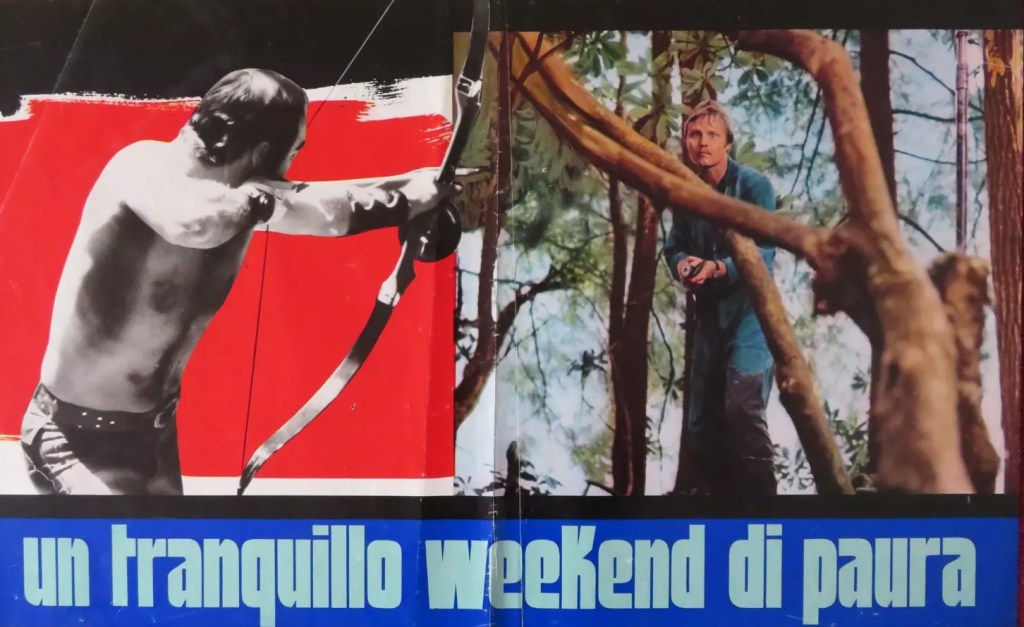
Presumably expecting campfire singalongs Drew (Ronny Cox) has brought his guitar, forgetting it might not be so easily transported through the rapids, but he thinks he’s made contact with the inhabitants when he duets with a banjo player (Billy Redden). Macho Lewis (Burt Reynolds), easily identified as the toughest of the quartet by his visible chest hair and archery set, is at one with nature, assuming that the beasts he presumably intends to kill are okay with that. He believes he’s got one-up on the natives when he beats a local down to $40 for moving their cars to the finish-point, not considering for a moment that the fellow would probably have done it for half.
Ed (Jon Voigt) is the calm one, the peacemaker, keeping the volatile Lewis and the nervous Bobby (Ned Beatty), inclined to poke fun, in check. Turns out the locals don’t take kindly to this kind of invasion and two ambush Ned and Bobby, rape the former, but before they can work their way round to the latter, are interrupted by Lewis who puts an arrow through one of the mountain men. The toothless one escapes.
This is where it gets tricky. Lewis, inner Clint Eastwood to the fore, justifies his slaying. Chances are, if he’d fired a warning shot, the rapists would have scarpered. The chances, too, of Bobby reporting the crime are a big fat zero because the humiliation would be unendurable, even if the local cops accepted a crime like male rape even existed, and given the general lack of police interest in female rape no guarantee it would even be investigated.
Course, you kill one of “them” and you’re setting yourself up as a target for revenge. Our quartet would skedaddle but the only way out is downriver. Drew, in complete shock, topples overboard and drowns, the canoes crash into each other, Lewis breaks his leg, leaving Ed to lead them to safety.
He climbs a cliff, armed with the archery kit, in case they are being stalked by the other hillbilly. When he spots him, he fires, killing the hillbilly. So Ed has to get the injured Lewis and the useless Bobby to safety and hope nobody finds the bodies, one buried in the ground, the other dumped into the river. The cops do come calling, but the trio brave it out.
And the audience is left with a moral quandary – an even more resonant one these days. Are the killers morally justified? In, they presume, a lawless patch, where men are as likely to rape their own gender as women, are they permitted to take the law into their own hands? Stand up for themselves? Be a man? Rather than waiting for someone else to clean up their mess.
Or are they obnoxious over-entitled tourists who can pillage their way through the countryside? They had assumed that the hillbillies would not call in the law in case the cops were hunting for illicit stills. As if the mountain men didn’t have families who would hold them dear, no matter their crimes.
Sure, they get away with it, but don’t the rich always get off scot-free, one rule for the wealthy, another for the poor? Back in the day, I’m sure Americans feared these kinds of hinterlands, where mountain men ran wild, and the idea of ecology was a whistle in the wind. Our guys aren’t campaigning against the loss of the wilderness, but enjoying one last trip before the scenery is flooded.
Some standout moments – the duelling banjos (a hit single), “squeal like a pig,” the white water canoeing, Ed ramming his fingers in the corpse’s mouth to check for give-away missing teeth, the nightmare at the end that set a trend for what today would be termed a post-credit sequence.
Director John Boorman (Point Blank, 1972) easily sits astride his own fence. If all you’re looking for is action in an unusual setting and the Western trope of pacific man roused to anger, then you can go home happy. If you’re sniffing around for something deeper, for the ease with which the morally upright defend the indefensible, then you’ll have plenty to talk about. Poet James Dickey, author of the original unexpected bestseller, turned in the screenplay.
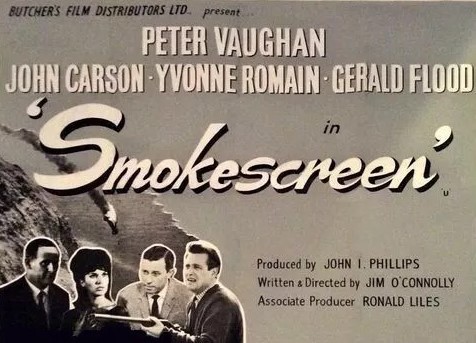
Little gem with a terrific central performance. We tend to be condescending to these old British crime B-features. Occasionally one achieves cult status but mostly critics these days are as dismissive as back in the day. You might be surprised to learn that audiences treated them with a good deal more respect. In making up the support on a double bill, they represented value for money.
It’s also easy to forget that at this point the public were not inundated with television detectives and the true-crime genre had not been invented. Tales like this one, while lacking a big budget, proved very satisfactory viewing, especially if they were as clever as this. I could see the plot of Smokescreen being easily remade for a television one-off or as part of a series.
Main character, insurance agent rather than police detective, in his personal awkward demeanor, reminds me a great deal of the current BBC hit Ludwig.
Significant effort has gone into developing Roper (Peter Vaughan). For someone meant to be upholding the law, he skirts the rules in the matter of his personal expenses, ensuring he always finds the correct price for a taxi or a hotel meal before doing without and claiming it. So he doesn’t at all come across as an attractive character. He looks sly, sleekit, and he’s not smart enough to know how to butter up the office secretary Miss Breen (Barbara Hicks), who always wants minor attention, a postcard or similar.
Like Charles like Nothing but the Best (1964), he’s a sponger, without that character’s class or charm. Sent out on a case to Brighton on England’s south coast, hoping to find a missing man still alive and his wife making a false claim, he ensures that a professional colleague Carson (Trevor Bayliss) does all the driving, saving Roper on taxi fares which he can illicitly claim back. There’s an excuse for this unattractive behavior, but I preferred him less obviously redeemed.
Anyway, he’s a joy to watch, a real person with ordinary flaws rather than the usual ones afflicted contemporary detectives such as alcohol or drug abuse or failing marriage or an affair or requiring serious redemption for past major error.
All the characters have been well fleshed out. Carson nurtures secret feelings for supposed widow Janet (Yvonne Romaine). But she doesn’t at all come across as a femme fatale, which goes against the actress’s screen persona. There’s a great scene with a doctor (Derek Francis) whom his colleague upsets – Roper tiptoes away from the trouble – and who then demands a fee for being professionally consulted even if it’s only a few minutes in his garden.
Local cop Insp Wright (Glynn Edwards) is similarly offhand and down-to-earth, there’s a nice piece of comedy with a station master (Derek Guyler) and a great scene where Roper is way out of his element – and his league – trying to pump information out of a very attractive secretary (Penny Morrell) by getting her drunk, and wincing every time she puts an expensive cocktail on the bill.
Roper’s diligence pays off in the end, but there’s no grandstanding, as there is with Ludwig or any other cop, when he solves the case.
It’s a very clever story well told, enough interest to keep an audience feeling it has been entertained and if the main feature comes up to scratch back in the day would come out of the cinema very satisfied indeed. Roper manages proper detection, miffed when said colleague is correct in an assumption Roper dismissed, and the diligence that requires.
With little of a budget to speak of, these B-features had to make up for the lack of expensive location shots or camera tricks by ensuring the script not just ticked along nicely and provided an interesting resolution but that the characters appeared real, making up for lacking the cosmetic of attractiveness by reminding an audience of real people. Everyone would know a penny-pincher like Roper’s boss or a snippy secretary who can bring employees to heel or a sleekit colleague who’s doing a minor bit of ducking and diving.
This is a particularly significant turn by Peter Vaughan – who you might remember as the elderly Maester in Game of Thrones – because he made his name playing villains generally lacking any nuance. He was the titular evil criminal mastermind in Hammerhead (1968), a thug in Twist of Sand (1968), a nasty piece of work in Straw Dogs (1971). Although he found regular work as a character actor, he might find it somewhat disappointing that he was never again let near anything quite as finished as this piece. Yvonne Romain (Return to Sender, 1963) toys with her screen persona. Future British television dependables pop up everywhere, Gerald Flood and Sam Kydd in addition to Glynn Edwards and Deryck Guyler
Writer-director Jim O’Connolly (The Valley of Gwangi) writes some great stuff and is lucky to have the actors who can pull it off.
Great characters, solid detection and excellent twists.
Fifty years on, the title has an ironic ring as the main character may well be viewed as more feminist than victim, taking her men as and when she wants them, and not especially ground down by rejection and setbacks. Should be a favorite of Martin Scorsese for its reliance on interior monologue. However, that now comes across as unnecessary indulgence. Her abilities as a survivor are apparent without such declamation.
Indulgent, too, is the casual sweep over her surroundings in almost documentary style to make up for the lack of any driving narrative. As a slice-of-life kitchen-sink drama minus any of the acceptable angry young men of earlier in the decade, it’s superior to the male-dominated species in that at least they can rail against injustice from the perspective of one who, thanks to their gender, has a fair chance of rising above it, whereas here Joy (Carol White) is not so much a victim of circumstance as an ace manipulator.
If she’s occasionally dealt a bad hand it’s through her own bad choices. She likes the company of men – and, let’s face it, regular sex – too much to consider consequence. She’s as likely to take up with a thug like husband Tom (John Bindon) as the more caring Dave (Terence Stamp) as a baker or any other geezer she meets in a pub who gives her a “funny feeling” in her stomach.
Being a single mother doesn’t seem to prevent her taking up with a variety of men and it’s only when her child goes missing – though quickly found – that she faces up to her responsibilities. While she flirts with easier ways of making money – modelling for leering male amateur photographers – and readily accepts gifts from her admirers, which could as easily be fresh-baked bread as tiny amounts of cash, but wouldn’t stoop to prostitution as a way of easing her path.
It’s a male dominant world peopled by the kind of men who would slap you around the face for refusing to change the channel on the television (in the days before remote control, obviously, and fights over who holds the remote control) and take pleasure in exerting such power in small humiliating ways. You can stand up to a fellow as much as you like until he whacks you one, and then you realise how little defense you have against such brutality.
Luckily, Tom gets put away after a robbery goes wrong and she can pass the time more peacefully with Dave (Terence Stamp) who has a more romantic and gentle nature, although he, too, a thief, gets jailed. She’s unable to remain faithful to either of them while they’re inside, but it’s the more vulnerable Dave who requires assurance that she’s not playing around while he’s locked up. By now, of course, she’s a deft liar and able to put his mind at ease.
Tom doesn’t expect her to remain true, he has a harder view of life, doesn’t expect anything from anybody, not even his best pals, and should he find himself in an extreme situation, wouldn’t expect anyone to come to this aid.
So the narrative, such as it is, revolves around her going from one bloke to the other, taking her pleasures where she can, manipulating any susceptible male, without for a moment losing audience sympathy. Though for a time she occupies a nice house in a middle-class estate, most of the time she lives in less salubrious apartments, often next door to buildings that are being demolished.
Whether director Ken Loach has tossed bit parts to all and sundry or has simply shot footage in pubs and cafes documentary-style is unclear but it’s quite a different kind of Britain he presents, not the happy Cockney nor making a point about an underclass, but simply presenting a world that rarely merits screen time.
Given Loach’s later political stances, this is surprisingly free of a left-wing perspective, beyond the notion, recounted by a crook, that everyone is a crook.
What gives it its power are the naturalistic performances of Carol White (Daddy’s Gone-A-Hunting, 1969) and, especially given his tendency to over-stylized performances, Terence Stamp (Modesty Blaise, 1966). Some sequences are more marked because, in contributing nothing whatsoever to the drama, they stand out as the kind of talking about nothing dialog with which Tarantino made his name. I’d also point out the titles of the various chapters would appeal to a contemporary audience since they turn the whole chapter-title notion on its head.
Joy stands out as a genuine character full of contradiction and possibly as the most freewheeling female character of the entire decade, and one who’s not remotely troubled by guilt.
Distinctive debut by Ken Loach (Kes, 1969) who co-wrote the screenplay with Nell Dunn from her novel of the same name. Soundtrack by Donovan.
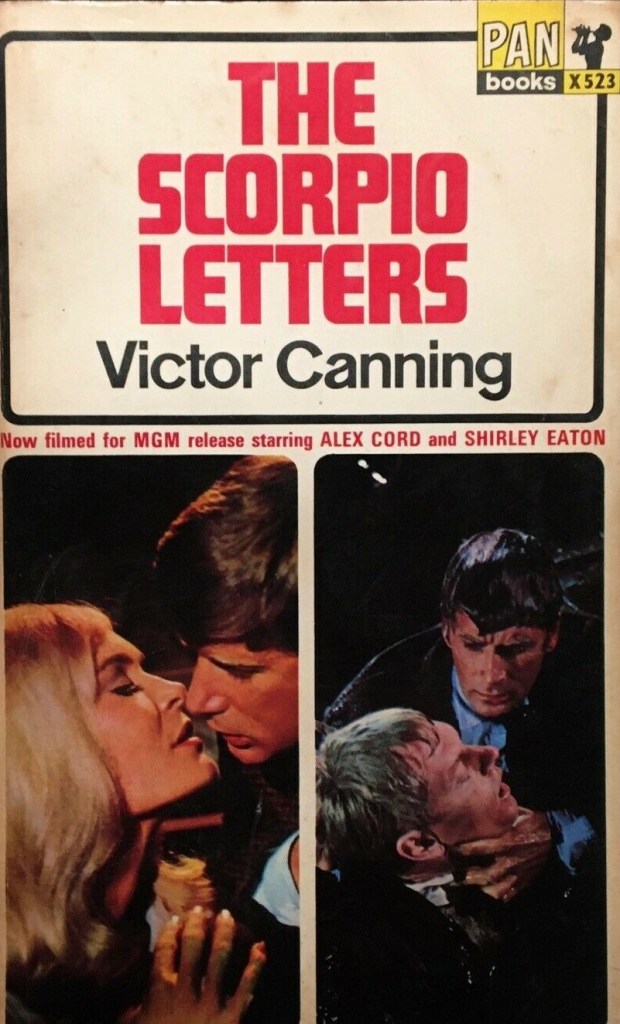
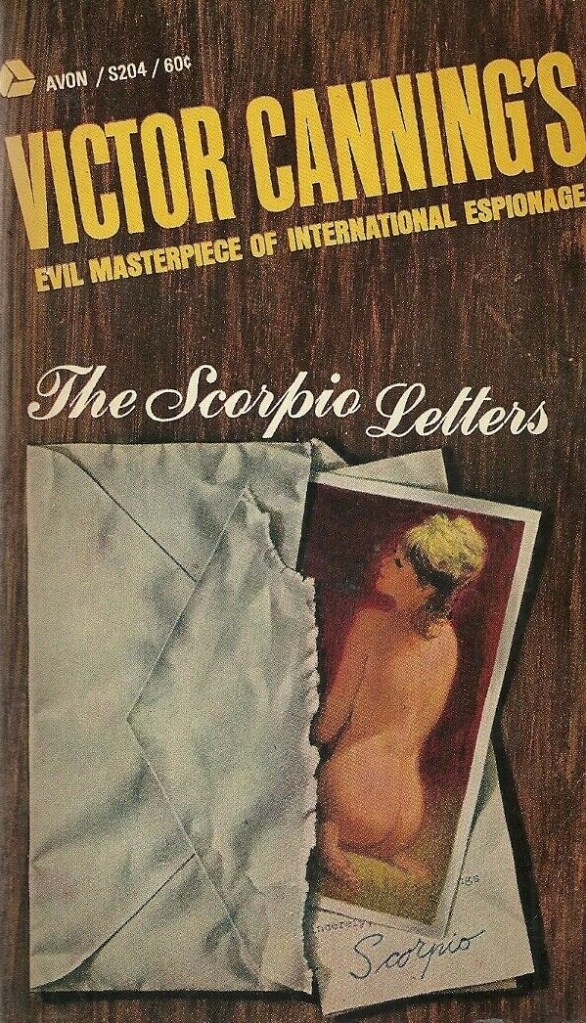
Desultory spy thriller with over-complicated story that’s worth a look mostly for the performance of Alex Cord (Stiletto, 1969). I can’t say I was a big fan of Cord and I certainly didn’t shower him with praise for his role as a disillusioned Mafia hitman in that movie. But now I’m wondering if I have been guilty of under-rating him.
Normally, critics line up to acclaim actors if they deliver widely differing performances – Daniel Day-Lewis considered the touchstone in this department after Room with a View and My Beautiful Launderette opened in New York on the same day in 1985. But usually screen persona rarely changes, a heightened or amalgamated version of the actor’s character or features. Once Charles Bronson, for example, started wearing his drooping mustache, for example, he was never seen without. Actors may grow old, but never bald.
The macho mustachioed Cord of Stiletto is nowhere in sight. In fact, in The Scorpio Letters minus moustache and resisting attempts to reveal his musculature, he is almost unrecognizable. In this picture Joe Christopher (Alex Cord) is flip, resentful, thoughtful, occasionally pedantic, more natural than many of the current crop of Hollywood new stars, and for once in a movie that has transplanted an American in London rather scornful of British traditions.
There’s a realistic flourish here, too, he is so poorly paid – and on a temporary contract – that he has to take the bus. And although he is an ex-cop fired for brutality, that level of violence ain’t on show here. Virtually the opposite of the character Cord created for Stiletto, I’m sure you’ll agree. So full marks for versatility and talent.
Unfortunately, the rest of the movie is not up to much, at the very bottom of the three-star review, almost toppling into two-star territory. Christopher is investigating the death of a British agent who was the subject of a blackmail attempt. By coincidence – or perhaps not – another part of British Intelligence is investigating the same death, and this brings Christopher into contact with Phoebe Stewart (Shirley Eaton) and eventually they work together to unravel a list of codenames and uncover the conspiracy with a bit of risk to life and limb.
But the pay-off doesn’t work despite all the exposition attempting to build it up and you’re left with a kind of drawing-room drama rather than exciting spy adventure. It’s determinedly London-centric with red buses, red postboxes, Big Ben, Horse Guards Parade all putting in an appearance. The scene shifts to Paris and Nice without much increase in tension. There’s also an irate German chef. Despite a couple of neat scenes – a chase held up behind a wedding party, an interrogation in a wine cellar – it’s much too formulaic.
Cord apart, Shirley Eaton (Goldfinger, 1964) adds some glamour, but her rounded portrait depicts a character with warmth rather than oozing sex. This is the kind of film that should be awash with character actors and up-and-comers, but I recognized few names except for Danielle De Metz (The Karate Killers, 1967), Oscar Beregi (Morituri, 1965) and Laurence Naismith (The Persuaders tv series, 1971).
One-time top MGM megger Richard Thorpe (The Truth about Spring, 1965) was coming to the end of a distinguished career which had included Ivanhoe (1952) and Knights of the Round Table (1953). This was his penultimate film. The appropriately named Adrian Spies (Dark of the Sun, 1968) wrote the screenplay based on the Victor Canning thriller. Making his movie debut was composer Dave Grusin (Divorce American Style, 1967)
Albeit with a limited budget of $900,000, MGM intended the picture for theatrical release but with a short cinema window to make it available for a speedy showing on ABC TV. It was originally scheduled for a May 1967 theatrical release but MGM decided to cut out the American release and so it made its debut in the “Sunday Night at the Movies” slot on February 19, 1967, and was shown in cinemas abroad. Nor was it shown first on U.S. television because the studio believed it a disaster. Variety (February 22, 1967, page 42) called it “very hip.”
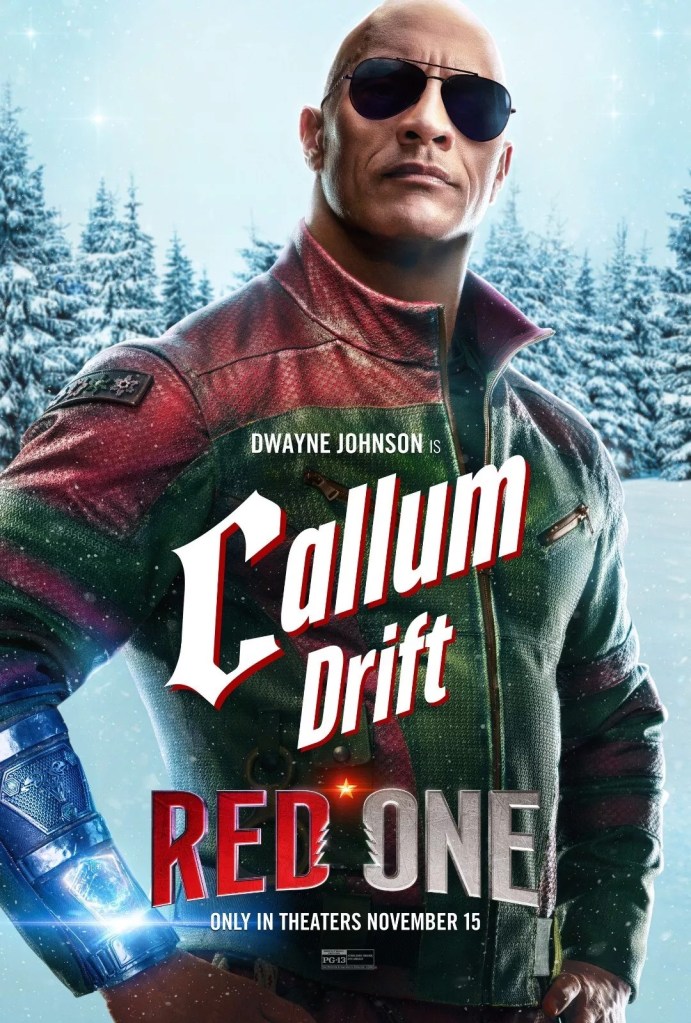
Santa Claus meets Die Hard might have worked well enough if it hadn’t been padded out with all sorts of other festive characters from the dark side of Xmas and a sludge of sentiment about an absent father reconnecting with his son. Can’t quite decide if it’s family-friendly or aiming for a queasier relationship with a Beetlejuice, Beetlejuice audience. And I suspect if Amazon had the courage of its theatrical convictions, it would made this a Xmas cinema release rather than chucking it into picture houses now and lining it up for a small-screen Xmas special.
Attempts to merge James Bond-style big budget thriller with underworld shenanigans conjuring up the kind of misfits who’d have been slung out of a Star Wars cantina while at the same time as making up the rules as it goes along. There’s a mix-and-match feel to the characters – we get Gryla, a mythical Icelandic monster, Krampus, a hairy devil of Germanic extraction who has his fun the night before Xmas, but is repurposed here as a Santa’s big bad brother, as well as a bunch of gargoyles who are way too easily distracted by a hen who they, mysteriously, can’t manage to catch, and then like a throwback to Transformers we get tiny Lego style figures who turn gigantic when let loose. You can stop snowmen in their tracks by whipping off their carrot noses.
Face-slapping is reinvented, shapeshifting is the game, and as if nobody had watched how badly Ghostbusters: Frozen Empire failed we’re back to a villain with icy superpowers. The giant polar bear featured – cousin to the armored bear in The Golden Compass (2007) – in the poster is underused. Not to mention that Xmas staple, the kids threatened with losing out on presents if they are naughty. None of this should work at all, but it does fairly well.
On the eve of said Mr Claus’s big night, he gets kidnapped. Bodyguard Callum (Dwayne Johnson), who turns out to be more than 500 years old, is on the trail and tracks down hacker Jack (Chris Evans) who’s sold Santa’s secret location to villain Gryla (Kieman Shipka), the ex- of Krampus’s (Kristofer Hivju), who wants to trap every night child in the world inside the kind of glass snow globe that was a traditional Xmas present. She’s manufactured these in the gazillions.
Callum and Jack team up though the latter’s not much use, his contribution to the double act consisting mainly of double takes and it’s only when he doesn’t take the opportunity to escape Krampus’s lair that he becomes one of the team. Mostly, it’s one bizarre situation after another and although at just over two hours it’s already outstaying its welcome it could have done with spending some more time on outlining the background and developing the fiendish characters. It’s a world that seems surprisingly undercooked given the mega budget. On the plus side – or perhaps the minus depending on your perspective – there’s a cuteness bypass. There’s a little too much time spent on – unsuccessfully – showing how Santa manages to get himself down every single chimney in the world in the space of a night including time to gobble down some treats. Would have done better to stick to the Santa hijack than include a technologically-improved Xmas.
Xmas spirit missing in this previous red one.
This didn’t need the presence of Dwayne Johnson (Black Adam, 2022) and certainly Chris Evans (The Gray Man, 2022) is wasted but with the MCU world closing its doors on both actors, perhaps this is an attempt to set up a new series. As Mr Claus, J.K. Simmons (Juror #2, 2024) isn’t in it long enough. Jake Kasdan (Jumanji, The Next Level, 2019) directed from a script by Chris Morgan (Shazam! Fury of the Gods, 2023) and Hiram Garcia (Jumaji, The Next Level).
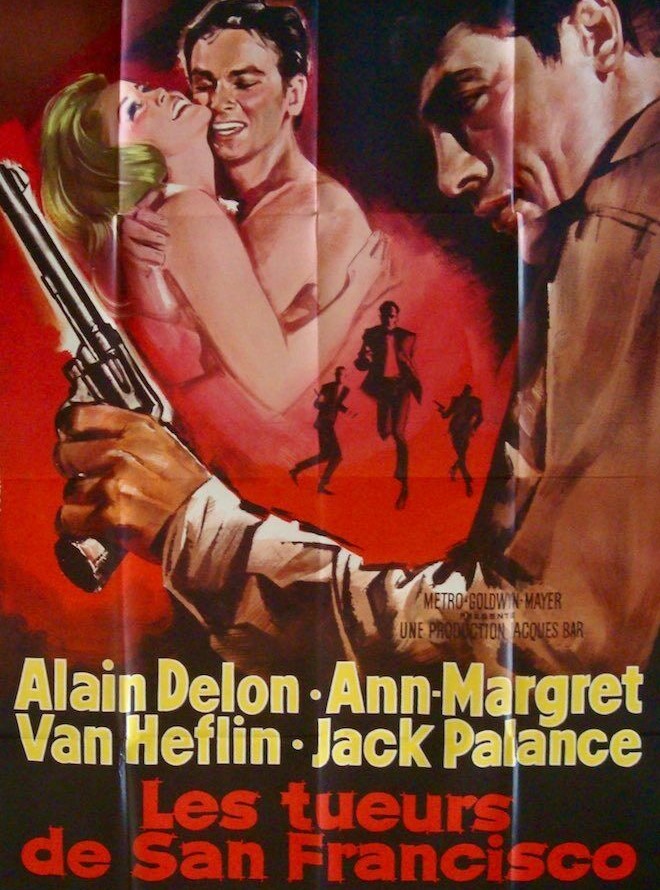
Film noir gem with terrific cast filmed in black-and-white and often at night that crams into a taut storyline different slants of the themes of the con-going-straight, the vendetta and the double-cross. While Hollywood at this point had imported platoons of foreign beauties in the Sophia Loren-Elke Sommer vein, there had been less interest in the male of the species with the exception of a small British contingent and possibly Omar Sharif, on whom the jury was still out.
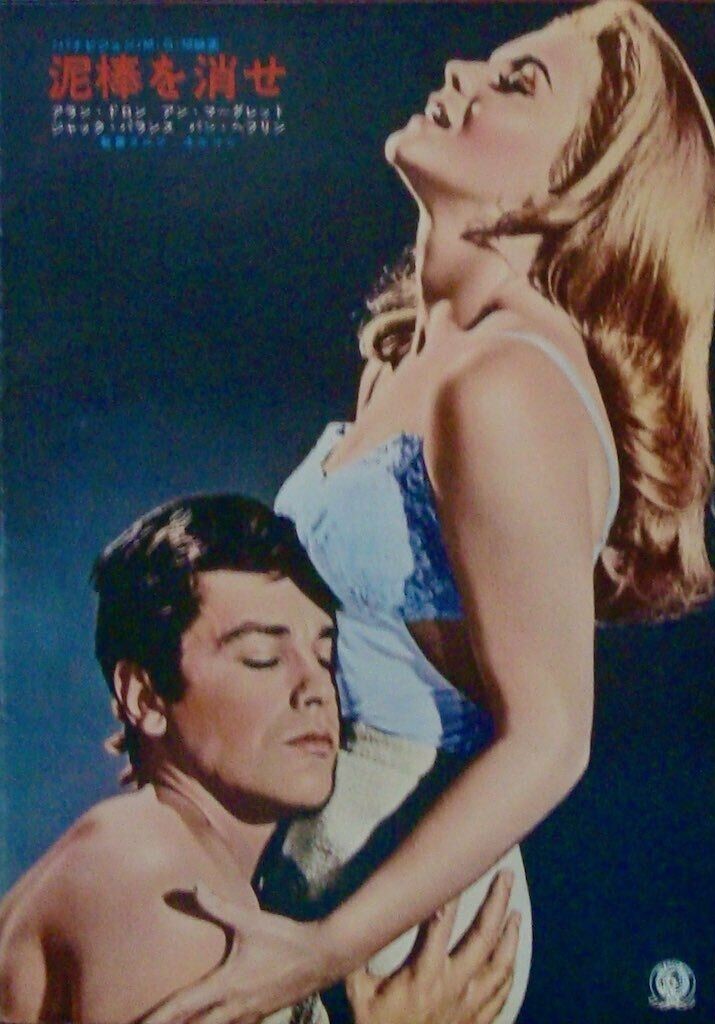
MGM was gambling on Frenchman Alain Delon (Farewell Friend / Adieu L’Ami, 1968) to alter industry perspective at the same time as pushing new contract star Ann-Margret (The Swinger, 1966) along more dramatic lines away from the glossy puffery that had made her name and which relied more upon her physical assets than acting potential. Had she continued in this vein, her career would certainly have taken a different turn.
Eddie Pedak (Alain Delon), former minor hood turned San Francisco truck driver, is happily married to Kristine (Ann-Margret) with a young daughter they both adore. But tough cop Mike Vido (Van Heflin), with a reputation for brutality, is determined to pin a murder on him in revenge for purportedly being shot by him early in Eddie’s previous career. Eddie manages for a time to resist the overtures of brother Walter (Jack Palance) to participate in a million-dollar diamond heist. But when he loses his job, that changes.
While the robbery naturally takes center stage, that’s not actually the dramatic highlight. Instead, it is the Eddie-Kristine relationship. Instead of Eddie being the usual down-on-his-luck ex-con, he has clearly turned his life around, so much so he can afford a $500 down payment on a small boat. A loving father, he accepts without rancor when his daughter interrupts a night-time lovemaking session. And he’s stylish, too, wearing an iconic sheepskin jacket and driving a snazzy 1931 Ford Model A roadster. Kristine just wants a normal home life, desiring domesticity above all else, but swallowing her pride when she needs to go out to work in a night club to make ends meet, for a time rendering the unemployed Eddie a house husband.
But Eddie is not all he initially seems. His tough streak has not been smothered by the good life. In a brilliant Catch-22 situation he gets violent when an employment benefits clerk refuses to accept that Eddie was fired from his job, instead believing his employer’s claim that he resigned – the former triggering relief payment, the latter zilch. But that’s nothing to the beating he administers to Kristine when, pride injured that he is not the breadwinner, he discovers the skimpy costume she wears for her job.
Adding to the unusual mix are Vido and Walter, the former’s brooding presence somewhat undercut by the fact that in middle age he still lives with his mother, the latter while a big-time gangster letting nothing get in the way of strong fraternal feeling for Eddie.
You won’t be surprised to learn double cross is in the air, not when Walter employs a creepy sunglass-wearing henchman Sargantanas (John Davis Chandler) who appears to have more than a passing interest in little girls. The climax, which contains both emotional and dramatic twist, involves redemption and sacrifice.
Delon has played the cold-eyed ruthless but romantic character before, but here adds depth from his paternal commitment and as a man turned inside out by the system.
Ann-Margret is the revelation, truly believable as mother first, sexy wife second, and her anguish in the later parts of the picture showcase a different level of acting skill to anything she previously essayed. This role immediately preceded her man-eater in The Cincinnati Kid (1965) which attracted far more attention and considerably bigger box office and it would been interesting to see how her career might have panned out had Once a Thief been the critical and commercial triumph. She probably did not attain such acting heights again until Carnal Knowledge (1971). And I did wonder, as with Daliah Lavi (The Demon, 1963) before her, whether her acting skills were too often overshadowed in the Hollywood mindset by her physical attributes.
Van Heflin (Cry ofBattle, 1963) is excellent as the cop tormented by the idea that a villain is walking free, Jack Palance (The Professionals, 1966) is good as always and character actor Jeff Corey (The Cincinnati Kid) puts in an appearance as Vido’s whip-cracking boss and this marks the debut of Tony Musante (The Bird with the Crystal Plumage, 1970). Watch for a cameo by screenwriter Zekial Marko (Any Number Can Win, 1963) , who wrote the original book.
This represented another change of pace for director Ralph Nelson, Oscar-nominated for the Lilies of the Field (1963) and also known for box office comedy hit Father Goose (1964). His use of an experimental, more light-sensitive, camera eliminated the bulky lighting commensurate with filming at night, bringing freshness and greater freedom to those scenes. His natural gift for drama ensured that the emotional was given as much prominence as the action. Racial awareness was demonstrated by the opening scene in a jazz club where African Americans were clearly welcome, hardly the norm at that time.
Mention again of a terrific score by Lalo Schifrin, especially the bold drum solo that played out over the credit sequence.
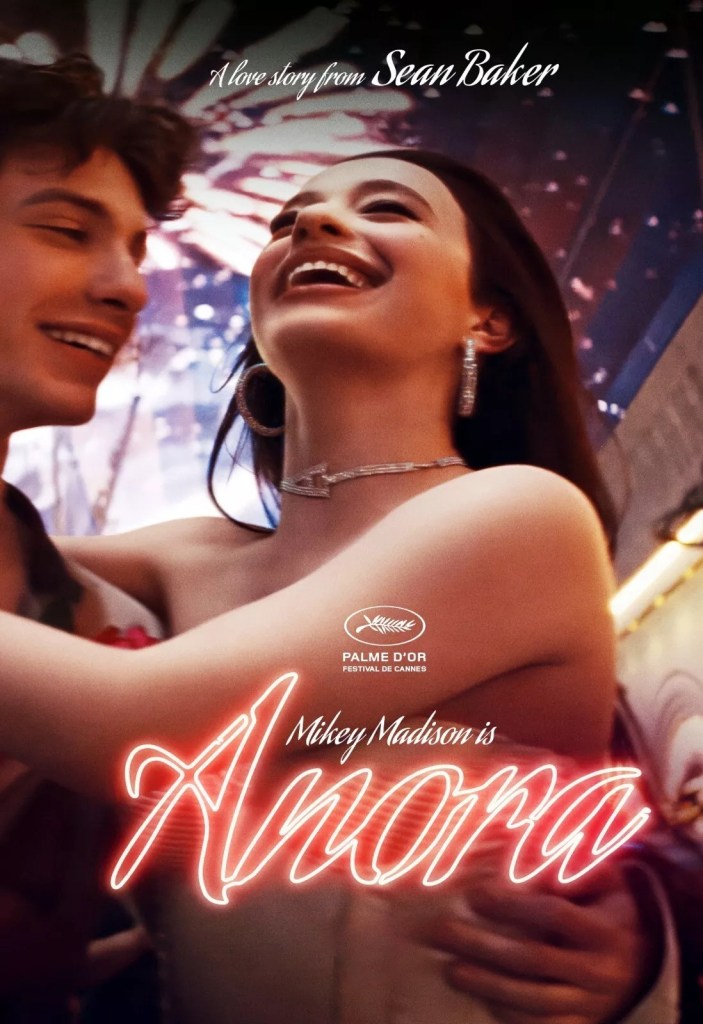
This poses two questions. Am I so out of touch with modern film-making that I consider this a terrible film? Or are the jurors at the Cannes Film Festival and a whole raft of critics so out of touch with modern film-making that they think it’s a great film.
One of the problems for proper critics – that is the people who see every single film that comes out as part of their job and are hired to offer their opinions in eminent media as opposed to the self-styled critics who have podcasts and blogs but pick and choose what they watch – is the sheer volume of product.
From speaking over the years (over the decades) I know that one of the perennial problems facing the critic is boredom. They see so much dreck and are equally turned off by earnest movies or by seeing the same old same old that they tend to get extremely excited when they come upon something that’s new, refreshing, different. Added to that they want to champion new invigorating film-makers rather than poke holes in the latest Hollywood disaster.
So there’s a tendency to over-champion and to patronise, pumping up films which critics feel audiences should see. And over the years there’s been no shortage of forgettable movies that enjoyed a moment in the sun, picked out by a critic as the next best thing in a very dull week, and over-praised, or by a critic who simply wanted to get behind home-grown product or a particular favored director or star.
There’s a sense that critics feel they are needed more than ever in order to steer audiences in the right direction, forgetting that moviegoers are perfectly capable of making up their own minds. The Cannes Film Festival hasn’t usually had an iffy reputation. Sure, for every game changer like Easy Rider (1969), Sex, Lies and Videotape (1989) or Pulp Fiction (1994) and solid successes like The Piano (1993) or The White Ribbon (2009) or Blue Is the Warmest Colour (2013) there are king-sized stumbles. Let’s not hear it for the likes of Elephant (2003) or Tree of Life (2011) – efforts to buff up fading reputations – and Triangle of Sadness (2022) which took a long time going nowhere. But poor choices are a relatively minor phenomenon.
This is worse than any of them. The worst of the worst. It’s not even redeemable like yesterday’s Doctors Wives (1971) which is one of the best so-bad-it’s-good pictures you’ll come across. Some clever dick tagged this as a contemporary Pretty Woman (1990) but it bears as much resemblance to that picture as Donald Trump to Joe Biden.
If you’re aiming for a Cinderella story involving a sex worker you’re going to need the oodles of narrative charm and screen charisma that proved Pretty Woman’s major selling point or you disguise the commercial instincts of the female lead beneath a sheen of “presents” as in Butterfield 8 (1960) and Breakfast at Tiffany’s (1961).
Even better, you just learn how to tell a story. And that doesn’t mean repeating the same scene with minor variations for nearly half an hour. Stripper Ani (Mikey Madison) is hired for a week of sex by juvenile Russian playboy Vanya (Mark Eidelstein). When they’re not having sex in every possible position and she’s subtly trying to make him last longer, he’s off his head with drink and drugs and playing computer games. That’s basically it for a full hour. Initial lap dances, off to his amazing mansion, then sex, drugs, computer game, sex, drugs, computer game, sex, drugs, computer game. Am I boring you yet?
Yes, there is some mild backstage bickering at the strip club and partying with his friends but that’s just minor interruption to sex, drugs, computer games, sex, drugs, computer games, sex, drugs, computer games. Vanya is so out of it he asks Ani to marry him, which she does, in Vegas, possibly with the ulterior motive of him getting a green card. But he doesn’t seem to have a single thought in his head beyond sex, drugs, computer games, and that kind of conniving would require a more competent brain.
Anyway, of course, mom and pop back in Russia get wind of their son marrying a sex worker and send Toros, a Russian Orthodox priest, to sort out the mess. Best scene in the film is Toros, carrying out a baptism in a crowded church, taking a text message in the middle of the ceremony and dumping the unbaptized baby in the arms of the astonished parents and rushing off. If the rest of the film were up to the originality of that scene, we might be onto something.
Maybe there were great scenes to come. I couldn’t tell you. And maybe I shouldn’t be reviewing this at all because I walked out just after the baptism.
Nobody comes out of this well, least of writer-director Sean Baker whose last effort Red Rocket (2021) was similarly concerned with sexual low-lifes. Mikey Madison (Scream, 2022) and Mark Eidelstein get their kits off to no avail.
No great surprise that the political thriller has made a return – all subgenres resurface after a while. The surprise here is the context. The Catholic Church hardly seems a fitting setting, given it’s been wracked for decades by accusations of child molestation, Oscar-winning Spotlight (2015) taking it down over historic malfeasance in Boston, though that was more in the line of another subgenre, the fearless journalistic expose.
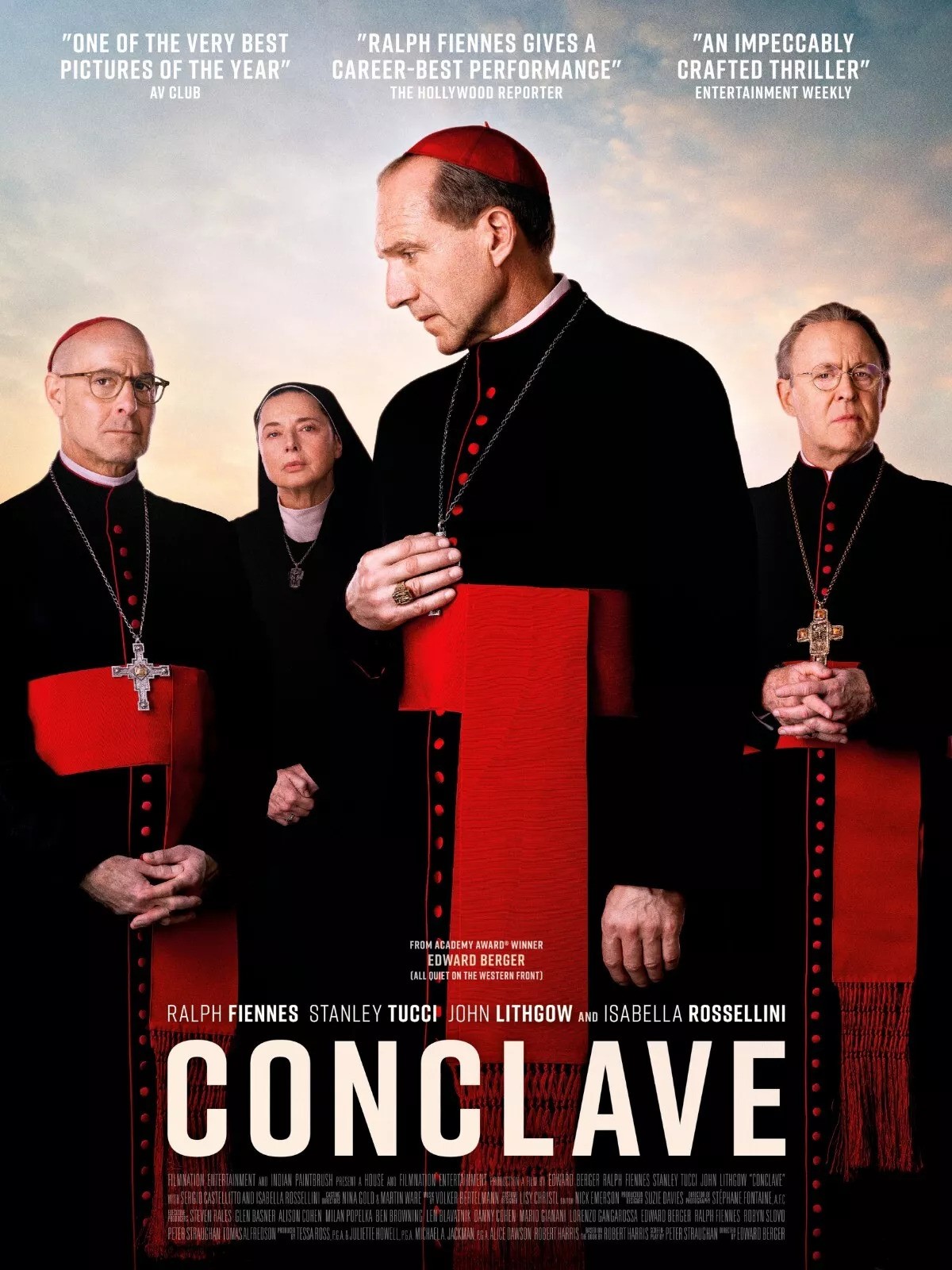
Nor would you expect the drama of the election by all the Cardinals of a new Pope to turn into a riveting thriller, with a stunner of a twist at the end which carries considerable contemporary heft. The last time the goings-on in the Catholic Church attracted the attention of Hollywood was in Otto Preminger’s The Cardinal (1963) and The Shoes of the Fisherman (1968), which were cut from a more traditional cloth. Except for some interesting procedural background and some argument about the future direction of the Church, the bulk of this picture concerns the horse-trading and corruption that threatens to envelop the election.
Our guide through the shenanigans is Lawrence (Ralph Fiennes), the dead Pope’s righthand man, who, although filled with his own doubts, is in charge of managing the actual election. He’s so self-effacing that it comes as something of a shock to him to discover that he’s one of the candidates. It’s a blind-voting system and continues until one person has secured 72 votes. As you might expect there’s wheeling-and-dealing with the liberal elements set against the more entrenched right-wing groups.
The main contenders are: Bellini (Stanley Tucci), favored by Lawrence, Tremblay (John Lithgow), Adeyemi (Lucian Msamati), a black African who would be a popular winner except for his stringent views on homosexuality, Tedesco (Sergio Castellito) who wants to cancel all the liberal developments of the Church in the last half century, and surprise packet Benitez (Carlos Diehz) from Afghanistan who represents the downtrodden that the rest of the high-living Cardinals appear to have forgotten.
You’re going to remember the twists more than any moral message. But it does allow time for debate of the major moral questions, mostly handled with subtlety. The Cardinals are all sequestered away from the outside world for the duration of the election. Turns out the deceased Pope was trying to rig the election to suit his own ends, conspiring against those Cardinals he felt were too ambitious, self-obsessed or had unsightly, but secret, stains on their characters.
For a holy fellow the dead Pope set some remarkable traps which leave Lawrence reeling. And as the election proceeds, Lawrence is revealed, on the one hand, to be quite a tough egg, like a good journalist determined to uncover the truth, but on the other hand given to bouts of crying as the weight of duty and expectation and, I guess, shock at the findings get to him.
This is quite an adult movie. Not in the sense that we’re dealing with a particularly controversial subject matter, but it’s a kind of courtroom drama in all but name, and except for the sprinkling of revelations, and the inherent tension of an election, apt to be slow moving, allowing characters time to breathe and to put various points across. The structure makes no concessions to the MCU generation. Nor to the traditional Hollywood approach which would have allocated a certain amount of time to tourist Rome. A couple of cheats – hidden documents, access to a computer when access to anything was denied – don’t get in the way.
I’m always worried when trailers concentrate on the number of Oscar winners or nominees involved because generally that suggests to me a weak narrative. But, in fact, two-time nominees Ralph Fiennes (No Time to Die, 2021) and John Lithgow (Interstellar, 2014), and one-time nominee Stanley Tucci (The Hunger Games, 2012) deliver terrific, largely understated performances, while director, also a nominee, Gerard Berger (All Quiet on the Western Front (2022) brings it together with a stately majesty.
He’s allowed himself a certain amount of self-indulgence. The overhead shot of the lines of Cardinals moving through the rain and carrying white umbrellas bears no narrative weight but is visually splendid. As if escaping from a more offbeat movie, turtles appear from time to time. The rigmarole of ritual is compelling.
Some scenes are conducted in Latin, with subtitles of course. Thank goodness, I know now what “in secula seculorum” now means. But you didn;t need to know back in the day. That was the point. It was like joining a secret society. The Catholic Church once had an unique ID that it threw away – the fact that all Masses were spoken in Latin, and therefore universally appreciated, and you could go to a Church in any country and understand what was going on, whereas now you’d need Google translate.
Screenwriter Peter Straughan (Tinker, Tailor, Soldier, Spy, 2011) is on something of a roll at the moment, his teleplay for Wolf Hall: The Mirror and the Light just out. Robert Harris, who’s not had much luck at the box office with the various movie interpretations of his bestsellers Enigma (2001), The Ghost Writer (2010), and An Officer and a Spy (2019) – banned pretty much everywhere because of Roman Polanski’s involvement – gets his just reward here for laying down such a superb template. The music by Volker Bertelmann was particularly striking. Oddly enough his Oscar win for All Quiet on the Western Front didn’t warrant a mention in the trailer.














 The Magnificent 60s