
Might have been pitched higher had it appeared after Honor Blackman Moment to Moment, 1966) began her stint as Cathy Gale in hit television show The Avengers. As it is, still a neat job. Few stylistic flourishes – a zoom shot (highly unusual), use of silhouette, camera swivel, substantial location work and some judicious use of the overhead camera. But mostly a crime picture that delivers in tidy fashion. As another plus point, it’s short.
Ideal support material, the kind of movie that was easy to get off the ground in the U.K. because of the Eady Levy (a tax break) and the quota system whereby cinemas had to show a certain percentage of home-grown movies. Films capitalizing on this were known as “quota quickies” and most deserved to disappear from view shortly after being made.
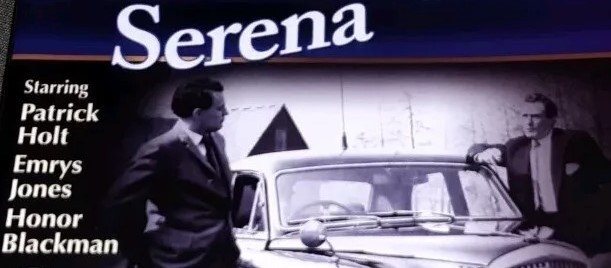
This is an exception, and damned clever it is too, and though a few of the “clues” wouldn’t register with a contemporary audience, it piles on the twists and turns so it’s one narrative beat after another.
Detective Inspector Gregory (Patrick Holt) and Sergeant Conway (Bruce Beeby) come calling on artist Howard Rogers (Emrys Jones) with news his wife has been murdered. They’re separated three years, divorce unlikely due to the wife’s Catholicism. Howard is putting the finishing touches to a painting of voluptuous brunette model Serena, who subsequently can’t be found to substantiate his alibi.
The blonde wife’s face has been blown apart by shotgun pellets so there’s a question-mark over her identity. So when said wife Ann (Honor Blackman) turns up, it’s clear someone else is dead. Ann is all set for reconciliation and the couple plan to head off for France to live off the £280,000 left in her father’s will.
Soon becomes apparent to the doughty investigation team that the murderer has killed the wrong woman. Ann, fearing she was being followed and worried about her safety, had called in old chum Cathy, an actress, also a blonde, to dress up in her clothes and pretend to be the wife. Clothes are found in the river. The finger of suspicion points at the missing Serena, in love with the artist and perhaps wanting to bump off her rival.
The clues, such as they are, are infinitesimal, though of course in those days there was little recourse to forensics. But they don’t mount up to much and their importance to the investigation – a modest piece of sleight of hand – is kept from the audience, spared the endless poring over red herrings to be found in modern detective tales, so it’s only at the end that the culprits are found.
And you can see why the director withheld crucial evidence because the climax is exceptionally well done. Ann’s lawyer is executor of the will, so, perforce, she would have had several meetings with him.
When the police arrive as the reconciled couple are packing their bags before hopping over the Channel, the ever-helpful cops offer them a lift to the train station. But, in fact, plan to take them to the police station. In the car for no apparent reason is the lawyer. But no words of greeting are exchanged between him and the wife.
Ergo, she’s not the wife.
That’s Serena in the car. Howard and Serena conspired to kill the wife. Clever use of wigs turned Serena into the brunette model and then the blonde wife. Two clues – plus the continued absence of the model – had led Insp Gregory to this conclusion. They found spirit-gum on the clothes found in the river, and that’s used to attach wigs, and in church the false Ann was seen crossing herself with her left hand rather than her right, de rigeur for that religion even if you were left-handed.
So, as I said, tidily done, mystery stoked high until the end.
Peter Maxwell (Impact, 1963) was mostly a jobbing television director only afforded a handful of movies, and all of these B-pictures, into which he injects the occasional stylistic touch, but which fitted well into the supporting picture category.
Patrick Holt reminded me of Peter Finch (The Legend of Lylah Clare, 1968), same build, haircut, stolidness and pursing of the lips, but he’s not asked to plumb any emotional depths. You might well have forecast a bright future for Honor Blackman after this movie but she was already established enough, making the transition to adult roles from child star, and since she’s not called upon to play a femme fatale, there’s not much for her to get her teeth into either. Emrys Jones (The Trials of Oscar Wilde, 1960) is good as the schemer.
Quite a few hands involved in tricking out the screenplay including the director, Edward and Valerie Abraham (Dominique, 1978) and Reginald Hearne (The Sicilians, 1964) .
One of the best examples of the “quota quickie.”

 The Magnificent 60s
Do like a quota quickie, short films are increasingly appealing; someone should package them up for a streaming sidebar or a blu-ray box…
LikeLike