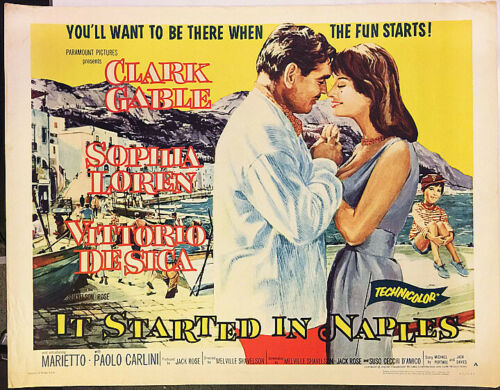
By this point in her career Sophia Loren was adopted by Hollywood primarily as a means of rejuvenating the romantic screen careers of much older male stars. John Wayne was over two decades her senior in Legend of the Lost (1957), Frank Sinatra and Gregory Peck nearly two decades older in The Pride and the Passion (1957, and Cary Grant a full three decades in Houseboat (1959). But where Grant was sprightly enough and with superb comic timing and Loren had the charm to make Houseboat work, the May-December notion lost much of its appeal when translated to her Italian homeland and an aging Clark Gable.
While engaging enough, the tale mostly relies on a stereotypical stuffy American’s encounters with a stereotypical down-to-earth Italian although Loren adds considerable zap with her singing-and-dancing numbers. Lawyer Michael Hamilton (Clark Gable), in Italy to settle his deceased brother’s affairs, discovers the dead man has left behind an eight-year-old boy Nando (Marietto) being looked after in haphazard fashion and impoverished circumstances in Capri by his aunt Lucia (Sophia Loren), a nightclub singer. Determined to give the boy a proper American education, Hamilton engages in a tug-of-war with Lucia.
In truth, Lucia lacks maternal instincts, allowing the boy to stay up till one o’clock in the morning handing out nightclub flyers and not even knowing where the local school is. Hamilton is in turns appalled and attracted to Lucia, in some part pretending romantic interest to come to a out-of-court settlement. To complicate matters, Hamilton is due to get married back home.
At times it is more travelog than romantic comedy, with streets packed for fiestas and cafes full well into the night, a speedboat ride round the glorious bay, another expedition under the majestic caves, a cable car trip up the cliffs to view spectacular scenery, and the local population enjoying their version of la dolce vita. But the piece de resistance is Lucia’s performance in the nightclub, ravishing figure accompanied by more than passable voice as she knocks out “Tu vuo fa L’Americano” (which you might remember from the jazz club scene in The Talented Mr Ripley, 199). She has a zest that her suitor cannot match but which is of course immensely appealing.
Lucia is torn between giving the boy a better start in life, already insisting for example that he speak English, and holding on to him while street urchin Nando is intent on acting as matchmaker.
Most of the humor is somewhat heavy-handed except for a few exceptional lines – complaining that he cannot sleep for the noise outside, Hamilton asks a waiter how do these people ever sleep only to receive the immortal reply: “together.”
Gable lacks the double-take that served Cary Grant so well and instead of looking perplexed and captivated mostly looks grumpy. But this is still Gable and the camera still loves him even if he has added a few pounds. He was a bigger global star than in the Hollywood Golden Era thanks in part to regular reissues of Gone with the Wind (1939) but mostly to a wider range of roles and he was earning far more than at MGM, in the John Wayne/William Holden league of remuneration. Loren was the leading Italian female star, well ahead in Hollywood eyes of competitors Claudia Cardinale and Gina Lollobrigida, and had the ability, despite whatever age difference was foisted upon her, to make believable any unlikely romance.

 The Magnificent 60s
Loren is always good, but I find late Gable to be a bit of a chore. As you say, Gone with the Wind kept him in the pubic eye, but I’m not sure I want to be there when the fun starts’ here…
LikeLiked by 1 person
Freudian slip? Pubic eye? That’s a new one.
LikeLike