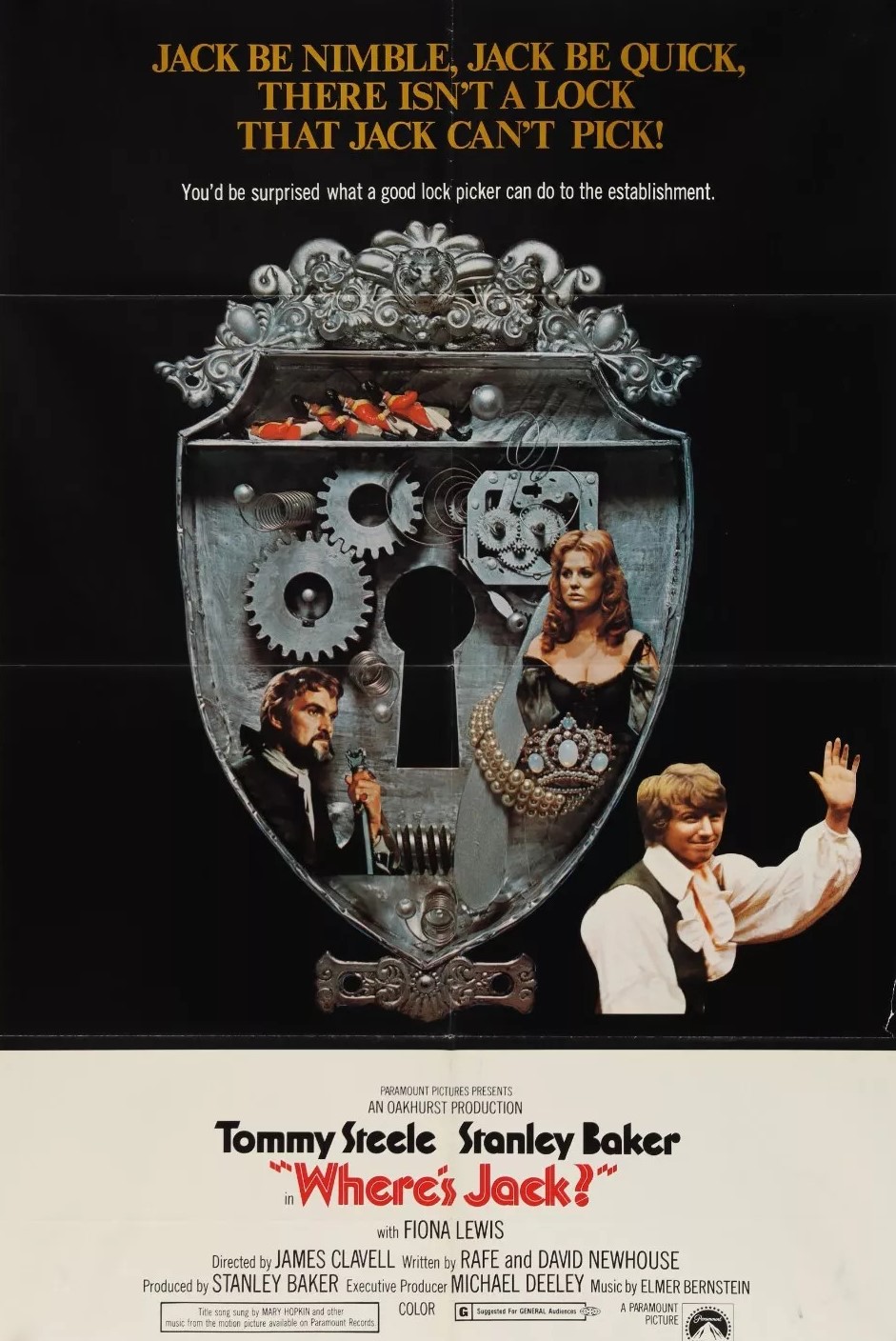
Prison escapees tend to conform to a certain type. Think Charles Bronson and Steve McQueen (The Great Escape, 1969), Paul Newman (Cool Hand Luke, 1967) and Clint Eastwood (Escape from Alcatraz, 1979). Admittedly, Tim Robbins (The Shawshank Redemption, 1994) doesn’t fit the bill, but he’s got brains instead of brawn. But he’s not twinkle-eyed or twinkle-toed or diminutive like British hoofer Tommy Steele (Half a Sixpence, 1967) who’s not helped here by being up against a distinctively tough screen character in the shape of Stanley Baker (Zulu, 1964).
Served up as an antidote to the tomfoolery and sexuality of Tom Jones (1963), more interested in the seamier side of Ye Olde England, it ignores the more interesting tale of criminal corruption and hypocrisy of Jonathan Wild (Stanley Baker), the Thief-Taker, in favor of young thief Jack Sheppard (Tommy Steele) who proves his nemesis.

Wild was the ultimate hypocrite, not just stewed in the corruption of the times but taking advantage of it, and not so much poacher-turned-gamekeeper but gamekeeper who had not entirely abandoned his previous profession. Wild, a notorious thief, managed to set himself up as London’s top lawman, keeping other thieves in line and handing over a certain number to the hangman. He had another sideline. He sold back stolen goods to burglarized owners. Most of this was condoned by the authorities who believed that it took a thief to catch a thief.
Wild enrages Sheppard, apprentice locksmith to trade, by reneging on a deal to free Sheppard’s criminal brother. Sheppard sets out to teach the antique godfather a lesson, breaking into his warehouse and stealing the contents.
Wild has him arrested on a variety of occasions, but each time Sheppard breaks out from prisons that had the reputation of the later Alcatraz, in one instance through a sewer, in another via a chimney, turning himself into a local hero in the process. Sheppard’s main trade is not so much burglary as highwayman and further annoying Wild by bringing such criminal solicitation to the streets of posh London, from which it had, by decree of Wild, been outlawed.
In so doing, Sheppard encounters Lady Darlington (Sue Lloyd), so taken with our scamp that had this been Tom Jones there would have been some rollicking in the hay (or the Mayfair equivalent). Instead, she bets her Scottish estate that he will escape from his latest incarceration.

Sheppard has the hots for barmaid Bess (Fiona Lewis) but this not being Tom Jones we don’t go much beyond cleavage. The sub-plot involving Lady Darlington, which I’m guessing forms part of the Jack Sheppard legend (since he was a real-life character), takes up valuable time which could have been spent either developing the romance or on the escapes, which don’t generate the necessary tension, or filling out the crook’s character.
Narrative-wise there’s more at stake for Wild, not just being led a merry dance by Sheppard and losing respect (the crime of crimes against a criminal mastermind) but also by potentially damaging his cosy relationship with the authorities, led by snippy Lord Chancellor (Alan Badel) who is on the other side of the Lady Darlington wager.
Fair amount of rubbish being tossed out of windows, unruly tavern occupants, poverty and homelessness abounding, and general but unspecified bawdiness, in fact a truer perspective of the times, doesn’t compensate for the lack of compelling narrative.
On paper, this should have amounted to a lot more. Mostly, it goes askew from miscasting. Tommy Steele is outshone without much difficulty by Stanley Baker and it’s asking a lot of an audience to accept that a cheeky chappie can outwit the exceptionally clever tough guy. It’s Baker who makes the most of his scenes, either lording it over his gangs, using cruelty to keep them in line, or fearing that he might be toppled from his lofty position and end up either back in the gutter or at the end of a noose.
There’s a bit of complicated jiggery-pokery relating to the effect your weight has on how long you can dangle on the end of a rope. Hangmen in those days did not follow scientific principles and provide some kind of weighting handicap as occurred later to prevent unnecessary suffering and make death as swift as possible.
Anyway, our Jack, being a skinny little runt (and this plot-point key to the climax ensuring the part required a skinny little runt rather than someone hewn from the normal tough guy runt) doesn’t die from the hanging, escaping the fury of Wild and (so legend has it) managing to escape to the colonies.
Put a Michael Caine (The Ipcress File, 1965) in the leading role or Richard Harris (Major Dundee, 1965) or even a Nicol Williamson (The Reckoning, 1970) and you would have quite a different movie, a more believable protagonist. Even Peter O’Toole (Night of the Generals, 1966), while devoid of muscle, would suggest the brains to outwit his opponent.
In the face of the mop-haired pop singers and raucous rock stars, Tommy Steele had reinvented himself from 1950s teen idol into Broadway musical star with Half a Sixpence and then viewed as a squeaky-clean alternative to the more louche movie star turned up in harmless offerings like Disney’s The Happiest Millionaire (1967) and Francis Ford Coppola’s non-grandiose Finian’s Rainbow (1968).
Oddly enough, it was to escape such typecasting that he took on what was perceived as a much tougher role only to discover he lacked the acting cojones to pull it off. Baker, Badel (Bitter Harvest, 1963) and Lloyd (Corruption, 1968) beat him hands down.
Director James Clavell was riding high after To Sir, with Love (1967) as was producer-star Stanley Baker after Robbery (1967) and screenwriters David and Rafe Newhouse following Point Blank (1967). This brought them down to earth.
More Artful Dodger than Get Carter.

 The Magnificent 60s
Steel is a lightweight lead, but I still kinda enjoyed this. Amazed to see this on Prime, which is where I saw it.
LikeLiked by 1 person