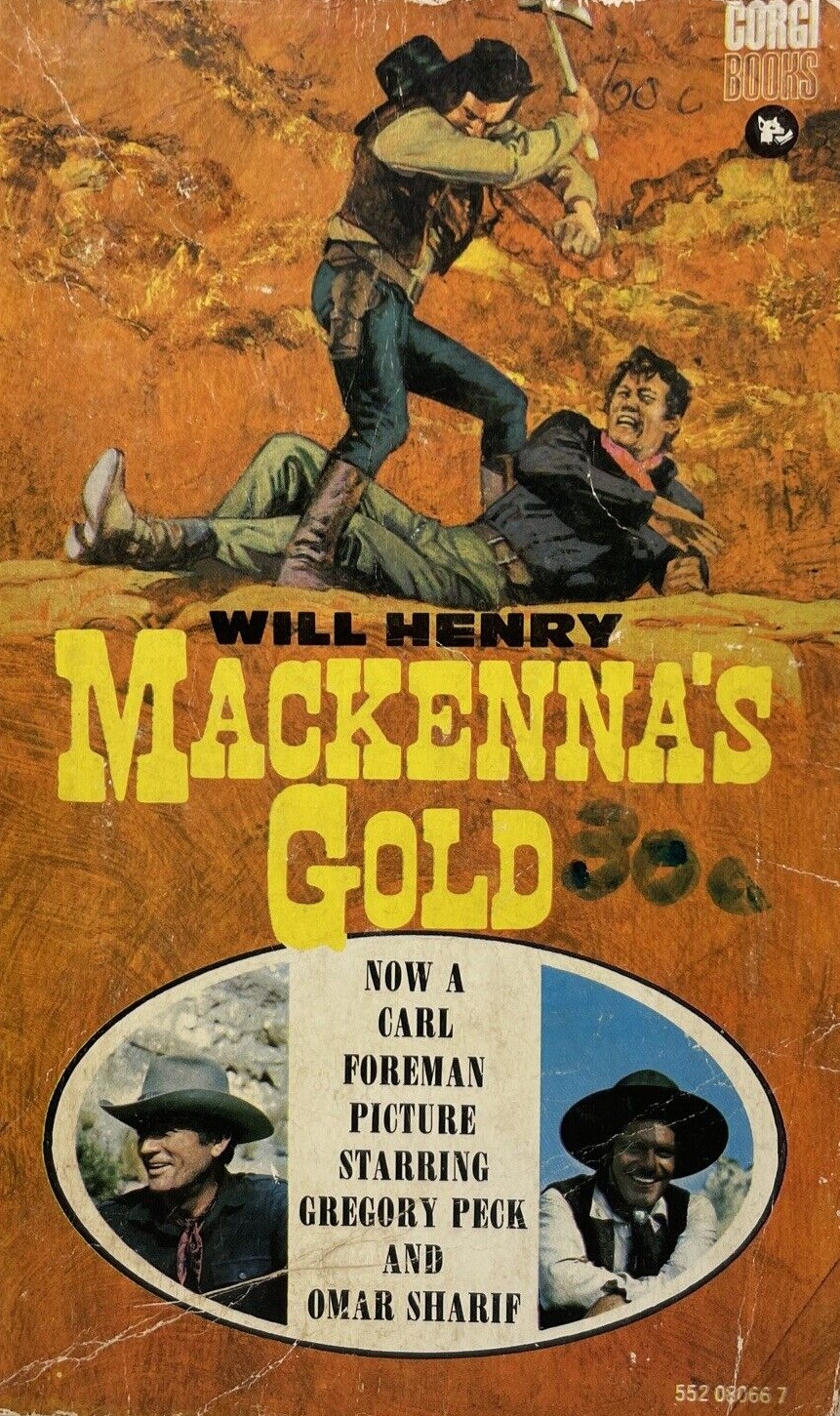
Will Henry’s 1964 source novel was, by today’s standards, a slim volume. The principal idea of Mackenna being given a map by a dying Indian comes from the book, as does the capture of the white woman (named Francie in the novel), and the surprisingly erotic description of Hesh-Ke’s attempted seduction of Mackenna in the pool, the Apache mysticism, and, equally surprisingly, the earthquake denouement.
Some white men do join the party, but they are of rougher stock, the “Good Men” of Hadleyburg entirely producer Carl Foreman’s invention. Foreman turned Mackenna into a lawman rather than just a prospector, made the map more tangible (in the book it was drawn in the sand), gave Mackenna a past with Hesh-Ke and with the outlaw Colorado (named Pelon in the book), and, just as Sergio Leone did with Henry Fonda in Once Upon a Time in the West, realized that a handsome attractive villain was far more interesting than the “jug-eared, ugly man” described in Henry’s book.
Foreman made Tibbs a sergeant and added 20 years to the raw-boned youngster of the book. But in the original, Hesh-Ke was killed, accidentally, just after the pool incident, and it was another of the outlaws, Hachita, who killed Colorado so that the climactic fight on the ledge was between the axe-wielding Hachita and the unarmed Mackenna rather than between Mackenna and Colorado, but Henry had the woman taken hostage kill the Indian.
The various shoot-outs and chases are primarily a Foreman invention. He gives Mackenna more depth, and the vices of gambling and alcohol. Most important of all, it was Foreman who added the visual grandeur. There is no Shaking Rock in the source material, and no waiting for sunrise or for a shadow to point the way to the entrance to the canyon.
A writer-producer was the worst kind of hyphenate as far as a director was concerned in that, as suggested previously, the producer might be more apt to protect his original vision and dialog than adapt the screenplay, which is always only ever intended as a blueprint, to other ideas as the movie went into production.

The opening of the picture is pure Foreman, on a par with the introductory section of The Guns of Navarone, and the extensive use of narration ran counter to a director who felt the camera should tell the story. The greed aspect is spelled out well enough in the original novel, and comparisons with the classic examination of how gold turns men inside out was portrayed best as far as most people were concerned in The Treasure of the Sierra Madre (1948) so quite why Foreman felt obliged to hammer the point home so obviously in Mackenna’s Gold is anybody’s guess, except that the producer saw himself as a man with a message, the anti-war themes of The Guns of Navarone (1961) and The Victors (1964) having eliciting critical approval. You get the impression the original novel didn’t require as much tampering as this to be turned into a more than adequate picture.
Will Henry was a pseudonym, one of two he used for writing westerns, the other being Clay Fisher. His real name was Henry Wilson Allen and he began in the movies, joining MGM in 1937 as a screenwriter for cartoon shorts. He also wrote screenplays for cartoon shorts under the pen names Heck Allen and Henry Allen. Many of these were Tex Avery cartoons written between 1944 and 1955 which were considered some of the funniest ever made. He also worked on Woody Woodpecker and other cartoon characters. When he started writing novels in the 1950s he did so under a pseudonym to avoid attracting unwanted attention from his studio employers. He was a five-time winner of The Spur Award including for From Where the Sun Now Stands (1960) – which also won The Saddleman Award – and The Gates of the Mountains (1963).
Westerns made from his novels were Santa Fe Passage (1955) starring John Payne, The Tall Men (1955) directed by Raoul Walsh and starring Clark Gable and Jane Russell, Pillars of the Sky (1956) starring Jeff Chandler, and Yellowstone Kelly (1959) starring Clint Walker. At the same time as Mackenna’s Gold was sold, his 1960 book Journey to Shiloh was being set up under the title Fields of Honor to be directed by veteran Mervyn LeRoy and when this fell through was made into a film under the original title in 1969 with newcomer James Caan while Who Rides with Wyatt would be released as Young Billy Young starring Robert Mitchum in fall 1969.

 The Magnificent 60s
Foreman really seems to have changed so much, I’m surprised he bothered to get the rights; I think your point about producer-writers is a good one, more inclined to work against the director…
LikeLiked by 1 person
Young Winston had fallen through so I think he did this to keep working.
LikeLiked by 1 person
A great review. I haven’t heard of this film, but your review has compelled me to check it out. I was once a massive fan of westerns. I’ve always enjoyed classic spaghetti westerns made in the 1960’s, and this appears to be one of them. The plot for this film reminds me a lot of the classic western “The Good, The Bad and the Ugly”. Sergio Leone’s masterpiece introduced westerns to the world. Clint Eastwood created an iconic hero in search for gold. Interestingly, that film also focused on gold playing a pivotal role in the plot. It was really the first ever film that introduced me to the genre. Based on this interest in classic westerns, I think that I’ll check out this film. Thanks for the recommendation.
Here’s why I adored “The Good, the Bad and the Ugly”:
LikeLike
I prefer Once Upon a Time in the West to GBU.
LikeLiked by 1 person