
British circuit ABC’s major rival, the Rank Organisation, effectively operated three chains. The main chain was known as the Odeon, but it also ran a subsidiary operating as Gaumont. Since you would often find an Odeon and a Gaumont in the same city or large town, it made sense that they were not in competition.
By and large, Rank put its biggest potential blockbusters on the Odeon circuit with lesser titles doing the rounds of the Gaumonts in what was termed rather confusingly as the “National Release”, with that chain also used to mop up box office excess should a film have done exceptionally well on the major circuit, John Wayne western The Commancheros (1961) and the second James Bond adventure From Russia with Love (1963) moving from one to the other in a short space of time. Rank was also a major player in the roadshow business, the Gaumont in Glasgow, for example, the venue for such long-runners as The Sound of Music (1965).
Perhaps because it felt obliged to feed movies into two streams rather than one, the Rank cinemas were less inclined at the start of the decade to go full tilt down the double bill route. You might have thought with so many cinemas to support that the obvious approach would be to limit the number of double bills made available.
In fact, the opposite was true. Perhaps more aware of the need to give the moviegoer value-for-money, Odeon offered far fewer single bills than rival ABC. Whereas ABC programmed in somewhere between 28 and 37 single bills every year during the 1960s, Odeon had less. Its peak was 21 in 1960. But that was followed by a dramatic tail off, the next highest year saw 15 single bills in 1967, quite a few of these being roadshows entering general release for the first time. For the entire decade Odeon averaged around 13 single bills a year.
In other words, while ABC in a busy year for double bills might get through a total of 76 films, Odeon’s output would be 90-100.
However, the kind of double bill you might see at an Odeon was, until later in the decade, an inferior product to what you would watch at an ABC cinema. Odeon was prone to stuffing its programs with filler material, genuine old-fashioned B-movies, often running little over an hour rather than the 90/100-minute picture audiences might expect from a genuine double bill.
Whereas there was a decent chance that a movie on the lower part of a double bill shown on the ABC circuit would have a recognizable star, it was almost certain that you would never have heard of any of the stars in films carrying out the same role on the Odeon circuit.
For example, supporting Peter Sellers-Sophia Loren comedy The Millionairess (1960) was the undistinguished Squad Car (1960) starring Vici Raaf. The Magnificent Seven (1960) was accompanied by Police Dog Story (1961) starring James Brown. Womanhunt with Steve Peck was allocated to The Commancheros (1961) and The Deadly Duo with Craig Hill to Dr No (1962).
Alternatively, Odeon would dig into the vaults and team up one new feature with an oldie. So musical State Fair (1962) was stuck with The Desert Rats (1953) starring Richard Burton; Glenn Ford-Lee Remick thriller The Grip of Fear (aka Experiment in Terror, 1962) with Operation Mad Ball (1957) headlining Jack Lemmon; Stephen Boyd psychological thriller The Third Secret (1964) with Frank Sinatra revival Can-Can (1960).
Other times, the double bill was a pair of oldies, Billy Wilder courtroom drama Witness for the Prosecution (1957) teamed up with James Stewart western The Far Country (1954) or the start of the James Bond reissue onslaught beginning with From Russia with Love (1963)/Dr No (1962). Sandra Dee comedy I’d Rather Be Rich (1964) initially on the lower half of a double bill with Send Me No Flowers (1964) was within a few months performing the same function for Gregory Peck amnesia thriller Mirage (1965).
And just like ABC, some of the double bills didn’t work out. Romantic comedy Two and Two Make Six (1962) starring George Chakiris and Janette Scott coupled with heist picture Strongroom (1962) failed to make it past the first few days. Billy Wilder’s Kiss Me, Stupid (1964) and The Sicilians (1964) was yanked off the screens after dire returns. In the case of the Madigan/Games double bill it was the latter that met with audience hostility.
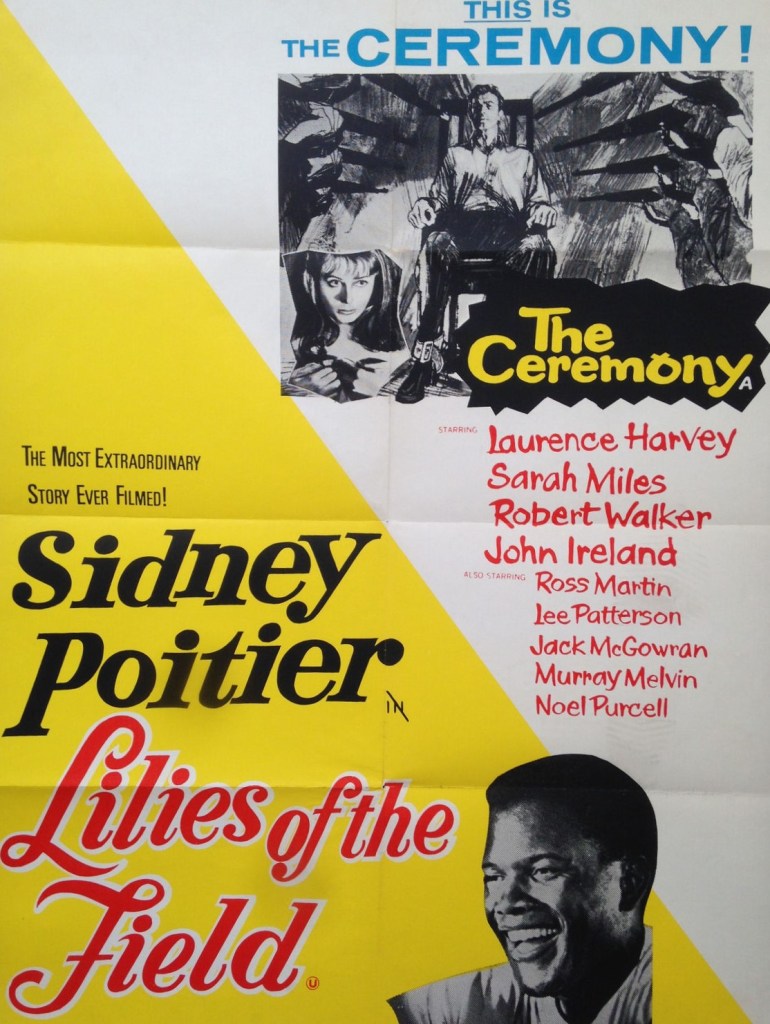
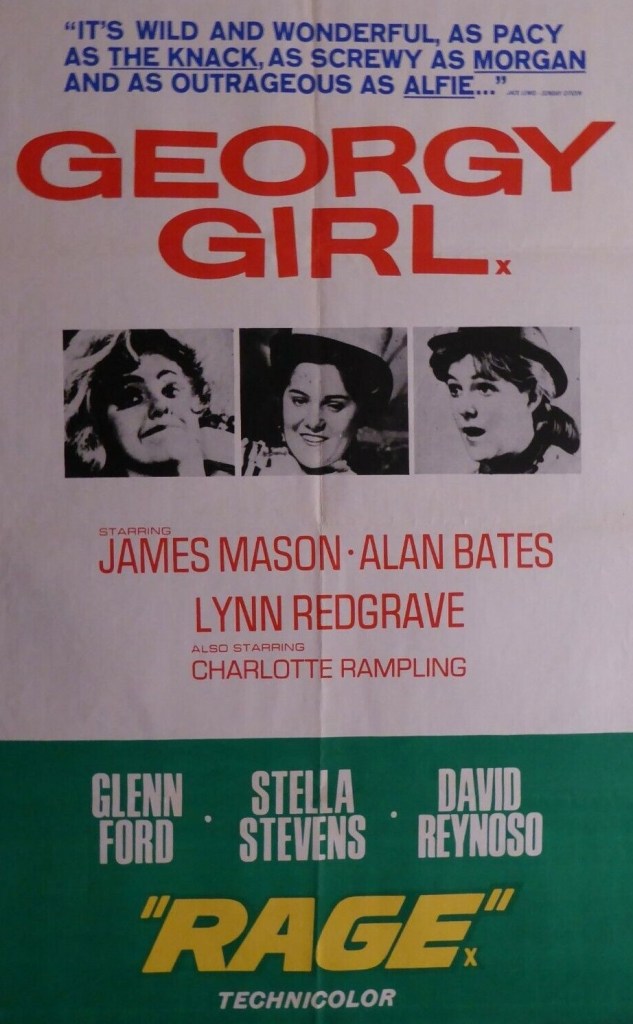
So it took Odeon some time to hit its stride and pitch together the kind of double bill program that might attract a decent audience. Good examples would be: The Ceremony (1963) starring Laurence Harvey dualed with Sidney Poitier in Oscar-winning form in Lilies of the Field (1963); and Oscar fave Georgy Girl (1965) and rabies thriller Rage (1966) featuring Glenn Ford and Stella Stevens..
You might well attract customers for the remake double bill of Beau Geste (1966) and Madame X (1966); and French hit A Man and a Woman (1966) and Sailor from Gibralter (1967) with French star Jeanne Moreau.
I would have made time to see George Peppard-Dean Martin western Rough Night in Jericho (1967) with what was intended as a star-making turn from Robert Wagner in Banning (1967). The St Valentine’s Day Massacre (1967) and George C. Scott-Michael Sarrazin One Born Every Minute (aka The Flim-Flam Man, 1967) seemed an interesting program. And you wouldn’t go far wrong with spy thriller Danger Route (1967) and John Sturges western Hour of the Gun (1967).
I remember being highly entertained by a double bill of John Wayne as an oil wildcatter in The Hellfighters (1969) and Doug McClure and Jill St John in swashbuckler The King’s Pirate (1969). Thought went into programming together heist movie Duffy (1968) starring James Coburn and spy thriller Hammerhead (1968); fashion-set drama Joanna (1968) and Pretty Poison (1968); and George Segal war picture The Bridge at Remagen (1969) and Robert Mitchum western Young Billy Young (1969).
But sometimes you got the impression the Odeon circuit was hard put to find relevant product and was happy to stick out in the lower part of the double bill a movie that had been sitting on the shelf such as Ann-Margret small town drama Bus Riley’s Back in Town (1965) which went out as support to Rock Hudson and Claudie Cardinale in Blindfold (1966) or Jerry Lewis comedy Way, Way Out (1966) supporting Raquel Welch as Fathom (1967).
The 10th Victim (1965) took an age to be slotted in below The Night of the Big Heat (1967). Claude Chabrol’s The Road to Corinth with Jean Seberg was two years old when packed off with the second Bulldog Drummond adventure Some Girls Do (1969). British sex drama The Touchables (1968) waited a year before emerging in the wake of James Coburn-Lee Remick thriller Hard Contract (1969).
Sometimes, double bills revealed the hard truth about fading marquee pull. Glenn Ford films were often on the lower part of a double bill and so were offerings by Tony Curtis, James Garner, Anthony Perkins, Ann-Margret and Robert Mitchum.
By the end of the next decade, Odeon was still more reliant on double bills than ABC, though often these programmes were made up of reissues of Bond, Pink Panther, Three Musketeers, the Confessions series and Rocky/Network (both 1976) while the likes of early Stallone vehicle The Lord of Flatbush (1974), documentary Let The Good Times Roll (1973) and romance Jeremy (1973) were revived as supporting features.
Britain had some smaller circuits in operation but both Granada and Scottish outfit Caledonian Associated Cinemas tended to cherry-pick from either the Odeon or ABC releases.
SOURCE: Allen Eyles, Odeon Cinemas 2: From J. Arthur Rank to the Multiplex (CTA, 2005) p206-214, 219-220.

 The Magnificent 60s
OH, CAC, I’d forgotten about them, think they might be the source of the double bills I remember…
LikeLiked by 1 person
In theory there’s a lot of archive material available on CAC but I’ve never been able to find it.
LikeLiked by 1 person
Just the name brings back a flash of recognition.
LikeLike
Fascinating stuff. I did attempt to comment on this but WordPress threw a wobbly and seems to have trashed it. I was querying your “Rank operated three chains . . .” statement, surely it was just two? There was a brief attempt by Fox to start a temporary circuit of independents which would show its CinemaScope films from 1954 onwards but Rank finally decided to go with ‘Scope and ABC soon realised that ‘Scope would win out. There was also a ‘virtual’ third circuit operated by British Lion which didn’t own cinemas. But they did distribute films in the 1950s by Korda and then by various groups not in the Rank or ABC camp. I guess British Lion were able to include some bookings in Rank or ABC houses.
The Eyles books are very good but mostly view the industry from a London perspective and focus on cinemas rather than distributors.
I’m with Film Authority on double bills. I think they lasted quite well through the 1970s and it was the 1980s before they began to disappear. I remember going to see a double bill of ‘Hot Stuff’ with Dom DeLuise and ‘Steel’ with Lee Majors in January 1980 (God knows why, but it’s in my records). I checked on some Newspaper Display listings for January 1980 and most cinemas at the time, both circuits and independents, were still showing double bills, although in many cases they were re-releases.
LikeLike
I was being a bit cute about Rank operating three circuits. I was just trying to find some definition for its roadshow business. I didn’t attempt to bother with the 1950s. But in the 1960s, Granada was still a force but it tended from 1960 onwards not to be big enough to persuade distributors to make it first port of call. There were other regional chains – Caledonian Associated Cinemas in Scotland, for example, was bigger than either ABC or Odeon and so often received preferential treatment. Love Story ran in its La Scala in Glasgow rather than the ABC. By 1986 it had more screens (10) in the Glasgow area than ABC (8) or Odeon (3).
I agree that double bills didn’t end in the 1970s but since I was relying on the Eyles books for easy access and he didn’t track programmes beyond the 1970s I left it there. And there was also for a time the Classic chain which mostly showed reissues, often in double bills.
LikeLike