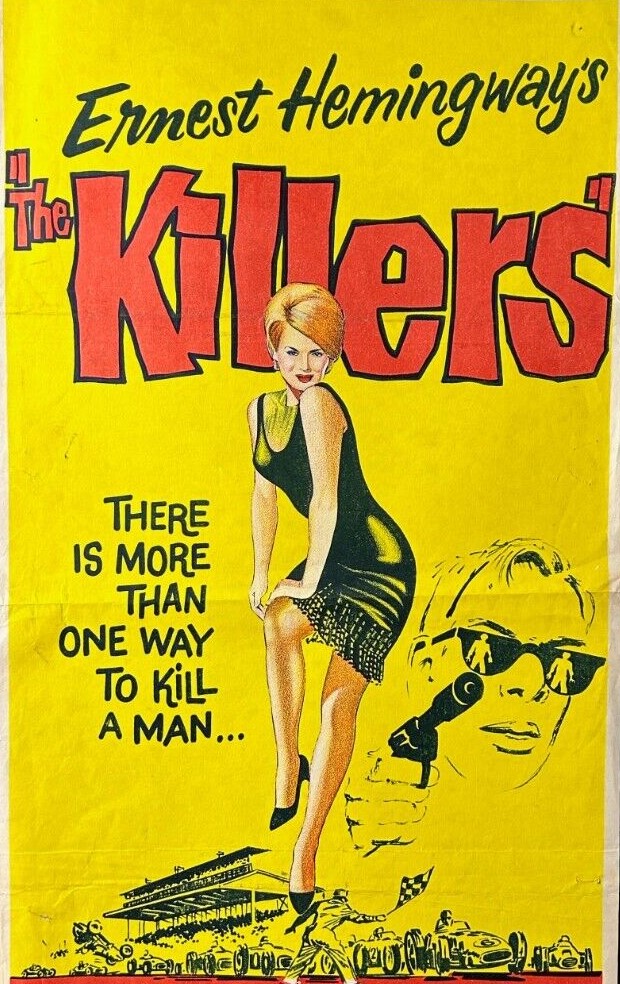
Angie Dickinson (Jessica, 1962) is the standout as the cold-blooded double-crossing femme fatale in this slick tale of a double heist. Sure, Lee Marvin (The Professionals, 1966) attracted the bulk of the critical attention as the no-nonsense hitman and John Cassavetes (Machine Gun McCain, 1969) attempts to steal the show as the dupe, but Dickinson walks away with it. Although he makes a vicious entrance, Marvin really only tops and tails the movie.
Violence wasn’t the marketable commodity it proved later in the decade, and this was initially made with television in mind, so it’s surprising how stunning the brutality remains today. In the opening sequence, set in a home for the blind, hitmen Charlie (Lee Marvin) and Lee (Clu Gulager) knock around a sightless receptionist before moving on to shooting at point-blank range their victim, ex-racing driver Johnny North (John Cassavettes). But when they get to thinking why they were paid way over the odds to shoot North, they discover he was involved in a million-dollar heist and before you can say flashback we tumble into the story of how gangster’s moll Sheila (Angie Dickinson) lured him into participating in the robbery organized by boyfriend Jack (Ronald Reagan).

There’s nothing particularly complicated about Jack’s plan – hijacking a mail truck on a remote road – but the movie takes its sweet time getting there, focusing on Johnny’s racetrack antics and on Sheila nudging Johnny into the illegal kind of pole position. She’s pretty convincing as the all het-up lover to the extent of persuading Johnny to double-cross Jack but her convictions only run one way – to whatever best suits herself.
Eventually, it appears as if the million bucks has disappeared into thin air. Jack presents himself as an honest businessman, but Sheila only holds to the party line for as long as it takes the hitmen to dangle her from a fourth-storey window. But gangsters are rarely as amenable or as dumb as the schmucks they snooker, so Jack is more than able to take care of himself and his property (counting the loot and Sheila in that category).
There might be twists a-plenty but the main narrative thrust is which way will Sheila spin? Was she ever even in love with Johnny? Or having snared Johnny and then managed to convince him to double-cross Jack did she plan to run off with the money herself? Or was she going to double-cross him all along once his usefulness was over?

And even if her heart is in the right place, then that’s plain tragic, stuck with the lout, unable to break free, perhaps playing all the alpha males off against each other her only hope of maintaining her fine lifestyle while not ending up another casualty.
A surprising chunk of time is spent on the racecourse, not just building up the romance and endorsing Johnny’s driving skills, and as well as the tension of a specific race – and the possibility that too much loving could fatally damage the driver’s track ambitions – you are kept in some kind of narrative limbo as you keep wondering when the heck the killers are going to re-enter the equation.
Don (here credited as Donald) Siegel (Coogan’s Bluff, 1968) directs with considerable aplomb, especially as this carries a television-movie-sized budget and that he hadn’t had a stab at a decent picture since making his initial mark with Invasion of the Body Snatchers (1956). From the iconic opening shot of a pair of dark sunglasses to the sad greed-soaked finale, Siegel’s brilliant use of sound and movement plays in stark contrast to moments of stillness and silence. Throw in aerial tracking sequences, realistic race scenes, and one bold shot of a handgun being pointed at the audience (a similar shot in his Dirty Harry, 1971, ruffled more feathers and generated more critical note).
But the director’s cleverest ploy is to introduce the hitman, then dive elsewhere, leaving audiences begging for more. So it’s just as well that Angie Dickinson delivers in spades. You need to believe she could be as conniving as she is seductive for the entire tale to work. She is the linchpin far more than Lee Marvin.
And that’s to take nothing away from his performance, a far cry from the over-the-top villains of The Commancheros (1961) and The Man Who Shot Liberty Valance (1962), setting up the template for the later quiet-spoken thug of Point Blank (1967).
As highly watchable as this is, it wasn’t a career breakout for any concerned. Lee Marvin was just a supporting actor on Ship of Fools (1965) and far from first choice for Cat Ballou (1965), the movie that did make his name. Don Siegel wasn’t offered another movie for four years. Angie Dickinson tumbled down the credits, reduced to second female lead in The Art of Love (1965) and working in television or in movies as a supporting actor until the low-budget The Last Challenge/Pistolero of Red River (1967).
Ronald Reagan bowed out of the movies after this. Clu Gulager, who had a running role in The Virginian (1963-1968) only made three movies in the next seven years.
Gene Coon (Journey to Shiloh, 1968) adapted the short story by Ernest Hemingway which when previously filmed in 1946 marked the debut of Burt Lancaster with the sultry Ava Gardner as the femme fatale.
Striking, tense, and a must for fans of Dickinson, Marvin and Siegel.

 The Magnificent 60s
This was an important film for pioneer film teachers in the UK in the 1960s and 1970s. Alan Lovell wrote an essay for a National Film Theatre season of Siegel’s films in 1968 which was expanded into a BFI booklet in 1975. This is an indication of early scholarly interest in Siegel, whose low budget pictures were available on 16mm in the UK in the days before videotapes. Siegel worked mainly on low budget films from The Verdict (1946) onwards and he said that TV production offered more opportunities as Hollywood shifted to fewer, big budget films. He also suggested that Universal delayed releasing The Killers into cinemas because of its violence. He had completed the film in late 1963 soon after Kennedy’s assassination. I struggle to understand this as US TV would surely have been more sensitive about violence than film distribution?
Siegel worked extensively on TV series in the early 1960s. There is work to do to investigate the economics of TV versus cinema film production in this period. Two other significant ‘TV movies’ that received a UK theatrical release prompting Hollywood reconsideration were Spielberg’s Duel in 1972 and Michael Mann’s The Jericho Mile in 1979.
LikeLiked by 2 people
Hadn’t realised its importance to film teaching though I am aware Siegel was lionised quicker over here than in the USA. As far as I understand it the violence made it a no-no for TV so Universal had no option but to put it into cinemas to recoup their money. Though as I guess they could just have snipped out the violence for TV it leaves me wondering if in fact they thought it was too good for TV and since it was low-cost might do a better turn in the cinemas. Wonder, also, what happened when it was screened on TV.
I remember seeing Duel and The Jericho Mile in the cinema. Was it Dylis Powell who pushed for Duel to to get a cinema release over here?
Though sometimes, as you know, US TV subjects were often released as films for foreign distribution, any number of TV shows thrown together to make a feature, the Uncle films the most obvious examples but plenty others as well.
LikeLiked by 2 people
Verbal warning for spelling Don Siegel’s name two different ways in the same paragraph.
LikeLiked by 1 person
I’m going for three. Dawn Siegel.
LikeLiked by 1 person
Thanks. Corrected.
LikeLiked by 1 person
Sorry for being such a pedant. They sure loved yellow and red posters in the 69’s, that’s two in two days…
LikeLiked by 1 person
Well spotted. Colours of the decade.
LikeLiked by 1 person
This was a minor hit on release. The opening and the climax grabbed my attention. Lee Marvin first caught my attention in I Died A Thousand Times starring Jack Palance in the 50s.
LikeLiked by 2 people
I think it it okay everywhere though Marvin wasn;t yet a big star.
LikeLiked by 1 person
That’s a remake, one of the best ! I’ve seen it an d reviewed.
You’re right about Dickinson as the the center of gravity for the film. Cassavetes plays the same old nervous guy, but I prefer Lancaster in the part. But, the genious starting idea is to start from the eyes (the sunglasses should I say) of the killers. Marvin is perfect, and Clu Gulager a revelation as a vicious little thug. And what about Reagan ! Not a very good image for a future governer (and president). Such a badness climate in this movie thanx to the grand Don Siegel !
LikeLiked by 2 people
Yes, great cast and it set up Marvin for later tough guy roles.
LikeLiked by 2 people